
The Quantum 7 Dwarves Alexandra Kolla Gatis Midrijanis
- Slides: 16
The Quantum 7 Dwarves Alexandra Kolla Gatis Midrijanis UCB CS 252 2006
Seven Dwarves n n Key time consuming problems for next decade by Phillip Colella High-end simulation in physical sciences Representive codes may vary over time, but these numberical methods will be important for a long time For us: help to understand what styles of architectures we need
7 Dwarves n n n 1, 2, 6 - structured and unstructured grid problems, particle methods 3 - Fast Fourier Transform 4, 5 – Linear Algebra (dense and sparse) 7 Monte Carlo + search + sorting + HMM+ others
Why Quantum Computing? n n Provides a method by bypassing the end of Moore’s Law Provides a way of utilizing the inevitable appearance of quantum phenomena. Factoring (break RSA), simulations of quantum mechanical systems. . . More efficient on quantum computer than on any classical Cryptography: doesn’t require assumptions about factoring
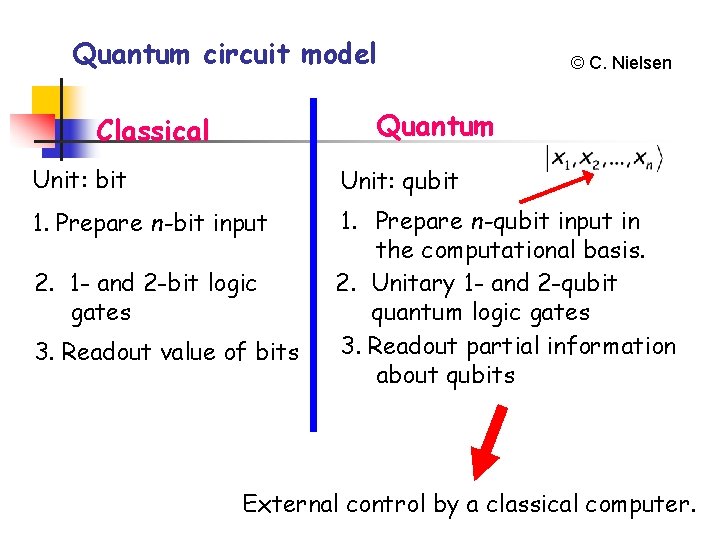
Quantum circuit model © C. Nielsen Quantum Classical Unit: bit Unit: qubit 1. Prepare n-bit input 1. Prepare n-qubit input in the computational basis. 2. Unitary 1 - and 2 -qubit quantum logic gates 3. Readout partial information about qubits 2. 1 - and 2 -bit logic gates 3. Readout value of bits External control by a classical computer.
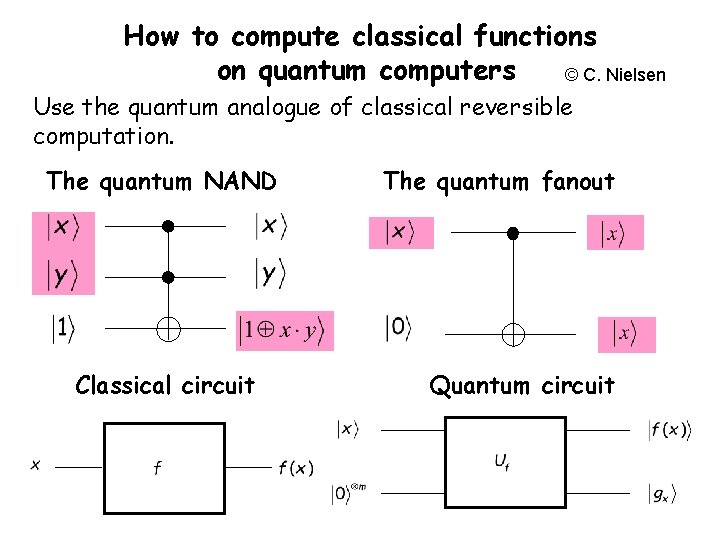
How to compute classical functions on quantum computers © C. Nielsen Use the quantum analogue of classical reversible computation. The quantum NAND Classical circuit The quantum fanout Quantum circuit
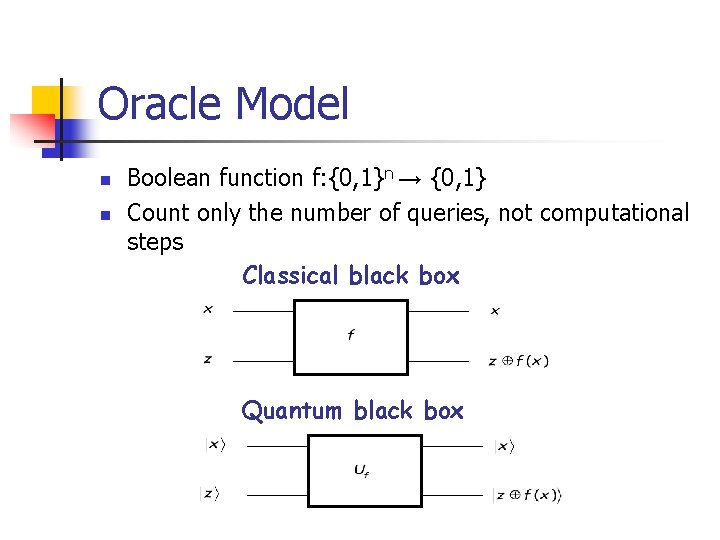
Oracle Model n n Boolean function f: {0, 1}n → {0, 1} Count only the number of queries, not computational steps Classical black box Quantum black box
Quantum Lower Bounds n n Very hard to show circuit lower bounds (even classically) Show oracle lower bounds There is no quantum speed-up for reading and outputing n bit string There is no is exponential speed-up for unstructured search
Dwarves 1, 2, 6 Not a good match for quantum computing n Even reading N*N grid needs Ω(N*N) operations n But: there is known quantum speed-up for simulating differential operators n
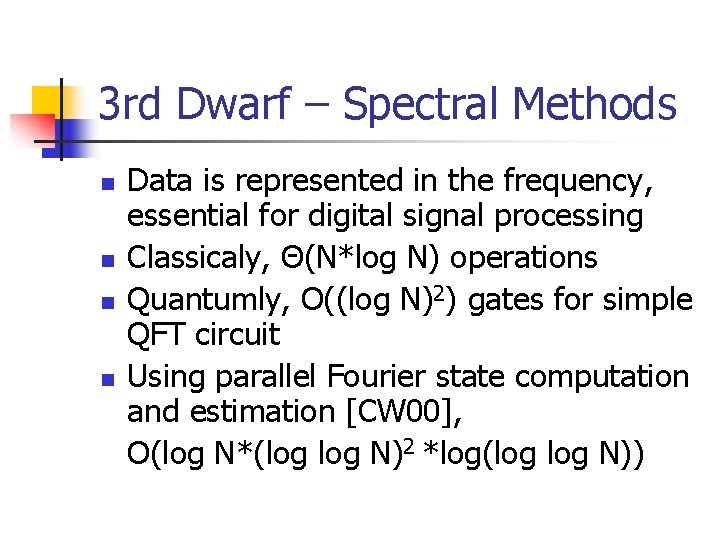
3 rd Dwarf – Spectral Methods n n Data is represented in the frequency, essential for digital signal processing Classicaly, Θ(N*log N) operations Quantumly, O((log N)2) gates for simple QFT circuit Using parallel Fourier state computation and estimation [CW 00], O(log N*(log N)2 *log(log N))
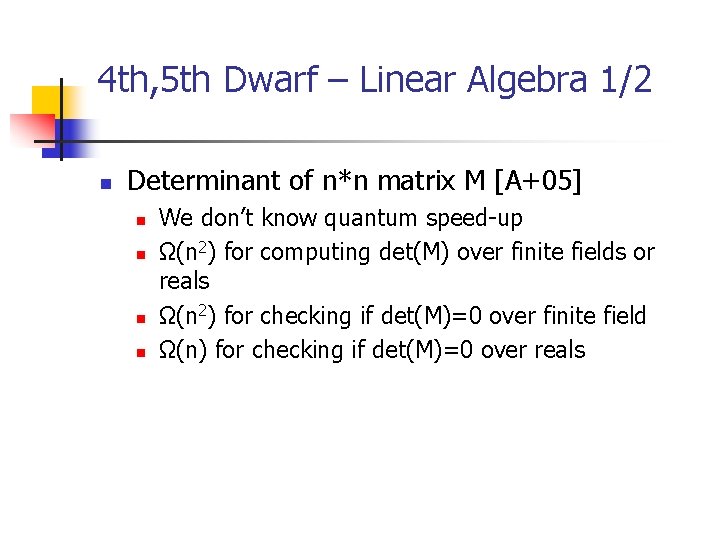
4 th, 5 th Dwarf – Linear Algebra 1/2 n Determinant of n*n matrix M [A+05] n n We don’t know quantum speed-up Ω(n 2) for computing det(M) over finite fields or reals Ω(n 2) for checking if det(M)=0 over finite field Ω(n) for checking if det(M)=0 over reals
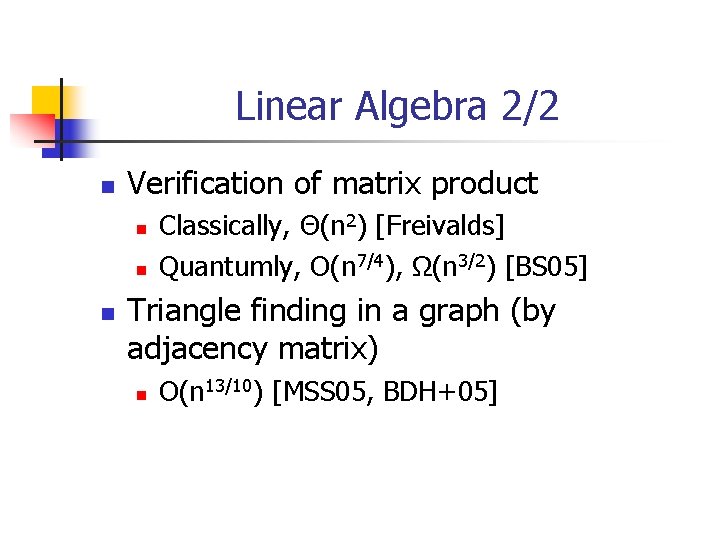
Linear Algebra 2/2 n Verification of matrix product n n n Classically, Θ(n 2) [Freivalds] Quantumly, O(n 7/4), Ω(n 3/2) [BS 05] Triangle finding in a graph (by adjacency matrix) n O(n 13/10) [MSS 05, BDH+05]
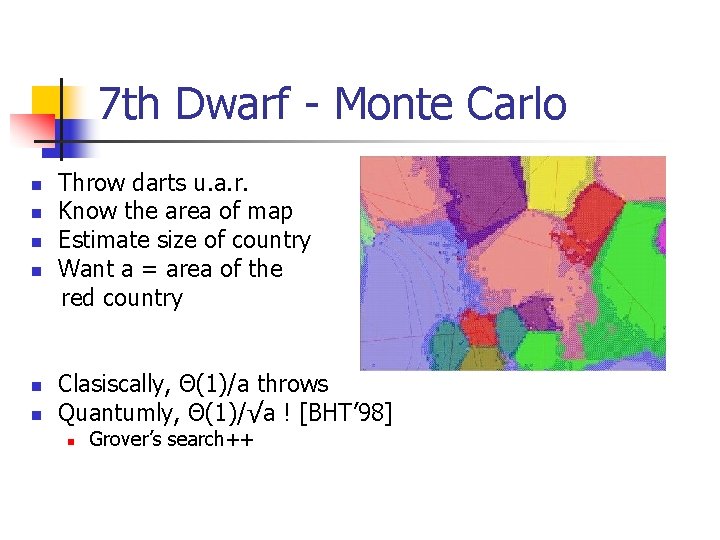
7 th Dwarf - Monte Carlo n n n Throw darts u. a. r. Know the area of map Estimate size of country Want a = area of the red country Clasiscally, Θ(1)/a throws Quantumly, Θ(1)/√a ! [BHT’ 98] n Grover’s search++
Hidden Markov Models 1/2 n n n Markov process with unknown paramaters Used to solve many problems like speech recognition or bioinformatics One canonical type of problems solved by HMM: n n we know Markov process we know ouput sequence we want to know most likely path, ie. Viterbi path Classically – Viterbi algorithm
Hidden Markov Models 2/2 n n n Output string of length n m-states Markov process Viterbi algorithm has O(nm 2) steps Quantum Viterbi – O(nm 3/2) steps Optimal in each parameter n n Ω(n) (for DNA) Ω(m 3/2) (for speech recognition)
I guess we are out of time… Questions?