
The qualitative research paradigm B Dierckx de Casterl
The qualitative research paradigm B. Dierckx de Casterlé Academic Center of Nursing and Midwifery Department of Public Health & Primary Care 1
What is qualitative research? “Qualitative research involves any research that uses data that do not indicate ordinal values” (Nkwi, Nyamongo & Ryan, 2001) Functional & outcome based Type of data as defining criterion 2
What is qualitative research? “Qualitative researchers are interested in understanding the meaning people have constructed, that is, how people make sense of their world and the experiences they have in the world. ” (Merriam, 2009) Research purpose & focus 3
What is qualitative research? “Investigation of phenomena, typically in an indepth and holistic fashion, through collection of rich narrative materials using a flexible research design” (Polit & Beck, 2004) “Covers complex (social) phenomena, studied in their natural setting, and useful for understanding the processes that are at play in a situation. ” (Morse, 1997) Subject, aim, design, data collection, … 4
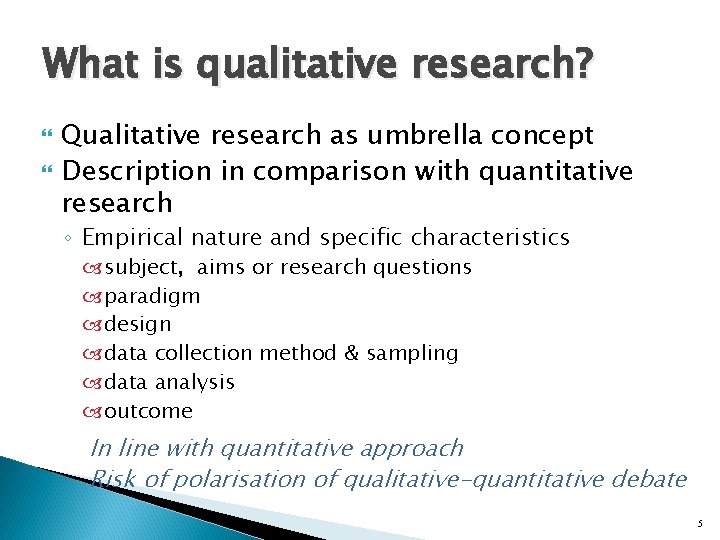
What is qualitative research? Qualitative research as umbrella concept Description in comparison with quantitative research ◦ Empirical nature and specific characteristics subject, aims or research questions paradigm design data collection method & sampling data analysis outcome In line with quantitative approach Risk of polarisation of qualitative-quantitative debate 5
1. Subject, aims, questions When do we need a qualitative design? Subjects explored in qualitative studies? Specific aims & research questions? What is the role of nurses in the care for patients requesting euthanasia? 6
1. Subject, aims, questions (2) What is the role of nurses in the care for patients requesting euthanasia? How many involved? How often they perform euthanasia? What exactly doing? . . 7
1. Subject, aims, questions (3) What is the role of nurses in the care for patients requesting euthanasia? Understanding the process How nurses experience being involved? How nurse manage the process and deal with ethical challenges? How nurses experience their responsability? Which dynamics impede/facilitate the process? … 8
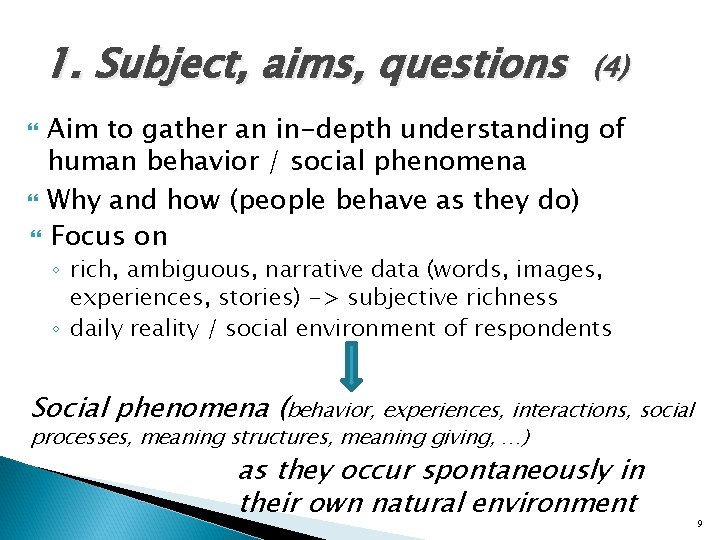
1. Subject, aims, questions (4) Aim to gather an in-depth understanding of human behavior / social phenomena Why and how (people behave as they do) Focus on ◦ rich, ambiguous, narrative data (words, images, experiences, stories) -> subjective richness ◦ daily reality / social environment of respondents Social phenomena (behavior, experiences, interactions, social processes, meaning structures, meaning giving, …) as they occur spontaneously in their own natural environment 9
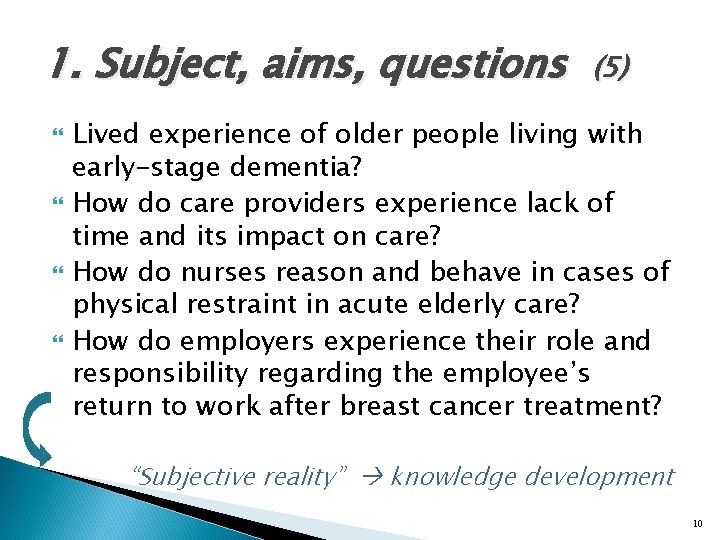
1. Subject, aims, questions (5) Lived experience of older people living with early-stage dementia? How do care providers experience lack of time and its impact on care? How do nurses reason and behave in cases of physical restraint in acute elderly care? How do employers experience their role and responsibility regarding the employee’s return to work after breast cancer treatment? “Subjective reality” knowledge development 10

2. Research paradigm Paradigm ◦ “A set of assumptions, concepts, values, and practices that constitutes a way of viewing reality for the community that shares them, especially in an intellectual discipline” Research paradigm http: //www. thefreedictionary. com/paradigm ◦ Models/frameworks (derived from a worldview or belief system) about the nature of knowledge and existence ◦ How do we know the world? ◦ What is the relationship researcher-known? ◦ What is reality? … ◦ Shared by a scientific community and guide how a community of researchers act with regard to inquiry Qualitative & quantitative approaches rooted in different paradigms (different ideas about reality & knowledge development) http: //www. qualres. org/Home. Phil-3514. html 11
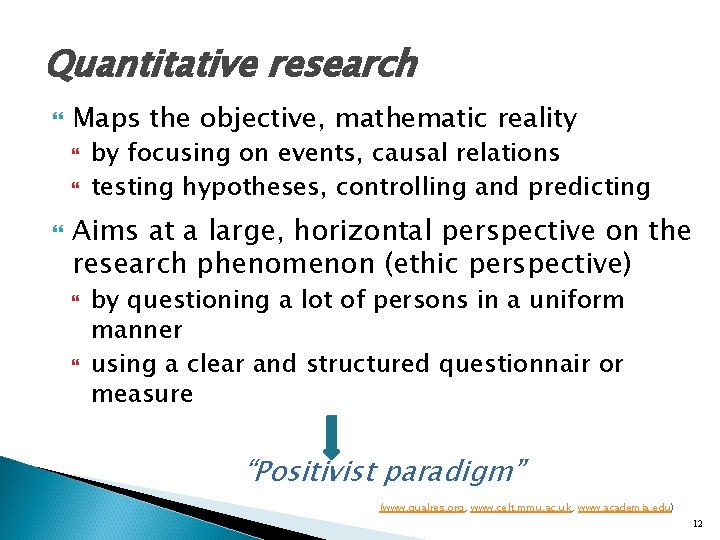
Quantitative research Maps the objective, mathematic reality by focusing on events, causal relations testing hypotheses, controlling and predicting Aims at a large, horizontal perspective on the research phenomenon (ethic perspective) by questioning a lot of persons in a uniform manner using a clear and structured questionnair or measure “Positivist paradigm” (www. qualres. org, www. celt. mmu. ac. uk, www. academia. edu) 12
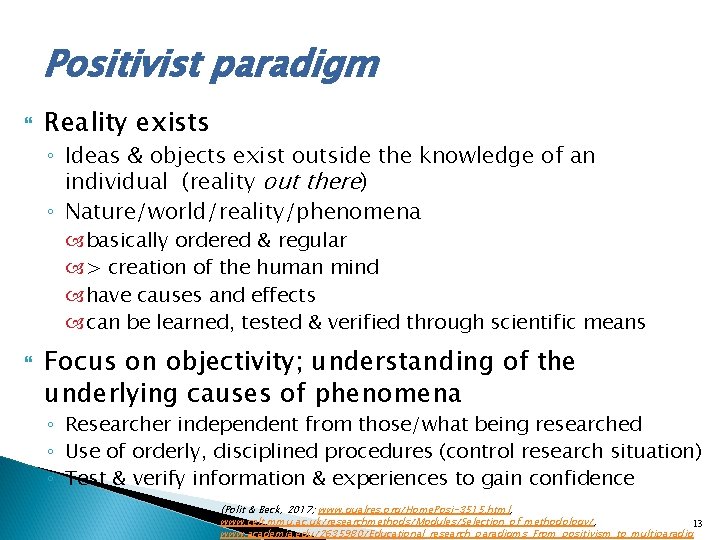
Positivist paradigm Reality exists ◦ Ideas & objects exist outside the knowledge of an individual (reality out there) ◦ Nature/world/reality/phenomena basically ordered & regular > creation of the human mind have causes and effects can be learned, tested & verified through scientific means Focus on objectivity; understanding of the underlying causes of phenomena ◦ Researcher independent from those/what being researched ◦ Use of orderly, disciplined procedures (control research situation) ◦ Test & verify information & experiences to gain confidence (Polit & Beck, 2017; www. qualres. org/Home. Posi-3515. html, www. celt. mmu. ac. uk/researchmethods/Modules/Selection_of_methodology/, 13 www. academia. edu/2635980/Educational_research_paradigms_From_positivism_to_multiparadig
Qualitative research Essentially trying to understand interpret the subjective reality ◦ Discovering the meaning persons give to their experiences & situation ◦ Discovering the underlying social processes and interactions explaining behavior/phenomena? Focusses on an indepth, vertical view in order to understand the phenomenon in its complexity (emic perspective) “Interpretivist/constructivist paradigm” 14
Interpretivist/constructivist paradigm Reality is not a fixed entity but a construction of the participants ◦ Reality exists with a context, many constructions are possible ◦ No ultimate truth ◦ Reality depends on the meaning given by the persons to their experiences or situation Persons studied as human beings who to a large extent construct their world through meaning giving and meaning experiences Basic idea: the way persons react and behave mainly can be explained in terms of the meaning persons give at their daily life, their situations, … 15
Interpretivist/constructivist paradigm Reality is constructed through experiences and relationships ◦ Meanings and understandings developed socially and experientially ◦ We cannot separate ourselves from what we know or from what we investigate Try to understand/interpret this subjective reality ◦ Looking for patterns, structure & commonalities ◦ Negotiated through dialogue Voices & interpretations of research participants crucial to obtain a more informed and sophisticated understanding (subjective interactions = primary way to access them) Findings = product of interactions researcher - participants 16
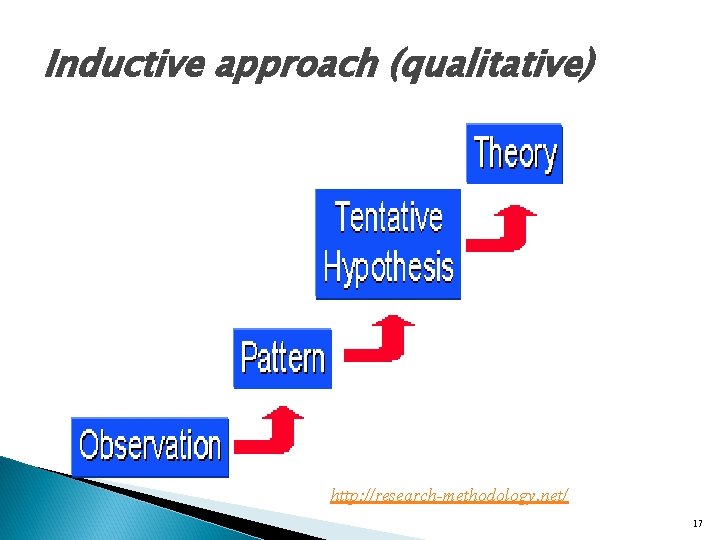
Inductive approach (qualitative) http: //research-methodology. net/ 17
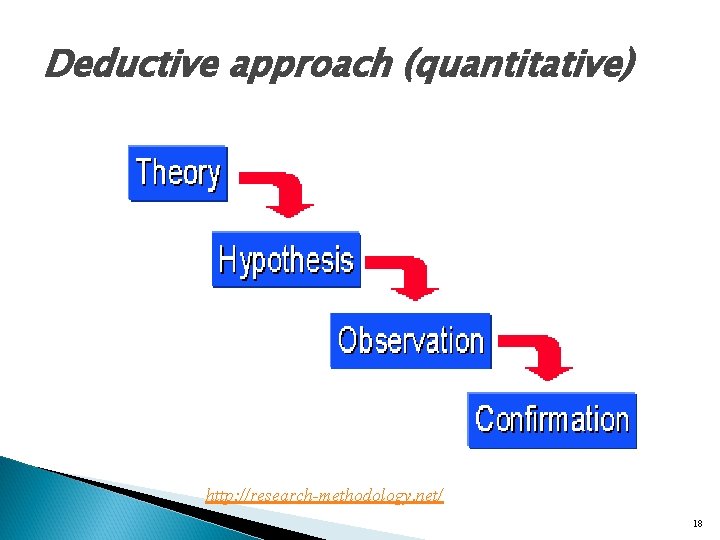
Deductive approach (quantitative) http: //research-methodology. net/ 18
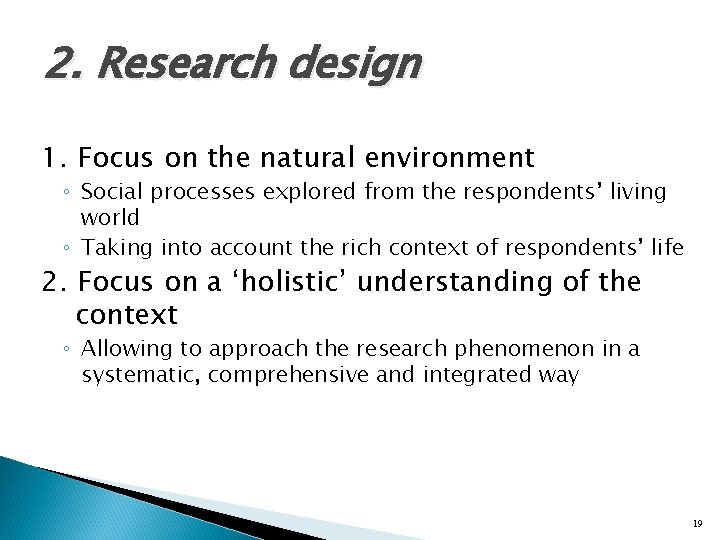
2. Research design 1. Focus on the natural environment ◦ Social processes explored from the respondents’ living world ◦ Taking into account the rich context of respondents’ life 2. Focus on a ‘holistic’ understanding of the context ◦ Allowing to approach the research phenomenon in a systematic, comprehensive and integrated way 19
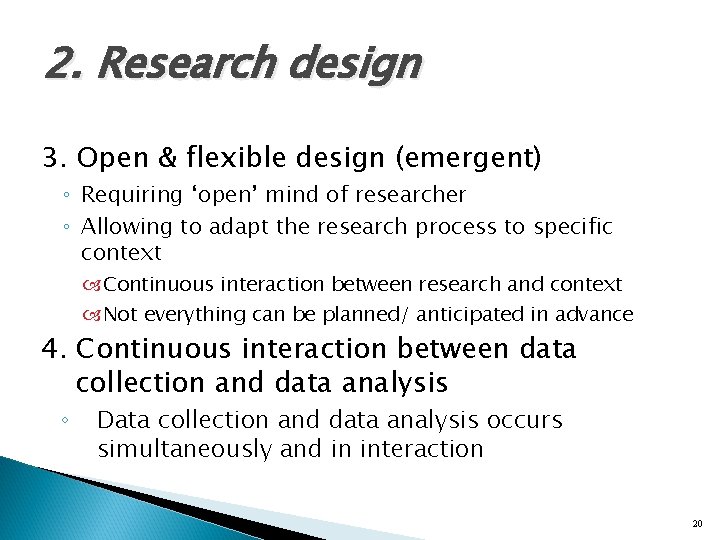
2. Research design 3. Open & flexible design (emergent) ◦ Requiring ‘open’ mind of researcher ◦ Allowing to adapt the research process to specific context Continuous interaction between research and context Not everything can be planned/ anticipated in advance 4. Continuous interaction between data collection and data analysis ◦ Data collection and data analysis occurs simultaneously and in interaction 20
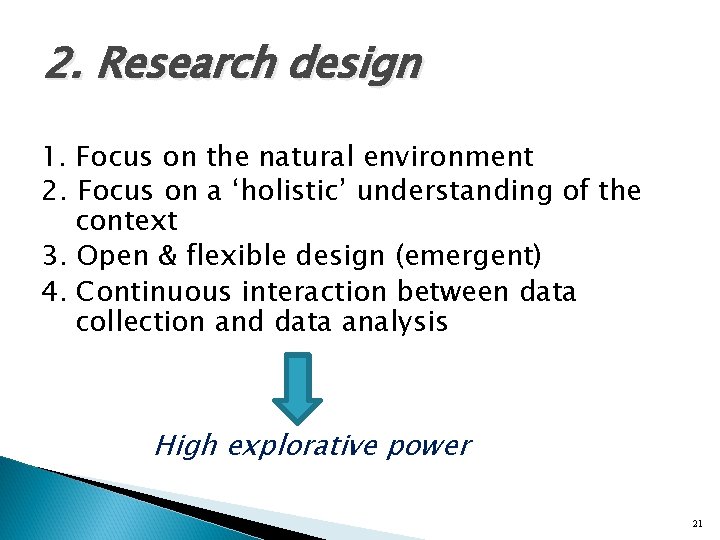
2. Research design 1. Focus on the natural environment 2. Focus on a ‘holistic’ understanding of the context 3. Open & flexible design (emergent) 4. Continuous interaction between data collection and data analysis High explorative power 21
3. Data collection In general: data collected using interviews or observations o o Focus on the respondents’ perspectives, the way they give meaning to their life, their experiences Respondents are invited and stimulated to tell in detail about their experiences or will be observed in their natural setting Open and flexible ◦ Room for unexpected events ◦ Often mix of methods (individual/focus interviews, observation, analysis of document) Often requires intense/sustained contact with respondents in their environment (rich & nuanced information) 22
& Sampling Purposively selected sample ◦ To discover and understand meanings (in the specific context) ◦ Looking for a mix of cases/participants/ perspectives to obtain rich and nuanced information ◦ Variation allowing to get an overall insight in the complex process ◦ Quality > quantity of the participants ◦ Sample size determined by principle of saturation Point where a sense of closure is attaint because new data/interviews do not result in new information (redundant information) <-> large, random sampling (generalisability) 23
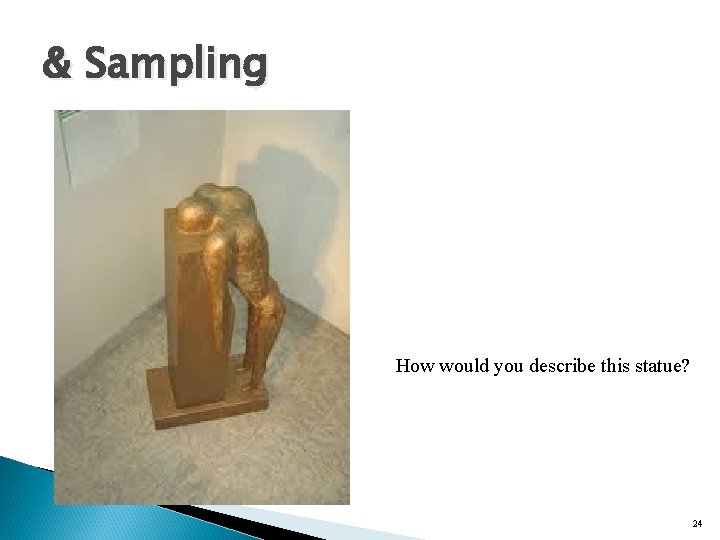
& Sampling How would you describe this statue? 24
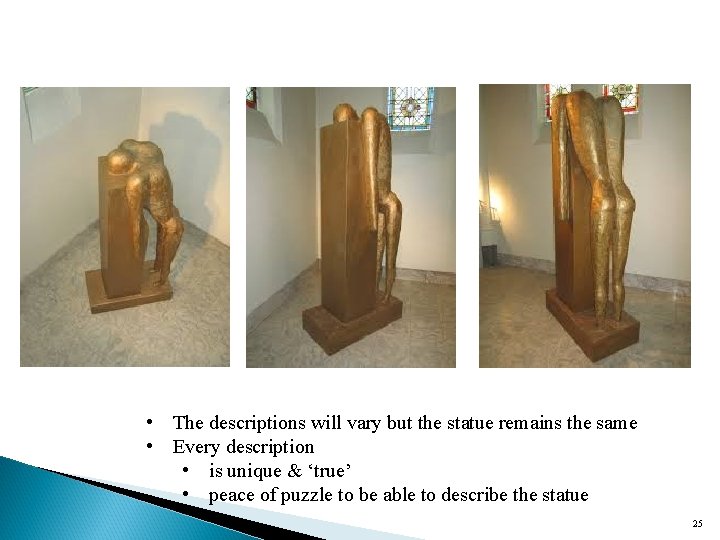
• The descriptions will vary but the statue remains the same • Every description • is unique & ‘true’ • peace of puzzle to be able to describe the statue 25
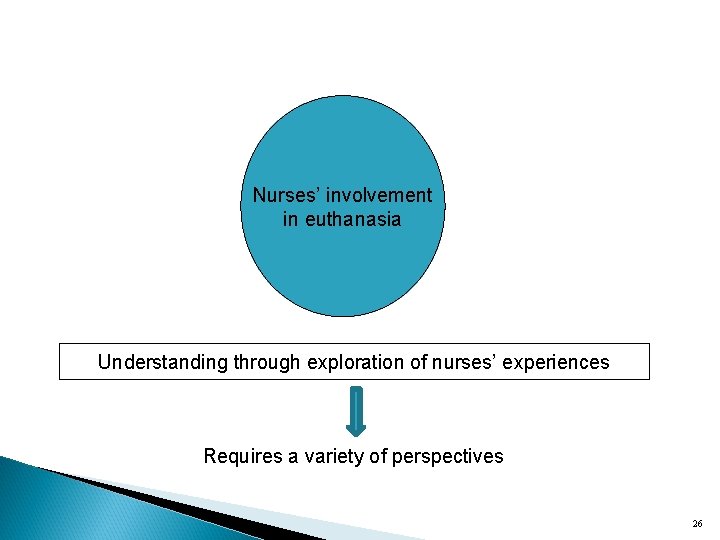
Nurses’ involvement in euthanasia Understanding through exploration of nurses’ experiences Requires a variety of perspectives 26
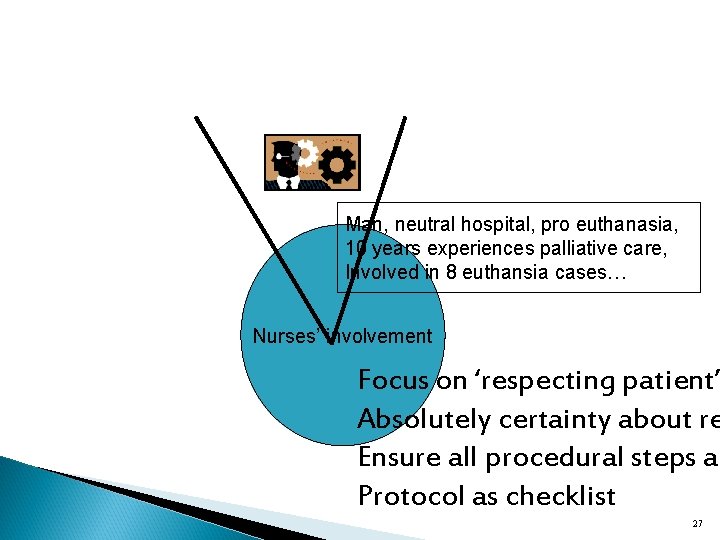
Man, neutral hospital, pro euthanasia, 10 years experiences palliative care, Involved in 8 euthansia cases… Nurses’ involvement Focus on ‘respecting patient’ Absolutely certainty about re Ensure all procedural steps ar Protocol as checklist 27
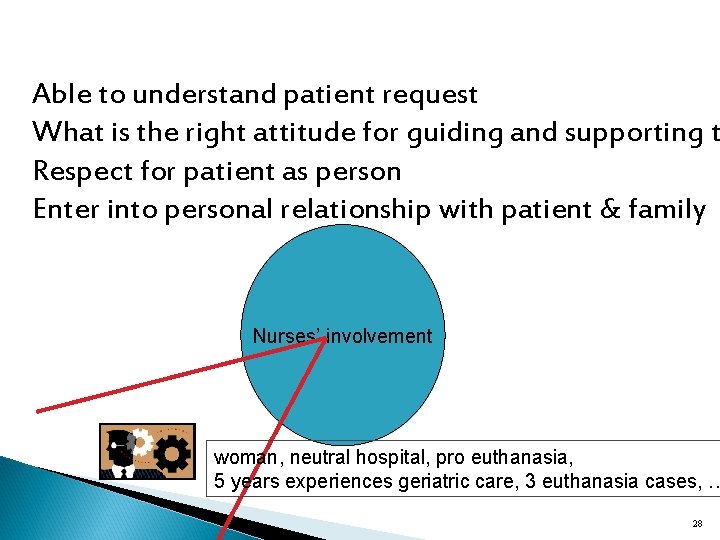
Able to understand patient request What is the right attitude for guiding and supporting t Respect for patient as person Enter into personal relationship with patient & family Nurses’ involvement woman, neutral hospital, pro euthanasia, 5 years experiences geriatric care, 3 euthanasia cases, … 28
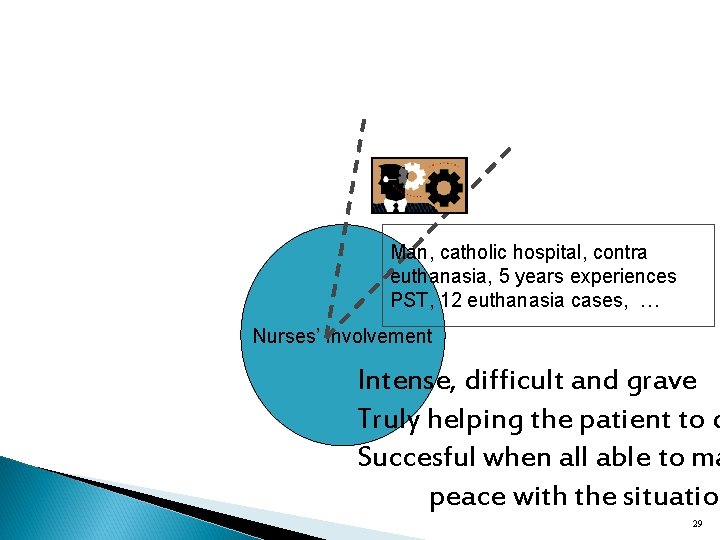
Man, catholic hospital, contra euthanasia, 5 years experiences PST, 12 euthanasia cases, … Nurses’ involvement Intense, difficult and grave Truly helping the patient to d Succesful when all able to ma peace with the situation 29
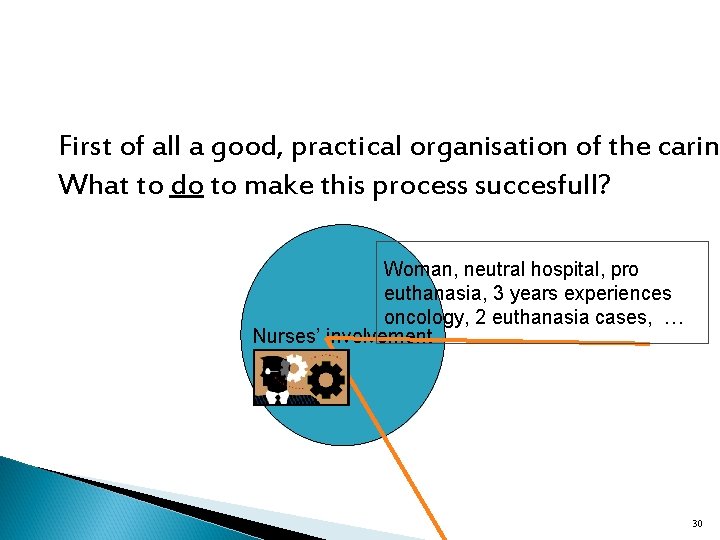
First of all a good, practical organisation of the carin What to do to make this process succesfull? Woman, neutral hospital, pro euthanasia, 3 years experiences oncology, 2 euthanasia cases, … Nurses’ involvement 30
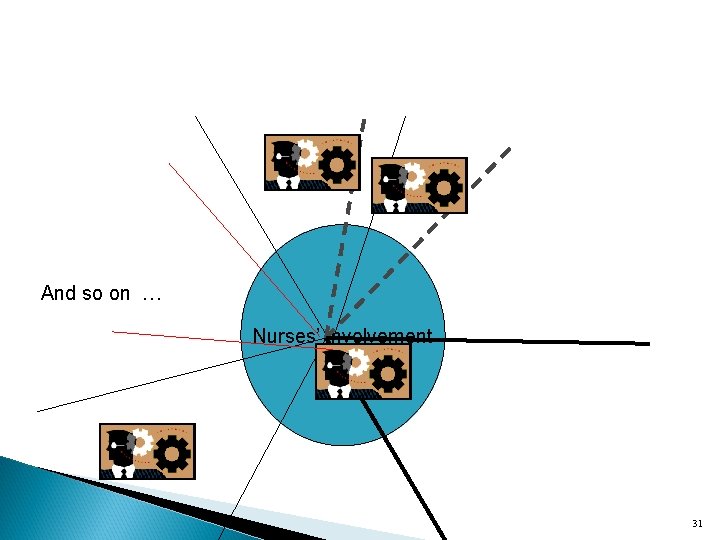
And so on … Nurses’ involvement 31
Nurses’ involvement in euthanasia Good sampling: ◦ Requires diversity in perspectives to make the circle round to develop an indepth and holistich understanding of the phenomenon ◦ Quality more important than quantity of respondents ◦ Interaction data collection & data analysis (theoretical sampling) 32
4. Data analysis Purpose: organize, provide structure and elicit meaning from data ◦ ◦ Grasping a sense of the whole Extracting the significant facts Discovering the meaning beyond the facts & Reconstruct the story on a conceptual level Data collection and data analysis often occur simultanuously Particularly challenging enterprise ◦ Huge amount of rich and divers data ◦ No universal rules or standard procedures ◦ Labor-intensive activity that requires riguour, creativity, conceptual sensitivity and skills 33
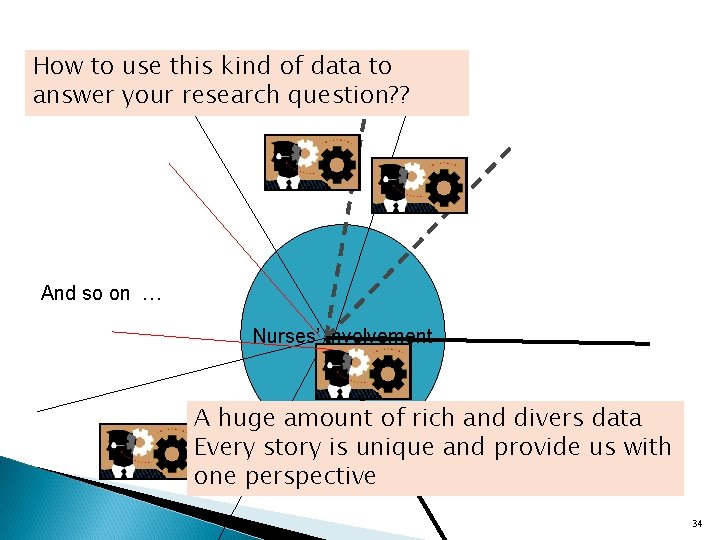
How to use this kind of data to answer your research question? ? And so on … Nurses’ involvement A huge amount of rich and divers data Every story is unique and provide us with one perspective 34
Imagine … How to analyse and interpret all these divers and nuanced data? How to discover the underlying meanings and reconstruct a conceptual story? How to integrate all these data without losing the integrity of each story? Challenge of the qualitative data analysis

36
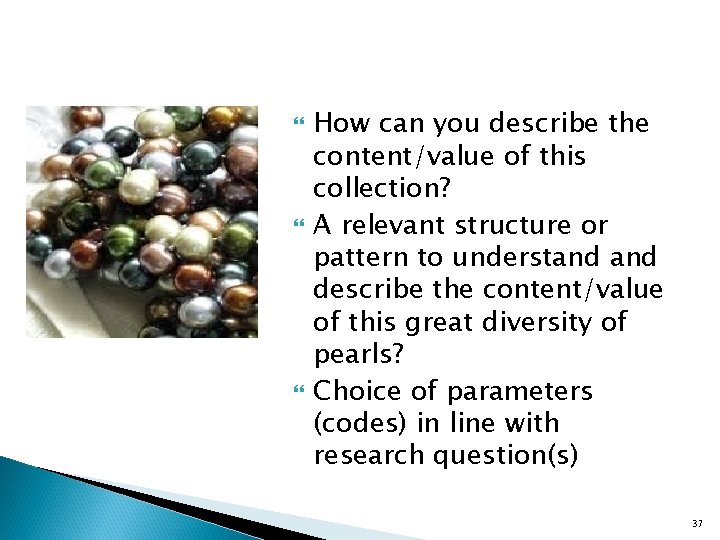
How can you describe the content/value of this collection? A relevant structure or pattern to understand describe the content/value of this great diversity of pearls? Choice of parameters (codes) in line with research question(s) 37
4. Data analysis Most important challenge: ◦ Coping with the great wealth and diversity in the interpretation and development of conceptual and theoretical insights Requires ‘peopleware’ rather than software ◦ ‘Making meaning beyond the facts’ (aha-erlebenis) ◦ Expertise in thinking, imagining, conceiving, connecting, conceptualizing, condensing and creating ‘intellectual craftmanship’(Sandelowski, 1995) Quagol (Dierckx de Casterlé et al, International Journal of Nursing Studies, 2012, 49, 360 -371); Qualicraft (OOF, 2013 -2016) 38
5. Outcome Word, themes, concepts (models & theories) Produces knowledge in the intra- and interpersonal field ◦ What health or illness feels like to patients ◦ Where interpretations of health and illness come from ◦ How experiences change under a variety of interpersonal, historical, cultural an other conditions. . . Comprehensive, holistic, expansive 39
Usefulness qualitative evidence? Depending on two characteristics of qualitative findings: ◦ Complexity findings situated into a multifaceted web of interactions ◦ Discovery New perspectives on or information about the human phenomenon under study The higher the levels of complexity and discovery, the greater is the potential for clinical insights and application (Kearney, 2001; Research in Nursing and Health, 24, 145 -153) 40
Usefulness qualitative evidence? Open letter to The BMJ editors on qualitative research (BMJ, 2016; 352: i 563) ◦ 76 senior academics from 11 countries ◦ Invitation to reconsider journal policy regarding qualitative research (rejection on the grounds of low priority) 41
Usefulness qualitative evidence? Good qualitative research with a clear and important clinical message can be highly cited, is popular with readers, and enriches The BMJ’s overall contribution to the knowledge base ◦ 20 nominated papers: 11 commentaries or editorials 3 three randomised controlled trials 3 qualitative studies 2 surveys & 1 methodological paper More citations for qualitative papers than for RCT 42
Usefulness qualitative evidence? Different study designs provide complementary perspectives ◦ Few research topics in clinical decision making and patient care can be sufficiently understood through quantitative research alone ◦ E. g. patient safety RCT: Effect size of interventions to improve safety QR: why did the observed effect occurred in some cases and not in others (qualitative systemic review based on 18 qualitative studies help explain why) 43
- Slides: 43