
The Pursuit of Perfection In Antebellum preU S

“The Pursuit of Perfection” In Antebellum [pre-U. S. Civil War] America 1820 to 1860 Adapted from a work created by SJS in Houston, Texas Michael Quiñones, NBCT www. socialstudiesguy. com
Assignment: What was gained or lost • Create an electronic poster that selects one of the Utopian/Perfectionist communities. • In your poster you are asked to describe what you believe the communities gained or lost by isolating themselves from the outside world. • Be sure to include images, names of well known leaders of the community, unique beliefs and what you belief was gained or lost by the communities by their isolation. • Be as specific as possible about all information. • Students submit the assignment via email.
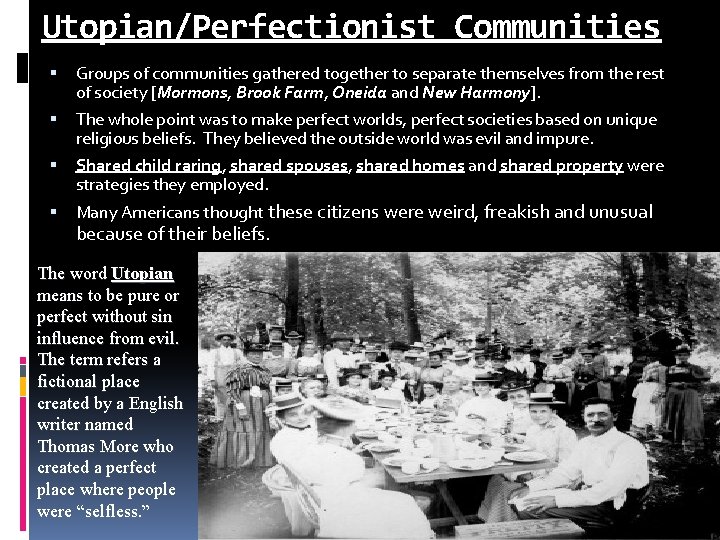
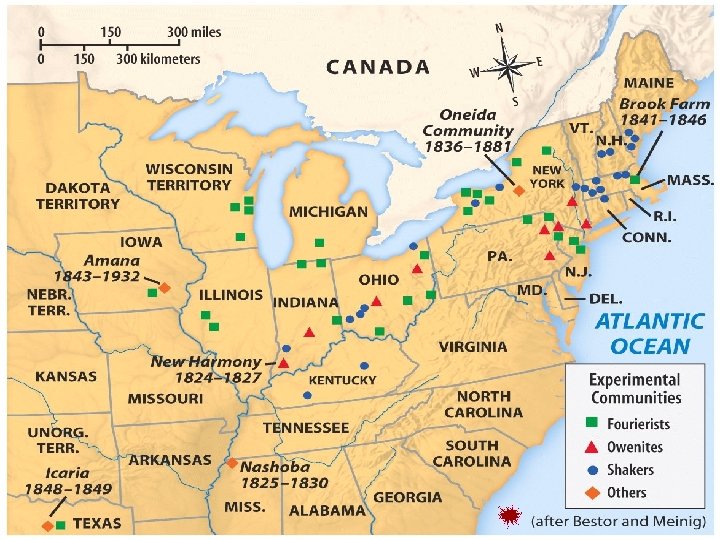
Utopian/Perfectionist Communities Groups of communities gathered together to separate themselves from the rest of society [Mormons, Brook Farm, Oneida and New Harmony]. The whole point was to make perfect worlds, perfect societies based on unique religious beliefs. They believed the outside world was evil and impure. Shared child raring, shared spouses, shared homes and shared property were strategies they employed. Many Americans thought these citizens were weird, freakish and unusual because of their beliefs. The word Utopian means to be pure or perfect without sin influence from evil. The term refers a fictional place created by a English writer named Thomas More who created a perfect place where people were “selfless. ”
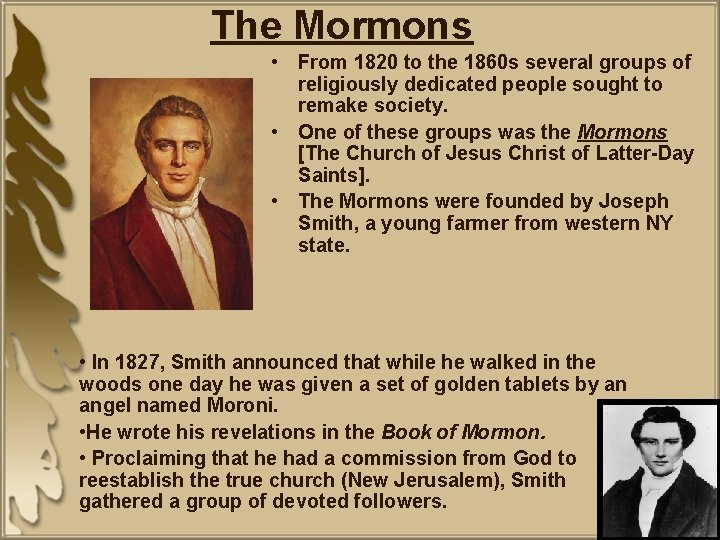
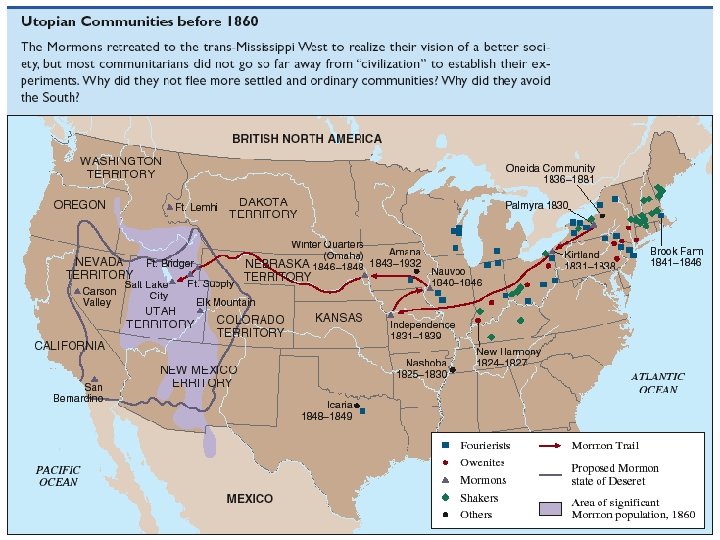
The Mormons • From 1820 to the 1860 s several groups of religiously dedicated people sought to remake society. • One of these groups was the Mormons [The Church of Jesus Christ of Latter-Day Saints]. • The Mormons were founded by Joseph Smith, a young farmer from western NY state. • In 1827, Smith announced that while he walked in the woods one day he was given a set of golden tablets by an angel named Moroni. • He wrote his revelations in the Book of Mormon. • Proclaiming that he had a commission from God to reestablish the true church (New Jerusalem), Smith gathered a group of devoted followers.
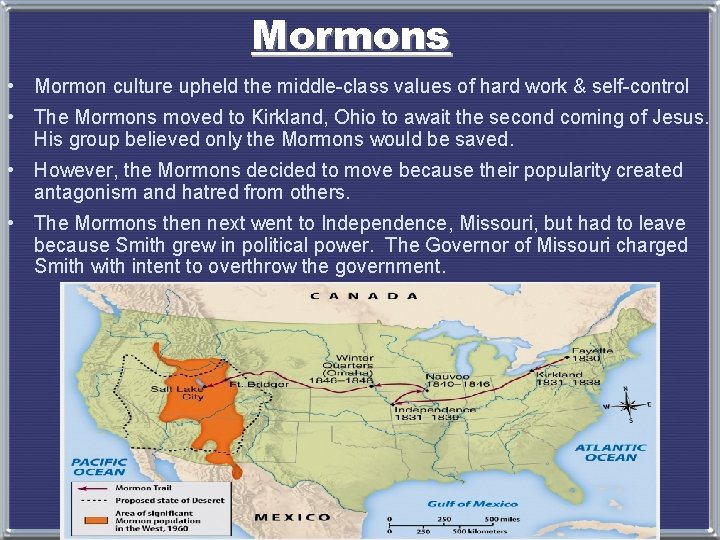
Mormons • Mormon culture upheld the middle-class values of hard work & self-control • The Mormons moved to Kirkland, Ohio to await the second coming of Jesus. His group believed only the Mormons would be saved. • However, the Mormons decided to move because their popularity created antagonism and hatred from others. • The Mormons then next went to Independence, Missouri, but had to leave because Smith grew in political power. The Governor of Missouri charged Smith with intent to overthrow the government.
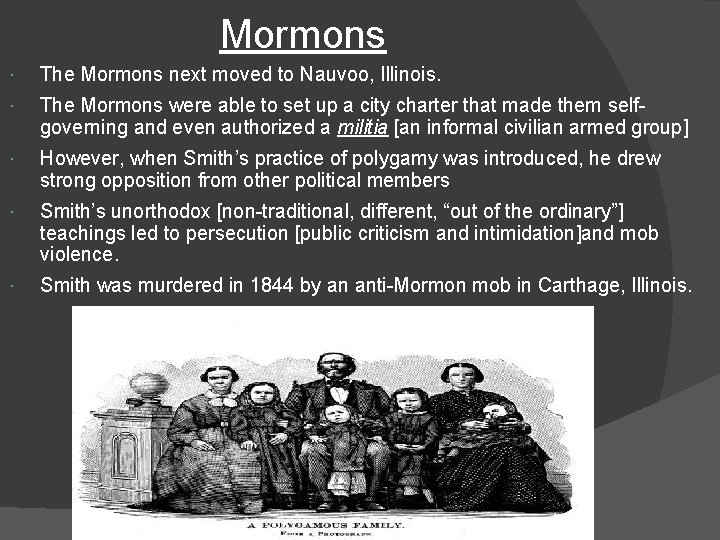
Mormons The Mormons next moved to Nauvoo, Illinois. The Mormons were able to set up a city charter that made them selfgoverning and even authorized a militia [an informal civilian armed group] However, when Smith’s practice of polygamy was introduced, he drew strong opposition from other political members Smith’s unorthodox [non-traditional, different, “out of the ordinary”] teachings led to persecution [public criticism and intimidation]and mob violence. Smith was murdered in 1844 by an anti-Mormon mob in Carthage, Illinois.
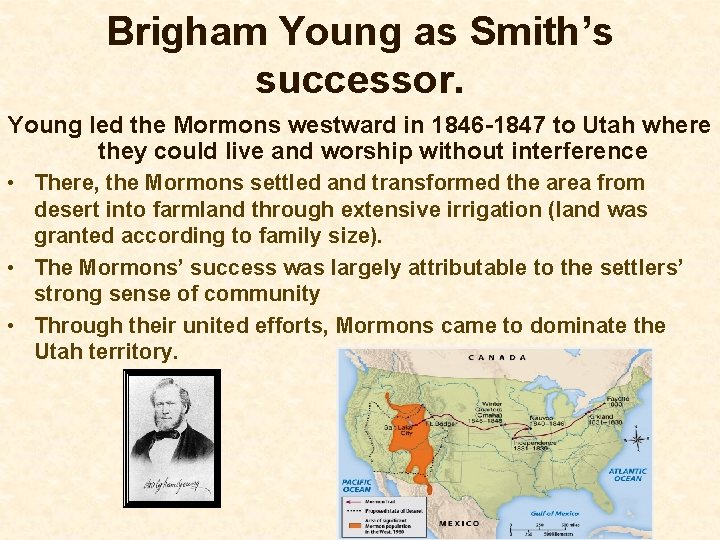
Brigham Young as Smith’s successor. Young led the Mormons westward in 1846 -1847 to Utah where they could live and worship without interference • There, the Mormons settled and transformed the area from desert into farmland through extensive irrigation (land was granted according to family size). • The Mormons’ success was largely attributable to the settlers’ strong sense of community • Through their united efforts, Mormons came to dominate the Utah territory.
Relgious convictions fortified the Latter -day Saints to withstand persecution • The Mormons offered success to anyone who would join. • Many of the recruits were poor and uneducated. • To those who rejected existing churches, the Mormons offered fellowship and religious certainty within a tight-knit society and cooperative economic system.
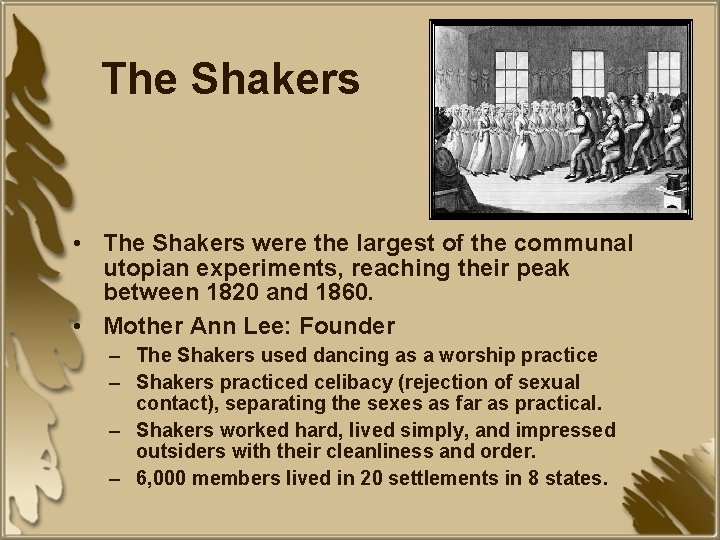
The Shakers • The Shakers were the largest of the communal utopian experiments, reaching their peak between 1820 and 1860. • Mother Ann Lee: Founder – The Shakers used dancing as a worship practice – Shakers practiced celibacy (rejection of sexual contact), separating the sexes as far as practical. – Shakers worked hard, lived simply, and impressed outsiders with their cleanliness and order. – 6, 000 members lived in 20 settlements in 8 states.
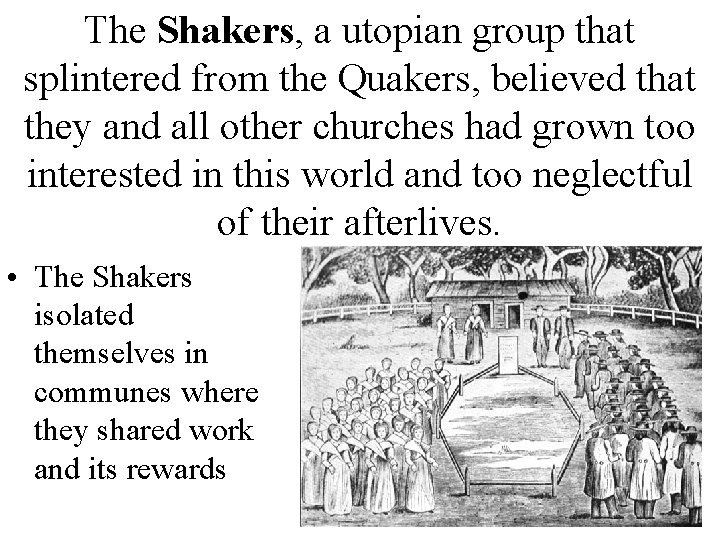
The Shakers, a utopian group that splintered from the Quakers, believed that they and all other churches had grown too interested in this world and too neglectful of their afterlives. • The Shakers isolated themselves in communes where they shared work and its rewards
Mother Ann Lee (1736 -1784) The Shakers Ø Emphasized agriculture and hand crafts; most managed to become self-sufficient and profitable enterprises Ø Shaker furniture became famous for its simplicity, beauty of design, and excellent construction Ø Many of their settlements became temporary refuges for orphans, runaways, abused wives, and unemployed workers during hard times
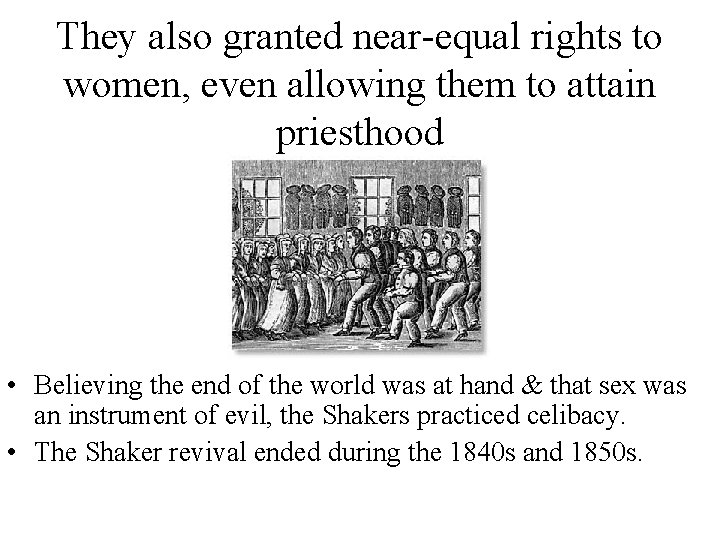
They also granted near-equal rights to women, even allowing them to attain priesthood • Believing the end of the world was at hand & that sex was an instrument of evil, the Shakers practiced celibacy. • The Shaker revival ended during the 1840 s and 1850 s.
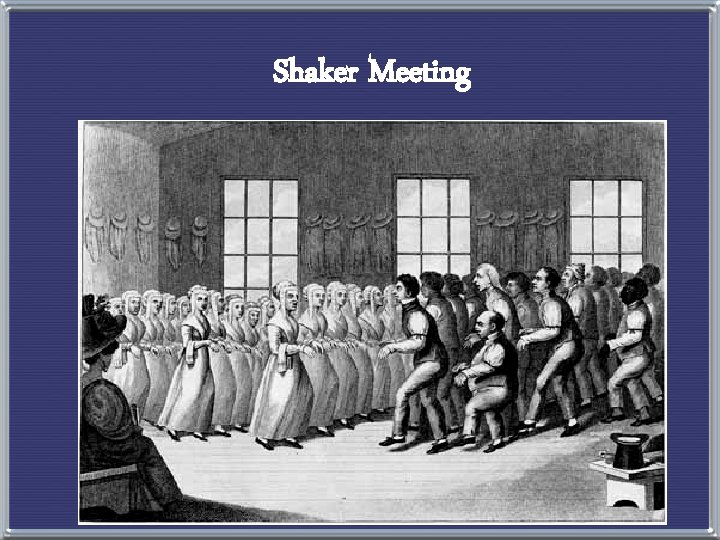
Shaker Meeting
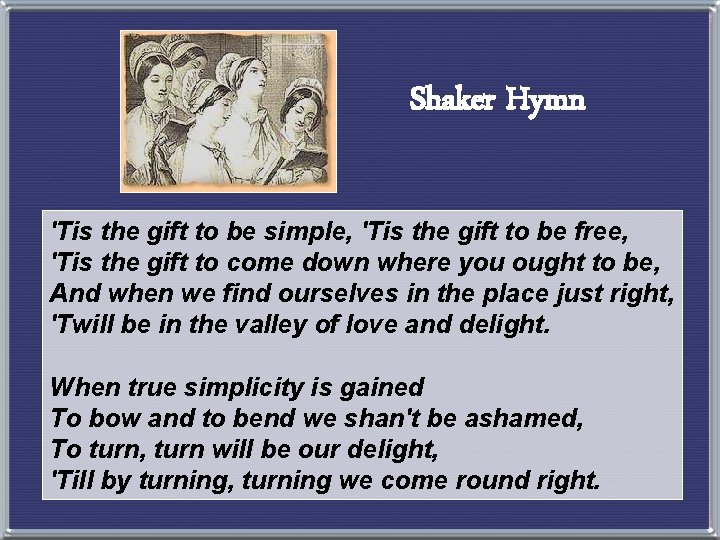
Shaker Hymn 'Tis the gift to be simple, 'Tis the gift to be free, 'Tis the gift to come down where you ought to be, And when we find ourselves in the place just right, 'Twill be in the valley of love and delight. When true simplicity is gained To bow and to bend we shan't be ashamed, To turn, turn will be our delight, 'Till by turning, turning we come round right.

Secular Utopian Communities Individual Freedom Demands of Community Life Ø spontaneity Ø discipline Ø self-fulfillment Ø organizational hierarchy
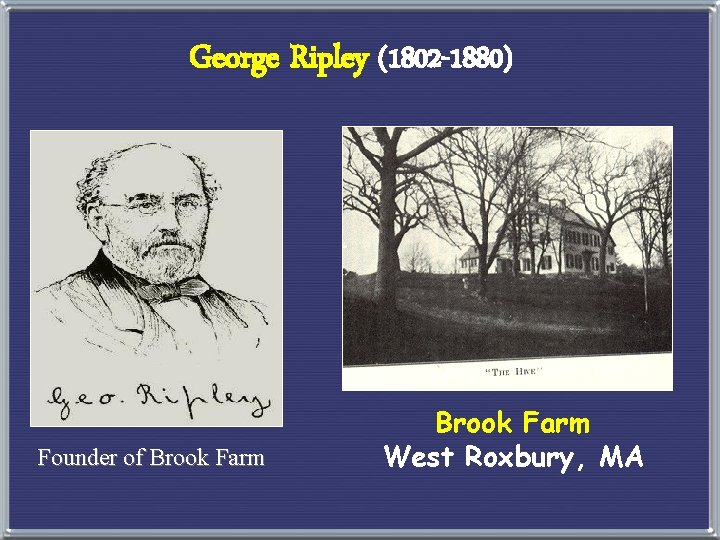
George Ripley (1802 -1880) Founder of Brook Farm West Roxbury, MA
Bases of Brook Farm: Transcendentalism e “Liberation from understanding and the cultivation of reasoning. ” e “Transcend” the limits of intellect and allow the emotions, the SOUL, to create an original relationship with the Universe. • People of Brook Farm rejected materialism • Their rural communalism combined spirituality, manual labor, intellectual life, and play.

Transcendentalist Intellectuals/Writers and their written works Concord, MA Ralph Waldo Emerson Nature (1832) Self-Reliance (1841) “The American Scholar” (1837) Henry David Thoreau Walden (1854) Civil Disobedience (1849)
- Slides: 20