
The purposes of grading student work Emily Marshman
- Slides: 12
The purposes of grading student work Emily Marshman d. B-SERC lunch discussion 10 -9 -2017
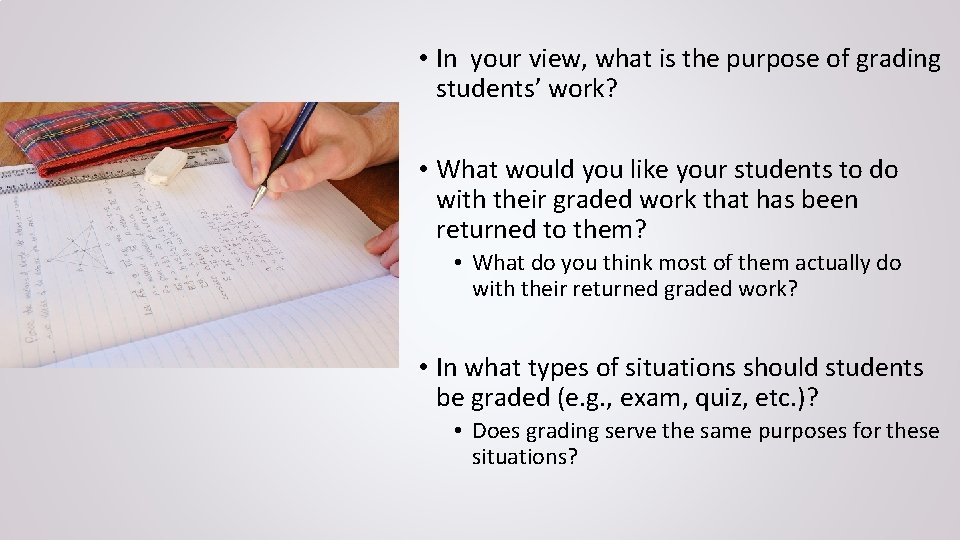
• In your view, what is the purpose of grading students’ work? • What would you like your students to do with their graded work that has been returned to them? • What do you think most of them actually do with their returned graded work? • In what types of situations should students be graded (e. g. , exam, quiz, etc. )? • Does grading serve the same purposes for these situations?
Purposes of grading … • Helps students • • Learn content Develop problem-solving skills Develop expertise in a domain … • Helps instructors • Give a final score / rank students • Identify areas of understanding and difficulties • …
Grading send messages to students • What is important? • • • Process? Final answer? Checking work? Etc. Be transparent about your requirements • students should explicitly know learning goals & grading criteria • Am I smart enough to succeed? • • Test averages should be C before curving Low performance is demoralizing for students, despite a curve 30 -40 average is threatening / shocking to students Encourage a “Growth mindset” • Students should view their graded assignments as opportunities for learning and that their intelligence is “malleable”
Types of assessments • Summative assessment - measure the extent to which students have learned and whether the goals of the course have been met (nothing more) • Formative assessment - obtain feedback on students’ understanding to allow instructor and students to address student difficulties • Assignments, quizzes, and even exams can be thought of as a learning opportunity • Grading in the spirit of formative assessment • What feedback should I give to students? • What can I use from students’ graded work to improve teaching / learning?
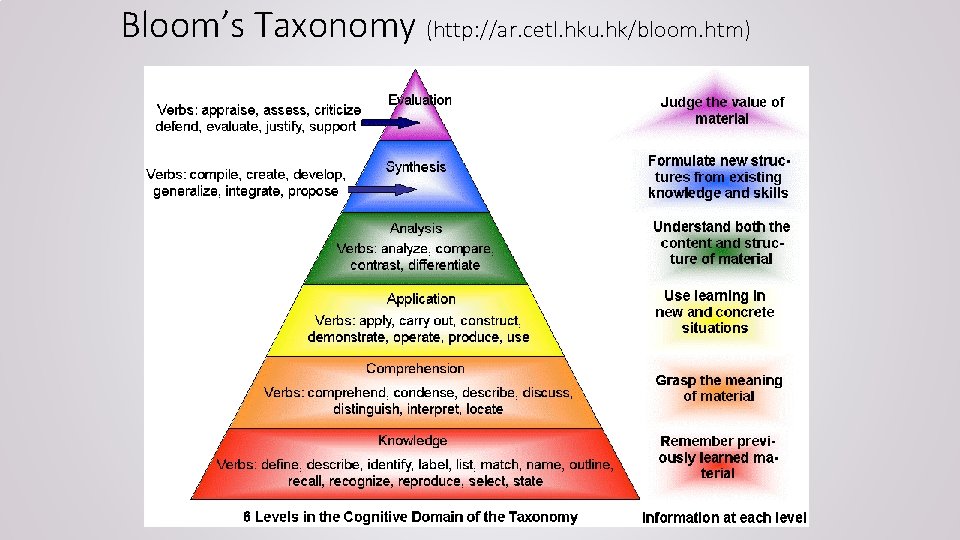
Bloom’s Taxonomy (http: //ar. cetl. hku. hk/bloom. htm)
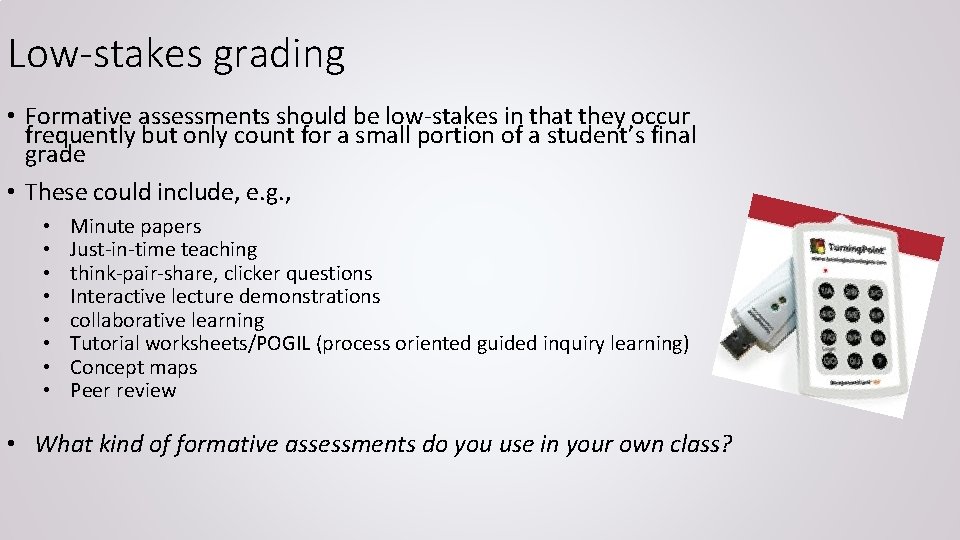
Low-stakes grading • Formative assessments should be low-stakes in that they occur frequently but only count for a small portion of a student’s final grade • These could include, e. g. , • • Minute papers Just-in-time teaching think-pair-share, clicker questions Interactive lecture demonstrations collaborative learning Tutorial worksheets/POGIL (process oriented guided inquiry learning) Concept maps Peer review • What kind of formative assessments do you use in your own class?
Grading rubrics • Scoring tools which outline the performance expectations for an assignment. • divide a problem into various parts and provide descriptions of how scores should be allocated for varying levels of mastery. • Concrete grading criteria and reasons for scores are crucial • How often do you use grading rubrics in your own class? What are the advantages of using a grading rubric? • Advantages • Incentivizes the use of effective approaches to the in the present assignment and in future assignments (Reif) • Instructors can obtain a clearer picture of what aspects are difficult for students • Students obtain a clearer picture of what aspects they are struggling with / what they have mastered • Consistent grading standard – ensure fairness
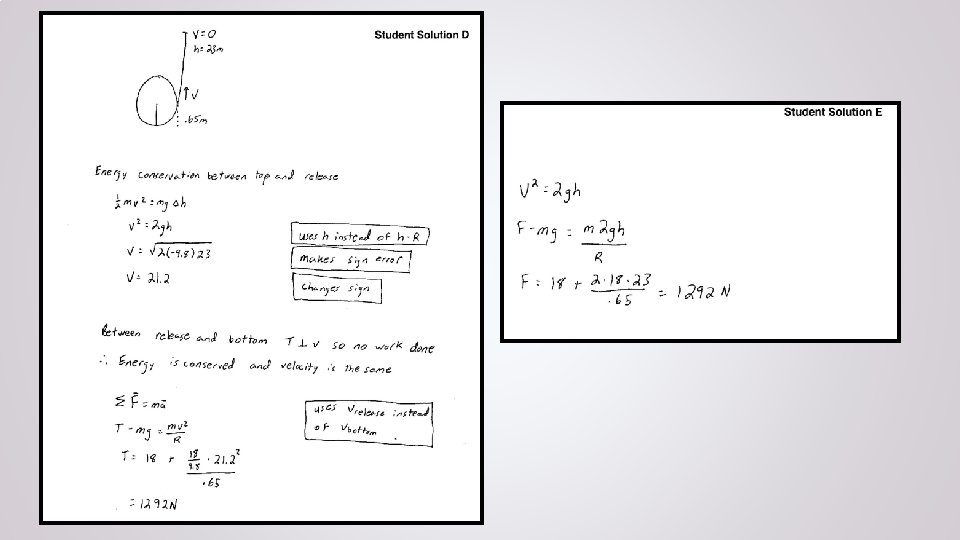
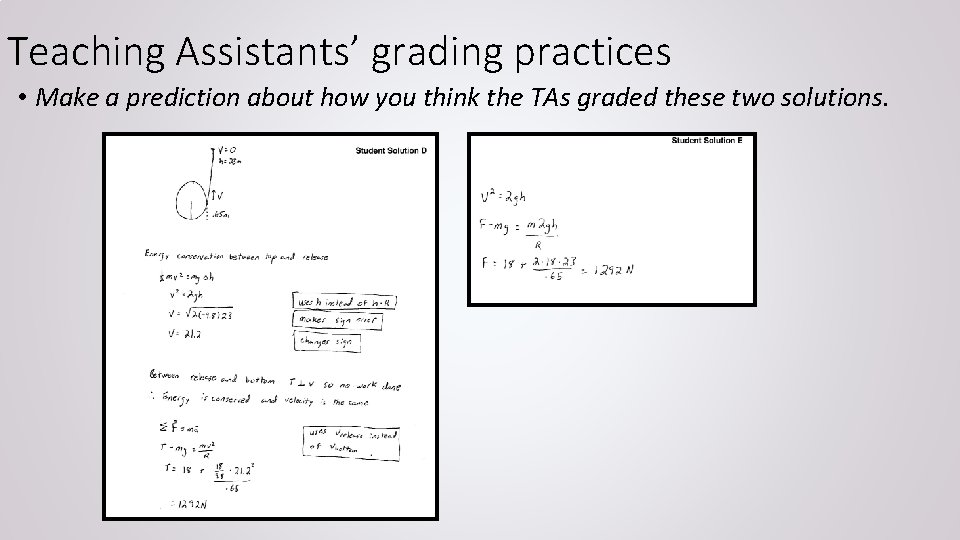
Teaching Assistants’ grading practices • Make a prediction about how you think the TAs graded these two solutions.
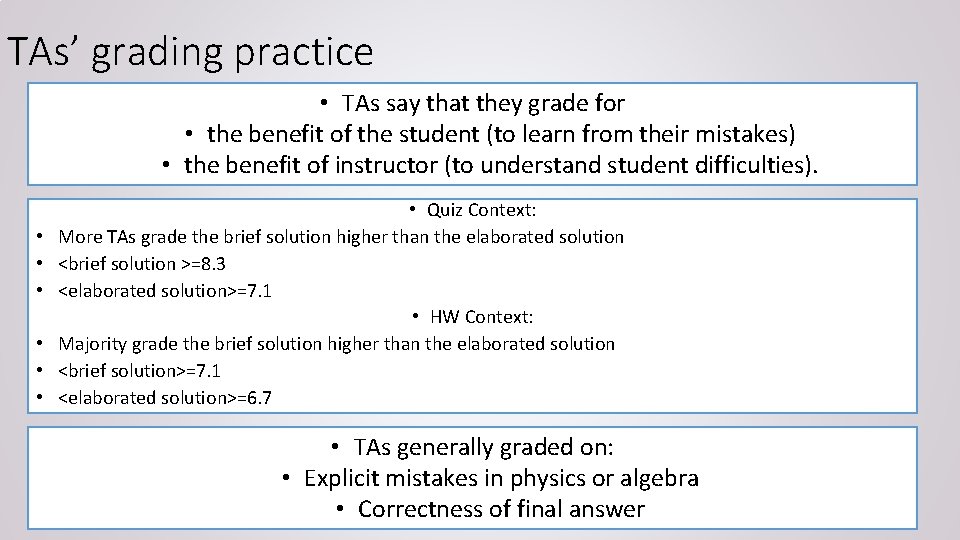
TAs’ grading practice • TAs say that they grade for • the benefit of the student (to learn from their mistakes) • the benefit of instructor (to understand student difficulties). • • Quiz Context: More TAs grade the brief solution higher than the elaborated solution <brief solution >=8. 3 <elaborated solution>=7. 1 • HW Context: Majority grade the brief solution higher than the elaborated solution <brief solution>=7. 1 <elaborated solution>=6. 7 • TAs generally graded on: • Explicit mistakes in physics or algebra • Correctness of final answer
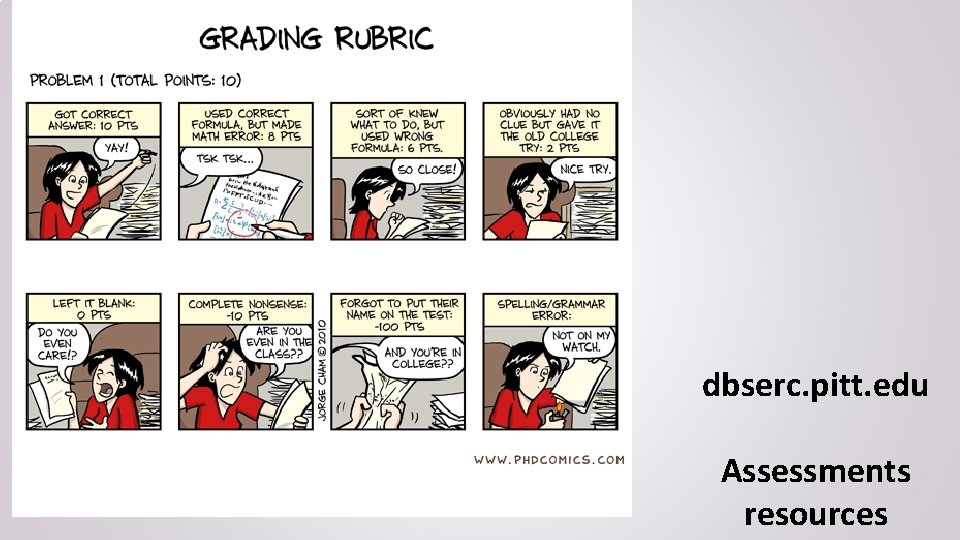
dbserc. pitt. edu Assessments resources