
The Puritan Philosophy Basic Timeline 1630 The Great
The Puritan Philosophy
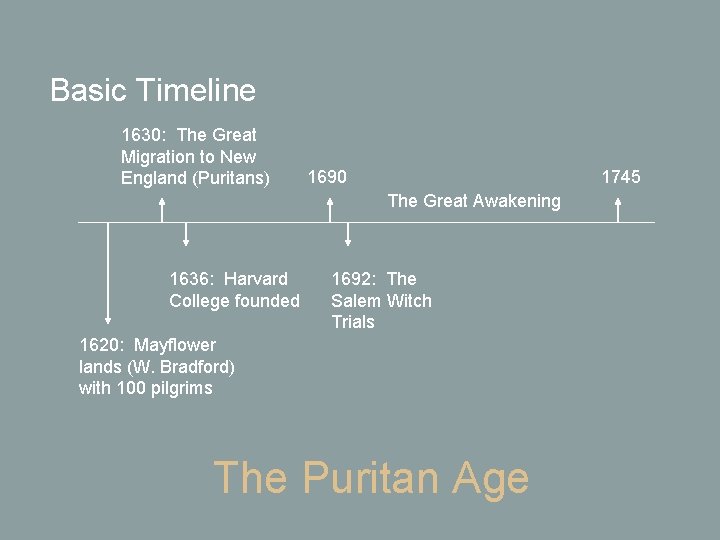
Basic Timeline 1630: The Great Migration to New England (Puritans) 1690 1745 The Great Awakening 1636: Harvard College founded 1692: The Salem Witch Trials 1620: Mayflower lands (W. Bradford) with 100 pilgrims The Puritan Age
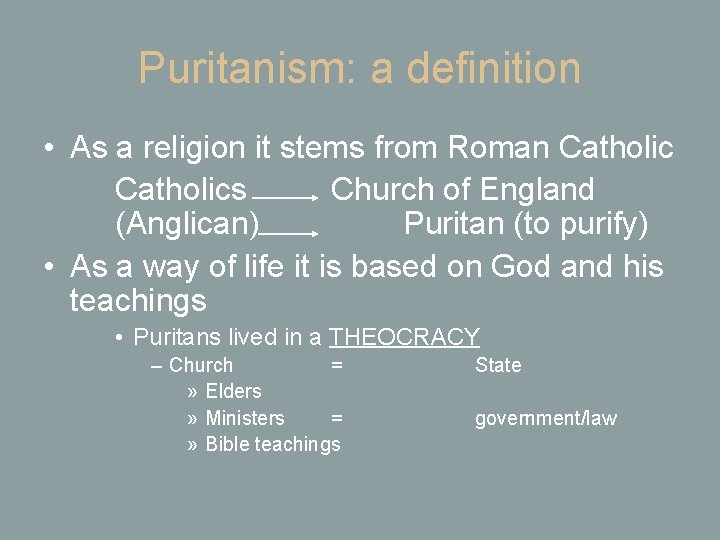
Puritanism: a definition • As a religion it stems from Roman Catholics Church of England (Anglican) Puritan (to purify) • As a way of life it is based on God and his teachings • Puritans lived in a THEOCRACY – Church = » Elders » Ministers = » Bible teachings State government/law
Puritan Views: • View of God – – All-powerful All-knowing Revengeful Just/fair • View of Man – Sinful – Unworthy of salvation • View of Nature - Used by God as a way to punish or reward man
Puritan Tenets (beliefs): 1. The Bible is the inerrant (without errors) word of God an outline for living 2. Special people (good Puritans) have been chosen by God to carry out certain actions 3. Your eternal destiny is decided before you are born. How you live life hints to this destiny. 4. In all aspects of life, be pragmatic (practical) and avoid frivolous (unnecessary) activities.
Puritan reasons for writing: • Puritan literature is both PRAGMATIC and THEOCRATIC • Reasons for writing are – Loneliness – To describe the new land – For support from Europe – To explain action (esp. W. Bradford) – For religious purposes (esp. J. Edwards)
William Bradford & Of Plymouth Plantation
William Bradford: bio • Son of an English farmer • Was the typical first New England settler • Extremely religious; joined a group of Puritans • Fled from England to Holland then to America because of religious persecution • Reached Plymouth in 1620 aboard the Mayflower • Wife either jumped or fell overboard and drowned • 1 st winter in America ½ the settlers died • Became governor of Plymouth (re-elected 30+ times
Bio, cont. • Wrote Plymouth’s • Of Plymouth history (began in 1630 Plantation describes and ended in 1647) – Puritan’s flight from England to Holland to • 200 years later the America manuscript was st – The trials of the 1 published winter • Bradford was – The bloody Pequot disappointed that War America fell short of its promise
“Of Their Voyage, and How They Passed the Sea; and of Their Safe Arrival to Cape Cod” • Bradford shows Puritan ideals through the story of the “profane young seaman” – Many of the ship passengers were very seasick. The young seaman made fun of the sick and proclaimed that he would “cast half of them overboard” – This young seaman was struck down with a terrible disease and was, himself, the first to be thrown overboard – The fate of man is based on his actions (God
• Voyage was a mix of fair winds and fierce storms • One of the main beams bowed and cracked ½ way through the journey • Repaired the beam with a great iron screw (to raise it) and a post (to secure it) • Again, pilgrims believed that God would be fair to them – “So they committed themselves to the will of God and resolved to proceed” (26)
• God saves a good Puritan from drowning – John Howland was thrown into the sea during a storm – “it pleased God that he caught hold of the topsail halyards” (26) – John Howland “lived many years and became a profitable member both in church and commonwealth” (his good life yielded a good fate) • One person (besides the seaman) perished on the voyage, William Butten
• They first try to land @ Cape Cod • Then they decide to travel south down the Hudson (meet with rough waters) • Ultimately, they docked @ Cape Harbor • They landed in winter with no friends to meet them & no place for them to go • Bradford declares his trust in God to get them through – “What could now sustain them but the Spirit of God and His Grace? ” (27)
“The Starving Time” • In 2 or 3 months’ time, ½ the ship’s passengers died – Lack of proper housing – Infected with scurvy • 6 or 7 Puritans were healthy enough to care for the others (chosen by God) • The seamen were greedy and selfish, keeping food and drink for themselves even with the passengers so sick.
• The seamen began falling ill too • Nearly half of the seamen died before they set sail again • The pilgrims were much more willing to help each other in times of need and illness • The seamen were more barbaric and selfcentered. They cursed each other instead of caring for each other
“Indian Relations” • Samoset, an Indian that approached the pilgrims, helped them become familiar with the land • Squanto and the pilgrims set terms under which they would all live. These terms primarily favored the pilgrims (see page 30) • Squanto continued with the pilgrims as their interpreter and was “sent from God” (31) • He aided the pilgrims until he died
Anne Bradstreet & selected poems
Anne Bradstreet: Bio • 1630 she came from England to Boston • Grew up in a Puritan household • Married Simon Bradstreet @ 16 • Father (Thomas Dudley) and husband both became governor of MA • Published the 1 st book of poetry by an American • One of the 1 st volumes of poetry by a woman • 1 st volume of poetry contains long poems on subjects such as medicine, history, and the qualities of fire
Bio, cont. • 2 nd volume of poetry • Poems express the contains shorter Puritan belief that one poems in a simpler must not get too style about children, attached to the things family, & home of the world • Later poems are more • Typical Puritan wife, intimate and express quick to acknowledge her deep attachment the superiority of men to family and a sense • Considered the 1 st of loss American poet
“To My Dear and Loving Husband” nd • Most likely from her 2 volume of poetry because it is shorter, written more simply, and addresses family (specifically her husband) • Lines 5 -6 create an image of wealth (mines of gold & riches of the East) • Bradstreet contrasts this material wealth with spiritual wealth (the love of her husband God) • Last 2 lines = Puritan belief that successful marriages (faithfulness) are rewarded in the afterlife
“Upon the Burning of Our House July 10 th , 1666” • Most likely from her 1 st volume of poetry because it is longer and concerns the qualities of fire • Lines 8 -10 “And to my God…leave me succorless” show Bradstreet relying on God to give her strength in tough times and to be fair in his actions • Lines 14 -16 “I blest his name…so ‘twas just” show the Puritan belief in God’s purpose (it must have happened for a reason)
• Bradstreet began valuing earthly possession more than her faith, therefore God took them away • Puritans are of the opinion that all things in this world are God’s and he has the right to take them away when he sees fit • Lines 43 -48 illustrate that Puritans have a permanent house in heaven “house on high erect/Framed by that mighty Architect” • The end of the poem reinforces the Puritan belief in simplicity and plainness “There is wealth enough, I need no more…my hope and treasure lies above”
Jonathan Edwards & “Sinners in the Hands of an Angry God”
Jonathan Edwards: bio • Born in East Windsor, Connecticut • Puritan minister • Believes that everything in God’s universe exists for some purpose (stated @ age 11) • Went to Yale College @ 13 • Early 20 s her married Sarah Pierrepont, a woman as absorbed in God as he • Was an important part of the Great Awakening (1735 – 1742)
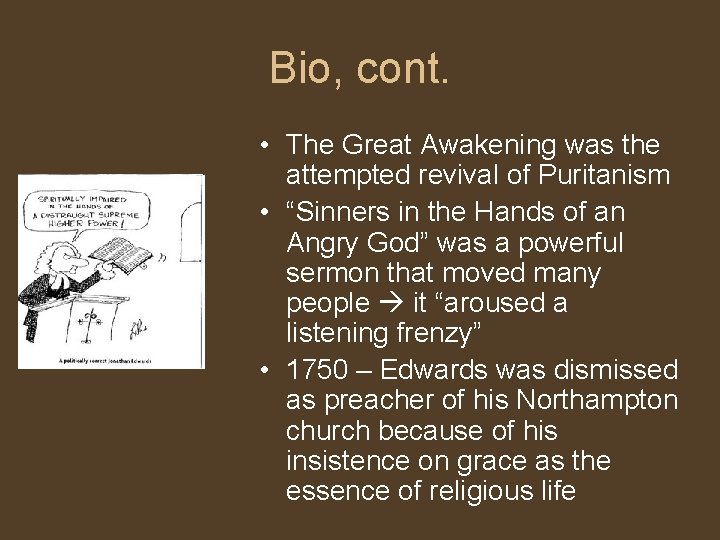
Bio, cont. • The Great Awakening was the attempted revival of Puritanism • “Sinners in the Hands of an Angry God” was a powerful sermon that moved many people it “aroused a listening frenzy” • 1750 – Edwards was dismissed as preacher of his Northampton church because of his insistence on grace as the essence of religious life
“Sinners in the Hands of an Angry God” • Edward’s sermon begins with a thesis – God is all-powerful and keeps you from harm • He attempts to persuade his congregation through fear • Humans, his congregation, take their good health as a sign that they will be kept from hell • In reality, if it were not for God, all would fall straight to Hell • “…wickedness is as heavy as lead” – A simile comparing wickedness to a tangible (touchable) item – Lead drops just as people weighted with sin would
• Man’s attempt to keep out of Hell is ineffective – Edwards compare it to a spider’s web stopping a falling rock – impossible • Imagery – black clouds of God’s wrath, full of storm and thunder (meant to instill fear) • God keeps the storm from rushing upon you • The wrath of God is like great waters dammed; His power, over time, builds • God may temporarily withhold his vengeance, but your guilt builds greater and greater
• God is the only one that keeps you from death • YOU=spider, loathsome insect, hateful venomous serpent • If you are not born again (achieve grace) then you are in danger of receiving God’s wrath • Not all people have the opportunity to repent for their sins; those that do are lucky • Edwards end with hope for his congregation to receive salvation
- Slides: 28