
The Psychology Theory of Color The How and
- Slides: 33
The Psychology& Theory of Color The How and Why of Color
Color Attributes • There are literally millions of colors, but they can be divided into just a few color families. • And every color can be described in terms of having three main attributes: hue, saturation and brightness.
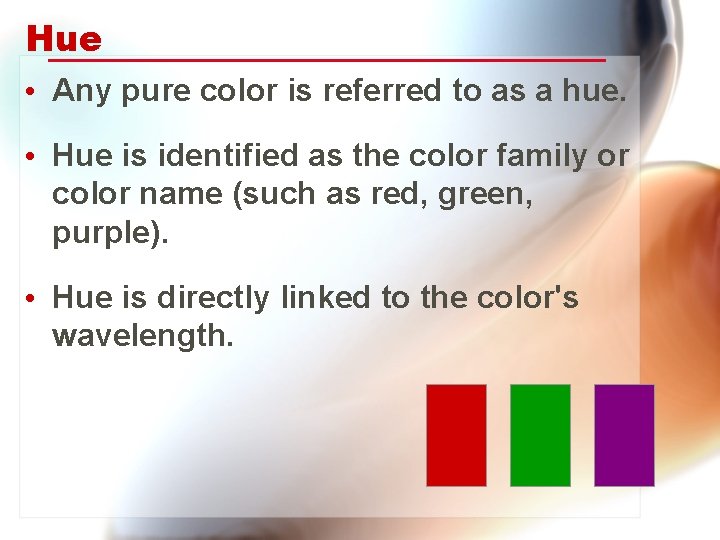
Hue • Any pure color is referred to as a hue. • Hue is identified as the color family or color name (such as red, green, purple). • Hue is directly linked to the color's wavelength.
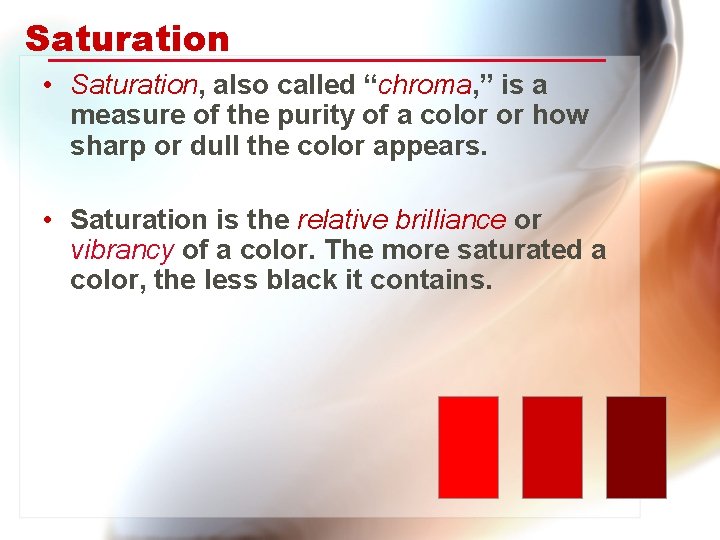
Saturation • Saturation, also called “chroma, ” is a measure of the purity of a color or how sharp or dull the color appears. • Saturation is the relative brilliance or vibrancy of a color. The more saturated a color, the less black it contains.
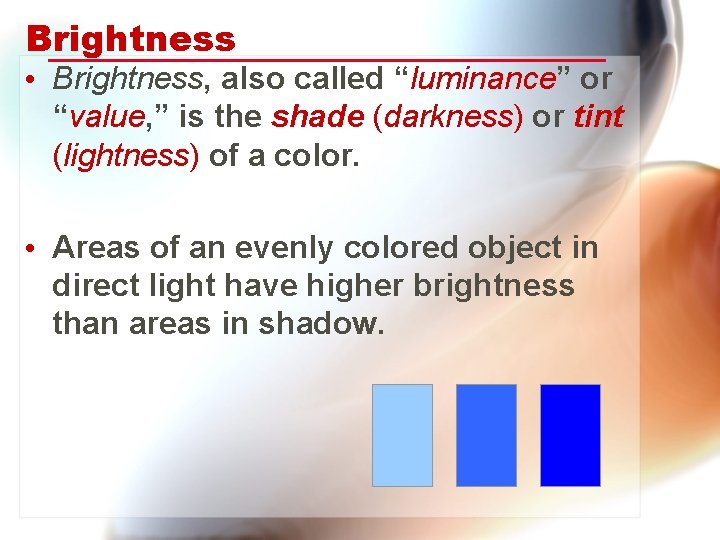
Brightness • Brightness, also called “luminance” or “value, ” is the shade (darkness) or tint (lightness) of a color. • Areas of an evenly colored object in direct light have higher brightness than areas in shadow.
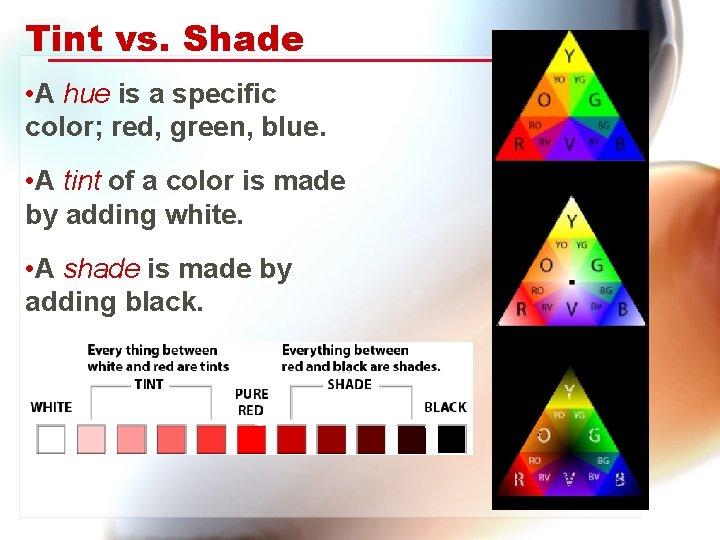
Tint vs. Shade • A hue is a specific color; red, green, blue. • A tint of a color is made by adding white. • A shade is made by adding black.
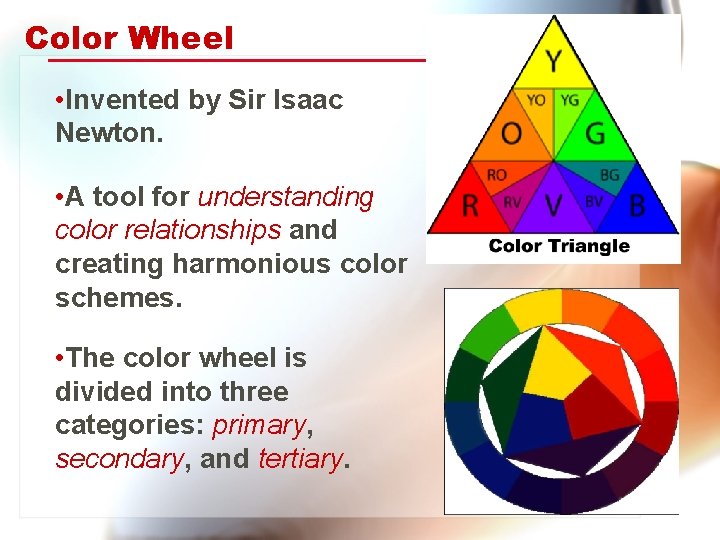
Color Wheel • Invented by Sir Isaac Newton. • A tool for understanding color relationships and creating harmonious color schemes. • The color wheel is divided into three categories: primary, secondary, and tertiary.
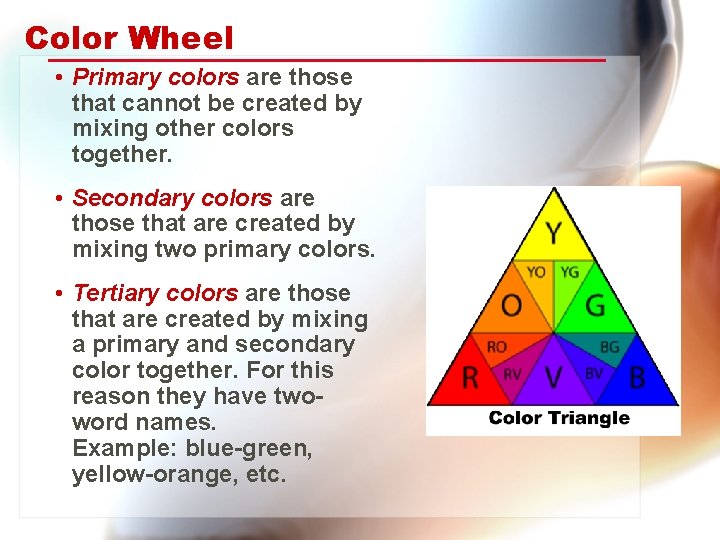
Color Wheel • Primary colors are those that cannot be created by mixing other colors together. • Secondary colors are those that are created by mixing two primary colors. • Tertiary colors are those that are created by mixing a primary and secondary color together. For this reason they have twoword names. Example: blue-green, yellow-orange, etc.
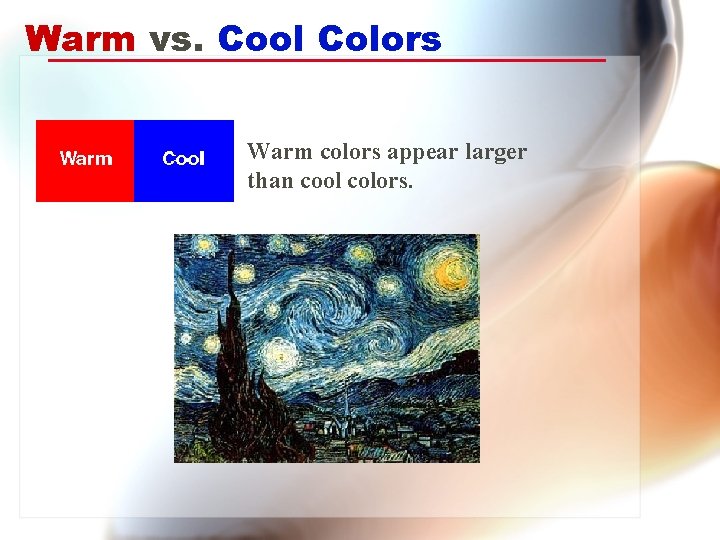
Warm vs. Cool Colors Warm colors appear larger than cool colors.
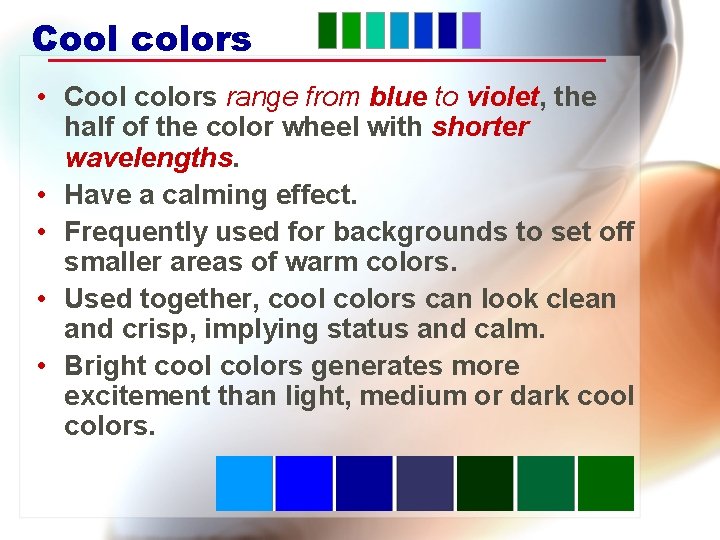
Cool colors • Cool colors range from blue to violet, the half of the color wheel with shorter wavelengths. • Have a calming effect. • Frequently used for backgrounds to set off smaller areas of warm colors. • Used together, cool colors can look clean and crisp, implying status and calm. • Bright cool colors generates more excitement than light, medium or dark cool colors.
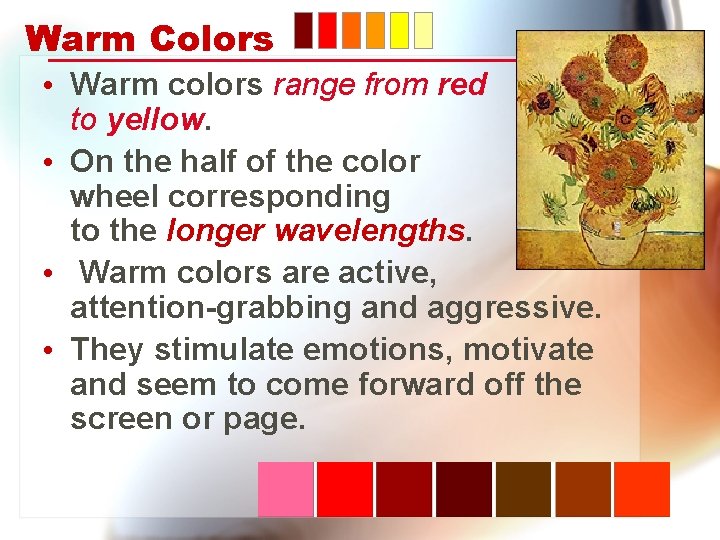
Warm Colors • Warm colors range from red to yellow. • On the half of the color wheel corresponding to the longer wavelengths. • Warm colors are active, attention-grabbing and aggressive. • They stimulate emotions, motivate and seem to come forward off the screen or page.
Color Schemes • Selecting color combinations may be based on several traditional color schemes. These are: – – – – Compliments Monochromatic Neutral Analogous Low Intensity Split Compliments Double Compliments
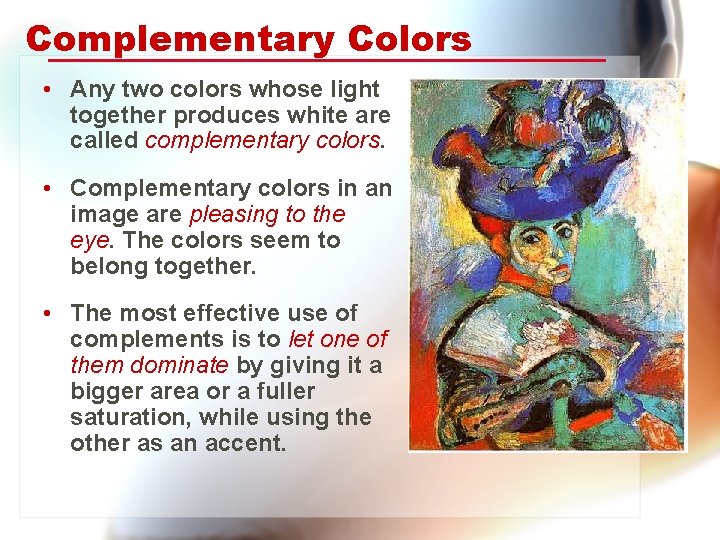
Complementary Colors • Any two colors whose light together produces white are called complementary colors. • Complementary colors in an image are pleasing to the eye. The colors seem to belong together. • The most effective use of complements is to let one of them dominate by giving it a bigger area or a fuller saturation, while using the other as an accent.
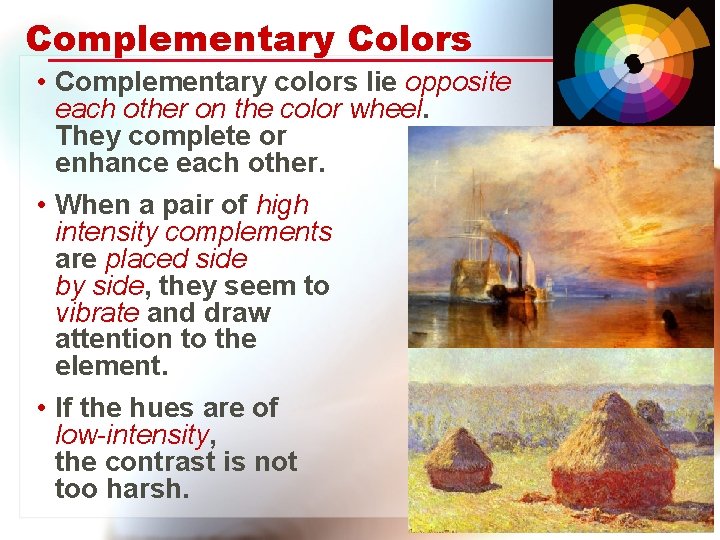
Complementary Colors • Complementary colors lie opposite each other on the color wheel. They complete or enhance each other. • When a pair of high intensity complements are placed side by side, they seem to vibrate and draw attention to the element. • If the hues are of low-intensity, the contrast is not too harsh.
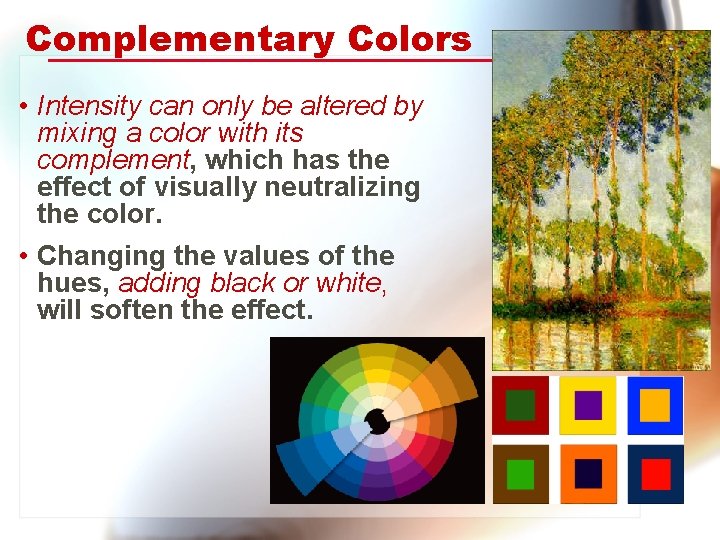
Complementary Colors • Intensity can only be altered by mixing a color with its complement, which has the effect of visually neutralizing the color. • Changing the values of the hues, adding black or white, will soften the effect.
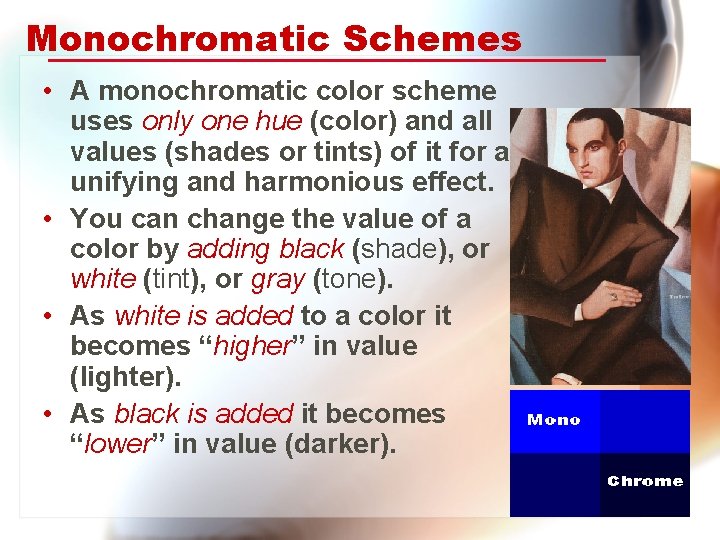
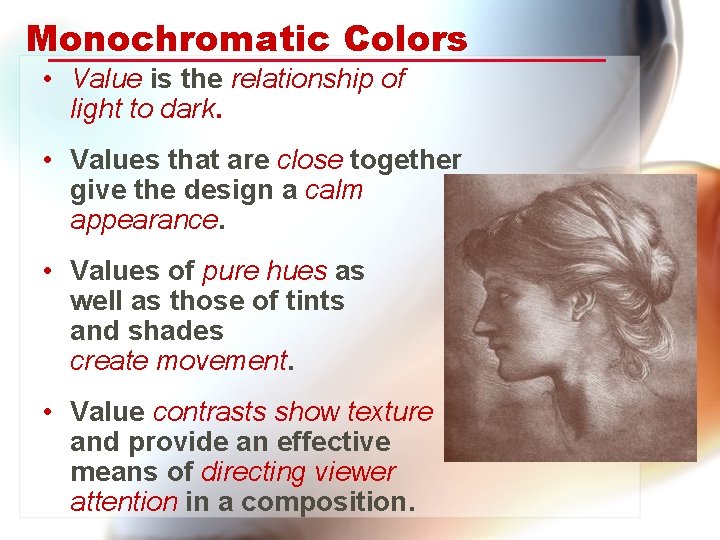
Monochromatic Schemes • A monochromatic color scheme uses only one hue (color) and all values (shades or tints) of it for a unifying and harmonious effect. • You can change the value of a color by adding black (shade), or white (tint), or gray (tone). • As white is added to a color it becomes “higher” in value (lighter). • As black is added it becomes “lower” in value (darker).
Monochromatic Colors • Value is the relationship of light to dark. • Values that are close together give the design a calm appearance. • Values of pure hues as well as those of tints and shades create movement. • Value contrasts show texture and provide an effective means of directing viewer attention in a composition.
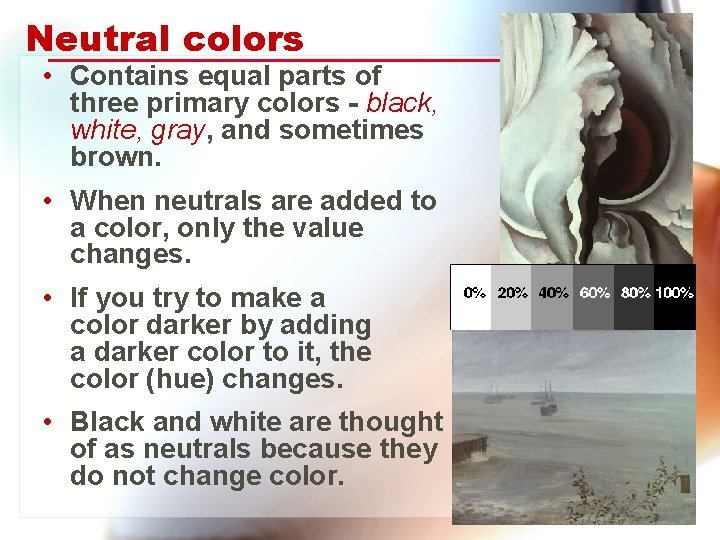
Neutral colors • Contains equal parts of three primary colors - black, white, gray, and sometimes brown. • When neutrals are added to a color, only the value changes. • If you try to make a color darker by adding a darker color to it, the color (hue) changes. • Black and white are thought of as neutrals because they do not change color.
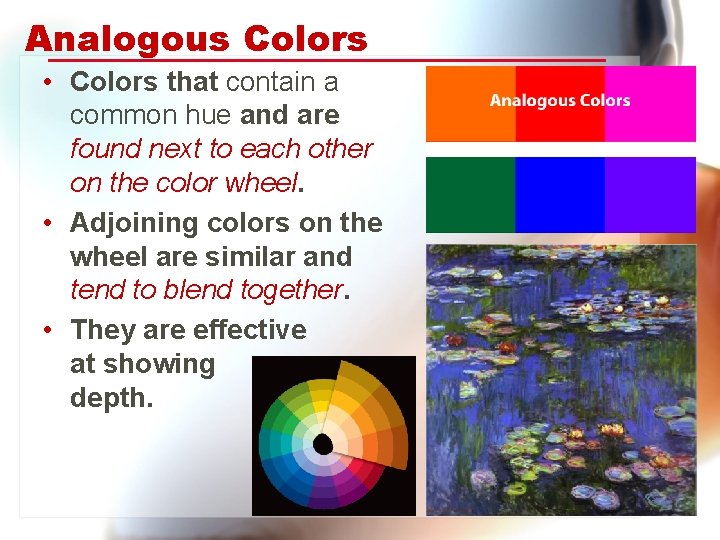
Analogous Colors • Colors that contain a common hue and are found next to each other on the color wheel. • Adjoining colors on the wheel are similar and tend to blend together. • They are effective at showing depth.
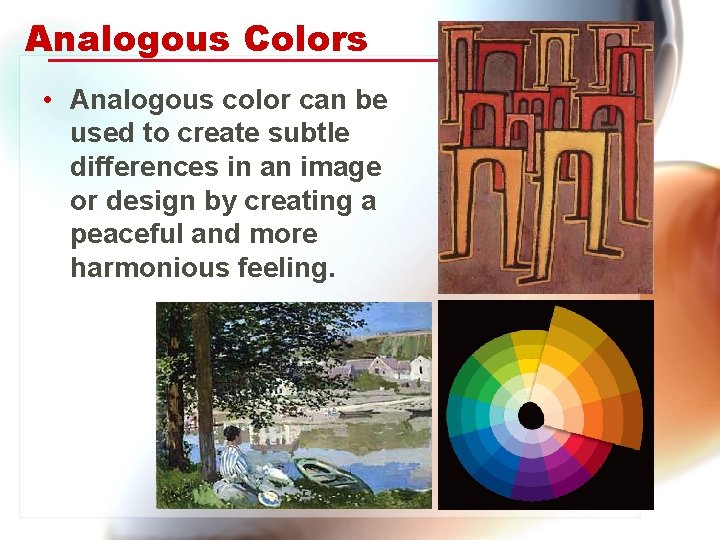
Analogous Colors • Analogous color can be used to create subtle differences in an image or design by creating a peaceful and more harmonious feeling.
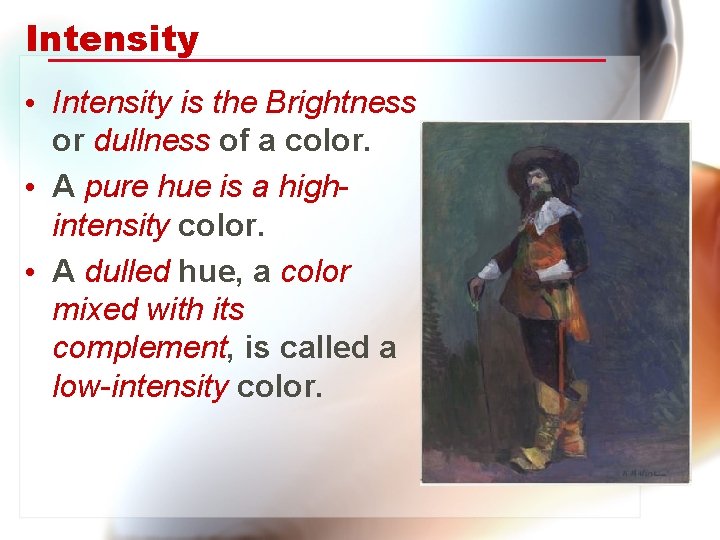
Intensity • Intensity is the Brightness or dullness of a color. • A pure hue is a highintensity color. • A dulled hue, a color mixed with its complement, is called a low-intensity color.
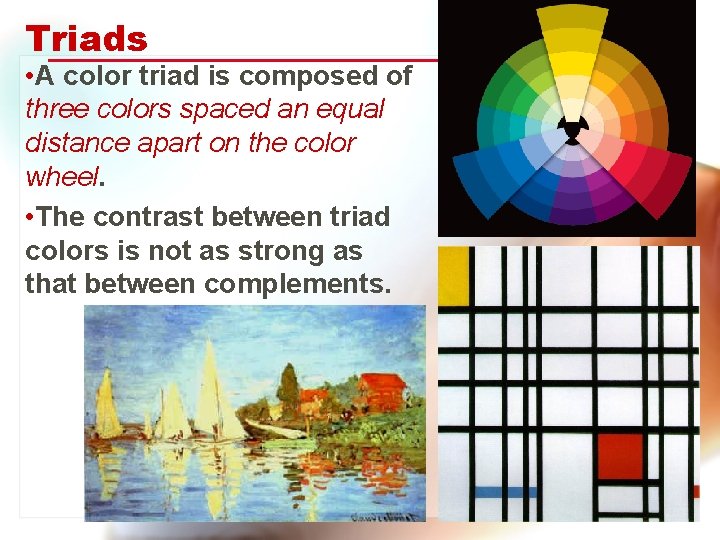
Triads • A color triad is composed of three colors spaced an equal distance apart on the color wheel. • The contrast between triad colors is not as strong as that between complements.
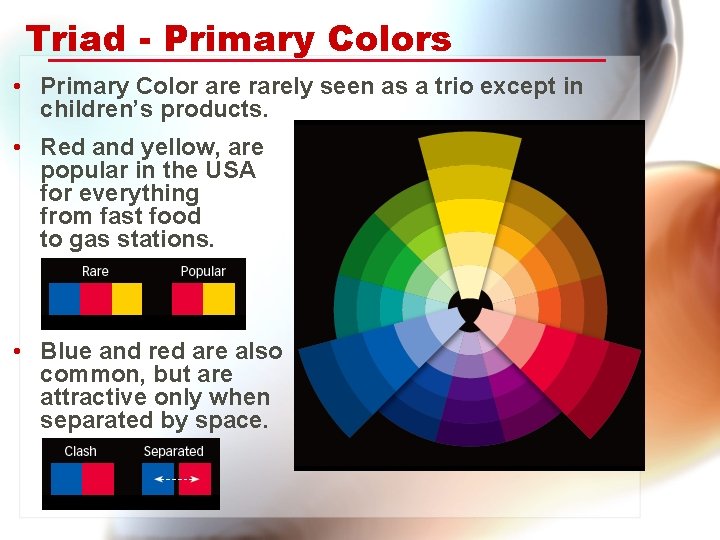
Triad - Primary Colors • Primary Color are rarely seen as a trio except in children’s products. • Red and yellow, are popular in the USA for everything from fast food to gas stations. • Blue and red are also common, but are attractive only when separated by space.
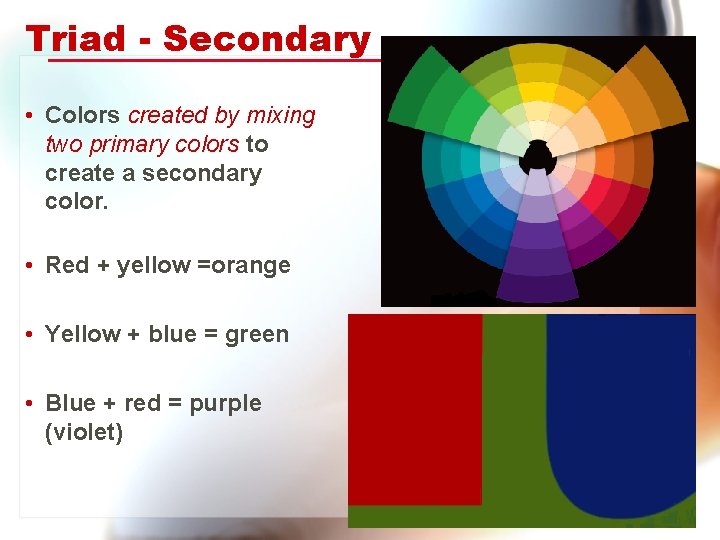
Triad - Secondary • Colors created by mixing two primary colors to create a secondary color. • Red + yellow =orange • Yellow + blue = green • Blue + red = purple (violet)
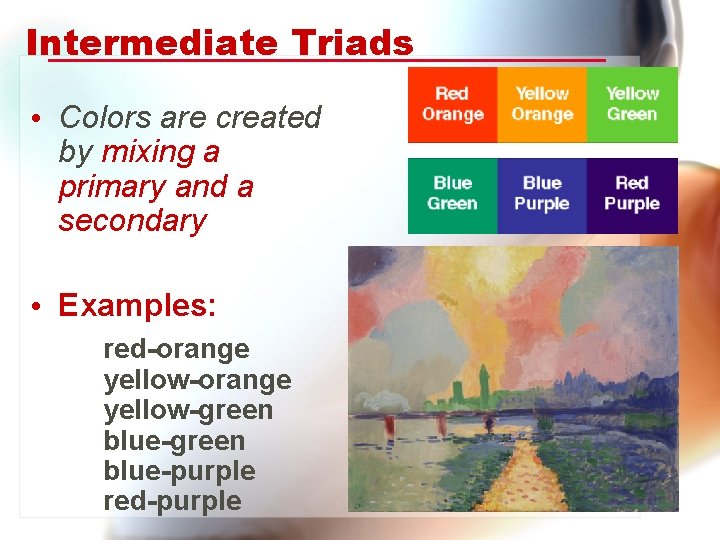
Intermediate Triads • Colors are created by mixing a primary and a secondary • Examples: red-orange yellow-green blue-purple red-purple
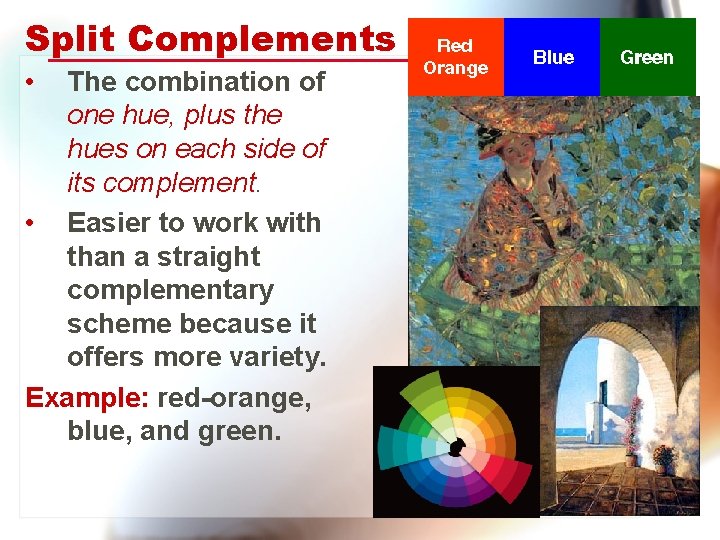
Split Complements • The combination of one hue, plus the hues on each side of its complement. • Easier to work with than a straight complementary scheme because it offers more variety. Example: red-orange, blue, and green.
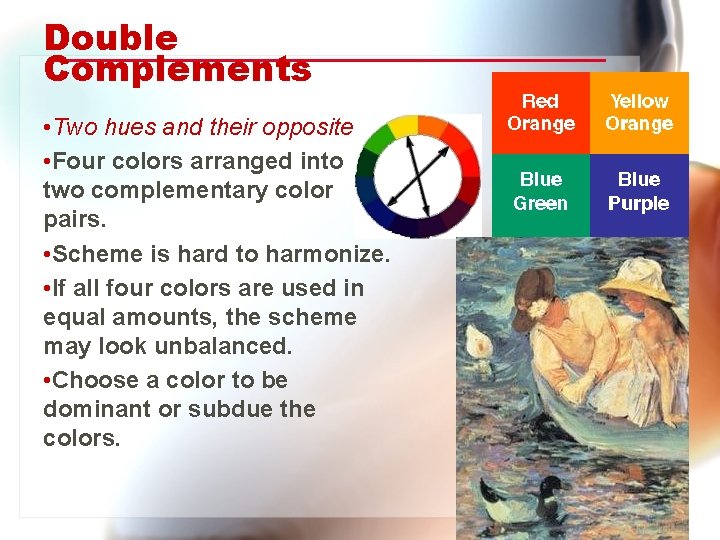
Double Complements • Two hues and their opposites. • Four colors arranged into two complementary color pairs. • Scheme is hard to harmonize. • If all four colors are used in equal amounts, the scheme may look unbalanced. • Choose a color to be dominant or subdue the colors.
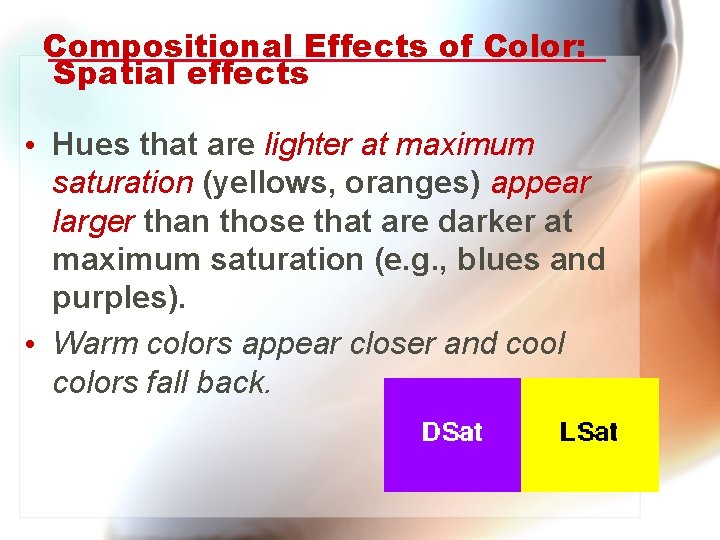
Compositional Effects of Color: Spatial effects • Hues that are lighter at maximum saturation (yellows, oranges) appear larger than those that are darker at maximum saturation (e. g. , blues and purples). • Warm colors appear closer and cool colors fall back.
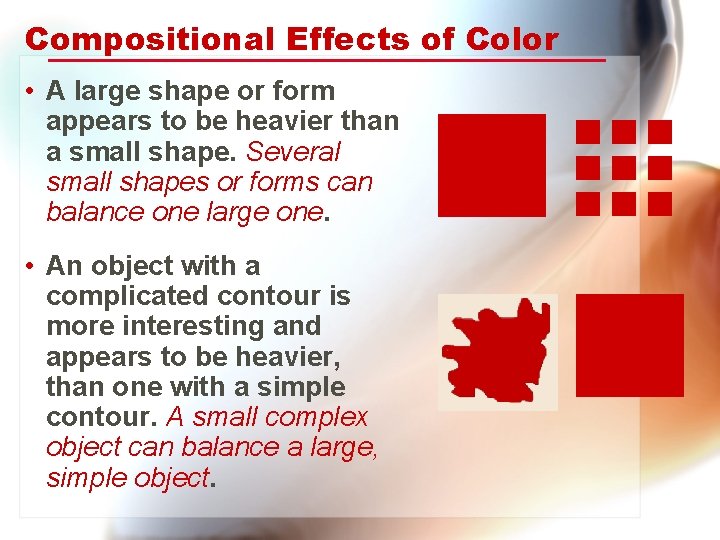
Compositional Effects of Color • A large shape or form appears to be heavier than a small shape. Several small shapes or forms can balance one large one. • An object with a complicated contour is more interesting and appears to be heavier, than one with a simple contour. A small complex object can balance a large, simple object.
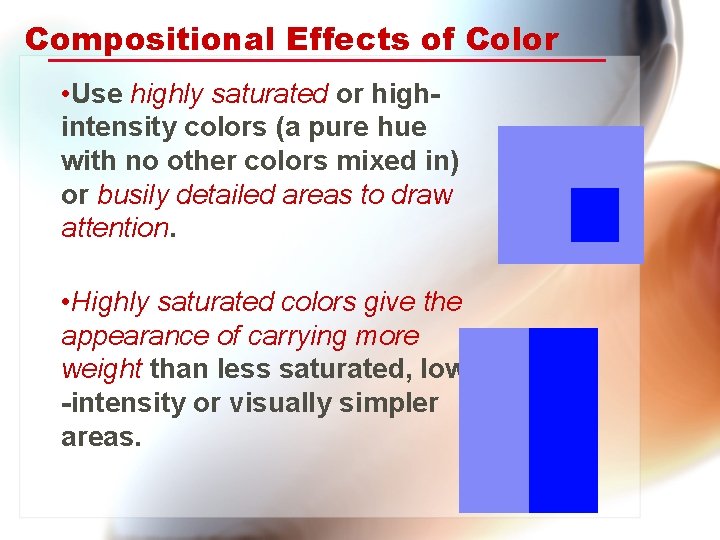
Compositional Effects of Color • Use highly saturated or highintensity colors (a pure hue with no other colors mixed in) or busily detailed areas to draw attention. • Highly saturated colors give the appearance of carrying more weight than less saturated, low -intensity or visually simpler areas.
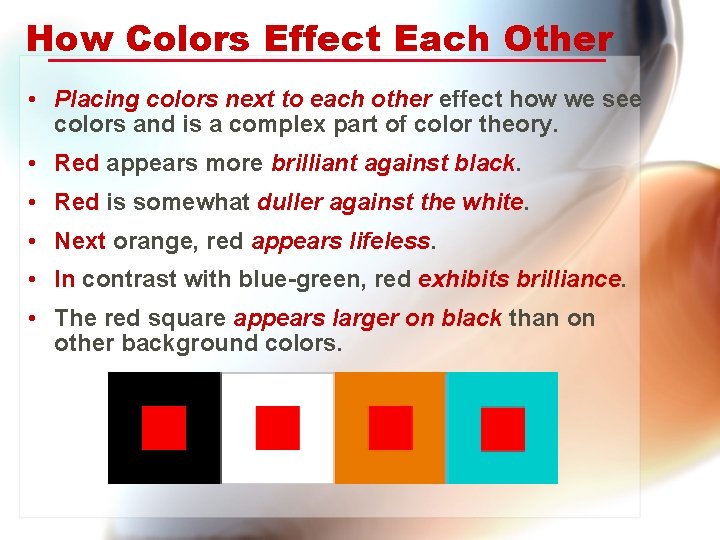
How Colors Effect Each Other • Placing colors next to each other effect how we see colors and is a complex part of color theory. • Red appears more brilliant against black. • Red is somewhat duller against the white. • Next orange, red appears lifeless. • In contrast with blue-green, red exhibits brilliance. • The red square appears larger on black than on other background colors.
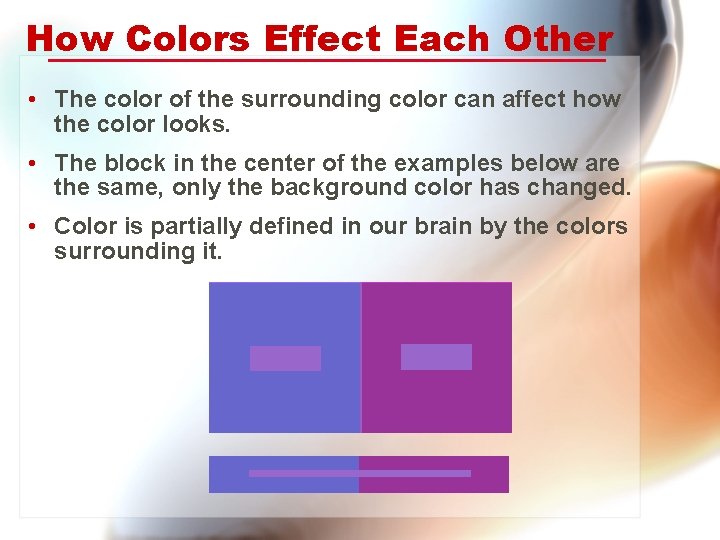
How Colors Effect Each Other • The color of the surrounding color can affect how the color looks. • The block in the center of the examples below are the same, only the background color has changed. • Color is partially defined in our brain by the colors surrounding it.
Sources of Information • Write Design on-line http: //www. writedesignonline. com/resource s/design/rules/color. html