
The Psychology of SLA Language and the brain
The Psychology of SLA Language and the brain
The Brain
The Brain
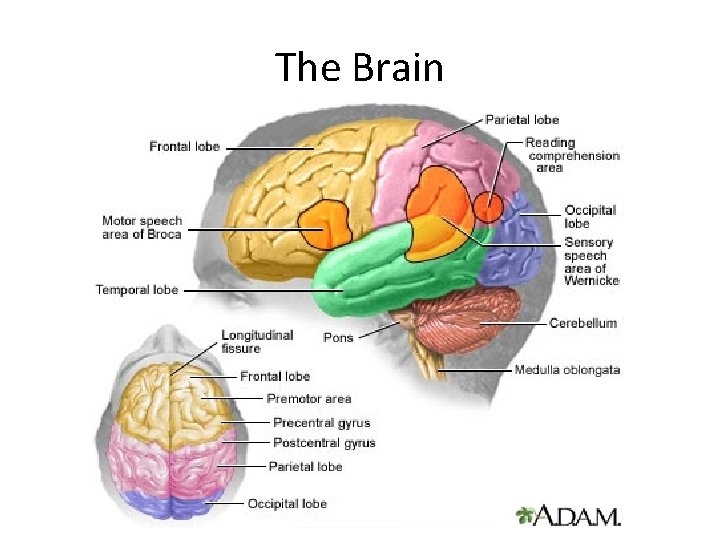
The Brain • Not all things (in the brain) are equal: lateralization – Over time, our brain begins to distribute different “tasks” to more or less one side of the brain or the other. • What is being added to the brain with SLA is not entirely different/separate from L 1 learning.
How independent are the languages of multilinguals? • There are 3 hypotheses, but nothing’s totally clear yet. – Coordinate bilingualism – Compound bilingualism – Subordinate bilingualism
How are multiple languages’ structures organized? • 2 or more languages that exist in a person’s brain may overlap as far as the part(s) of the brain in which they’re contained, but not completely. • Despite this, they’re all predominantly in the left hemisphere. • L 2 seems to be more dispersed (found in more and different areas) than the L 1.
Does L 2 vs. L 1 organization differ with age of acquisition? • Yes, very probably so. • Most likely due to lateralization.
Does L 2 vs. L 1 organization differ in how it’s learned? • Yes, probably. • L 2 is usually learned by many means (e. g. classroom, media, conscious effort etc. ), while the L 1 is learned typically via 1 means (e. g. parents, unconsciously) • Due to this, there is usually more variation in finding right hemisphere involvement in the L 2
Does L 2 vs. L 1 organization differ with proficiency level? • Yes, probably, but it’s still unclear. • So far, it seems that L 2 is more dispersed at lower proficiency levels and more compact (not found in as many locations) in highly proficient people. • Why? ! Possibly because the more fluent a person is, the more they rely on meaning and the less they rely on memory.

Do 2+ languages show the same sort of loss/disruption after brain damage? If not, which recovers first? • Most of the time, there the same or similar patterns of language loss and recovery of all languages occur, but not always. • There a couple ways to explain cases where there are different patterns of language disruption and/or recovery.
Differential language disruption and/or recovery • Hypothesis: It’s most likely that the language used most in the years prior to the brain damage is more important than which language is L 1 and which L 2. • Sometimes the SAME language is affected in different ways. For example, only pragmatics or only grammar may be affected in one language, but not necessarily in the other – This strengthens the argument that different aspects of language are stored in different parts of the brain.
- Slides: 11