
The Psychology of Parricide Julia Mitrevski MD University





























- Slides: 59
The Psychology of Parricide Julia Mitrevski, MD University of California, San Francisco Psychiatry and the Law Program
What drives someone to kill their parents?
Definitions • Parricide – Killing one’s mother or father • Matricide – Killing one’s mother • Patricide – Killing one’s father
Overview • Epidemiology • Spectrum of reactive & psychotic parricides with case examples • Psychological theories of parricide • Specific issues in matricide • Female offenders
Epidemiology
Epidemiology of Parricide (1) • It is uncommon • Accounts for less than 4% of homicides • Accounts for 20 -30% of homicides committed by psychotic individuals Marleau J et al. International Journal of Law and Psychiatry, 2003
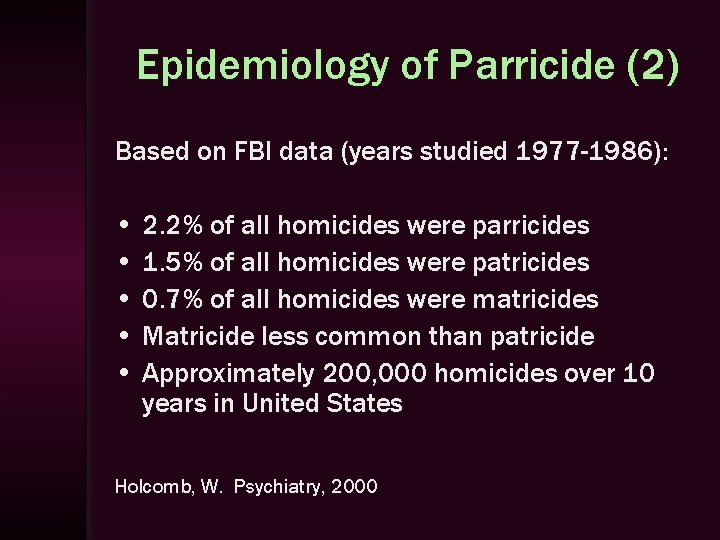
Epidemiology of Parricide (2) Based on FBI data (years studied 1977 -1986): • 2. 2% of all homicides were parricides • 1. 5% of all homicides were patricides • 0. 7% of all homicides were matricides • Matricide less common than patricide • Approximately 200, 000 homicides over 10 years in United States Holcomb, W. Psychiatry, 2000
Epidemiology of Parricide (3) • Male to female ratio 6: 1 • Many studies indicate that patricide committed by sons is the most frequent form of parricide • However, in parricides committed by psychotic individuals, the number of matricides equals the number of patricides • In Canada, 90% of parricide offenders were sons (1961 -1989) Marleau J et al. International Journal of Law and Psychiatry, 2003
Epidemiology of Parricide (4) • Sons who kill their fathers tend to be younger than those who kill their mothers • 86% of matricides committed by sons • Average of matricide offenders: 30 (only 15% below age 18) Holcomb, W. Psychiatry, 2000
Spectrum of Psychotic & Reactive Parricides
Spectrum of Psychotic & Reactive Parricides Psychotic Parricides • History of chronic psychotic illness • Delusional about victim(s) • Dependent on victim(s) – may be because of illness itself rather than innate family dysfunction Reactive Parricides • Not psychotic • In response to severe family dysfunction • Hostile-dependent relationship with victim(s) • Usually adolescent offenders
Case example: Mr. A • 25 year old man with schizophrenia • Living with his parents • No prior criminal history • Killed both his mother and his father • Paranoid, delusional • Was off medications at the time of the killing
Mr. A • Bludgeoned parents in their home with a baseball bat • Believed that they were devils and that he was saving the world • No known inciting event • Arresting officers found him bizarre but calm – he confessed his actions • Found not guilty by reason of insanity
Risk Factors for Psychotic Parricides • Paranoid schizophrenia with persecutory, grandiose, and religious delusions • Dependent on parent-victim, having never been independent • ? youngest child or youngest male child
Case example: Gino From Wertham’s Dark Legend • 17 year old boy who was described as friendly and outgoing • His father died when he was 10 • Physically abused and neglected by his mother • When he was 12, vowed to kill his mother
Gino • Behavior changed in the month before the matricide • Preoccupied with plans of killing his mother • Stabbed her 32 times with a bread knife he had asked her to sharpen • Felt calm and no remorse after the matricide
Psychological Theories of Parricide
Theories of Reactive Parricide • Psychoanalytic theories – Focus on intrapsychic dynamics – A lethal combination of sexual and homicidal impulses • Family systems theories – Focus on pathological family dynamics – A lethal combination of severe abuse, ‘lockage, ’ and social isolation
Oedipus • Left his hometown to escape a prophecy that he would kill his father and marry his mother • On his journey, he killed a man • He went on to solve the riddle of the Sphinx and married the widowed queen of Thebes
Oedipus
Oedipus complex • Freud used the myth of Oedipus as an allegory describing the unconscious wishes of every man
Oedipus complex • A characteristic constellation of drives, relations, fears, and identifications that manifest from age 3 to 6 but persist throughout life • Broadly used to designate a triangular relationship between the child and his or her parents • The child fears retaliation for the forbidden incestuous and parricidal wishes
Theories of Matricide Psychoanalytic: • Oedipal sexual rivalry (triangular dynamic) – Sexual strivings for father, rivalry with mother – Matricide as proxy for sexual intercourse with mother • A non-rivalrous, but sexualized attachment to the mother (dyadic dynamic) Holcomb, W. Psychiatry, 2000
Orestes • Orestes’s mother and her new lover killed his father • As an adult, Orestes killed his mother and her husband to avenge his father’s murder
Orestes complex • Studied by Wertham in the 1930 s-40 s • An alternative view that hatred of the mother was a derivative of the Oedipus complex • Refers to an ambivalent and excessive attachment to the mother that may be transformed into matricidal rage • Wertham claimed that matricidal men used excessive violence
Wertham’s Dark Legend Published in 1940 s, study of matricide – No history of delinquency – “Excessively attached” to and “unusually fond” of their mother – Matricide usually in mother’s bedroom – Shift from fantasy to action: “catathymic crisis” (hatred for mother superimposed on sexual desire for her) Scherl DJ et al. Journal of American Academy of Child Psychiatry, 1966
Theories of Parricide Family Systems Theory: • Primary cause attributed to an abusive and pathological family structure • In severe cases, one parent utilizes the adolescent as an instrument of spouse murder Holcomb, W. Psychiatry, 2000
Family Systems Theory (1) Risk factors for reactive parricide: • Extreme abuse • Isolation of offender • Conflict-oriented style of problem solving (win/lose) • Pressure to please parents or rescue one parent • Family denial of desperate situation Holcomb, W. Psychiatry, 2000
Family Systems Theory (2) • Enmeshed family leading to social isolation • Presence of weapons • Suppression of anger can lead to “pressure cooker” effect • Culmination of parental abuse that can no longer be tolerated Post, S. Child Welfare, 1982
Family Systems Theory (3) • Reactive parricide offenders have experienced chronic hatred for the parentvictim • This hatred accounts for the goal-directed nature of the killing • These parricides are committed because the adolescent is sufficiently autonomous to carry out the act but too dependent to be able to break away from the parental home Tanay, E. Journal of Forensic Sciences, 1976
Reactive Patricide Case example: • 22 year old man with a long history of physical abuse by his father • Also witnessed his father abusing his siblings and his mother • Claimed he killed his father to save himself, his mother, and his siblings from the misery and cruelty of his father Singhal S. et al. Acta Psychiatrica Scandinavica , 1990
Comparison of Adolescent Parricides & Other Homicides Case-control study: 1. adolescents charged with parricide 2. adolescents charged with murdering a non-parent relative or close friend 3. adolescents charged with murdering a stranger Corder B. et al. American Journal of Psychiatry, 1976
Comparison of Adolescent Parricides & Other Homicides • All came from homes with severe family dysfunction – marital conflict, economic insecurity, parental brutality, social isolation • All showed a low incidence of selfdestructive behavior and no drug or alcohol intoxication at the time of the crime Corder B. et al. American Journal of Psychiatry, 1976
Comparison of Adolescent Parricides & Other Homicides Adolescents charged with stranger homicide • poor impulse control • aggressive behavior • previous arrests • antisocial behavior common in parents Corder B. et al. American Journal of Psychiatry, 1976
Comparison of Adolescent Parricides & Other Homicides Adolescents charged with parricide • fewer social outlets • fewer indications of poor impulse control or aggression • more severe abuse by parents • overattachment to mother • sexually overstimulated by parents • presence of domestic violence Corder B. et al. American Journal of Psychiatry, 1976
Psychotic Parricide (1) Studied 15 men who committed matricide and were admitted to a forensic hospital • Divided into diagnostic groups – Schizophrenia – Substance-induced psychosis • Psychology and social factors explored Campion J et al. American Journal of Psychiatry, 1985
Psychotic Parricide (2) Schizophrenia (8 of 15) • Youngest child, youngest male child, or only child • Dependent on mother, despite hostility perceived by the men • Ineffectual or absent fathers • Excessive force used, 5 mothers killed in their bedrooms • No evidence of incest Campion J et al. American Journal of Psychiatry, 1985
Psychotic Parricide (3) Schizophrenia, continued • Psychotic for days to months preceding the event • Admitted murder • 4 had attempted suicide before the event, 2 attempted after • 7 had previously assaulted or seriously threatened mother – these men had prior history of chronic psychotic illness Campion J et al. American Journal of Psychiatry, 1985
Psychotic Parricide (4) Substance-induced psychosis 2 cases, both in their early 20 s: • In the context of acute intoxication, killed their mothers – one also sodomized his aunt, the other slashed his mother’s breast and mutilated her vagina • Psychotic only when intoxicated (both used alcohol, one also used cannabis) Campion J et al. American Journal of Psychiatry, 1985
Psychotic Parricide (5) Schizophrenia: • desperate attempt to separate from the mother • a reaction to a perceived threat of annihilation Substance-induced psychosis: • perceived threat specifically to their masculine identity Campion J et al. American Journal of Psychiatry, 1985
Psychotic Double Parricide (1) Two cases described where both parents were shot by their schizophrenic son. • Family dynamics – Denial of illness despite hospitalizations – Parental indulgence – Father-son conflict – Dependent son Maas, RL et al. Psychiatric Quarterly, 1984
Psychotic Double Parricide (2) • Knowledge of guns • Warning signs – Killed a dog prior to the parricide – Paranoid delusions – No treatment • Neither made a homicidal threat prior to the parricide Maas, RL et al. Psychiatric Quarterly, 1984
Dependence • In almost all reported cases of psychotic and reactive parricides, the offender is dependent on the victimparent • In some cases the dependence is because of debilitating illness and in other cases the dependence is because of pathological family dynamics
Parricide & Mental Illness (1) Studied 12 men who were mentally ill at the time of their offense • Mean age 31 (17 -44) • Single, unemployed, living with the victim • 7 matricides, 6 patricides • Paranoid schizophrenia and alcohol abuse most prevalent diagnoses • 5 also were diagnosed with a personality disorder (borderline or dependent) Millaud F et al. International Journal of Law and Psychiatry, 1996
Parricide & Mental Illness (2) • Delusions present in all (persecutory, religious) • Precipitating factors – Drug/alcohol use – Cessation of medications – Death in the offender’s circle Millaud F et al. International Journal of Law and Psychiatry, 1996
Parricide & Mental Illness (3) • 25% had voiced a previous threat of assault • Personal and family history of violence • Only 50% of parents acknowledged illness • Psychosis as a risk factor for matricide Millaud F et al. International Journal of Law and Psychiatry, 1996
Specific Issues in Matricide
Psychosis as a Risk Factor for Matricide ? • Unlike parricide in general, studies have indicated that in psychotic parricides , the number of mother-victims equals the number of father-victims • Is it simply that more schizophrenic sons live alone with their mothers? • Or are there other psychological reasons?
Types of Matricide Offenders 1. Juvenile with no mental illness who is abused by the family 2. Person with mental illness who is delusional at the time of the offense may be dependent on mother but likely because of illness 3. Person with both an abusive family and mental illness (at highest risk for overkill) Holcomb, W. Psychiatry, 2000
Epidemiology of Matricide (1) Based on descriptive studies of samples from psychiatric hospitals: • 75%-85% suffer from severe mental illness • About 50 -75% experience psychotic symptoms at the time of the offense • Only or youngest child who lives alone with the mother-victim • Incest seldom documented, however, sexual conflict present in 30% of cases Holcomb, W. Psychiatry, 2000
Epidemiology of Matricide (2) • Both female and male matricide offenders have an entangled, hostile dependent relationship with a domineering mother • “Lockage” phenomenon • 70% female offenders have prior histories of suicide attempts • 40% of male offenders have prior histories of interpersonal violence (20% have histories of violence against mother) Holcomb, W. Psychiatry, 2000
Reactive Matricide • Minority of matricide offenders are under 18 (15%) • Reactive matricide most common among adolescent offenders • Concept of “lockage” – offender has tried to leave the situation but cannot • Sexual provocation, domination, and humiliation by the mother • Passive or absent father Holcomb, W. Psychiatry, 2000
Methods of Killing Matricide Patricide Firearm* 39% Knife 29% Blunt object 12% Other 11% Firearm 65% Knife 20% Blunt object 7% Other 5% *65% of juvenile vs. 34% of adult matricide offenders use firearms Holcomb, W. Psychiatry, 2000
Female Offenders
Female Offenders (1) • Female parricide is exceptionally rare • In a study of 17 female parricides – 14 matricides and 3 patricides • 11 had a psychotic illness (all matricides), 3 had a personality disorder, 1 had alcohol dependence • 2 had no psychiatric disorder (both patricides) • 76% were living alone with victim • In most cases, the immediate precipitant was an argument with the victim d’Orbán et al. British Journal of Psychiatry, 1989
Female Offenders (2) Matricide offenders: • The mother-daughter relationship had been chronically disturbed regardless of psychiatric disorder • Relationship characterized by mutual dependence and hostility • Deliberate and advanced planning only seen among psychotic offenders • Extreme violence was seen in about 50% • 1 case with sexual elements d’Orbán et al. British Journal of Psychiatry, 1989
Matricide By Daughters & Sons • Characteristically, female matricides were committed by socially isolated women in mid-life, living alone with an elderly, domineering mother • Mother-daughter relationship marked with mutual hostility and dependence • Killing committed with extreme violence • This is similar to characteristics of male matricides d’Orbán et al. British Journal of Psychiatry, 1989
Female Offenders (3) Patricide offenders: • Circumstances similar to reactive parricides • All three cases had been severely abused by their fathers • Sexual elements were present in 2 of the 3 cases d’Orbán et al. British Journal of Psychiatry, 1989
Spectrum of Psychotic & Reactive Parricides Psychotic Parricides • History of chronic psychotic illness • Delusional about victim(s) • Dependent on victim(s) – may be because of illness itself rather than innate family dysfunction Reactive Parricides • Not psychotic • In response to severe family dysfunction • Hostile-dependent relationship with victim(s) • Usually adolescent offenders