
The Psychology of Human Relationships S Why is
- Slides: 30
The Psychology of Human Relationships S
Why is there a need to study human relationships? S
Why study Human Relationships? Society is based on how people interact with one another, how they work, live, and play together. By our very nature, humans are social creatures.
Why study Human Relationships? The study of human relationships helps us understand the society around us, and how it serves some, while sometimes neglecting others. With this understanding, we can better understand how we impact others, and how others impact us…
Why study Human Relationships? The study of human relationships helps us understand the society around us, and how it serves some, while sometimes neglecting others. With this understanding, we can better understand how we impact others, and how others impact us…
Understanding relationships through the need for selfless behavior v Most of us are probably allured by the attractive notion that effortless relationships exist. v Is it possible to maintain fulfilling relationships without the absence of thought for others? Why or why not?
Understanding relationships through the need for selfless behavior v Whether it be happily-ever-after marriages, or friendships which last forever, or parent/child bonds which supersede the need to understand each other, we'd all like to believe that our most intimate relationships are unconditional, and strong enough to withstand whatever may come. v However, at some point in our lives most of us need to face the fact that relationships require effort (sometimes selfless effort) to keep them strong and positive, and that even wonderful, strong relationships can be destroyed by neglect.
Understanding relationships through the need for selfless behavior v As Aristotle asserted; Humans are social animals. v Our motivations – which some argue are products of our evolutionary history – push us to seek out relationships with other human beings. v A large body of scientific literature has provided evidence that people easily develop group identifications, attachments to caregivers, and relationships with strangers. This seems to be an innate (biological) behavior….
Understanding relationships through the need for selfless behavior v In fact, the etic nature of this type of behavior and the fact that humans almost always have relationships provides strong evidence that human socialization is both innate and universal across cultures. v In addition to these indicators, there is other evidence that suggests humans possess a strong motivation to belong. v But what is required to belong to survive in a group ?
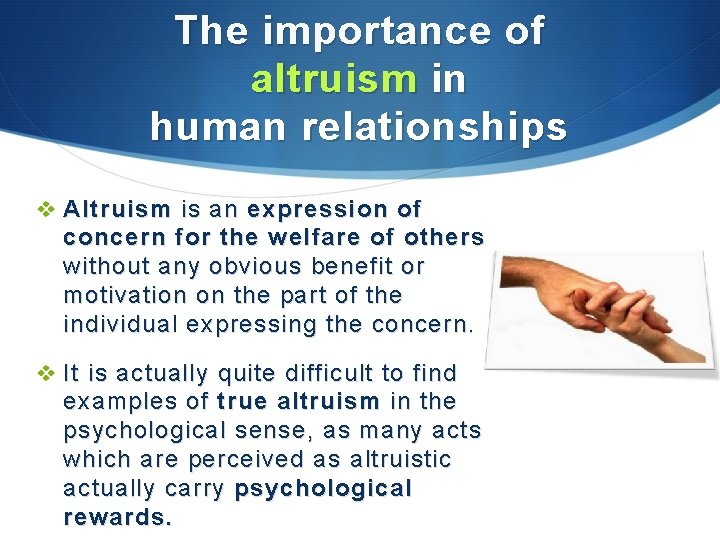
The importance of altruism in human relationships v Altruism is an expression of concern for the welfare of others without any obvious benefit or motivation on the part of the individual expressing the concern. v It is actually quite difficult to find examples of true altruism in the psychological sense, as many acts which are perceived as altruistic actually carry psychological rewards.
How can perceived altruism be seen as a biological adaptation? S
An evolutionary explanation for altrusim (BLOA 3. 2, BLOA 3. 3, Po. HR 1. 1, Po. HR 1. 2, Po. HR 2. 1, Po. HR 2. 2) v According to evolutionary psychologists, evolution has somehow created a brain that yearns for selfless behavior beyond our capability such as altruism. v Darwin argued that self -sacrificial behavior, though disadvantageous for the individual, might be beneficial at the group. v Thus evolutionary psychologists support the idea that altruistic behavior supports group survival.
An evolutionary explanation for altrusim v Darwin suggested, “A tribe including many members who. . . were always ready to give aid to each other and sacrifice themselves for the common good, would be victorious over most other tribes; and this would be natural selection ” (Darwin, 1871). v Darwin's suggestion is that the altruistic behavior may have evolved by a process of between- group selection.
Theories of altruism Arguments for a biological adaptation of altruism: S Kin Selection Theory S Reciprocal altruism
Kin Selection Theory As a biological factor that influences relationships v Kin selection is an evolutionary theory that proposes that people are more likely to help those who are blood relatives because it will increase the odds of gene transmission to future generations. v The theory suggests that altruism towards close relatives occurs in order to ensure the continuation of shared genes. The more closely the individuals are related, the more likely people are to help.
Kin Selection Theory As a biological factor that influences relationships v The basic idea of kin selection is simple. Imagine a gene which causes its bearer to behave altruistically towards other organisms, e. g. by sharing food with them. v Organisms without the gene are selfish — they keep all their food for themselves, and sometimes get handouts from the altruists. Clearly the altruists will be at a fitness disadvantage, so we should expect the altruistic gene to be eliminated from the population.
Kin Selection Theory As a biological factor that influences relationships v The assumption is that the altruistic gene can in principle spread by natural selection. v The gene causes an organism to behave in a way which reduces its own fitness but boosts the fitness of its relatives — who have a greater than average chance of carrying the gene themselves.
Kin Selection Theory As a biological factor that influences relationships v So the overall effect of the behavior may be to increase the number of copies of the altruistic gene found in the next generation, and thus the incidence of the altruistic behavior itself.
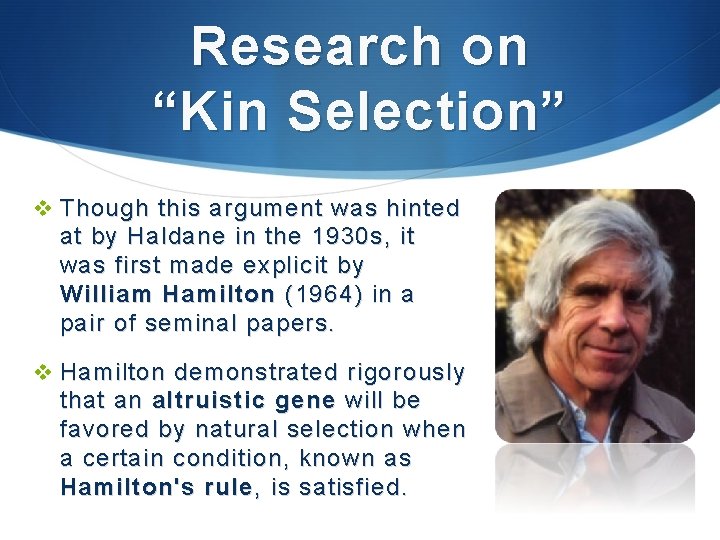
Research on “Kin Selection” v Though this argument was hinted at by Haldane in the 1930 s, it was first made explicit by William Hamilton (1964) in a pair of seminal papers. v Hamilton demonstrated rigorously that an altruistic gene will be favored by natural selection when a certain condition, known as Hamilton's rule , is satisfied.
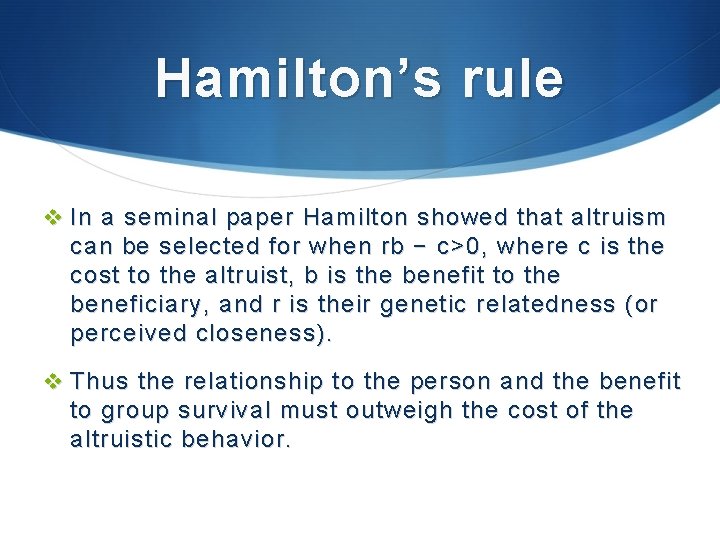
Hamilton’s rule v In a seminal paper Hamilton showed that altruism can be selected for when rb − c>0, where c is the cost to the altruist, b is the benefit to the beneficiary, and r is their genetic relatedness (or perceived closeness). v Thus the relationship to the person and the benefit to group survival must outweigh the cost of the altruistic behavior.
Hamilton’s rule v If an individual family member shares food with the rest of the family, it reduces his or her personal likelihood of survival but increases the chances of family members passing on their genes, many of which are common to the entire family. v Hamilton's rule simply states that whether or not an organism shares its food with another depends on its genetic closeness (how many genes it shares) with the other organism.
Dawkins and the Selfish Gene v If an individual family member shares food with the rest of the family, it reduces his or her personal likelihood of survival but increases the chances of family members passing on their genes, many of which are common to the entire family. v Hamilton's rule simply states that whether or not an organism shares its food with another depends on its genetic closeness (how many genes it shares) with the other organism.
Dawkins and the Selfish Gene v If an individual family member shares food with the rest of the family, it reduces his or her personal likelihood of survival but increases the chances of family members passing on their genes, many of which are common to the entire family. v Hamilton's rule simply states that whether or not an organism shares its food with another depends on its genetic closeness (how many genes it shares) with the other organism.
How can this biological explanation help us to understand how or why we behave a certain way in familial relationships? (BLOA 3. 2, BLOA 3. 3, Po. HR 1. 1) S
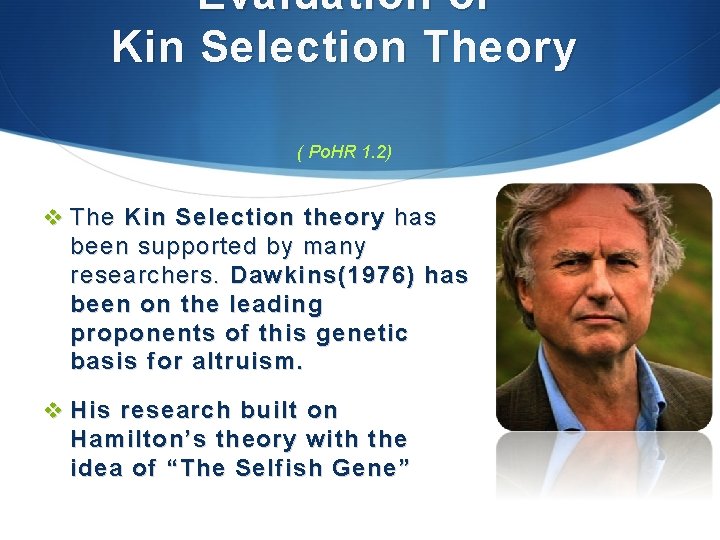
Evaluation of Kin Selection Theory ( Po. HR 1. 2) v The Kin Selection theory has been supported by many researchers. Dawkins(1976) has been on the leading proponents of this genetic basis for altruism. v His research built on Hamilton’s theory with the idea of “The Selfish Gene”
Dawkins and “The Selfish Gene” ( Po. HR 1. 2) v Dawkins states in his 1976 book, “If we think of an individual as a set of genes rather than as a separate, 'bounded' organism, then it should be regarded as distributed across kin, i. e. , it shares some proportion of its genes with relatives, according to how close the relationship is.
Dawkins and “The Selfish Gene” ( Po. HR 1. 2) v It follows that it is possible for an individual to preserve its genes through its own self-sacrifice ; if a mother dies in the course of saving her three offspring from a predator, she will have saved 1½ times her own genes (since each offspring inherits one half of its mother's genes ). v This theory gives a strong empirically supported biological explanation for altruistic behavior. It suggests that we behave altruistically in relationships as a means of group survival.
What are limitations to this biologically engineered theory? (BLOA 3. 2, BLOA 3. 3, Po. HR 1. 1) S
Limitations ( Po. HR 1. 2, 2. ) v How do we account for our care for nature, animals, the elderly, and unrelated people? Does this behavior have an evolutionary explanation? Why or why not? v Can we empirically and ethically test evolutionary adaptations in humans? Many research studies (including Hamilton) study gene adaptations in insects and birds. v It is possible for genes to CAUSE a behavior? Why or why not? Can your culture change the amount of
Limitations ( Po. HR 1. 2, 2. ) v How do we account for our care for nature, animals, the elderly, and unrelated people? Does this behavior have an evolutionary explanation? Why or why not? v Can we empirically and ethically test evolutionary adaptations in humans? Many research studies (including Hamilton) study gene adaptations in insects and birds. v It is possible for genes to CAUSE a behavior? Why or why not? Can your culture change the amount of