
The Psychology of Human Error Why do people
- Slides: 22
The Psychology of ‘Human Error’: Why do people get things wrong? Claire Philp ©Human Applications
BSc Psychology MSc Organizational Psychology Behavioural Safety consultant
Risk BSc Management Psychology Consultancy MSc Midlands Organizational Psychology Health & Behavioural Safety, consultant Physical Ergonomics, Usability
• ‘Human error’ – what do we mean?
Definition • “people operating within our systems in a way which we do not desire”
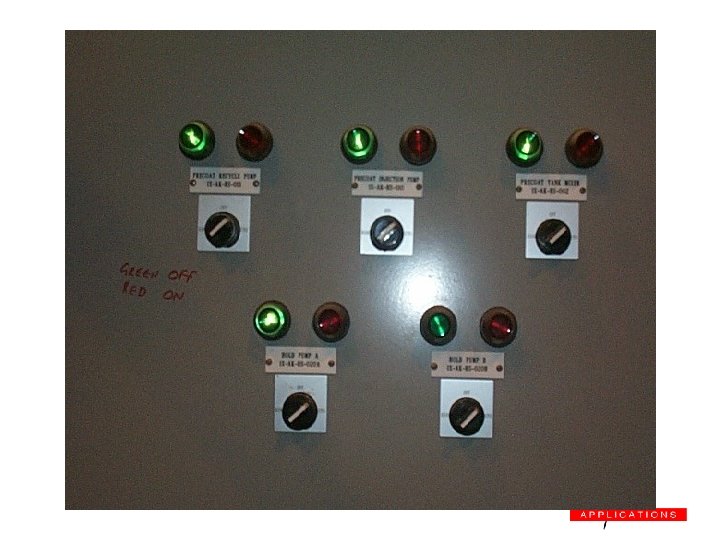
Charlie – a case study
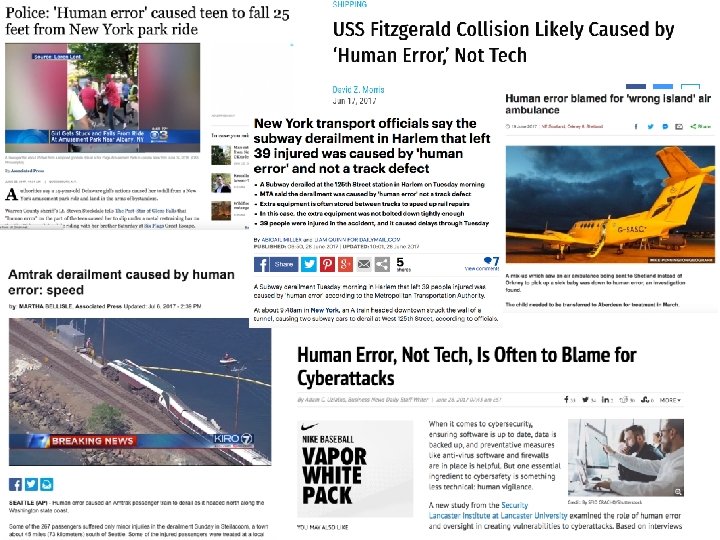
The ‘Human Error’ problem • ‘Human error’ provides the public with a simple headline to draw a line underneath major disasters • But beneath this banner the lessons and the subtleties are lost • Despite the well-documented problems with the use of the term, ’human error’ doesn’t seem to be going anywhere fast
How do we talk to clients about ‘Human Error? ’ • We need to maximise organisational learning • Organisations need to respond appropriately • We need to move the focus away from blame • We need to drive behaviour change
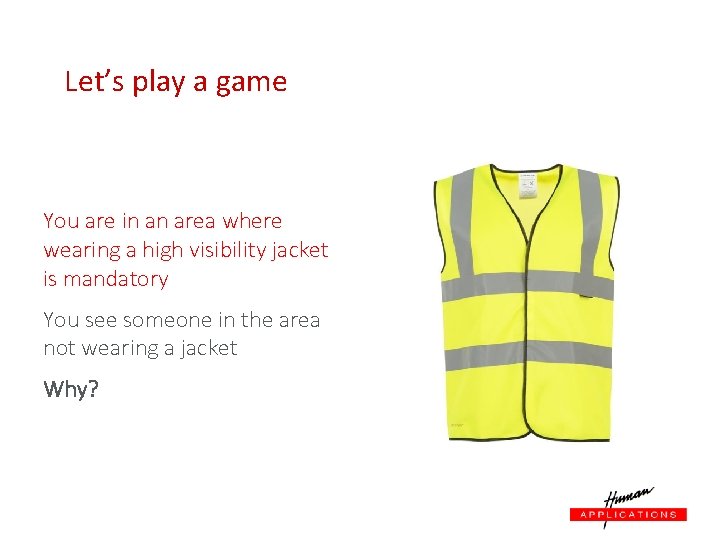
Let’s play a game You are in an area where wearing a high visibility jacket is mandatory You see someone in the area not wearing a jacket Why?
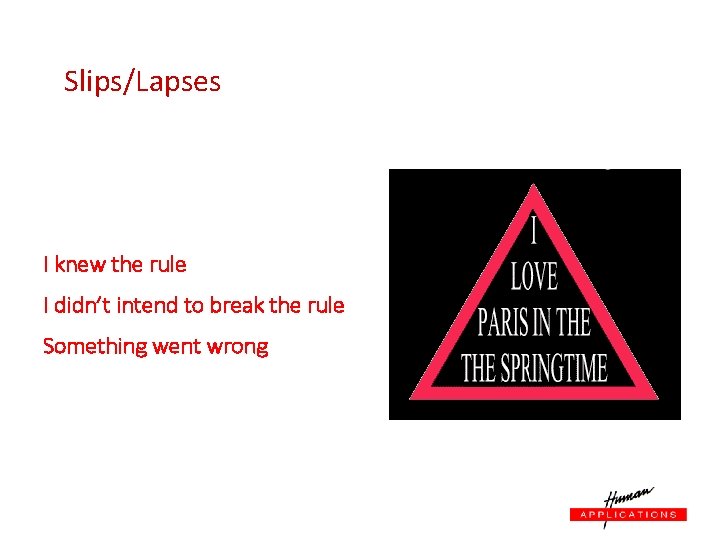
Slips/Lapses I knew the rule I didn’t intend to break the rule Something went wrong
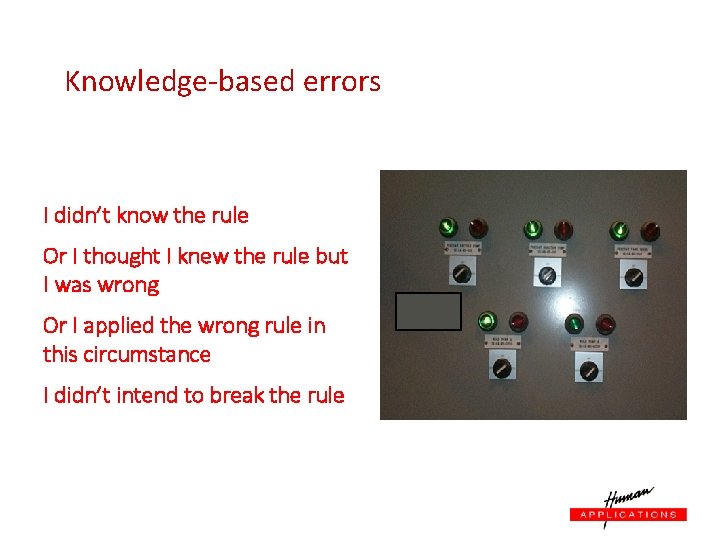
Knowledge-based errors I didn’t know the rule Or I thought I knew the rule but I was wrong Or I applied the wrong rule in this circumstance I didn’t intend to break the rule
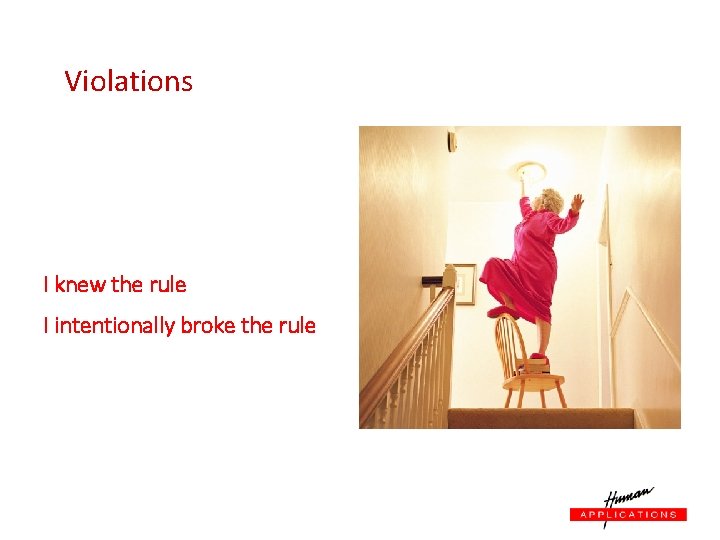
Violations I knew the rule I intentionally broke the rule
Error categorisation • Adapted from Rasmussen and Reason’s categories • Small number of categories • Simple language
Human error and accident investigation • Understanding human error is important in accident investigation • We expect managers to make sound judgements • We are all susceptible to conscious and unconscious biases • A lack of understanding compounds this
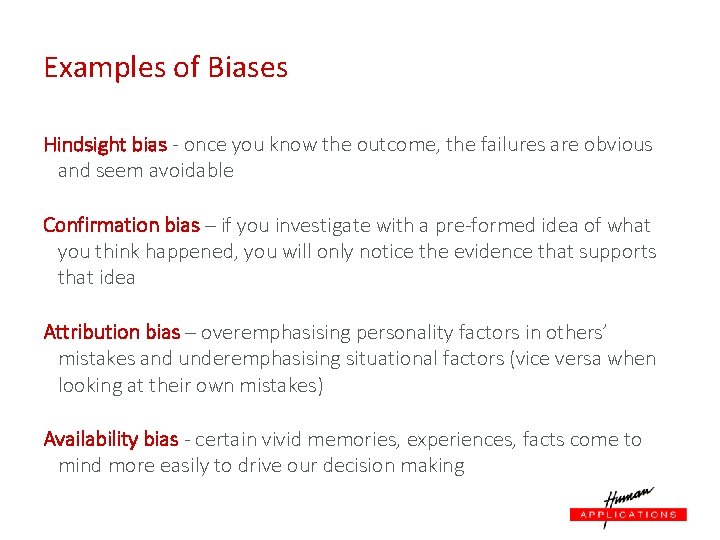
Examples of Biases Hindsight bias - once you know the outcome, the failures are obvious and seem avoidable Confirmation bias – if you investigate with a pre-formed idea of what you think happened, you will only notice the evidence that supports that idea Attribution bias – overemphasising personality factors in others’ mistakes and underemphasising situational factors (vice versa when looking at their own mistakes) Availability bias - certain vivid memories, experiences, facts come to mind more easily to drive our decision making
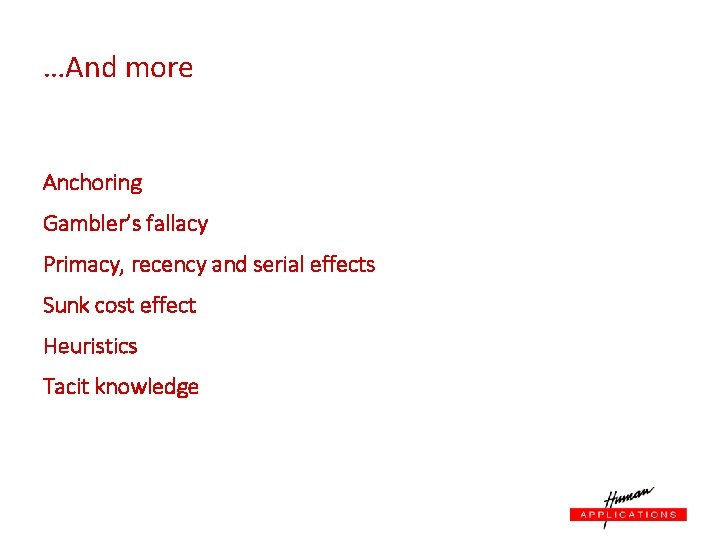
…And more Anchoring Gambler’s fallacy Primacy, recency and serial effects Sunk cost effect Heuristics Tacit knowledge
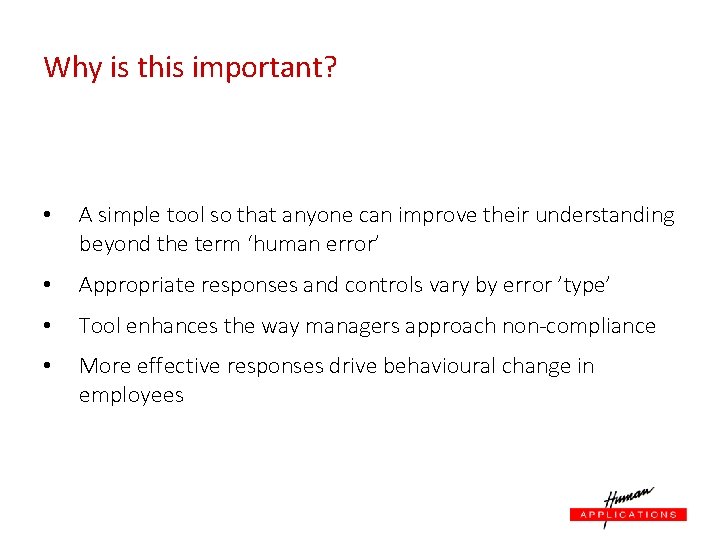
Why is this important? • A simple tool so that anyone can improve their understanding beyond the term ‘human error’ • Appropriate responses and controls vary by error ’type’ • Tool enhances the way managers approach non-compliance • More effective responses drive behavioural change in employees
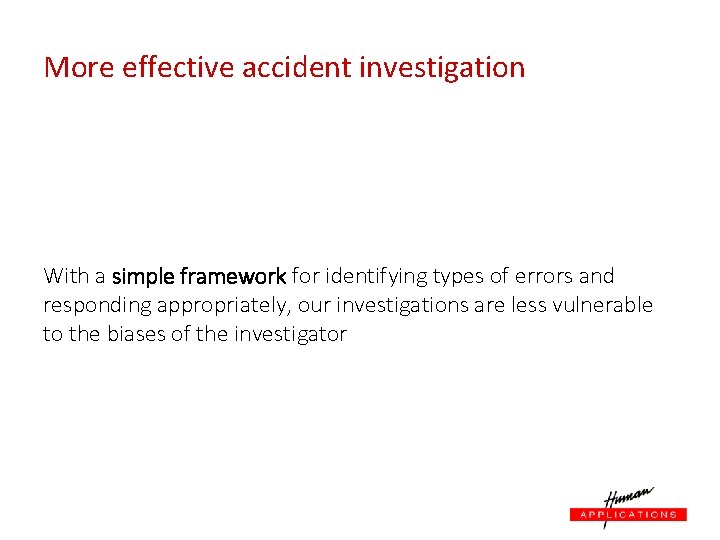
More effective accident investigation With a simple framework for identifying types of errors and responding appropriately, our investigations are less vulnerable to the biases of the investigator
Thank you Any questions?
Human Applications The Elms, Elms Grove Loughborough, Leicestershire LE 11 1 RG, UK 01509 211866 enquiries@humanapps. co. uk www. humanapps. co. uk