
The Psychological Inventory of Criminal Thinking Styles PICTS
- Slides: 1
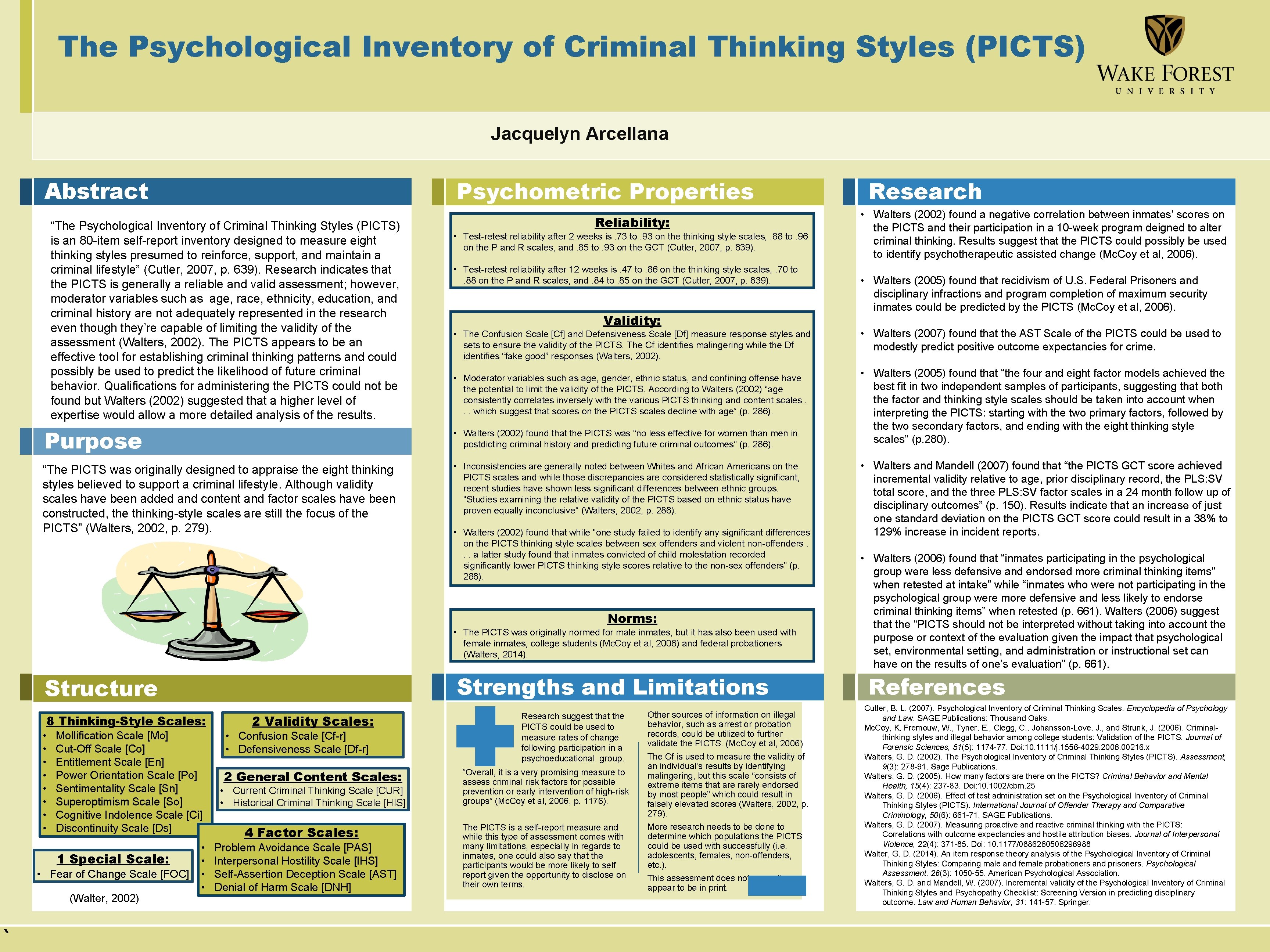
The Psychological Inventory of Criminal Thinking Styles (PICTS) Jacquelyn Arcellana Abstract Psychometric Properties “The Psychological Inventory of Criminal Thinking Styles (PICTS) is an 80 -item self-report inventory designed to measure eight thinking styles presumed to reinforce, support, and maintain a criminal lifestyle” (Cutler, 2007, p. 639). Research indicates that the PICTS is generally a reliable and valid assessment; however, moderator variables such as age, race, ethnicity, education, and criminal history are not adequately represented in the research even though they’re capable of limiting the validity of the assessment (Walters, 2002). The PICTS appears to be an effective tool for establishing criminal thinking patterns and could possibly be used to predict the likelihood of future criminal behavior. Qualifications for administering the PICTS could not be found but Walters (2002) suggested that a higher level of expertise would allow a more detailed analysis of the results. Reliability: • Test-retest reliability after 2 weeks is. 73 to. 93 on the thinking style scales, . 88 to. 96 on the P and R scales, and. 85 to. 93 on the GCT (Cutler, 2007, p. 639). • Test-retest reliability after 12 weeks is. 47 to. 86 on the thinking style scales, . 70 to. 88 on the P and R scales, and. 84 to. 85 on the GCT (Cutler, 2007, p. 639). Validity: • The Confusion Scale [Cf] and Defensiveness Scale [Df] measure response styles and sets to ensure the validity of the PICTS. The Cf identifies malingering while the Df identifies “fake good” responses (Walters, 2002). • Moderator variables such as age, gender, ethnic status, and confining offense have the potential to limit the validity of the PICTS. According to Walters (2002) “age consistently correlates inversely with the various PICTS thinking and content scales. . . which suggest that scores on the PICTS scales decline with age” (p. 286). Purpose • Walters (2002) found that the PICTS was “no less effective for women than men in postdicting criminal history and predicting future criminal outcomes” (p. 286). “The PICTS was originally designed to appraise the eight thinking styles believed to support a criminal lifestyle. Although validity scales have been added and content and factor scales have been constructed, the thinking-style scales are still the focus of the PICTS” (Walters, 2002, p. 279). • Inconsistencies are generally noted between Whites and African Americans on the PICTS scales and while those discrepancies are considered statistically significant, recent studies have shown less significant differences between ethnic groups. “Studies examining the relative validity of the PICTS based on ethnic status have proven equally inconclusive” (Walters, 2002, p. 286). • Walters (2002) found that while “one study failed to identify any significant differences on the PICTS thinking style scales between sex offenders and violent non-offenders. . . a latter study found that inmates convicted of child molestation recorded significantly lower PICTS thinking style scores relative to the non-sex offenders” (p. 286). Norms: • The PICTS was originally normed for male inmates, but it has also been used with female inmates, college students (Mc. Coy et al, 2006) and federal probationers (Walters, 2014). Strengths and Limitations Structure 8 Thinking-Style Scales: • • Mollification Scale [Mo] Cut-Off Scale [Co] Entitlement Scale [En] Power Orientation Scale [Po] Sentimentality Scale [Sn] Superoptimism Scale [So] Cognitive Indolence Scale [Ci] Discontinuity Scale [Ds] 1 Special Scale: • Fear of Change Scale [FOC] (Walter, 2002) ` • • 2 Validity Scales: • Confusion Scale [Cf-r] • Defensiveness Scale [Df-r] 2 General Content Scales: • Current Criminal Thinking Scale [CUR] • Historical Criminal Thinking Scale [HIS] 4 Factor Scales: Problem Avoidance Scale [PAS] Interpersonal Hostility Scale [IHS] Self-Assertion Deception Scale [AST] Denial of Harm Scale [DNH] Research suggest that the PICTS could be used to measure rates of change following participation in a psychoeducational group. “Overall, it is a very promising measure to assess criminal risk factors for possible prevention or early intervention of high-risk groups” (Mc. Coy et al, 2006, p. 1176). The PICTS is a self-report measure and while this type of assessment comes with many limitations, especially in regards to inmates, one could also say that the participants would be more likely to self report given the opportunity to disclose on their own terms. Other sources of information on illegal behavior, such as arrest or probation records, could be utilized to further validate the PICTS. (Mc. Coy et al, 2006) The Cf is used to measure the validity of an individual’s results by identifying malingering, but this scale “consists of extreme items that are rarely endorsed by most people” which could result in falsely elevated scores (Walters, 2002, p. 279). More research needs to be done to determine which populations the PICTS could be used with successfully (i. e. adolescents, females, non-offenders, etc. ). This assessment does not currently appear to be in print. Research • Walters (2002) found a negative correlation between inmates’ scores on the PICTS and their participation in a 10 -week program deigned to alter criminal thinking. Results suggest that the PICTS could possibly be used to identify psychotherapeutic assisted change (Mc. Coy et al, 2006). • Walters (2005) found that recidivism of U. S. Federal Prisoners and disciplinary infractions and program completion of maximum security inmates could be predicted by the PICTS (Mc. Coy et al, 2006). • Walters (2007) found that the AST Scale of the PICTS could be used to modestly predict positive outcome expectancies for crime. • Walters (2005) found that “the four and eight factor models achieved the best fit in two independent samples of participants, suggesting that both the factor and thinking style scales should be taken into account when interpreting the PICTS: starting with the two primary factors, followed by the two secondary factors, and ending with the eight thinking style scales” (p. 280). • Walters and Mandell (2007) found that “the PICTS GCT score achieved incremental validity relative to age, prior disciplinary record, the PLS: SV total score, and the three PLS: SV factor scales in a 24 month follow up of disciplinary outcomes” (p. 150). Results indicate that an increase of just one standard deviation on the PICTS GCT score could result in a 38% to 129% increase in incident reports. • Walters (2006) found that “inmates participating in the psychological group were less defensive and endorsed more criminal thinking items” when retested at intake” while “inmates who were not participating in the psychological group were more defensive and less likely to endorse criminal thinking items” when retested (p. 661). Walters (2006) suggest that the “PICTS should not be interpreted without taking into account the purpose or context of the evaluation given the impact that psychological set, environmental setting, and administration or instructional set can have on the results of one’s evaluation” (p. 661). References Cutler, B. L. (2007). Psychological Inventory of Criminal Thinking Scales. Encyclopedia of Psychology and Law. SAGE Publications: Thousand Oaks. Mc. Coy, K, Fremouw, W. , Tyner, E. , Clegg, C. , Johansson-Love, J. , and Strunk, J. (2006). Criminalthinking styles and illegal behavior among college students: Validation of the PICTS. Journal of Forensic Sciences, 51(5): 1174 -77. Doi: 10. 1111/j. 1556 -4029. 2006. 00216. x Walters, G. D. (2002). The Psychological Inventory of Criminal Thinking Styles (PICTS). Assessment, 9(3): 278 -91. Sage Publications. Walters, G. D. (2005). How many factors are there on the PICTS? Criminal Behavior and Mental Health, 15(4): 237 -83. Doi: 10. 1002/cbm. 25 Walters, G. D. (2006). Effect of test administration set on the Psychological Inventory of Criminal Thinking Styles (PICTS). International Journal of Offender Therapy and Comparative Criminology, 50(6): 661 -71. SAGE Publications. Walters, G. D. (2007). Measuring proactive and reactive criminal thinking with the PICTS: Correlations with outcome expectancies and hostile attribution biases. Journal of Interpersonal Violence, 22(4): 371 -85. Doi: 10. 1177/0886260506296988 Walter, G. D. (2014). An item response theory analysis of the Psychological Inventory of Criminal Thinking Styles: Comparing male and female probationers and prisoners. Psychological Assessment, 26(3): 1050 -55. American Psychological Association. Walters, G. D. and Mandell, W. (2007). Incremental validity of the Psychological Inventory of Criminal Thinking Styles and Psychopathy Checklist: Screening Version in predicting disciplinary outcome. Law and Human Behavior, 31: 141 -57. Springer.