
The Psychodynamic Approach Most closely associated with the



- Slides: 38
The Psychodynamic Approach Most closely associated with the work of Sigmund Freud (although other post. Freudians expanded on his work) Learning Intentions: • To be able to outline the Psychodynamic approach • To be able to evaluate the psychodynamic approach • To be able to apply your knowledge to exam style questions.
Have you heard of Freud or any of his theories? !
Key Assumptions • Most of our behaviour is governed by our unconscious mind and our conscious is only ‘the tip of the iceberg’ • The unconscious stores our drives, desires, instincts and repressed memories. • Early childhood experiences affect a person’s later behaviour and mental state (often reappearing as problems for the adult). • The personality is made up of 3 parts: The id, ego and superego. • Psycho “of the mind/mental processes” Dynamic “constant change and activity”
Key Assumptions • In deliberate contrast to behavioural psychology, psychodynamic psychology ignores the trappings of science and instead focuses on trying to get inside the head of individuals in order to make sense of their relationships, experiences and how they see the world. • The psychodynamic approach includes all theories in psychology that see human functioning based upon the interaction of drives and forces within the person, particularly unconscious, and between the different structures of the personality. SCIENTIFIC?
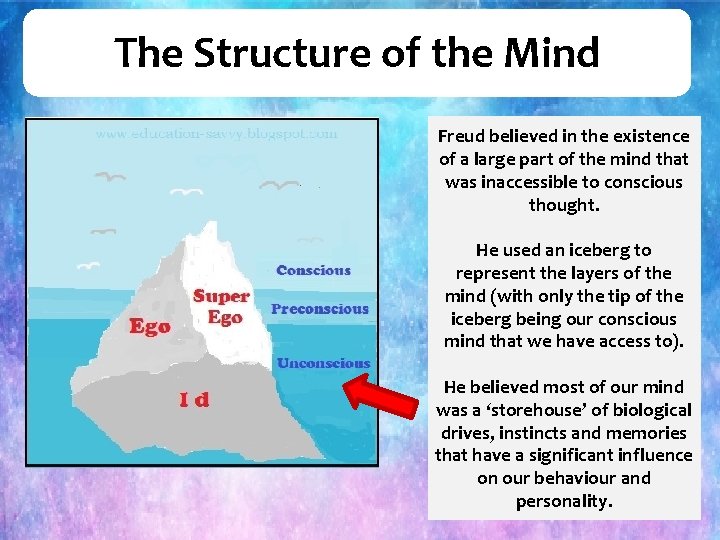
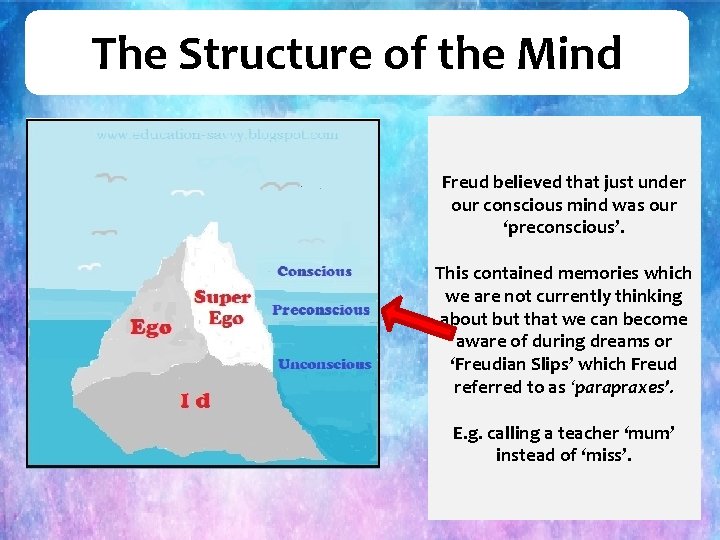
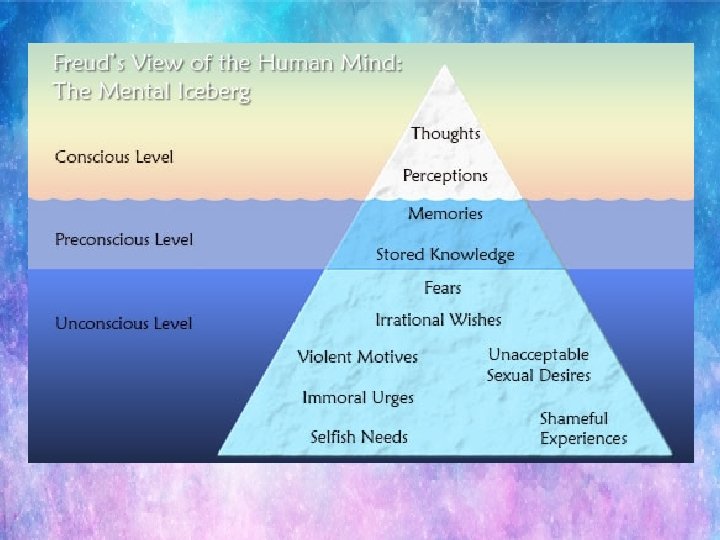
The Structure of the Mind Freud believed in the existence of a large part of the mind that was inaccessible to conscious thought. He used an iceberg to represent the layers of the mind (with only the tip of the iceberg being our conscious mind that we have access to). He believed most of our mind was a ‘storehouse’ of biological drives, instincts and memories that have a significant influence on our behaviour and personality.
• Do you remember how you felt on your third birthday? • Do you remember the first time you felt really upset about something? Most of your memories and feelings and experiences are unconscious- you do not have access to them, but they define who you are. Freud suggested the contents of our unconscious often ‘leak out’ in dreams and slips of the tongue- Freudian Slip? ! Freud believed that our unconscious mind is used to contain threatening and disturbing memories that have been repressed, or ‘locked away’ and forgotten about.
The Structure of the Mind Freud believed that just under our conscious mind was our ‘preconscious’. This contained memories which we are not currently thinking about but that we can become aware of during dreams or ‘Freudian Slips’ which Freud referred to as ‘parapraxes’. E. g. calling a teacher ‘mum’ instead of ‘miss’.
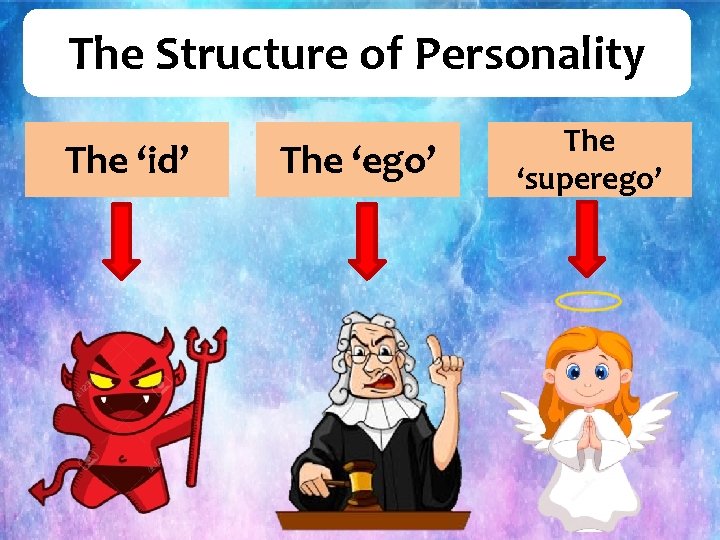
The Structure of Personality The ‘id’ The ‘ego’ The ‘superego’
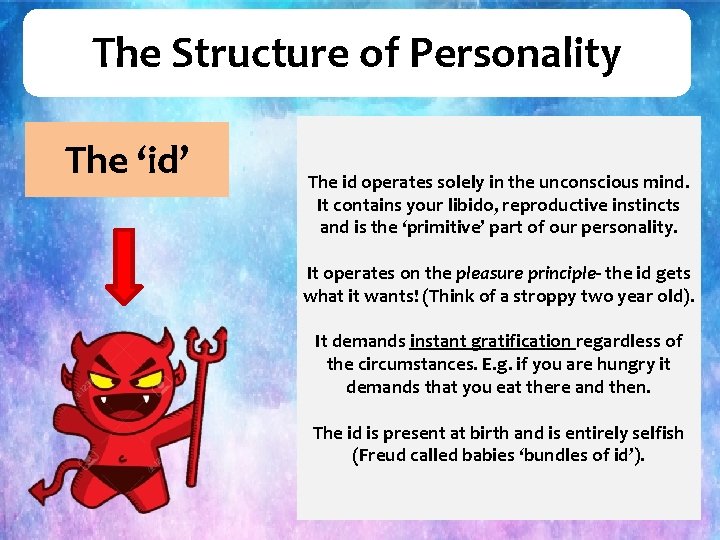
The Structure of Personality The ‘id’ The id operates solely in the unconscious mind. It contains your libido, reproductive instincts and is the ‘primitive’ part of our personality. It operates on the pleasure principle- the id gets what it wants! (Think of a stroppy two year old). It demands instant gratification regardless of the circumstances. E. g. if you are hungry it demands that you eat there and then. The id is present at birth and is entirely selfish (Freud called babies ‘bundles of id’).
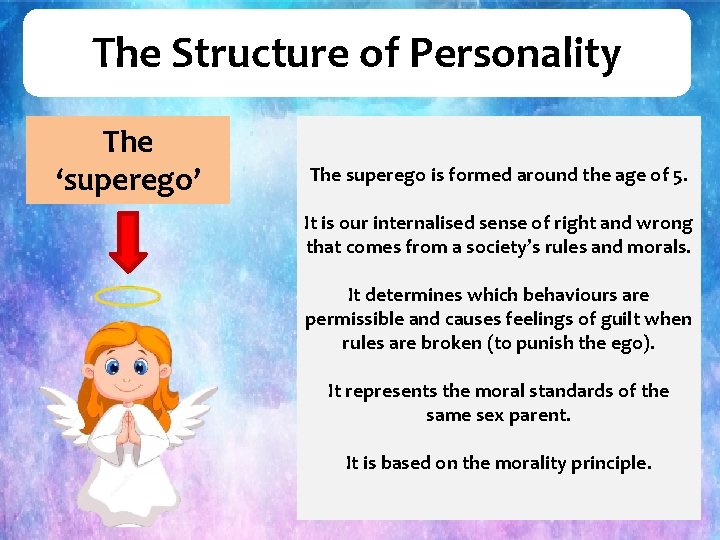
The Structure of Personality The ‘superego’ The superego is formed around the age of 5. It is our internalised sense of right and wrong that comes from a society’s rules and morals. It determines which behaviours are permissible and causes feelings of guilt when rules are broken (to punish the ego). It represents the moral standards of the same sex parent. It is based on the morality principle.
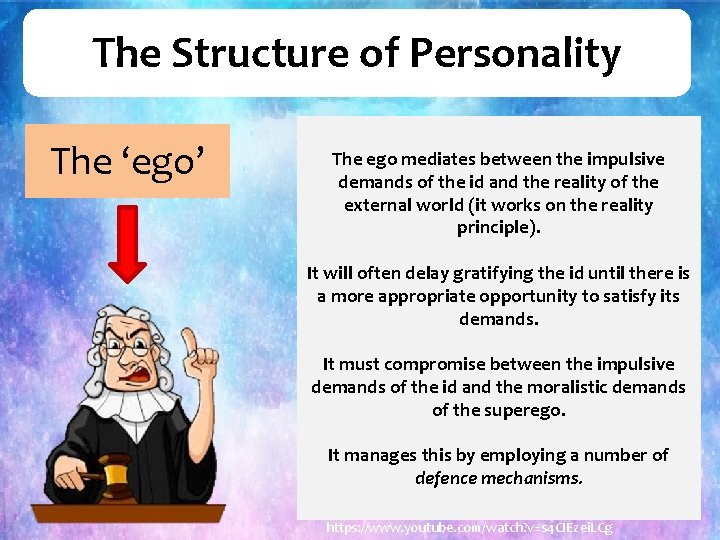
The Structure of Personality The ‘ego’ The ego mediates between the impulsive demands of the id and the reality of the external world (it works on the reality principle). It will often delay gratifying the id until there is a more appropriate opportunity to satisfy its demands. It must compromise between the impulsive demands of the id and the moralistic demands of the superego. It manages this by employing a number of defence mechanisms. https: //www. youtube. com/watch? v=s 4 CIEzei. LCg
What would the id, ego and superego suggest you do in these situations? 1. You are just leaving work and your boss asks you to stay an extra hour. 2. You are sat on a bus and notice someone has just got up and left a wallet full of £ 50 notes. 3. You are driving home and another car pulls out in front of you nearly causing a collision.
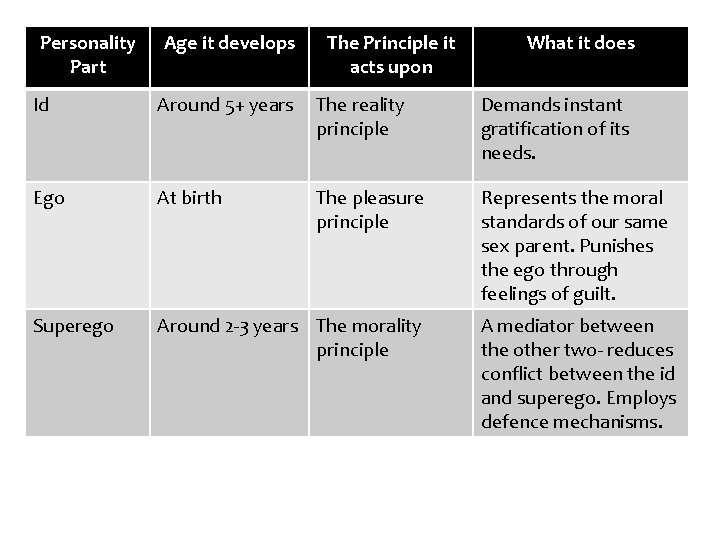
Personality Part Age it develops The Principle it acts upon What it does Id Around 5+ years The reality principle Demands instant gratification of its needs. Ego At birth The pleasure principle Represents the moral standards of our same sex parent. Punishes the ego through feelings of guilt. Superego Around 2 -3 years The morality principle A mediator between the other two- reduces conflict between the id and superego. Employs defence mechanisms.
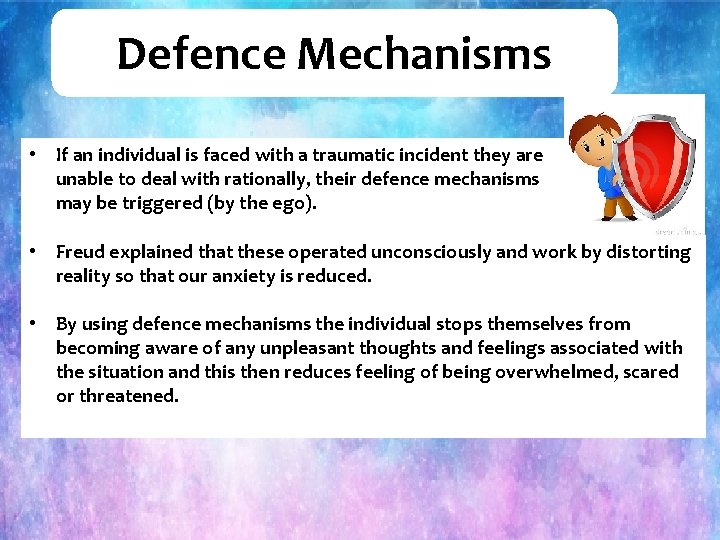
Defence Mechanisms • If an individual is faced with a traumatic incident they are unable to deal with rationally, their defence mechanisms may be triggered (by the ego). • Freud explained that these operated unconsciously and work by distorting reality so that our anxiety is reduced. • By using defence mechanisms the individual stops themselves from becoming aware of any unpleasant thoughts and feelings associated with the situation and this then reduces feeling of being overwhelmed, scared or threatened.
Defence Mechanisms There are 3 main types of defence mechanisms (although there a few more that you may want to research in your own time!). 1. Repression: The unconscious blocks any unacceptable thoughts and impulses. We cannot remember these repressed thoughts but they continue to influence our behaviour without the individual realising. Example: A child who was abused by their parents may have no recollection of it but might struggle to form relationships with others. Can you think of any more examples? ! A mother refuses to buy a dog for her children but can’t explain why. She has no recollection of being savagely attacked by a dog she was younger.
Defence Mechanisms 2. Displacement: This involves redirecting or transferring thoughts or feelings away from the person or situation in which they should be directed towards. Instead hostile feelings are ‘taken out’ on a helpless victim or object. This gives their feelings and ‘outlet’ even though they are applied to the wrong person. Example: Shouting at your girlfriend after a hard day at work. Can you think of any more examples? ! Kicking the dog after being shouted at by your parents.
Defence Mechanisms 3. Denial: The refusal to accept reality so as to avoid having to deal with painful feelings that might be associated with that event. The person acts as if the event never happened (something which others may find bizarre!) Example: An alcoholic may deny they have a drinking problem, despite being arrested multiple times for drunk and disorderly. Can you think of any more examples? ! Continuing to set a place at the table for a child to have dinner, even though they have passed away.
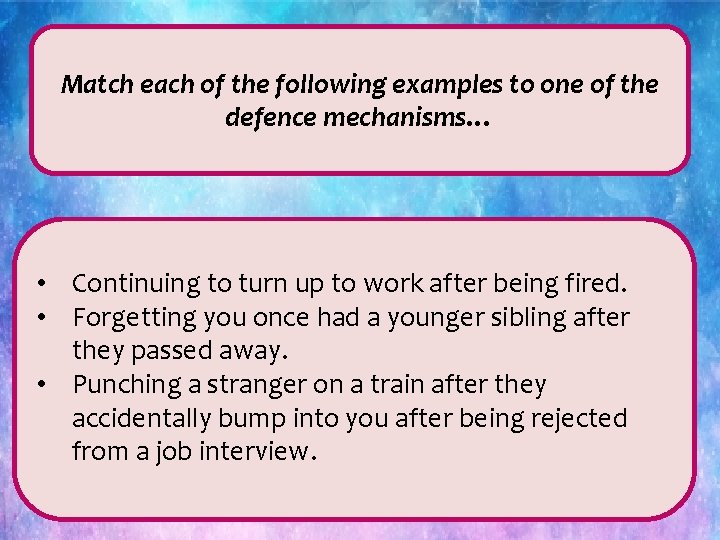
Match each of the following examples to one of the defence mechanisms… • Continuing to turn up to work after being fired. • Forgetting you once had a younger sibling after they passed away. • Punching a stranger on a train after they accidentally bump into you after being rejected from a job interview.
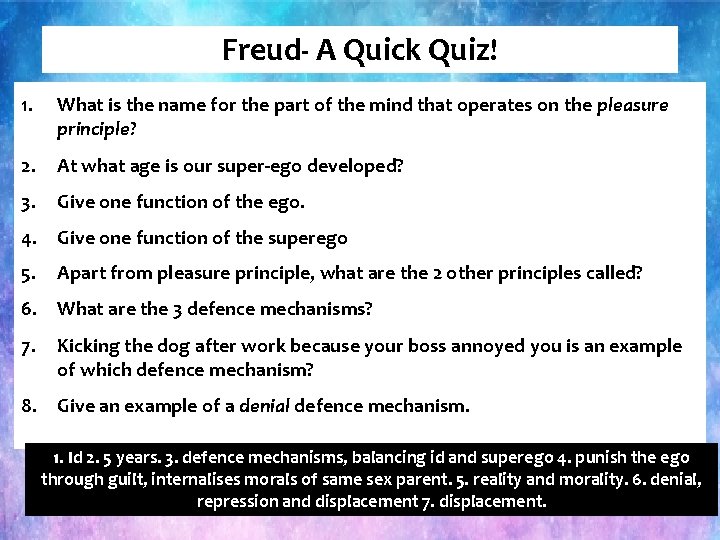
Freud- A Quick Quiz! 1. What is the name for the part of the mind that operates on the pleasure principle? 2. At what age is our super-ego developed? 3. Give one function of the ego. 4. Give one function of the superego 5. Apart from pleasure principle, what are the 2 other principles called? 6. What are the 3 defence mechanisms? 7. Kicking the dog after work because your boss annoyed you is an example of which defence mechanism? 8. Give an example of a denial defence mechanism. 1. Id 2. 5 years. 3. defence mechanisms, balancing id and superego 4. punish the ego through guilt, internalises morals of same sex parent. 5. reality and morality. 6. denial, repression and displacement 7. displacement.
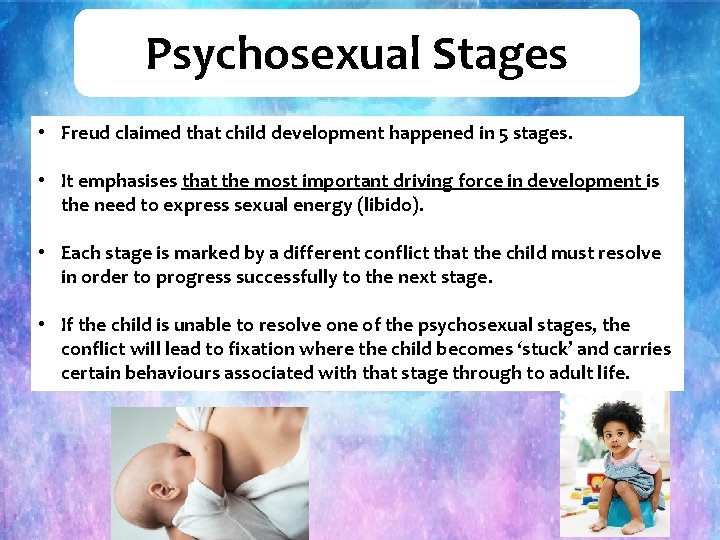
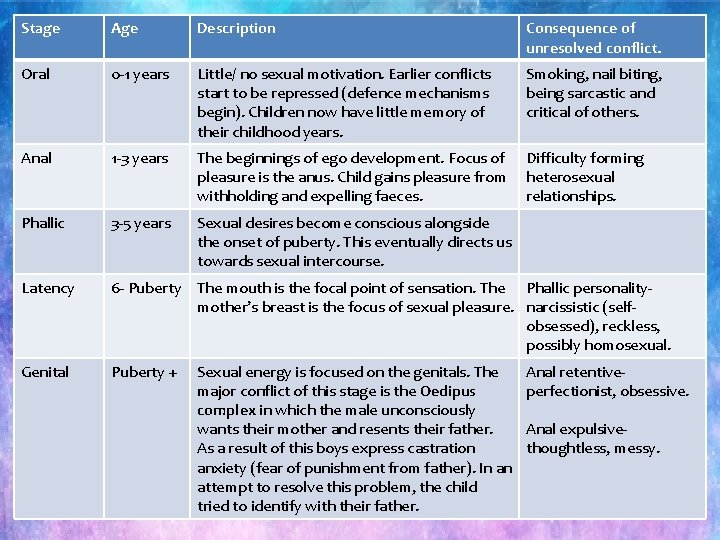
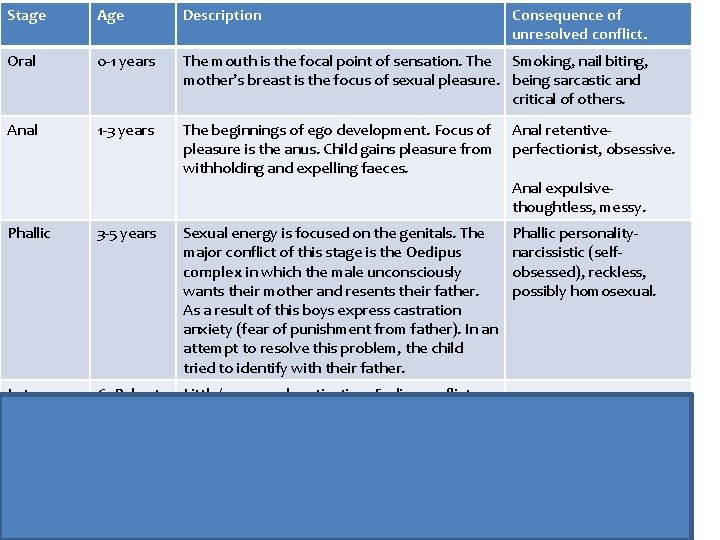
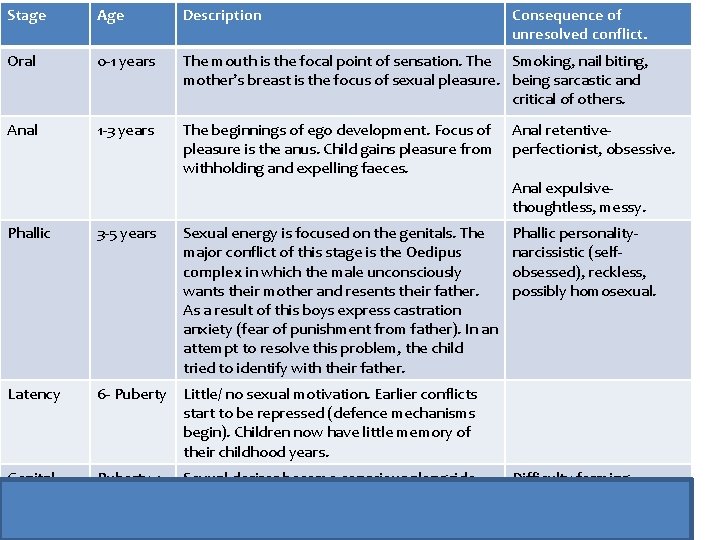
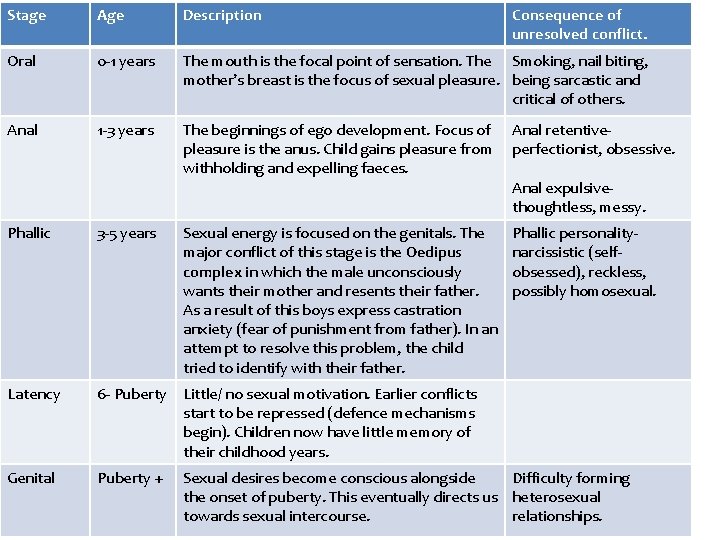
Psychosexual Stages • Freud claimed that child development happened in 5 stages. • It emphasises that the most important driving force in development is the need to express sexual energy (libido). • Each stage is marked by a different conflict that the child must resolve in order to progress successfully to the next stage. • If the child is unable to resolve one of the psychosexual stages, the conflict will lead to fixation where the child becomes ‘stuck’ and carries certain behaviours associated with that stage through to adult life.
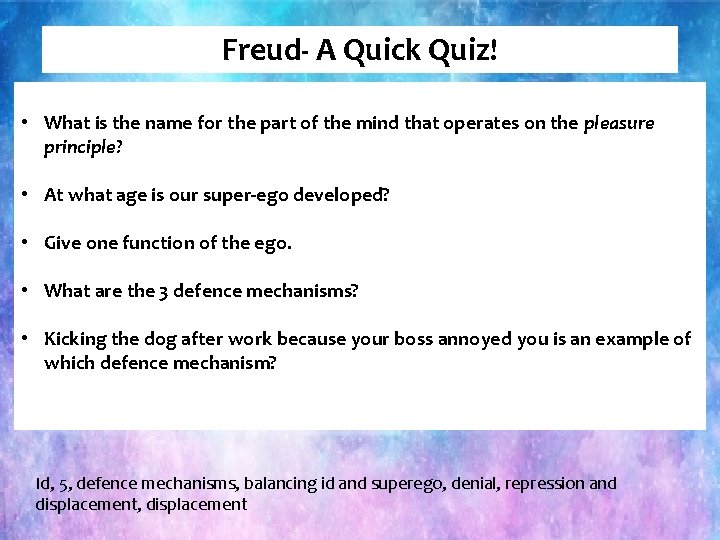
Freud- A Quick Quiz! • What is the name for the part of the mind that operates on the pleasure principle? • At what age is our super-ego developed? • Give one function of the ego. • What are the 3 defence mechanisms? • Kicking the dog after work because your boss annoyed you is an example of which defence mechanism? Id, 5, defence mechanisms, balancing id and superego, denial, repression and displacement, displacement
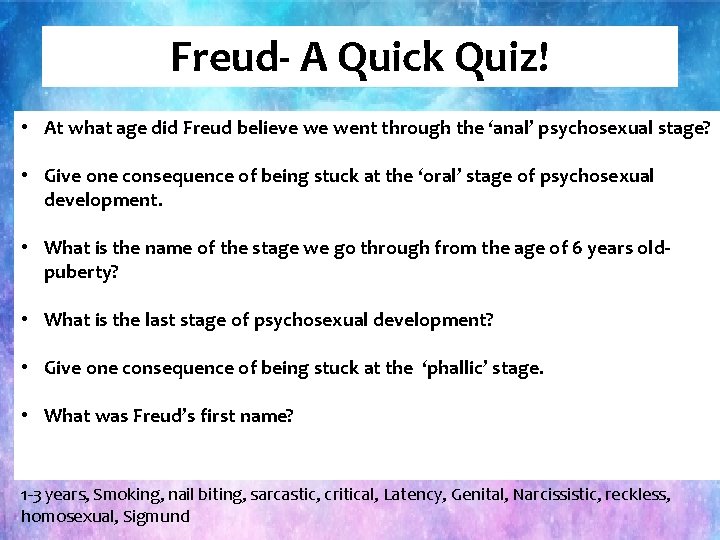
Freud- A Quick Quiz! • At what age did Freud believe we went through the ‘anal’ psychosexual stage? • Give one consequence of being stuck at the ‘oral’ stage of psychosexual development. • What is the name of the stage we go through from the age of 6 years old- puberty? • What is the last stage of psychosexual development? • Give one consequence of being stuck at the ‘phallic’ stage. • What was Freud’s first name? 1 -3 years, Smoking, nail biting, sarcastic, critical, Latency, Genital, Narcissistic, reckless, homosexual, Sigmund
Stage Age Description Consequence of unresolved conflict. Oral 0 -1 years Little/ no sexual motivation. Earlier conflicts start to be repressed (defence mechanisms begin). Children now have little memory of their childhood years. Smoking, nail biting, being sarcastic and critical of others. Anal 1 -3 years The beginnings of ego development. Focus of pleasure is the anus. Child gains pleasure from withholding and expelling faeces. Difficulty forming heterosexual relationships. Phallic 3 -5 years Sexual desires become conscious alongside the onset of puberty. This eventually directs us towards sexual intercourse. Latency 6 - Puberty The mouth is the focal point of sensation. The Phallic personalitymother’s breast is the focus of sexual pleasure. narcissistic (selfobsessed), reckless, possibly homosexual. Genital Puberty + Sexual energy is focused on the genitals. The major conflict of this stage is the Oedipus complex in which the male unconsciously wants their mother and resents their father. As a result of this boys express castration anxiety (fear of punishment from father). In an attempt to resolve this problem, the child tried to identify with their father. Anal retentiveperfectionist, obsessive. Anal expulsivethoughtless, messy.
Stage Age Description Consequence of unresolved conflict. Oral 0 -1 years Little/ no sexual motivation. Earlier conflicts start to be repressed (defence mechanisms begin). Children now have little memory of their childhood years. Smoking, nail biting, being sarcastic and critical of others. Anal 1 -3 years The beginnings of ego development. Focus of pleasure is the anus. Child gains pleasure from withholding and expelling faeces. Difficulty forming heterosexual relationships. Phallic 3 -5 years Sexual desires become conscious alongside the onset of puberty. This eventually directs us towards sexual intercourse. Latency 6 - Puberty The mouth is the focal point of sensation. The Phallic personalitymother’s breast is the focus of sexual pleasure. narcissistic (selfobsessed), reckless, possibly homosexual. Genital Puberty + Sexual energy is focused on the genitals. The major conflict of this stage is the Oedipus complex in which the male unconsciously wants their mother and resents their father. As a result of this boys express castration anxiety (fear of punishment from father). In an attempt to resolve this problem, the child tried to identify with their father. Anal retentiveperfectionist, obsessive. Anal expulsivethoughtless, messy.
Stage Age Description Consequence of unresolved conflict. Oral 0 -1 years The mouth is the focal point of sensation. The Smoking, nail biting, mother’s breast is the focus of sexual pleasure. being sarcastic and critical of others. Anal 1 -3 years The beginnings of ego development. Focus of pleasure is the anus. Child gains pleasure from withholding and expelling faeces. Anal retentiveperfectionist, obsessive. Phallic personalitynarcissistic (selfobsessed), reckless, possibly homosexual. Anal expulsivethoughtless, messy. Phallic 3 -5 years Sexual energy is focused on the genitals. The major conflict of this stage is the Oedipus complex in which the male unconsciously wants their mother and resents their father. As a result of this boys express castration anxiety (fear of punishment from father). In an attempt to resolve this problem, the child tried to identify with their father. Latency 6 - Puberty Little/ no sexual motivation. Earlier conflicts start to be repressed (defence mechanisms begin). Children now have little memory of their childhood years. Genital Puberty + Sexual desires become conscious alongside Difficulty forming the onset of puberty. This eventually directs us heterosexual towards sexual intercourse. relationships.
Stage Age Description Consequence of unresolved conflict. Oral 0 -1 years The mouth is the focal point of sensation. The Smoking, nail biting, mother’s breast is the focus of sexual pleasure. being sarcastic and critical of others. Anal 1 -3 years The beginnings of ego development. Focus of pleasure is the anus. Child gains pleasure from withholding and expelling faeces. Anal retentiveperfectionist, obsessive. Phallic personalitynarcissistic (selfobsessed), reckless, possibly homosexual. Anal expulsivethoughtless, messy. Phallic 3 -5 years Sexual energy is focused on the genitals. The major conflict of this stage is the Oedipus complex in which the male unconsciously wants their mother and resents their father. As a result of this boys express castration anxiety (fear of punishment from father). In an attempt to resolve this problem, the child tried to identify with their father. Latency 6 - Puberty Little/ no sexual motivation. Earlier conflicts start to be repressed (defence mechanisms begin). Children now have little memory of their childhood years. Genital Puberty + Sexual desires become conscious alongside Difficulty forming the onset of puberty. This eventually directs us heterosexual towards sexual intercourse. relationships.
Stage Age Description Consequence of unresolved conflict. Oral 0 -1 years The mouth is the focal point of sensation. The Smoking, nail biting, mother’s breast is the focus of sexual pleasure. being sarcastic and critical of others. Anal 1 -3 years The beginnings of ego development. Focus of pleasure is the anus. Child gains pleasure from withholding and expelling faeces. Anal retentiveperfectionist, obsessive. Phallic personalitynarcissistic (selfobsessed), reckless, possibly homosexual. Anal expulsivethoughtless, messy. Phallic 3 -5 years Sexual energy is focused on the genitals. The major conflict of this stage is the Oedipus complex in which the male unconsciously wants their mother and resents their father. As a result of this boys express castration anxiety (fear of punishment from father). In an attempt to resolve this problem, the child tried to identify with their father. Latency 6 - Puberty Little/ no sexual motivation. Earlier conflicts start to be repressed (defence mechanisms begin). Children now have little memory of their childhood years. Genital Puberty + Sexual desires become conscious alongside Difficulty forming the onset of puberty. This eventually directs us heterosexual towards sexual intercourse. relationships.
Stage Age Description Consequence of unresolved conflict. Oral 0 -1 years The mouth is the focal point of sensation. The Smoking, nail biting, mother’s breast is the focus of sexual pleasure. being sarcastic and critical of others. Anal 1 -3 years The beginnings of ego development. Focus of pleasure is the anus. Child gains pleasure from withholding and expelling faeces. Anal retentiveperfectionist, obsessive. Phallic personalitynarcissistic (selfobsessed), reckless, possibly homosexual. Anal expulsivethoughtless, messy. Phallic 3 -5 years Sexual energy is focused on the genitals. The major conflict of this stage is the Oedipus complex in which the male unconsciously wants their mother and resents their father. As a result of this boys express castration anxiety (fear of punishment from father). In an attempt to resolve this problem, the child tried to identify with their father. Latency 6 - Puberty Little/ no sexual motivation. Earlier conflicts start to be repressed (defence mechanisms begin). Children now have little memory of their childhood years. Genital Puberty + Sexual desires become conscious alongside Difficulty forming the onset of puberty. This eventually directs us heterosexual towards sexual intercourse. relationships.
Stage Age Description Consequence of unresolved conflict. Oral 0 -1 years The mouth is the focal point of sensation. The Smoking, nail biting, mother’s breast is the focus of sexual pleasure. being sarcastic and critical of others. Anal 1 -3 years The beginnings of ego development. Focus of pleasure is the anus. Child gains pleasure from withholding and expelling faeces. Anal retentiveperfectionist, obsessive. Phallic personalitynarcissistic (selfobsessed), reckless, possibly homosexual. Anal expulsivethoughtless, messy. Phallic 3 -5 years Sexual energy is focused on the genitals. The major conflict of this stage is the Oedipus complex in which the male unconsciously wants their mother and resents their father. As a result of this boys express castration anxiety (fear of punishment from father). In an attempt to resolve this problem, the child tried to identify with their father. Latency 6 - Puberty Little/ no sexual motivation. Earlier conflicts start to be repressed (defence mechanisms begin). Children now have little memory of their childhood years. Genital Puberty + Sexual desires become conscious alongside Difficulty forming the onset of puberty. This eventually directs us heterosexual towards sexual intercourse. relationships.
Fruit Speed Dating: Evaluation PEEL your paragraph! Round 1: Strawberries & Oranges, Grapes & Watermelons Round 2: Strawberries & Grapes, Watermelons with Oranges Round 3: Strawberries & Watermelons, Oranges and Grapes
Freud believed, in relation to human behaviour that there was no such thing as an ‘accident’. Even something as random as a ‘slip of the tongue’ (such as mistakenly describing your partners outfit as ‘fattening’ rather than ‘flattering’) is driven by unconscious forces and has deep symbolic meaning (though the meaning is pretty clear in the ‘fattening’ example). The psychodynamic approach explains all behaviour- even accidents- as determined by unconscious conflicts that are rooted in childhood such that any free will we think we have is an illusion. WHAT IS THE MAIN POINT OF THIS PARAGRAPH? - The psychodynamic approach is deterministic. Freud thought that all behaviour comes from our unconscious, for example even seemingly accidental Freudian slips have a deep symbolic meaning, rooted in the unconscious. Therefore the approach suffers from psychic determinism and ignores the idea that humans may have free will.
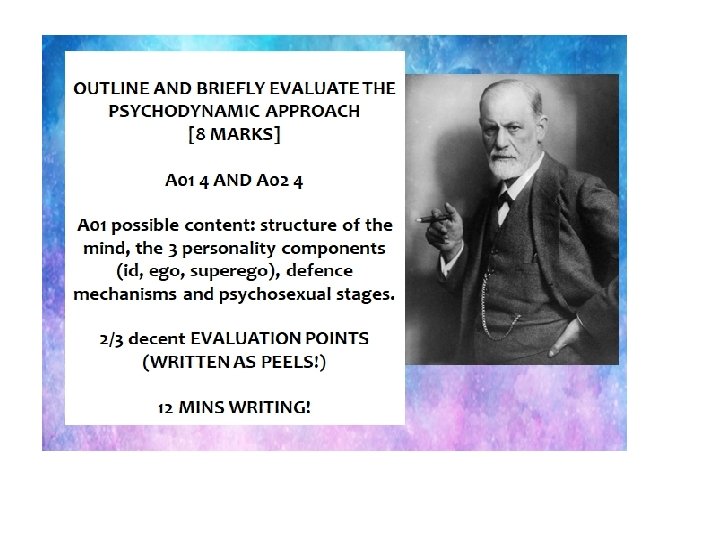
OUTLINE AND BRIEFLY EVALUATE THE PSYCHODYNAMIC APPROACH [8 MARKS] A 01 4 AND A 03 4 A 01 possible content: structure of the mind, the 3 personality components (id, ego, superego), defence mechanisms and psychosexual stages. 2/3 decent EVALUATION POINTS (WRITTEN AS PEELS!) 12 MINS WRITING!
Can you: 1. Explain the role of the unconscious (3 marks) 2. Outline the structure of the personality from a psychodynamic perspective (4 marks) 3. Explain what is meant by the terms id, ego and superego (2 marks each) 4. Explain the defence mechanisms of repression, denial and displacement. (2 marks each). 5. Outline and explain two psychosexual stages (2 marks each) Pick a minimum of 6 marks to answer!
Evaluation Giving the strengths and weaknesses of an approach or theory. Comparing it with other theories. Finding research that supports/contradicts theory. Assessing whether it has good real life applications. Worth half of the marks in your essay! You need 5 evaluation points for top marks in a 16 mark essay.
Pros Cons
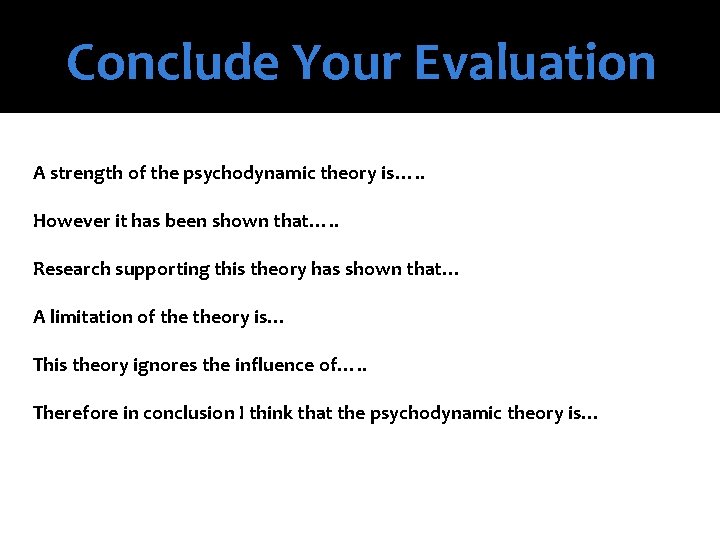
Conclude Your Evaluation A strength of the psychodynamic theory is…. . However it has been shown that…. . Research supporting this theory has shown that… A limitation of theory is… This theory ignores the influence of…. . Therefore in conclusion I think that the psychodynamic theory is…