
The prudence principle as a new framework for

- Slides: 9
The prudence principle as a new framework for fiscal policy? Comment on the paper by Eric Lonergan and Mark Blyth Peter Bofinger Universität Würzburg
The LB-rule • If r ≥ g: „target a stable debt/GDP rule“ • If g > r: „flexibility to pursue policies that would require increased borrowing. “ But: • What is the policy rule if g > r • There is no mechanism enforcing a reduction of the debt/GDP levels. If the LB-rule is applied over the longer-term, debt/GDP levels will get out of control. • What happens, if with a very high debt/GDP level a long period with r > g follows?
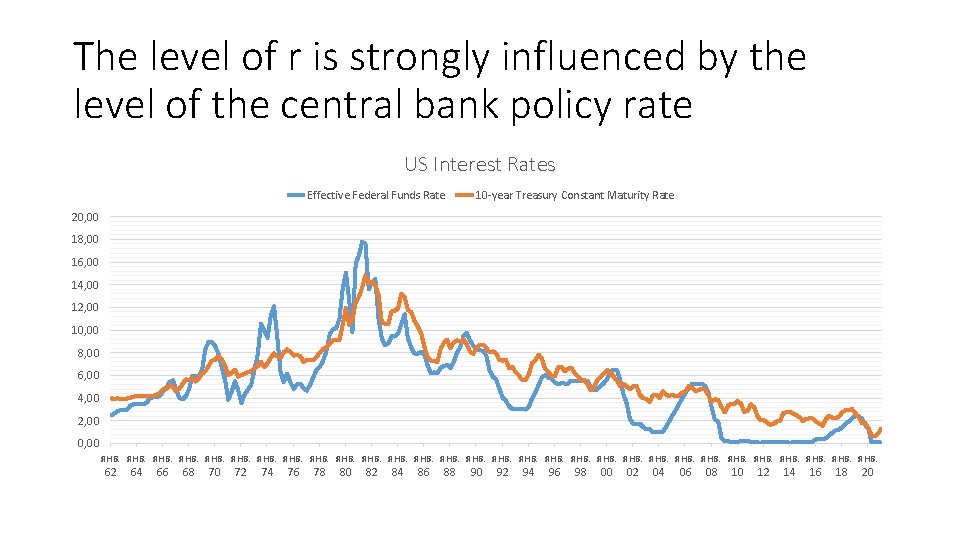
The level of r is strongly influenced by the level of the central bank policy rate US Interest Rates Effective Federal Funds Rate 10 -year Treasury Constant Maturity Rate 20, 00 18, 00 16, 00 14, 00 12, 00 10, 00 8, 00 6, 00 4, 00 2, 00 0, 00 янв. янв. 62 64 66 68 70 72 74 76 78 80 82 84 86 88 90 92 94 96 98 00 02 04 06 08 10 12 14 16 18 20
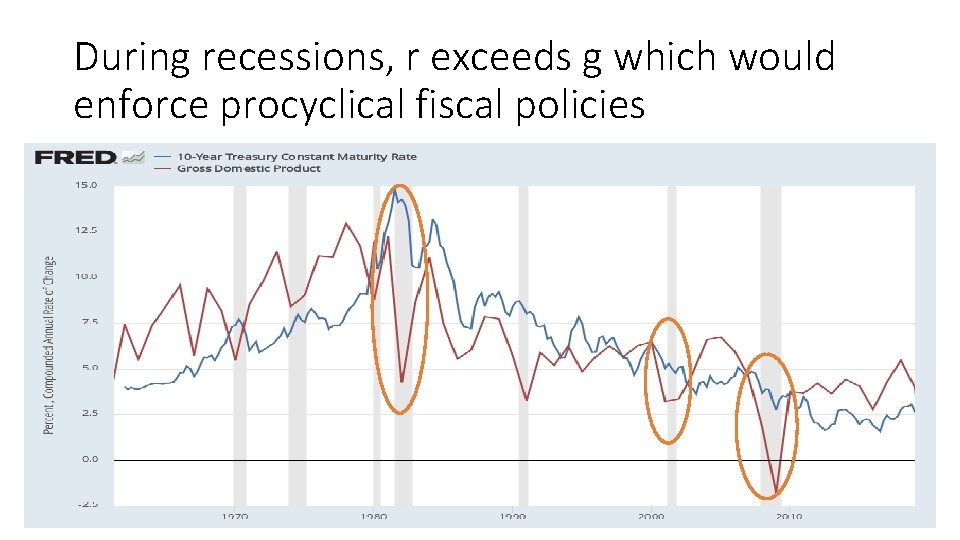
During recessions, r exceeds g which would enforce procyclical fiscal policies
„Functional finance“: a fiscal theory of the price level Abba Lerner (1943) “The (…) responsibility of the government (…) is to keep the total rate of spending in the country on goods and services neither greater nor less than that rate which at the current prices would buy all the goods that it is possible to produce. If total spending is allowed to go above this there will be inflation, and if it is allowed to go below this there will be unemployment. ” “(…) any excess over money revenues, if it cannot be met out of money hoards must be met by printing new money”
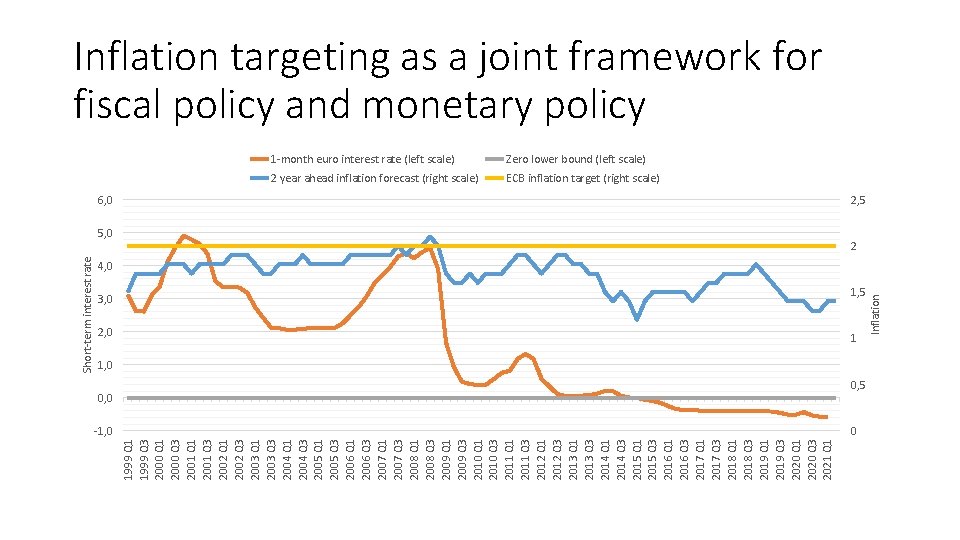
1999 Q 1 1999 Q 3 2000 Q 1 2000 Q 3 2001 Q 1 2001 Q 3 2002 Q 1 2002 Q 3 2003 Q 1 2003 Q 3 2004 Q 1 2004 Q 3 2005 Q 1 2005 Q 3 2006 Q 1 2006 Q 3 2007 Q 1 2007 Q 3 2008 Q 1 2008 Q 3 2009 Q 1 2009 Q 3 2010 Q 1 2010 Q 3 2011 Q 1 2011 Q 3 2012 Q 1 2012 Q 3 2013 Q 1 2013 Q 3 2014 Q 1 2014 Q 3 2015 Q 1 2015 Q 3 2016 Q 1 2016 Q 3 2017 Q 1 2017 Q 3 2018 Q 1 2018 Q 3 2019 Q 1 2019 Q 3 2020 Q 1 2020 Q 3 2021 Q 1 Short-term interest rate 1 -month euro interest rate (left scale) Zero lower bound (left scale) 2 year ahead inflation forecast (right scale) ECB inflation target (right scale) 6, 0 5, 0 3, 0 1, 5 2, 0 1 1, 0 0, 5 -1, 0 0 Inflation targeting as a joint framework for fiscal policy and monetary policy 2, 5 2 4, 0
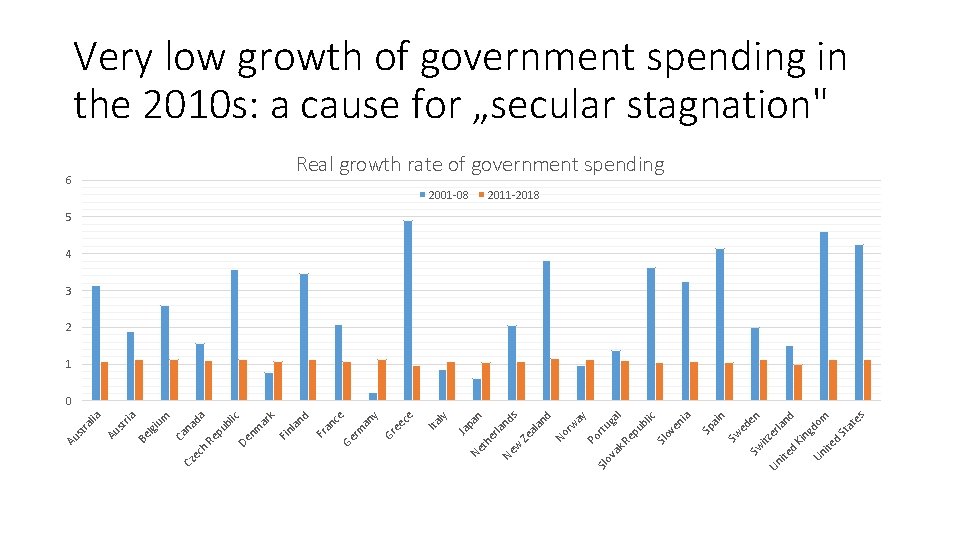
d St at e s m nd do ng Ki la n a en ed er itz ite Un d ite Un Sw Sw ai Sp l lic ni ve Slo ub ep ga rtu Po ay rw No s d an al Ze k. R va Slo w la nd er n 2001 -08 Ne th pa Ja ly Ita 6 Ne Cz ec Ca na da h Re pu bl ic De nm ar k Fin la nd Fr an ce Ge rm an y Gr ee ce um lgi Be ria st Au lia ra st Au Very low growth of government spending in the 2010 s: a cause for „secular stagnation" Real growth rate of government spending 2011 -2018 5 4 3 2 1 0
Summary • The LB-rule is not a convincing solution to the difficult challenge of finding new fiscal rules for the euro area • Lerner’s theory of functional finance provides a simple and useful fiscal theory of the price level • Inflation targeting as a benchmark for fiscal policy helps to identify situations where fiscal policy stimulus is required to achieve inflation targets • Austerity has led to inadequate fiscal stimuli after the Great Recession which is a main reason for “secular stagnation” and low interest rates
Yield curve control avoids increase in longterm rates Bank of Japan: • "yield curve control, " in which the Bank will seek for the decline in real interest rates by controlling short-term and long-term interest rates, would be placed at the core of the new policy framework • a combination of the negative interest rate on current account balances at the Bank and JGB purchases is effective for yield curve control. “