
The proton radius from atomicmolecular spectroscopy Current status
- Slides: 29
The proton radius from atomic/molecular spectroscopy : Current status and perspectives Jean-Philippe Karr 1 Laboratoire Kastler Brossel (UPMC, ENS, CNRS, Collège de France) 2 Université d’Evry – Val d’Essonne 5 th French-Ukrainian workshop Instrumentation developments for high energy physics LAL, Orsay, 7 November 2017 1
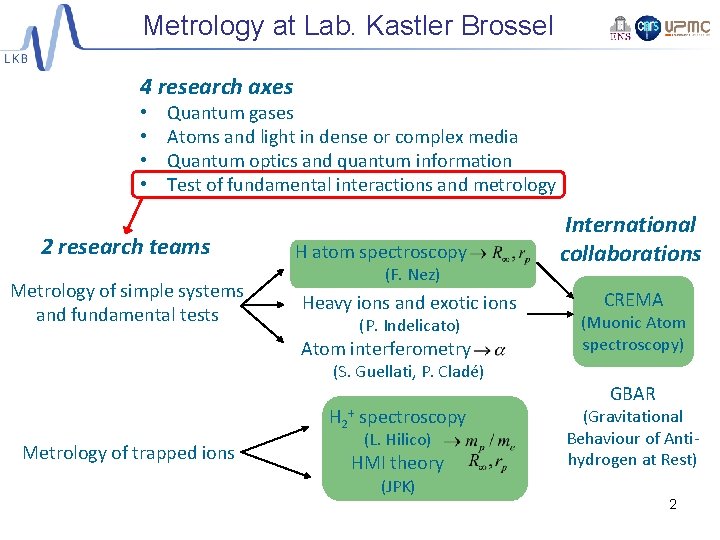
Metrology at Lab. Kastler Brossel 4 research axes • • Quantum gases Atoms and light in dense or complex media Quantum optics and quantum information Test of fundamental interactions and metrology 2 research teams Metrology of simple systems and fundamental tests H atom spectroscopy (F. Nez) Heavy ions and exotic ions (P. Indelicato) Atom interferometry (S. Guellati, P. Cladé) H 2+ spectroscopy Metrology of trapped ions (L. Hilico) HMI theory (JPK) International collaborations CREMA (Muonic Atom spectroscopy) GBAR (Gravitational Behaviour of Antihydrogen at Rest) 2
Outline I. Introduction Atomic energy levels, and the proton radius II. Current status of the “puzzle” After recent measurements in hydrogen III. New experiments Focus on the hydrogen molecular ions 3
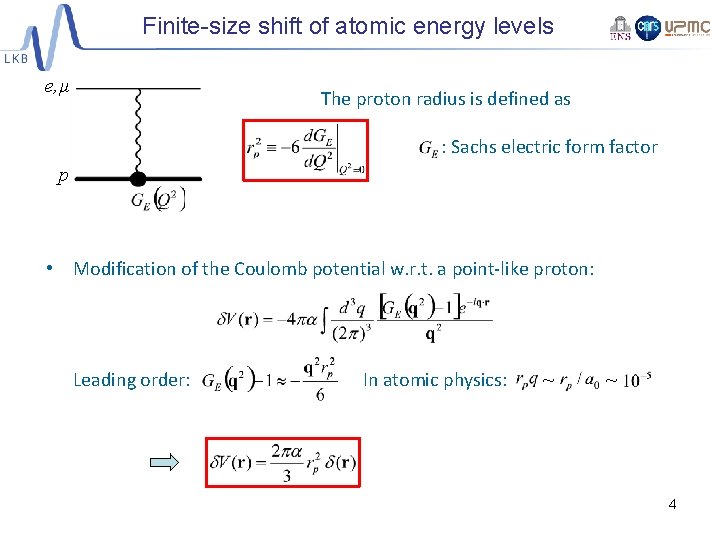
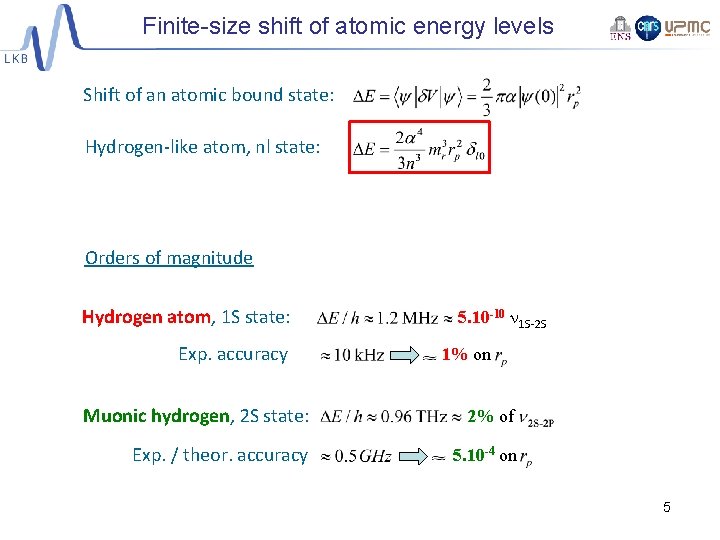
Finite-size shift of atomic energy levels e, µ The proton radius is defined as : Sachs electric form factor p • Modification of the Coulomb potential w. r. t. a point-like proton: Leading order: In atomic physics: ~ ~ 4
Finite-size shift of atomic energy levels Shift of an atomic bound state: Hydrogen-like atom, nl state: Orders of magnitude Hydrogen atom, 1 S state: Exp. accuracy 5. 10 -10 n 1 S-2 S 1% on Muonic hydrogen, 2 S state: 2% of Exp. / theor. accuracy 5. 10 -4 on 5
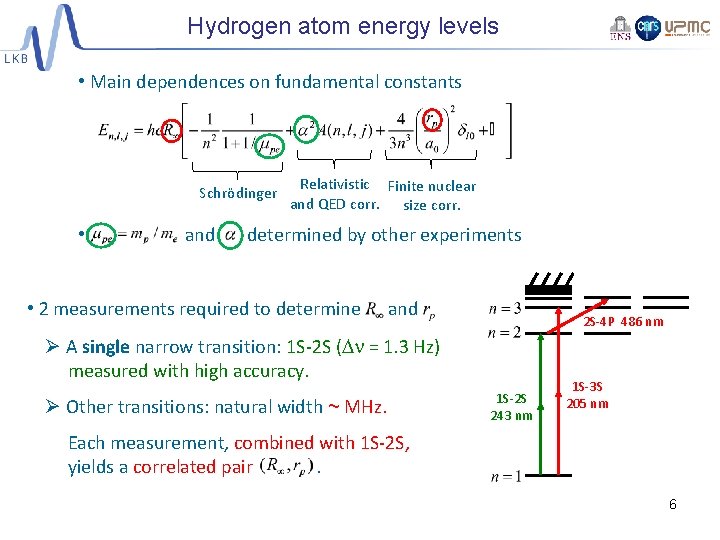
Hydrogen atom energy levels • Main dependences on fundamental constants Schrödinger • and Relativistic Finite nuclear and QED corr. size corr. determined by other experiments • 2 measurements required to determine and 2 S-4 P 486 nm Ø A single narrow transition: 1 S-2 S (Dn = 1. 3 Hz) measured with high accuracy. Ø Other transitions: natural width ~ MHz. 1 S-2 S 243 nm 1 S-3 S 205 nm Each measurement, combined with 1 S-2 S, yields a correlated pair. 6
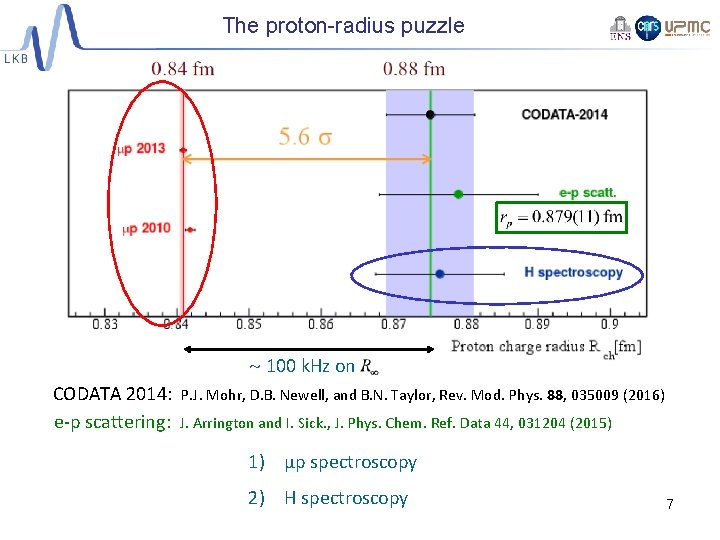
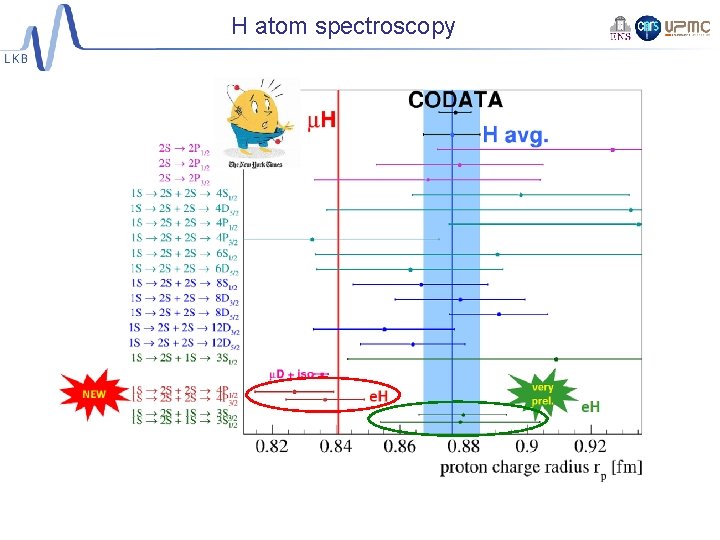
The proton-radius puzzle 100 k. Hz on CODATA 2014: e-p scattering: P. J. Mohr, D. B. Newell, and B. N. Taylor, Rev. Mod. Phys. 88, 035009 (2016) J. Arrington and I. Sick. , J. Phys. Chem. Ref. Data 44, 031204 (2015) 1) µp spectroscopy 2) H spectroscopy 7
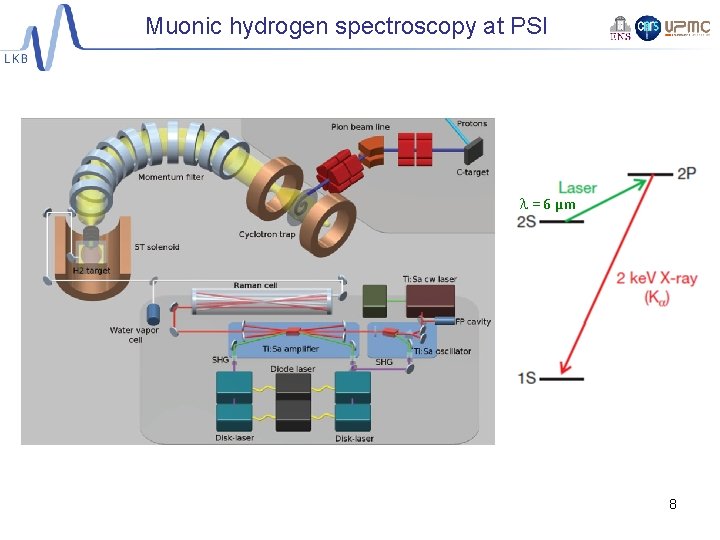
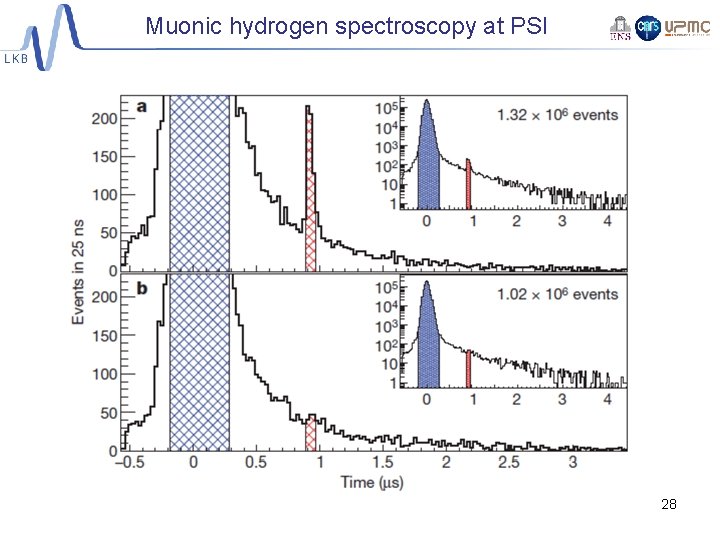
Muonic hydrogen spectroscopy at PSI l = 6 µm 8
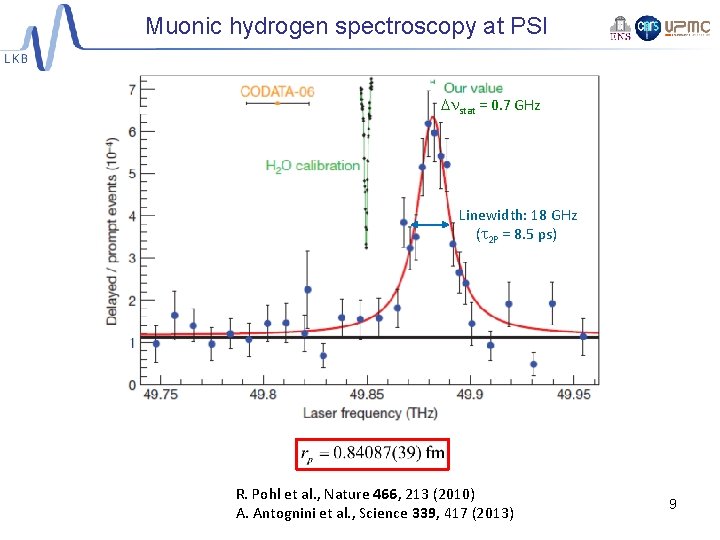
Muonic hydrogen spectroscopy at PSI Dnstat = 0. 7 GHz Linewidth: 18 GHz (t 2 P = 8. 5 ps) R. Pohl et al. , Nature 466, 213 (2010) A. Antognini et al. , Science 339, 417 (2013) 9
H atom spectroscopy
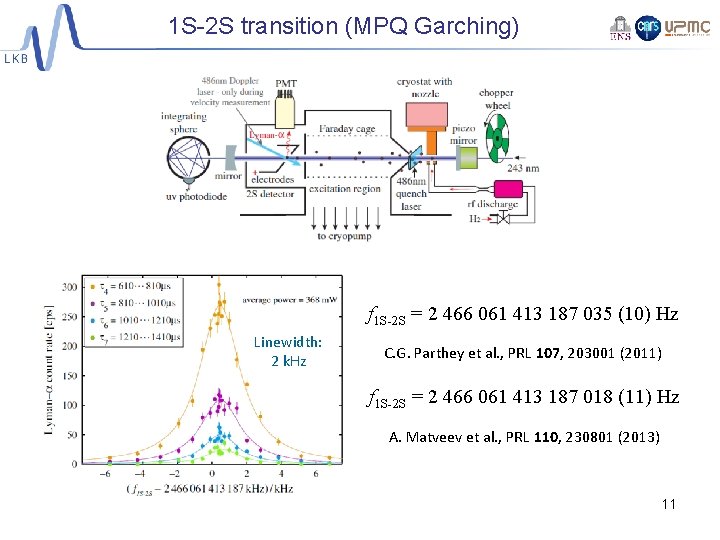
1 S-2 S transition (MPQ Garching) f 1 S-2 S = 2 466 061 413 187 035 (10) Hz Linewidth: 2 k. Hz C. G. Parthey et al. , PRL 107, 203001 (2011) f 1 S-2 S = 2 466 061 413 187 018 (11) Hz A. Matveev et al. , PRL 110, 230801 (2013) 11
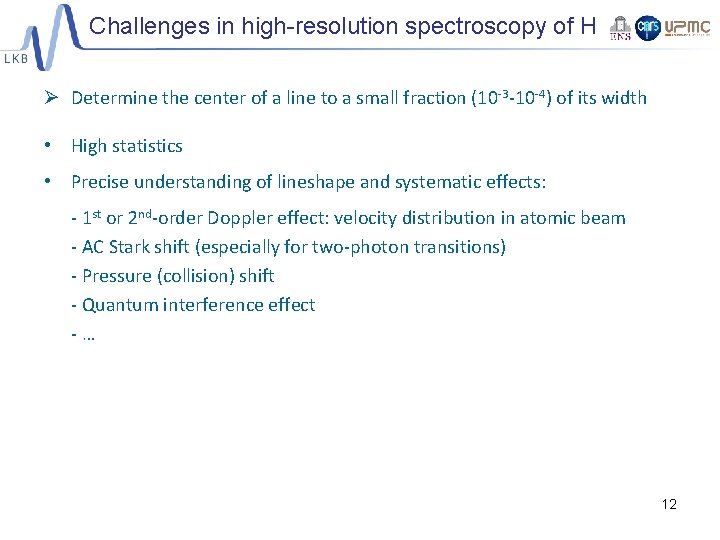
Challenges in high-resolution spectroscopy of H Ø Determine the center of a line to a small fraction (10 -3 -10 -4) of its width • High statistics • Precise understanding of lineshape and systematic effects: - 1 st or 2 nd-order Doppler effect: velocity distribution in atomic beam - AC Stark shift (especially for two-photon transitions) - Pressure (collision) shift - Quantum interference effect -… 12
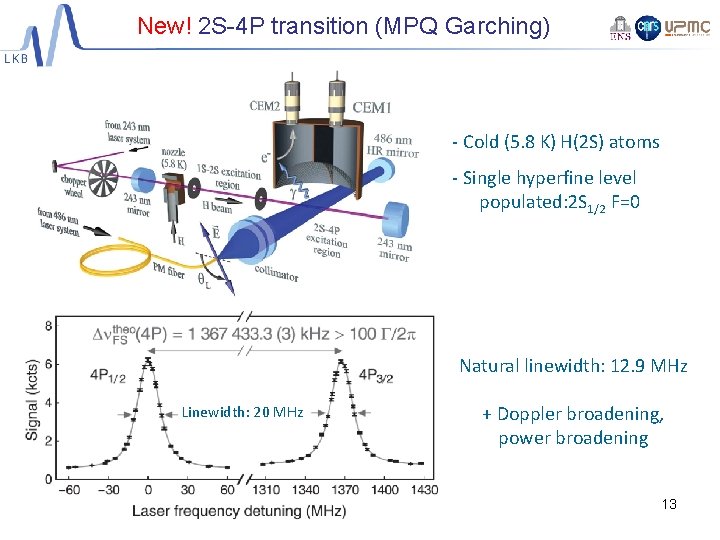
New! 2 S-4 P transition (MPQ Garching) - Cold (5. 8 K) H(2 S) atoms - Single hyperfine level populated: 2 S 1/2 F=0 Natural linewidth: 12. 9 MHz Linewidth: 20 MHz + Doppler broadening, power broadening 13
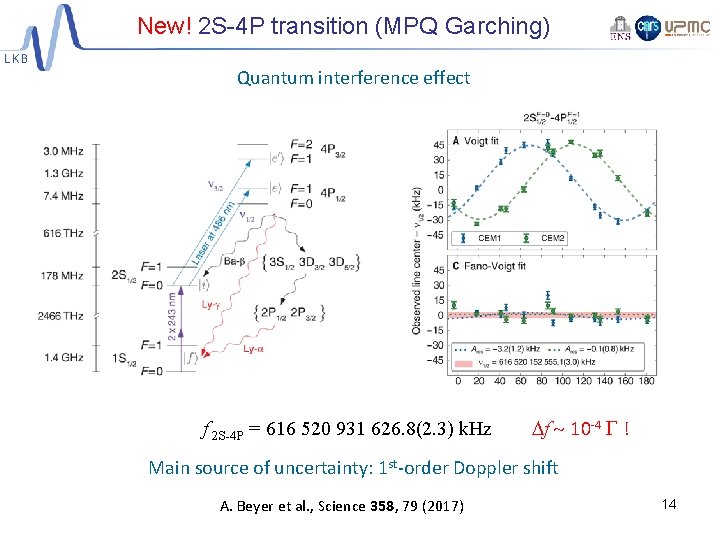
New! 2 S-4 P transition (MPQ Garching) Quantum interference effect f 2 S-4 P = 616 520 931 626. 8(2. 3) k. Hz Df 10 -4 G ! Main source of uncertainty: 1 st-order Doppler shift A. Beyer et al. , Science 358, 79 (2017) 14
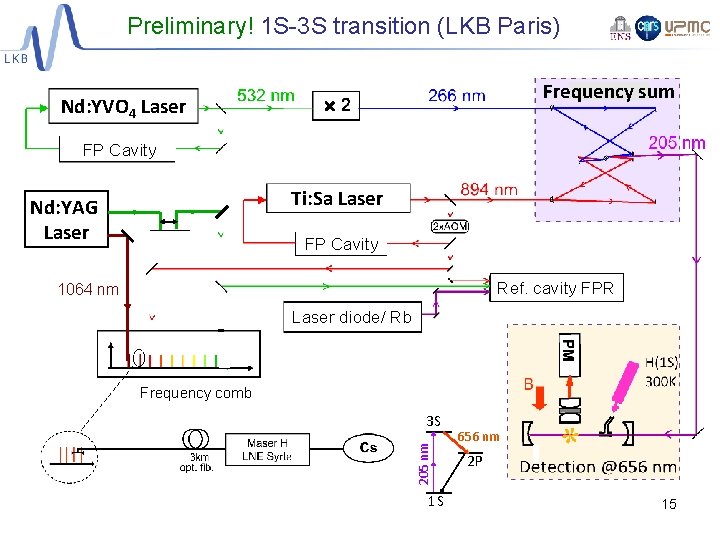
Preliminary! 1 S-3 S transition (LKB Paris) Frequency sum Nd: YVO 4 Laser FP Cavity Ti: Sa Laser Nd: YAG Laser FP Cavity Ref. cavity FPR 1064 nm Laser diode/ Rb Frequency comb 205 nm 3 S 1 S 656 nm 2 P 15
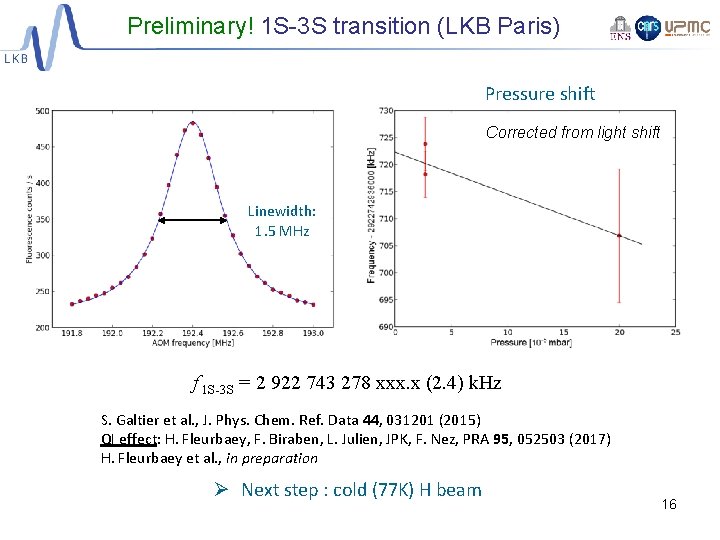
Preliminary! 1 S-3 S transition (LKB Paris) Pressure shift Corrected from light shift Linewidth: 1. 5 MHz f 1 S-3 S = 2 922 743 278 xxx. x (2. 4) k. Hz S. Galtier et al. , J. Phys. Chem. Ref. Data 44, 031201 (2015) QI effect: H. Fleurbaey, F. Biraben, L. Julien, JPK, F. Nez, PRA 95, 052503 (2017) H. Fleurbaey et al. , in preparation Ø Next step : cold (77 K) H beam 16
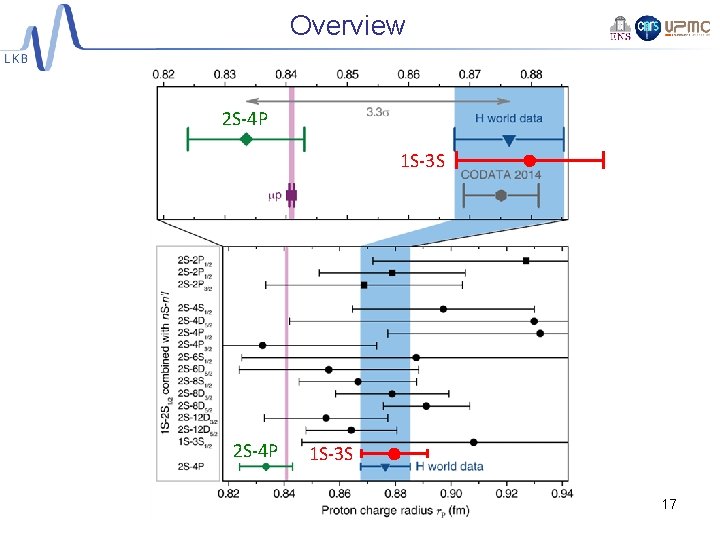
Overview 2 S-4 P 1 S-3 S 17
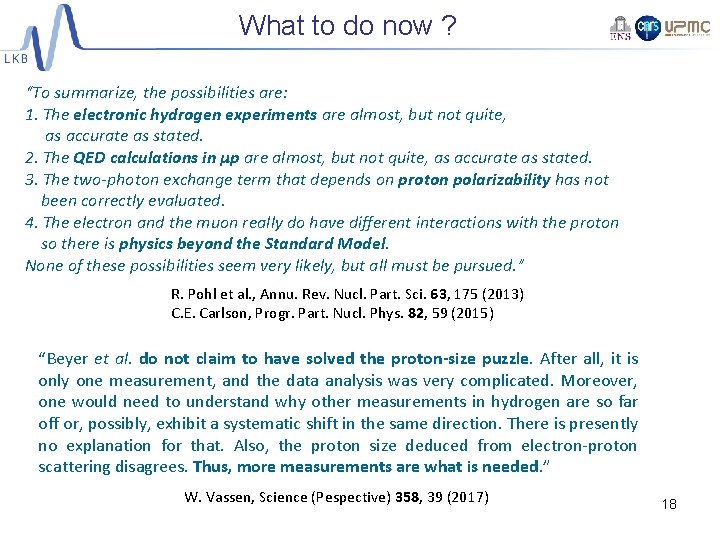
What to do now ? “To summarize, the possibilities are: 1. The electronic hydrogen experiments are almost, but not quite, as accurate as stated. 2. The QED calculations in µp are almost, but not quite, as accurate as stated. 3. The two-photon exchange term that depends on proton polarizability has not been correctly evaluated. 4. The electron and the muon really do have different interactions with the proton so there is physics beyond the Standard Model. None of these possibilities seem very likely, but all must be pursued. ” R. Pohl et al. , Annu. Rev. Nucl. Part. Sci. 63, 175 (2013) C. E. Carlson, Progr. Part. Nucl. Phys. 82, 59 (2015) “Beyer et al. do not claim to have solved the proton-size puzzle. After all, it is only one measurement, and the data analysis was very complicated. Moreover, one would need to understand why other measurements in hydrogen are so far off or, possibly, exhibit a systematic shift in the same direction. There is presently no explanation for that. Also, the proton size deduced from electron-proton scattering disagrees. Thus, more measurements are what is needed. ” W. Vassen, Science (Pespective) 358, 39 (2017) 18
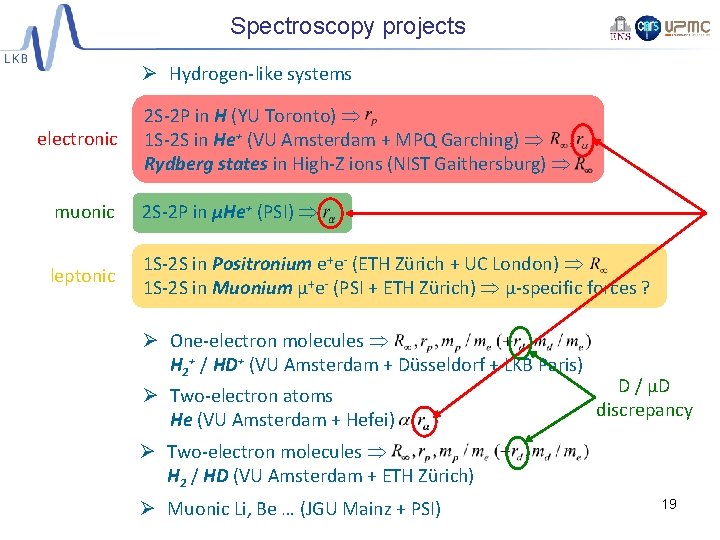
Spectroscopy projects Ø Hydrogen-like systems electronic 2 S-2 P in H (YU Toronto) 1 S-2 S in He+ (VU Amsterdam + MPQ Garching) Rydberg states in High-Z ions (NIST Gaithersburg) muonic 2 S-2 P in µHe+ (PSI) leptonic 1 S-2 S in Positronium e+e- (ETH Zürich + UC London) 1 S-2 S in Muonium µ+e- (PSI + ETH Zürich) µ-specific forces ? Ø One-electron molecules H 2+ / HD+ (VU Amsterdam + Düsseldorf + LKB Paris) Ø Two-electron atoms He (VU Amsterdam + Hefei) D / µD discrepancy Ø Two-electron molecules H 2 / HD (VU Amsterdam + ETH Zürich) Ø Muonic Li, Be … (JGU Mainz + PSI) 19
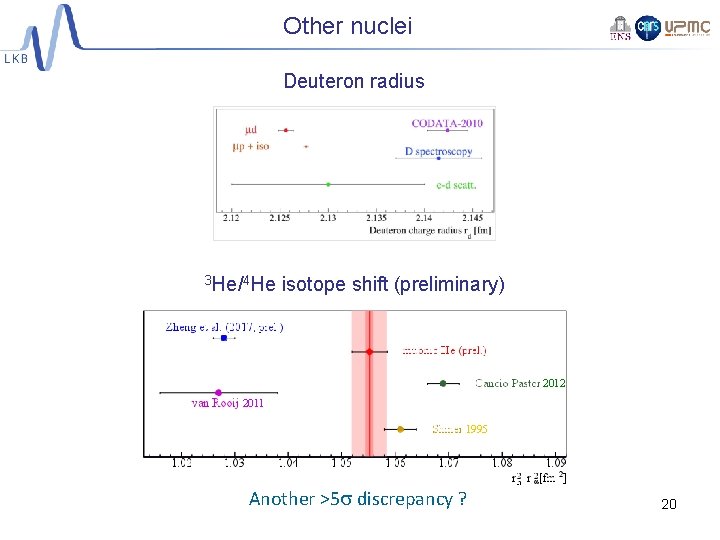
Other nuclei Deuteron radius 3 He/4 He isotope shift (preliminary) 2012 2011 1995 Another >5 s discrepancy ? 20
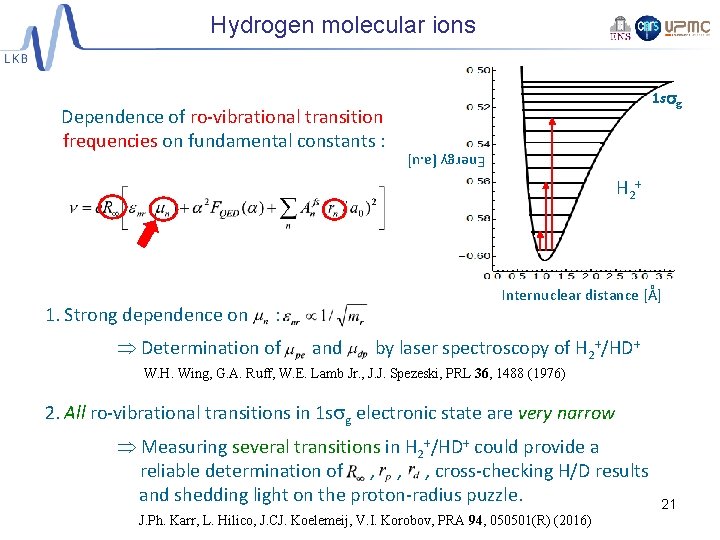
Hydrogen molecular ions 1 ssg Dependence of ro-vibrational transition frequencies on fundamental constants : Energy [a. u] H 2 + 1. Strong dependence on Internuclear distance [Å] : Determination of and by laser spectroscopy of H 2+/HD+ W. H. Wing, G. A. Ruff, W. E. Lamb Jr. , J. J. Spezeski, PRL 36, 1488 (1976) 2. All ro-vibrational transitions in 1 ssg electronic state are very narrow Measuring several transitions in H 2+/HD+ could provide a reliable determination of , , , cross-checking H/D results and shedding light on the proton-radius puzzle. J. Ph. Karr, L. Hilico, J. CJ. Koelemeij, V. I. Korobov, PRA 94, 050501(R) (2016) 21
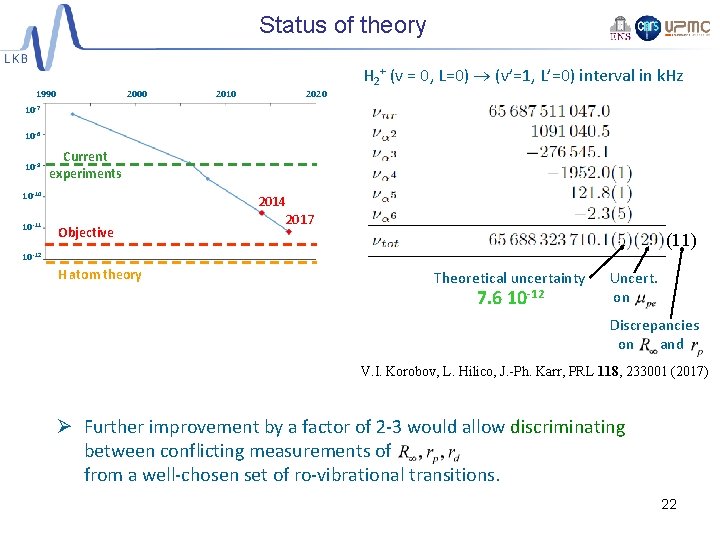
Status of theory 2000 1990 2010 2020 H 2+ (v = 0, L=0) (v’=1, L’=0) interval in k. Hz 10 -7 10 -8 10 -9 Current experiments 10 -10 10 -11 Objective 2014 2017 (11) 10 -12 H atom theory Theoretical uncertainty 7. 6 10 -12 Uncert. on Discrepancies on and V. I. Korobov, L. Hilico, J. -Ph. Karr, PRL 118, 233001 (2017) Ø Further improvement by a factor of 2 -3 would allow discriminating between conflicting measurements of from a well-chosen set of ro-vibrational transitions. 22
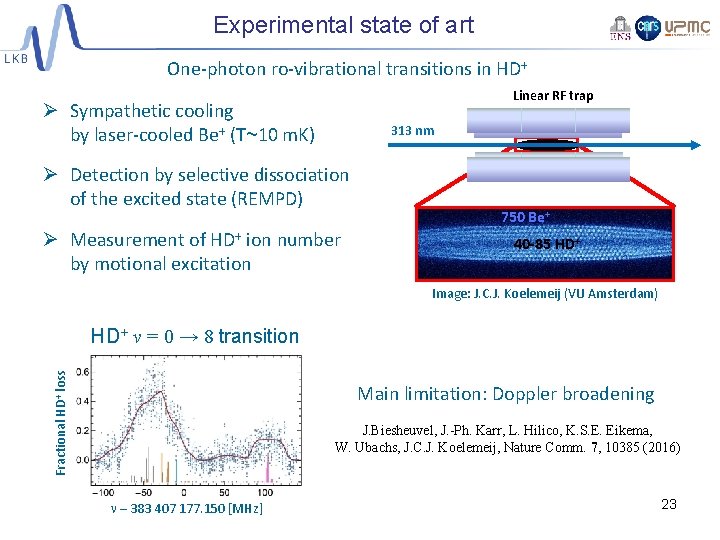
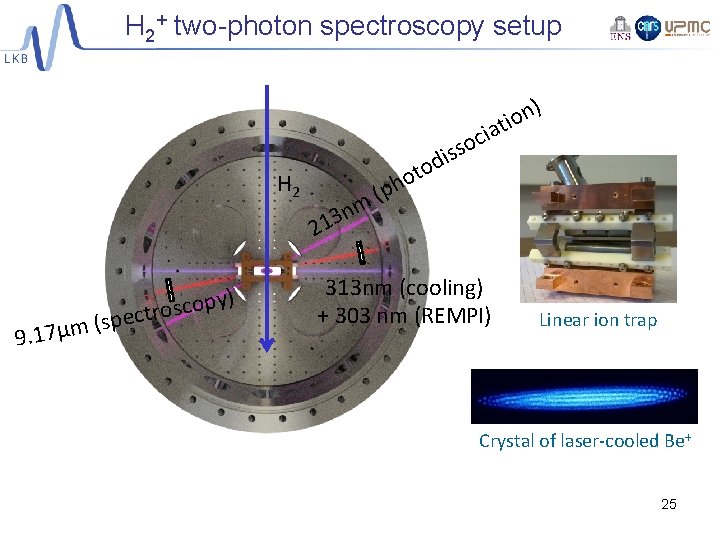
Experimental state of art One-photon ro-vibrational transitions in HD+ Linear RF trap Ø Sympathetic cooling by laser-cooled Be+ (T~10 m. K) 313 nm Ø Detection by selective dissociation of the excited state (REMPD) Ø Measurement of HD+ ion number by motional excitation 750 Be+ 40 -85 HD+ Image: J. C. J. Koelemeij (VU Amsterdam) Fractional HD+ loss HD+ v = 0 → 8 transition Main limitation: Doppler broadening J. Biesheuvel, J. -Ph. Karr, L. Hilico, K. S. E. Eikema, W. Ubachs, J. C. J. Koelemeij, Nature Comm. 7, 10385 (2016) n – 383 407 177. 150 [MHz] 23
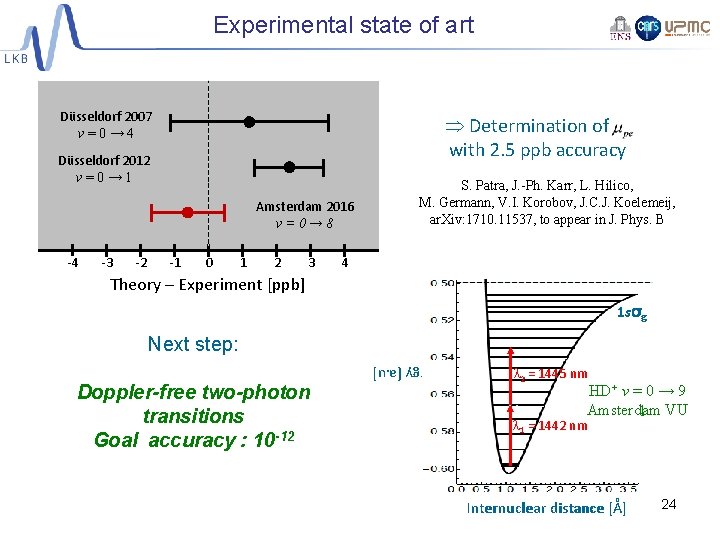
Experimental state of art Düsseldorf 2007 v=0→ 4 Determination of with 2. 5 ppb accuracy Düsseldorf 2012 v=0→ 1 Amsterdam 2016 v=0→ 8 -4 -3 -2 -1 0 1 2 3 S. Patra, J. -Ph. Karr, L. Hilico, M. Germann, V. I. Korobov, J. C. J. Koelemeij, ar. Xiv: 1710. 11537, to appear in J. Phys. B 4 Theory – Experiment [ppb] 1 ss g Next step: Energy [a. u] Doppler-free two-photon transitions Goal accuracy : 10 -12 l 2 = 1445 nm HD+ v = 0 → 9 H 2+ v. Amsterdam = 0 → 1 VU l 1 = 1442 nm. LKB l = 9. 17 µm Internuclear distance [Å] 24
H 2+ two-photon spectroscopy setup a H 2 p s ( m µ 9. 17 y) p o c s o r ect ph ( m i c o iss ) it on d o t o n 3 1 2 313 nm (cooling) + 303 nm (REMPI) Linear ion trap Crystal of laser-cooled Be+ 25
Acknowledgements Albane Nicolas Douillet Sillitoe (Ph. D) Johannes Laurent Heinrich (Ph. D) Hilico Thomas Louvradoux (Ph. D) Vladimir Korobov (JINR, Dubna, Russia) Amsterdam VU Jeroen Koelemeij Sayan Patra Matthias Germann Juriaan Biesheuvel Frank Cozijn Kjeld Eikema Wim Ubachs 26
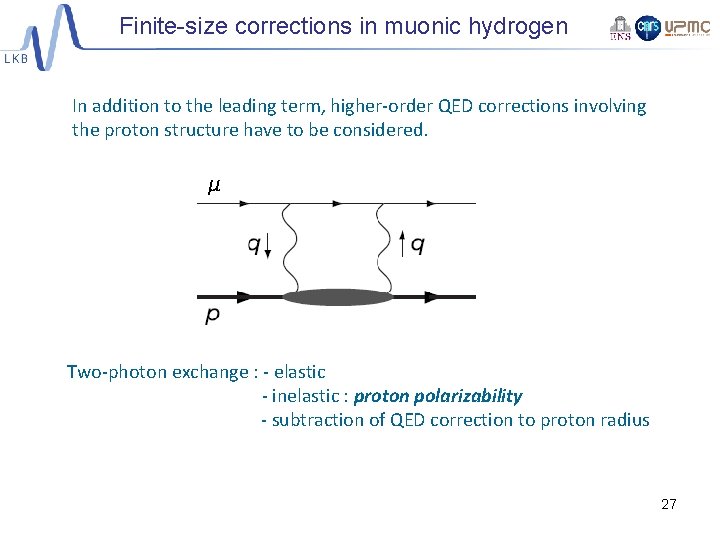
Finite-size corrections in muonic hydrogen In addition to the leading term, higher-order QED corrections involving the proton structure have to be considered. µ Two-photon exchange : - elastic - inelastic : proton polarizability - subtraction of QED correction to proton radius 27
Muonic hydrogen spectroscopy at PSI 28
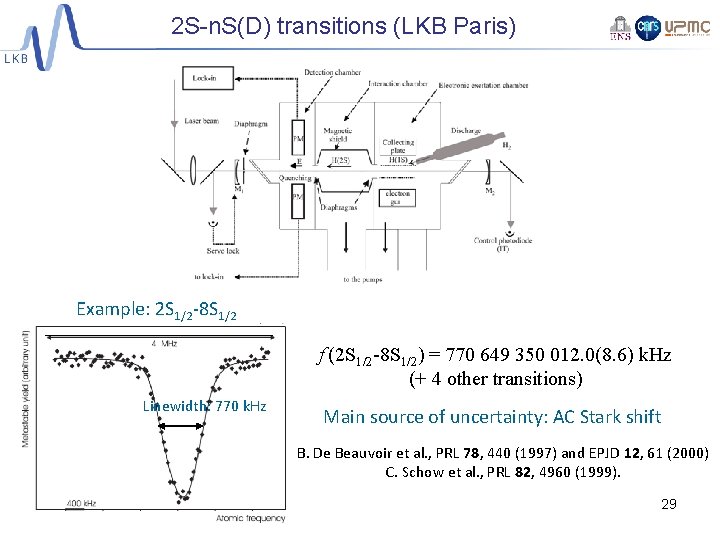
2 S-n. S(D) transitions (LKB Paris) Example: 2 S 1/2 -8 S 1/2 f (2 S 1/2 -8 S 1/2) = 770 649 350 012. 0(8. 6) k. Hz (+ 4 other transitions) Linewidth: 770 k. Hz Main source of uncertainty: AC Stark shift B. De Beauvoir et al. , PRL 78, 440 (1997) and EPJD 12, 61 (2000) C. Schow et al. , PRL 82, 4960 (1999). 29