
The Protestant Reformation Warmup n Write your name

- Slides: 31
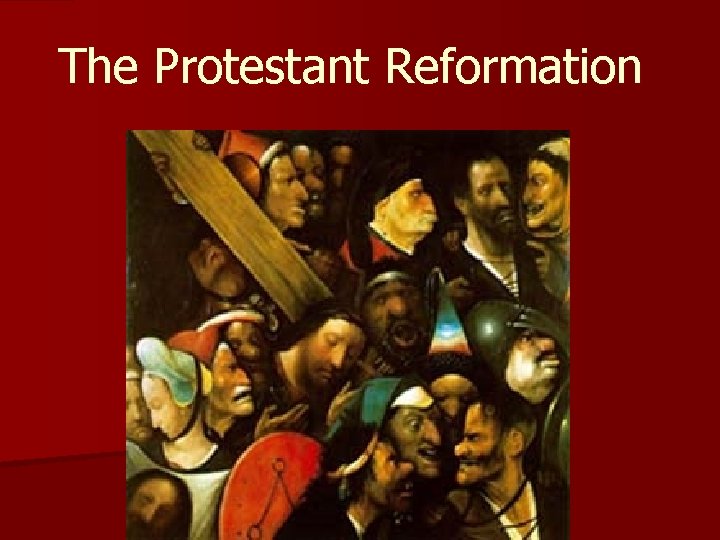
The Protestant Reformation
Warmup n Write your name backwards (like da Vinci)
Agenda n Warmup n Power. Point with Notes n Reformation Crossword Puzzle
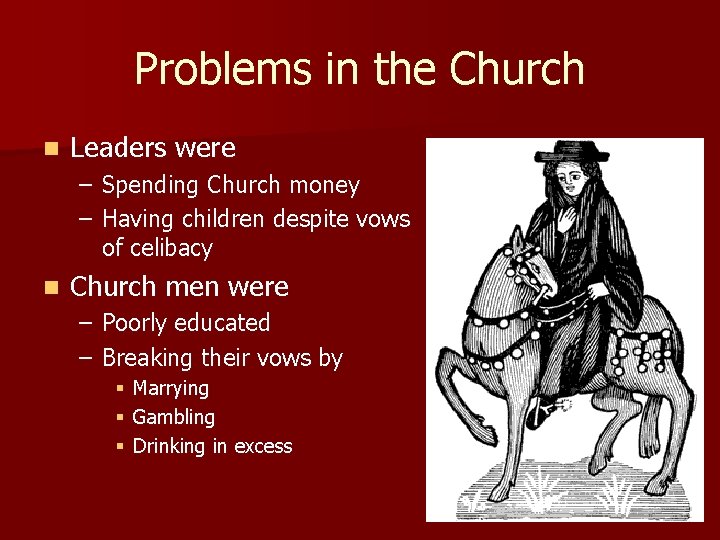
Problems in the Church n Leaders were – Spending Church money – Having children despite vows of celibacy n Church men were – Poorly educated – Breaking their vows by § § § Marrying Gambling Drinking in excess
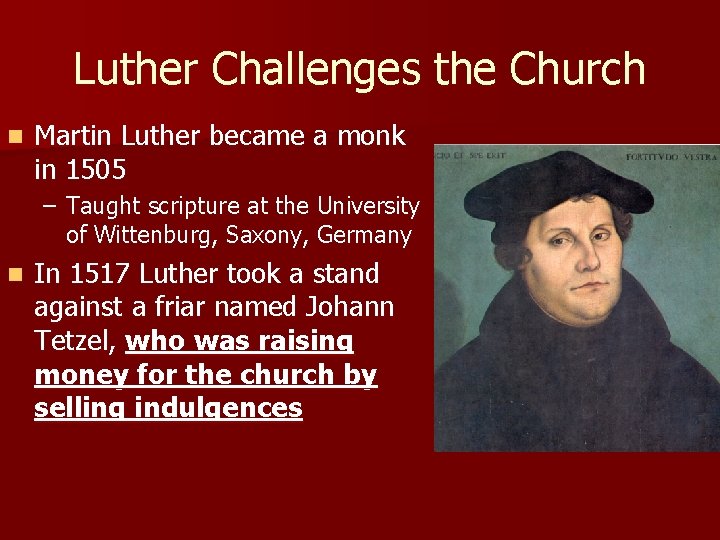
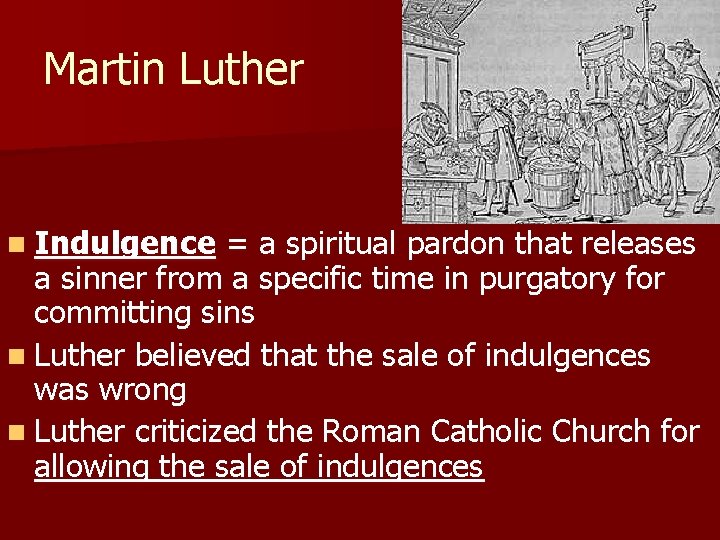
Luther Challenges the Church n Martin Luther became a monk in 1505 – Taught scripture at the University of Wittenburg, Saxony, Germany n In 1517 Luther took a stand against a friar named Johann Tetzel, who was raising money for the church by selling indulgences
Martin Luther n Indulgence = a spiritual pardon that releases a sinner from a specific time in purgatory for committing sins n Luther believed that the sale of indulgences was wrong n Luther criticized the Roman Catholic Church for allowing the sale of indulgences
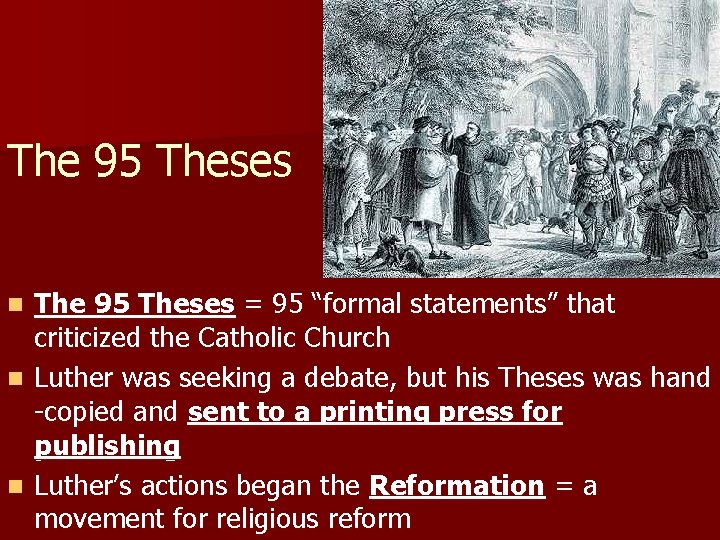
The 95 Theses = 95 “formal statements” that criticized the Catholic Church n Luther was seeking a debate, but his Theses was hand -copied and sent to a printing press for publishing n Luther’s actions began the Reformation = a movement for religious reform n
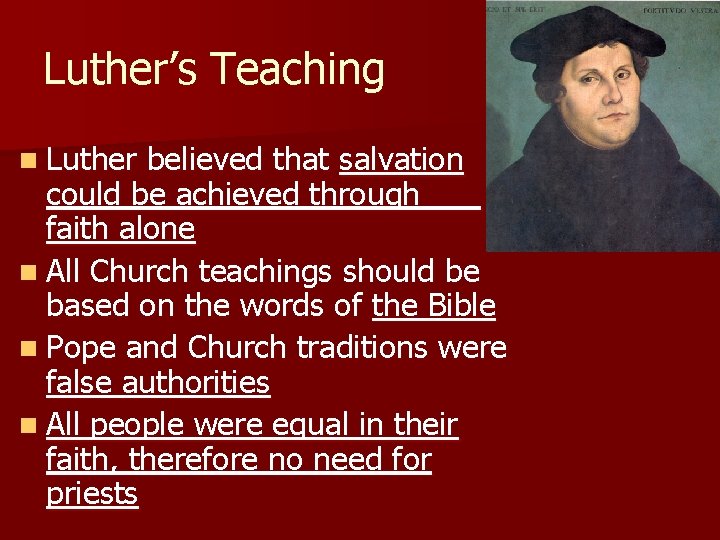
Luther’s Teaching n Luther believed that salvation could be achieved through faith alone n All Church teachings should be based on the words of the Bible n Pope and Church traditions were false authorities n All people were equal in their faith, therefore no need for priests
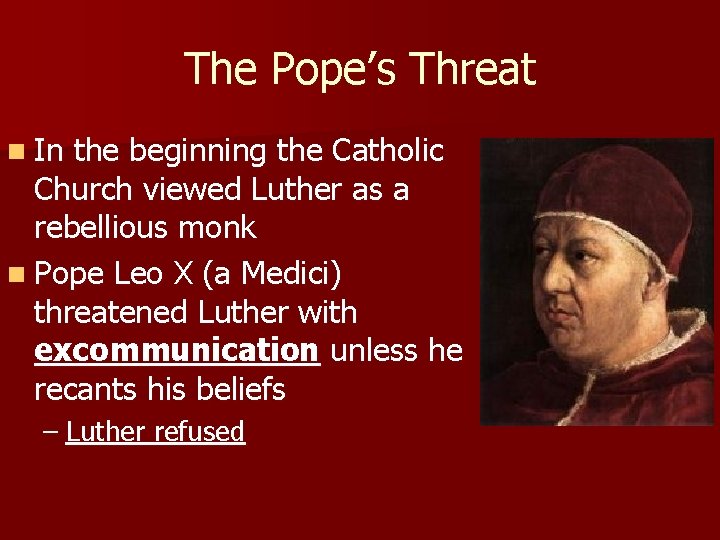
The Pope’s Threat n In the beginning the Catholic Church viewed Luther as a rebellious monk n Pope Leo X (a Medici) threatened Luther with excommunication unless he recants his beliefs – Luther refused
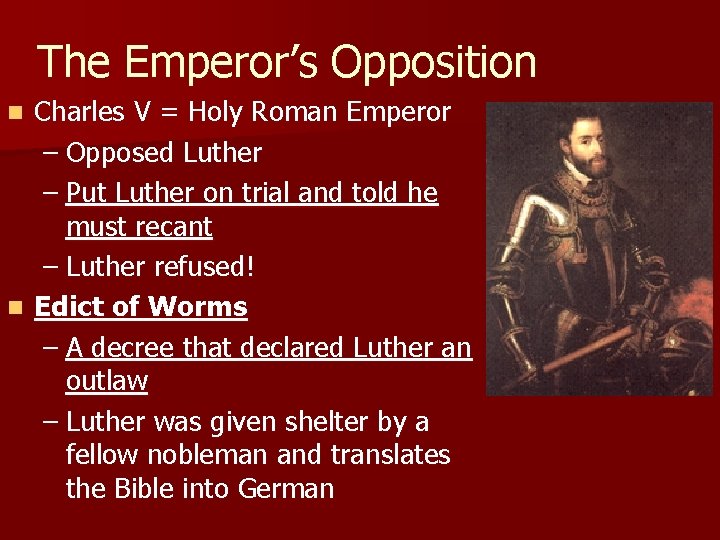
The Emperor’s Opposition Charles V = Holy Roman Emperor – Opposed Luther – Put Luther on trial and told he must recant – Luther refused! n Edict of Worms – A decree that declared Luther an outlaw – Luther was given shelter by a fellow nobleman and translates the Bible into German n
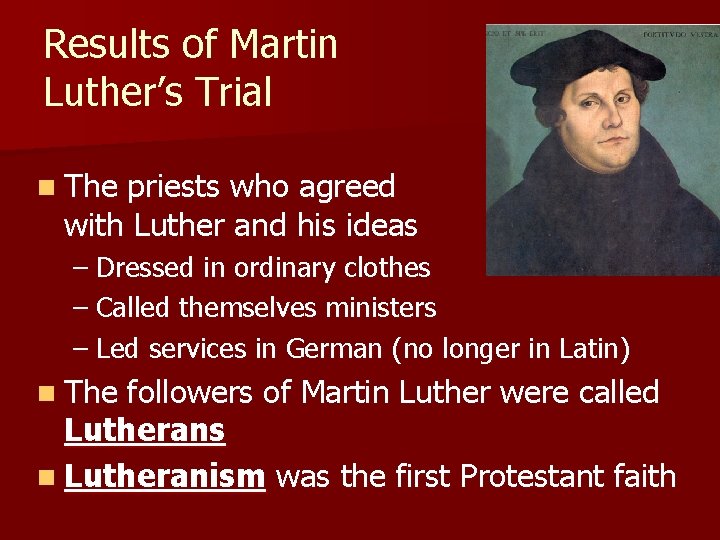
Results of Martin Luther’s Trial n The priests who agreed with Luther and his ideas – Dressed in ordinary clothes – Called themselves ministers – Led services in German (no longer in Latin) n The followers of Martin Luther were called Lutherans n Lutheranism was the first Protestant faith
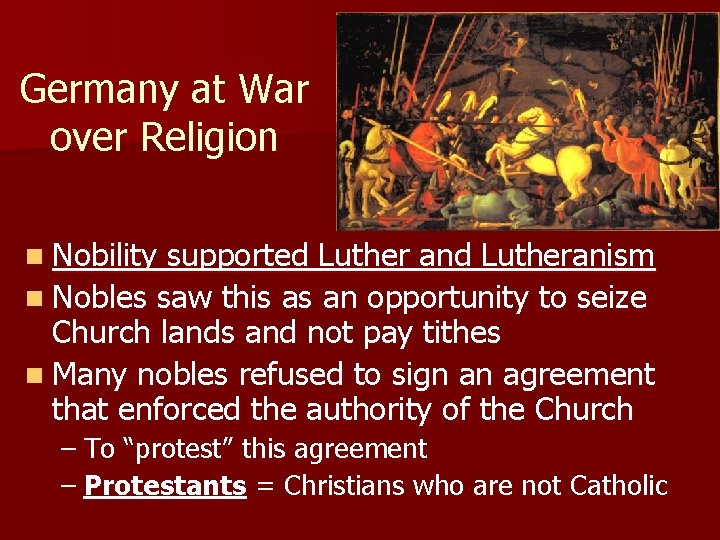
Germany at War over Religion n Nobility supported Luther and Lutheranism n Nobles saw this as an opportunity to seize Church lands and not pay tithes n Many nobles refused to sign an agreement that enforced the authority of the Church – To “protest” this agreement – Protestants = Christians who are not Catholic
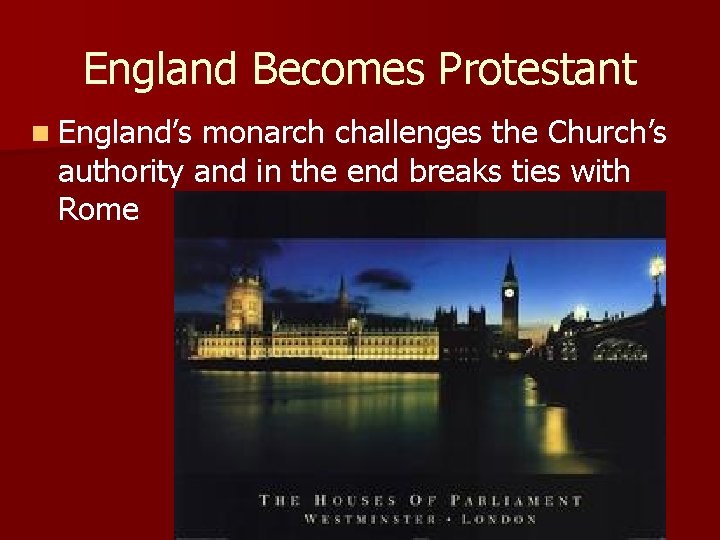
England Becomes Protestant n England’s monarch challenges the Church’s authority and in the end breaks ties with Rome
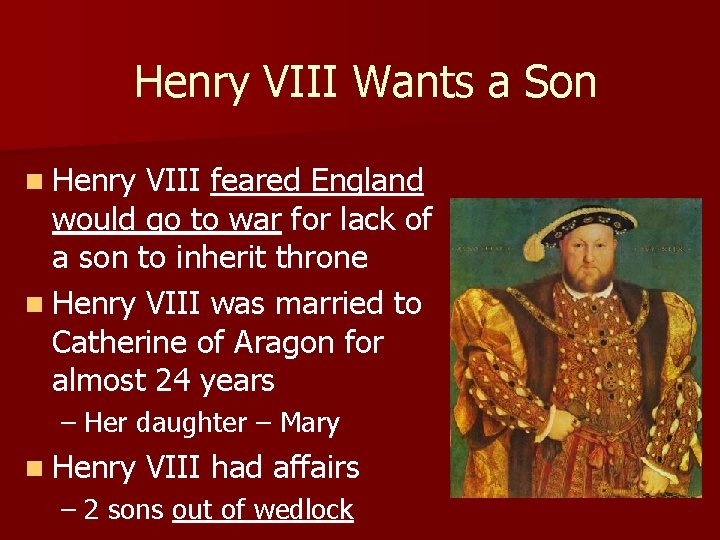
Henry VIII Wants a Son n Henry VIII feared England would go to war for lack of a son to inherit throne n Henry VIII was married to Catherine of Aragon for almost 24 years – Her daughter – Mary n Henry VIII had affairs – 2 sons out of wedlock
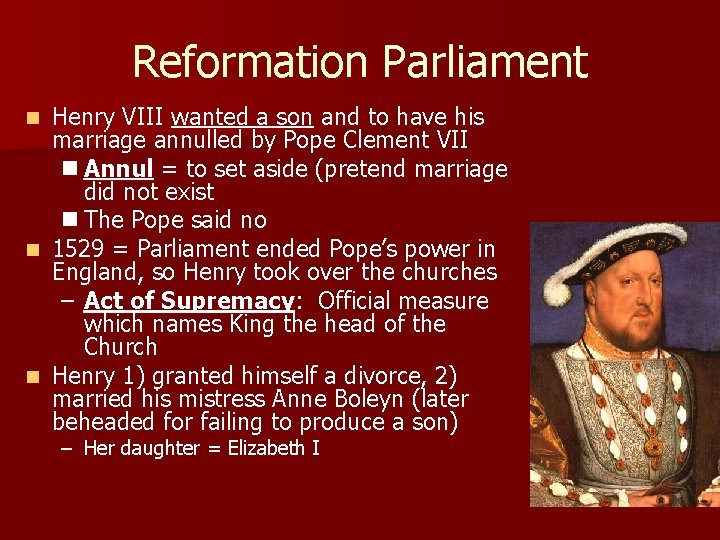
Reformation Parliament Henry VIII wanted a son and to have his marriage annulled by Pope Clement VII n Annul = to set aside (pretend marriage did not exist n The Pope said no n 1529 = Parliament ended Pope’s power in England, so Henry took over the churches – Act of Supremacy: Official measure which names King the head of the Church n Henry 1) granted himself a divorce, 2) married his mistress Anne Boleyn (later beheaded for failing to produce a son) n – Her daughter = Elizabeth I
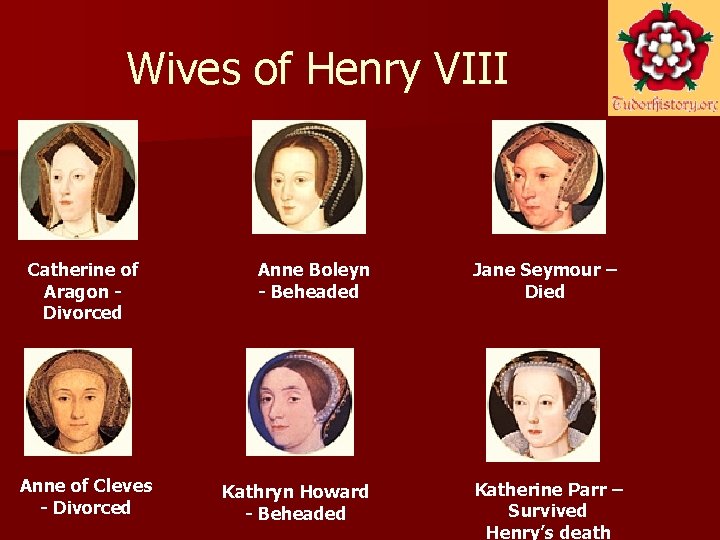
Wives of Henry VIII Catherine of Aragon Divorced Anne of Cleves - Divorced Anne Boleyn - Beheaded Kathryn Howard - Beheaded Jane Seymour – Died Katherine Parr – Survived Henry’s death
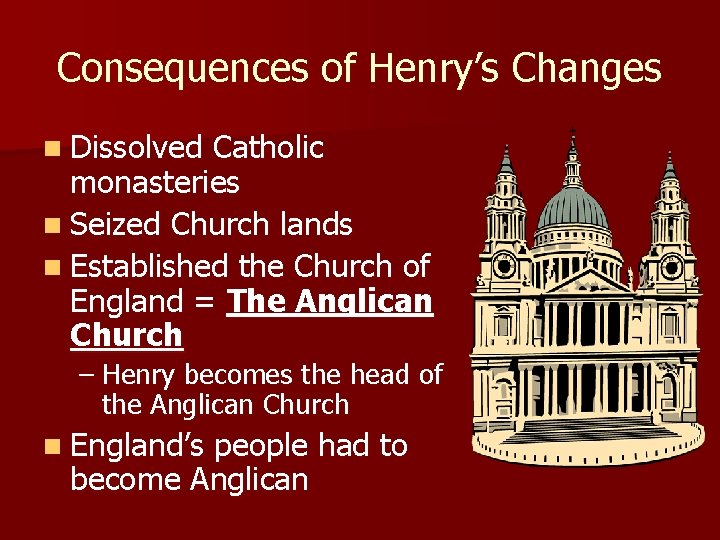
Consequences of Henry’s Changes n Dissolved Catholic monasteries n Seized Church lands n Established the Church of England = The Anglican Church – Henry becomes the head of the Anglican Church n England’s people had to become Anglican
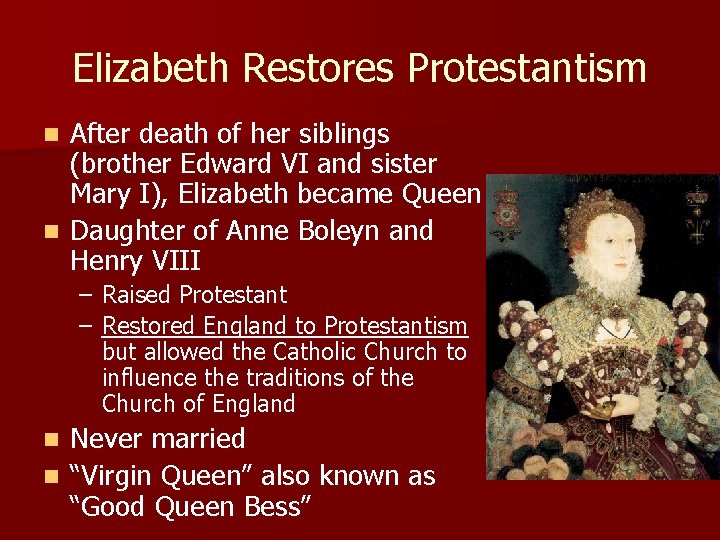
Elizabeth Restores Protestantism After death of her siblings (brother Edward VI and sister Mary I), Elizabeth became Queen n Daughter of Anne Boleyn and Henry VIII n – Raised Protestant – Restored England to Protestantism but allowed the Catholic Church to influence the traditions of the Church of England Never married n “Virgin Queen” also known as “Good Queen Bess” n
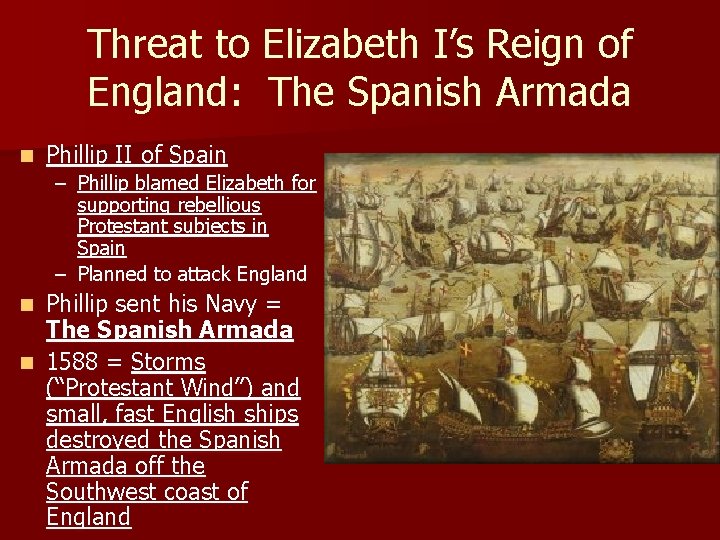
Threat to Elizabeth I’s Reign of England: The Spanish Armada n Phillip II of Spain – Phillip blamed Elizabeth for supporting rebellious Protestant subjects in Spain – Planned to attack England Phillip sent his Navy = The Spanish Armada n 1588 = Storms (“Protestant Wind”) and small, fast English ships destroyed the Spanish Armada off the Southwest coast of England n
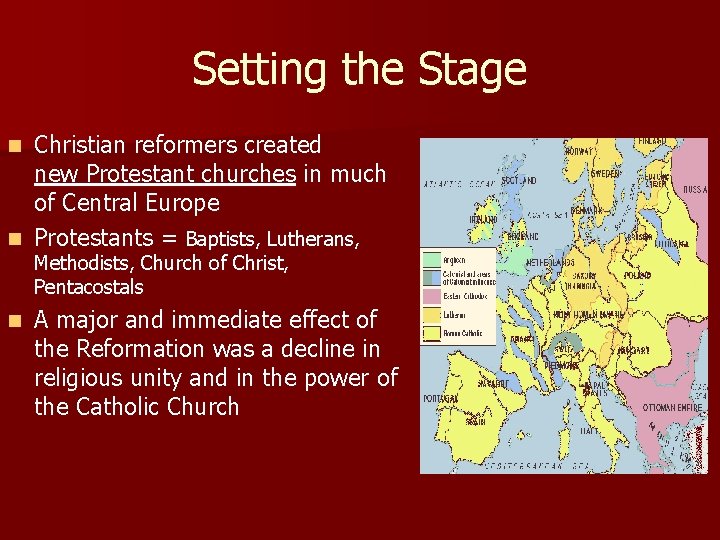
Setting the Stage Christian reformers created new Protestant churches in much of Central Europe n Protestants = Baptists, Lutherans, n Methodists, Church of Christ, Pentacostals n A major and immediate effect of the Reformation was a decline in religious unity and in the power of the Catholic Church
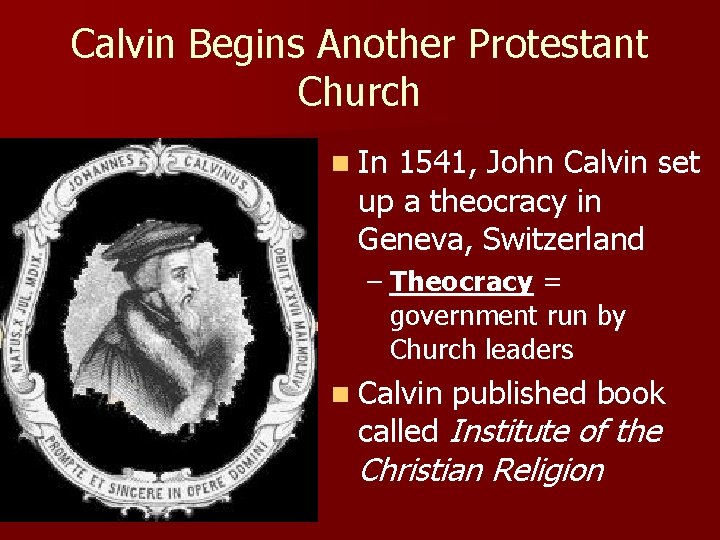
Calvin Begins Another Protestant Church n In 1541, John Calvin set up a theocracy in Geneva, Switzerland – Theocracy = government run by Church leaders n Calvin published book called Institute of the Christian Religion
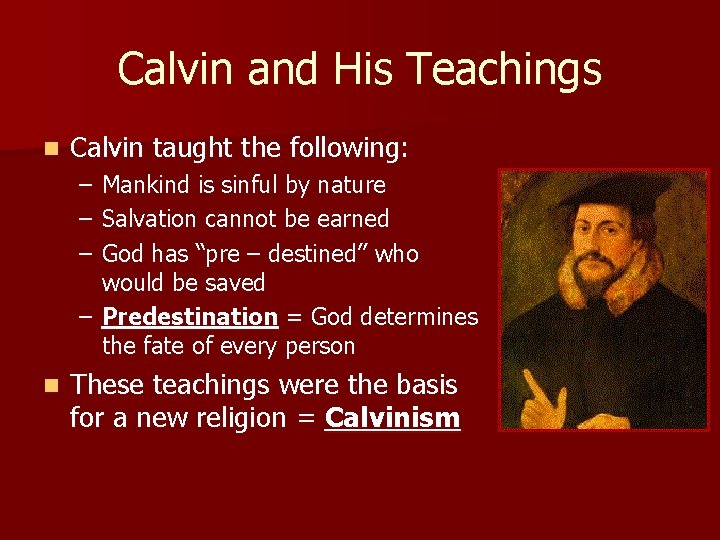
Calvin and His Teachings n Calvin taught the following: – – – Mankind is sinful by nature Salvation cannot be earned God has “pre – destined” who would be saved – Predestination = God determines the fate of every person n These teachings were the basis for a new religion = Calvinism
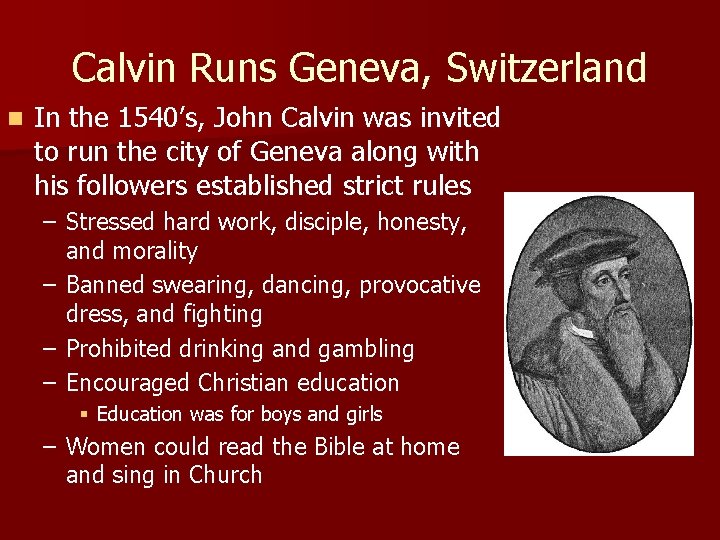
Calvin Runs Geneva, Switzerland n In the 1540’s, John Calvin was invited to run the city of Geneva along with his followers established strict rules – Stressed hard work, disciple, honesty, and morality – Banned swearing, dancing, provocative dress, and fighting – Prohibited drinking and gambling – Encouraged Christian education § Education was for boys and girls – Women could read the Bible at home and sing in Church
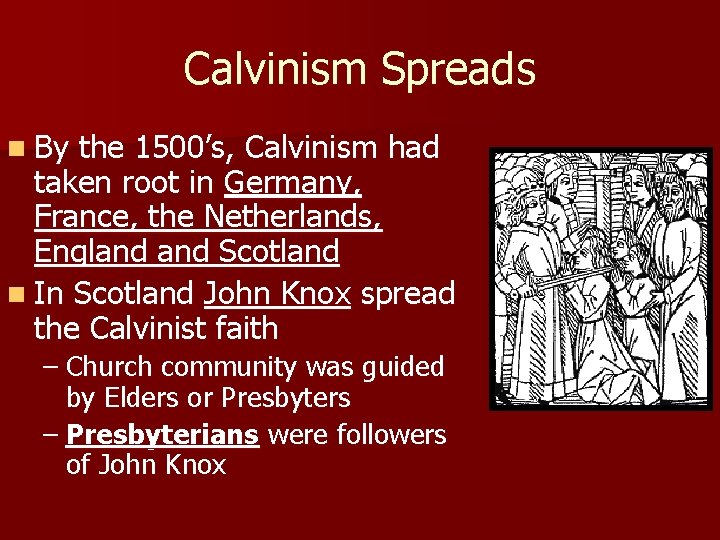
Calvinism Spreads n By the 1500’s, Calvinism had taken root in Germany, France, the Netherlands, England Scotland n In Scotland John Knox spread the Calvinist faith – Church community was guided by Elders or Presbyters – Presbyterians were followers of John Knox
Other Reformers n Various Christian groups began to interpret the Bible since it was believed that the Bible was the source of all truth n Many new Protestant groups formed based on their differences in belief
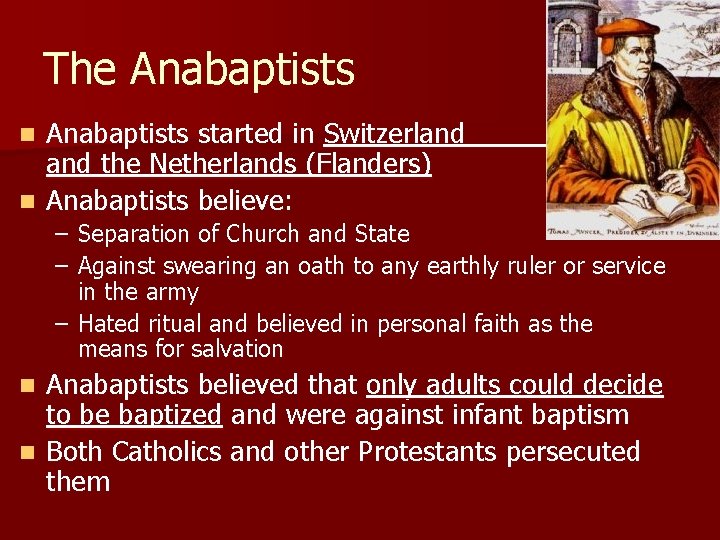
The Anabaptists started in Switzerland the Netherlands (Flanders) n Anabaptists believe: n – Separation of Church and State – Against swearing an oath to any earthly ruler or service in the army – Hated ritual and believed in personal faith as the means for salvation Anabaptists believed that only adults could decide to be baptized and were against infant baptism n Both Catholics and other Protestants persecuted them n
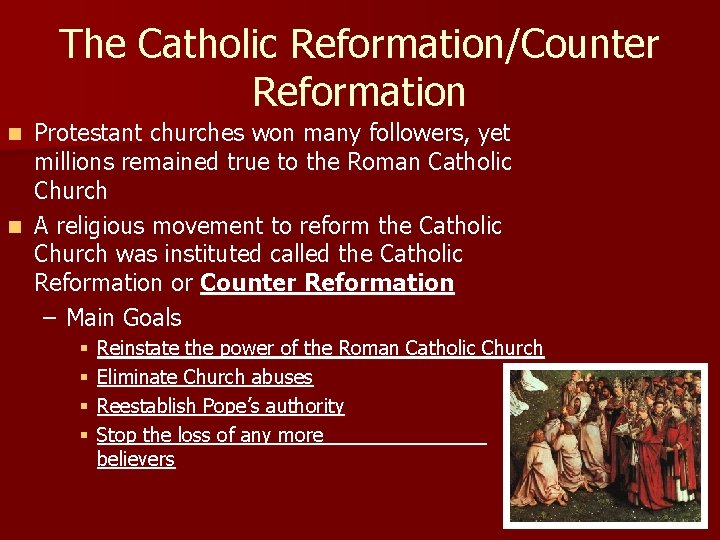
The Catholic Reformation/Counter Reformation Protestant churches won many followers, yet millions remained true to the Roman Catholic Church n A religious movement to reform the Catholic Church was instituted called the Catholic Reformation or Counter Reformation – Main Goals n § § Reinstate the power of the Roman Catholic Church Eliminate Church abuses Reestablish Pope’s authority Stop the loss of any more believers
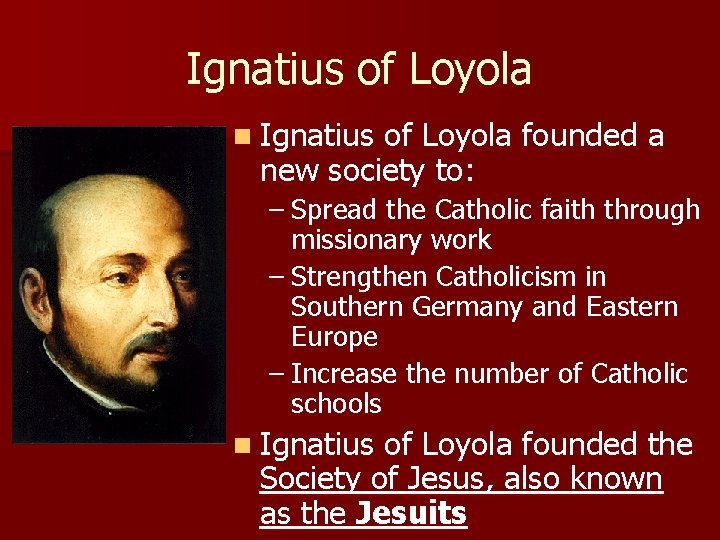
Ignatius of Loyola n Ignatius of Loyola founded a new society to: – Spread the Catholic faith through missionary work – Strengthen Catholicism in Southern Germany and Eastern Europe – Increase the number of Catholic schools n Ignatius of Loyola founded the Society of Jesus, also known as the Jesuits
Reforming Popes n Pope Paul II took major steps to reform the Church 1. Directed a council of cardinals to investigate indulgence selling and other church abuses 2. Approved the Jesuit order 3. Used the Inquisition to seek out and punish heresy 4. Called a great council of Church leaders to meet in Trent to agree on several doctrines (Council of Trent) § § The Church’s interpretation of the Bible was final Christians need faith and good works for salvation The Bible and Church teachings were equally powerful authorities in Christian life Indulgences were a valid expression of faith, but false selling of indulgences were band
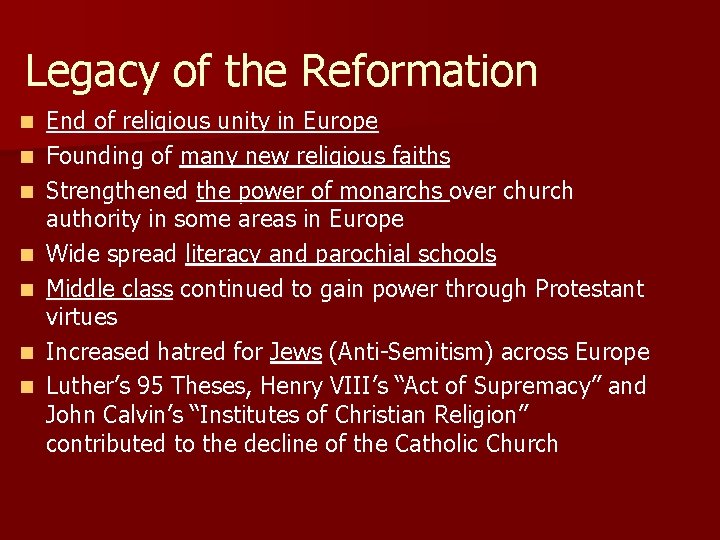
Legacy of the Reformation n n n End of religious unity in Europe Founding of many new religious faiths Strengthened the power of monarchs over church authority in some areas in Europe Wide spread literacy and parochial schools Middle class continued to gain power through Protestant virtues Increased hatred for Jews (Anti-Semitism) across Europe Luther’s 95 Theses, Henry VIII’s “Act of Supremacy” and John Calvin’s “Institutes of Christian Religion” contributed to the decline of the Catholic Church
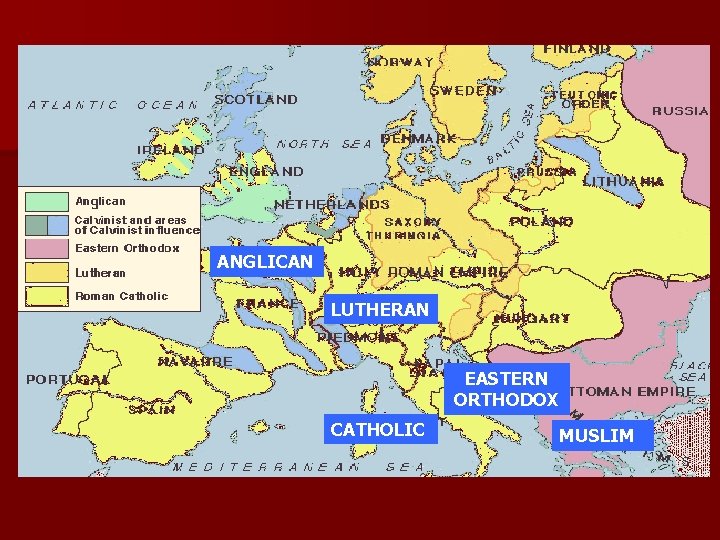
ANGLICAN LUTHERAN EASTERN ORTHODOX CATHOLIC MUSLIM