
The Protestant Reformation THE ROOTS OF THE PROTESTANT
- Slides: 39
The Protestant Reformation
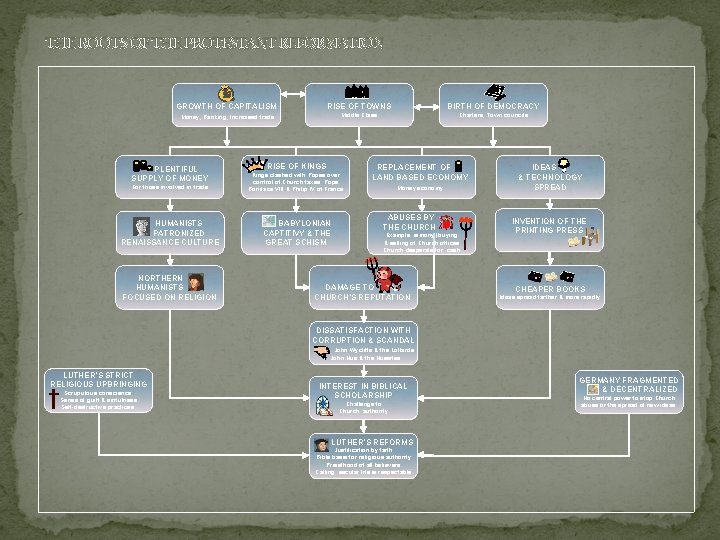
THE ROOTS OF THE PROTESTANT REFORMATION GROWTH OF CAPITALISM RISE OF TOWNS BIRTH OF DEMOCRACY Money, Banking, Increased trade Middle Class Charters, Town councils PLENTIFUL SUPPLY OF MONEY RISE OF KINGS For those involved in trade Kings clashed with Popes over control of Church taxes: Pope Boniface VIII & Philip IV of France HUMANISTS PATRONIZED RENAISSANCE CULTURE BABYLONIAN CAPTITIVY & THE GREAT SCHISM NORTHERN HUMANISTS FOCUSED ON RELIGION REPLACEMENT OF LAND BASED ECONOMY Money economy ABUSES BY THE CHURCH Example: simony (buying & selling of Church offices. Church desperate for cash. DAMAGE TO CHURCH’S REPUTATION IDEAS & TECHNOLOGY SPREAD INVENTION OF THE PRINTING PRESS CHEAPER BOOKS Ideas spread farther & more rapidly DISSATISFACTION WITH CORRUPTION & SCANDAL John Wycliffe & the Lollards John Hus & the Hussites LUTHER’S STRICT RELIGIOUS UPBRINGING Scrupulous conscience. Sense of guilt & sinfulness. Self-destructive practices. INTEREST IN BIBLICAL SCHOLARSHIP Challenge to Church authority LUTHER’S REFORMS Justification by faith Bible basis for religious authority Priesthood of all believers Calling: secular life is respectable GERMANY FRAGMENTED & DECENTRALIZED No central power to stop Church abuse or the spread of new ideas.
The Protestant Reformation �Many abuses in Church � Bishops too wealthy � Clergy getting involved in secular affairs � Selling of indulgences (pardon for sins)
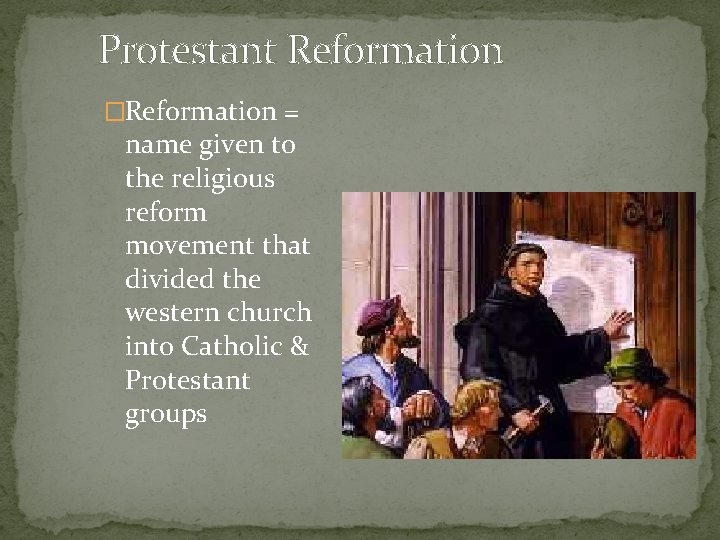
Protestant Reformation �Reformation = name given to the religious reform movement that divided the western church into Catholic & Protestant groups
Leading up to the Reformation �Christian humanism = was a school of thought that wanted to reform the Catholic Church �Christian humanists believed in the ability of human beings to reason & improve themselves/they thought if people would read the classics & basic works of Christianity, they would become more pious and then bring change to the Catholic Church �Christian humanists believed that in order to change society, they first had to change individuals
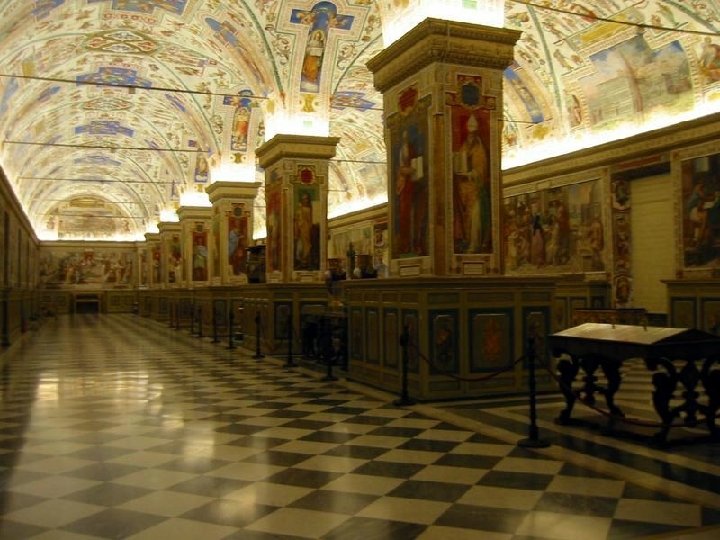
Corruption in the Church �Between 1450 & 1520 a series of popes known as Renaissance popes failed to meet the church’s spiritual needs �Popes too involved in political matters & not enough in religious matters �Church officials were concerned with money & used their church offices to get wealthy and advance their careers
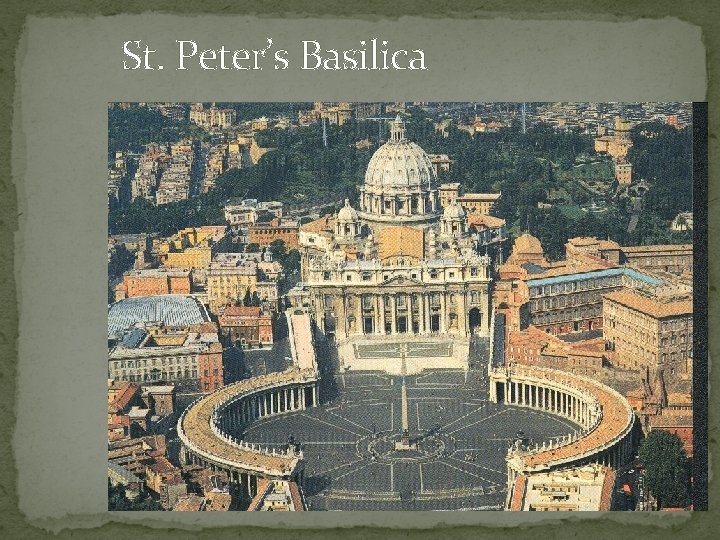
St. Peter’s Basilica
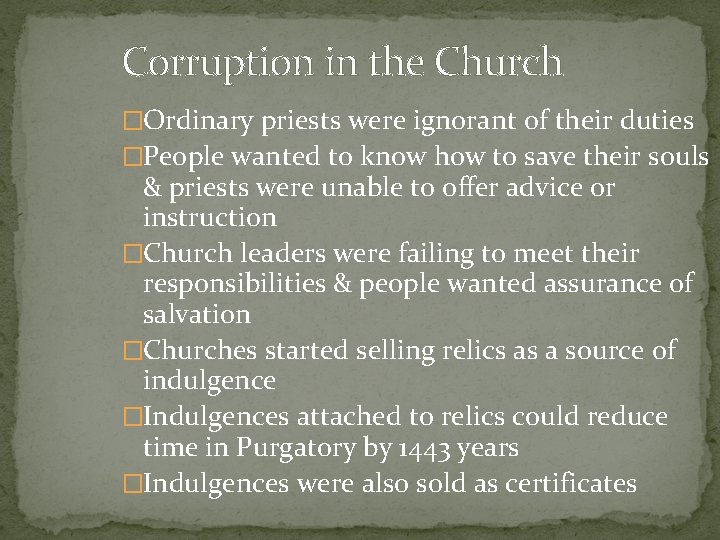
Corruption in the Church �Ordinary priests were ignorant of their duties �People wanted to know how to save their souls & priests were unable to offer advice or instruction �Church leaders were failing to meet their responsibilities & people wanted assurance of salvation �Churches started selling relics as a source of indulgence �Indulgences attached to relics could reduce time in Purgatory by 1443 years �Indulgences were also sold as certificates
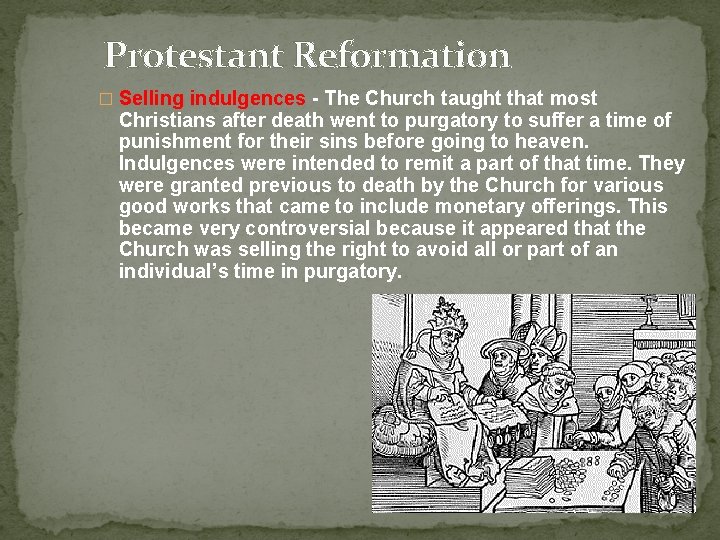
Protestant Reformation � Selling indulgences - The Church taught that most Christians after death went to purgatory to suffer a time of punishment for their sins before going to heaven. Indulgences were intended to remit a part of that time. They were granted previous to death by the Church for various good works that came to include monetary offerings. This became very controversial because it appeared that the Church was selling the right to avoid all or part of an individual’s time in purgatory.
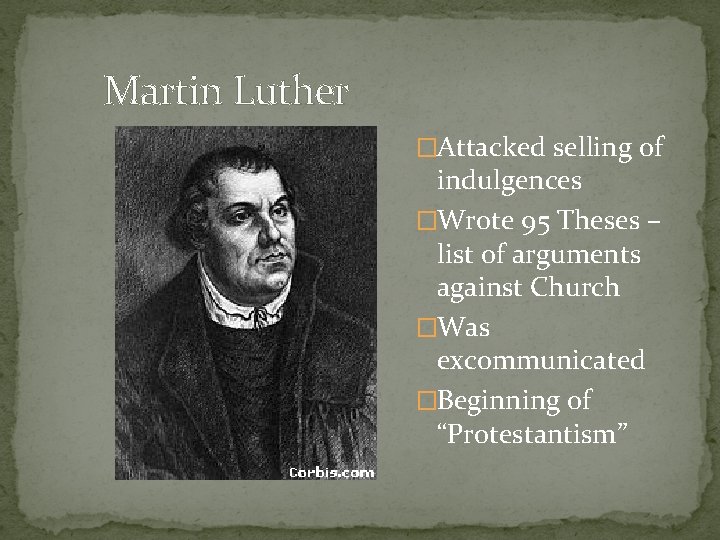
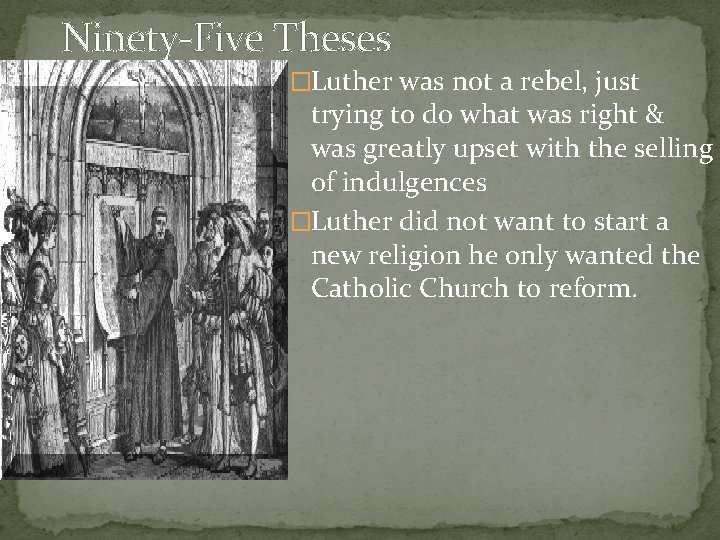
Martin Luther �Attacked selling of indulgences �Wrote 95 Theses – list of arguments against Church �Was excommunicated �Beginning of “Protestantism”
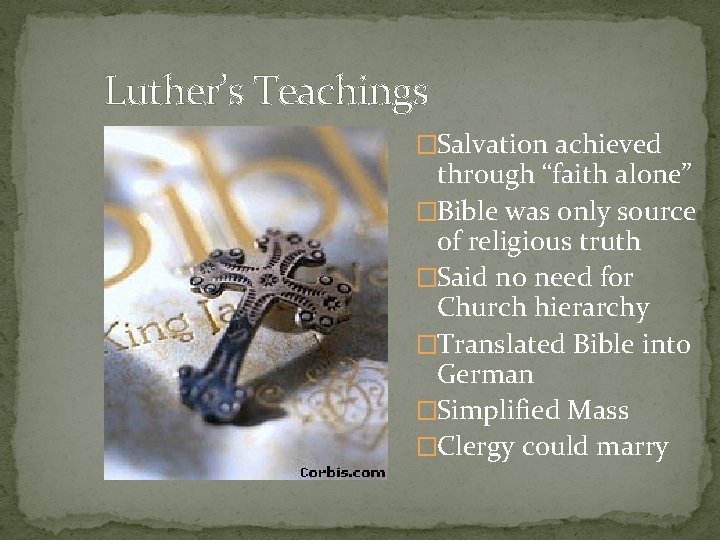
Luther’s Teachings �Salvation achieved through “faith alone” �Bible was only source of religious truth �Said no need for Church hierarchy �Translated Bible into German �Simplified Mass �Clergy could marry
Ninety-Five Theses �Luther was not a rebel, just trying to do what was right & was greatly upset with the selling of indulgences �Luther did not want to start a new religion he only wanted the Catholic Church to reform.
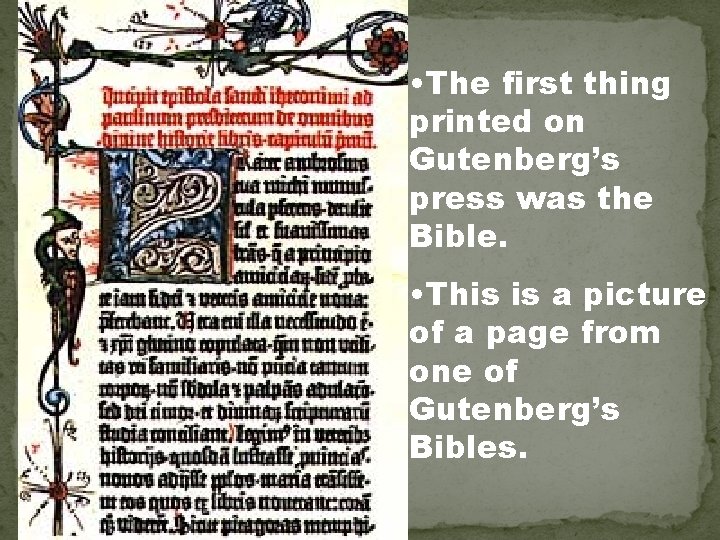
• The first thing printed on Gutenberg’s press was the Bible. • This is a picture of a page from one of Gutenberg’s Bibles.
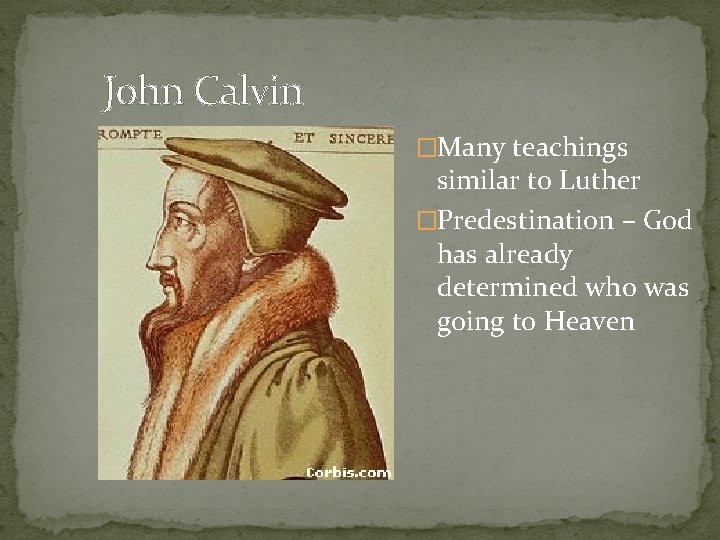
John Calvin �Many teachings similar to Luther �Predestination – God has already determined who was going to Heaven
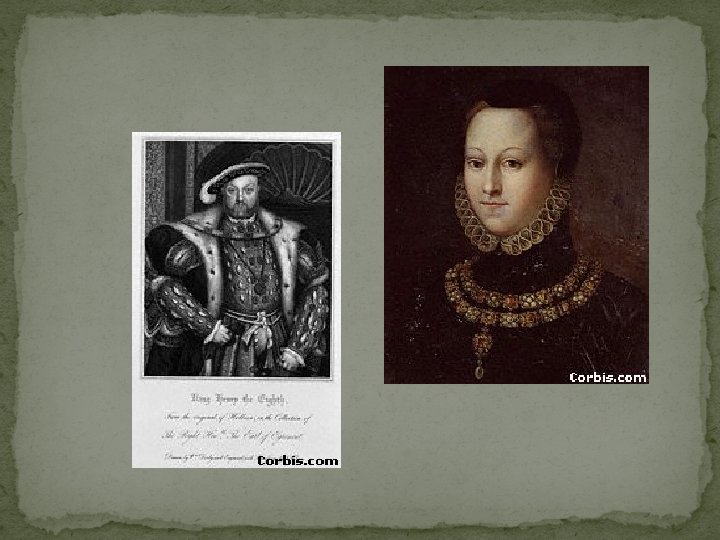
4 – Reformation Ideas Spread �Henry VIII broke from Church over marriage, annulment, divorce �He started Church of England �Catholic vs. Protestants in England �Elizabeth I keeps England Protestant
Break with the Church �By 1520, Luther was calling for a break from the Church/called on German princes to overthrow the papacy in Germany and form a reformed church �Luther attacked the use of sacraments/thought priests were using them to destroy the real meaning of the gospel �Luther only kept 2 sacraments = Baptism & Communion �Luther also called for the clergy to marry/went against Catholic requirement of celibacy
Lutheranism �Salvation by faith alone �Simplified church doctrine and rituals �Services in common language so more people could attend and understand �Bible was translated into German
Calvinist �John Calvin �God had all encompassing power �Directs everything; past, present and future �God determines the fate of every single person �Support came from the Netherlands and Scotland
Anabaptists �Initiated practice of baptism �Only people who were free and informed could make the decision to become Christians �Separation of church and state
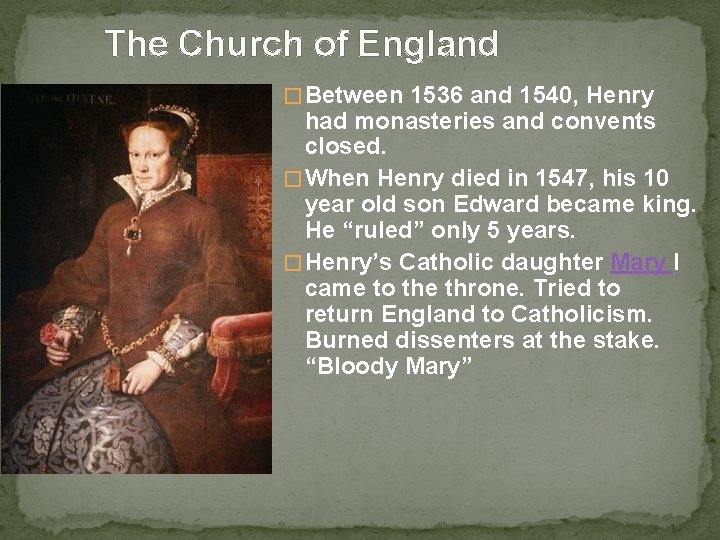
The Church of England � Between 1536 and 1540, Henry had monasteries and convents closed. � When Henry died in 1547, his 10 year old son Edward became king. He “ruled” only 5 years. � Henry’s Catholic daughter Mary I came to the throne. Tried to return England to Catholicism. Burned dissenters at the stake. “Bloody Mary”
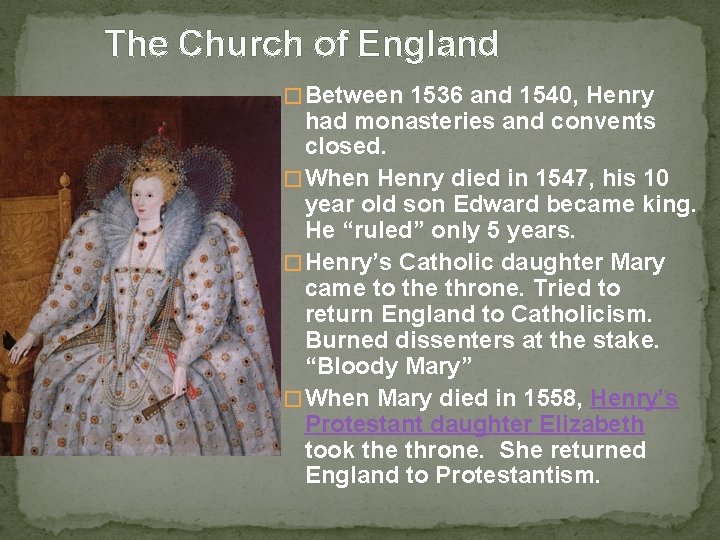
The Church of England � Between 1536 and 1540, Henry had monasteries and convents closed. � When Henry died in 1547, his 10 year old son Edward became king. He “ruled” only 5 years. � Henry’s Catholic daughter Mary came to the throne. Tried to return England to Catholicism. Burned dissenters at the stake. “Bloody Mary” � When Mary died in 1558, Henry’s Protestant daughter Elizabeth took the throne. She returned England to Protestantism.
Catholic Reformation or Counter-Reformation
Reforms �Eliminate Abuses �Rebirth of faith among followers �Reassess Church Principles �Restore authority to Pope �Stop spread of Protestantism
Inquisition �Rid Italy of those that denied the existence of the church, especially the Protestants �Restore authority of the Pope �Implemented censorship to stop spread of humanist thinking that led the Italian Renaissance �Published list of banned books
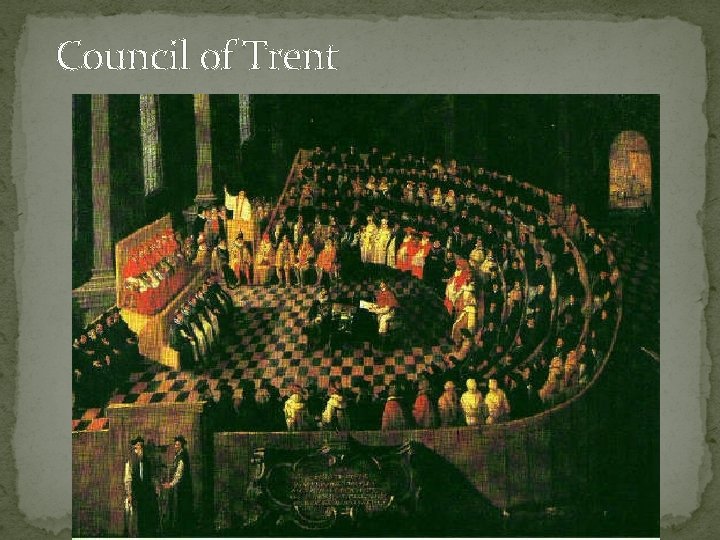
Council of Trent
Catholic Reformation �The commission blamed the problems on corrupt popes �Final decrees of Council of Trent = reaffirmed traditional Catholic teachings, both faith and good works were declared necessary for salvation, seven sacraments were upheld, Belief in purgatory was strengthened, selling of indulgences was forbidden
The Catholic Reformation or Counter Reformation �Roman Catholic church reacts - reforms � Refining doctrine, missionary activities to Protestants, attempt to renew spiritual activity �Council of Trent (1545 -1563) periodic meetings to discuss reform �Society of Jesus (Jesuits) founded by St. Ignatius Loyola (1491 -1556) � Rigorous religious and secular education � Effective missionaries 29
Results of Catholic Reformation �Tried to spread Catholicism and win back lands lost to Protestants �Jesuits were the key missionaries that went out �The Catholics were not successful in completely stopping the spread of Protestantism
Witch Hunts �Most prominent in regions of tension between Catholics and Protestants �Late 15 th century development in belief in Devil and human assistants � 16 th-17 th centuries approximately 110, 000 people put on trial, some 60, 000 put to death � Vast majority females, usually single, widowed � Held accountable for crop failures, miscarriages, etc. �New England: 234 witches tried, 36 hung 31
Religious Wars �Protestants and Roman Catholics fight in France (1562 -1598) � 1588 Philip II of Spain attacks England to force return to Catholicism �Netherlands rebel against Spain, gain independence by 1610 32
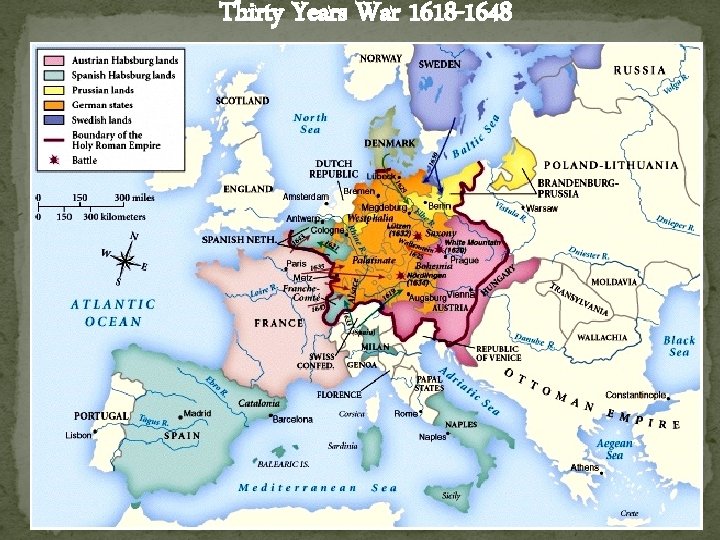
The Thirty Years’ War (1618 -1645) �Holy Roman emperor attempts to force Bohemians to return to Roman Catholic Church �All of Europe becomes involved in conflict � Principal battleground: Germany �Political, economic issues involved �Approximately one-third of German population destroyed 33
Thirty Years War 1618 -1648
Characteristics of the Thirty Years War v The Holy Roman Empire was the battleground. v At the beginning it was the Catholics vs. the Protestants. • Resolved by the Treaty of Westphalia in 1648.
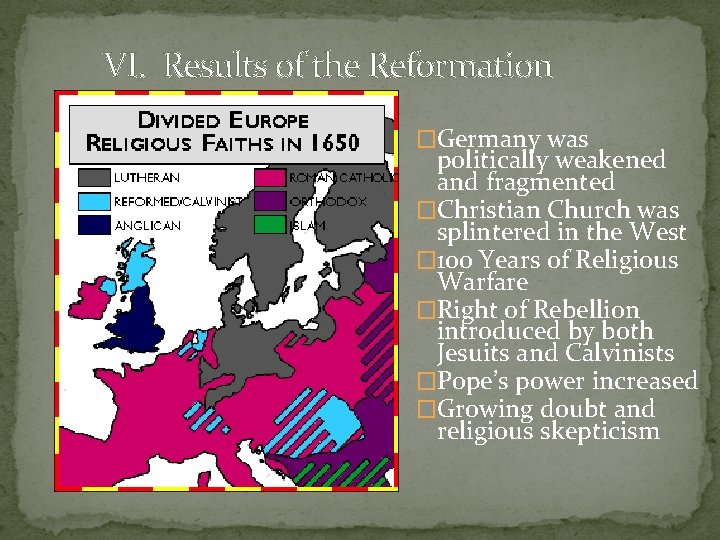
VI. Results of the Reformation �Germany was politically weakened and fragmented �Christian Church was splintered in the West � 100 Years of Religious Warfare �Right of Rebellion introduced by both Jesuits and Calvinists �Pope’s power increased �Growing doubt and religious skepticism
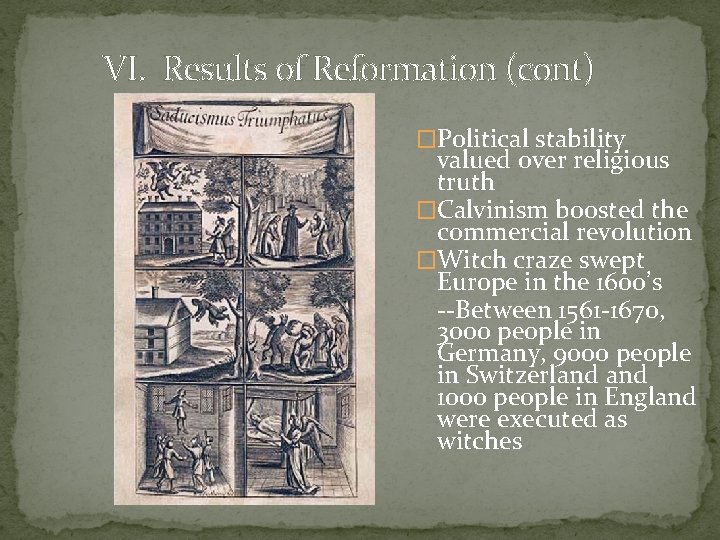
VI. Results of Reformation (cont) �Political stability valued over religious truth �Calvinism boosted the commercial revolution �Witch craze swept Europe in the 1600’s --Between 1561 -1670, 3000 people in Germany, 9000 people in Switzerland 1000 people in England were executed as witches
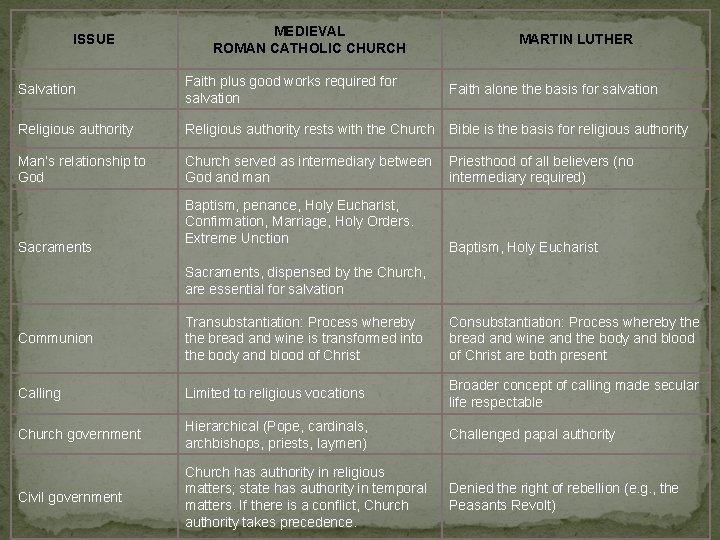
ISSUE MEDIEVAL ROMAN CATHOLIC CHURCH MARTIN LUTHER Salvation Faith plus good works required for salvation Religious authority rests with the Church Bible is the basis for religious authority Man’s relationship to God Church served as intermediary between God and man Sacraments Baptism, penance, Holy Eucharist, Confirmation, Marriage, Holy Orders. Extreme Unction Faith alone the basis for salvation Priesthood of all believers (no intermediary required) Baptism, Holy Eucharist Sacraments, dispensed by the Church, are essential for salvation Communion Transubstantiation: Process whereby the bread and wine is transformed into the body and blood of Christ Consubstantiation: Process whereby the bread and wine and the body and blood of Christ are both present Calling Limited to religious vocations Broader concept of calling made secular life respectable Church government Hierarchical (Pope, cardinals, archbishops, priests, laymen) Challenged papal authority Civil government Church has authority in religious matters; state has authority in temporal matters. If there is a conflict, Church authority takes precedence. Denied the right of rebellion (e. g. , the Peasants Revolt)
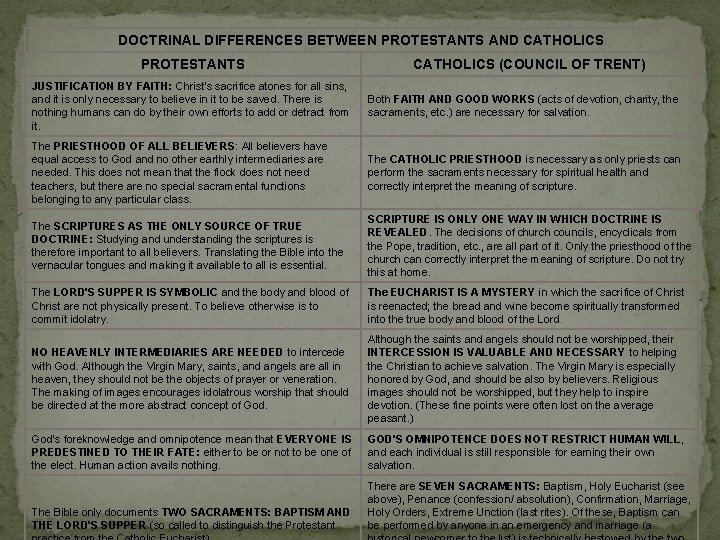
DOCTRINAL DIFFERENCES BETWEEN PROTESTANTS AND CATHOLICS PROTESTANTS CATHOLICS (COUNCIL OF TRENT) JUSTIFICATION BY FAITH: Christ's sacrifice atones for all sins, and it is only necessary to believe in it to be saved. There is nothing humans can do by their own efforts to add or detract from it. Both FAITH AND GOOD WORKS (acts of devotion, charity, the sacraments, etc. ) are necessary for salvation. The PRIESTHOOD OF ALL BELIEVERS: All believers have equal access to God and no other earthly intermediaries are needed. This does not mean that the flock does not need teachers, but there are no special sacramental functions belonging to any particular class. The CATHOLIC PRIESTHOOD is necessary as only priests can perform the sacraments necessary for spiritual health and correctly interpret the meaning of scripture. The SCRIPTURES AS THE ONLY SOURCE OF TRUE DOCTRINE: Studying and understanding the scriptures is therefore important to all believers. Translating the Bible into the vernacular tongues and making it available to all is essential. SCRIPTURE IS ONLY ONE WAY IN WHICH DOCTRINE IS REVEALED. The decisions of church councils, encyclicals from the Pope, tradition, etc. , are all part of it. Only the priesthood of the church can correctly interpret the meaning of scripture. Do not try this at home. The LORD'S SUPPER IS SYMBOLIC and the body and blood of Christ are not physically present. To believe otherwise is to commit idolatry. The EUCHARIST IS A MYSTERY in which the sacrifice of Christ is reenacted; the bread and wine become spiritually transformed into the true body and blood of the Lord. NO HEAVENLY INTERMEDIARIES ARE NEEDED to intercede with God. Although the Virgin Mary, saints, and angels are all in heaven, they should not be the objects of prayer or veneration. The making of images encourages idolatrous worship that should be directed at the more abstract concept of God. Although the saints and angels should not be worshipped, their INTERCESSION IS VALUABLE AND NECESSARY to helping the Christian to achieve salvation. The Virgin Mary is especially honored by God, and should be also by believers. Religious images should not be worshipped, but they help to inspire devotion. (These fine points were often lost on the average peasant. ) God's foreknowledge and omnipotence mean that EVERYONE IS PREDESTINED TO THEIR FATE: either to be or not to be one of the elect. Human action avails nothing. GOD'S OMNIPOTENCE DOES NOT RESTRICT HUMAN WILL, and each individual is still responsible for earning their own salvation. The Bible only documents TWO SACRAMENTS: BAPTISM AND THE LORD'S SUPPER (so called to distinguish the Protestant There are SEVEN SACRAMENTS: Baptism, Holy Eucharist (see above), Penance (confession/ absolution), Confirmation, Marriage, Holy Orders, Extreme Unction (last rites). Of these, Baptism can be performed by anyone in an emergency and marriage (a