
The Protestant Reformation AP WORLD HISTORY CHAPTER 16
- Slides: 37
The Protestant Reformation AP WORLD HISTORY CHAPTER 16 NOTES RELIGION & SCIENCE (1450 -1750)
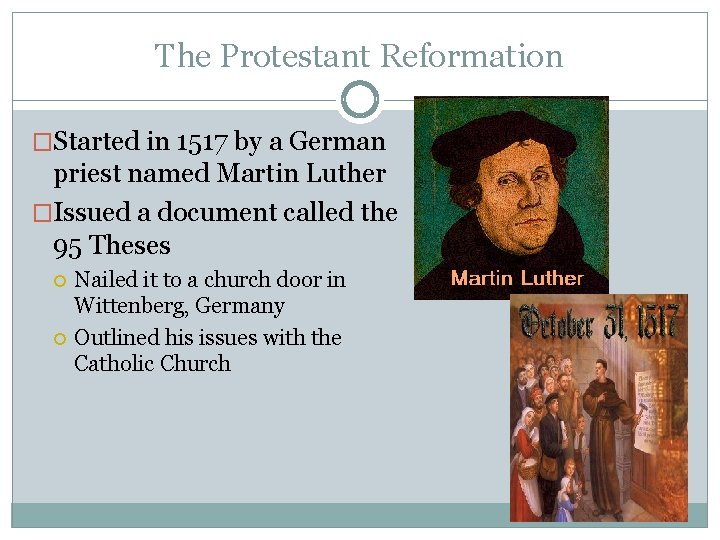
The Protestant Reformation �Started in 1517 by a German priest named Martin Luther �Issued a document called the 95 Theses Nailed it to a church door in Wittenberg, Germany Outlined his issues with the Catholic Church
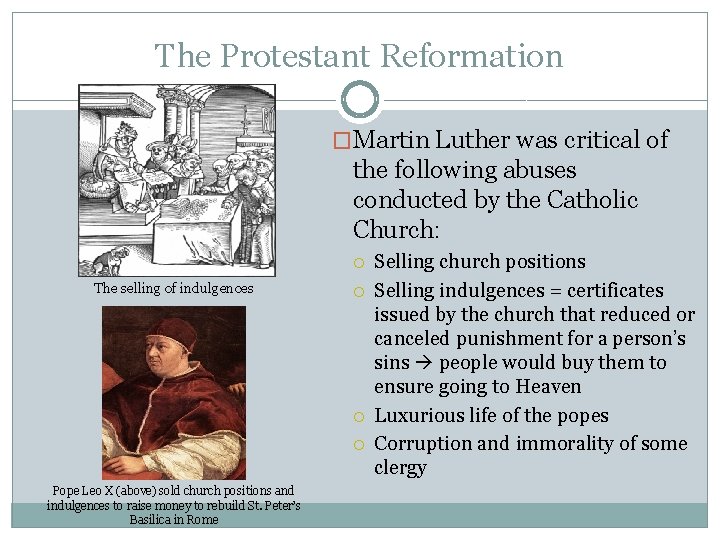
The Protestant Reformation �Martin Luther was critical of the following abuses conducted by the Catholic Church: The selling of indulgences Pope Leo X (above) sold church positions and indulgences to raise money to rebuild St. Peter’s Basilica in Rome Selling church positions Selling indulgences = certificates issued by the church that reduced or canceled punishment for a person’s sins people would buy them to ensure going to Heaven Luxurious life of the popes Corruption and immorality of some clergy
Martin Luther’s Beliefs �Salvation = came through faith alone; God’s grace is freely and directly granted to believers �Source of religious authority = the Bible (as interpreted by the individual), not the Pope or church leaders �These ideas = created a massive rift between Catholic and Protestant Christianity
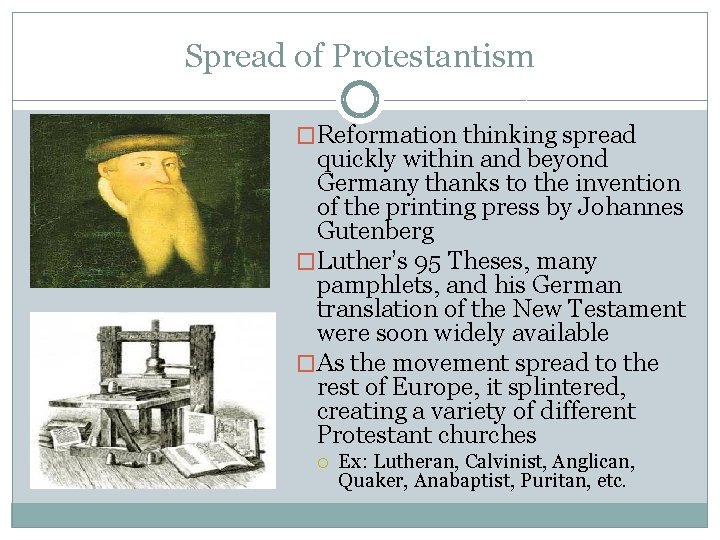
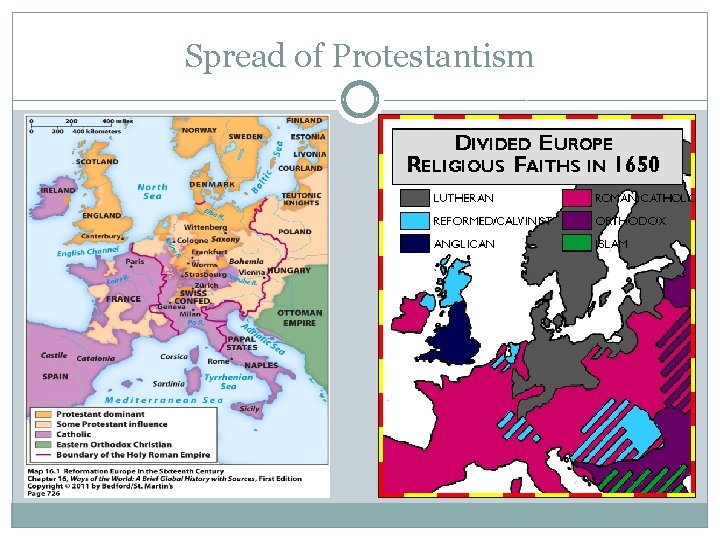
Spread of Protestantism �Reformation thinking spread quickly within and beyond Germany thanks to the invention of the printing press by Johannes Gutenberg �Luther’s 95 Theses, many pamphlets, and his German translation of the New Testament were soon widely available �As the movement spread to the rest of Europe, it splintered, creating a variety of different Protestant churches Ex: Lutheran, Calvinist, Anglican, Quaker, Anabaptist, Puritan, etc.
Spread of Protestantism
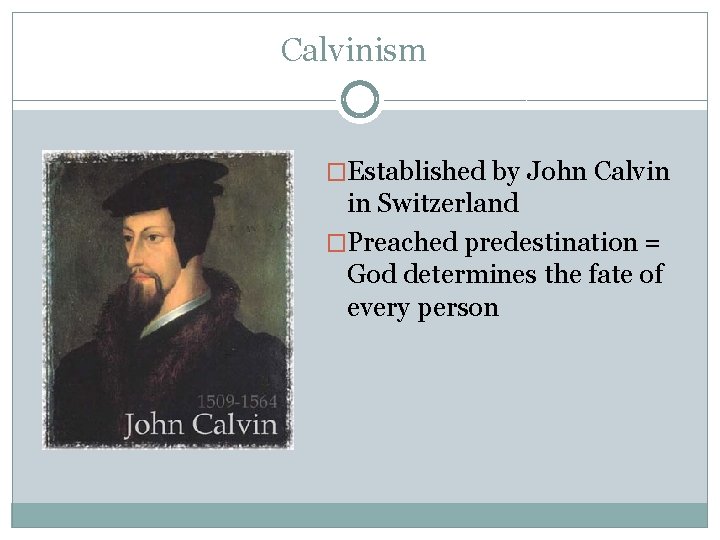
Calvinism �Established by John Calvin in Switzerland �Preached predestination = God determines the fate of every person
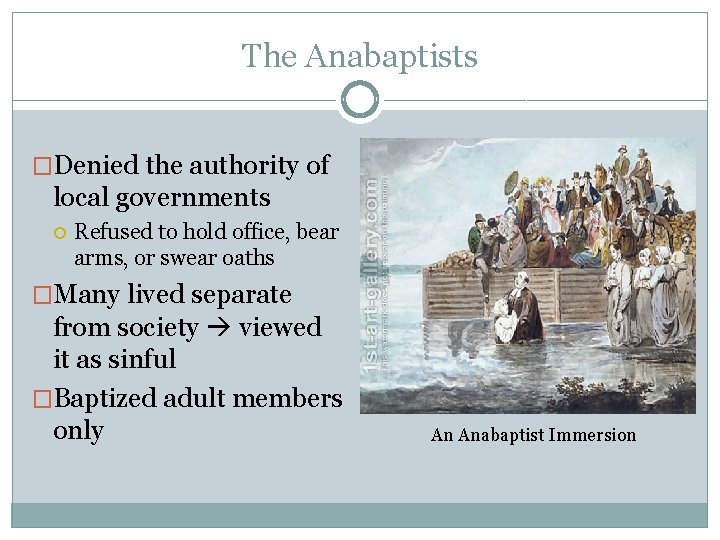
The Anabaptists �Denied the authority of local governments Refused to hold office, bear arms, or swear oaths �Many lived separate from society viewed it as sinful �Baptized adult members only An Anabaptist Immersion
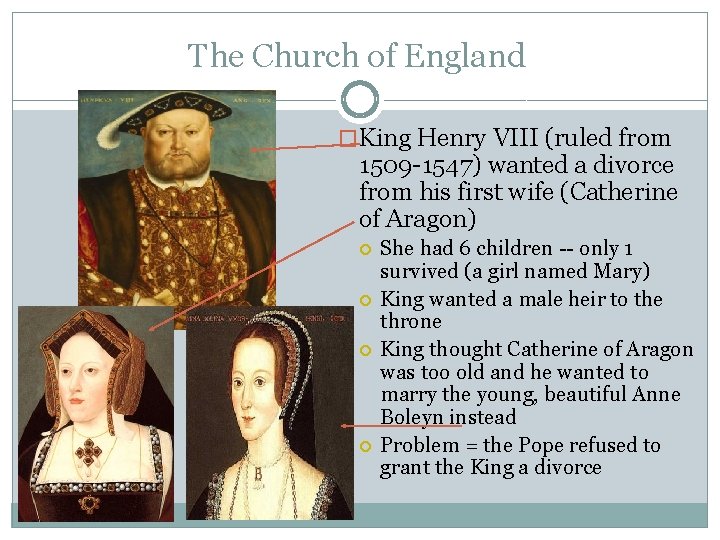
The Church of England �King Henry VIII (ruled from 1509 -1547) wanted a divorce from his first wife (Catherine of Aragon) She had 6 children -- only 1 survived (a girl named Mary) King wanted a male heir to the throne King thought Catherine of Aragon was too old and he wanted to marry the young, beautiful Anne Boleyn instead Problem = the Pope refused to grant the King a divorce
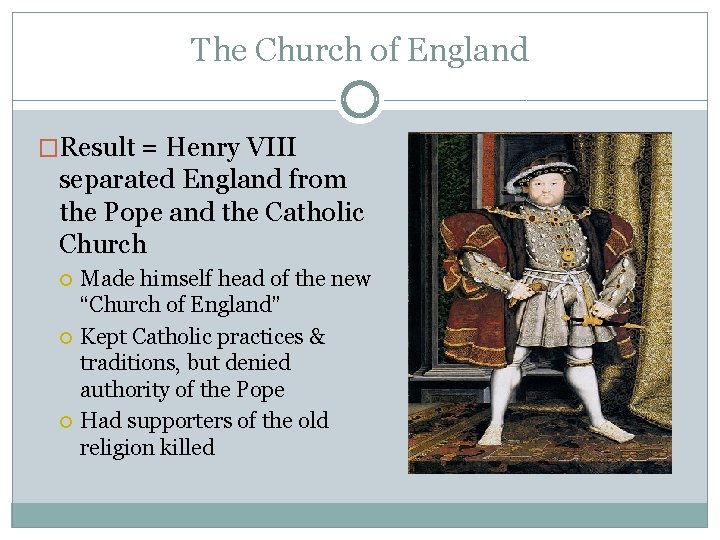
The Church of England �Result = Henry VIII separated England from the Pope and the Catholic Church Made himself head of the new “Church of England” Kept Catholic practices & traditions, but denied authority of the Pope Had supporters of the old religion killed
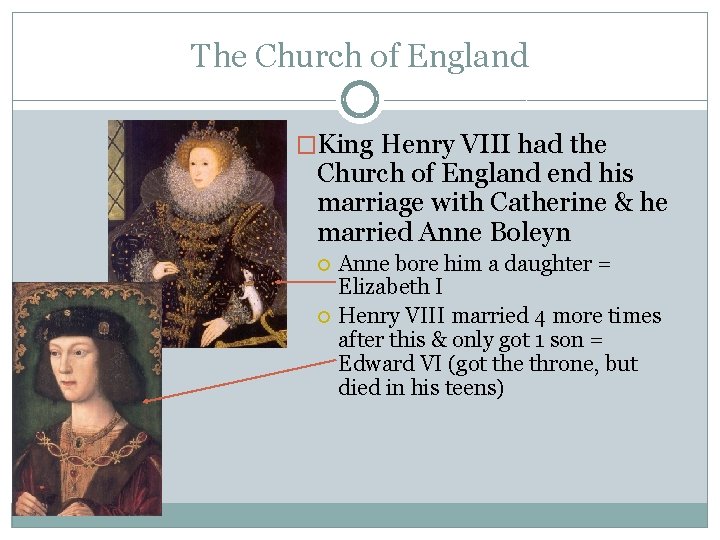
The Church of England �King Henry VIII had the Church of England end his marriage with Catherine & he married Anne Boleyn Anne bore him a daughter = Elizabeth I Henry VIII married 4 more times after this & only got 1 son = Edward VI (got the throne, but died in his teens)
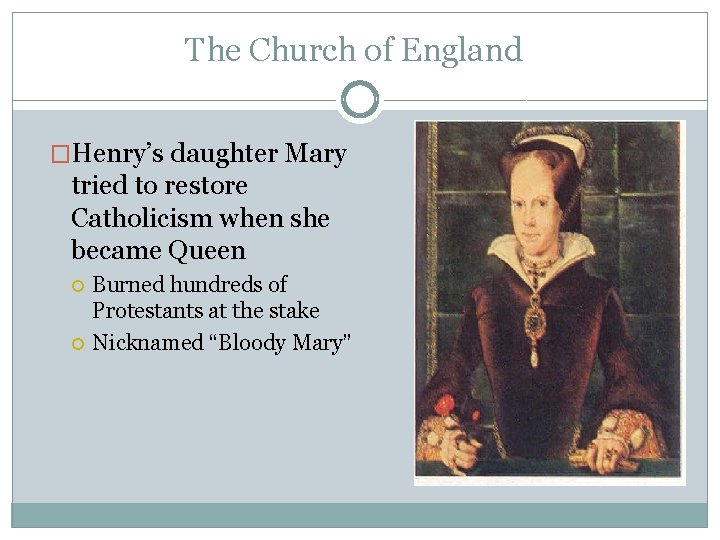
The Church of England �Henry’s daughter Mary tried to restore Catholicism when she became Queen Burned hundreds of Protestants at the stake Nicknamed “Bloody Mary”
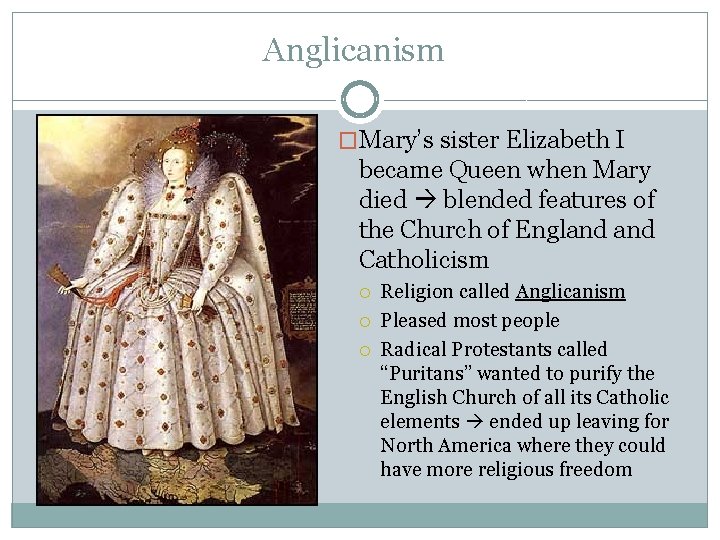
Anglicanism �Mary’s sister Elizabeth I became Queen when Mary died blended features of the Church of England Catholicism Religion called Anglicanism Pleased most people Radical Protestants called “Puritans” wanted to purify the English Church of all its Catholic elements ended up leaving for North America where they could have more religious freedom
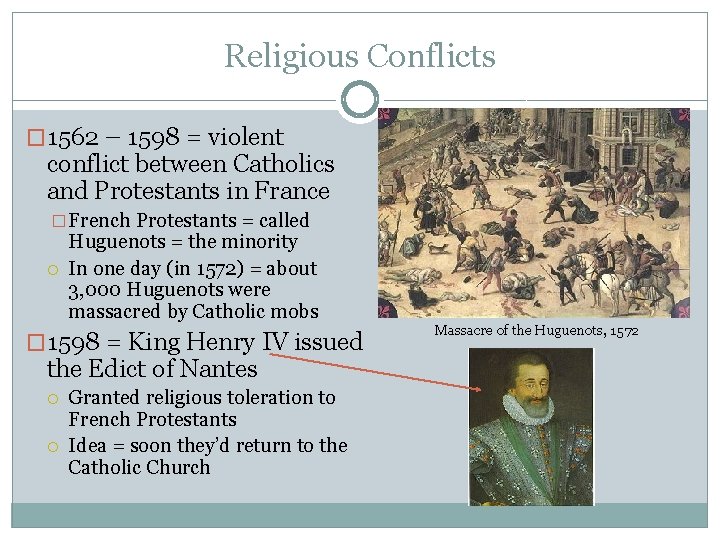
Religious Conflicts � 1562 – 1598 = violent conflict between Catholics and Protestants in France �French Protestants = called Huguenots = the minority In one day (in 1572) = about 3, 000 Huguenots were massacred by Catholic mobs � 1598 = King Henry IV issued the Edict of Nantes Granted religious toleration to French Protestants Idea = soon they’d return to the Catholic Church Massacre of the Huguenots, 1572
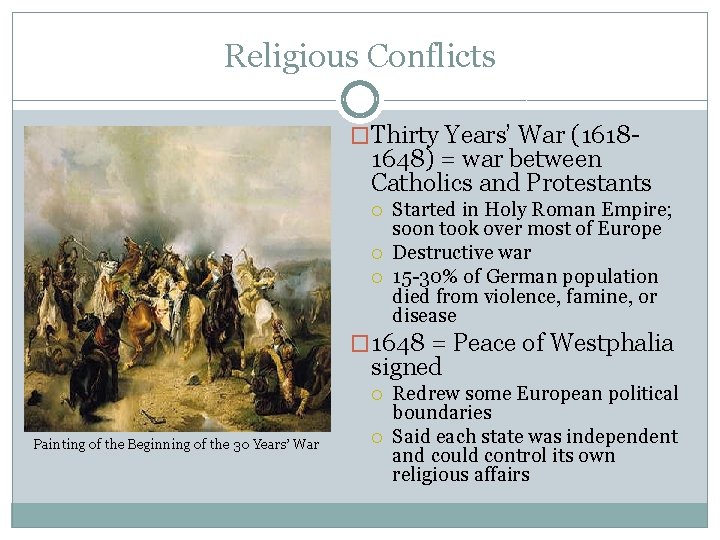
Religious Conflicts �Thirty Years’ War (1618 - 1648) = war between Catholics and Protestants Started in Holy Roman Empire; soon took over most of Europe Destructive war 15 -30% of German population died from violence, famine, or disease � 1648 = Peace of Westphalia signed Painting of the Beginning of the 30 Years’ War Redrew some European political boundaries Said each state was independent and could control its own religious affairs
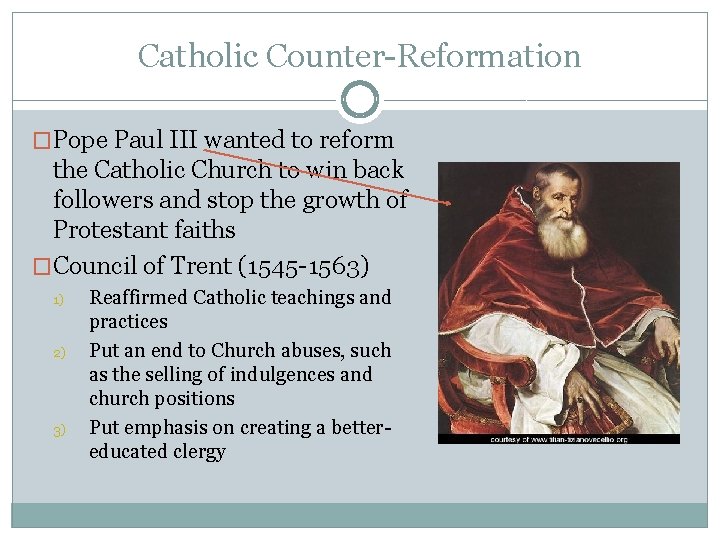
Catholic Counter-Reformation �Pope Paul III wanted to reform the Catholic Church to win back followers and stop the growth of Protestant faiths �Council of Trent (1545 -1563) 1) 2) 3) Reaffirmed Catholic teachings and practices Put an end to Church abuses, such as the selling of indulgences and church positions Put emphasis on creating a bettereducated clergy
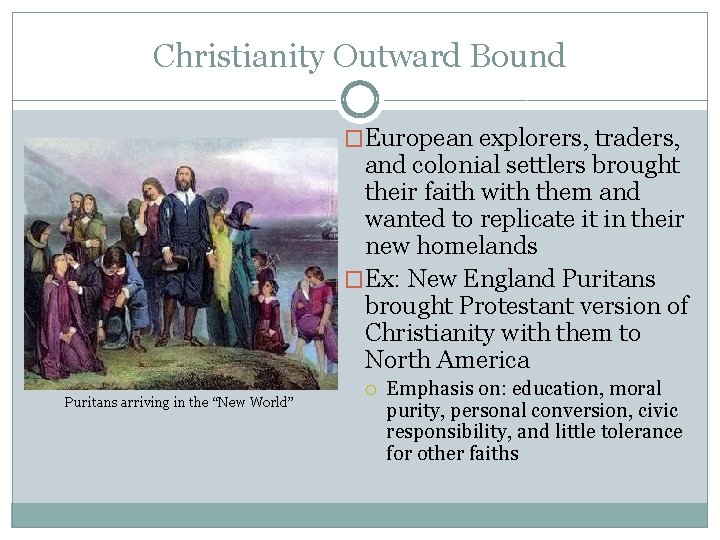
Christianity Outward Bound �European explorers, traders, and colonial settlers brought their faith with them and wanted to replicate it in their new homelands �Ex: New England Puritans brought Protestant version of Christianity with them to North America Puritans arriving in the “New World” Emphasis on: education, moral purity, personal conversion, civic responsibility, and little tolerance for other faiths
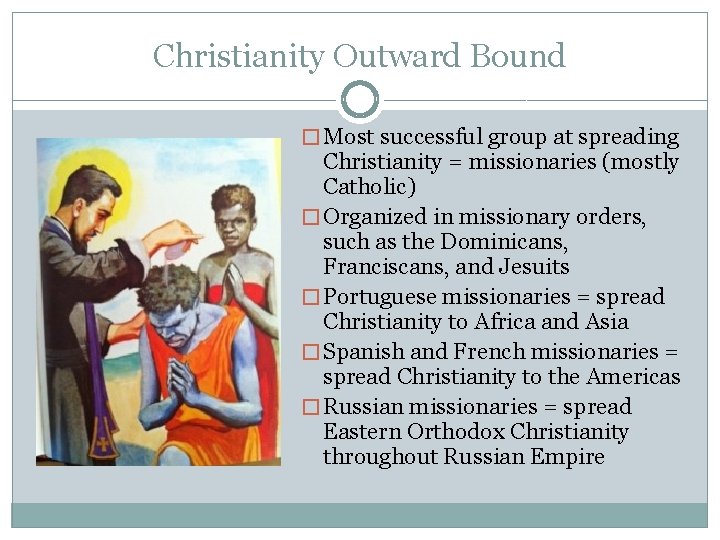
Christianity Outward Bound � Most successful group at spreading Christianity = missionaries (mostly Catholic) � Organized in missionary orders, such as the Dominicans, Franciscans, and Jesuits � Portuguese missionaries = spread Christianity to Africa and Asia � Spanish and French missionaries = spread Christianity to the Americas � Russian missionaries = spread Eastern Orthodox Christianity throughout Russian Empire
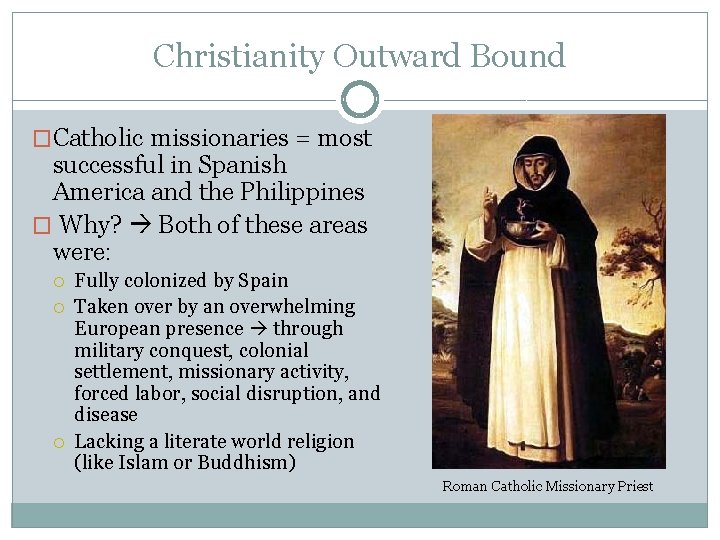
Christianity Outward Bound �Catholic missionaries = most successful in Spanish America and the Philippines � Why? Both of these areas were: Fully colonized by Spain Taken over by an overwhelming European presence through military conquest, colonial settlement, missionary activity, forced labor, social disruption, and disease Lacking a literate world religion (like Islam or Buddhism) Roman Catholic Missionary Priest
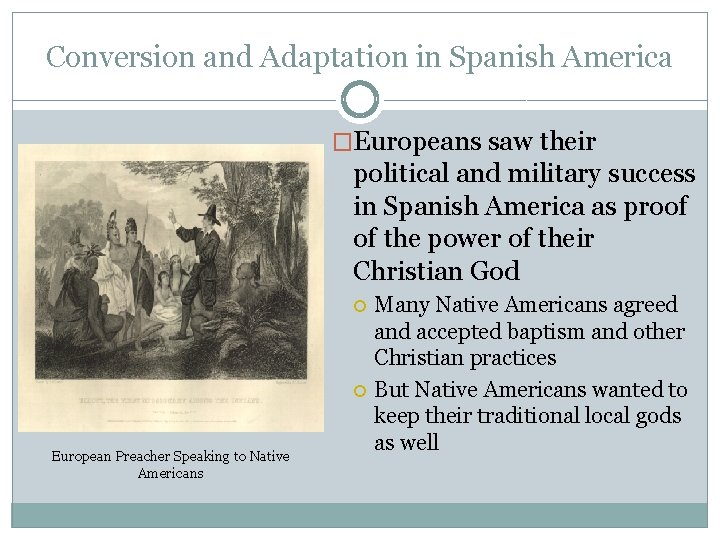
Conversion and Adaptation in Spanish America �Europeans saw their political and military success in Spanish America as proof of the power of their Christian God European Preacher Speaking to Native Americans Many Native Americans agreed and accepted baptism and other Christian practices But Native Americans wanted to keep their traditional local gods as well
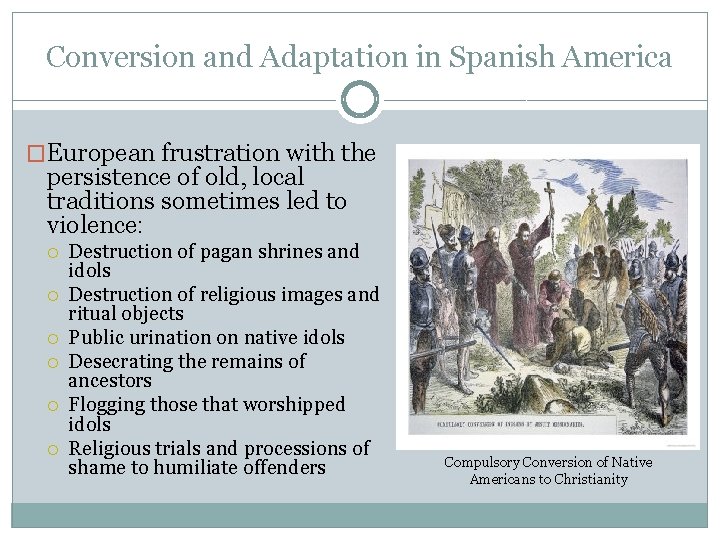
Conversion and Adaptation in Spanish America �European frustration with the persistence of old, local traditions sometimes led to violence: Destruction of pagan shrines and idols Destruction of religious images and ritual objects Public urination on native idols Desecrating the remains of ancestors Flogging those that worshipped idols Religious trials and processions of shame to humiliate offenders Compulsory Conversion of Native Americans to Christianity
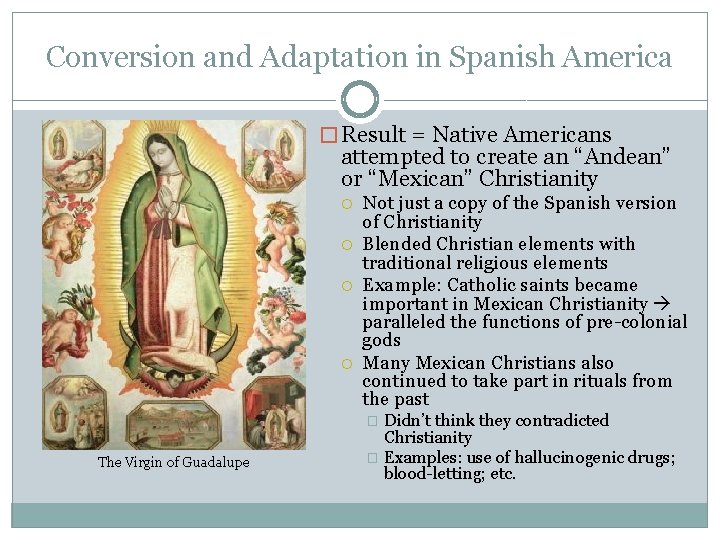
Conversion and Adaptation in Spanish America � Result = Native Americans attempted to create an “Andean” or “Mexican” Christianity Not just a copy of the Spanish version of Christianity Blended Christian elements with traditional religious elements Example: Catholic saints became important in Mexican Christianity paralleled the functions of pre-colonial gods Many Mexican Christians also continued to take part in rituals from the past Didn’t think they contradicted Christianity � Examples: use of hallucinogenic drugs; blood-letting; etc. � The Virgin of Guadalupe
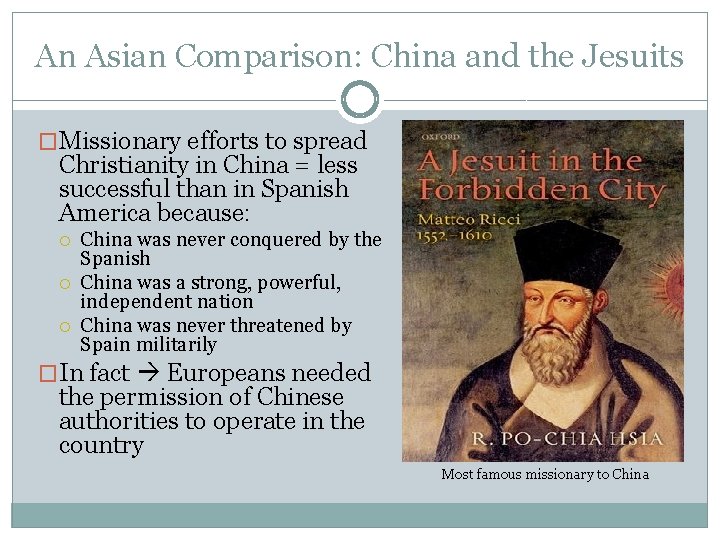
An Asian Comparison: China and the Jesuits �Missionary efforts to spread Christianity in China = less successful than in Spanish America because: China was never conquered by the Spanish China was a strong, powerful, independent nation China was never threatened by Spain militarily �In fact Europeans needed the permission of Chinese authorities to operate in the country Most famous missionary to China
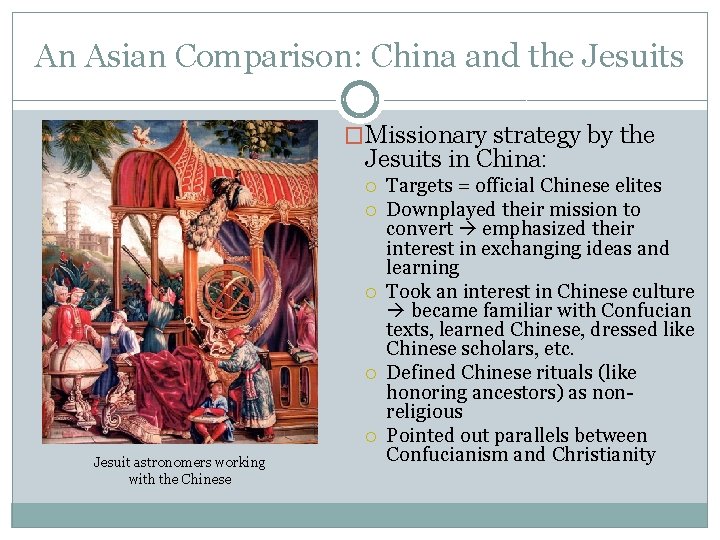
An Asian Comparison: China and the Jesuits �Missionary strategy by the Jesuits in China: Jesuit astronomers working with the Chinese Targets = official Chinese elites Downplayed their mission to convert emphasized their interest in exchanging ideas and learning Took an interest in Chinese culture became familiar with Confucian texts, learned Chinese, dressed like Chinese scholars, etc. Defined Chinese rituals (like honoring ancestors) as nonreligious Pointed out parallels between Confucianism and Christianity
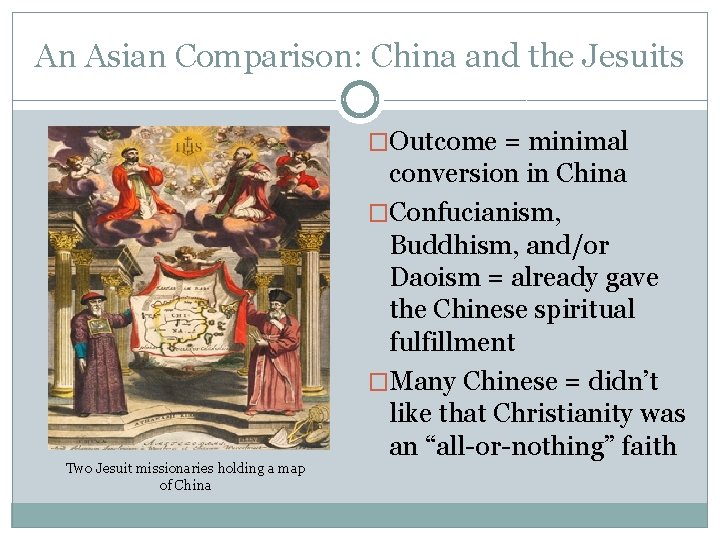
An Asian Comparison: China and the Jesuits �Outcome = minimal Two Jesuit missionaries holding a map of China conversion in China �Confucianism, Buddhism, and/or Daoism = already gave the Chinese spiritual fulfillment �Many Chinese = didn’t like that Christianity was an “all-or-nothing” faith
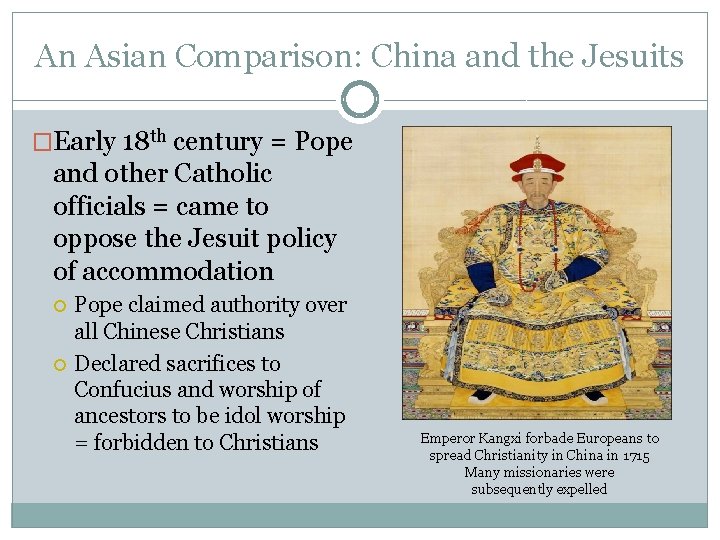
An Asian Comparison: China and the Jesuits �Early 18 th century = Pope and other Catholic officials = came to oppose the Jesuit policy of accommodation Pope claimed authority over all Chinese Christians Declared sacrifices to Confucius and worship of ancestors to be idol worship = forbidden to Christians Emperor Kangxi forbade Europeans to spread Christianity in China in 1715 Many missionaries were subsequently expelled
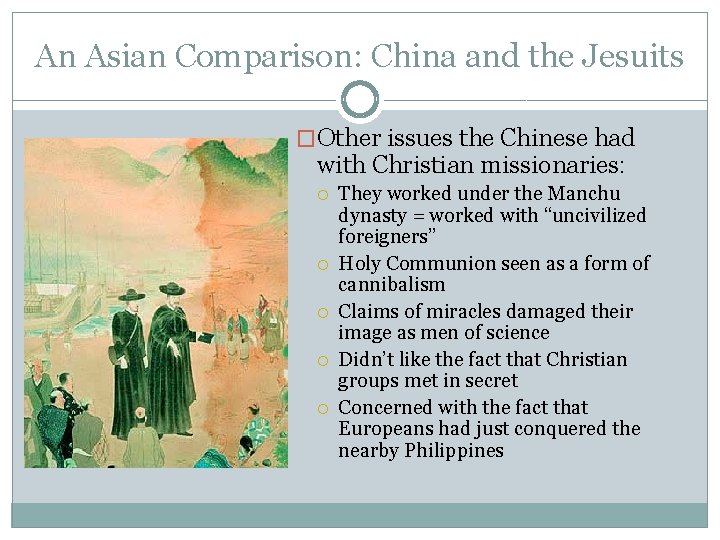
An Asian Comparison: China and the Jesuits �Other issues the Chinese had with Christian missionaries: They worked under the Manchu dynasty = worked with “uncivilized foreigners” Holy Communion seen as a form of cannibalism Claims of miracles damaged their image as men of science Didn’t like the fact that Christian groups met in secret Concerned with the fact that Europeans had just conquered the nearby Philippines
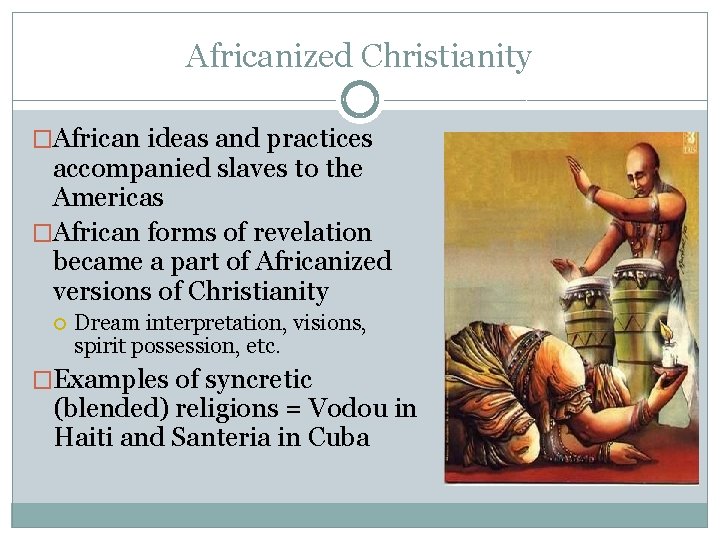
Africanized Christianity �African ideas and practices accompanied slaves to the Americas �African forms of revelation became a part of Africanized versions of Christianity Dream interpretation, visions, spirit possession, etc. �Examples of syncretic (blended) religions = Vodou in Haiti and Santeria in Cuba
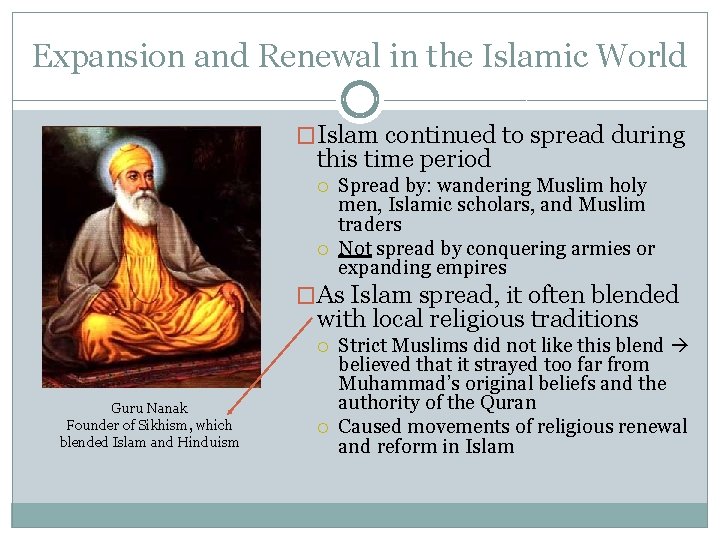
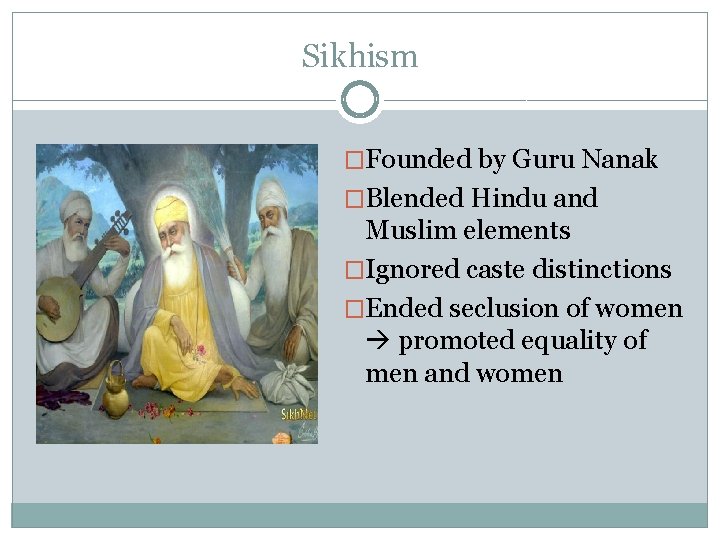
Expansion and Renewal in the Islamic World �Islam continued to spread during this time period Spread by: wandering Muslim holy men, Islamic scholars, and Muslim traders Not spread by conquering armies or expanding empires �As Islam spread, it often blended with local religious traditions Guru Nanak Founder of Sikhism, which blended Islam and Hinduism Strict Muslims did not like this blend believed that it strayed too far from Muhammad’s original beliefs and the authority of the Quran Caused movements of religious renewal and reform in Islam
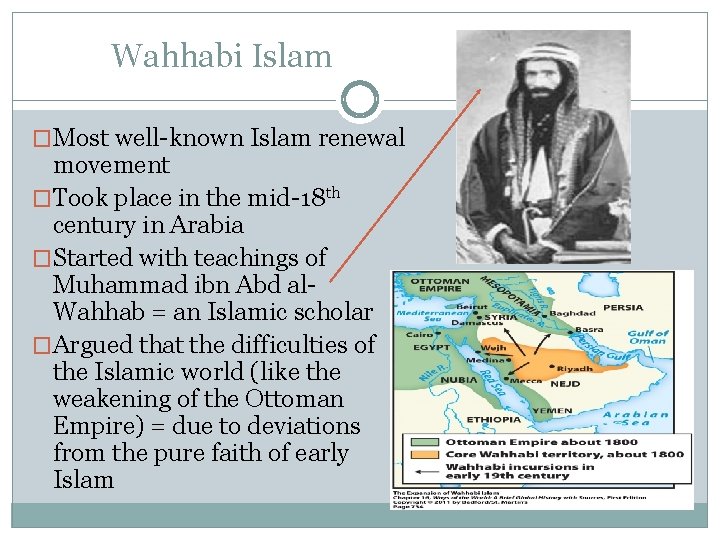
Wahhabi Islam �Most well-known Islam renewal movement �Took place in the mid-18 th century in Arabia �Started with teachings of Muhammad ibn Abd al. Wahhab = an Islamic scholar �Argued that the difficulties of the Islamic world (like the weakening of the Ottoman Empire) = due to deviations from the pure faith of early Islam
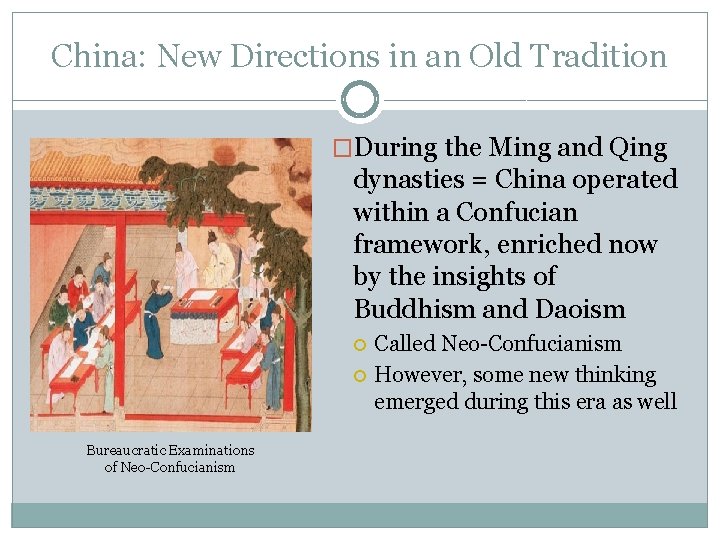
China: New Directions in an Old Tradition �During the Ming and Qing dynasties = China operated within a Confucian framework, enriched now by the insights of Buddhism and Daoism Bureaucratic Examinations of Neo-Confucianism Called Neo-Confucianism However, some new thinking emerged during this era as well
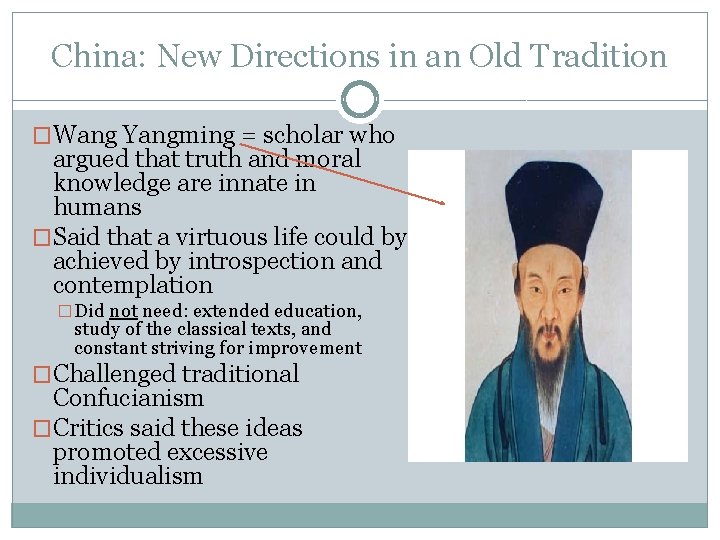
China: New Directions in an Old Tradition �Wang Yangming = scholar who argued that truth and moral knowledge are innate in humans �Said that a virtuous life could by achieved by introspection and contemplation � Did not need: extended education, study of the classical texts, and constant striving for improvement �Challenged traditional Confucianism �Critics said these ideas promoted excessive individualism
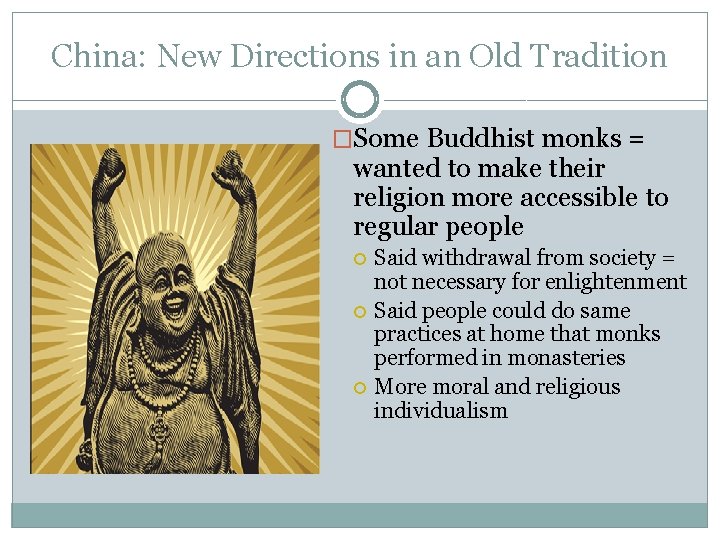
China: New Directions in an Old Tradition �Some Buddhist monks = wanted to make their religion more accessible to regular people Said withdrawal from society = not necessary for enlightenment Said people could do same practices at home that monks performed in monasteries More moral and religious individualism
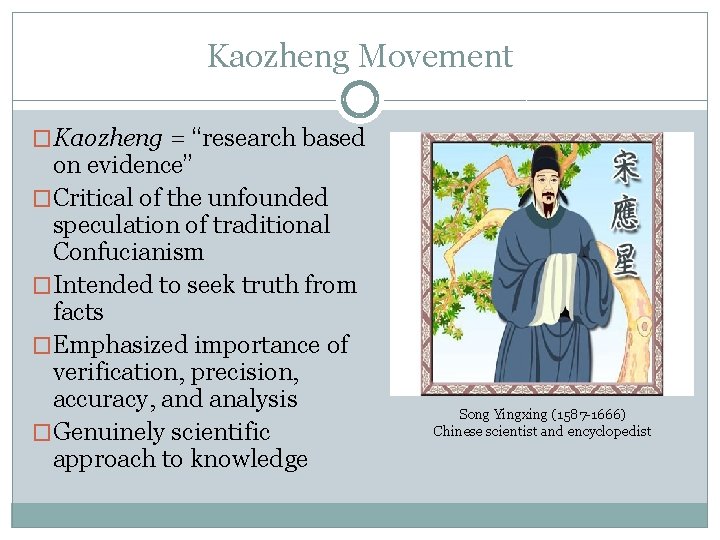
Kaozheng Movement �Kaozheng = “research based on evidence” �Critical of the unfounded speculation of traditional Confucianism �Intended to seek truth from facts �Emphasized importance of verification, precision, accuracy, and analysis �Genuinely scientific approach to knowledge Song Yingxing (1587 -1666) Chinese scientist and encyclopedist
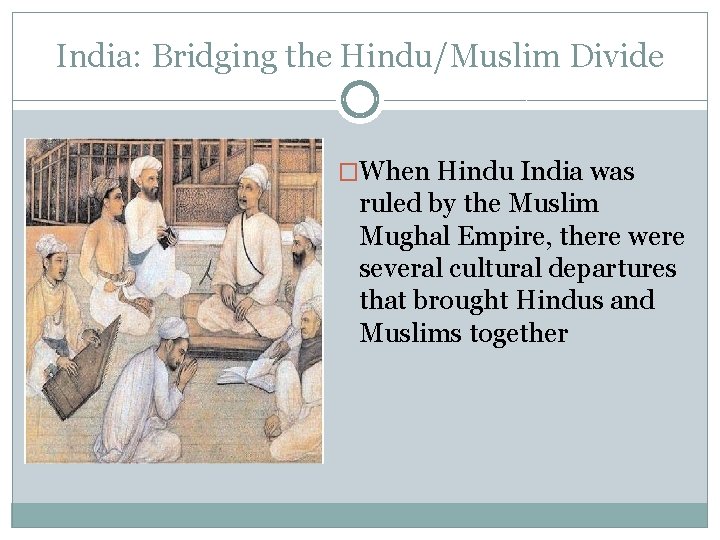
India: Bridging the Hindu/Muslim Divide �When Hindu India was ruled by the Muslim Mughal Empire, there were several cultural departures that brought Hindus and Muslims together
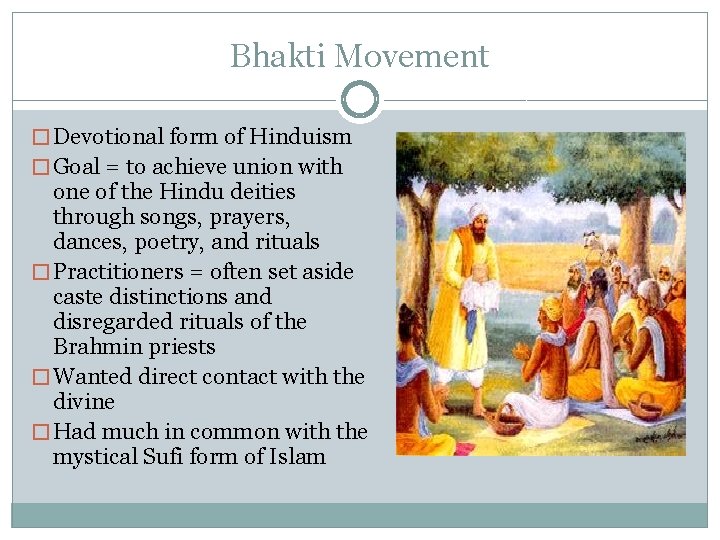
Bhakti Movement � Devotional form of Hinduism � Goal = to achieve union with one of the Hindu deities through songs, prayers, dances, poetry, and rituals � Practitioners = often set aside caste distinctions and disregarded rituals of the Brahmin priests � Wanted direct contact with the divine � Had much in common with the mystical Sufi form of Islam
Sikhism �Founded by Guru Nanak �Blended Hindu and Muslim elements �Ignored caste distinctions �Ended seclusion of women promoted equality of men and women