
The Proposal The Final Product Introduction Including your


- Slides: 22
The Proposal
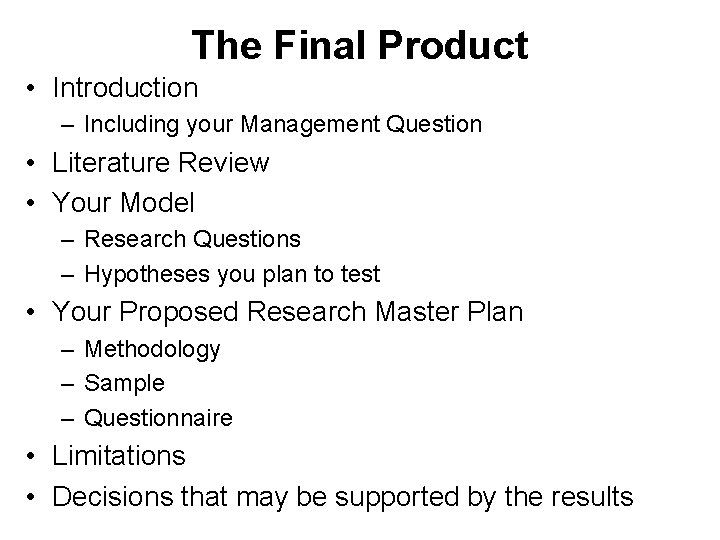
The Final Product • Introduction – Including your Management Question • Literature Review • Your Model – Research Questions – Hypotheses you plan to test • Your Proposed Research Master Plan – Methodology – Sample – Questionnaire • Limitations • Decisions that may be supported by the results
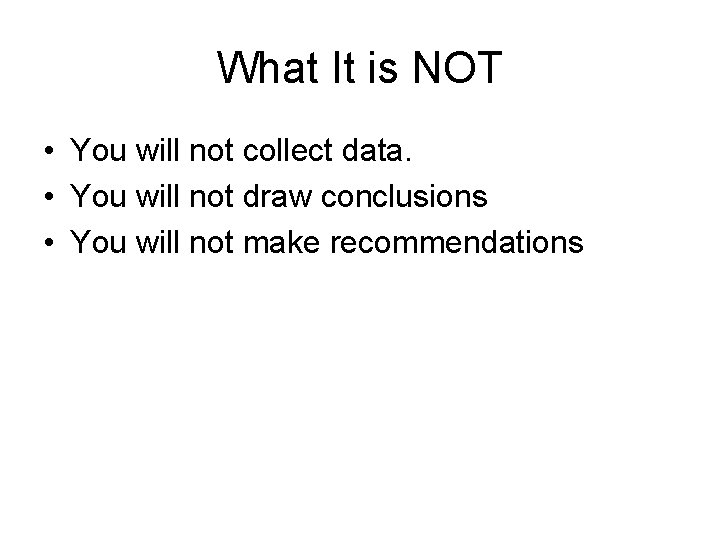
What It is NOT • You will not collect data. • You will not draw conclusions • You will not make recommendations
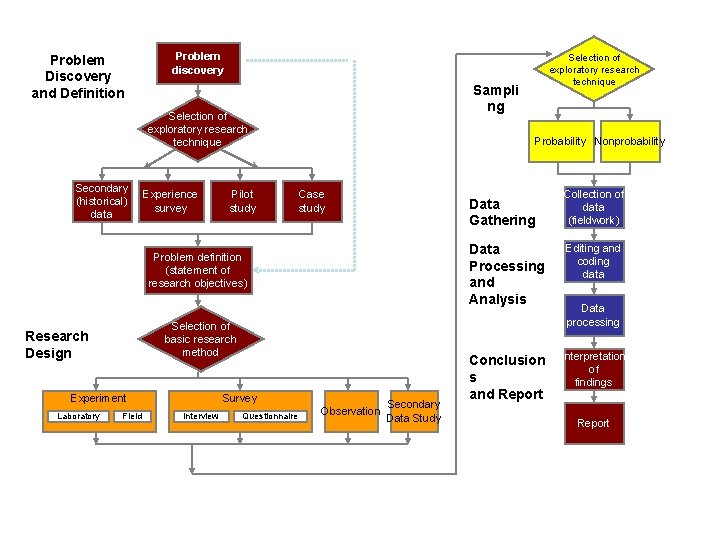
Problem Discovery and Definition Problem discovery Sampli ng Selection of exploratory research technique Secondary (historical) data Experience survey Pilot study Probability Nonprobability Case study Data Gathering Problem definition (statement of research objectives) Selection of basic research method Research Design Experiment Laboratory Field Survey Interview Questionnaire Selection of exploratory research technique Observation Secondary Data Study Collection of data (fieldwork) Data Processing and Analysis Editing and coding data Conclusion s and Report Interpretation of findings Data processing Report
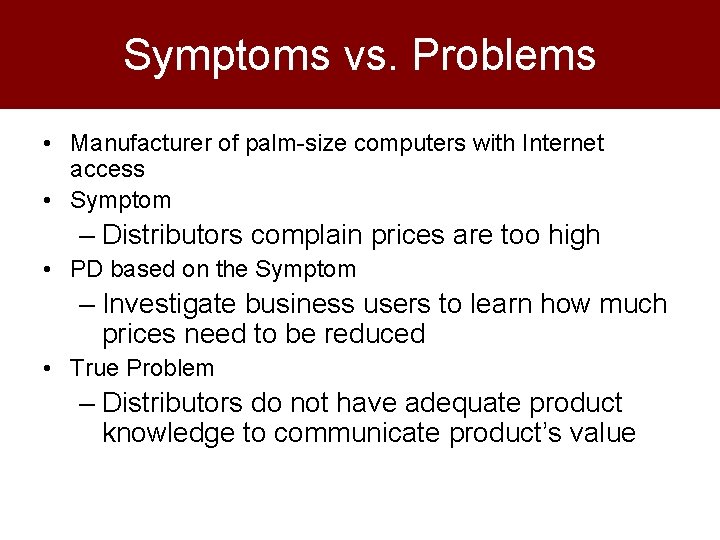
Symptoms vs. Problems • Manufacturer of palm-size computers with Internet access • Symptom – Distributors complain prices are too high • PD based on the Symptom – Investigate business users to learn how much prices need to be reduced • True Problem – Distributors do not have adequate product knowledge to communicate product’s value
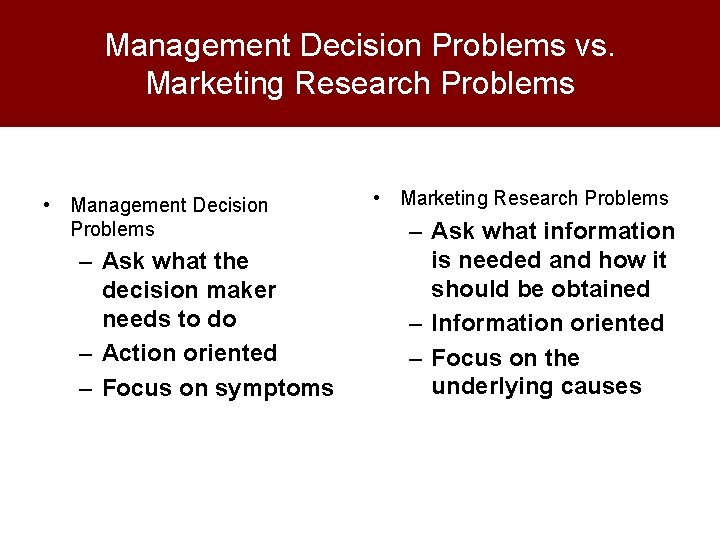
Management Decision Problems vs. Marketing Research Problems • Management Decision Problems – Ask what the decision maker needs to do – Action oriented – Focus on symptoms • Marketing Research Problems – Ask what information is needed and how it should be obtained – Information oriented – Focus on the underlying causes
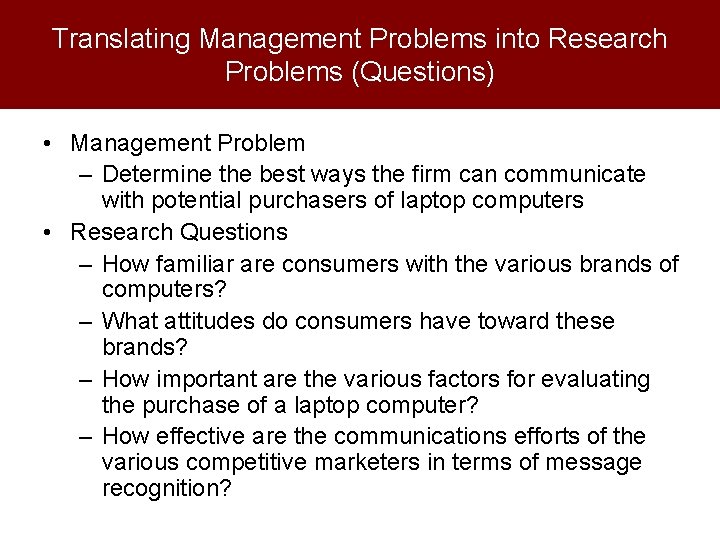
Translating Management Problems into Research Problems (Questions) • Management Problem – Determine the best ways the firm can communicate with potential purchasers of laptop computers • Research Questions – How familiar are consumers with the various brands of computers? – What attitudes do consumers have toward these brands? – How important are the various factors for evaluating the purchase of a laptop computer? – How effective are the communications efforts of the various competitive marketers in terms of message recognition?
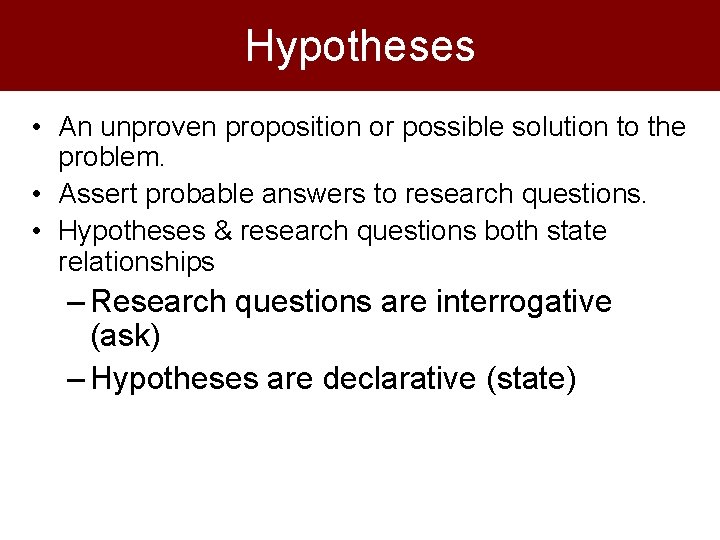
Hypotheses • An unproven proposition or possible solution to the problem. • Assert probable answers to research questions. • Hypotheses & research questions both state relationships – Research questions are interrogative (ask) – Hypotheses are declarative (state)
Planning the Research Design
Research Design • A master plan that specifies the methods and procedures for collecting and analyzing needed information.
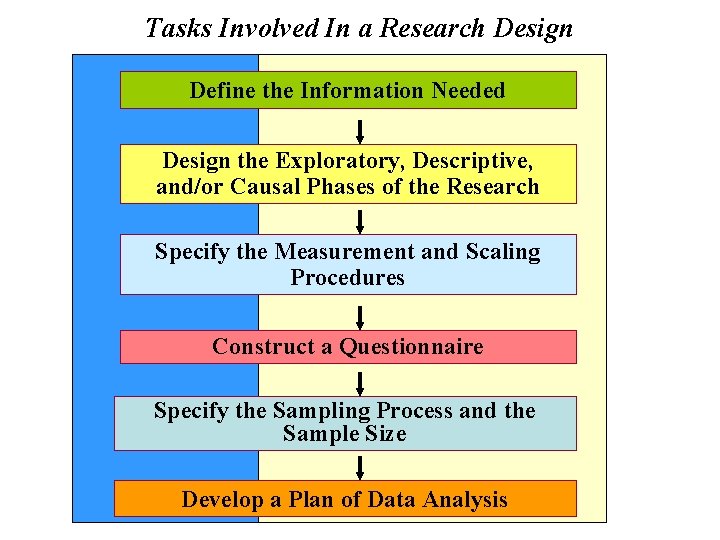
Tasks Involved In a Research Design Define the Information Needed Design the Exploratory, Descriptive, and/or Causal Phases of the Research Specify the Measurement and Scaling Procedures Construct a Questionnaire Specify the Sampling Process and the Sample Size Develop a Plan of Data Analysis
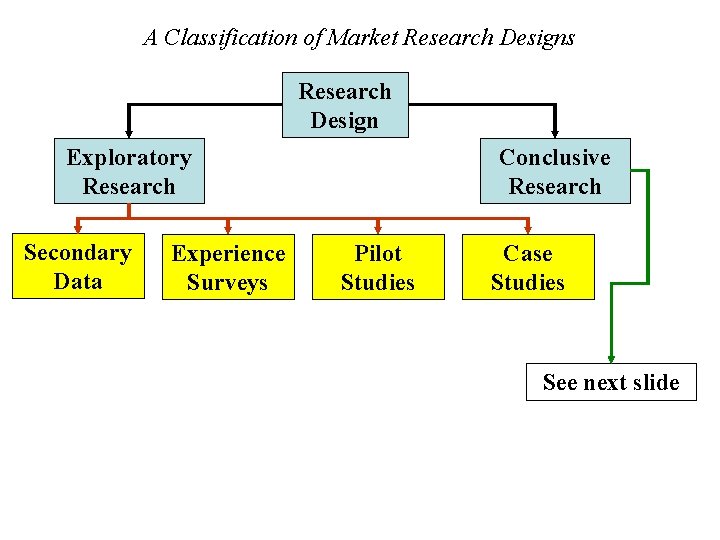
A Classification of Market Research Designs Research Design Exploratory Research Secondary Data Experience Surveys Conclusive Research Pilot Studies Case Studies See next slide
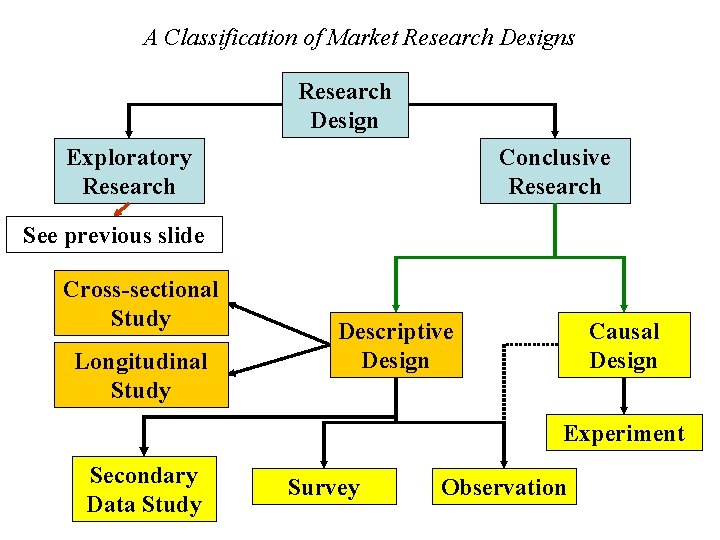
A Classification of Market Research Designs Research Design Exploratory Research Conclusive Research See previous slide Cross-sectional Study Longitudinal Study Descriptive Design Causal Design Experiment Secondary Data Study Survey Observation
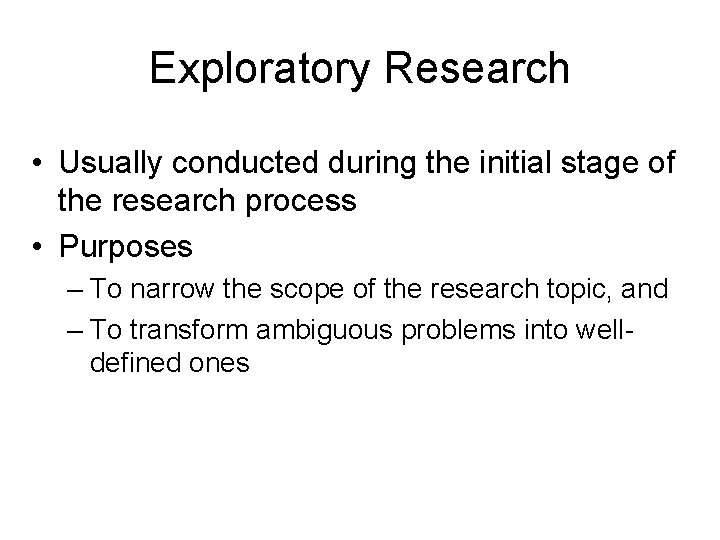
Exploratory Research • Usually conducted during the initial stage of the research process • Purposes – To narrow the scope of the research topic, and – To transform ambiguous problems into welldefined ones
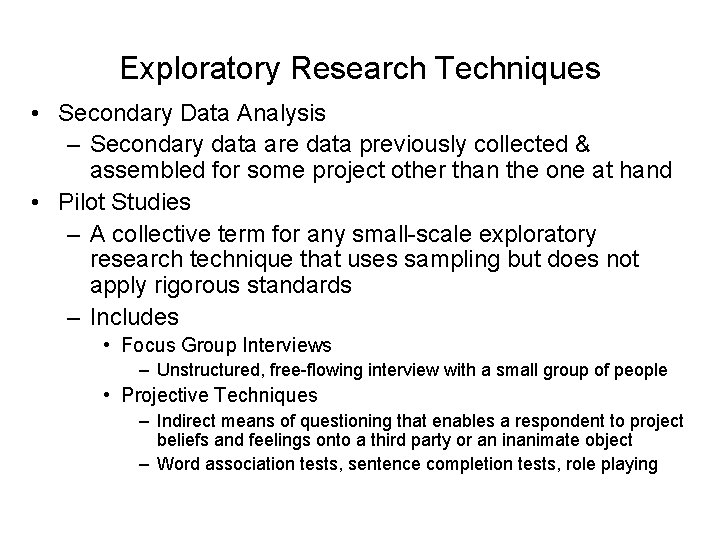
Exploratory Research Techniques • Secondary Data Analysis – Secondary data are data previously collected & assembled for some project other than the one at hand • Pilot Studies – A collective term for any small-scale exploratory research technique that uses sampling but does not apply rigorous standards – Includes • Focus Group Interviews – Unstructured, free-flowing interview with a small group of people • Projective Techniques – Indirect means of questioning that enables a respondent to project beliefs and feelings onto a third party or an inanimate object – Word association tests, sentence completion tests, role playing
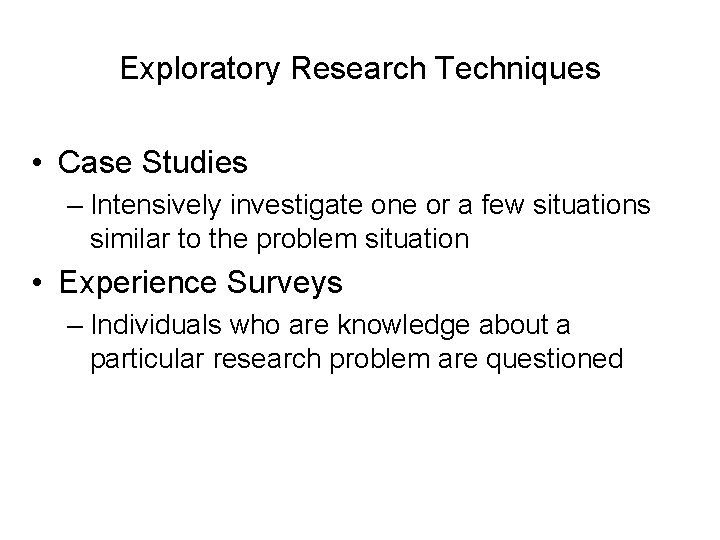
Exploratory Research Techniques • Case Studies – Intensively investigate one or a few situations similar to the problem situation • Experience Surveys – Individuals who are knowledge about a particular research problem are questioned
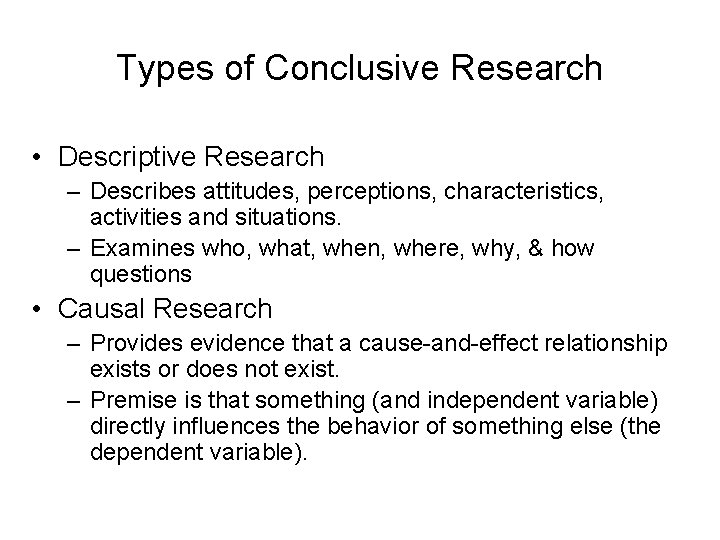
Types of Conclusive Research • Descriptive Research – Describes attitudes, perceptions, characteristics, activities and situations. – Examines who, what, when, where, why, & how questions • Causal Research – Provides evidence that a cause-and-effect relationship exists or does not exist. – Premise is that something (and independent variable) directly influences the behavior of something else (the dependent variable).
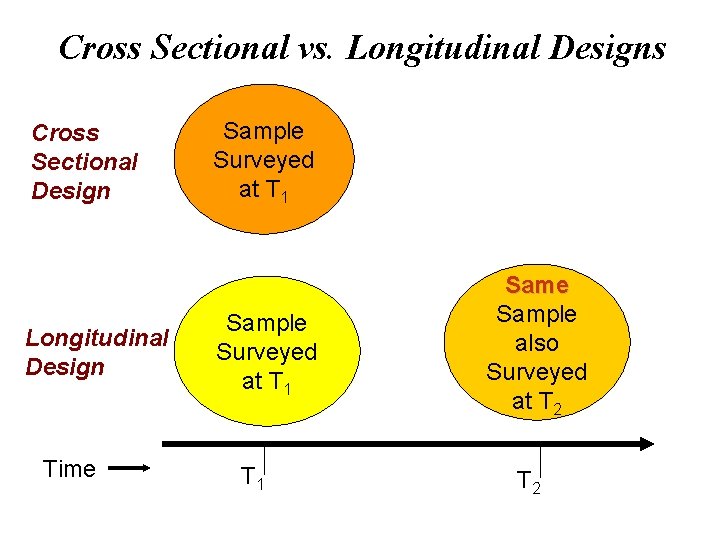
Cross Sectional vs. Longitudinal Designs Cross Sectional Design Longitudinal Design Time Sample Surveyed at T 1 T 1 Same Sample also Surveyed at T 2
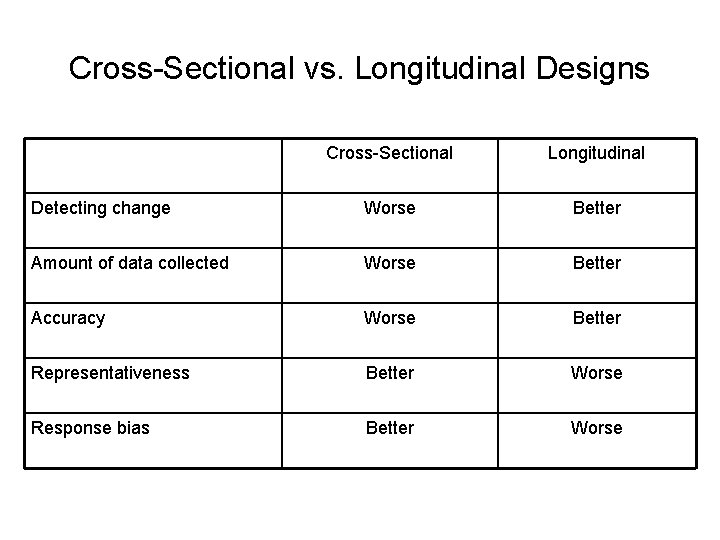
Cross-Sectional vs. Longitudinal Designs Cross-Sectional Longitudinal Detecting change Worse Better Amount of data collected Worse Better Accuracy Worse Better Representativeness Better Worse Response bias Better Worse
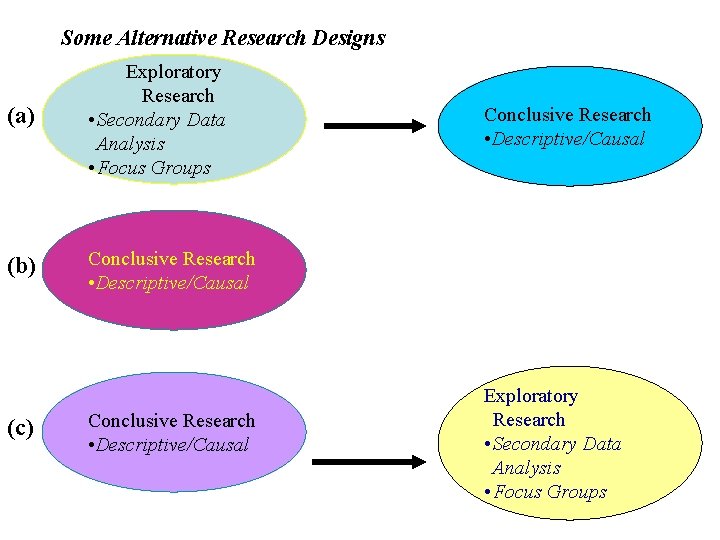
Some Alternative Research Designs (a) Exploratory Research • Secondary Data Analysis • Focus Groups (b) Conclusive Research • Descriptive/Causal (c) Conclusive Research • Descriptive/Causal Exploratory Research • Secondary Data Analysis • Focus Groups
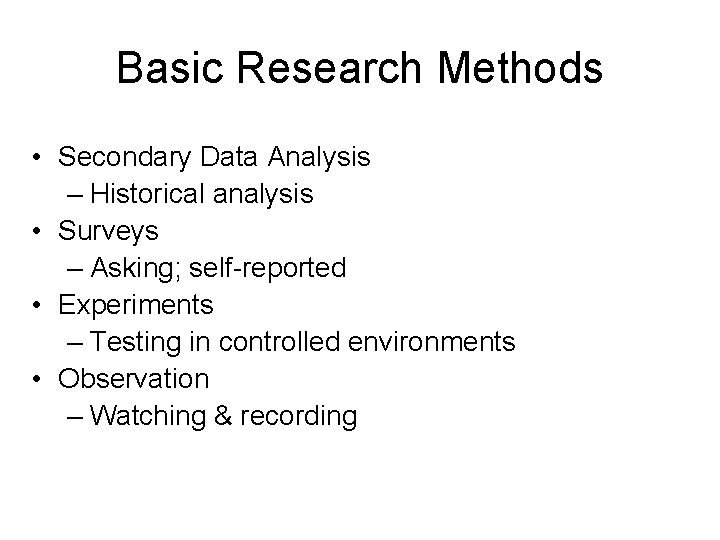
Basic Research Methods • Secondary Data Analysis – Historical analysis • Surveys – Asking; self-reported • Experiments – Testing in controlled environments • Observation – Watching & recording
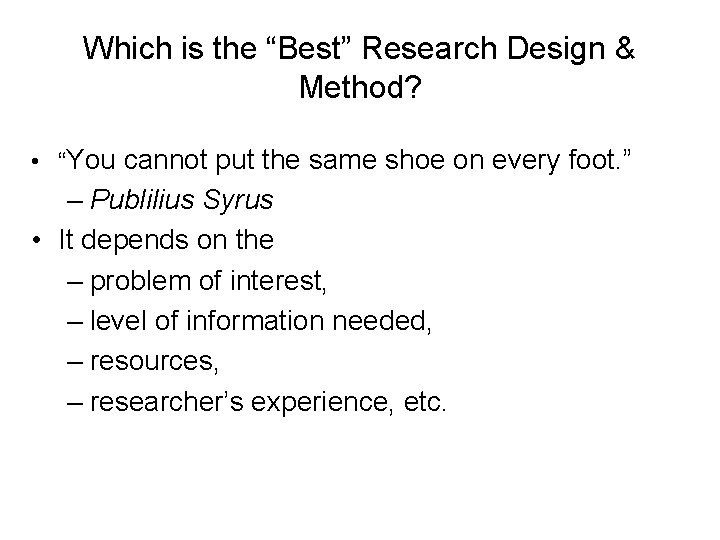
Which is the “Best” Research Design & Method? • “You cannot put the same shoe on every foot. ” – Publilius Syrus • It depends on the – problem of interest, – level of information needed, – resources, – researcher’s experience, etc.