
The Project Management Context Chapter 2 and more









- Slides: 66
The Project Management Context (Chapter 2 and more) 1
Projects – The Larger Context • In mature project-oriented organizations, project management may occur in the larger context of portfolio and program management • A program is a group of related projects whose management is coordinated to ensure benefits that may not be attainable if the projects are managed separately • A portfolio is a collection of projects or programs – perhaps related, but not necessarily – grouped together to facilitate their management for strategic benefit 2
Projects and Strategic Planning • Projects are frequently used to help achieve strategic objectives for an organization • Strategic drivers for such projects could include: • Market demands • New market opportunities • Business needs • Customer requests • Competitive-enabling development projects • Legal and regulatory requirements
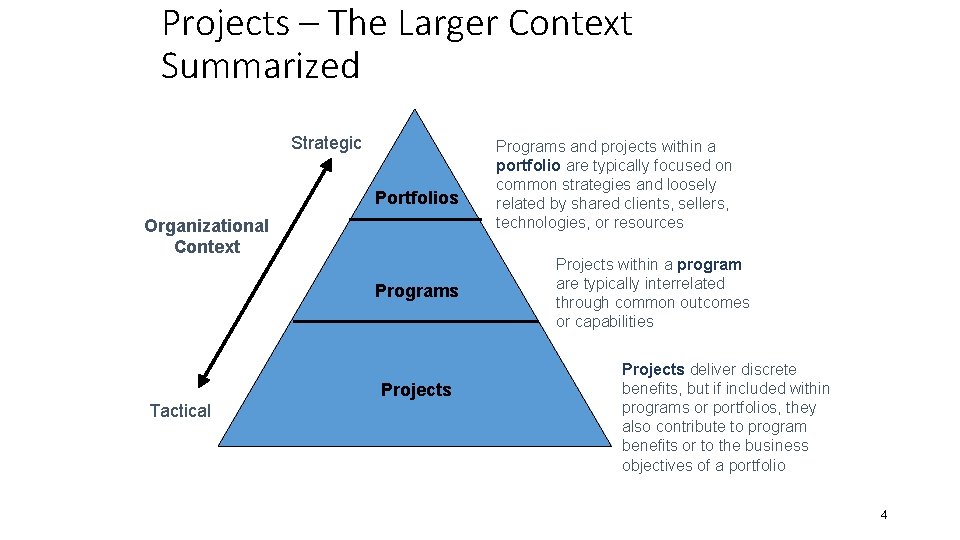
Projects – The Larger Context Summarized Strategic Portfolios Organizational Context Programs Projects Tactical Programs and projects within a portfolio are typically focused on common strategies and loosely related by shared clients, sellers, technologies, or resources Projects within a program are typically interrelated through common outcomes or capabilities Projects deliver discrete benefits, but if included within programs or portfolios, they also contribute to program benefits or to the business objectives of a portfolio 4
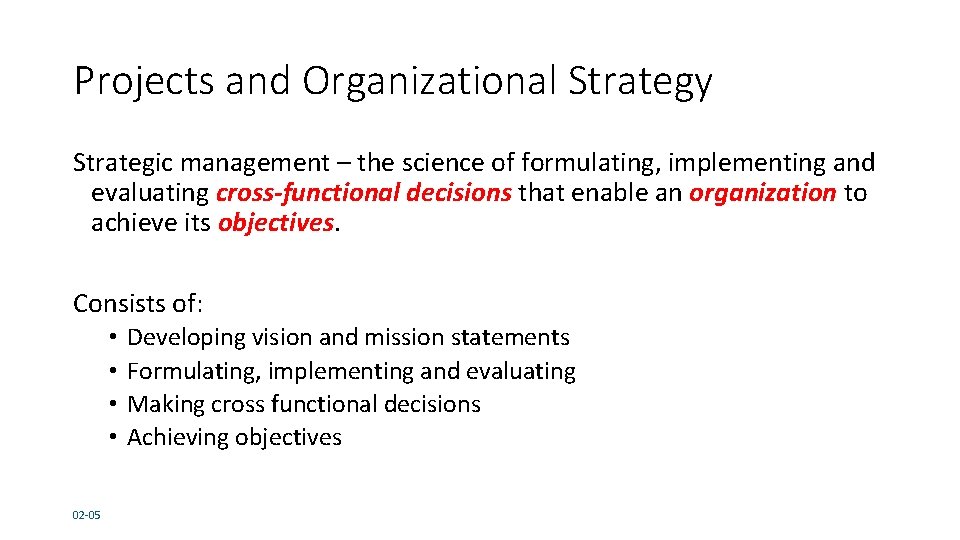
Projects and Organizational Strategy Strategic management – the science of formulating, implementing and evaluating cross-functional decisions that enable an organization to achieve its objectives. Consists of: • • 02 -05 Developing vision and mission statements Formulating, implementing and evaluating Making cross functional decisions Achieving objectives
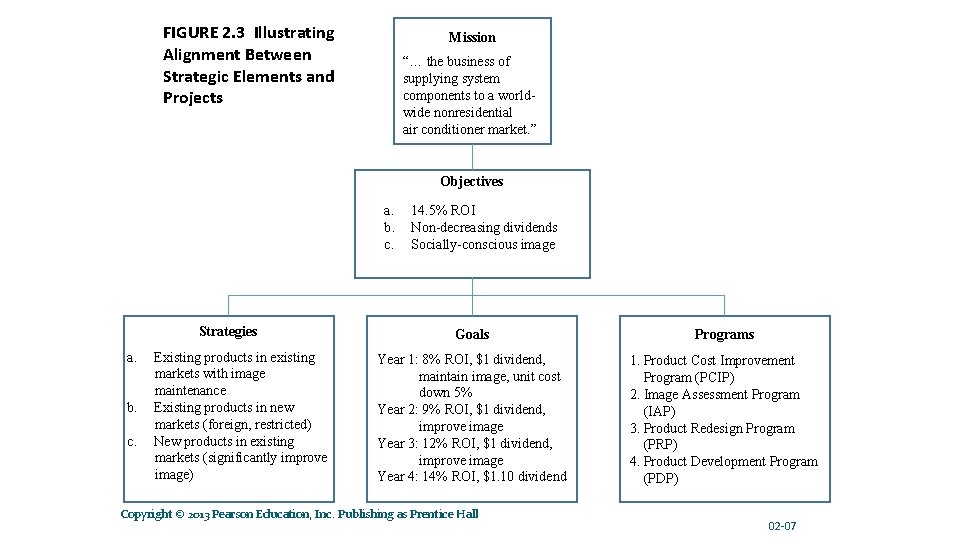
Relationship of Strategic Elements Mission Objectives Strategy 02 -06 Goals Programs Figure 2. 2
FIGURE 2. 3 Illustrating Alignment Between Strategic Elements and Projects Mission “… the business of supplying system components to a worldwide nonresidential air conditioner market. ” Objectives a. b. c. Strategies a. b. c. Existing products in existing markets with image maintenance Existing products in new markets (foreign, restricted) New products in existing markets (significantly improve image) 14. 5% ROI Non-decreasing dividends Socially-conscious image Goals Programs Year 1: 8% ROI, $1 dividend, maintain image, unit cost down 5% Year 2: 9% ROI, $1 dividend, improve image Year 3: 12% ROI, $1 dividend, improve image Year 4: 14% ROI, $1. 10 dividend 1. Product Cost Improvement Program (PCIP) 2. Image Assessment Program (IAP) 3. Product Redesign Program (PRP) 4. Product Development Program (PDP) Copyright © 2013 Pearson Education, Inc. Publishing as Prentice Hall 02 -07
The Project Management Life Cycle • A project life cycle is a set of phases that are generally employed sequentially to complete the project work • We say these are generally done sequentially, but there are no hard and fast rules about that, and phases sometimes overlap a bit • Whether or not this occurs is a function of several factors, including the organizational culture, the tightness of the project schedule, and nature of the work that the project involves • In any case, the life cycle provides the basic framework for managing the project 8
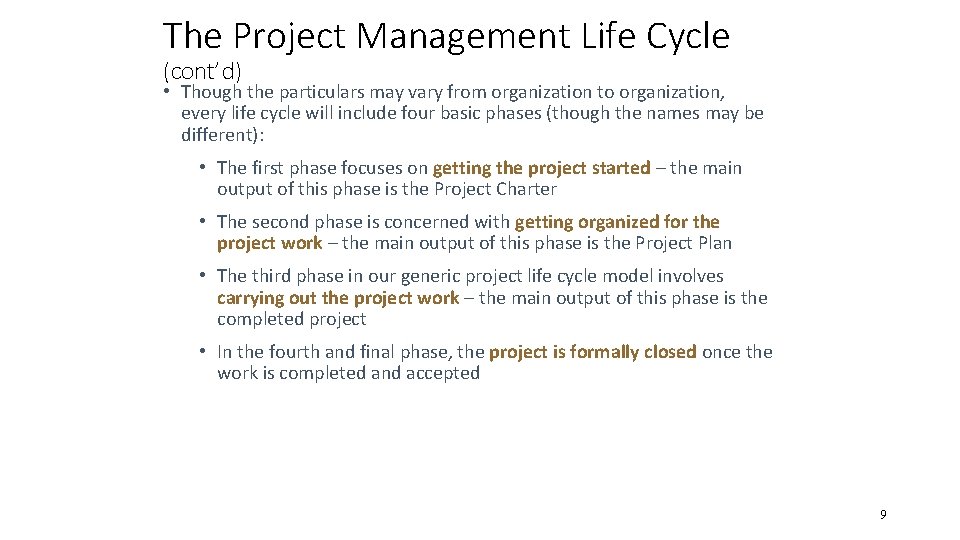
The Project Management Life Cycle (cont’d) • Though the particulars may vary from organization to organization, every life cycle will include four basic phases (though the names may be different): • The first phase focuses on getting the project started – the main output of this phase is the Project Charter • The second phase is concerned with getting organized for the project work – the main output of this phase is the Project Plan • The third phase in our generic project life cycle model involves carrying out the project work – the main output of this phase is the completed project • In the fourth and final phase, the project is formally closed once the work is completed and accepted 9
Phases and Process Groups • The use of the term “phase” can be confusing in project management • It is very important to note, as we remarked earlier, that the five major process groups we defined earlier are not phases • Phases are generally done sequentially • But remember that the process groups are not sequential, and in fact as we saw, the three process groups of planning, executing, and controlling/monitoring are inherently iterative 10
More on Project Phases • Another way that the term “phase” can be confusing is the way it is commonly used to describe extending a project’s work well beyond the original deadline • This can happen when a project breaks into a sequence of what we mislabel as “phases” when the original project’s scope is reduced by mutual consent … Phase 1 then afterwards Phase 2 etc. • The original project is completed and closed although with less than the planned functionality, and the missing functionality is added on as additional work in later phases • Precisely speaking, we are in effect creating a new project whose requirements focus on the missing functionality • This second project has its own internal set of phases (and process groups) and should be managed as a separate project to obtain optimum benefits 11
Project Life Cycle and Product Life Cycle • The term “life cycle” can also lead to confusion • We need to make a clear distinction between the project life cycle and the product life cycle for building an underlying project deliverable • The project life cycle provides a structure for doing all the project work – only one component of which is building the deliverable • The product life cycle provides structure and an approach for doing the focused work to build the relevant product 12
Project Life Cycle and Product Life Cycle (cont’d) • The software life cycle and associated methodology set standards for the phases and deliverables associated with the software product itself • But there are other tasks that must be managed well to enable the software production work • These enabling and facilitating tasks are the main focus of project management • The project management life cycle provides the framework for the software development and all these other tasks 13
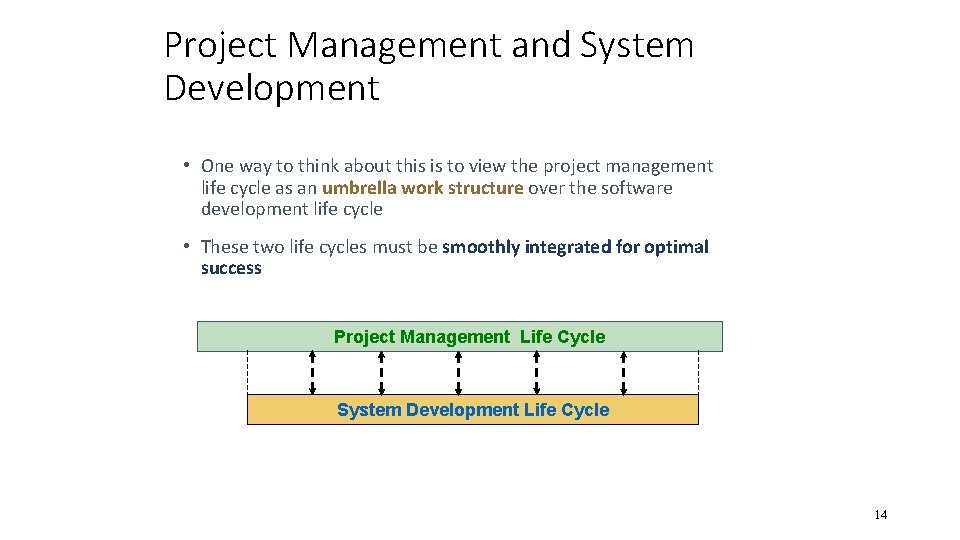
Project Management and System Development • One way to think about this is to view the project management life cycle as an umbrella work structure over the software development life cycle • These two life cycles must be smoothly integrated for optimal success Project Management Life Cycle System Development Life Cycle 14
Project Stakeholders
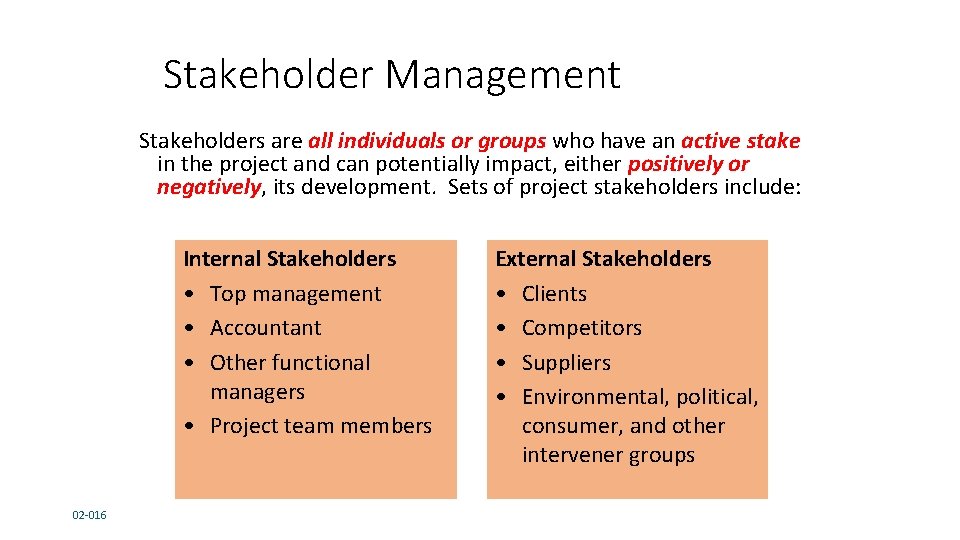
Stakeholder Management Stakeholders are all individuals or groups who have an active stake in the project and can potentially impact, either positively or negatively, its development. Sets of project stakeholders include: Internal Stakeholders • Top management • Accountant • Other functional managers • Project team members 02 -016 External Stakeholders • Clients • Competitors • Suppliers • Environmental, political, consumer, and other intervener groups
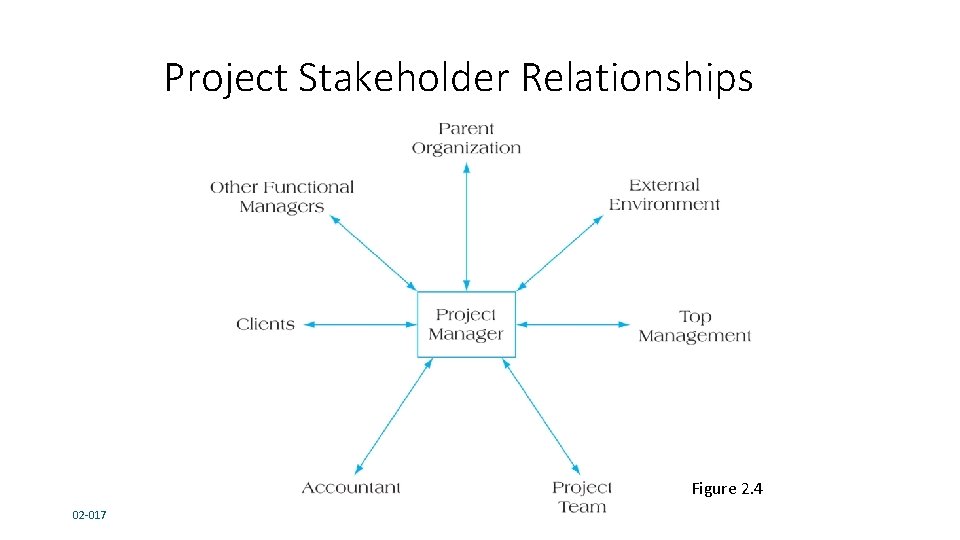
Project Stakeholder Relationships Figure 2. 4 02 -017
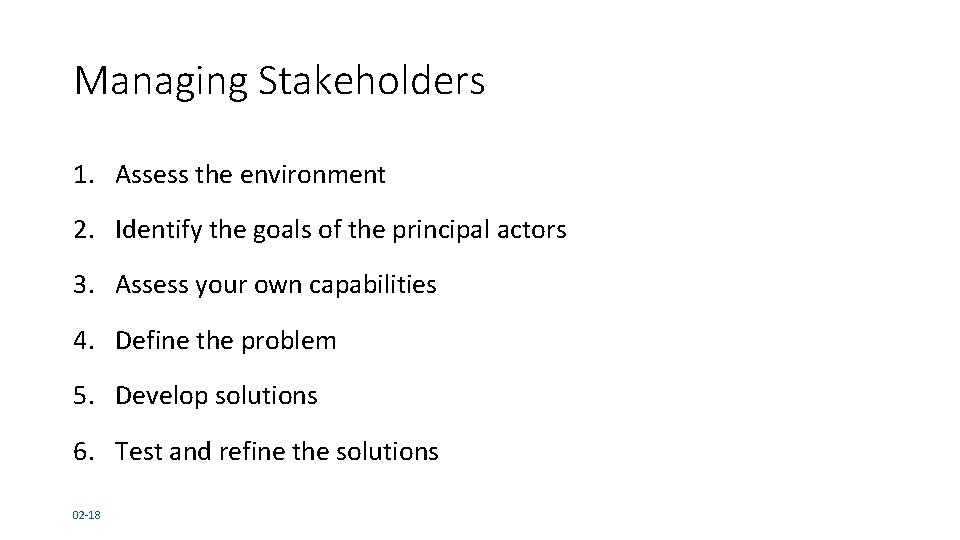
Managing Stakeholders 1. Assess the environment 2. Identify the goals of the principal actors 3. Assess your own capabilities 4. Define the problem 5. Develop solutions 6. Test and refine the solutions 02 -18
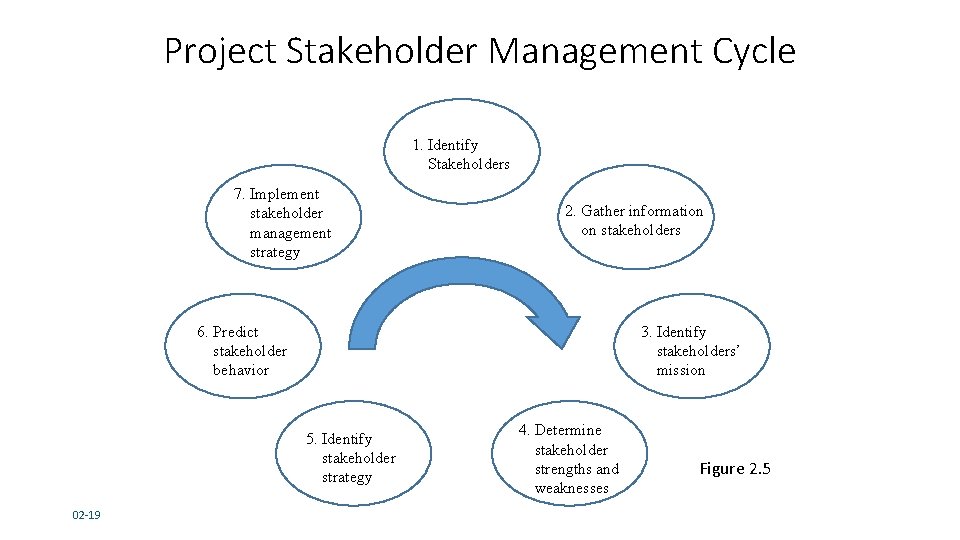
Project Stakeholder Management Cycle 1. Identify Stakeholders 7. Implement stakeholder management strategy 2. Gather information on stakeholders 6. Predict stakeholder behavior 3. Identify stakeholders’ mission 5. Identify stakeholder strategy 02 -19 4. Determine stakeholder strengths and weaknesses Figure 2. 5
Customers and Users • Customers are the persons or organizations that will use the deliverables of the project – whether a product or service • Customers and users could be internal to the organization or external to it, and there may in fact be several layers of customers and users • Sometimes customers and users are the same, but often they are not • For example, your customer likely has customers, and these second tier customers may be the primary users of the product or service you’re delivering • Similarly there could be customers of those customers, and so on 20
Involving Customers and Users • Research studies show that customer/user involvement is one of the primary project success factors • Requirements typically reside in the customer’s mind and must be coaxed out and articulated • It may not always be possible to involve all levels of customers in the project planning • But it is always important to try to understand what they will expect of the project deliverables • Their acceptance, or their lack of acceptance, of the end result is the deciding factor for the success of your project 21
Project Sponsors • A sponsor is the person or organization who pays for the project • Hence the project sponsor will likely have direct influence on the project • The sponsor typically plays an important, even crucial, role at the beginning of the project in helping define its objectives and its scope • The sponsor is also likely to play a major role in approving or disapproving the inevitable changes as the project proceeds 22
Program and Portfolio Managers • Recall that many projects are not undertaken as standalone efforts • Many are positioned within programs, collections of interrelated projects, or portfolios, collections of projects grouped to facilitate their management for some strategic benefit • In either of these cases, the appropriate program and/or portfolio managers will be important stakeholders, providing both guidance and constraints for your project 23
Project Management Offices • Recall that a PMO (or Project Management Office) is an organization or entity that has certain responsibilities related to the management of projects within its scope • A PMO will be a stakeholder if it has direct or indirect responsibility for the outcome of our project 24
Project Team as Stakeholder • The project team comprises an important stakeholder • This group of individuals is responsible for the project work, but not necessarily directly involved in the management of the project • Because the project team will know the project work better than any other group, the wise project manager will consult often with the team to manage other stakeholders’ requests and attempts to influence the project 25
Functional and Operational Managers • Functional managers are key stakeholders who control human resources, finances, and procurement, etc. • Clearly, the project manger must work closely and effectively with this group to achieve success • Operations mangers are individuals who have the management responsibility for ongoing operations • The operations managers responsible for the ongoing maintenance and service associated with your project’s deliverables are important project stakeholders • Early consultation with operational managers can save a lot of pain later on 26
External Stakeholders • Vendors, suppliers, and subcontractors are external organizations that the project may depend on for vitally important resources • External business partners may be involved in the marketing, financing, and certification of the project • External groups may be needed for specialized expertise in the performance of the project work • All these external entities are potentially important stakeholders 27
Dynamic Nature of Stakeholder Involvement • Stakeholders can have varying levels of involvement on a project and these levels can, and often do, change as the project proceeds • So, stakeholder identification and management is an ongoing process throughout the project • Identifying stakeholders at the appropriate time and understanding their relative importance to the project’s success are among the most important tasks that a project manager has 28
Stakeholder Involvement at the Right Time • Failing to recognize stakeholders at the appropriate time can have serious impact on a project • For example: • Not recognizing the need to involve the legal department of your organization early in a project which involves serious legal issues, like privacy, legal permits, intellectual property rights, and so on, can result in disastrous delays and increased costs later on • Forgetting about an important class of users and failing to take their perspectives on a software product into account in the planning phases can result in their poor acceptance, or even outright rejection, of the final project result • Failure to involve infrastructure resources early on in a project that requires infrastructure upgrades can lead to a failed project 29
The Organization
Processes within Organizations • Let’s reflect a moment about how processes are utilized within organizations • Every organization is different, of course, and so we should expect the processes that an organization applies to do its work to differ from organization to organization • In other words, processes must be adapted to an organization and sometimes to a project • What impacts and influences this adaptation? 31
Organizational Process Assets • Every organization will have its own unique set of organizational process assets • Organizational process assets provide guidelines and criteria for tailoring the organization's processes to the specific needs of projects within that organization • According to the PMBOK® Guide, organizational process assets are: Plans, processes, policies, procedures, and knowledge bases that are specific to and are used by the performing organization. 32
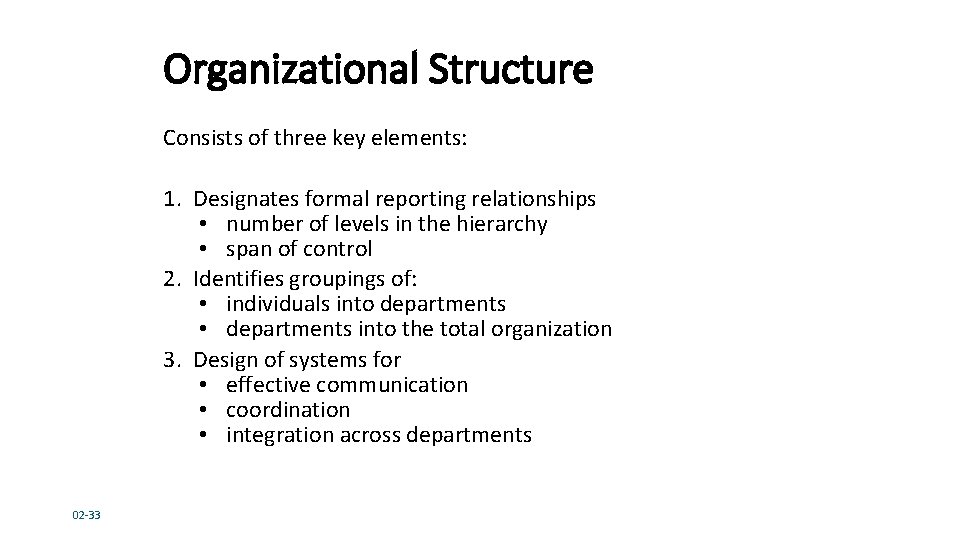
Organizational Structure Consists of three key elements: 1. Designates formal reporting relationships • number of levels in the hierarchy • span of control 2. Identifies groupings of: • individuals into departments • departments into the total organization 3. Design of systems for • effective communication • coordination • integration across departments 02 -33
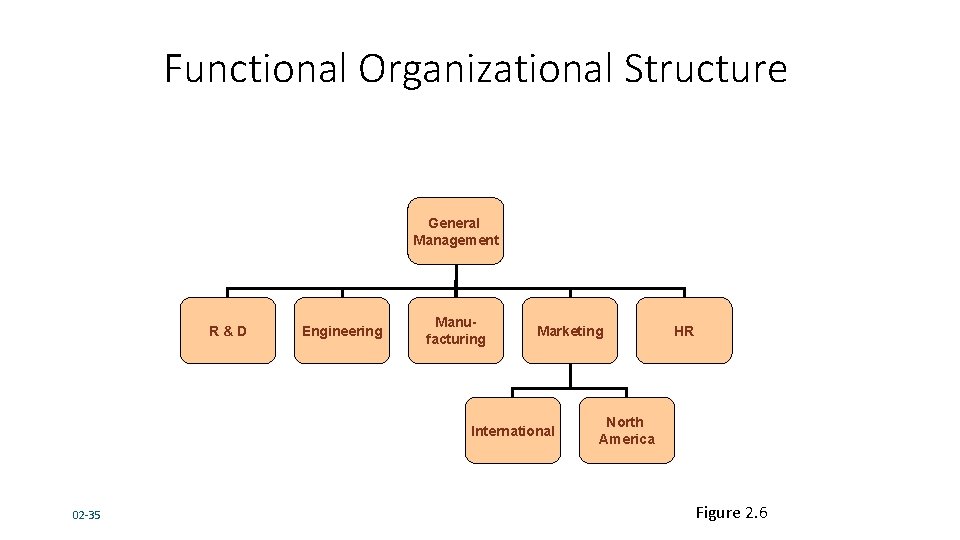
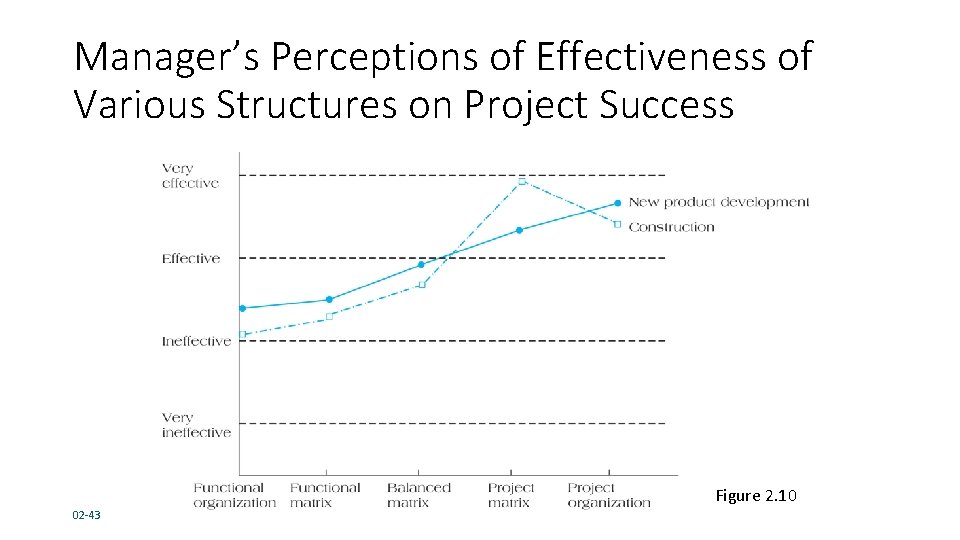
Forms of Organization Structure • Functional organizations – group people performing similar activities into departments • Project organizations – group people into project teams on temporary assignments • Matrix organizations – create a dual hierarchy in which functions and projects have equal prominence 02 -34
Functional Organizational Structure General Management R&D Engineering Manufacturing Marketing International 02 -35 HR North America Figure 2. 6
Functional Structures Strengths Weaknesses 1. Firm’s design maintained 1. Functional siloing 2. Fosters development of in-depth knowledge 2. Lack of customer focus 3. Standard career paths 3. Projects may take longer 4. Project team members remain connected with their functional group 4. Projects may be suboptimized Copyright © 2013 Pearson Education, Inc. Publishing as Prentice Hall 02 -36
Silo Effect Found in Functional Structures 02 -37 Figure 2. 7
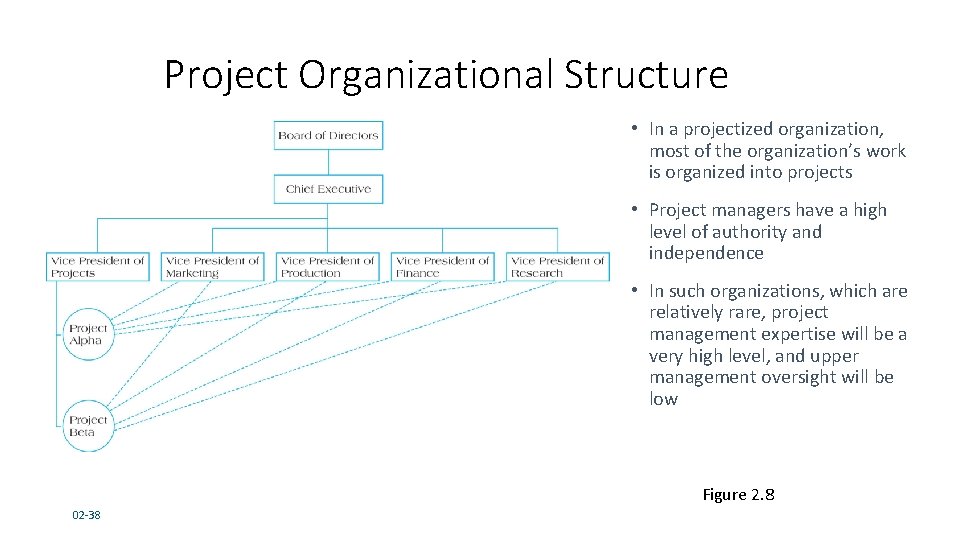
Project Organizational Structure • In a projectized organization, most of the organization’s work is organized into projects • Project managers have a high level of authority and independence • In such organizations, which are relatively rare, project management expertise will be a very high level, and upper management oversight will be low Figure 2. 8 02 -38
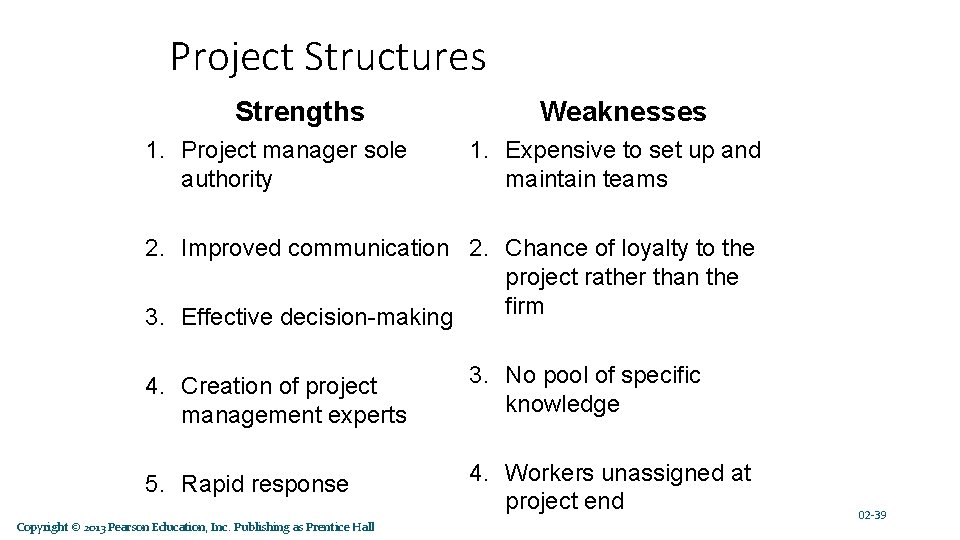
Project Structures Strengths 1. Project manager sole authority Weaknesses 1. Expensive to set up and maintain teams 2. Improved communication 2. Chance of loyalty to the project rather than the firm 3. Effective decision-making 4. Creation of project management experts 3. No pool of specific knowledge 5. Rapid response 4. Workers unassigned at project end Copyright © 2013 Pearson Education, Inc. Publishing as Prentice Hall 02 -39
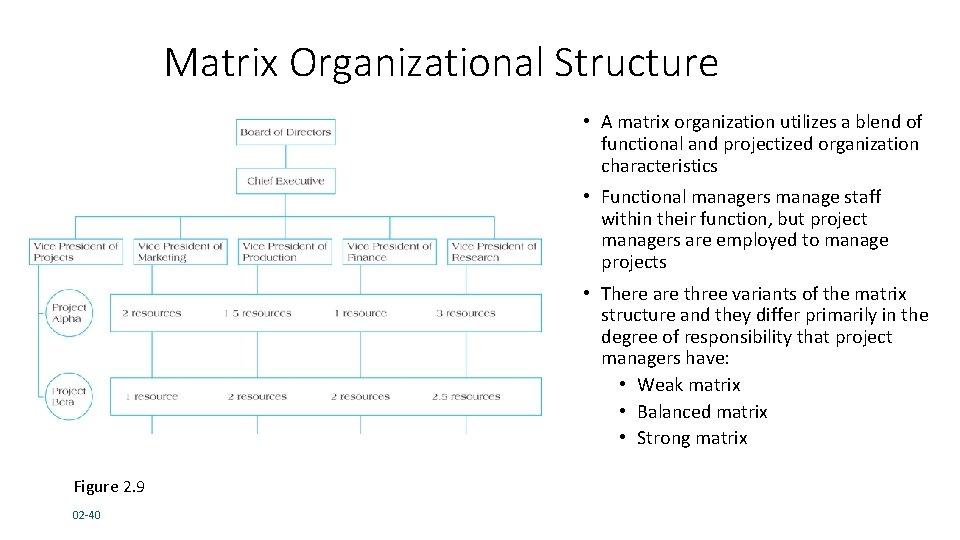
Matrix Organizational Structure • A matrix organization utilizes a blend of functional and projectized organization characteristics • Functional managers manage staff within their function, but project managers are employed to manage projects • There are three variants of the matrix structure and they differ primarily in the degree of responsibility that project managers have: • Weak matrix • Balanced matrix • Strong matrix Figure 2. 9 02 -40
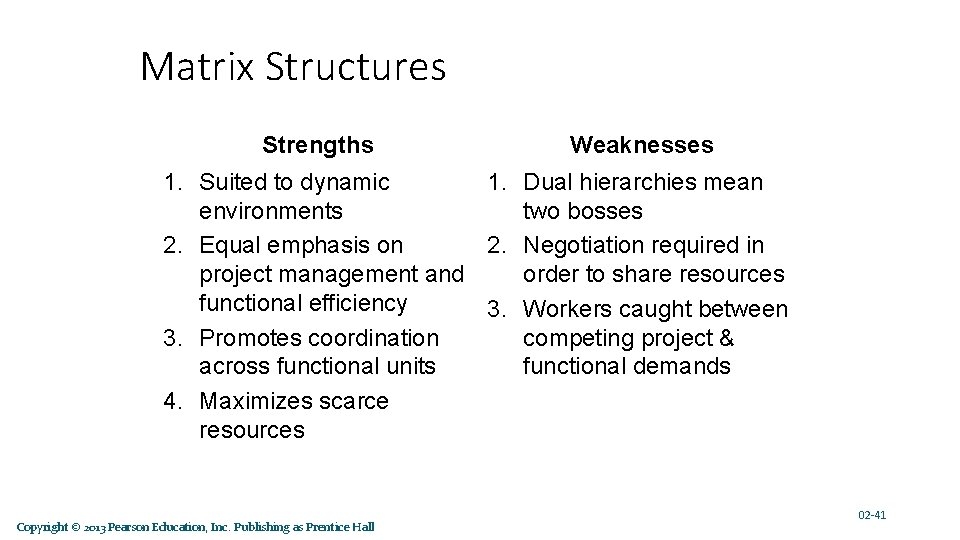
Matrix Structures Strengths Weaknesses 1. Suited to dynamic 1. Dual hierarchies mean environments two bosses 2. Equal emphasis on 2. Negotiation required in project management and order to share resources functional efficiency 3. Workers caught between 3. Promotes coordination competing project & across functional units functional demands 4. Maximizes scarce resources Copyright © 2013 Pearson Education, Inc. Publishing as Prentice Hall 02 -41
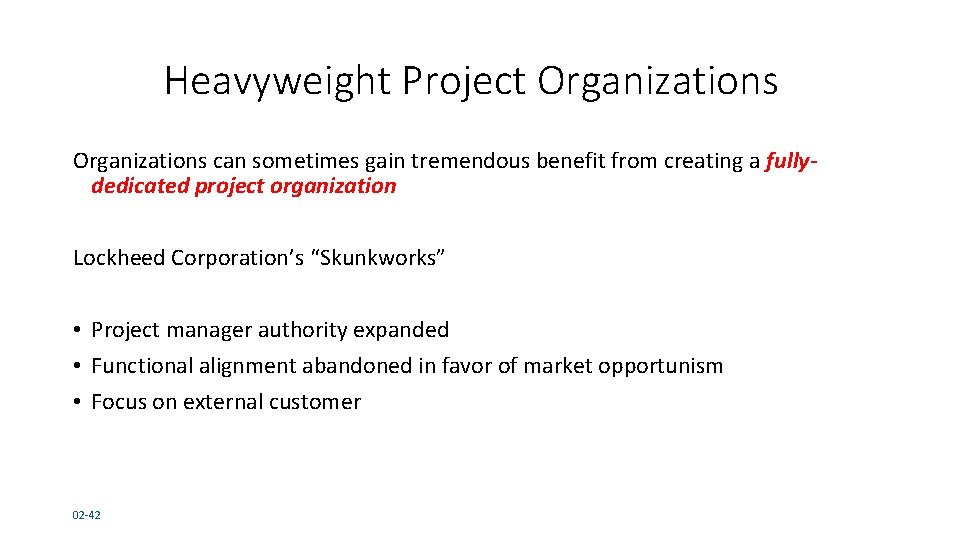
Heavyweight Project Organizations can sometimes gain tremendous benefit from creating a fullydedicated project organization Lockheed Corporation’s “Skunkworks” • Project manager authority expanded • Functional alignment abandoned in favor of market opportunism • Focus on external customer 02 -42
Manager’s Perceptions of Effectiveness of Various Structures on Project Success Figure 2. 10 02 -43
Project Management Offices A project management office, or PMO, is an organizational structure designed to support and help coordinate the project management activities of the organization (or some subset of the organization). Resource centers for: • Technical details • Expertise • Repository • Center for excellence 02 -44
PMO Activities May Include. . . • Selecting, managing, and deploying shared project resources, including project managers • Coaching, mentoring, and training in project management skills, processes, and techniques • Identifying, developing, and monitoring project management methodology, standards. and best-practices • Developing project and organizational assets deemed important for successful project management • Coordinating communication and interdependencies among projects 45
Organizational Culture The unwritten rules of behavior, or norms that are used to shape and guide behavior, is shared by some subset of organization members and is taught to all new members of the company. • Unwritten • Rules of behavior • Held by some subset of the organization • Taught to all new members 02 -46
Key Factors That Affect Culture Development • Technology • Environment • Geographical location • Reward systems • Rules and procedures • Key organizational members • Critical incidents 02 -47
Processes within Organizations • Let’s reflect a moment about how processes are utilized within organizations • Every organization is different, of course, and so we should expect the processes that an organization applies to do its work to differ from organization to organization • In other words, processes must be adapted to an organization and sometimes to a project • What impacts and influences this adaptation? 48
Organizational Process Assets • Every organization will have its own unique set of organizational process assets • Organizational process assets provide guidelines and criteria for tailoring the organization's processes to the specific needs of projects within that organization • According to the PMBOK® Guide, organizational process assets are: Plans, processes, policies, procedures, and knowledge bases that are specific to and are used by the performing organization. 49
Culture Affects Project Management • Departmental interaction • Employee commitment to goals • Project planning • Performance evaluation 02 -50
Summary • Understand how effective project management contributes to achieving strategic objectives. • Recognize three components of the corporate strategy model: formulation, implementation, and evaluation. • See the importance of identifying critical project stakeholders and managing them within the context of project development. • Recognize the strengths and weaknesses of three basic forms of organizational structure and their implications for managing projects. 02 -51
“Gathering” Project Requirements 52
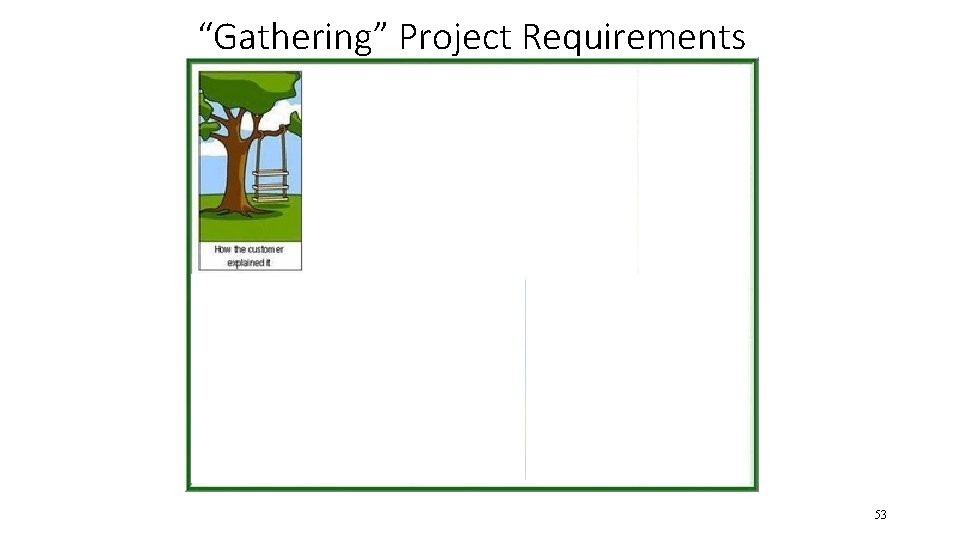
“Gathering” Project Requirements 53
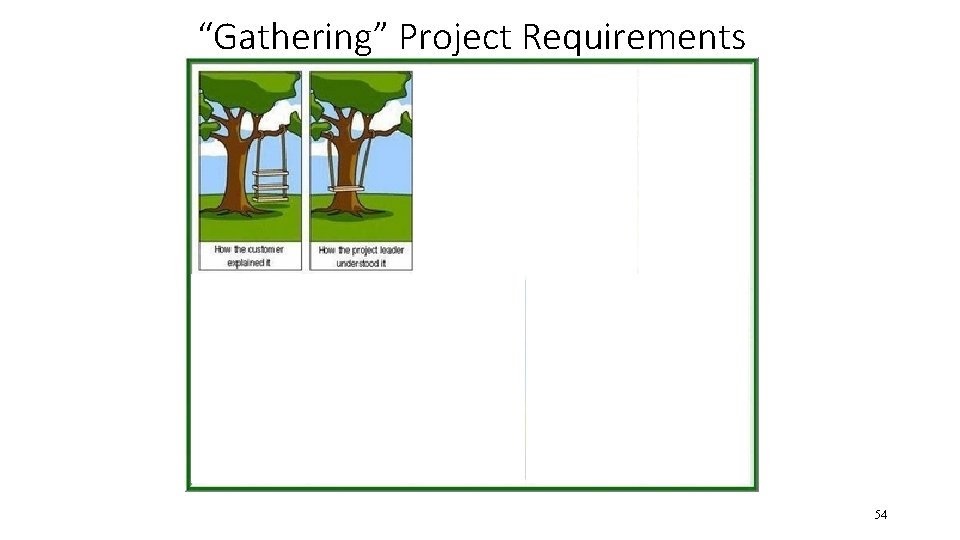
“Gathering” Project Requirements 54
“Gathering” Project Requirements 55
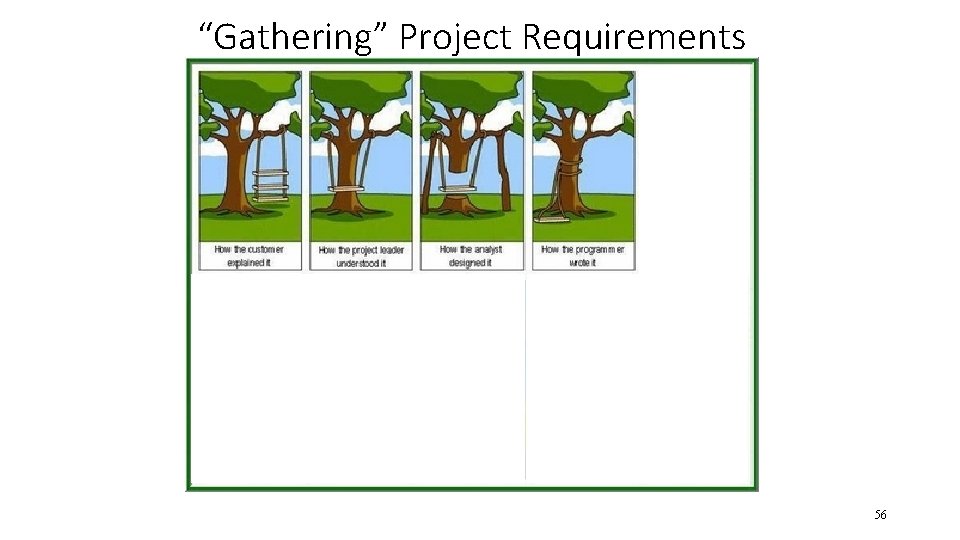
“Gathering” Project Requirements 56
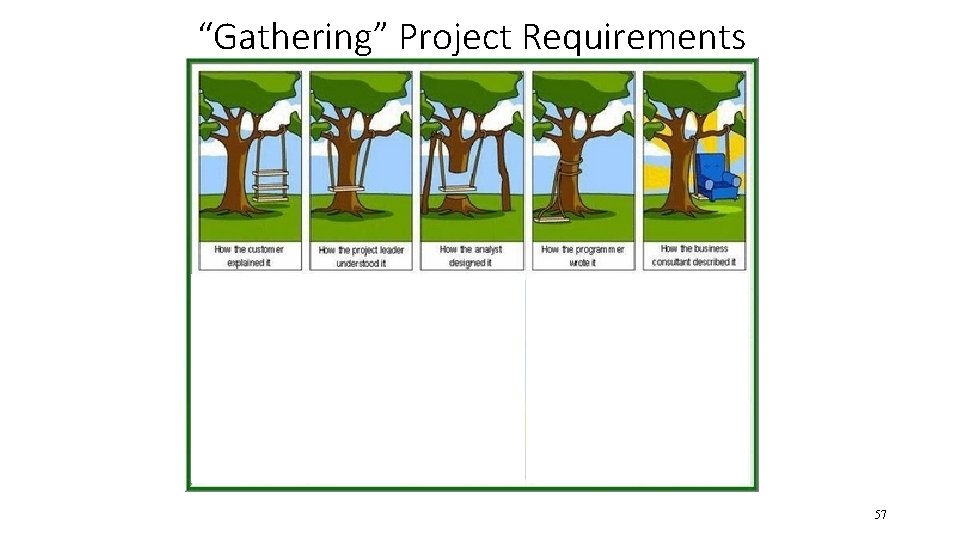
“Gathering” Project Requirements 57
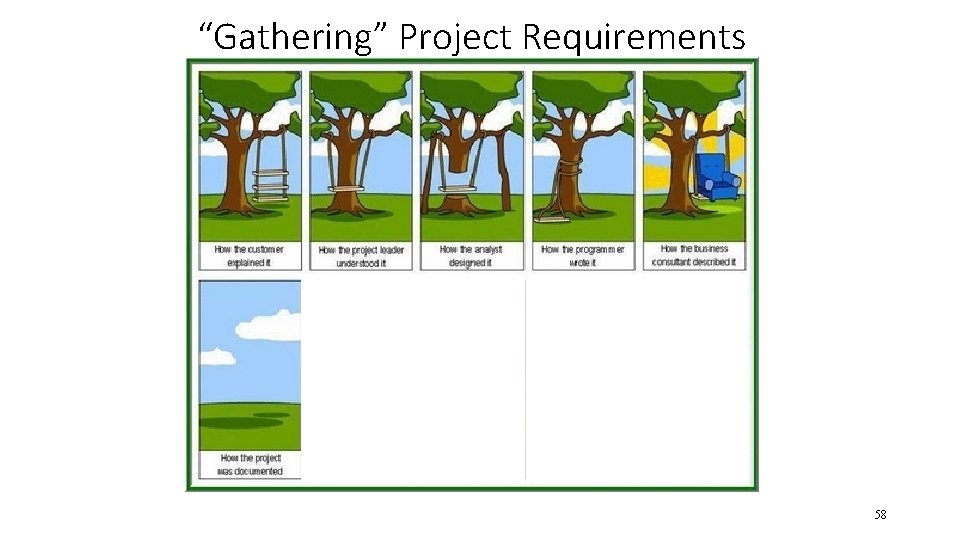
“Gathering” Project Requirements 58
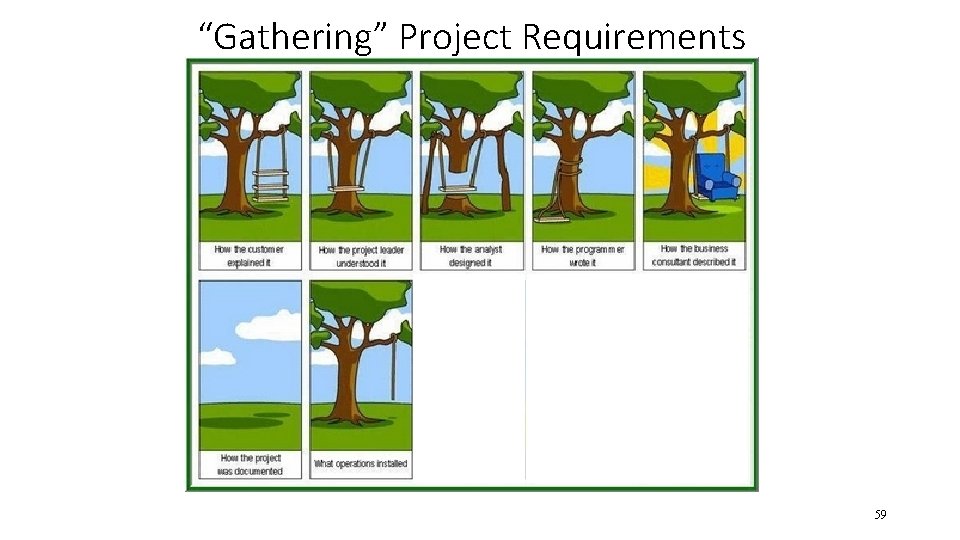
“Gathering” Project Requirements 59
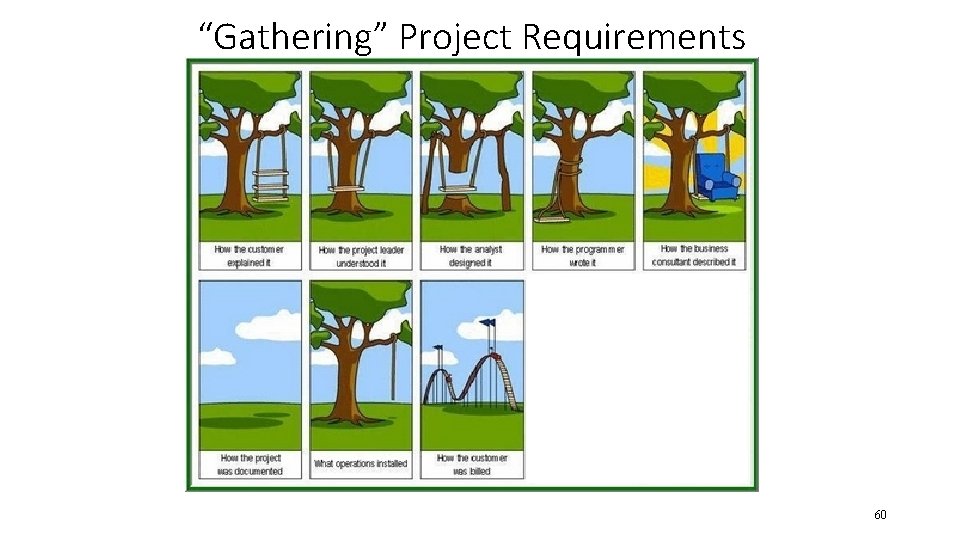
“Gathering” Project Requirements 60
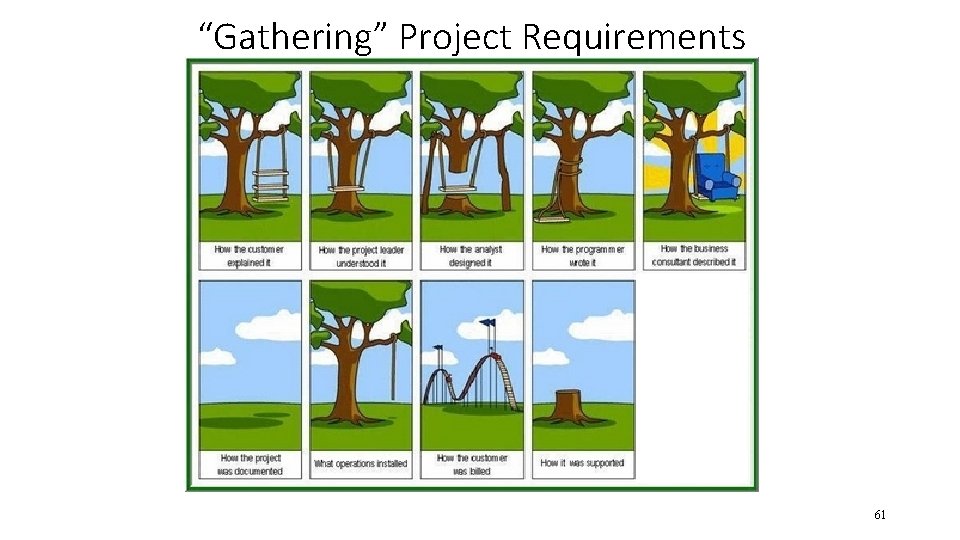
“Gathering” Project Requirements 61
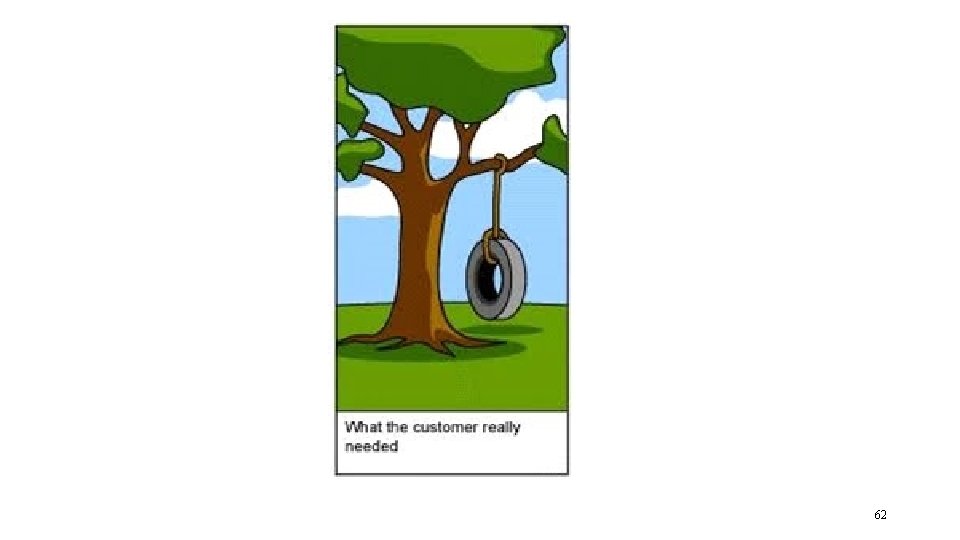
62
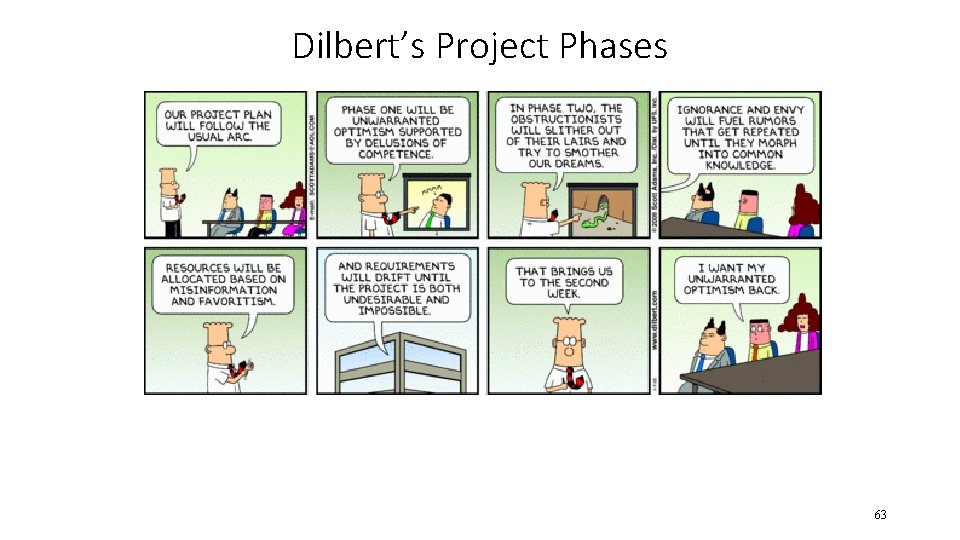
Dilbert’s Project Phases 63
Dilbert’s Resource Problems 64
Dilbert’s Project Timeline 65
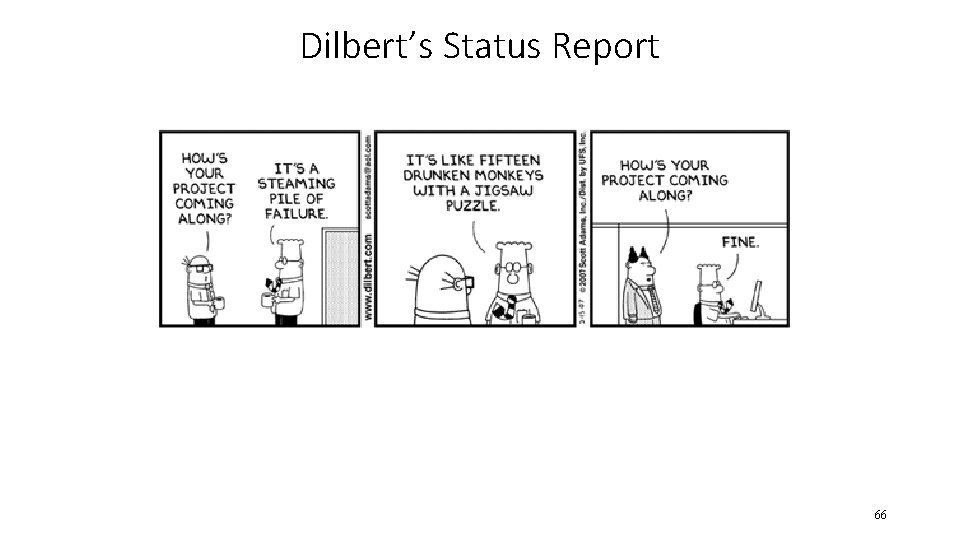
Dilbert’s Status Report 66