
The Project is funded by the European Union
The Project is funded by the European Union and implemented by the consortium led by GDSI Limited CIVIL PARTICIPATION IN DECISION MAKING PROCESSES Helpdesk: Support to the EU grantees from the Ea. P countries Svetlana Djukić, Ea. P Civil Society Facility – Regional Actions project 11 December 2019 Webinar
Webinar Introduction Eastern Partnership Civil Society Facility – Regional Actions Goal: to promote the role of civil society actors in the six Ea. P countries (Armenia, Azerbaijan, Belarus, Georgia, Moldova and Ukraine) in reforms taking place in their countries Funded by the European Union Implemented by a consortium led by GDSI Limited (Ireland) Duration: 2017 -2020 Details: http: //eapcivilsociety. eu/ 01 02 03 04 05 Mapping studies and research for a better understanding of civil society organisations in the partner countries and their problems E-learning courses and webinars to strengthen civil society capacity and local impact Hackathons to develop new ICT tools to enable broader participation of civil society in decision making processes Better communication for high-impact civil society work to improve the image of civil society work and learn how to communicate it better Civil Society Fellowships for future leaders in key sectors to enable them to drive changes
Webinar Introduction Participatory Democracy • It implies participation of citizens in political decisions and policies that affect their lives, not necessarily through elections, but also more directly. • Citizens, individually and through civil society organizations that represent their interest should be able to take part in policy making and development of legislation and should be able to monitor the enforcement of set rules and regulations. The Lisbon treaty is considered as a stepping stone for active and direct participation of citizens in decision making processes.
Webinar Introduction Participatory Democracy • The recognition of civil society organisations (CSOs) as governance actors. • CSOs engage in initiatives to advance participatory democracy for transparent, accountable and legitimate governance, also in fragile situations. • These synergies are key elements in reinforcing democratic governance. "The Roots of Democracy and sustainable development: Europe's Engagement with Civil Society in External Relations"
Webinar Introduction CSO Role in Eastern Partnership • A vibrant civil society sector is crucial for private sector development, sustainable economic growth, ambitious environmental policies and social innovation. Highquality sector reform dialogue can only be achieved through increased technical expertise and stronger leadership of civil society organisations. • An inclusive consultation process: All stakeholders were invited to send their contributions on the future of the Eastern Partnership post-2020 policy framework using the EU Survey. Eastern Partnership - 20 Deliverables for 2020 - “Engagement of civil society as a cross-cutting issue to the priority areas of the cooperation”
Webinar Introduction CSOs Meter in the Ea. P • The first tool designed for the Ea. P region by CSOs to support regular and consistent monitoring of the environment in which they operate in the region. • The CSO Meter assesses the civil society environment against a set of standards and indicators both in law and practice. • The report contains recommendations per each country, recommendations relevant across countries to the state and local authorities, but also provides guidance for the EU- DG NEAR and the Delegations on issues to support to civil society. As a result of the monitoring, local partners formulated altogether 273 recommendations under the 10 enabling environment areas. https: //csometer. info/documents/
Webinar Your Experience in Civil Participation Write your answers in the chat, please
Webinar In practice CSOs Meter Recommendations • Laws and practices should ensure effective public participation. • Existing laws on public participation in decision-making processes are not effectively and fully implemented in practice. • State and local authorities should strengthen mechanisms and tools that facilitate CSO engagement in decision-making processes. • Ensure that draft laws are published in a timely manner, that the CSO participants in the working groups, committees or councils are selected through transparent procedures and that the recommendations of CSOs are taken into consideration. • Strengthen state – CSO cooperation in all areas of public life. • Depending on the country, the necessary measures should include the adoption of a strategic policy document on cooperation, implementation of the commitments included in such document(s), regular monitoring of the implementation of the action plans and training of the public officials that are in charge of cooperation with CSOs. • It is also critical to stop negative campaigns and statements by public officials against CSOs. -> Could be used as basis for advocacy campaigns.
Webinar How to Engage in Decision-Making Processes
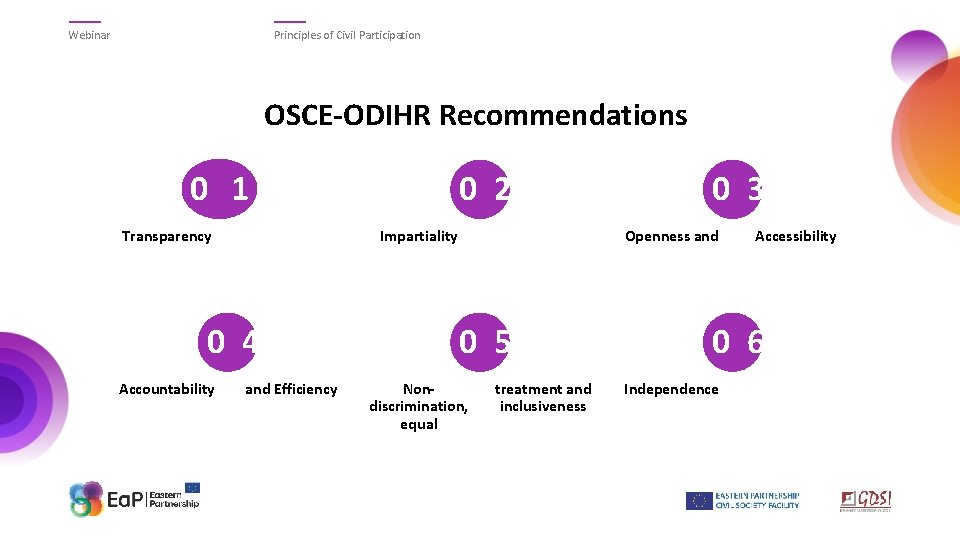
Webinar Principles of Civil Participation OSCE-ODIHR Recommendations 0 1 Transparency Impartiality 0 4 Accountability 0 2 and Efficiency 0 3 Openness and 0 5 Nondiscrimination, equal treatment and inclusiveness Accessibility 0 6 Independence
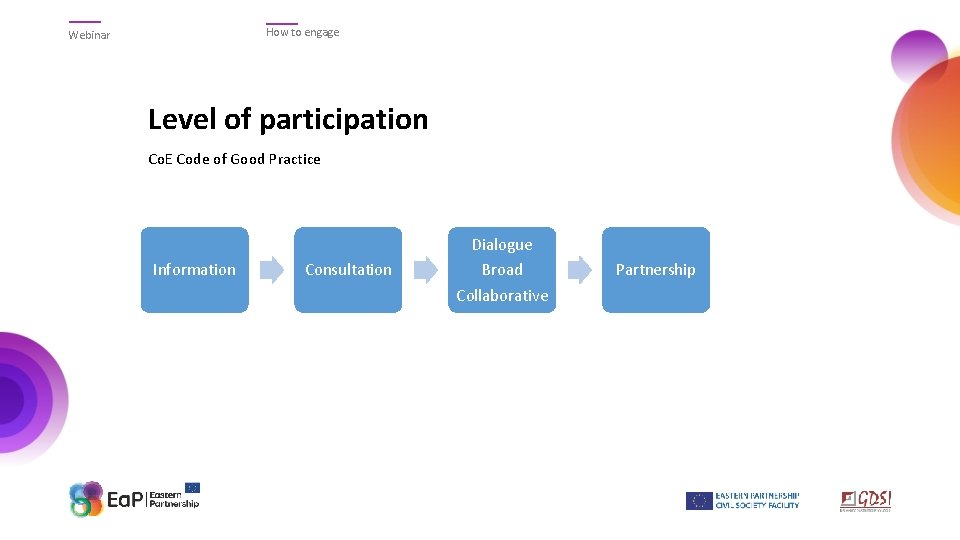
How to engage Webinar Level of participation Co. E Code of Good Practice Information Consultation Dialogue Broad Collaborative Partnership
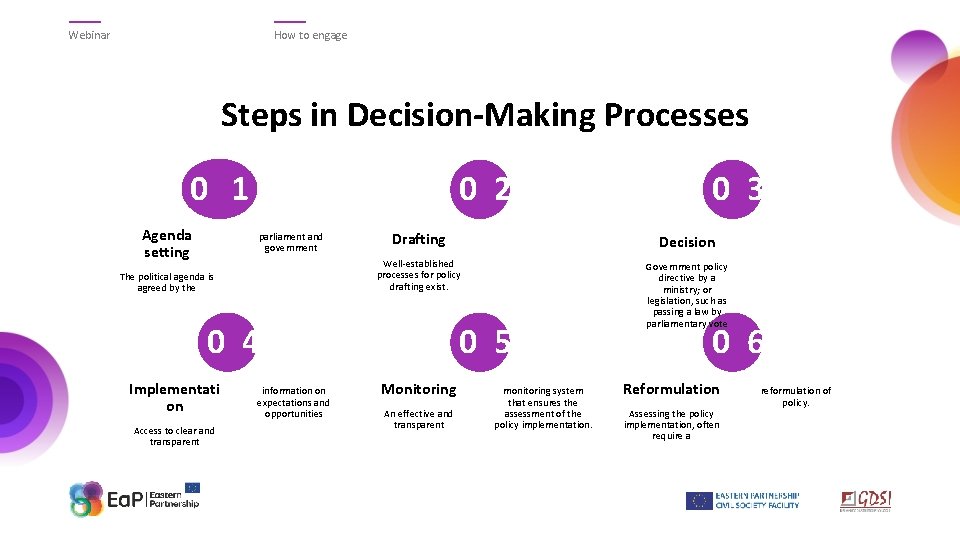
Webinar How to engage Steps in Decision-Making Processes 0 1 Agenda setting 0 2 parliament and government The political agenda is agreed by the Drafting Decision Well-established processes for policy drafting exist. Government policy directive by a ministry; or legislation, such as passing a law by parliamentary vote 0 4 Implementati on Access to clear and transparent information on expectations and opportunities 0 3 0 5 Monitoring An effective and transparent monitoring system that ensures the assessment of the policy implementation. 0 6 Reformulation Assessing the policy implementation, often require a reformulation of policy.
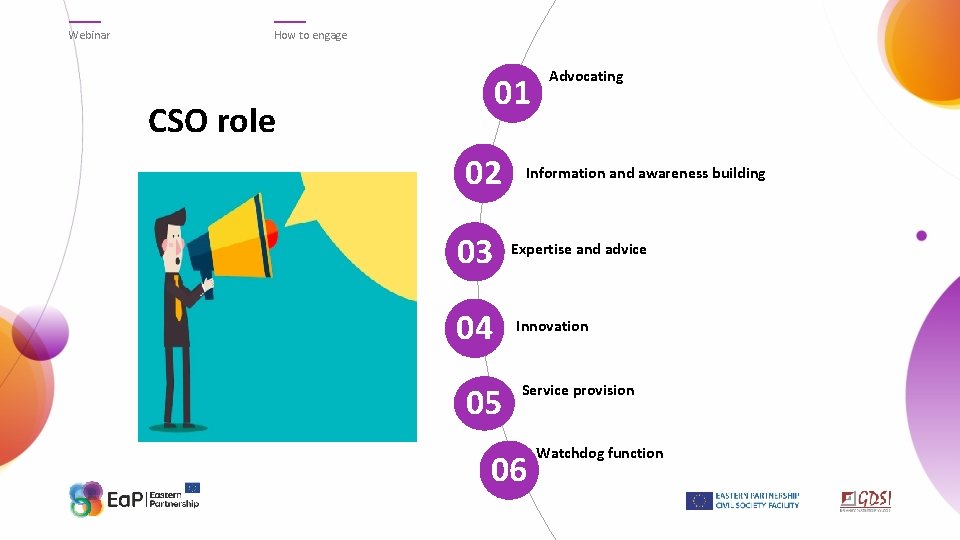
Webinar How to engage 01 CSO role 02 03 04 05 Advocating Information and awareness building Expertise and advice Innovation Service provision 06 Watchdog function
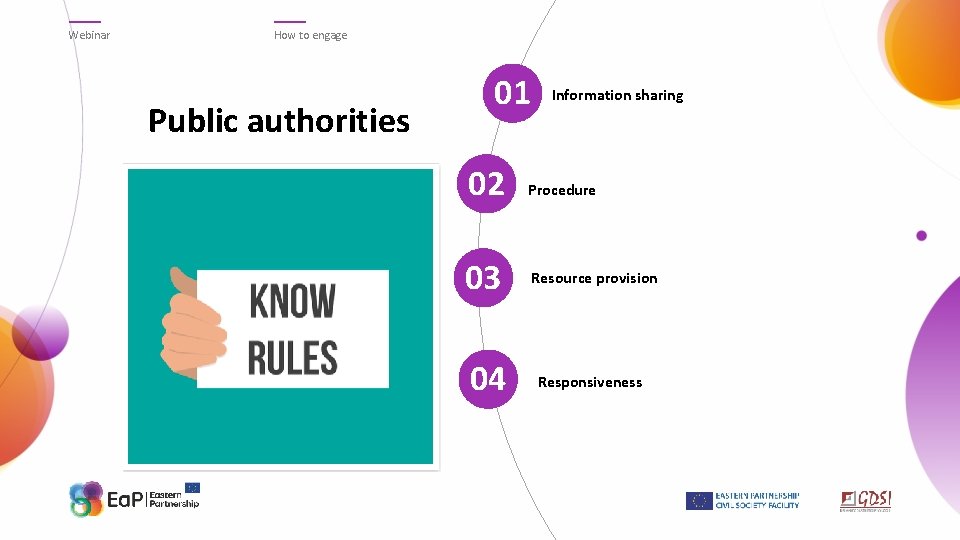
Webinar How to engage Public authorities 01 Information sharing 02 Procedure 03 Resource provision 04 Responsiveness
Webinar In practice…
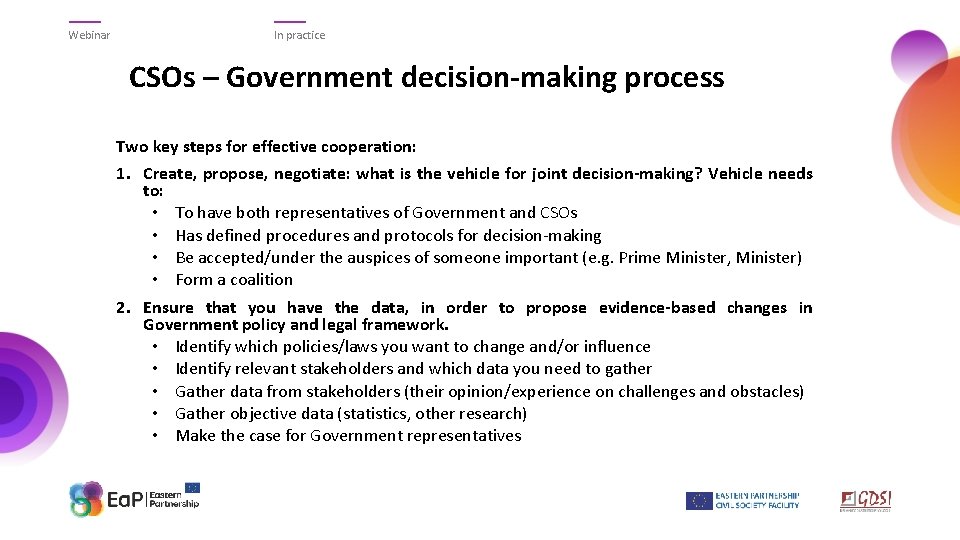
Webinar In practice CSOs – Government decision-making process Two key steps for effective cooperation: 1. Create, propose, negotiate: what is the vehicle for joint decision-making? Vehicle needs to: • To have both representatives of Government and CSOs • Has defined procedures and protocols for decision-making • Be accepted/under the auspices of someone important (e. g. Prime Minister, Minister) • Form a coalition 2. Ensure that you have the data, in order to propose evidence-based changes in Government policy and legal framework. • Identify which policies/laws you want to change and/or influence • Identify relevant stakeholders and which data you need to gather • Gather data from stakeholders (their opinion/experience on challenges and obstacles) • Gather objective data (statistics, other research) • Make the case for Government representatives
Webinar In practice Western Balkans: Law on Taxes Implementation Laws on taxes on legal entities have articles that define tax incentives for philanthropic giving from business sector to CSOs. However, CSOs that work on philanthropy development realized that companies and SMEs often do not use those incentives, which negatively influenced the level of giving. Research was conducted in two countries in WB region ( Serbia and Bosnia-Herzegovina): • Thorough analysis of existing legal framework • Survey among companies and SMEs: • Do they know for possibility of tax incentives? • Are they using the possibilities, and if not why not? • How that influences their giving? • What would help them to use the tax incentives? It turned out that local tax administrations gave different interpretations of the law to the businesses, often incorrect. Businesses therefore decided that it would be safer for them not to use the possibility of tax incentives, then to pay fines. The case was made to the Ministries of Finance and resulted in Tax Authorities in one of the countries (Serbia) creating obligatory manual for local departments of tax administration, that proscribed exact interpretation of the law and obligation to inform businesses. Let’s see the follow up…
Webinar In practice Western Balkans: Law on Taxes Implementation • Because of the lack of cooperation from the side of Ministry of Finance, Coalition for Philanthropy was established in Serbia, they approached Prime Minister and explained the idea of creating Council for Philanthropy which would work on improving policy and legal framework. • The idea was backed up by the same research on philanthropic giving that shows in over 50% of cases beneficiaries were state institutions (health, social, local governments etc. ). • Council for Philanthropy was formed as advisory body to the Prime Minister. • It consists of representatives of Coalition and all relevant Ministers • Strategy for Council, which defined goals, expected results and budget for Council work was adopted • 4 Working groups consist of representatives of Coalitions and Government; they provide analysis of the situation and necessary changes, conduct researches, does cost-benefit analysis (how much it would cost if the proposed change is applied) and based on these data proposes change in the law or policy. • Council was then enabled to make evidence-based and informed decision.
Webinar Ln practice Serbia: National Convention on the EU Platform for participation and monitoring the negotiation process with the EU • A permanent body for thematically structured debate on Serbian accession into the European Union, between representatives of the governmental bodies, political parties, NGOs, experts, syndicates, private sector and representatives of professional organizations. • The model was taken from Slovakia. Adapted to the European integration process environment in Serbia, the NCEU has monitored the process of negotiation about Stabilization and Association Agreement (SAA), as well as all other issues related to the Serbian accession to the EU. The platform should provide: • Regular consultations between Serbian governmental institutions and bodies and the interested public (civil society, local self governments and the representatives of the economy in the different phases of the accession process. • Definitions of recommendations and opinions about Serbian negotiation positions as well as monitoring if Serbia successfully manages to meet the conditions and benchmarks in various sectors as described in negotiation chapters. • Transparent and open dialogue during the analytical overview (screening), drafting negotiations position, the very process of negotiations as well as during the monitoring process of reform enforcement and obligations set by the negotiations. • Higher quality of informing the public about the accession process, negotiations and the consequences (obligations for different stakeholders, the economy, citizens…)
Webinar In practice Eastern Partnership Civil Society Forum • Existing since 2009 and bringing together +1000 organisations from the EU and Ea. P to promote European integration, facilitate reforms and democratic transformations. • Different structures: Annual Assembly, Working Groups, Steering Committee, National Platforms, Brussels-based Secretariat. • Aims to ensure the effective participation of civil societies of Eastern Partnership and the EU in the process of planning, monitoring and implementation of the Eastern Partnership policy in constructive dialogue with the EU and Ea. P decisionmakers. ADVOCACY • Access to EU institutions, EU member states and Ea. P policymakers through the Ea. P CSF channel; • Participation in the decision-making processes of the largest Ea. P civil society organisation; • Possibility to represent the Ea. P CSF at Ea. P Platform and Panel meetings with EU and Ea. P officials; • Possibility to represent the Ea. P CSF at the Ea. P Bilateral Civil Society Platforms ; • Participation in EU-driven consultations on Ea. P and consultations organised by the Council of Europe, World Bank, European Investment Bank and other institutional stakeholders; • Close co-operation on the most pressing issues with civil society organisations from across the Ea. P region and the EU; • Access to tailor-made information about what is happening at EU level in the areas covered by the Eastern Partnership • Access to tools to help your advocacy work better back home.
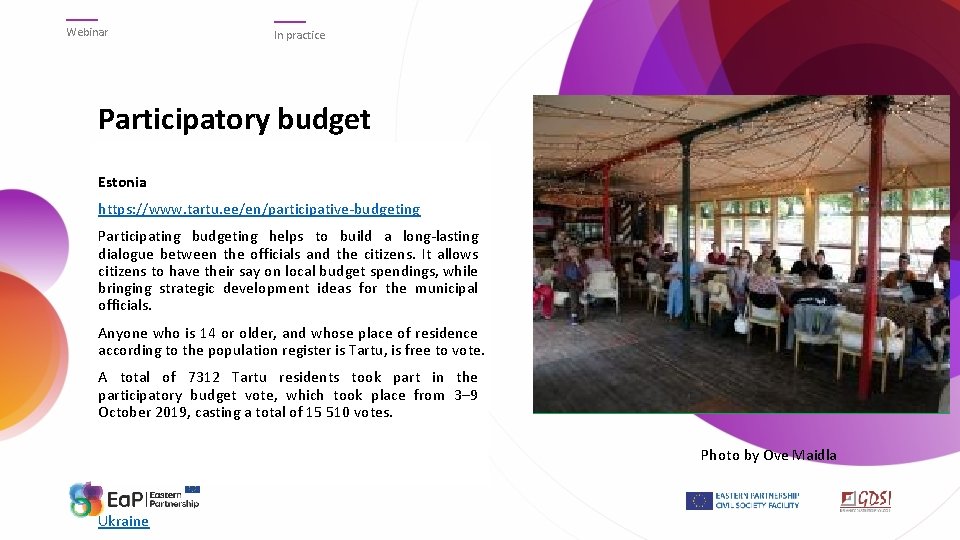
Webinar In practice Participatory budget Estonia https: //www. tartu. ee/en/participative-budgeting Participating budgeting helps to build a long-lasting dialogue between the officials and the citizens. It allows citizens to have their say on local budget spendings, while bringing strategic development ideas for the municipal officials. Anyone who is 14 or older, and whose place of residence according to the population register is Tartu, is free to vote. A total of 7312 Tartu residents took part in the participatory budget vote, which took place from 3– 9 October 2019, casting a total of 15 510 votes. Photo by Ove Maidla Ukraine
Webinar Participation Tools Cross-cutting tools
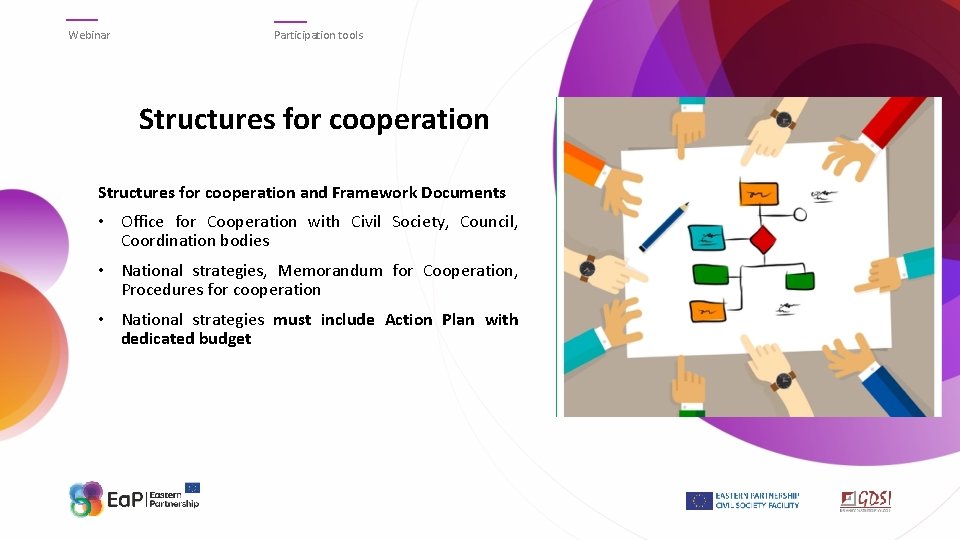
Webinar Participation tools Structures for cooperation and Framework Documents • Office for Cooperation with Civil Society, Council, Coordination bodies • National strategies, Memorandum for Cooperation, Procedures for cooperation • National strategies must include Action Plan with dedicated budget
Webinar Partic. Ipation tools Croatia : Office for Cooperation with NGOs Government Office for Cooperation with NGOs was founded by the Regulation on Government Office for Cooperation with NGOs in 1998 with the aim of performing expert work in the domain of the Croatian Government with regards to creating conditions for cooperation and partnership with non-governmental, nonprofit sector, especially with associations in the Republic of Croatia. The Office has a wide scope of activities: • Cooperation in creating and proposing new legislative frameworks for the activity of non-governmental, nonprofit sector in the Republic of Croatia, • Monitoring the implementation of the National Strategy for the Creation of an Enabling Environment for Civil Society Development and measures of the Operational Implementation Plan for the Strategy to forming a programme • Standards and recommendations for financing the activity of civil society organizations from the state budget and other public funds, as well as pre-accession and structural funds of the European Union. • The Office closely cooperates with the Council For the Development Of Civil Society to which it, at the same time, offers technical, administrative, professional and financial support in its work.
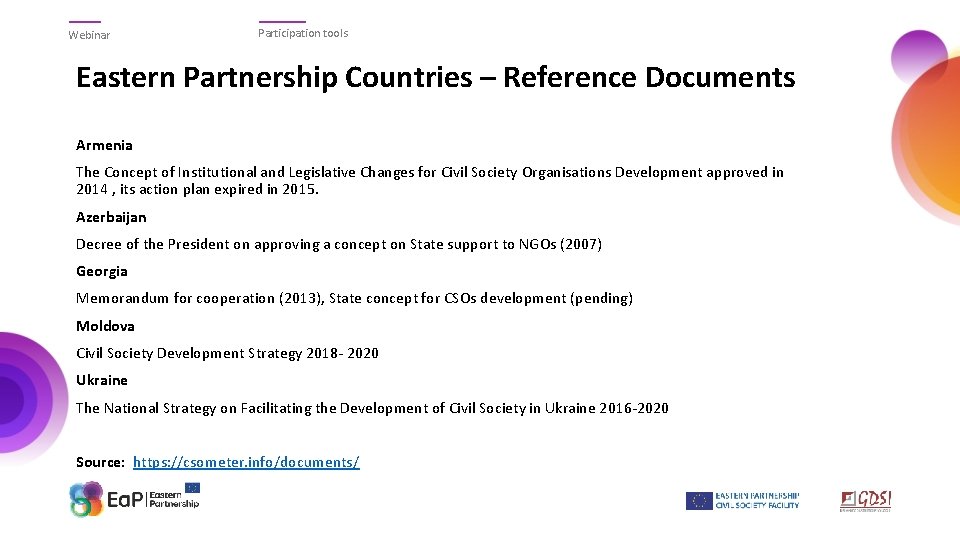
Webinar Participation tools Eastern Partnership Countries – Reference Documents Armenia The Concept of Institutional and Legislative Changes for Civil Society Organisations Development approved in 2014 , its action plan expired in 2015. Azerbaijan Decree of the President on approving a concept on State support to NGOs (2007) Georgia Memorandum for cooperation (2013), State concept for CSOs development (pending) Moldova Civil Society Development Strategy 2018 - 2020 Ukraine The National Strategy on Facilitating the Development of Civil Society in Ukraine 2016 -2020 Source: https: //csometer. info/documents/
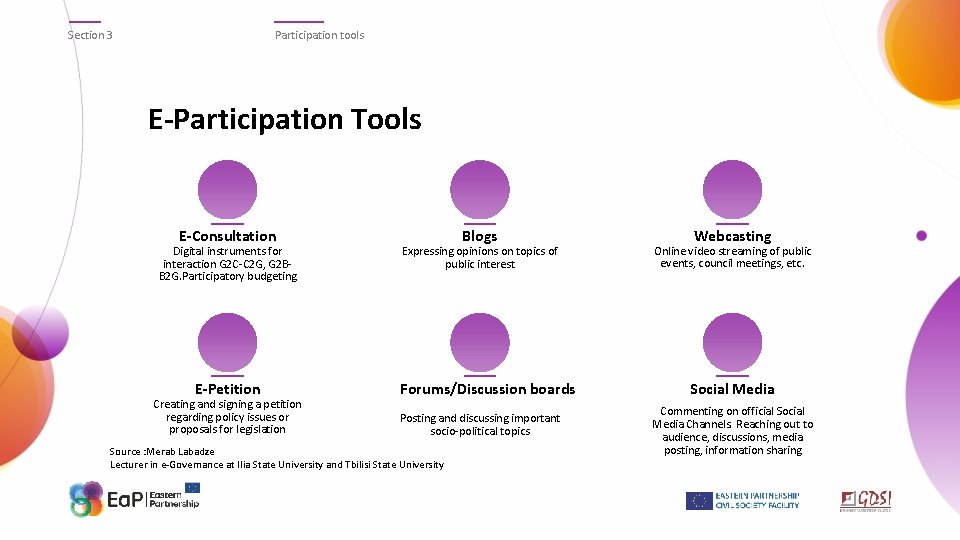
Section 3 Participation tools E-Participation Tools E-Consultation Digital instruments for interaction G 2 C-C 2 G, G 2 BB 2 G. Participatory budgeting E-Petition Creating and signing a petition regarding policy issues or proposals for legislation Blogs Expressing opinions on topics of public interest Forums/Discussion boards Posting and discussing important socio-political topics Source : Merab Labadze Lecturer in e-Governance at Ilia State University and Tbilisi State University Webcasting Online video streaming of public events, council meetings, etc. Social Media Commenting on official Social Media Channels. Reaching out to audience, discussions, media posting, information sharing
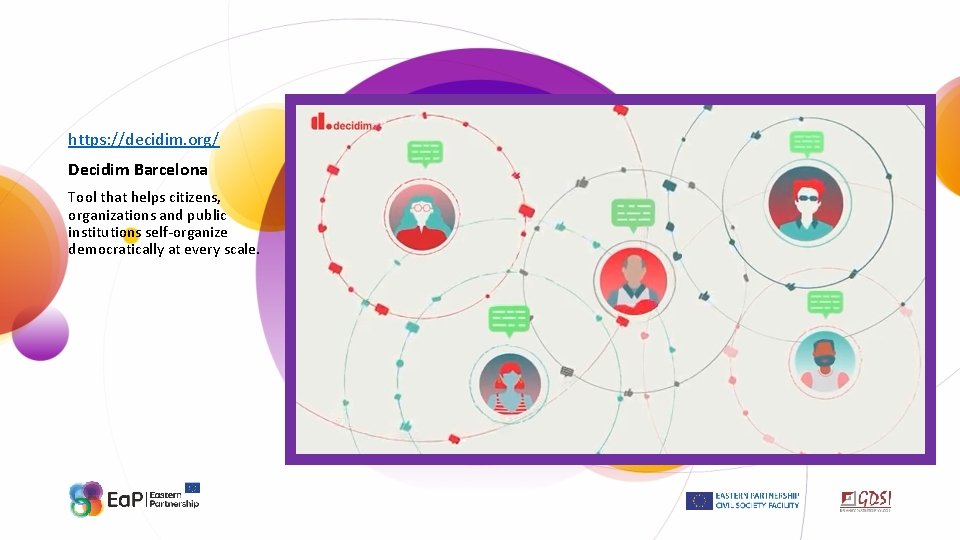
https: //decidim. org/ Decidim Barcelona Tool that helps citizens, organizations and public institutions self-organize democratically at every scale. Webinar
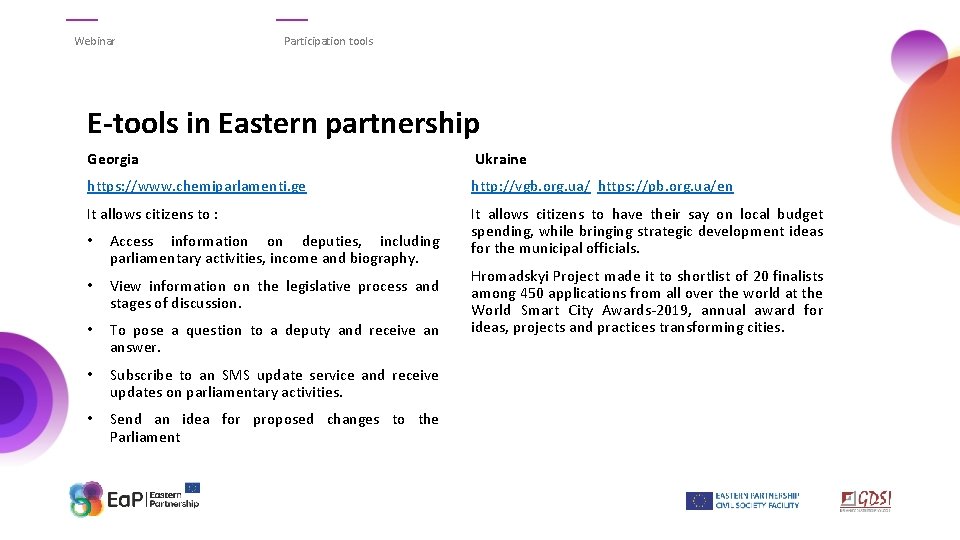
Webinar Participation tools E-tools in Eastern partnership Georgia Ukraine https: //www. chemiparlamenti. ge http: //vgb. org. ua/ https: //pb. org. ua/en It allows citizens to : It allows citizens to have their say on local budget spending, while bringing strategic development ideas for the municipal officials. • Access information on deputies, including parliamentary activities, income and biography. • View information on the legislative process and stages of discussion. • To pose a question to a deputy and receive an answer. • Subscribe to an SMS update service and receive updates on parliamentary activities. • Send an idea for proposed changes to the Parliament Hromadskyi Project made it to shortlist of 20 finalists among 450 applications from all over the world at the World Smart City Awards-2019, annual award for ideas, projects and practices transforming cities.
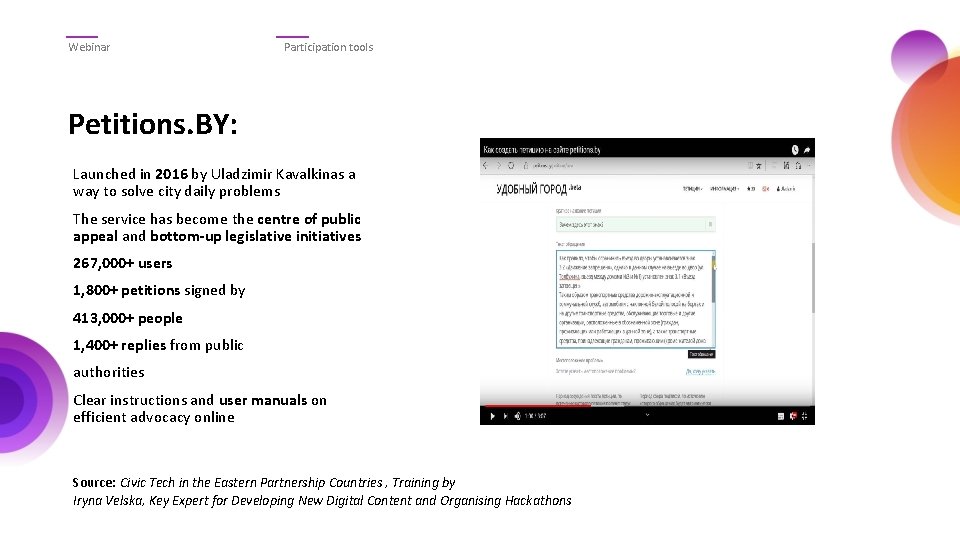
Webinar Participation tools Petitions. BY: Launched in 2016 by Uladzimir Kavalkinas a way to solve city daily problems The service has become the centre of public appeal and bottom-up legislative initiatives 267, 000+ users 1, 800+ petitions signed by 413, 000+ people 1, 400+ replies from public authorities Clear instructions and user manuals on efficient advocacy online Source: Civic Tech in the Eastern Partnership Countries , Training by Iryna Velska, Key Expert for Developing New Digital Content and Organising Hackathons
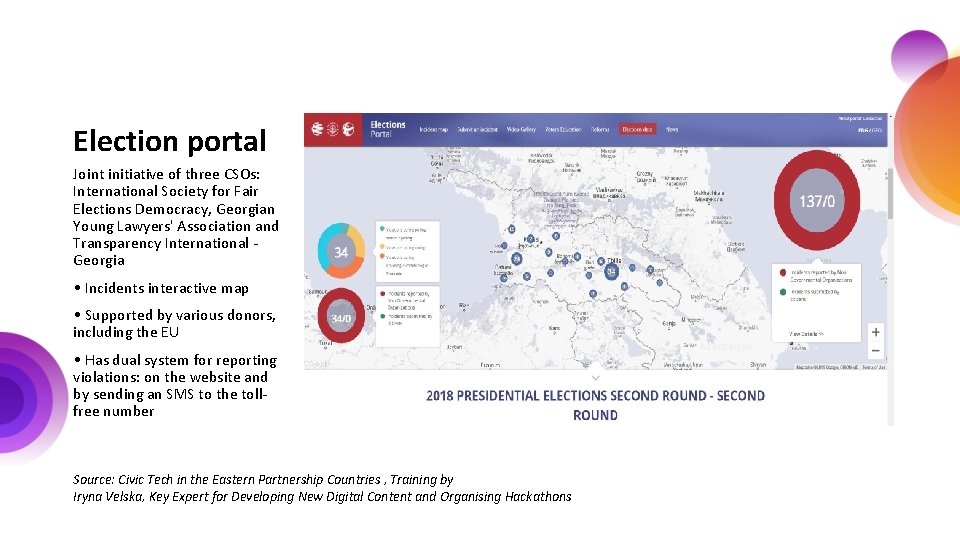
Election portal Joint initiative of three CSOs: International Society for Fair Elections Democracy, Georgian Young Lawyers' Association and Transparency International Georgia • Incidents interactive map • Supported by various donors, including the EU • Has dual system for reporting violations: on the website and by sending an SMS to the tollfree number Source: Civic Tech in the Eastern Partnership Countries , Training by Iryna Velska, Key Expert for Developing New Digital Content and Organising Hackathons
Webinar ICT Tools and Hackathons 2020 Ea. P Civil Society Hackathon http: //ict. eapcivilsociety. eu/ • Preceded by the Ea. P Regional Ideathon, an 1. 5 -day incubation meeting of authors of shortlisted ideas of digital solutions and the hackathon mentors • 2. 5 days of capacity building and coding • At least 60 civil society activists, IT professionals and web-designers (20 teams) from six Ea. P countries • 8 -10 mentors from the EU, the Ea. P and other countries • Three top-scoring solutions (two by public vote and one by the mentors’) will be nominated for the 2020 Digitalisation for Civil Society Award 01 02 03 04 05 31 January – 17 February Call for Applications among civil society activists for ideas of digital solutions (online registration at ict. eapcivilsociety. eu) 13 -14 March, Chisinau, Moldova Ea. P Regional Ideathon will name 20 ideas selected for the Hackathon in Kyiv 31 January – 16 March Call for Applications among developers and web designers (online registration at ict. eapcivilsociety. eu) 4 -30 March Webinars for selected participants and online meeting of the Hackathon participants 3 -5 April, Kyiv, Ukraine 2020 Ea. P Civil Society Hackathon
Contacts Thank you for your attention! Project Regional Office: GDSI Office: 23 Grigorenko Av. , Suite 2505, 02000 Kyiv, Ukraine Block 15, Galway Technology Parkmore, Galway, Ireland +38 063 376 55 46 +353 91 761000 welcome@Ea. PCivil. Society. eu consulting@gdsi. ie www. Ea. PCivil. Society. eu www. gdsi. ie Email: grantees_helpdesk@eapcivilsociety. eu Your questions are welcome !
- Slides: 32