
The Progress Principle a theory proposed by Professors
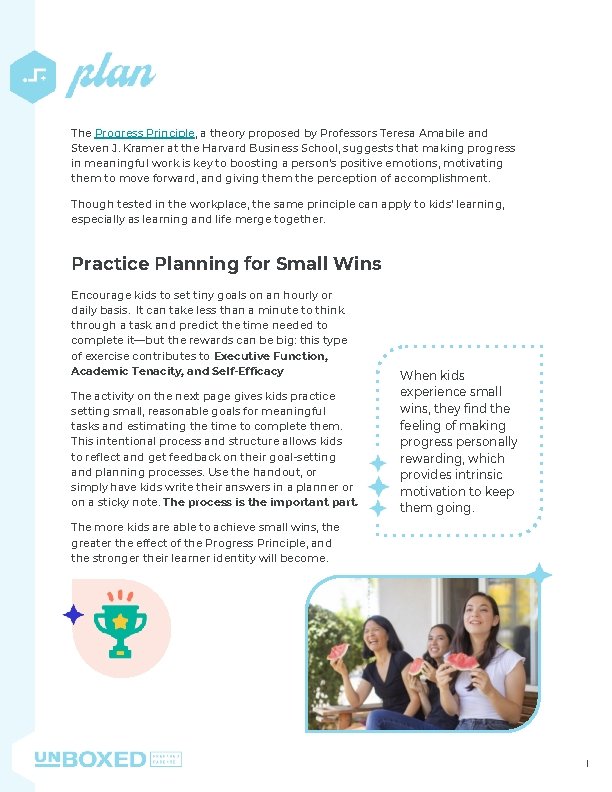
The Progress Principle, a theory proposed by Professors Teresa Amabile and Steven J. Kramer at the Harvard Business School, suggests that making progress in meaningful work is key to boosting a person’s positive emotions, motivating them to move forward, and giving them the perception of accomplishment. Though tested in the workplace, the same principle can apply to kids’ learning, especially as learning and life merge together. Practice Planning for Small Wins Encourage kids to set tiny goals on an hourly or daily basis. It can take less than a minute to think through a task and predict the time needed to complete it—but the rewards can be big: this type of exercise contributes to Executive Function, Academic Tenacity, and Self-Efficacy. The activity on the next page gives kids practice setting small, reasonable goals for meaningful tasks and estimating the time to complete them. This intentional process and structure allows kids to reflect and get feedback on their goal-setting and planning processes. Use the handout, or simply have kids write their answers in a planner or on a sticky note. The process is the important part. When kids experience small wins, they find the feeling of making progress personally rewarding, which provides intrinsic motivation to keep them going. The more kids are able to achieve small wins, the greater the effect of the Progress Principle, and the stronger their learner identity will become. 1
The Tiny Goal-Setting Cycle 1● Choose a small, specific task. 2● Estimate how long it will take to complete the task. 3● Work on the task until it is done. 4● Reflect This could be anything from reading a chapter in a book or writing a strong paragraph, to completing math homework or practicing a foundational skill to mastery. Think tiny! Time management is an important skill. Deliberate practice will help you improve! You can do it! Were you successful? Was your time accurate? Why or why not? 2
- Slides: 2