
The Programming Interface Libraries and languages make parallel
The Programming Interface Libraries and languages make parallel programming possible, but rarely easy
Commentary on Infix form of PP What was your experience with formulating a parallel prefix computation as an infix operation? 2/11/2022 (c) 2010 Larry Snyder 2
From last time: Tree Algorithms Trees are an important component of computing The “Schwartz tree” has been logical Trees as data structures are complicated because they are typically more dynamic Pointers are generally not available Work well with work queue approach As usual, we try to exploit locality and minimize communication 2/11/2022 (c) 2010 Larry Snyder 3
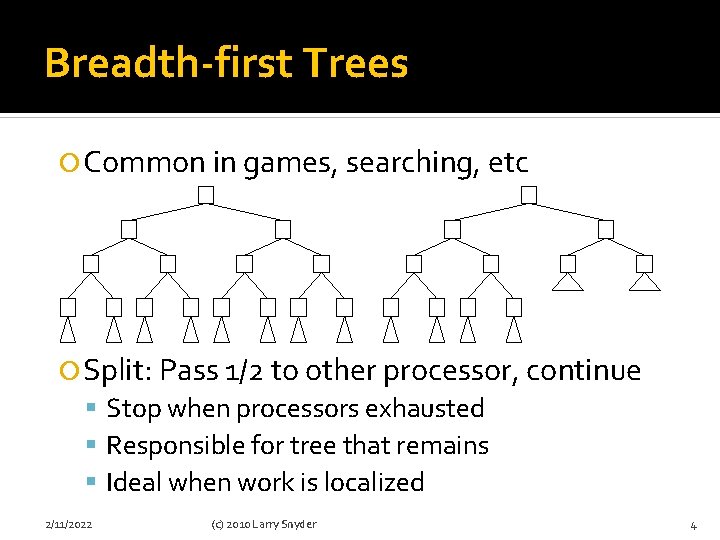
Breadth-first Trees Common in games, searching, etc Split: Pass 1/2 to other processor, continue Stop when processors exhausted Responsible for tree that remains Ideal when work is localized 2/11/2022 (c) 2010 Larry Snyder 4
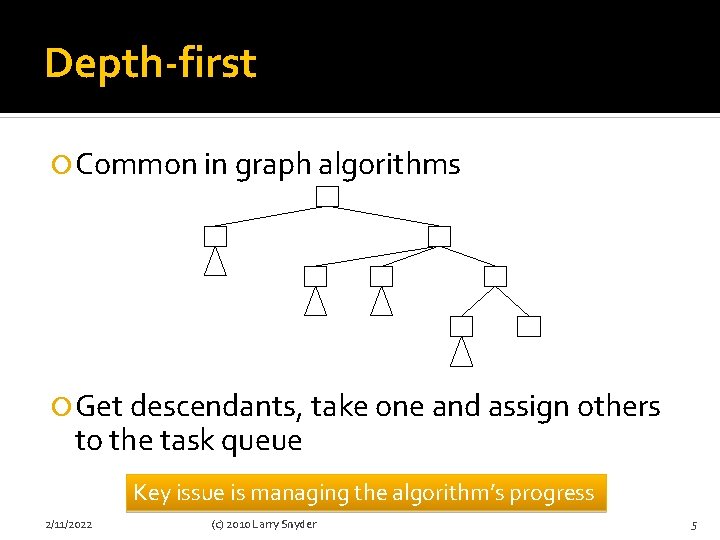
Depth-first Common in graph algorithms Get descendants, take one and assign others to the task queue Key issue is managing the algorithm’s progress 2/11/2022 (c) 2010 Larry Snyder 5
Coordination Among Nodes Tree algorithms often need to know how others are progressing Interrupt works if it is just a search: Eureka!! Record - cut-offs in global variable Other pruning data, e. g. best so far, also global Classic error is to consult global too frequently Rethink: What is tree data structure’s role? Write essay: Dijkstra’s algorithm is not a good… : ) 2/11/2022 (c) 2010 Larry Snyder 6
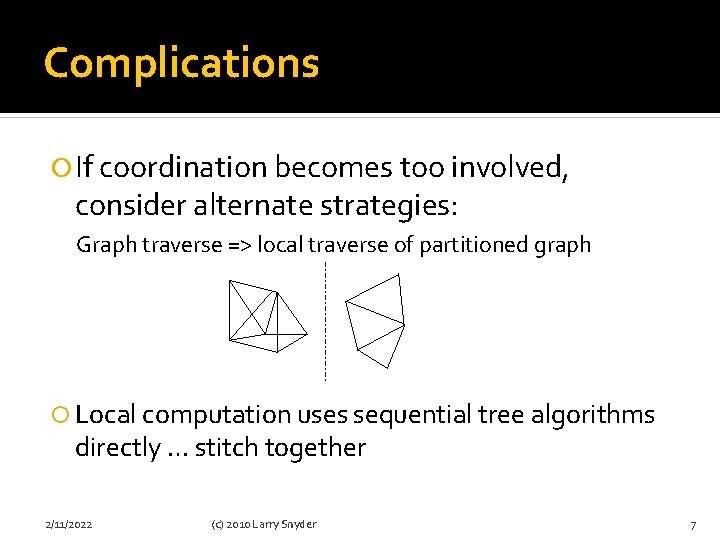
Complications If coordination becomes too involved, consider alternate strategies: Graph traverse => local traverse of partitioned graph Local computation uses sequential tree algorithms directly … stitch together 2/11/2022 (c) 2010 Larry Snyder 7
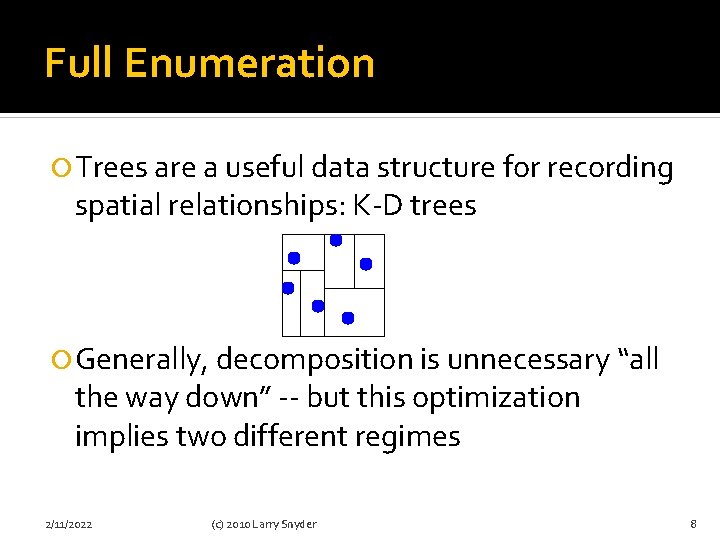
Full Enumeration Trees are a useful data structure for recording spatial relationships: K-D trees Generally, decomposition is unnecessary “all the way down” -- but this optimization implies two different regimes 2/11/2022 (c) 2010 Larry Snyder 8
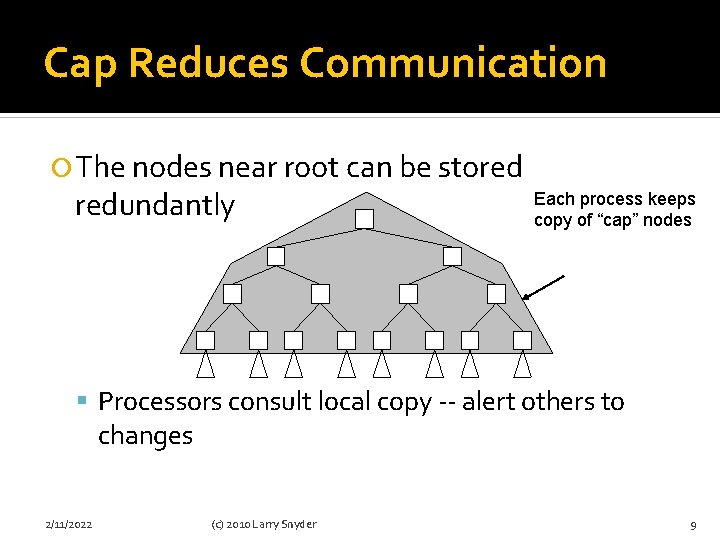
Cap Reduces Communication The nodes near root can be stored redundantly Each process keeps copy of “cap” nodes Processors consult local copy -- alert others to changes 2/11/2022 (c) 2010 Larry Snyder 9
Summary of Parallel Algorithms Reconceptualizing is often most effective Focus has not been on ||ism, but on other stuff Exploiting locality Balancing work Reducing inter-thread dependences We produced general purpose solution mechanisms: UD-reduce and UD-scan We like trees, but recognize that direct application is not likely 2/11/2022 (c) 2010 Larry Snyder 10
The Programming Interface “I don’t know what the technical characteristics of the standard language for scientific and engineering computation will be in the year 2000. . . but I know it will be called Fortran. ” John Backus, c. 1980
The Situation Today I have argued that a key property of a || programming system is that it embody an accurate (CTA) model of computation Recall why: Wrong model leads to picking wrong algorithm Communication costs -- they cannot be ignored || programs must port, so pick universal model So, which of our present languages do that? Today, we’ll see. 2/11/2022 (c) 2010 Larry Snyder 12
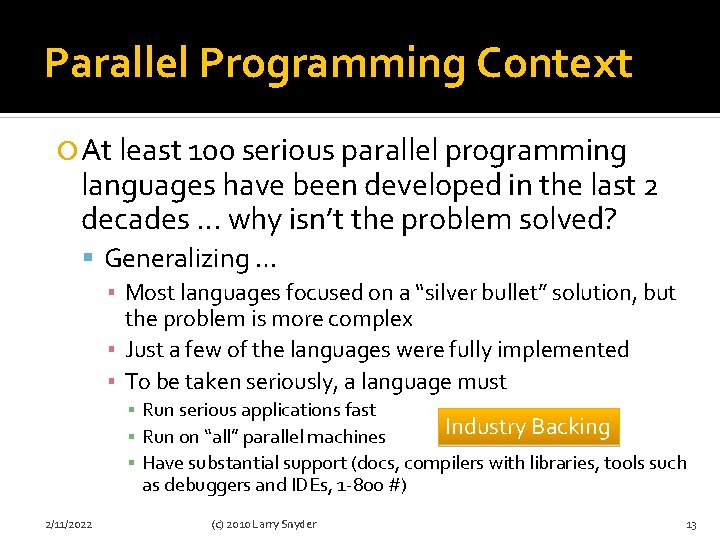
Parallel Programming Context At least 100 serious parallel programming languages have been developed in the last 2 decades … why isn’t the problem solved? Generalizing … ▪ Most languages focused on a “silver bullet” solution, but the problem is more complex ▪ Just a few of the languages were fully implemented ▪ To be taken seriously, a language must ▪ Run serious applications fast Industry Backing ▪ Run on “all” parallel machines ▪ Have substantial support (docs, compilers with libraries, tools such as debuggers and IDEs, 1 -800 #) 2/11/2022 (c) 2010 Larry Snyder 13
Not Surprisingly … No new languages crossed the bar Performance challenge … ▪ Serious applications programs are huge -- it is time consuming to write an equivalent program in any language, and it may require domain knowledge ▪ Production programs are often well optimized -- competing on performance implies an effective compiler and performance debugging tools ▪ “Linear speedup” goal (P processors will yield a P-fold speedup) is naïve, but widely assumed ▪ Doing well on one program is not persuasive Portability challenges are similar Will any programmer learn a new language? 2/11/2022 (c) 2010 Larry Snyder 14
Where We Stand Today, with few exceptions, we program using library-based facilities rather than languages Sequential language + message passing in MPI or PVM Sequential language + thread packages such as P -threads, or equivalently, Java-threads Open. MP with a pragma-aware compiler for a sequential programming language Consider each briefly before discussing new developments 2/11/2022 (c) 2010 Larry Snyder 15
Message Passing Message passing is “the lowest of the low”, but remains in widespread use because … It works -- embodies the CTA || model It is required for clusters, supercomputers, etc. Achieving performance is definitely possible Portability is essential for long-lived programs What is it? Variations on primitive send/receive Process spawning, broadcast, etc. Programming goodies: reduce, scan, processor groups 2/11/2022 (c) 2010 Larry Snyder 16
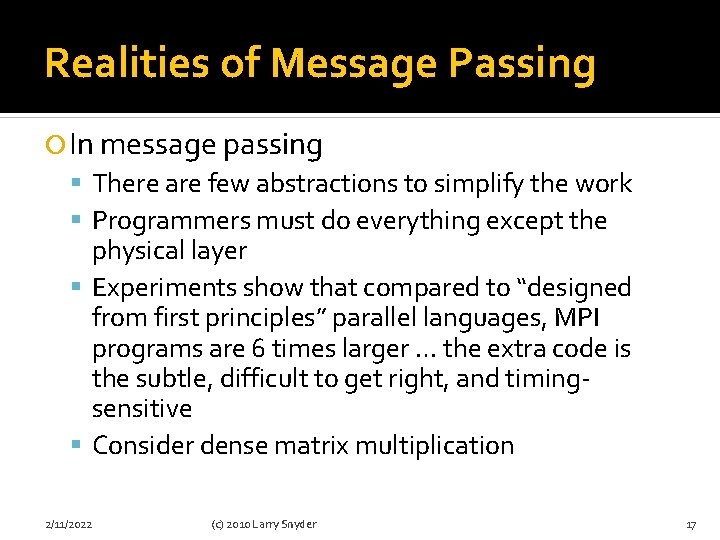
Realities of Message Passing In message passing There are few abstractions to simplify the work Programmers must do everything except the physical layer Experiments show that compared to “designed from first principles” parallel languages, MPI programs are 6 times larger … the extra code is the subtle, difficult to get right, and timingsensitive Consider dense matrix multiplication 2/11/2022 (c) 2010 Larry Snyder 17
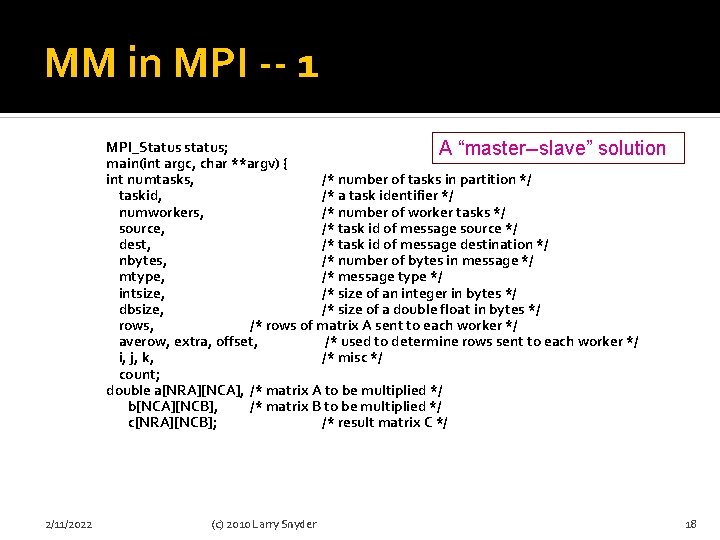
MM in MPI -- 1 MPI_Status status; A “master--slave” solution main(int argc, char **argv) { int numtasks, /* number of tasks in partition */ taskid, /* a task identifier */ numworkers, /* number of worker tasks */ source, /* task id of message source */ dest, /* task id of message destination */ nbytes, /* number of bytes in message */ mtype, /* message type */ intsize, /* size of an integer in bytes */ dbsize, /* size of a double float in bytes */ rows, /* rows of matrix A sent to each worker */ averow, extra, offset, /* used to determine rows sent to each worker */ i, j, k, /* misc */ count; double a[NRA][NCA], /* matrix A to be multiplied */ b[NCA][NCB], /* matrix B to be multiplied */ c[NRA][NCB]; /* result matrix C */ 2/11/2022 (c) 2010 Larry Snyder 18
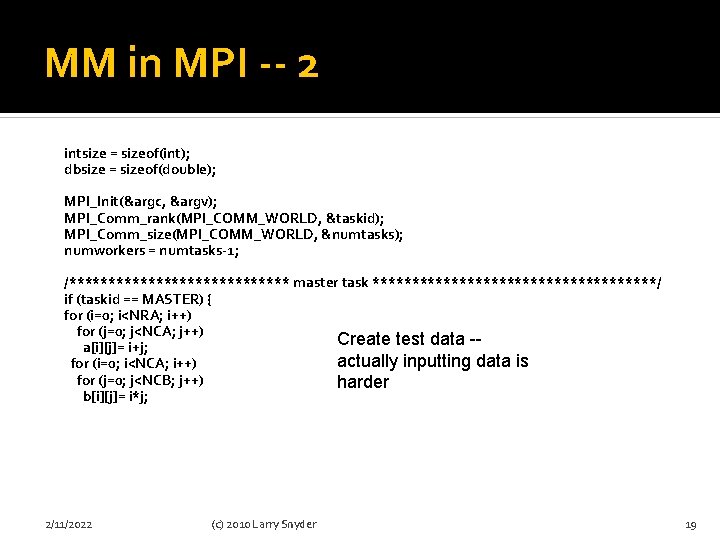
MM in MPI -- 2 intsize = sizeof(int); dbsize = sizeof(double); MPI_Init(&argc, &argv); MPI_Comm_rank(MPI_COMM_WORLD, &taskid); MPI_Comm_size(MPI_COMM_WORLD, &numtasks); numworkers = numtasks-1; /************** master task ******************/ if (taskid == MASTER) { for (i=0; i<NRA; i++) for (j=0; j<NCA; j++) Create test data -a[i][j]= i+j; actually inputting data is for (i=0; i<NCA; i++) for (j=0; j<NCB; j++) harder b[i][j]= i*j; 2/11/2022 (c) 2010 Larry Snyder 19
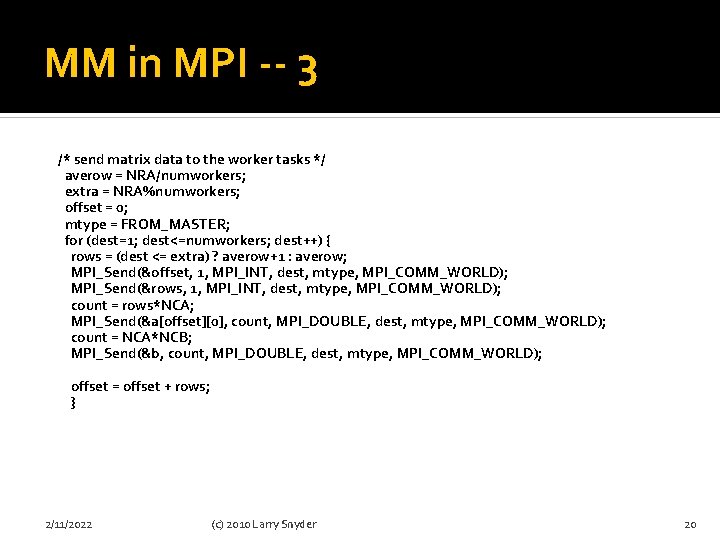
MM in MPI -- 3 /* send matrix data to the worker tasks */ averow = NRA/numworkers; extra = NRA%numworkers; offset = 0; mtype = FROM_MASTER; for (dest=1; dest<=numworkers; dest++) { rows = (dest <= extra) ? averow+1 : averow; MPI_Send(&offset, 1, MPI_INT, dest, mtype, MPI_COMM_WORLD); MPI_Send(&rows, 1, MPI_INT, dest, mtype, MPI_COMM_WORLD); count = rows*NCA; MPI_Send(&a[offset][0], count, MPI_DOUBLE, dest, mtype, MPI_COMM_WORLD); count = NCA*NCB; MPI_Send(&b, count, MPI_DOUBLE, dest, mtype, MPI_COMM_WORLD); offset = offset + rows; } 2/11/2022 (c) 2010 Larry Snyder 20
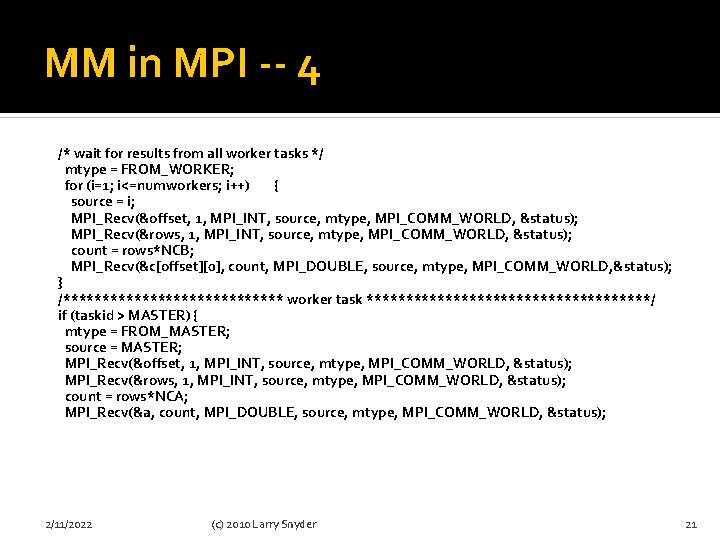
MM in MPI -- 4 /* wait for results from all worker tasks */ mtype = FROM_WORKER; for (i=1; i<=numworkers; i++) { source = i; MPI_Recv(&offset, 1, MPI_INT, source, mtype, MPI_COMM_WORLD, &status); MPI_Recv(&rows, 1, MPI_INT, source, mtype, MPI_COMM_WORLD, &status); count = rows*NCB; MPI_Recv(&c[offset][0], count, MPI_DOUBLE, source, mtype, MPI_COMM_WORLD, &status); } /************** worker task ******************/ if (taskid > MASTER) { mtype = FROM_MASTER; source = MASTER; MPI_Recv(&offset, 1, MPI_INT, source, mtype, MPI_COMM_WORLD, &status); MPI_Recv(&rows, 1, MPI_INT, source, mtype, MPI_COMM_WORLD, &status); count = rows*NCA; MPI_Recv(&a, count, MPI_DOUBLE, source, mtype, MPI_COMM_WORLD, &status); 2/11/2022 (c) 2010 Larry Snyder 21
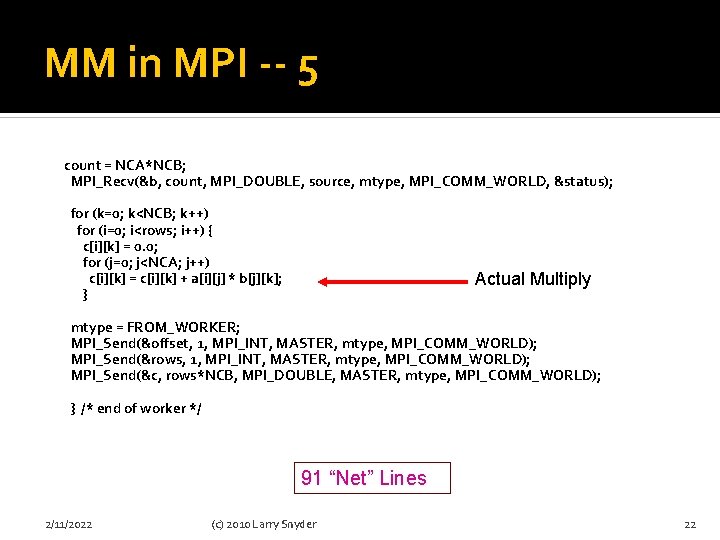
MM in MPI -- 5 count = NCA*NCB; MPI_Recv(&b, count, MPI_DOUBLE, source, mtype, MPI_COMM_WORLD, &status); for (k=0; k<NCB; k++) for (i=0; i<rows; i++) { c[i][k] = 0. 0; for (j=0; j<NCA; j++) c[i][k] = c[i][k] + a[i][j] * b[j][k]; } Actual Multiply mtype = FROM_WORKER; MPI_Send(&offset, 1, MPI_INT, MASTER, mtype, MPI_COMM_WORLD); MPI_Send(&rows, 1, MPI_INT, MASTER, mtype, MPI_COMM_WORLD); MPI_Send(&c, rows*NCB, MPI_DOUBLE, MASTER, mtype, MPI_COMM_WORLD); } /* end of worker */ 91 “Net” Lines 2/11/2022 (c) 2010 Larry Snyder 22
MPI Collective Communication Reduce and scan are called collective operations Reduce/scan apply to nodes, not values Basic operations +, *, min, max, &&, || Processor groups simplify collective ops on logical structures like “rows”, “leaves”, etc MPI allows user-defined scans … these have probably never been used! Bottom Line: Message passing is painful to use but it works … which makes it a solution of choice 2/11/2022 (c) 2010 Larry Snyder 23
Threading Libraries The P-threads library, designed for concurrency, is now also used for parallelism Sharing is implemented by referencing shared memory As mentioned, the memory not sequentially consistent Not CTA; P-threads use RAM performance model, a greater concern as latencies have increased Tends to promote very fine-grain sharing (recall count_3 s example), which limits the work that can be used to amortize the overhead costs such as thread creation, scheduling, etc. Scaling potential is limited Writing threaded code using CTA principles usually gives good results 2/11/2022 (c) 2010 Larry Snyder 24
Threading Is Subtle It is difficult to get threaded programs right Programmers are responsible for protecting all data references Avoiding deadlock requires discipline and care -and mistakes are easy to make, especially when optimizing Timing errors can remain latent for a very long time before emerging Main difficulties: Lots of work for small ||ism; poor scaling prospects 2/11/2022 (c) 2010 Larry Snyder 25
![Sample P-thread Code: Dot-Product # define NUMTHRDS 4 double sum; double a[256], b[256]; int](http://slidetodoc.com/presentation_image_h2/ab10e093c67310a83fa48ad006b8f6c1/image-26.jpg "Sample P-thread Code: Dot-Product # define NUMTHRDS 4 double sum; double a[256], b[256]; int")
Sample P-thread Code: Dot-Product # define NUMTHRDS 4 double sum; double a[256], b[256]; int status; int n = 256; pthread_t thds[NUMTHRDS]; pthread_mutex_t mutex_sum; int main ( int argc, char *argv[] ); void *dotprod ( void *arg ); int main ( int argc, char *argv[] ) { int i; pthread_attr_t attr; for ( i = 0; i < n; i++ ) { a[i] = i * 0. 5; b[i] = i * 2. 0; } 2/11/2022 (c) 2010 Larry Snyder Creating Data 26
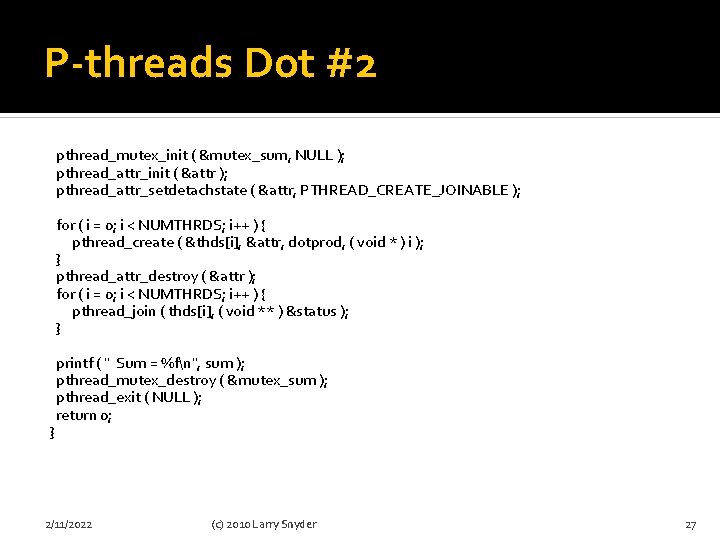
P-threads Dot #2 pthread_mutex_init ( &mutex_sum, NULL ); pthread_attr_init ( &attr ); pthread_attr_setdetachstate ( &attr, PTHREAD_CREATE_JOINABLE ); for ( i = 0; i < NUMTHRDS; i++ ) { pthread_create ( &thds[i], &attr, dotprod, ( void * ) i ); } pthread_attr_destroy ( &attr ); for ( i = 0; i < NUMTHRDS; i++ ) { pthread_join ( thds[i], ( void ** ) &status ); } } printf ( " Sum = %fn", sum ); pthread_mutex_destroy ( &mutex_sum ); pthread_exit ( NULL ); return 0; 2/11/2022 (c) 2010 Larry Snyder 27
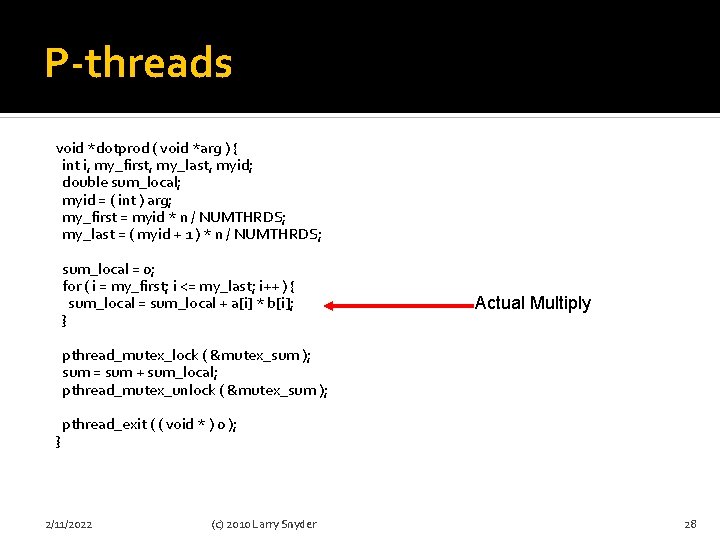
P-threads void *dotprod ( void *arg ) { int i, my_first, my_last, myid; double sum_local; myid = ( int ) arg; my_first = myid * n / NUMTHRDS; my_last = ( myid + 1 ) * n / NUMTHRDS; sum_local = 0; for ( i = my_first; i <= my_last; i++ ) { sum_local = sum_local + a[i] * b[i]; } Actual Multiply pthread_mutex_lock ( &mutex_sum ); sum = sum + sum_local; pthread_mutex_unlock ( &mutex_sum ); } pthread_exit ( ( void * ) 0 ); 2/11/2022 (c) 2010 Larry Snyder 28
Open. MP Developed as easy access to multi-threading Has second life with multi-core (Intel and others push) Approach Add pragmas to C or Fortran code Pragma-aware compiler links in appropriate library calls Pragma-unaware compiler -- no change from sequential All responsibility for parallel == sequential left to programmer Main benefit: little effort, some benefit Main liability: tight binding to sequential semantics 2/11/2022 (c) 2010 Larry Snyder 29
Note Open. MP Conflict The program is sequential ▪ When there is no compiler to interpret the pragmas, the code is sequential ▪ When there is no parallelism available, the sequential code runs ▪ When there is a compiler AND parallel processors the sequential code runs But, we often observe that there IS usually a conceptual difference between sequential and parallel algorithms 2/11/2022 (c) 2010 Larry Snyder 30
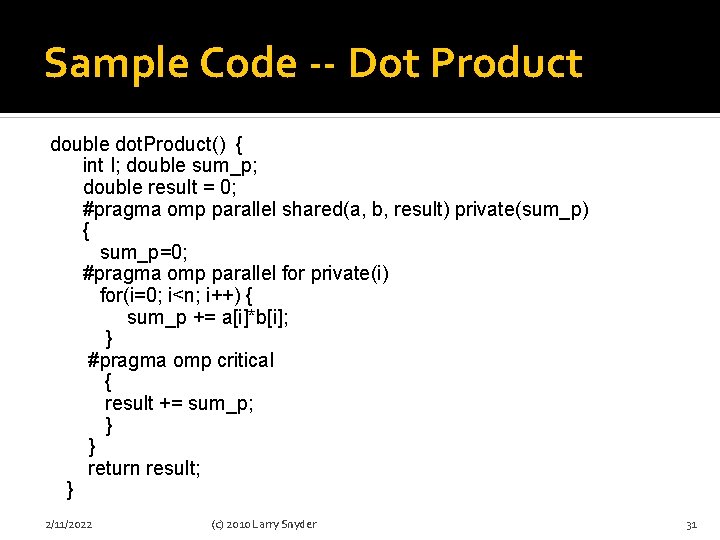
Sample Code -- Dot Product double dot. Product() { int I; double sum_p; double result = 0; #pragma omp parallel shared(a, b, result) private(sum_p) { sum_p=0; #pragma omp parallel for private(i) for(i=0; i<n; i++) { sum_p += a[i]*b[i]; } #pragma omp critical { result += sum_p; } } return result; } 2/11/2022 (c) 2010 Larry Snyder 31
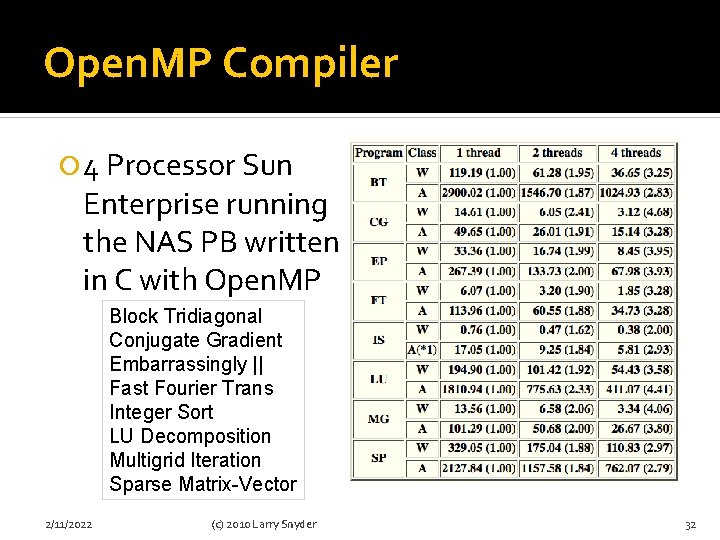
Open. MP Compiler 4 Processor Sun Enterprise running the NAS PB written in C with Open. MP Block Tridiagonal Conjugate Gradient Embarrassingly || Fast Fourier Trans Integer Sort LU Decomposition Multigrid Iteration Sparse Matrix-Vector 2/11/2022 (c) 2010 Larry Snyder 32
Critique of Open. MP The easy cases work well; harder cases are probably much harder Requires that the semantics of sequential computation be preserved Directly opposite of our thesis in this course that algorithms must be rethought Compilers must enforce the sequentially consistent memory model Limited abstractions 2/11/2022 (c) 2010 Larry Snyder 33
HPF: High Performance Fortran Philosophy Automatic parallelization won’t work For data parallelism, what’s important is data placement and data motion Give the compiler help: ▪ Extends Fortran with directives to guide data distribution Allow slow migration from legacy codes ▪ The directives are only hints Basic idea Processors operate on only part of overall data Directives say which processor operates on which data Much higher level than message passing 2/11/2022 (c) 2010 Larry Snyder 34
HPF History The beginning Designed by large consortium in the early 90’s Participation by academia, industry, and national labs ▪ All major vendors represented ▪ Convex, Cray, DEC, Fujitsu, HP, IBM, Intel, Meiko, Sun, Thinking Machines Heavily influenced by Fortran-D from Rice ▪ D stands for “Data” or “Distributed” HPF 2. 0 specified in 1996 2/11/2022 (c) 2010 Larry Snyder 35
Strategic Decisions Context Part of early 90’s trend towards consolidating supercomputing research To reduce risk, fund a few large projects rather than a lot of small risky projects Buoyed by the success of MPI Aware of the lessons of vectorizing compilers ▪ Compilers can train programmers by providing feedback 2/11/2022 (c) 2010 Larry Snyder 36
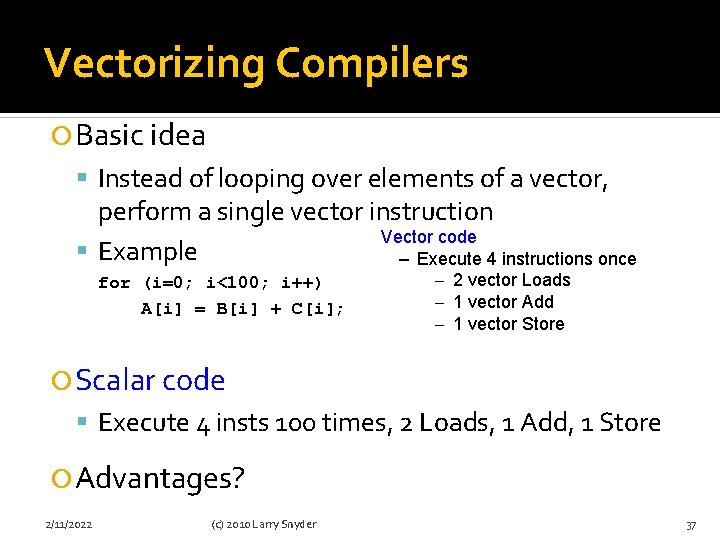
Vectorizing Compilers Basic idea Instead of looping over elements of a vector, perform a single vector instruction Vector code Example – Execute 4 instructions once for (i=0; i<100; i++) A[i] = B[i] + C[i]; – 2 vector Loads – 1 vector Add – 1 vector Store Scalar code Execute 4 insts 100 times, 2 Loads, 1 Add, 1 Store Advantages? 2/11/2022 (c) 2010 Larry Snyder 37
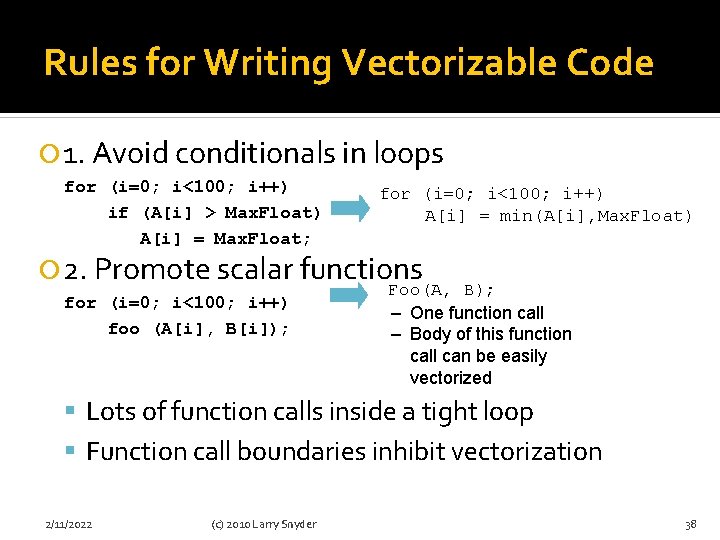
Rules for Writing Vectorizable Code 1. Avoid conditionals in loops for (i=0; i<100; i++) if (A[i] > Max. Float) A[i] = Max. Float; for (i=0; i<100; i++) A[i] = min(A[i], Max. Float) 2. Promote scalar functions for (i=0; i<100; i++) foo (A[i], B[i]); Foo(A, B); – One function call – Body of this function call can be easily vectorized Lots of function calls inside a tight loop Function call boundaries inhibit vectorization 2/11/2022 (c) 2010 Larry Snyder 38
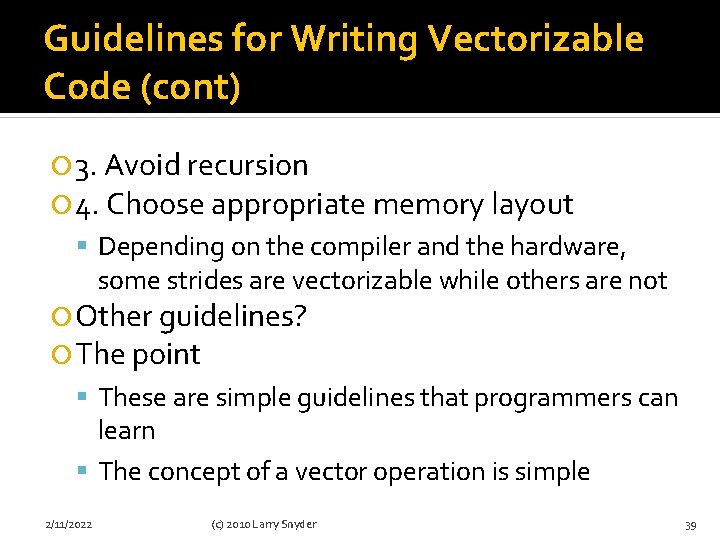
Guidelines for Writing Vectorizable Code (cont) 3. Avoid recursion 4. Choose appropriate memory layout Depending on the compiler and the hardware, some strides are vectorizable while others are not Other guidelines? The point These are simple guidelines that programmers can learn The concept of a vector operation is simple 2/11/2022 (c) 2010 Larry Snyder 39
Strategic Decisions (cont) A community project Compiler directives don’t change the program’s semantics They only affect performance Allows different groups to conduct research on different aspects of the problem Even the “little guy” can contribute 2/11/2022 (c) 2010 Larry Snyder 40
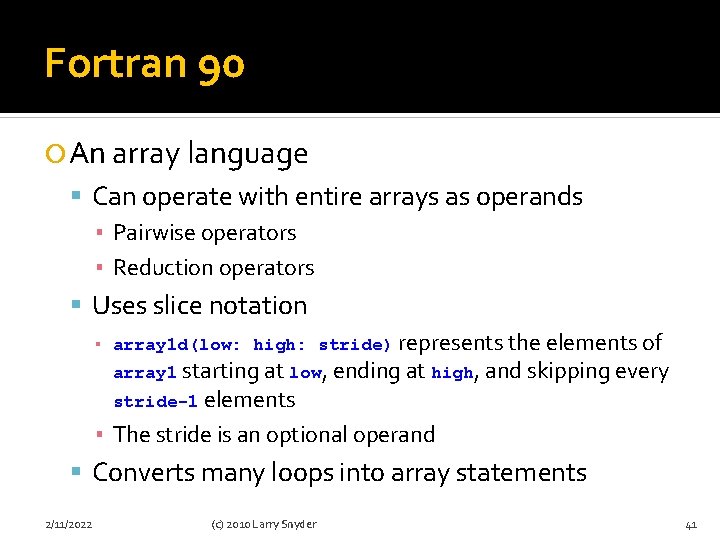
Fortran 90 An array language Can operate with entire arrays as operands ▪ Pairwise operators ▪ Reduction operators Uses slice notation ▪ array 1 d(low: high: stride) represents the elements of array 1 starting at low, ending at high, and skipping every stride-1 elements ▪ The stride is an optional operand Converts many loops into array statements 2/11/2022 (c) 2010 Larry Snyder 41
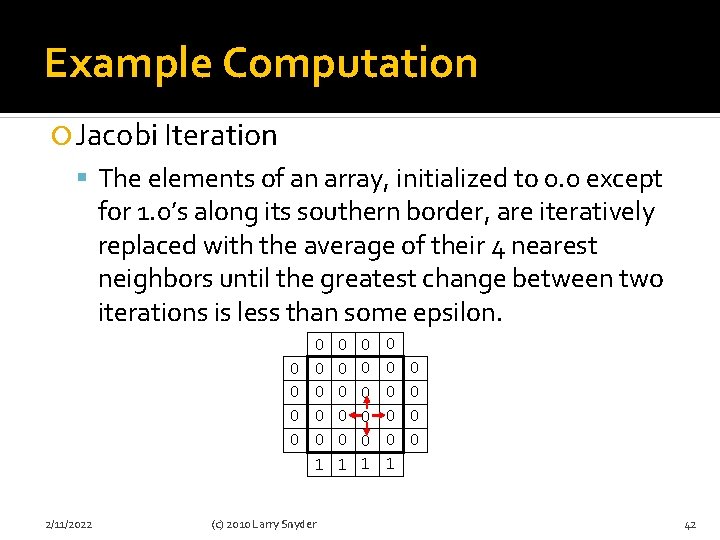
Example Computation Jacobi Iteration The elements of an array, initialized to 0. 0 except for 1. 0’s along its southern border, are iteratively replaced with the average of their 4 nearest neighbors until the greatest change between two iterations is less than some epsilon. 0 0 2/11/2022 0 0 0 1 (c) 2010 Larry Snyder 0 0 0 0 0 1 0 0 42
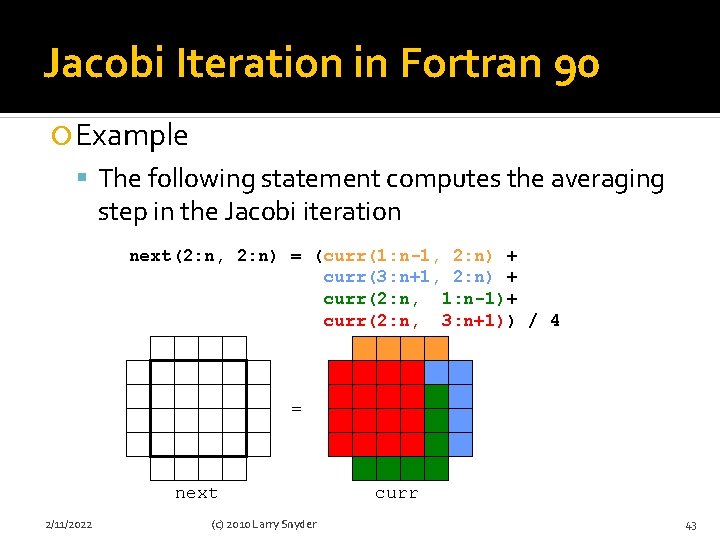
Jacobi Iteration in Fortran 90 Example The following statement computes the averaging step in the Jacobi iteration Assume that 2: n) next=and curr are 2 D arrays next(2: n, (curr(1: n-1, 2: n) + curr(3: n+1, 2: n) + curr(2: n, 1: n-1)+ curr(2: n, 3: n+1)) / 4 = next 2/11/2022 (c) 2010 Larry Snyder curr 43
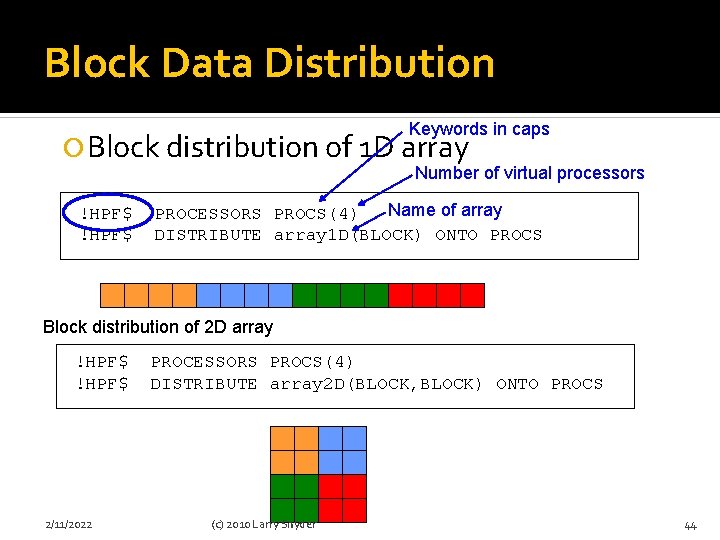
Block Data Distribution Keywords in caps Block distribution of 1 D array Number of virtual processors !HPF$ Name of array PROCESSORS PROCS(4) DISTRIBUTE array 1 D(BLOCK) ONTO PROCS Block distribution of 2 D array !HPF$ 2/11/2022 PROCESSORS PROCS(4) DISTRIBUTE array 2 D(BLOCK, BLOCK) ONTO PROCS (c) 2010 Larry Snyder 44
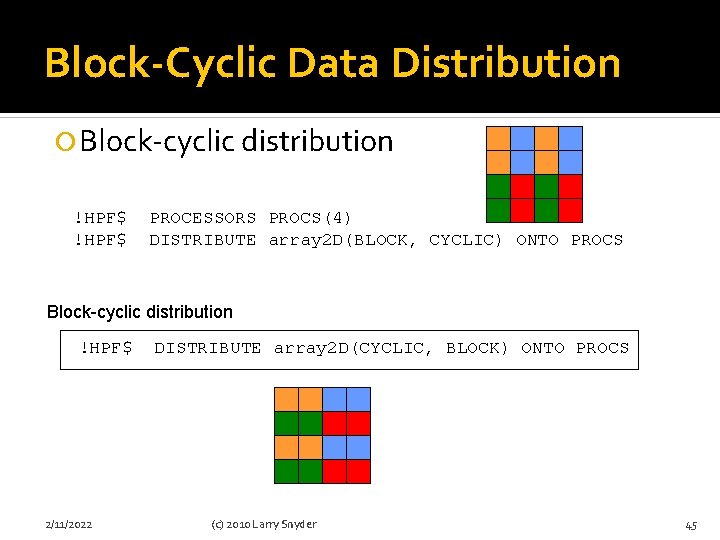
Block-Cyclic Data Distribution Block-cyclic distribution !HPF$ PROCESSORS PROCS(4) DISTRIBUTE array 2 D(BLOCK, CYCLIC) ONTO PROCS Block-cyclic distribution !HPF$ 2/11/2022 DISTRIBUTE array 2 D(CYCLIC, BLOCK) ONTO PROCS (c) 2010 Larry Snyder 45
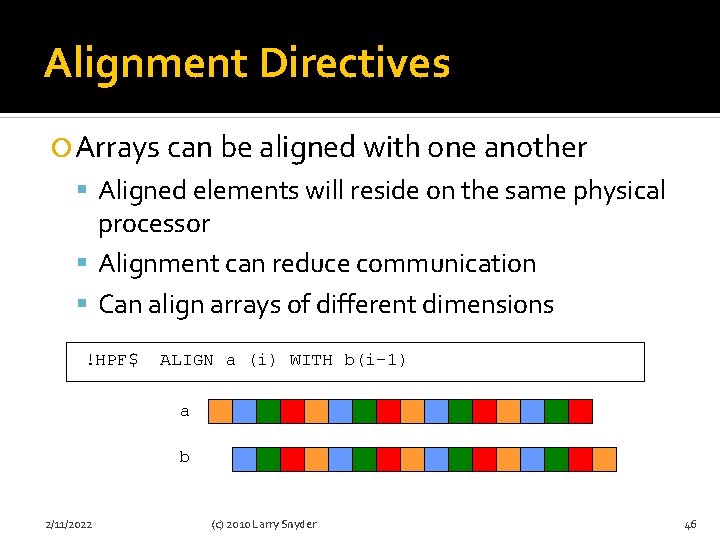
Alignment Directives Arrays can be aligned with one another Aligned elements will reside on the same physical processor Alignment can reduce communication Can align arrays of different dimensions !HPF$ ALIGN a (i) WITH b(i-1) a b 2/11/2022 (c) 2010 Larry Snyder 46
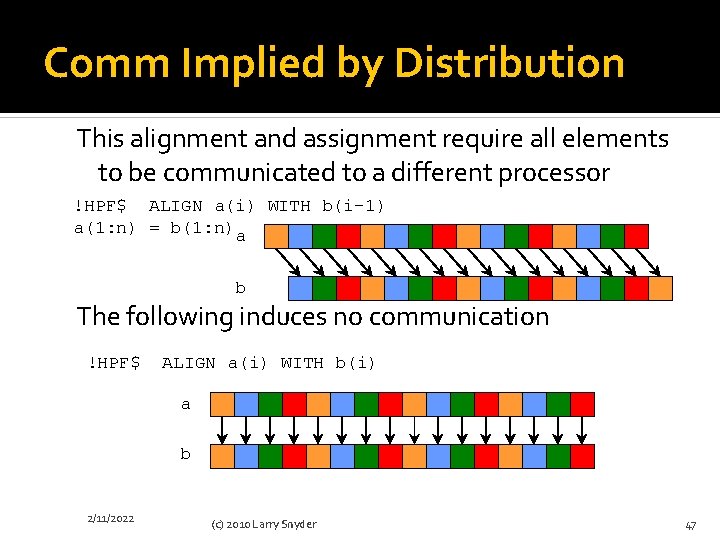
Comm Implied by Distribution This alignment and assignment require all elements to be communicated to a different processor !HPF$ ALIGN a(i) WITH b(i-1) a(1: n) = b(1: n)a b The following induces no communication !HPF$ ALIGN a(i) WITH b(i) a b 2/11/2022 (c) 2010 Larry Snyder 47
Break 2/11/2022 (c) 2010 Larry Snyder 48
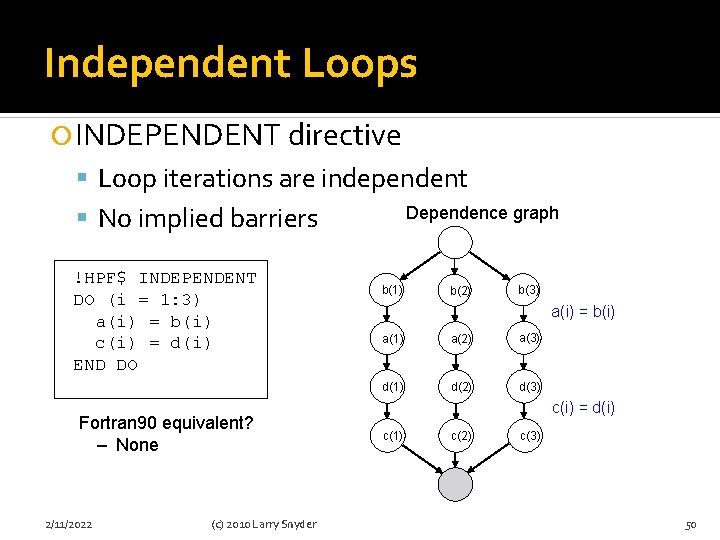
Independent Loops INDEPENDENT directive Loop iterations are independent No implied barriers !HPF$ INDEPENDENT DO (i = 1: 3) a(i) = b(i) c(i) = d(i) END DO Fortran 90 equivalent? – None 2/11/2022 (c) 2010 Larry Snyder Dependence graph b(1) b(2) b(3) a(i) = b(i) a(1) a(2) a(3) d(1) d(2) d(3) c(i) = d(i) c(1) c(2) c(3) 50
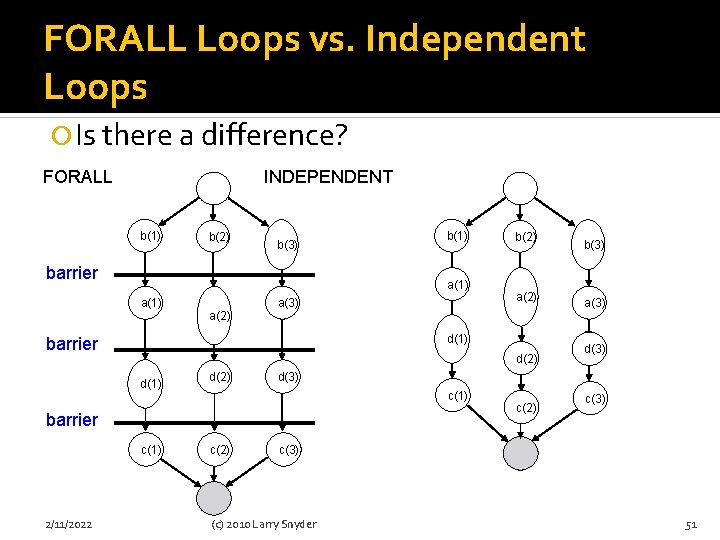
FORALL Loops vs. Independent Loops Is there a difference? FORALL INDEPENDENT b(1) b(2) b(3) barrier a(1) a(2) a(3) b(2) a(2) d(1) barrier d(2) d(1) d(2) c(1) c(2) b(3) a(3) d(3) barrier 2/11/2022 b(1) c(2) c(3) (c) 2010 Larry Snyder 51
Evaluation Your thoughts on HPF? Is this a convenient language to use? Can programmers get good performance? No performance model To understand locality and communication, need to understand complex interactions among distributions Does the following code induce communication? ▪ Procedure calls are particularly bad a(i) = b(i) Many hidden costs Small changes in distribution can have large 2/11/2022 performance impact (c) 2010 Larry Snyder 52
Evaluation (cont) No performance model Complex language Difficult language to compile ▪ Large variability among compilers ▪ Kernel HPF: A subset of HPF “guaranteed” to be fast An accurate performance model is essential Witness our experience with the PRAM Common user experience Play with random different distribution in an attempt try to get good performance 2/11/2022 (c) 2010 Larry Snyder 53
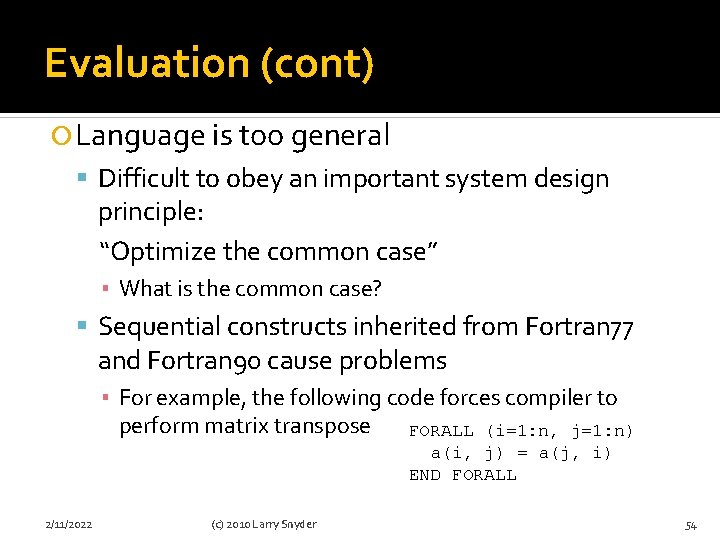
Evaluation (cont) Language is too general Difficult to obey an important system design principle: “Optimize the common case” ▪ What is the common case? Sequential constructs inherited from Fortran 77 and Fortran 90 cause problems ▪ For example, the following code forces compiler to perform matrix transpose FORALL (i=1: n, j=1: n) a(i, j) = a(j, i) END FORALL 2/11/2022 (c) 2010 Larry Snyder 54
ZPL Philosophy Provide performance portability for data-parallel programs Allow users to reason about performance Start from scratch ▪ Parallel is fundamentally different from sequential ▪ Be willing to throw out conveniences familiar to sequential programmers Basic idea ▪ An array language ▪ Implicitly parallel CS 380 P Lecture 17 Introduction to ZPL 55
ZPL History The beginning Designed by a small team beginning in 1993 Compiler and runtime released in 1997 Claims Portable to any MIMD parallel computer Performance comparable to C with message passing Generally outperforms HPF Convenient and intuitive CS 380 P Lecture 17 Introduction to ZPL 56
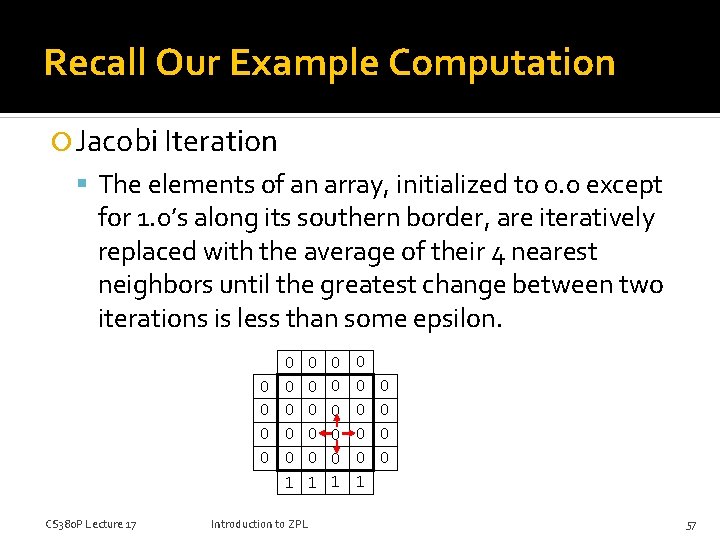
Recall Our Example Computation Jacobi Iteration The elements of an array, initialized to 0. 0 except for 1. 0’s along its southern border, are iteratively replaced with the average of their 4 nearest neighbors until the greatest change between two iterations is less than some epsilon. 0 0 CS 380 P Lecture 17 0 0 0 0 0 1 Introduction to ZPL 0 0 0 0 0 1 0 0 57
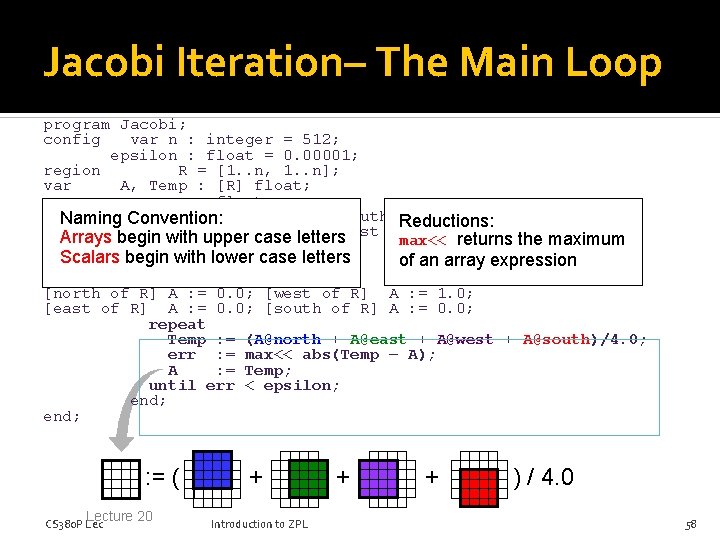
Jacobi Iteration– The Main Loop program Jacobi; config var n : integer = 512; epsilon : float = 0. 00001; region R = [1. . n, 1. . n]; var A, Temp : [R] float; err : float; direction north = [-1, 0]; south = [ 1, 0]; Naming Convention: Reductions: east [ 0, case 1]; letterswest = [ 0, -1]; Arrays begin with=upper max<< returns the maximum procedure Jacobi(); Scalars begin with lower case letters of an array expression [R] begin A : = 0. 0; [north of R] A : = 0. 0; [west of R] A : = 1. 0; [east of R] A : = 0. 0; [south of R] A : = 0. 0; repeat Temp : = (A@north + A@east + A@west + A@south)/4. 0; err : = max<< abs(Temp – A); A : = Temp; until err < epsilon; end; : = ( Lecture 20 CS 380 P Lecture 17 + Introduction to ZPL + + ) / 4. 0 58
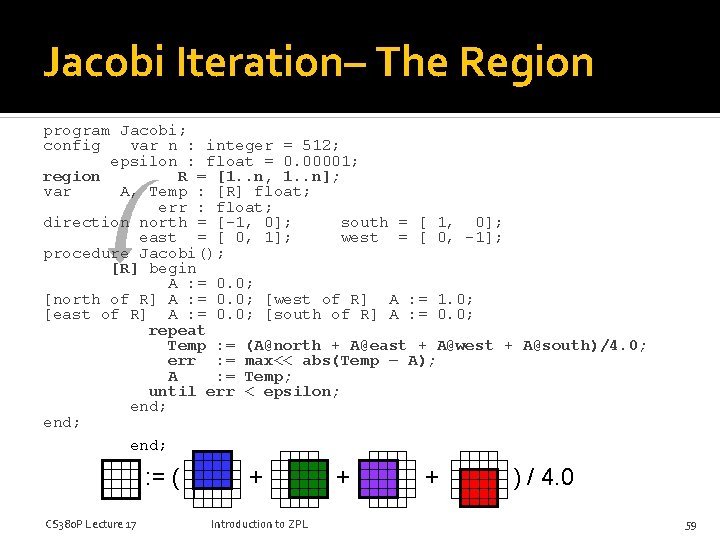
Jacobi Iteration– The Region program Jacobi; config var n : integer = 512; epsilon : float = 0. 00001; region R = [1. . n, 1. . n]; var A, Temp : [R] float; err : float; direction north = [-1, 0]; south = [ 1, 0]; east = [ 0, 1]; west = [ 0, -1]; procedure Jacobi(); [R] begin A : = 0. 0; [north of R] A : = 0. 0; [west of R] A : = 1. 0; [east of R] A : = 0. 0; [south of R] A : = 0. 0; repeat Temp : = (A@north + A@east + A@west + A@south)/4. 0; err : = max<< abs(Temp – A); A : = Temp; until err < epsilon; end; : = ( CS 380 P Lecture 17 + Introduction to ZPL + + ) / 4. 0 59
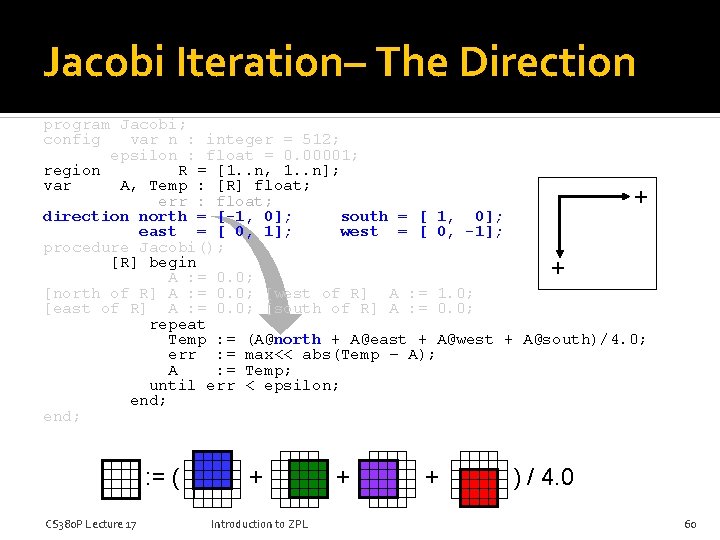
Jacobi Iteration– The Direction program Jacobi; config var n : integer = 512; epsilon : float = 0. 00001; region R = [1. . n, 1. . n]; var A, Temp : [R] float; + err : float; direction north = [-1, 0]; south = [ 1, 0]; east = [ 0, 1]; west = [ 0, -1]; procedure Jacobi(); [R] begin + A : = 0. 0; [north of R] A : = 0. 0; [west of R] A : = 1. 0; [east of R] A : = 0. 0; [south of R] A : = 0. 0; repeat Temp : = (A@north + A@east + A@west + A@south)/4. 0; err : = max<< abs(Temp – A); A : = Temp; until err < epsilon; end; : = ( CS 380 P Lecture 17 + Introduction to ZPL + + ) / 4. 0 60
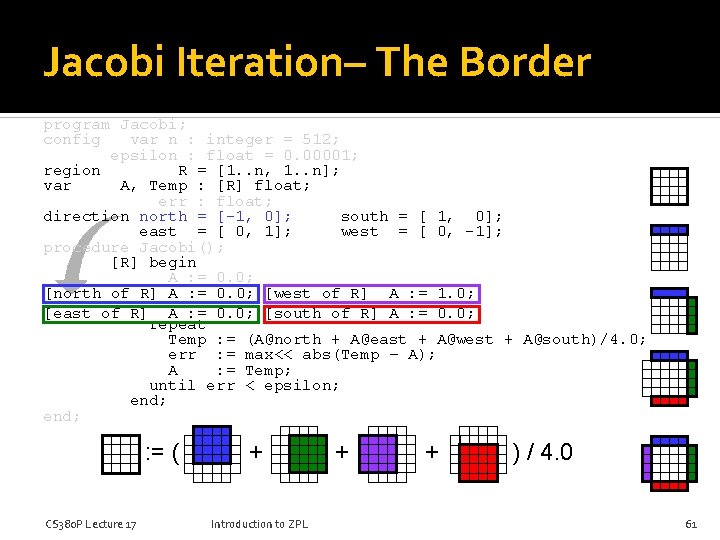
Jacobi Iteration– The Border program Jacobi; config var n : integer = 512; epsilon : float = 0. 00001; region R = [1. . n, 1. . n]; var A, Temp : [R] float; err : float; direction north = [-1, 0]; south = [ 1, 0]; east = [ 0, 1]; west = [ 0, -1]; procedure Jacobi(); [R] begin A : = 0. 0; [north of R] A : = 0. 0; [west of R] A : = 1. 0; [east of R] A : = 0. 0; [south of R] A : = 0. 0; repeat Temp : = (A@north + A@east + A@west + A@south)/4. 0; err : = max<< abs(Temp – A); A : = Temp; until err < epsilon; end; : = ( CS 380 P Lecture 17 + Introduction to ZPL + + ) / 4. 0 61
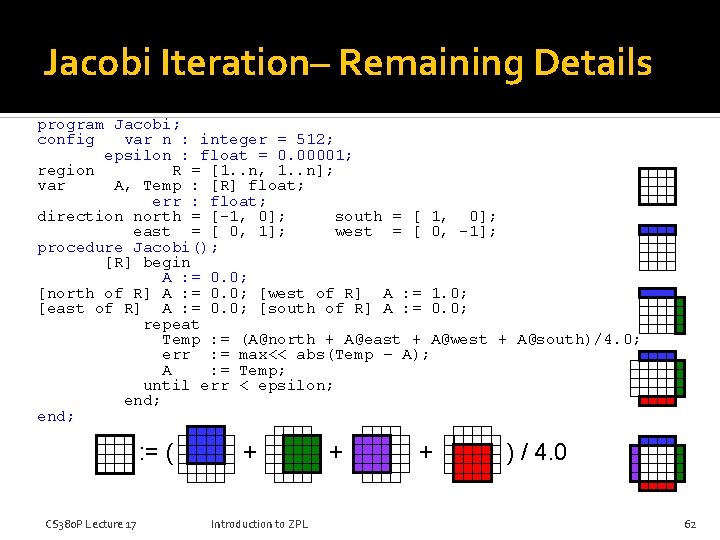
Jacobi Iteration– Remaining Details program Jacobi; config var n : integer = 512; epsilon : float = 0. 00001; region R = [1. . n, 1. . n]; var A, Temp : [R] float; err : float; direction north = [-1, 0]; south = [ 1, 0]; east = [ 0, 1]; west = [ 0, -1]; procedure Jacobi(); [R] begin A : = 0. 0; [north of R] A : = 0. 0; [west of R] A : = 1. 0; [east of R] A : = 0. 0; [south of R] A : = 0. 0; repeat Temp : = (A@north + A@east + A@west + A@south)/4. 0; err : = max<< abs(Temp – A); A : = Temp; until err < epsilon; end; : = ( CS 380 P Lecture 17 + Introduction to ZPL + + ) / 4. 0 62
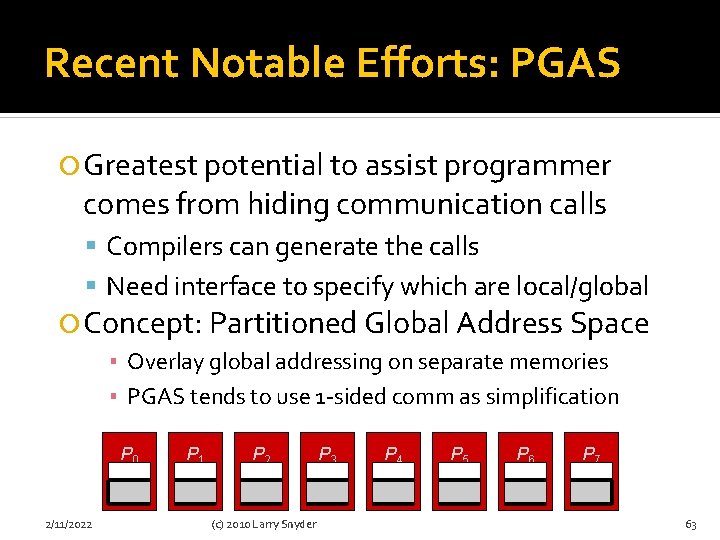
Recent Notable Efforts: PGAS Greatest potential to assist programmer comes from hiding communication calls Compilers can generate the calls Need interface to specify which are local/global Concept: Partitioned Global Address Space ▪ Overlay global addressing on separate memories ▪ PGAS tends to use 1 -sided comm as simplification P 0 2/11/2022 P 1 P 2 (c) 2010 Larry Snyder P 3 P 4 P 5 P 6 P 7 63
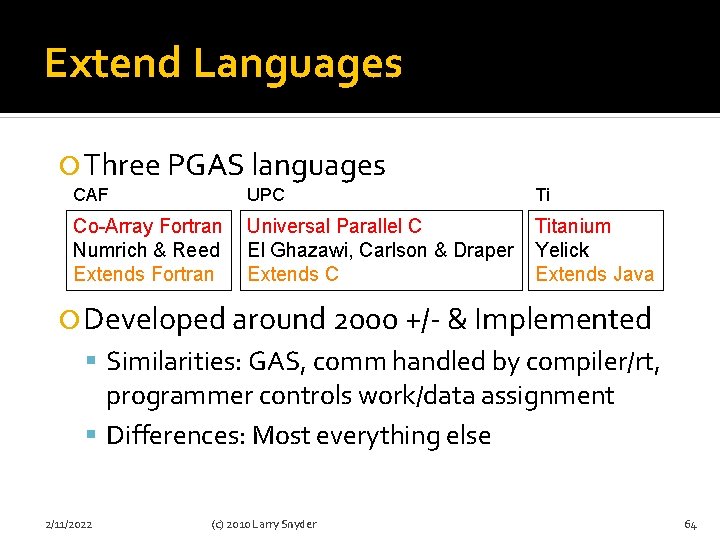
Extend Languages Three PGAS languages CAF UPC Ti Co-Array Fortran Numrich & Reed Extends Fortran Universal Parallel C El Ghazawi, Carlson & Draper Extends C Titanium Yelick Extends Java Developed around 2000 +/- & Implemented Similarities: GAS, comm handled by compiler/rt, programmer controls work/data assignment Differences: Most everything else 2/11/2022 (c) 2010 Larry Snyder 64
![Co-Array Fortran Incredibly elegant (for Fortran) extension real, dimension(n, n)[p, *]: : a, b,](http://slidetodoc.com/presentation_image_h2/ab10e093c67310a83fa48ad006b8f6c1/image-64.jpg "Co-Array Fortran Incredibly elegant (for Fortran) extension real, dimension(n, n)[p, *]: : a, b,")
Co-Array Fortran Incredibly elegant (for Fortran) extension real, dimension(n, n)[p, *]: : a, b, c. . . Co-array do k=1, n do q=1, p c(i, j)[my. P, my. Q]=c(i, j)[my. P, my. Q]+a(i, k)[my. P, q]*b(k, j)[q, my. Q] enddo my. Q enddo = my. P c 2/11/2022 (c) 2010 Larry Snyder * a b 65
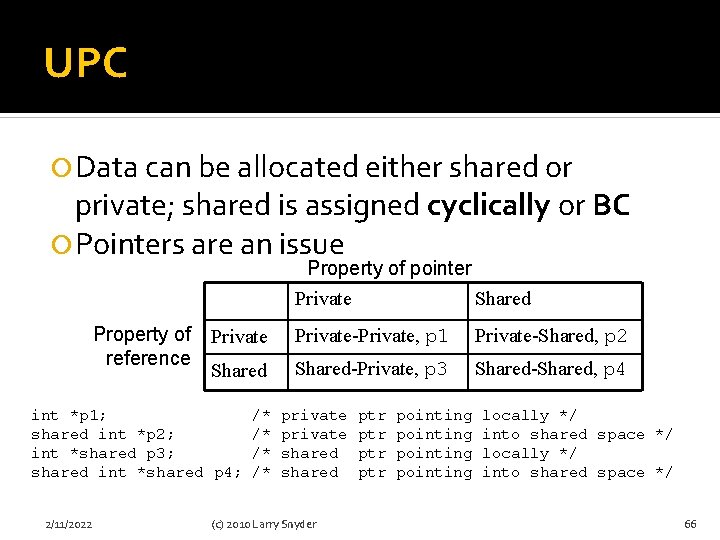
UPC Data can be allocated either shared or private; shared is assigned cyclically or BC Pointers are an issue Property of pointer Private Shared Property of reference Private-Private, p 1 Private-Shared, p 2 Shared-Private, p 3 Shared-Shared, p 4 int *p 1; shared int *p 2; int *shared p 3; shared int *shared p 4; 2/11/2022 /* /* private shared (c) 2010 Larry Snyder ptr ptr pointing locally */ into shared space */ 66
![UPC Code for Vector Sum shared int v 1[N], v 2[N], v 1 v](http://slidetodoc.com/presentation_image_h2/ab10e093c67310a83fa48ad006b8f6c1/image-66.jpg "UPC Code for Vector Sum shared int v 1[N], v 2[N], v 1 v")
UPC Code for Vector Sum shared int v 1[N], v 2[N], v 1 v 2 sum[N]; void main() { int i; shared int *p 1, *p 2; Affinity p 1=v 1; p 2=v 2; upc_forall(i=0; i<N; i++, p 1++, p 2++; i) { v 1 v 2 sum[i] = *p 1 + *p 2; } } 2/11/2022 (c) 2010 Larry Snyder 67
Titanium Java extensions including “regions, which support safe, performance- oriented memory management as an alternative to garbage collection. ” foreach is an unordered iteration, which logically raises the concurrency: foreach ( … ) { } Used with the concept of a point, tuple of integers that range over a domain 2/11/2022 (c) 2010 Larry Snyder 68
![Titanium Code for MM public static void mat. Mul(double [2 d] a, double [2](http://slidetodoc.com/presentation_image_h2/ab10e093c67310a83fa48ad006b8f6c1/image-68.jpg "Titanium Code for MM public static void mat. Mul(double [2 d] a, double [2")
Titanium Code for MM public static void mat. Mul(double [2 d] a, double [2 d] b, double [2 d] c) { foreach (ij in c. domain()) { double [1 d] a. Rowi = a. slice(1, ij[1]); double [1 d] b. Colj = b. slice(2, ij[2]); foreach (k in a. Rowi. domain()) { c[ij] += a. Rowi[k] * b. Colj[k]; } } } 2/11/2022 (c) 2010 Larry Snyder 69
Summarizing PGAS Languages The languages improve on the alternative-- base language + MPI Compiler provides significant help, but the need to be attuned to subtle detail remains Deep issues Global address space+private are good, but how they “play together” remains unclear Better abstractions to reduce detail 2/11/2022 (c) 2010 Larry Snyder 70
New Parallel Languages DARPA has supported three new “high productivity” parallel languages Is productivity really the issue? Project coupled with design of a new machine The final competitors: Cray’s Cascade High Productivity Language, Chapel IBM’s X 10 Sun’s Fortress 2/11/2022 (c) 2010 Larry Snyder 71
Chapel is a multithreaded language supporting Data ||ism, task ||ism, nested ||ism Optimizations for locality of data and computation Object oriented and generic programming techniques Parallel implementation is nearing completion Designed for experts, production programmers 2/11/2022 (c) 2010 Larry Snyder 72
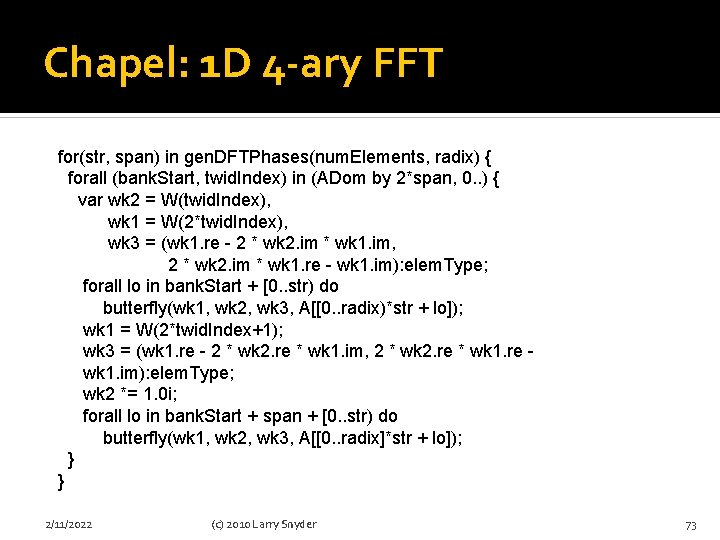
Chapel: 1 D 4 -ary FFT for(str, span) in gen. DFTPhases(num. Elements, radix) { forall (bank. Start, twid. Index) in (ADom by 2*span, 0. . ) { var wk 2 = W(twid. Index), wk 1 = W(2*twid. Index), wk 3 = (wk 1. re - 2 * wk 2. im * wk 1. im, 2 * wk 2. im * wk 1. re - wk 1. im): elem. Type; forall lo in bank. Start + [0. . str) do butterfly(wk 1, wk 2, wk 3, A[[0. . radix)*str + lo]); wk 1 = W(2*twid. Index+1); wk 3 = (wk 1. re - 2 * wk 2. re * wk 1. im, 2 * wk 2. re * wk 1. re wk 1. im): elem. Type; wk 2 *= 1. 0 i; forall lo in bank. Start + span + [0. . str) do butterfly(wk 1, wk 2, wk 3, A[[0. . radix]*str + lo]); } } 2/11/2022 (c) 2010 Larry Snyder 73
Fortress Developed at Sun, Fortress pushes the envelop in expressivity Focus on new programming ideas rather than parallel programming ideas: components and test framework assist with powerful compiler optimizations across libraries Textual presentation important -- subscripts and superscripts -- mathematical forms Transactions, locality specification, implicit ||ism Extendibility 2/11/2022 (c) 2010 Larry Snyder 74
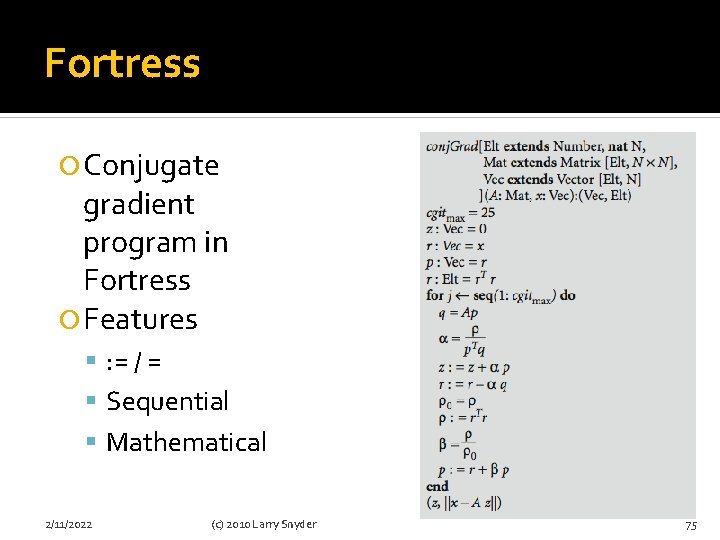
Fortress Conjugate gradient program in Fortress Features : = / = Sequential Mathematical 2/11/2022 (c) 2010 Larry Snyder 75
X-10 IBM’s X 10 is a type safe, distributed object oriented language in the PGAS family -- its “accessible to Java programmers” Many goodies including regions (a la ZPL), places (for locality), asynch, futures, foreach, atomic blocks and global manipulation of data structures 2/11/2022 (c) 2010 Larry Snyder 76
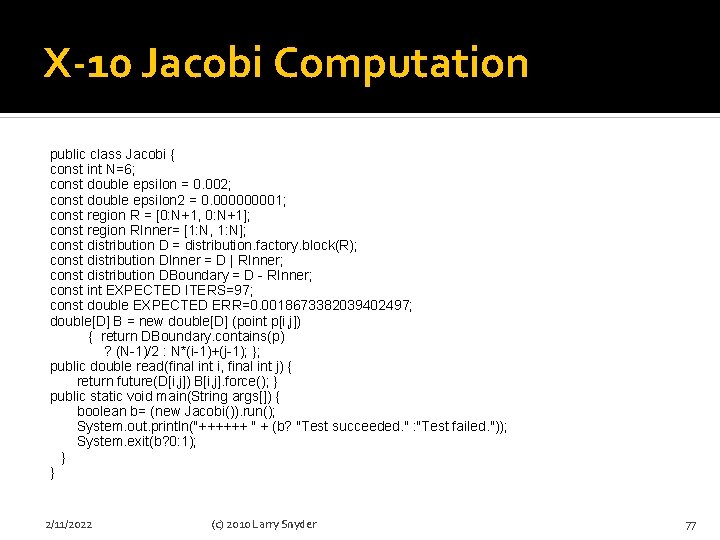
X-10 Jacobi Computation public class Jacobi { const int N=6; const double epsilon = 0. 002; const double epsilon 2 = 0. 00001; const region R = [0: N+1, 0: N+1]; const region RInner= [1: N, 1: N]; const distribution D = distribution. factory. block(R); const distribution DInner = D | RInner; const distribution DBoundary = D - RInner; const int EXPECTED ITERS=97; const double EXPECTED ERR=0. 0018673382039402497; double[D] B = new double[D] (point p[i, j]) { return DBoundary. contains(p) ? (N-1)/2 : N*(i-1)+(j-1); }; public double read(final int i, final int j) { return future(D[i, j]) B[i, j]. force(); } public static void main(String args[]) { boolean b= (new Jacobi()). run(); System. out. println("++++++ " + (b? "Test succeeded. " : "Test failed. ")); System. exit(b? 0: 1); } } 2/11/2022 (c) 2010 Larry Snyder 77
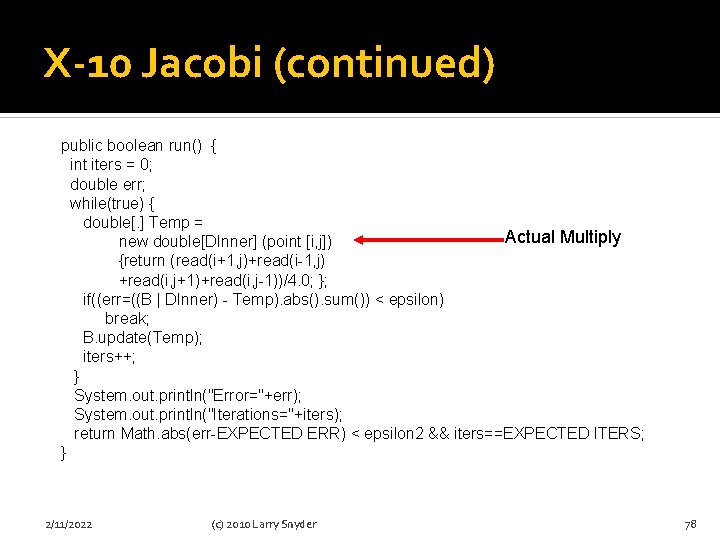
X-10 Jacobi (continued) public boolean run() { int iters = 0; double err; while(true) { double[. ] Temp = Actual Multiply new double[DInner] (point [i, j]) {return (read(i+1, j)+read(i-1, j) +read(i, j+1)+read(i, j-1))/4. 0; }; if((err=((B | DInner) - Temp). abs(). sum()) < epsilon) break; B. update(Temp); iters++; } System. out. println("Error="+err); System. out. println("Iterations="+iters); return Math. abs(err-EXPECTED ERR) < epsilon 2 && iters==EXPECTED ITERS; } 2/11/2022 (c) 2010 Larry Snyder 78
Summary Language is key tool to express parallelism State of the art is libraries – threads, message passing, Open. MP There has been tremendous experimentation with alternative language approaches ZPL, HPF, CAF, UPC, Titanium The next generation is here Chapel, X 10, Fortress 2/11/2022 (c) 2010 Larry Snyder 79
HW 6 Using online research become familiar with a parallel programming language and critique it NOT allowed: ZPL, Chapel, libraries The critique must include a small code example Relevant topics to discuss might include ▪ Execution model (data parallel, task, etc. ), mem model ▪ Mechanisms for creating threads, communicating, etc. ▪ Brief history, if known ▪ Evidence of performance, scalability, portability, etc. Any length OK, but ~2 pages is intended scale; refs 2/11/2022 (c) 2010 Larry Snyder 80
- Slides: 79