
The Product Life Cycle Year 11 Business Studies
The Product Life Cycle Year 11 Business Studies Marketing Unit
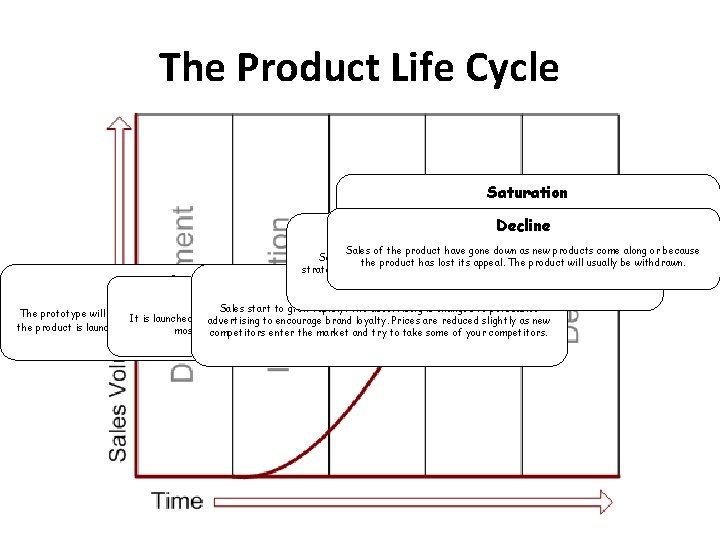
The Product Life Cycle Saturation Sales have stabilised at their highest point. Competition is high but there are no new competitors. Profits start to fall as sales are static and prices have to be reduced. Sales of the product have gone down as new products come along or because Sales now increase slowly. Competition becomes intense and pricing the product has lost its appeal. The product will usually be withdrawn. strategies are now competitive or promotional. A lot of advertising is used to maintain sales growth. Decline Maturity Development Introduction Growth Sales start to grow rapidly. The advertising is changed to persuasive The prototype will be tested and market research carried out before It is launched onto the market. Sales will grow at Prices first because advertising to encourage brandslowly loyalty. are reduced slightly as new the product is launched on to the market. There will no be sales at this most consumers willbe not aware of its existence. competitors enter the market and try to take some of your competitors. time
Extension Strategies When a business reaches the maturity or saturation stage of its product life cycle, a business may stop sales starting to fall by adopting extension strategies. Ways that sales are given a boost. Can you think of ways businesses might do this?
Extension Strategies… • Introduce new variations e. g. a children's version? • Sell into new markets e. g. export the product to another country? • Make small changes to the products design, colour/packaging • Use a new advertising campaign • Introduce a new, improved version of the old product • Sell through additional different retail outlets

The effect of extension strategies
- Slides: 5