
The Process of Socialization Giddens 2006 Socialisation is

- Slides: 37
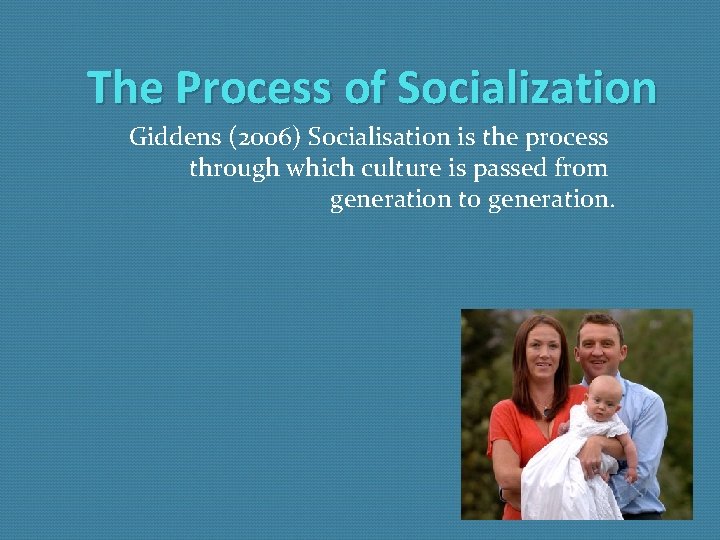
The Process of Socialization Giddens (2006) Socialisation is the process through which culture is passed from generation to generation.
Nature/Nurture debate - Feral Children http: //www. youtube. com/watch? v=lj. Vd 6 XS-J 0 s What does this tell us about the nature/nurture argument?
Agents of socialization These are the people or groups that play a part in our socialization. Sometimes they play an important part without us realising it.
Agents of socialisation Primary Secondary Family Education Media Peer group Religion Workplace
Primary socialization The early years of life are important in the learning process. This is the stage of primary socialization when we are normally in intimate and prolonged contact with our parents. We learn : Rules of general behaviour – Norms and values e. g queuing for a bus Norms and values associated with gender, ethnicity, social class.
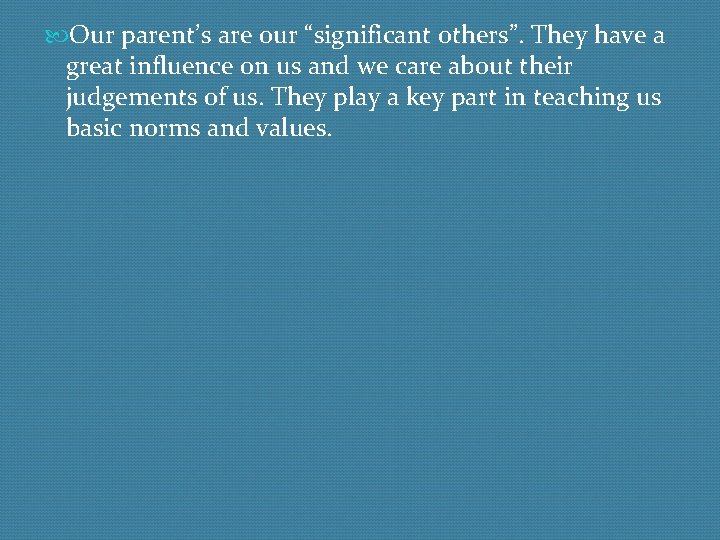
Our parent’s are our “significant others”. They have a great influence on us and we care about their judgements of us. They play a key part in teaching us basic norms and values.
Family and Parents The majority of children still grow up in a family headed by both natural parents.
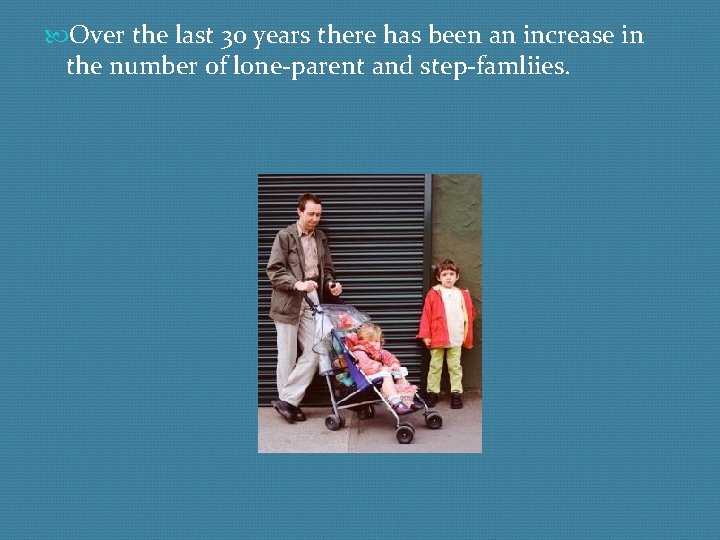
Over the last 30 years there has been an increase in the number of lone-parent and step-famliies.
Family life has therefore become more DIVERSE. Whatever the particular family set-up, parental figures remain the main agents of primary socialization. A sense of security during the earliest years has been identified as being crucial to developing a stable personality later on.
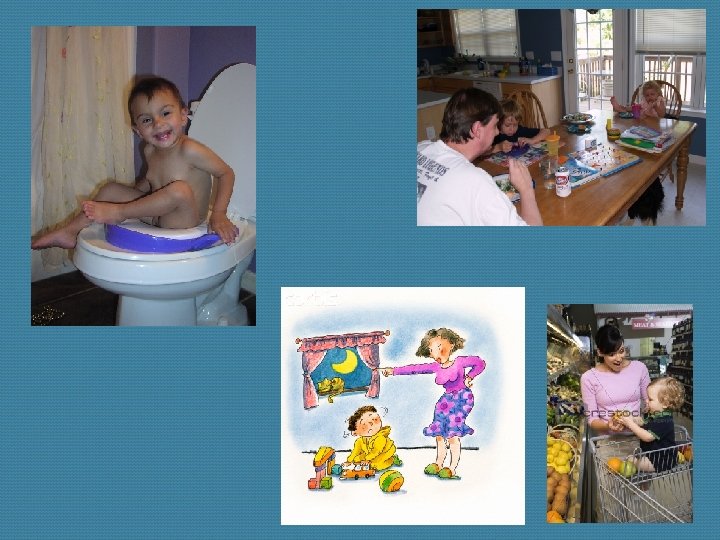
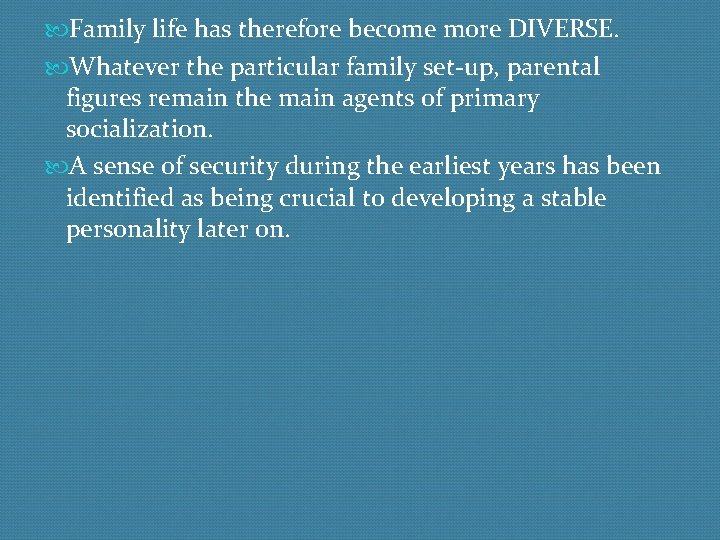
Learning from parents One way children learn from their parents is through IMITATION. They may copy the way their parents’ talk or their table-manners for example.
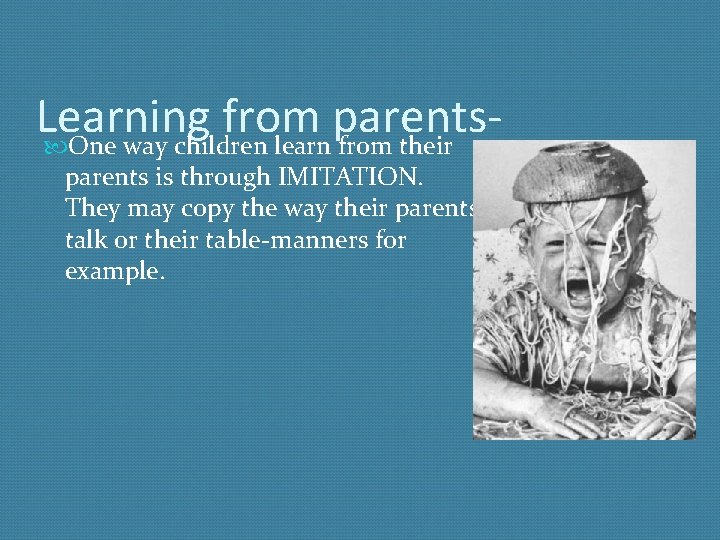
By a process of trial and error and with the application of formal and informal sanctions (social control) children learn what is unacceptable and unacceptable.
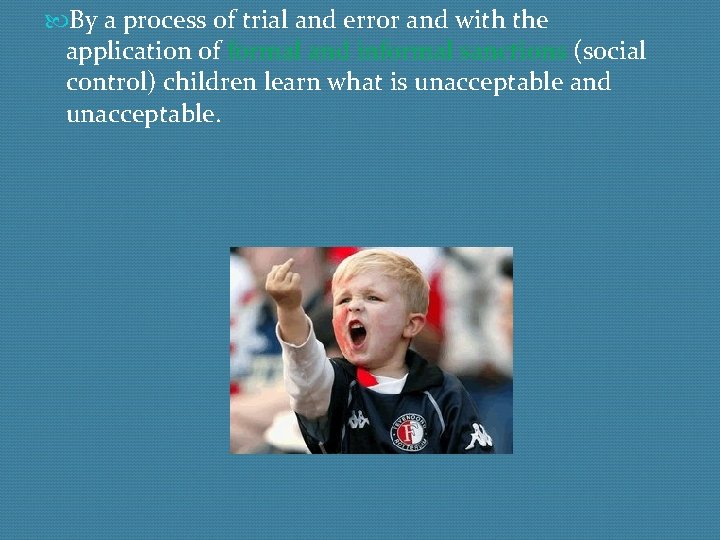
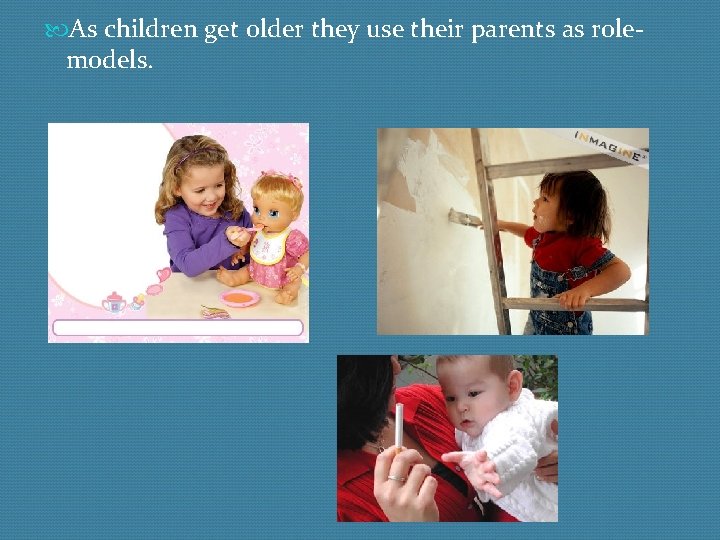
As children get older they use their parents as rolemodels.
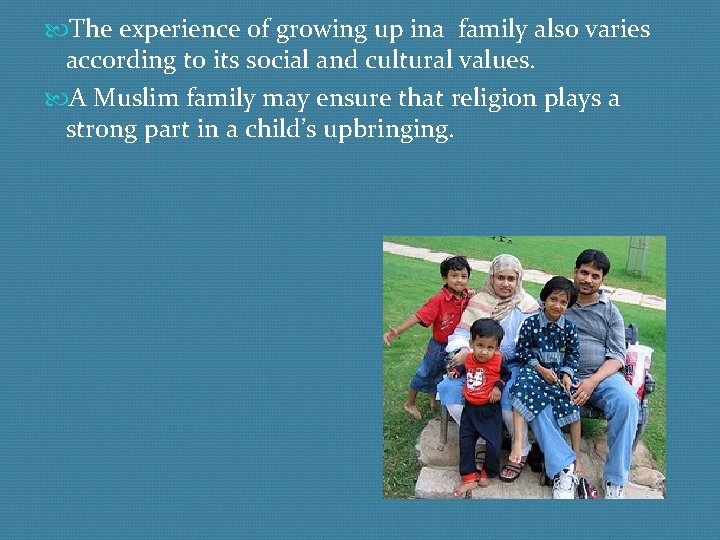
The experience of growing up ina family also varies according to its social and cultural values. A Muslim family may ensure that religion plays a strong part in a child’s upbringing.
Gender Roles Read pg 7 in booklets Think of ways that the family and parents teach us how to be feminine and masculine. 5 minutes in pairs
Activity Complete questions on page 7 of your booklets. Discuss
Secondary socialisation Education From the age of 5 in the Uk the family continues to be important for socialisation but Education also plays a big role. We are taught in two ways: http: //www. youtube. com/watch? v=o. Ukhd 9 YZH 98&f eature=related http: //www. youtube. com/watch? v=quz. Gek. Da. P 88&fe ature=related
Activity Use page 10 of the textbook to make your own notes on the following: Formal Curriculum Formal Social Control in schools Informal (hidden) Curriculum Informal Social Control in schools.
Plenary questions How do you think Functionalists might view the ‘hidden curriculum’? How do you think Marxists might view the use of the ‘hidden curriculum’ How do you think Feminists might view the ‘hidden curriculum’ Give an example of a formal sanction used by a school Give an example of informal sanction used by peer groups.
Recap The two kinds of social control Agent of primary socialisation Two agents of secondary socialisation One way that parents ensure appropriate gender behaviour is learned. • Phrase used to describe the teaching of social skills in school. • Name for teaching of knowledge like maths and English • •
Objectives To be able to describe ways that the media influences socialisation To answer and peer assess a real exam question.
The Mass Media The media has an impact on the development of gender roles, ethnic identity and social class identities. Media includes?
How does it happen? What were three ways that children learn norms and values and ways of behaving from their parents? ? ? ? Can these be applied to the media? http: //www. youtube. com/watch? v=qsy 3 Bblcj. CA http: //www. youtube. com/watch? v=yp. Ib. Tpnu. Ngg&fe ature=related
Objectives Know all the agents of socialisation and be able to give examples Complete a peer assessed timed essay Socialisation through education and the media – what would the perspectives say about this?
Research into influence of media Mc. Robbie – 1970 s found that girls magazines tended to encourage romance and ‘keeping a man’ often through domesticity. Currie (1999) found dramatic increase in emphasis on beautification. Concept of ‘slimblondeness’ Rutherford 2000 onwards - Growth of male magazines FHM, Loaded etc. and focus on body image. http: //www. youtube. com/watch? v=Tp 7 IP 1 XB 9 WY &feature=player_embedded
Religion can have a profound effect on socialisation. Recent TV program about Amish teenagers! The UK has been changing and becoming more ‘Secularised’ BSA (2006) found that in 1964 26% did not identify with any religion. By 2006 this rose to 69%.
Peer Group Some peer groups develop which are conforming to norms e. g boys playing football on the field and excluding girls. Some form as an expression of rebellion against the norm e. g Youth subcultures e. g emos, Groups often form around issues of commonality e. g ethnicity, gender, class. Each group has norms and values and we are encouraged to conform through peer group pressure – rewards and sanctions
Describe the norms and values Geeks Boffs Plastics Emo kids Lads ? ? ? ? Any others What would you have to do to become a member of their culture?
The workplace Read the description of the study by Ward and Winstanley (2005) on page 25 of the OCR book and write a summary in your own words.
Functionalists These are generally American thinkers. They say that the purpose of socialisation is to unite society in a set of shared norms and values. This is a ‘consensus’ sociology. Talcott Parsons said that all societies have functional prerequisites which must be met and shared culture provides for these needs.
Marxists These people say that the purpose of socialisation is to control the weak and defenceless and to give them the ideas that the powerful promote. People are taught an ideology This is known as ‘conflict’ sociology. Socialisation is conditioning which prepares the masses for exploitation
Feminism and Socialisation Oakley (1974) Socialisation perpetuates gender inequality. Gender differences are due to culture not biology. Thorne (1993) School systems also reinforce gender differences. Socialisation is preparing us for differentiated gender roles and to accept patriarchy.
Part b) 10 marks = 10 minutes This will ask you about: Culture transmission Agents of Socialisation (primary and secondary) Processes involved in socialisation (formal and informal social control) e. g Using material from the item and your own knowledge, describe and explain the ways in which any two agents of socialisation can influence behaviour. [10] AO 1 - There should be 4 points made showing knowledge and accurate and appropriate use of sociological terms should be evident for full marks. AO 2 - At least 3 of those points will be explained with examples or reference to the item.
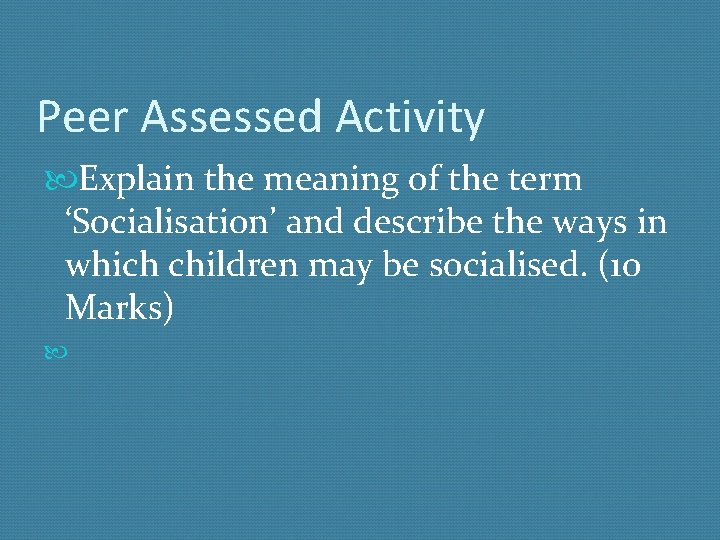
Peer Assessed Activity Explain the meaning of the term ‘Socialisation’ and describe the ways in which children may be socialised. (10 Marks)
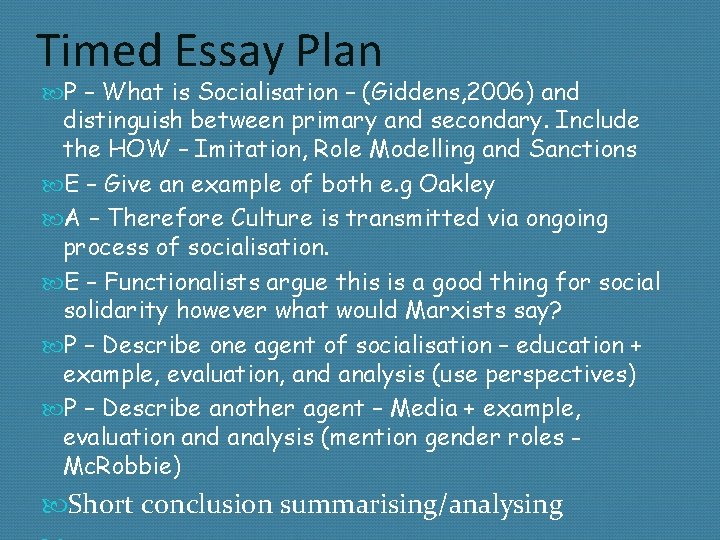
Timed Essay Plan P – What is Socialisation – (Giddens, 2006) and distinguish between primary and secondary. Include the HOW – Imitation, Role Modelling and Sanctions E – Give an example of both e. g Oakley A – Therefore Culture is transmitted via ongoing process of socialisation. E – Functionalists argue this is a good thing for social solidarity however what would Marxists say? P – Describe one agent of socialisation – education + example, evaluation, and analysis (use perspectives) P – Describe another agent – Media + example, evaluation and analysis (mention gender roles Mc. Robbie) Short conclusion summarising/analysing
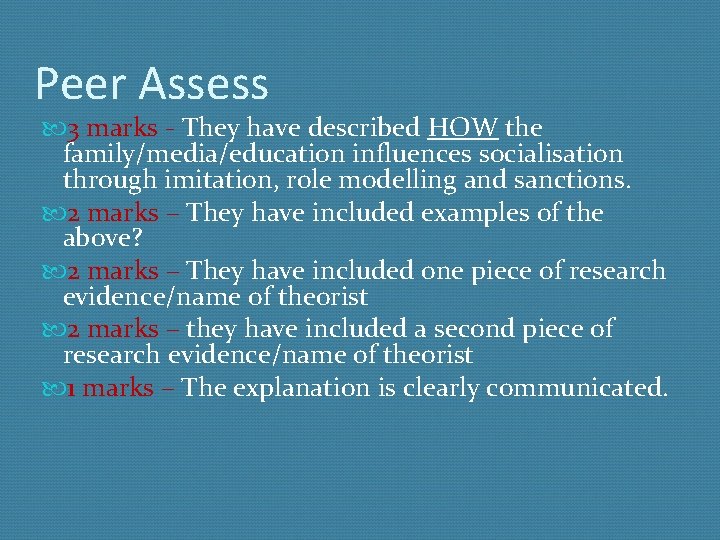
Peer Assess 3 marks - They have described HOW the family/media/education influences socialisation through imitation, role modelling and sanctions. 2 marks – They have included examples of the above? 2 marks – They have included one piece of research evidence/name of theorist 2 marks – they have included a second piece of research evidence/name of theorist 1 marks – The explanation is clearly communicated.
Plenary Write an improvement target for your partner and discuss it with them.