
THE PROCESS OF SCIENCE Why study science to
- Slides: 12
THE PROCESS OF SCIENCE Why study science? • to explain, investigate and understand the natural world and use the information gained to make accurate predictions about the events in the world around us • to gain a better understanding of the natural world and make informed decisions Science must be free of bias (personal preference, viewpoint and opinion) Copyright © 2009 Pearson Education, Inc.
§ There is a difference between a theory and a hypothesis – A hypothesis – a proposed explanation for a set of observations (a proposed answer to the question – what might be going on? ? ? ) – A theory – A well-tested explanation that is supported by a large and usually growing body of evidence – often include many related hypotheses – May be revised or replaced – is accepted by most scientists as being factual Copyright © 2009 Pearson Education, Inc.
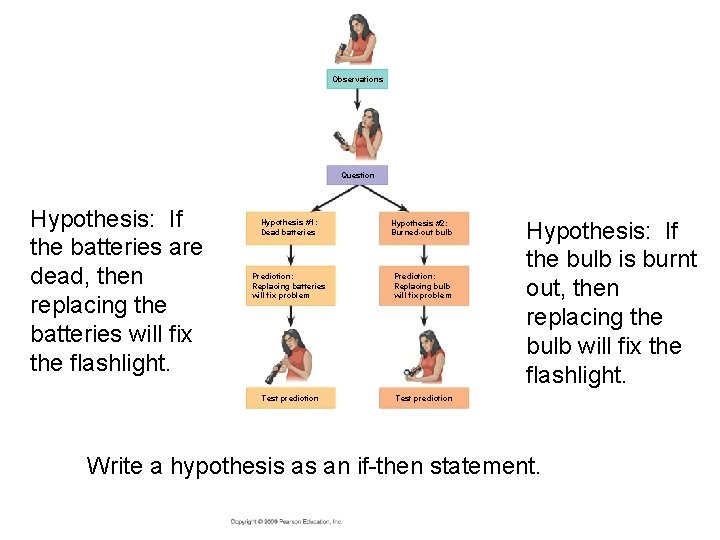
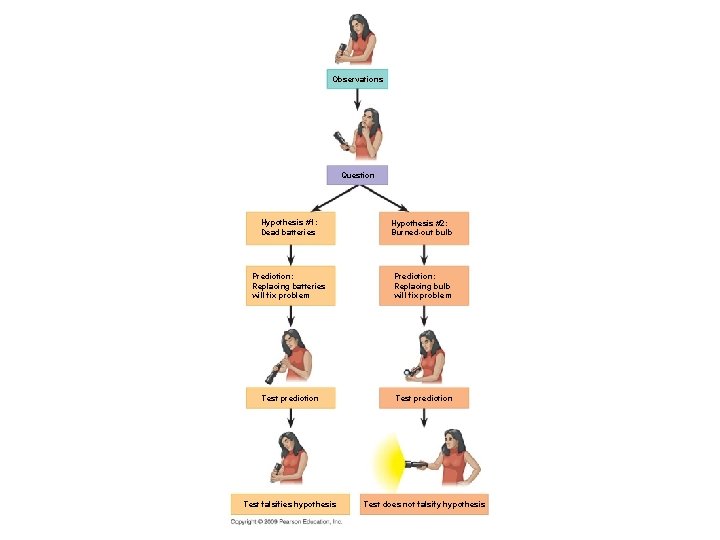
Scientist pose and test hypotheses § We solve everyday problems by using hypotheses – An example would be the reasoning we use to answer the question, “Why doesn’t the flashlight work? ” – Using deductive reasoning we realize that the problem is either the (1) bulb or (2) batteries. – The hypothesis must be testable by experimentation and observation – The hypothesis must be falsifiable – It may be challenged, revised or denied Copyright © 2009 Pearson Education, Inc.
Observations Question Hypothesis: If the batteries are dead, then replacing the batteries will fix the flashlight. Hypothesis #1: Dead batteries Hypothesis #2: Burned-out bulb Prediction: Replacing batteries will fix problem Prediction: Replacing bulb will fix problem Test prediction Hypothesis: If the bulb is burnt out, then replacing the bulb will fix the flashlight. Write a hypothesis as an if-then statement.
Observations Question Hypothesis #1: Dead batteries Hypothesis #2: Burned-out bulb Prediction: Replacing batteries will fix problem Prediction: Replacing bulb will fix problem Test prediction Test falsifies hypothesis Test does not falsify hypothesis
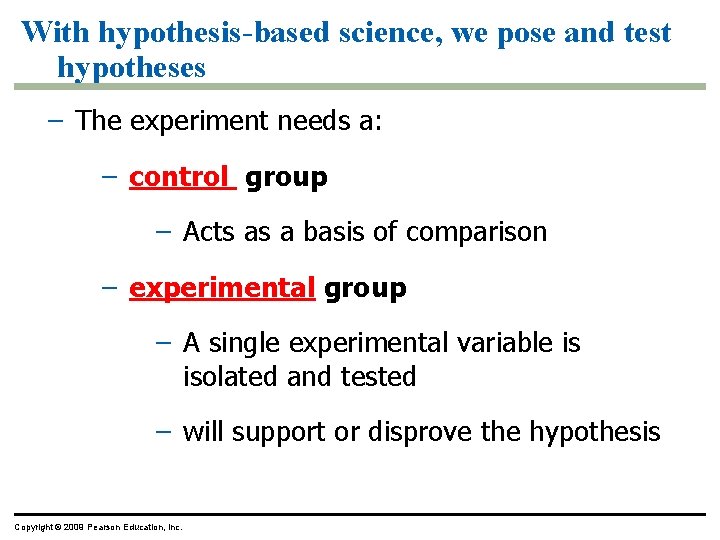
With hypothesis-based science, we pose and test hypotheses – The experiment needs a: – control group – Acts as a basis of comparison – experimental group – A single experimental variable is isolated and tested – will support or disprove the hypothesis Copyright © 2009 Pearson Education, Inc.
What are variables? any factor, trait, or condition that can exist in differing amounts or types any factor that may affect the outcome of an experiment
§ An experiment usually has three kinds of variables: independent, and controlled. • independent variable • the one that is changed by the scientist • a good experiment has only one independent (experimental) variable • as the scientist changes the independent variable, he or she observes what happens to the dependent variable.
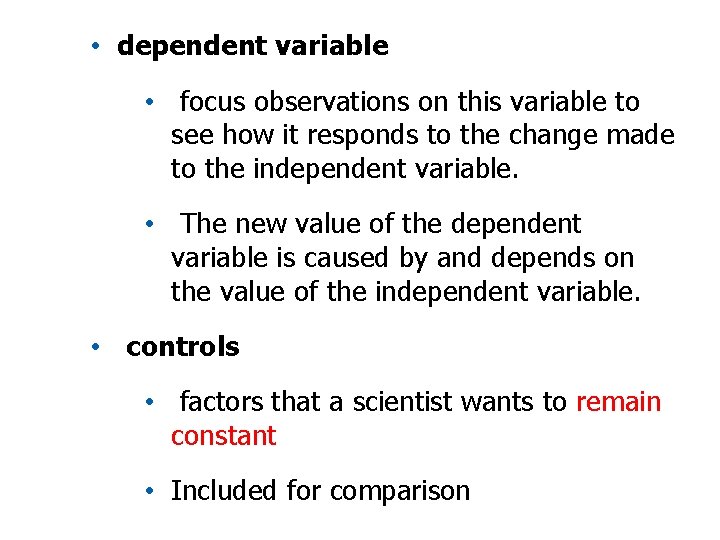
• dependent variable • focus observations on this variable to see how it responds to the change made to the independent variable. • The new value of the dependent variable is caused by and depends on the value of the independent variable. • controls • factors that a scientist wants to remain constant • Included for comparison
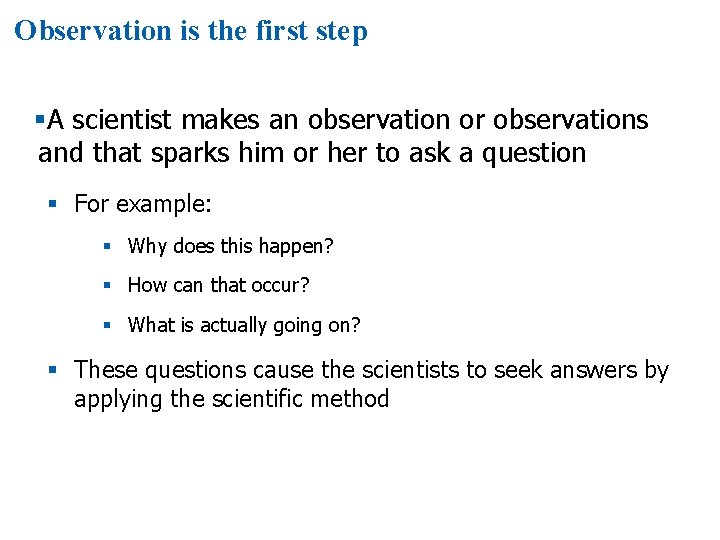
Observation is the first step §A scientist makes an observation or observations and that sparks him or her to ask a question § For example: § Why does this happen? § How can that occur? § What is actually going on? § These questions cause the scientists to seek answers by applying the scientific method
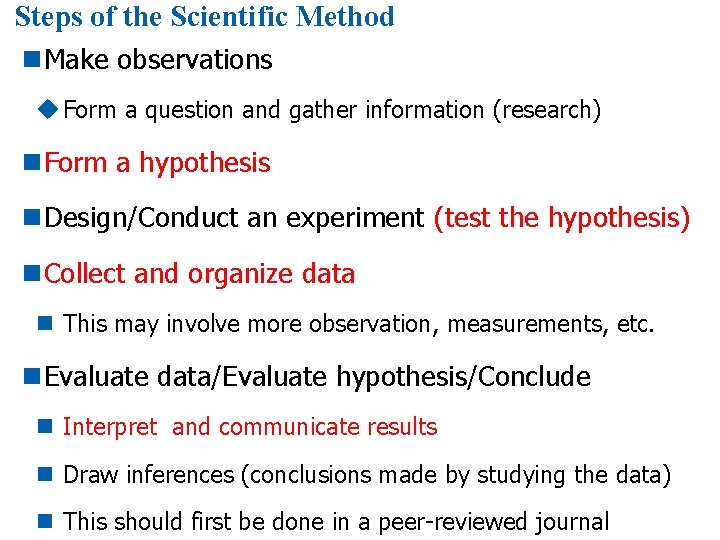
Steps of the Scientific Method n. Make observations u Form a question and gather information (research) n. Form a hypothesis n. Design/Conduct an experiment (test the hypothesis) n. Collect and organize data n This may involve more observation, measurements, etc. n. Evaluate data/Evaluate hypothesis/Conclude n Interpret and communicate results n Draw inferences (conclusions made by studying the data) n This should first be done in a peer-reviewed journal
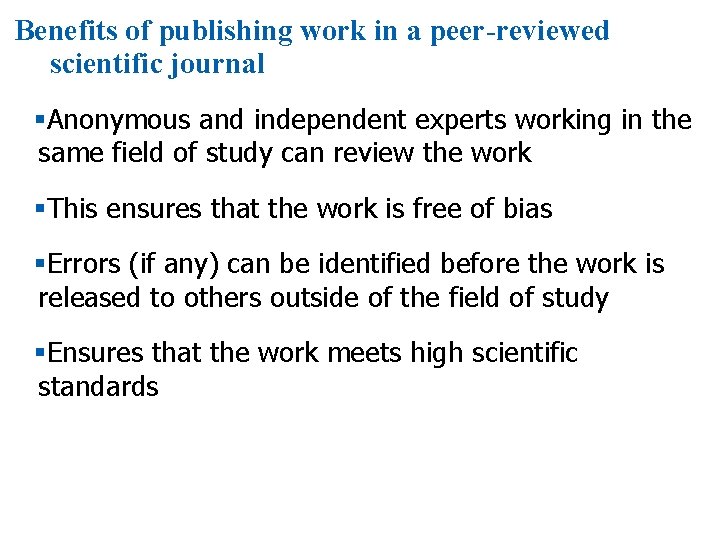
Benefits of publishing work in a peer-reviewed scientific journal §Anonymous and independent experts working in the same field of study can review the work §This ensures that the work is free of bias §Errors (if any) can be identified before the work is released to others outside of the field of study §Ensures that the work meets high scientific standards