
The process of marketing management Developed by Alina
The process of marketing management Developed by Alina Shcherbak
Agenda for today 1. Types of marketing activities 2. The marketing planning process 3. Marketing Control Process
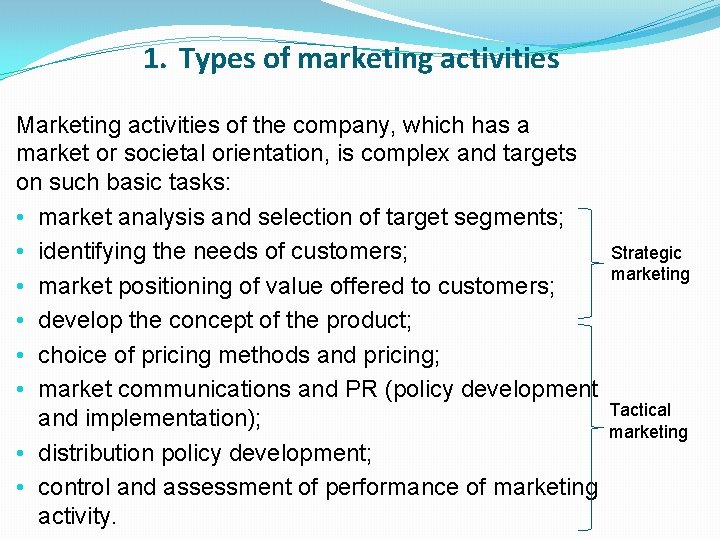
1. Types of marketing activities Marketing activities of the company, which has a market or societal orientation, is complex and targets on such basic tasks: • market analysis and selection of target segments; • identifying the needs of customers; • market positioning of value offered to customers; • develop the concept of the product; • choice of pricing methods and pricing; • market communications and PR (policy development and implementation); • distribution policy development; • control and assessment of performance of marketing activity. Strategic marketing Tactical marketing
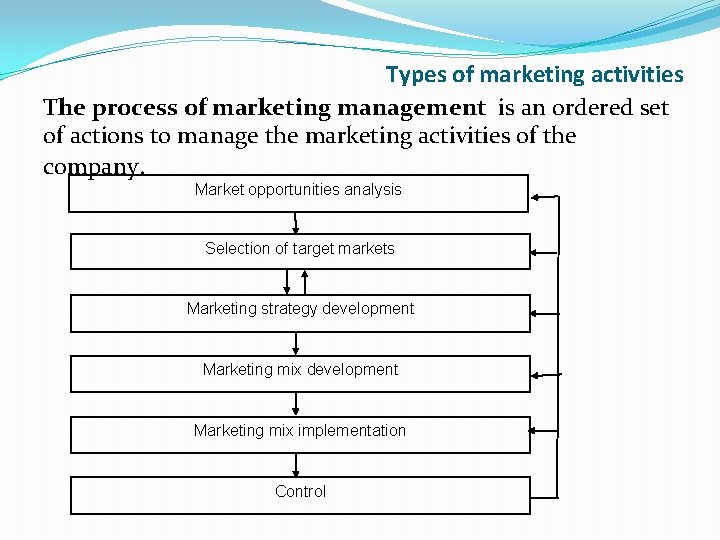
Types of marketing activities The process of marketing management is an ordered set of actions to manage the marketing activities of the company. Market opportunities analysis Selection of target markets Marketing strategy development Marketing mix implementation Control
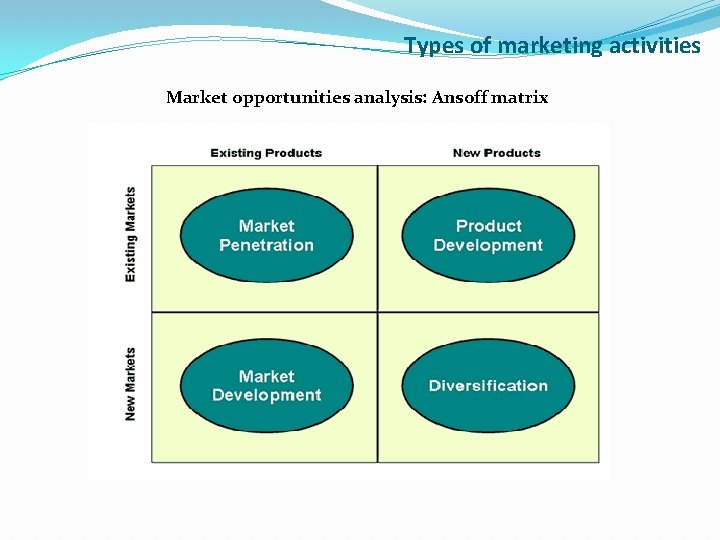
Types of marketing activities Market opportunities analysis: Ansoff matrix
Types of marketing activities Principles of marketing management • focus on satisfying the interests of the major stakeholders • focus on customer’s needs satisfaction through their study and offering of goods and services, which serve as effective, convenient and affordable means of solving problems or consumer satisfaction • strategic approach, focus on the long term development of the enterprise • flexibility in achieving of goals by adapting to the requirements of the environment, as well as alternative options for achieving the goal • focus on the most promising products and market segments, the most effective marketing tools, etc. • integrated approach to marketing plans development • proactivity • target-oriented approach to planning and implementation of activities • continuous improvement of marketing of the company • efficiency - validity of marketing costs in terms of their future overlap by earnings
Types of marketing activities Kotler’s ten tables: 1. Segment the market. Choose the most appropriate for you segments and occupy leading positions in them. 2. Follow needs, behavior, preferences and experiences of consumers. Client - is really the most important. 3. Study your competitors. 4. Install partnerships with all stakeholders. 5. Develop a system for searching and selecting the most promising market opportunities. 6. Use a planning system that will allow equally effectively prepare both long- term and short-term plans. 7. Establish severe quality control of products and services. 8. Create strong brands. 9. Strive to become a market leader. 10. Use new technologies that can provide competitive advantage.
2. The marketing planning process A marketing plan is a written document that details the necessary actions to achieve one or more marketing objectives. It can be for a product or service, a brand, or a product line. Marketing plans cover between one and five years. A marketing plan may be part of an overall business plan.

2. The marketing planning process
2. The marketing planning process Elements of marketing planning �Marketing planning aims and objectives �Detailed plans and programs �Measurement of progress �Using of marketing plans �Budgets as managerial tools
2. The marketing planning process � This "corporate mission" can be thought of as a definition of what the organization is. � The "marketing objectives" state just where the company intends to be at some specific time in the future. �The marketing objectives must usually be based, above all, on the organization's financial objectives; converting these financial measurements into the related marketing measurements.
Outline for a Marketing Plan These are the steps to be systematically considered in developing a marketing plan. 1. 0 Executive Summary—A one- to two-page summary of the market environment and business resources, financial and nonfinancial objectives, and marketing strategy including target market(s), value proposition, and marketing mix elements. 2. 0 Market Analysis Market demographics Market needs Market trends Market growth Buyer behavior Customer segments Competition Collaborators Macroeconomic forces 3. 0 Company Analysis Tangible assets Intangible assets Capabilities Areas of advantage
Outline for a Marketing Plan 4. 0 Objectives Financial Revenues Margins Growth rate Nonfinancial Customer satisfaction Perceived quality Loyalty % of sales from new products 5. 0 Segmentation, Targeting, and Positioning/Value Proposition Target market Functional, emotional, and/or self-expressive benefits Price 6. 0 Marketing Strategy Positioning: The process of designing the company’s image and value offering so that customers in the target market understand appreciate what the company stands for in relation to competitors Product and/or service attributes: New product development processes, decisions about what to sell and what features to include, branding strategies, packaging decisions, warranty, and ancillary services
Outline for a Marketing Plan Distribution: Locations at which product or service is made available to customer, and the channel members that offer it Promotion: A. Advertising strategies, regarding both the message content in ads and media used to communicate the message; may include direct media and new media B. Sales promotion strategies, regarding any short-term incentives for both trade members and consumers (coupons, rebates, premiums, etc. ) C. Public relations and publicity strategies, regarding the generation of news articles, community relations, event sponsorships, and goodwill D. Personal selling/trade shows Price: What to charge for specific products, features, or services, as well as discount structures and payment plans People: The marketing specialists who are required to execute the marketing strategy; includes systems for recruiting, motivating, and retaining them 7. 0 Budgeting and Control Financial resources required to execute the marketing strategy System for comparing results to objectives Processes for taking corrective action
2. The marketing planning process Measurement of progress �The final stage of any marketing planning process is to establish targets (or standards) so that progress can be monitored. Accordingly, it is important to put both quantities and timescales into the marketing objectives and into the corresponding strategies.
2. The marketing planning process Using of marketing plans �provides an unambiguous reference point for activities throughout the planning period �offers a unique opportunity, a forum, for informationrich and productively focused discussions between the various managers involved � provides an agreed context for their subsequent management activities
2. The marketing planning process Budgets as managerial tools �The purpose of a marketing budget is to pull together all the revenues and costs involved in marketing into one comprehensive document. �It is a managerial tool that balances what is needed to be spent against what can be afforded, and helps make choices about priorities.
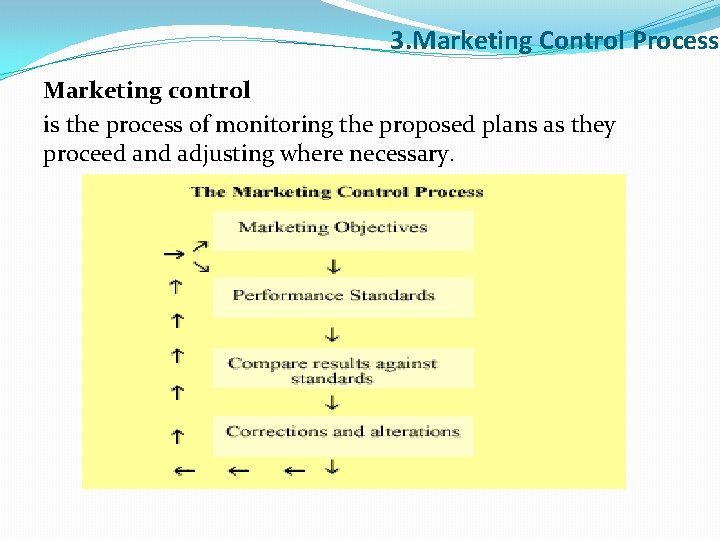
3. Marketing Control Process Marketing control is the process of monitoring the proposed plans as they proceed and adjusting where necessary.
3. Marketing Control Process Approaches to marketing control � Market share analysis. � Sales analysis. � Quality controls. � Budgets. � Ratio analysis. � Marketing research. � Marketing information systems (Mk. IS). � Feedback from customers satisfaction surveys. � Cash flow statements. � Customer Relationship Management (CRM) systems. � Sales per thousand customers, per factory, by segment. � Location of buyers and potential buyers. � Activities of competitors to aspects of your plan. � Distributor support. � Performance of any promotional activities. � Market reaction/acceptance to pricing polices. � Service levels.
3. Marketing Control Process Types of marketing control 1. Annual-plan control. The basis of annual-plan control is managerial objectives — specific goals, such as sales and profitability, that are established on a monthly or quarterly basis. Five tools to monitor plan performance: �sales analysis, in which sales goals are compared with actual sales and discrepancies are explained or accounted for; �market-share analysis, which compares a company’s sales with those of its competitors. Companies can express their market share in a number of ways, by comparing their own sales to total market sales, sales within the market segment, or sales of the segment’s top competitors;
3. Marketing Control Process �marketing expense-to-sales analysis gauges how much a company spends to achieve its sales goals. The ratio of marketing expenses to sales is expected to fluctuate, and companies usually establish an acceptable range for this ratio; �financial analysis estimates such expenses (along with others) from a corporate perspective. This includes a comparison of profits to sales (profit margin), sales to assets (asset turnover), profits to assets (return on assets), assets to worth (financial leverage), and, finally, profits to worth (return on net worth); �measuring of customer satisfaction as a means of tracking goal achievement.
3. Marketing Control Process 2. Profitability control demonstrates the relative profit-earning capacity of a company’s different products and consumer groups. 3. Efficiency control involves micro-level analysis of the various elements of the marketing mix, including sales force, advertising, sales promotion, and distribution. 4. Strategic control processes allow managers to evaluate a company’s marketing program from a critical long-term perspective. This involves a detailed and objective analysis of a company’s organization and its ability to maximize its strengths and market opportunities.

Summary

- Slides: 24