
The process of fat bloom formation in pralines
The process of fat bloom formation in pralines and its main causes Daniel Kalnin YKI, Institute for Surface Chemistry Life Sciences and Chemical Industries Section Stockholm, Sweden Claudia Delbaere FTE, Lab of Food Technology and Engineering Department of Food Safety and Food Quality Ghent University, Belgium

Outline • • • Introduction to fat bloom Chocolate surface structure Fat bloom mechanisms – – • Polymorphic transitions Oil migration Conclusions
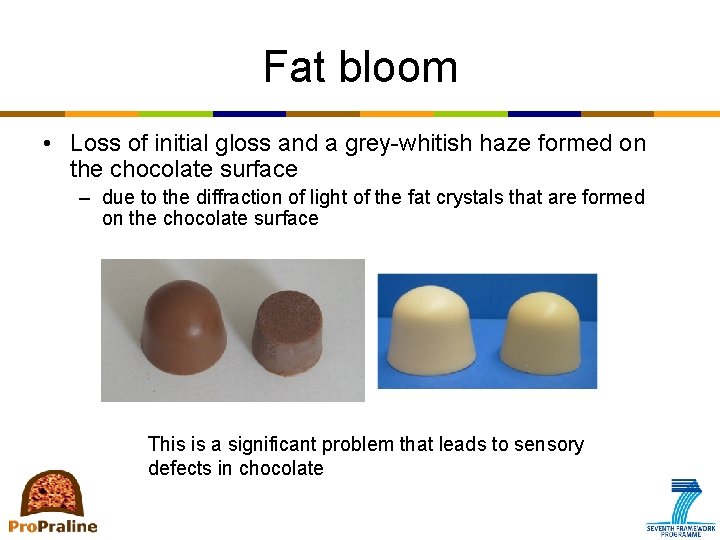
Fat bloom • Loss of initial gloss and a grey-whitish haze formed on the chocolate surface – due to the diffraction of light of the fat crystals that are formed on the chocolate surface This is a significant problem that leads to sensory defects in chocolate

Fat bloom • ≠ Sugar bloom – Caused by condensation (colder warmer) – Solubilization and recrystallization of sugar at the chocolate surface – Dissolves in water Bryony J. James, Bronwen G. Smith , “Surface structure and composition of fresh and bloomed chocolate analysed using X-ray photoelectron spectroscopy, cryo-scanning electron microscopy and environmental scanning electron microscopy. ” Food Science and Technology , 42 (2009), 929– 937.

Fat bloom causes • Origins of fat bloom → 3 main sources 1. Composition ü ü Incompatible fats Filled chocolates: center rich in oil content 2. Processing ü ü Tempering Post tempering (Cooling) 3. Storage conditions ü ü ü Storage temperature Temperature fluctuations Time Lonchampt, P. & Hartel R. W (2004). “Fat bloom in chocolate and compound coatings. ” European Journal of Lipid Science and Technology, 106 (4), 241 -274.

Fat bloom mechanisms • Numerous theories to explain bloom formation • None have covered multiplicity of the bloom problem • The specific mechanisms still remain largely unknown ↓ Fat bloom is a very complex phenomenon • Main theories – Polymorphic transitions ( V – VI) – Eutectic effects (Phase separation) – Migration of oil – Recrystallization

Fat bloom crystals - Scanning Electron Microscopy Fat bloom on well tempered chocolate Fat bloom on untempered chocolate 5 μm Bryony J. James, Bronwen G. Smith , “Surface structure and composition of fresh and bloomed chocolate analysed using X-ray photoelectron spectroscopy, cryo-scanning electron microscopy and environmental scanning electron microscopy. ” Food Science and Technology , 42 (2009), 929– 937.

In order to understand what happens when fat bloom forms on chocolate Identify and follow development at the very surface and understand what is going on before fat bloom occurs

Surface roughness - Profilometry 100 μm -1 μm Measure at the same spot as a function of time Qualitatively and quantitatively

Chocolate surface structure - Scanning Electron Microscopy - Fresh chocolate surface Fat bloom crystals on the surface
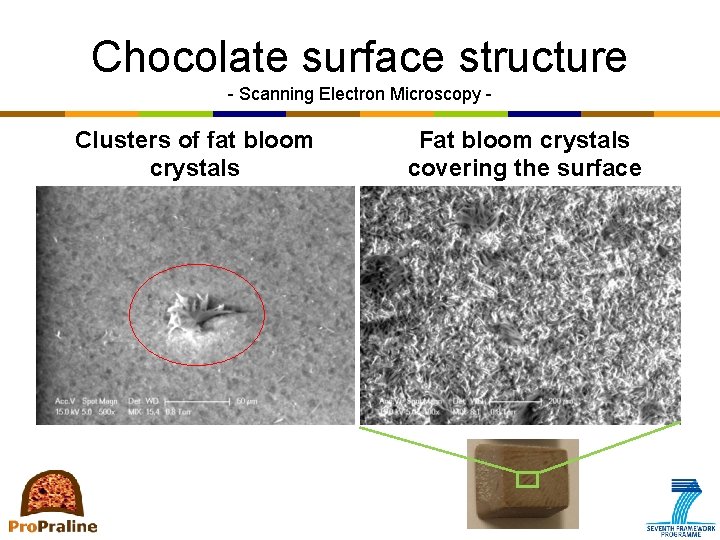
Chocolate surface structure - Scanning Electron Microscopy - Clusters of fat bloom crystals Fat bloom crystals covering the surface

Chocolate surface structure - Scanning Electron Microscopy - Pores Protrusions

Chocolate surface structure - Atomic Force Microscopy (AFM) imaging of chocolate surface - Sonwai, S. and D. Rousseau (2008). "Fat crystal growth and microstructural evolution in industrial milk chocolate. " Crystal Growth & Design 8(9): 3165 -3174.
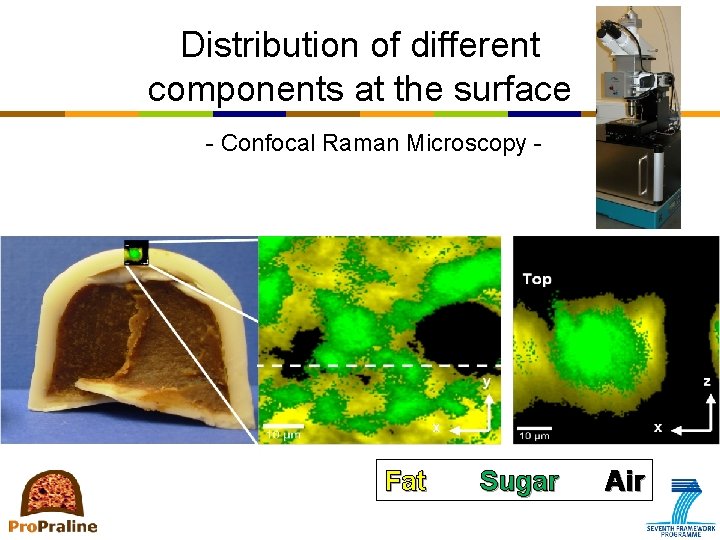
Distribution of different components at the surface - Confocal Raman Microscopy - Fat Sugar Air

Pores in chocolate Rousseau, D. and P. Smith (2008). "Microstructure of fat bloom development in plain and filled chocolate confections. " Soft Matter 4(8): 1706 -1712.

Fat bloom mechanisms • Main theories – – Polymorphic transitions ( V – VI) Eutectic effects (Phase separation ) Migration of oil Recrystallization • Fat bloom – Plain chocolate: cocoa butter crystal polymorphism ( V – VI) – Composed chocolate products: migration of ‘liquid’ foreign lipids (e. g. from the filling, nut, biscuit) into the chocolate

Polymorphic transitions βVI βV Bloomed chocolate Well tempered chocolate Liquid ’ α direct crystallization (during cooling) melting γ recrystallization Van Malssen, K. , Van Langevelde, A. , Peschar, R. & Schenk, H. (1999). Phase behavior and extended phase scheme of static cocoa butter investigated with real-time x-ray powder diffraction. Journal of the American Oil Chemists Society, 76 (6), 669 -676.

Polymorphic transitions βVI βV Liquid ’ • Crystal problem ü Fat bloom → VI ü Most stable crystals! ü At the outside as well as inside α γ Van Malssen, K. , Van Langevelde, A. , Peschar, R. & Schenk, H. (1999). Phase behavior and extended phase scheme of static cocoa butter investigated with real-time x-ray powder diffraction. Journal of the American Oil Chemists Society, 76 (6), 669 -676.
Polymorphic transitions • Several causes ü Composition ‒ Plain chocolate: cocoa butter crystal polymorphism ( V → VI) ‒ Migration: foreign fat induces V- VI transition (See ‘Migration fat bloom’) ü Processing ‒ Incorrect tempering o Undertempering ‒ Insufficient nuclei to ensure good crystallization upon cooling ‒ Generation of unstable polymorphs ( ’) ‒ Recrystallization ( ’→ V or VI) during early storage o Overtempering ‒ Crystal concentration is too high ‒ Poor crystallization in the mold, reduced contraction ‒ Gray dull and no bright surface
Polymorphic transitions • Several causes ü Processing ‒ Cooling rate o Cooling too fast ‒ Generation of unstable polymorphs ( ’) ‒ Recrystallization ( ’→ V or VI) during early storage ü Storage ‒ Polymorphic transition ( V → VI) is inevitable !
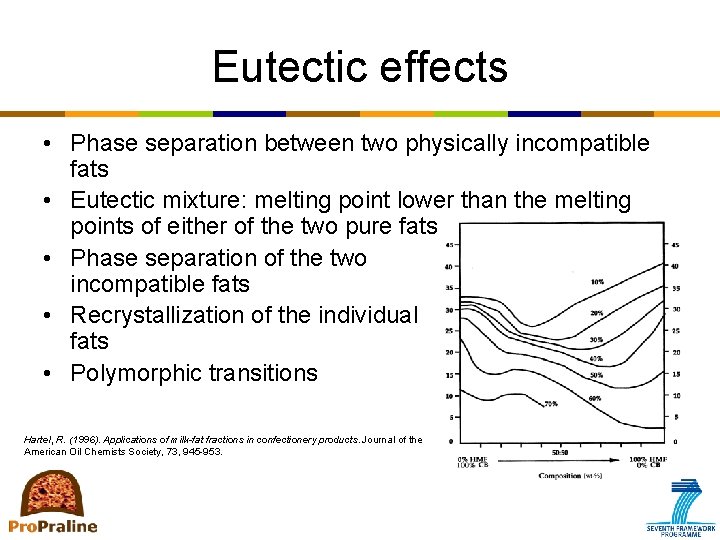
Eutectic effects • Phase separation between two physically incompatible fats • Eutectic mixture: melting point lower than the melting points of either of the two pure fats • Phase separation of the two incompatible fats • Recrystallization of the individual fats • Polymorphic transitions Hartel, R. (1996). Applications of milk-fat fractions in confectionery products. Journal of the American Oil Chemists Society, 73, 945 -953.

Migration fat bloom Image: courtesy of FTE (Ghent University)
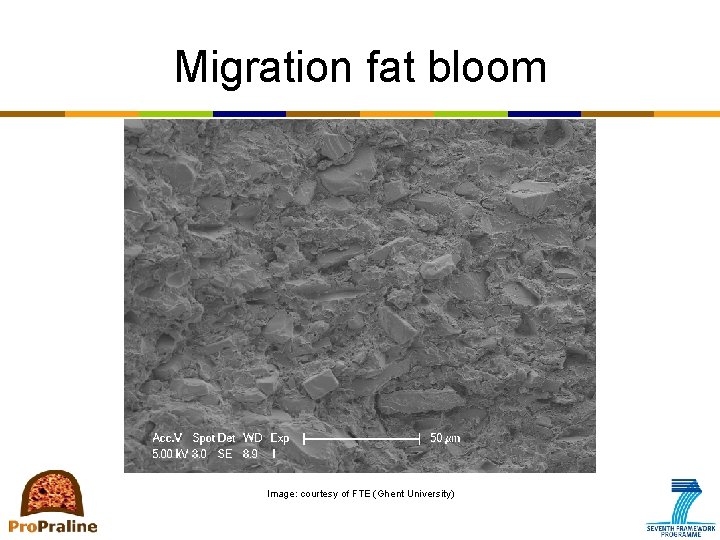
Migration fat bloom Image: courtesy of FTE (Ghent University)
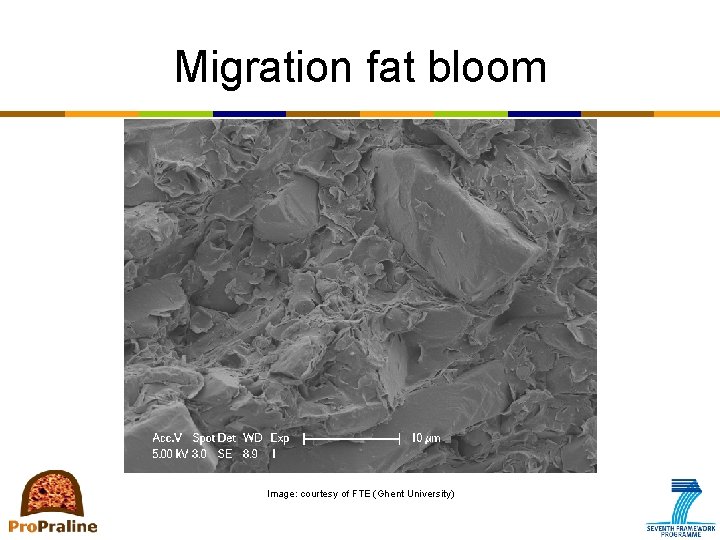
Migration fat bloom Image: courtesy of FTE (Ghent University)

Migration fat bloom • Plain dark chocolate Cocoa powder particles Sugar Matrix of cocoa butter
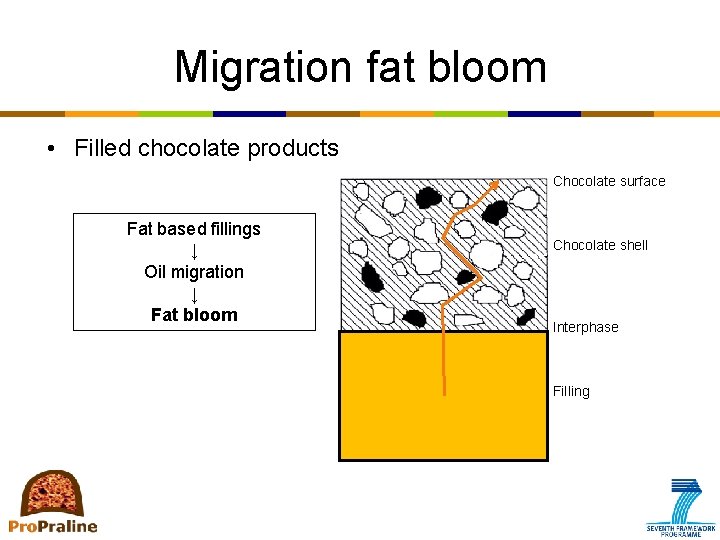
Migration fat bloom • Filled chocolate products Chocolate surface Fat based fillings ↓ Oil migration ↓ Fat bloom Chocolate shell Interphase Filling

Migration fat bloom Liquid oil migrates into the shell and dissolves cocoa butter TAGs, which then are carried to the surface of the chocolate. Image from: Galdamez, J. R. , K. Szlachetka, et al. (2009). "Oil migration in chocolate: A case of non-Fickian diffusion. " Journal of Food Engineering 92(3): 261 -268.

Migration fat bloom • Filled chocolate products – Less research compared to plain chocolate bloom • In contrast with current higher industrial relevance ! – Migration of ‘liquid’ foreign lipids (e. g. from the filling, nut, biscuit) into the chocolate – Driving force = difference in TAG concentration Smith, K. , Cain, F. & Talbot, G. (2007). Effect of nut oil migration on polymorphic transformation in a model system. Food Chemistry, 102 (6), 656 -663.
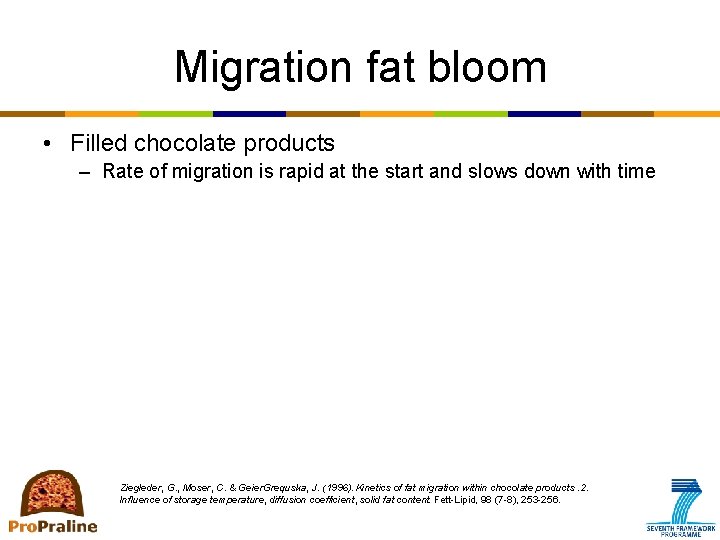
Migration fat bloom • Filled chocolate products – Rate of migration is rapid at the start and slows down with time Ziegleder, G. , Moser, C. & Geier. Grequska, J. (1996). Kinetics of fat migration within chocolate products. 2. Influence of storage temperature, diffusion coefficient, solid fat content. Fett-Lipid, 98 (7 -8), 253 -256.
Composition analysis of fat bloom in filled chocolate products have shown that it contains about 15% of Triolein, which is a proof for the diffusion of vegetable oils from the centre through the coating into the bloomed surface. Ziegleder, G. (1997). "Fat migration and bloom. " The manufacturing confectioner.
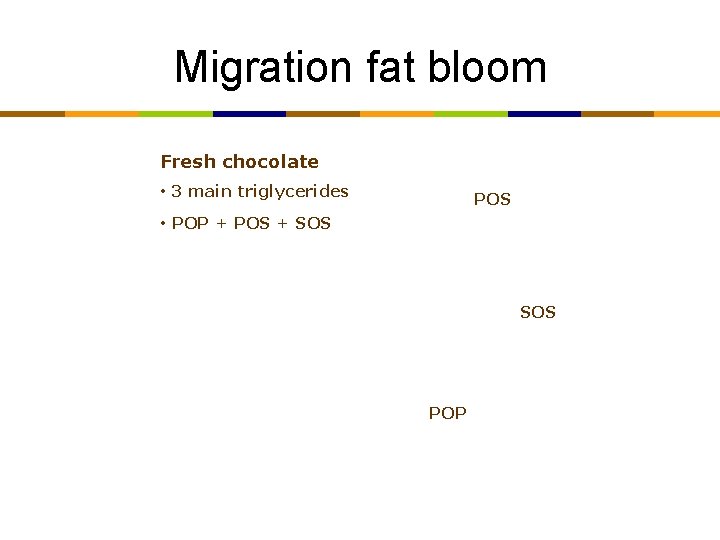
Migration fat bloom Fresh chocolate • 3 main triglycerides POS • POP + POS + SOS POP

Migration fat bloom Bloomed chocolate • chocolate triglycerides • + filling specific triglycerides, e. g. , OOO LOO

Migration fat bloom • Filled chocolate products – The liquid fat from the filling will mix with the cocoa butter present in the chocolate – Decrease of solid fat content in chocolate shell due to • Dissolution of the cocoa butter crystals in the liquid fat • The formation of a eutectic phase – Leads to migration of liquid cocoa butter to the surface – Recrystallization at the surface – Formation of fat bloom → Migration: foreign fat induces V- VI transition • Importance of microstructure – Migration does not always lead to fat bloom – Structure density decisive for crystal development?
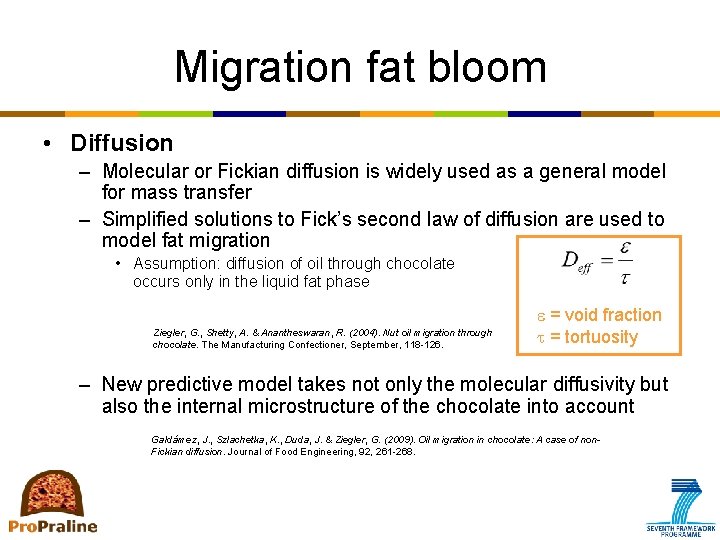
Migration fat bloom • Diffusion – Molecular or Fickian diffusion is widely used as a general model for mass transfer – Simplified solutions to Fick’s second law of diffusion are used to model fat migration • Assumption: diffusion of oil through chocolate occurs only in the liquid fat phase Ziegler, G. , Shetty, A. & Anantheswaran, R. (2004). Nut oil migration through chocolate. The Manufacturing Confectioner, September, 118 -126. = void fraction = tortuosity – New predictive model takes not only the molecular diffusivity but also the internal microstructure of the chocolate into account Galdámez, J. , Szlachetka, K. , Duda, J. & Ziegler, G. (2009). Oil migration in chocolate: A case of non. Fickian diffusion. Journal of Food Engineering, 92, 261 -268.
Migration fat bloom • Capillary forces – Capillary flow in pores and channels – Related to the porosity of the chocolate • Diffusion or capillary flow? – Some authors support the hypothesis of diffusion, whereas others find evidence for the hypothesis of capillary flow

Migration fat bloom research • • HPLC analysis X-ray diffraction DSC measurements NMR measurements Texture analyzer Automated image analysis Microscopy techniques – SEM – CLSM • Sensory research • … Triglyceride composition Polymorphic forms C Melting behavior Solid fat content F Hardness Fat bloom evaluation Surface microstructure Microstructure Visual fat bloom, hardness, melting behavior 10 1
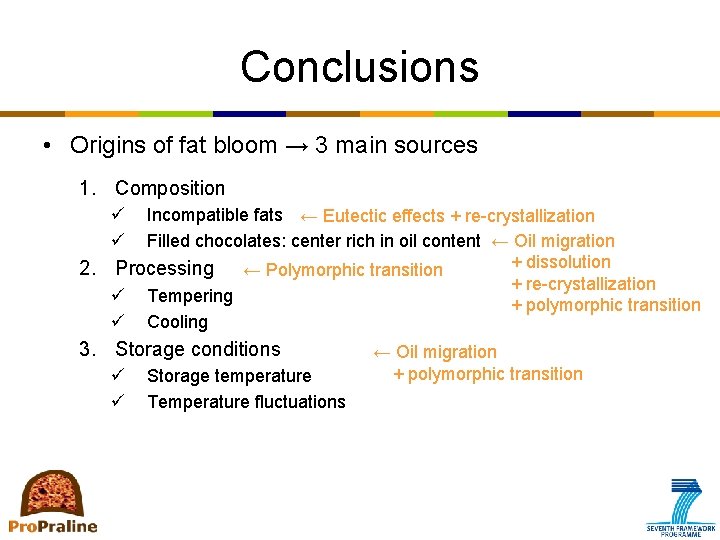
Conclusions • Origins of fat bloom → 3 main sources 1. Composition ü ü Incompatible fats ← Eutectic effects + re-crystallization Filled chocolates: center rich in oil content ← Oil migration + dissolution 2. Processing ← Polymorphic transition + re-crystallization ü Tempering + polymorphic transition ü Cooling 3. Storage conditions ü ü Storage temperature Temperature fluctuations ← Oil migration + polymorphic transition
- Slides: 37