
The Process of Cell Division Lesson Overview 10



- Slides: 18
The Process of Cell Division Lesson Overview 10. 2 The Process of Cell Division
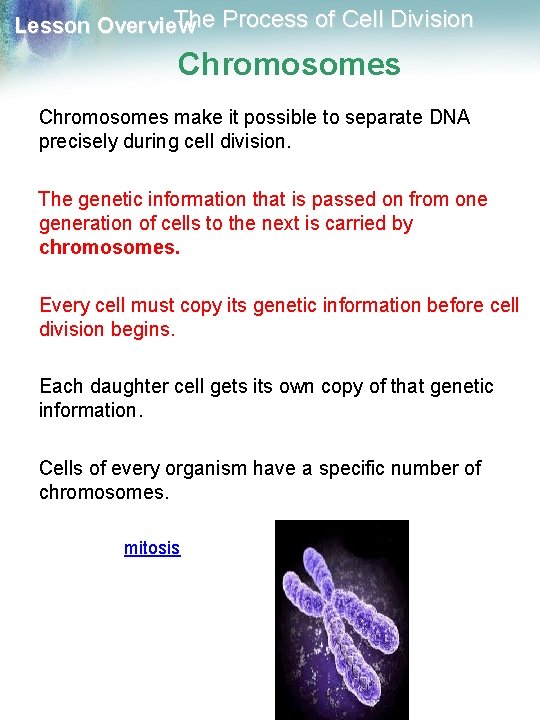
The Process of Cell Division Lesson Overview Chromosomes make it possible to separate DNA precisely during cell division. The genetic information that is passed on from one generation of cells to the next is carried by chromosomes. Every cell must copy its genetic information before cell division begins. Each daughter cell gets its own copy of that genetic information. Cells of every organism have a specific number of chromosomes. mitosis
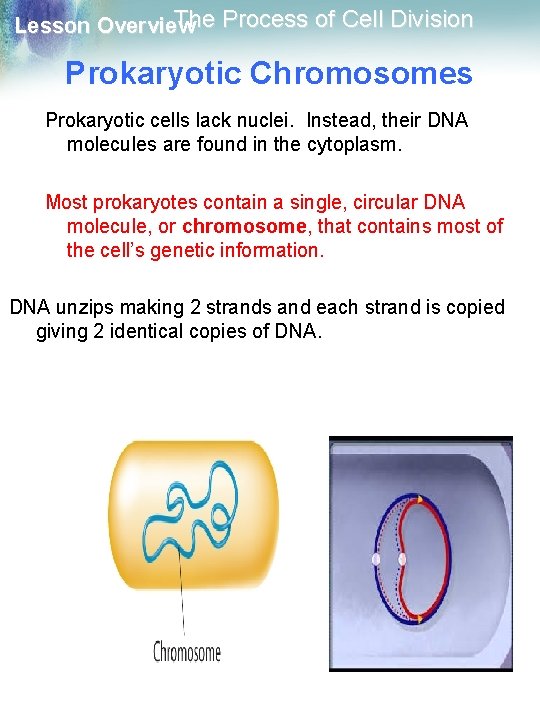
The Process of Cell Division Lesson Overview Prokaryotic Chromosomes Prokaryotic cells lack nuclei. Instead, their DNA molecules are found in the cytoplasm. Most prokaryotes contain a single, circular DNA molecule, or chromosome, that contains most of the cell’s genetic information. DNA unzips making 2 strands and each strand is copied giving 2 identical copies of DNA.
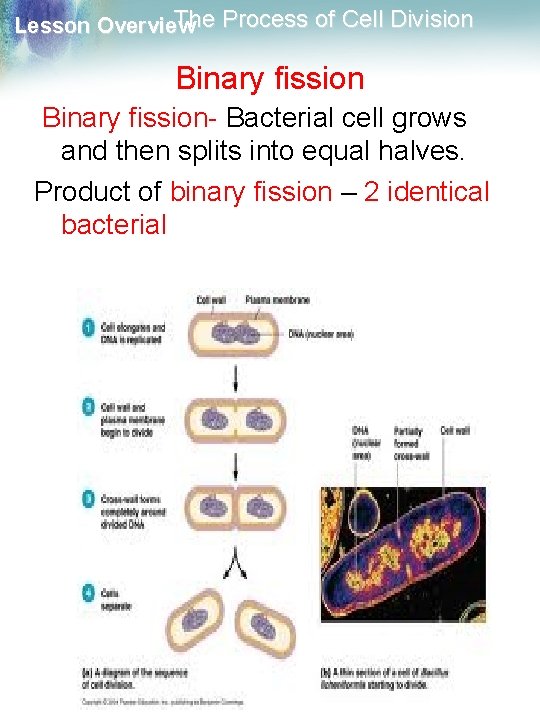
The Process of Cell Division Lesson Overview Binary fission- Bacterial cell grows and then splits into equal halves. Product of binary fission – 2 identical bacterial
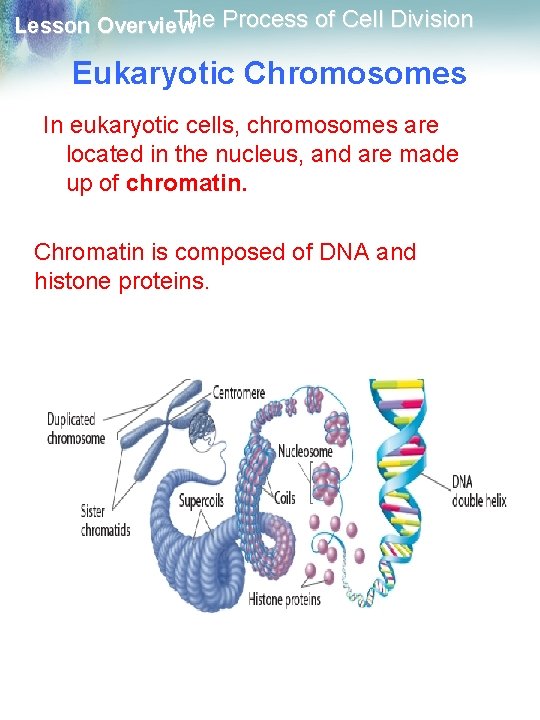
The Process of Cell Division Lesson Overview Eukaryotic Chromosomes In eukaryotic cells, chromosomes are located in the nucleus, and are made up of chromatin. Chromatin is composed of DNA and histone proteins.
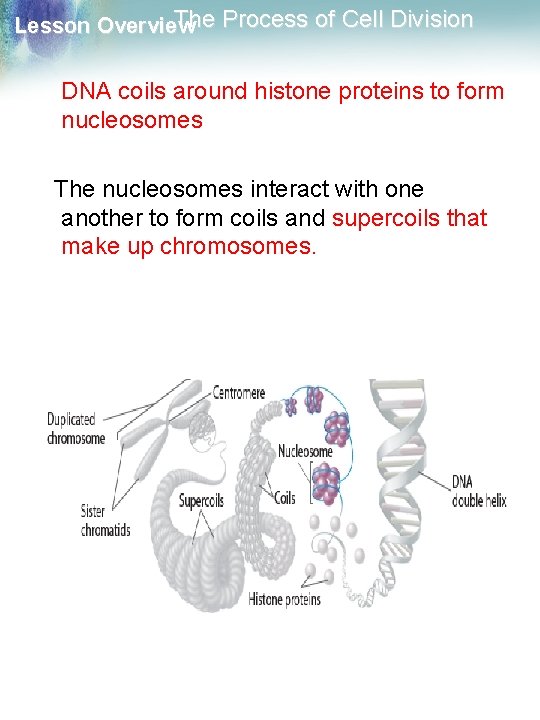
The Process of Cell Division Lesson Overview DNA coils around histone proteins to form nucleosomes The nucleosomes interact with one another to form coils and supercoils that make up chromosomes.
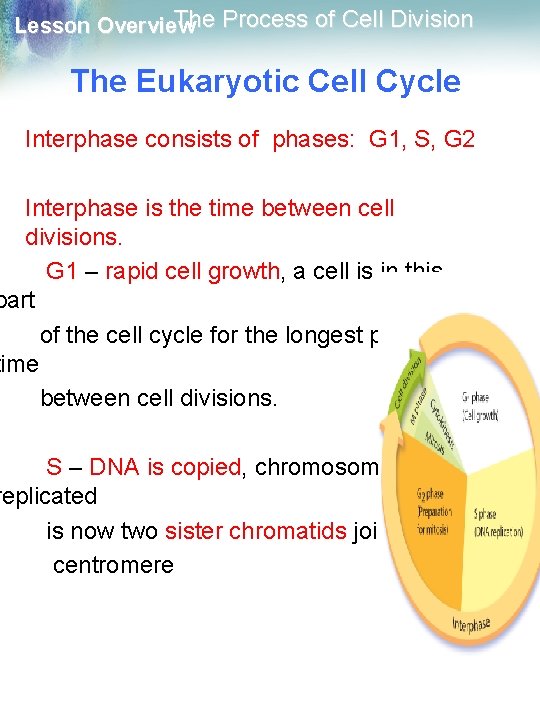
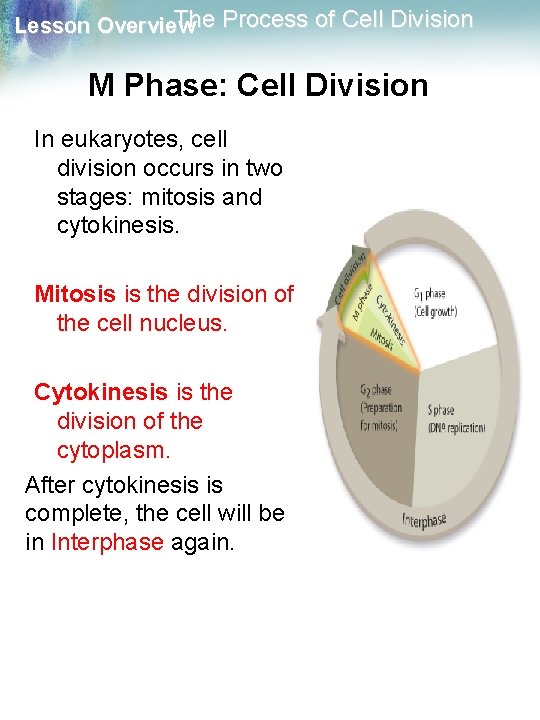
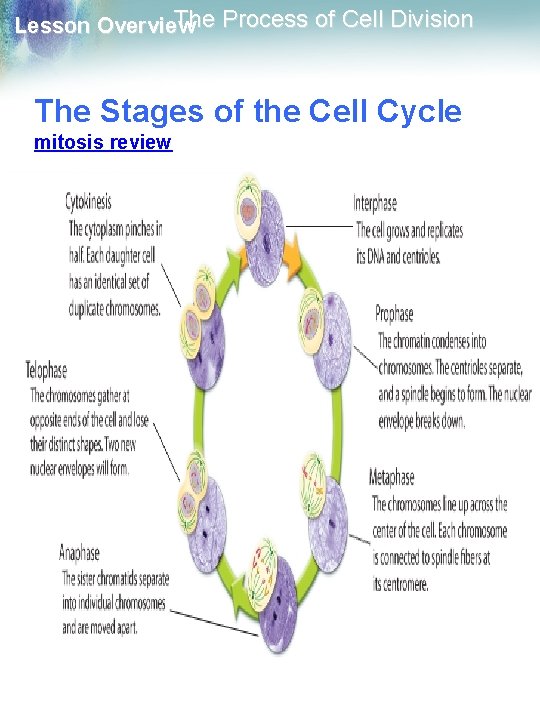
The Process of Cell Division Lesson Overview The Eukaryotic Cell Cycle Interphase consists of phases: G 1, S, G 2 Interphase is the time between cell divisions. G 1 – rapid cell growth, a cell is in this part of the cell cycle for the longest period of time between cell divisions. S – DNA is copied, chromosome replicated is now two sister chromatids joined at centromere
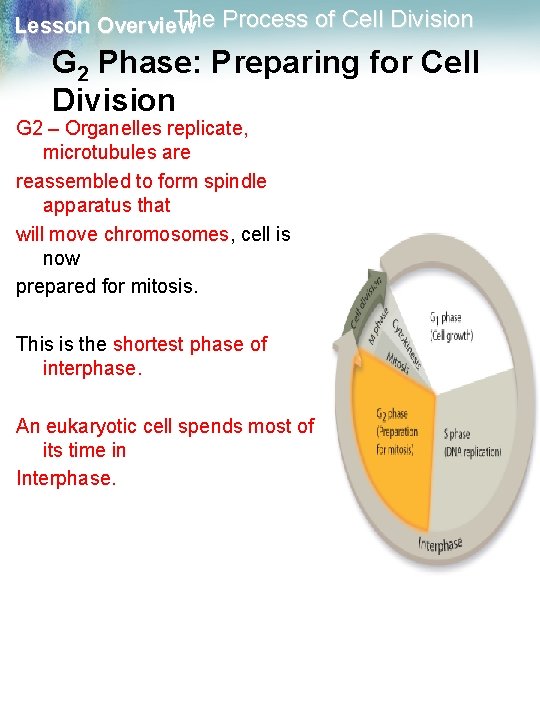
The Process of Cell Division Lesson Overview G 2 Phase: Preparing for Cell Division G 2 – Organelles replicate, microtubules are reassembled to form spindle apparatus that will move chromosomes, cell is now prepared for mitosis. This is the shortest phase of interphase. An eukaryotic cell spends most of its time in Interphase.
The Process of Cell Division Lesson Overview M Phase: Cell Division In eukaryotes, cell division occurs in two stages: mitosis and cytokinesis. Mitosis is the division of the cell nucleus. Cytokinesis is the division of the cytoplasm. After cytokinesis is complete, the cell will be in Interphase again.
The Process of Cell Division Lesson Overview MITOSIS Biologists divide the events of mitosis into four phases: 1. Prophase 2. Metaphase 3. Anaphase 4. Telophase
The Process of Cell Division Lesson Overview PROPHASE Chromosomes condense and become visible. Centrioles form and take up positions on opposite ends of the nucleus. Spindle becomes visible. Nuclear membrane breaks down, and the nucleolus disappears.
The Process of Cell Division Lesson Overview Metaphase Spindle fibers (kinetochore) assist in moving the chromosomes to the equator (middle) of the cell. The centromeres of all the sister chromatids line up. The imaginary line that bisects each of the chromatids through the centromere is called the metaphase plate.
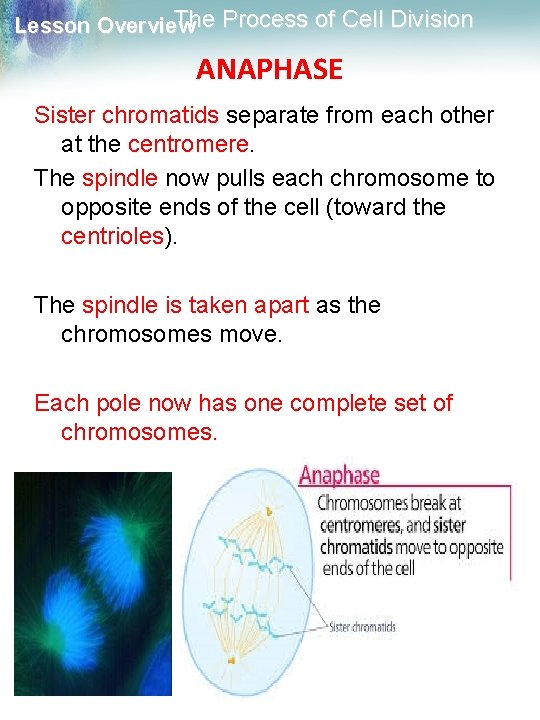
The Process of Cell Division Lesson Overview ANAPHASE Sister chromatids separate from each other at the centromere. The spindle now pulls each chromosome to opposite ends of the cell (toward the centrioles). The spindle is taken apart as the chromosomes move. Each pole now has one complete set of chromosomes.
The Process of Cell Division Lesson Overview TELOPHASE Chromosomes uncoil, spindle fibers disappear, and the nuclear membrane reforms. Mitosis is complete. Is the cell divided? ? ?
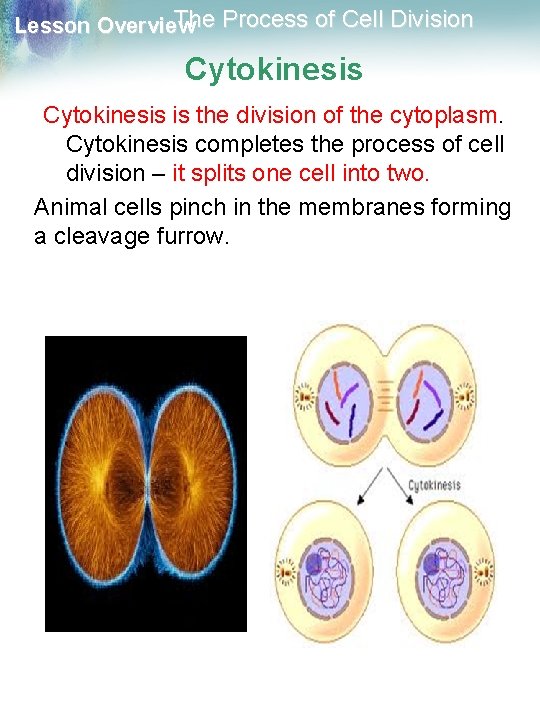
The Process of Cell Division Lesson Overview Cytokinesis is the division of the cytoplasm. Cytokinesis completes the process of cell division – it splits one cell into two. Animal cells pinch in the membranes forming a cleavage furrow.
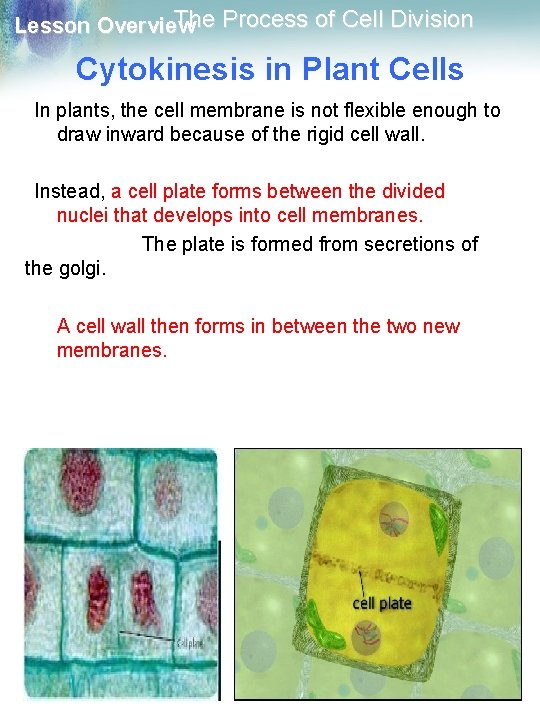
The Process of Cell Division Lesson Overview Cytokinesis in Plant Cells In plants, the cell membrane is not flexible enough to draw inward because of the rigid cell wall. Instead, a cell plate forms between the divided nuclei that develops into cell membranes. The plate is formed from secretions of the golgi. A cell wall then forms in between the two new membranes.
The Process of Cell Division Lesson Overview Important Cell Structures Involved in Mitosis Chromatin- genetic material in a non-dividing cell, loose strands Chromatid – each strand of a duplicated chromosome Centromere – the area where each pair of chromatids is joined Centrioles – tiny structures located in the cytoplasm of animal cells that help organize the spindle Spindle – a fanlike microtubule structure that helps separate the chromatids
The Process of Cell Division Lesson Overview The Stages of the Cell Cycle mitosis review