
The procedural parts of c Cstyle strings Pointers
- Slides: 21
The procedural parts of c++ C-style strings Pointers and references GETTING STARTED IN C++
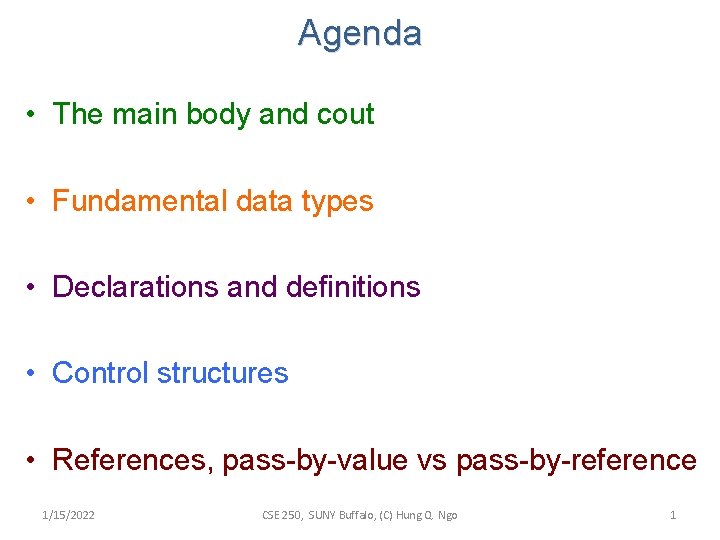
Agenda • The main body and cout • Fundamental data types • Declarations and definitions • Control structures • References, pass-by-value vs pass-by-reference 1/15/2022 CSE 250, SUNY Buffalo, (C) Hung Q. Ngo 1
C++ is an OO extension of C C++ has both procedural and object-oriented features We will use C++ as a procedural language with objects THE MAIN BODY AND COUT 1/15/2022 CSE 250, SUNY Buffalo, (C) Hung Q. Ngo 2
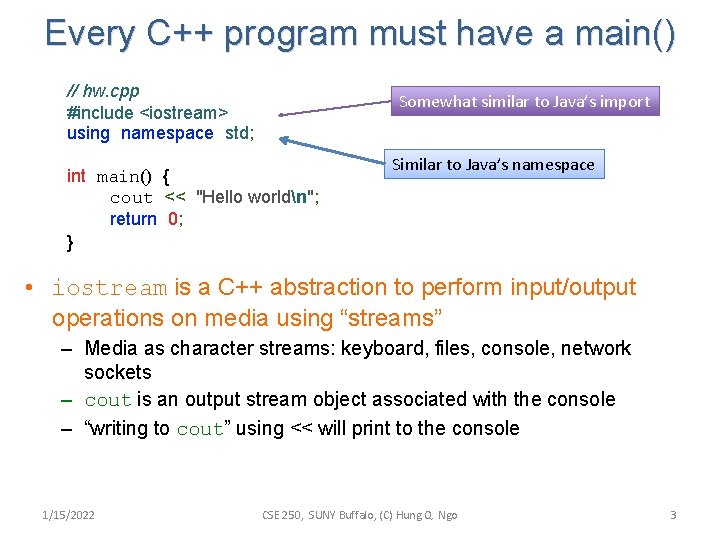
Every C++ program must have a main() // hw. cpp #include <iostream> using namespace std; Somewhat similar to Java’s import int main() { cout << "Hello worldn"; return 0; } Similar to Java’s namespace • iostream is a C++ abstraction to perform input/output operations on media using “streams” – Media as character streams: keyboard, files, console, network sockets – cout is an output stream object associated with the console – “writing to cout” using << will print to the console 1/15/2022 CSE 250, SUNY Buffalo, (C) Hung Q. Ngo 3
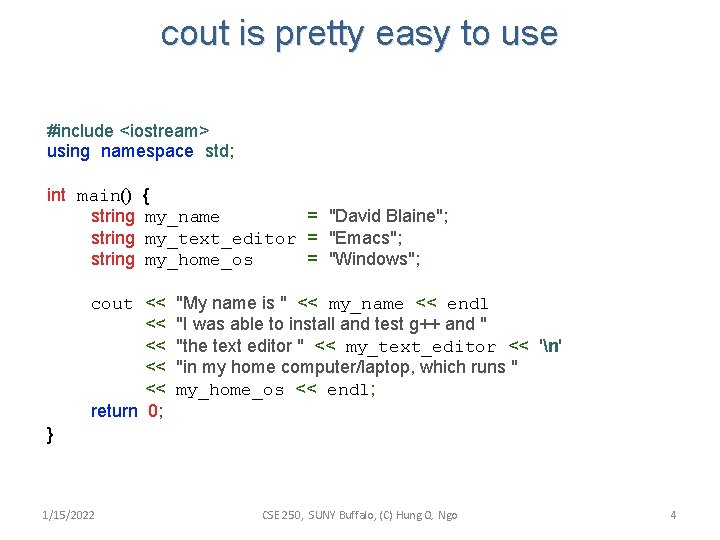
cout is pretty easy to use #include <iostream> using namespace std; int main() string { my_name = "David Blaine"; my_text_editor = "Emacs"; my_home_os = "Windows"; cout << << << return 0; "My name is " << my_name << endl "I was able to install and test g++ and " "the text editor " << my_text_editor << 'n' "in my home computer/laptop, which runs " my_home_os << endl; } 1/15/2022 CSE 250, SUNY Buffalo, (C) Hung Q. Ngo 4
They are what you expect them to be, similar to those in Java FUNDAMENTAL DATA TYPES 1/15/2022 CSE 250, SUNY Buffalo, (C) Hung Q. Ngo 5
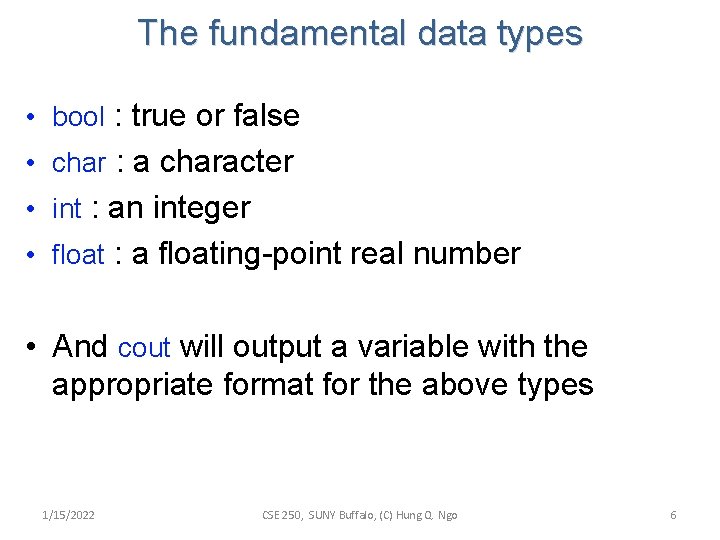
The fundamental data types • bool : true or false • char : a character • int : an integer • float : a floating-point real number • And cout will output a variable with the appropriate format for the above types 1/15/2022 CSE 250, SUNY Buffalo, (C) Hung Q. Ngo 6
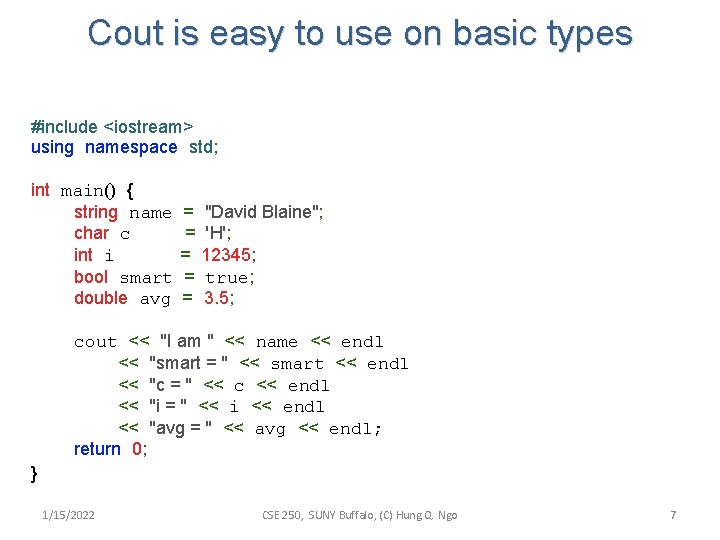
Cout is easy to use on basic types #include <iostream> using namespace std; int main() { string name char c int i bool smart double avg = = = "David Blaine"; 'H'; 12345; true; 3. 5; cout << "I am " << name << endl << "smart = " << smart << endl << "c = " << c << endl << "i = " << i << endl << "avg = " << avg << endl; return 0; } 1/15/2022 CSE 250, SUNY Buffalo, (C) Hung Q. Ngo 7
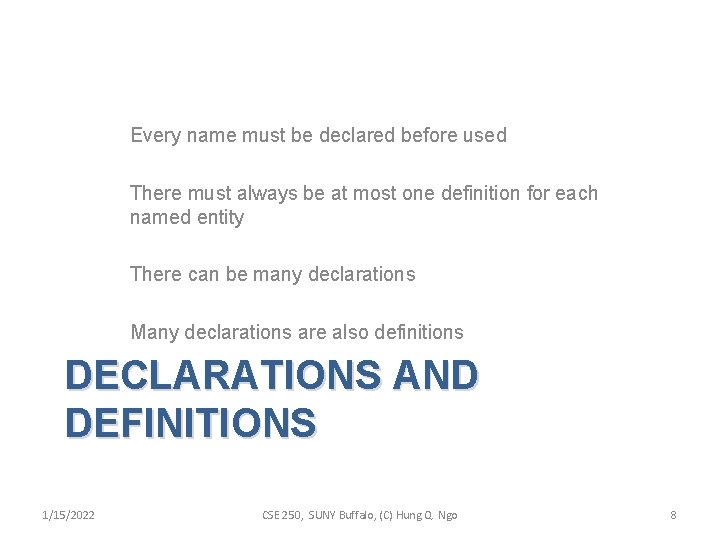
Every name must be declared before used There must always be at most one definition for each named entity There can be many declarations Many declarations are also definitions DECLARATIONS AND DEFINITIONS 1/15/2022 CSE 250, SUNY Buffalo, (C) Hung Q. Ngo 8
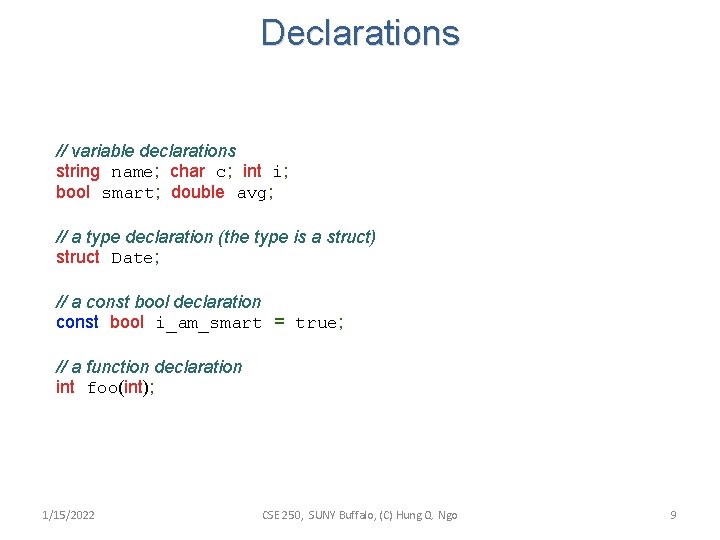
Declarations // variable declarations string name; char c; int i; bool smart; double avg; // a type declaration (the type is a struct) struct Date; // a const bool declaration const bool i_am_smart = true; // a function declaration int foo(int); 1/15/2022 CSE 250, SUNY Buffalo, (C) Hung Q. Ngo 9
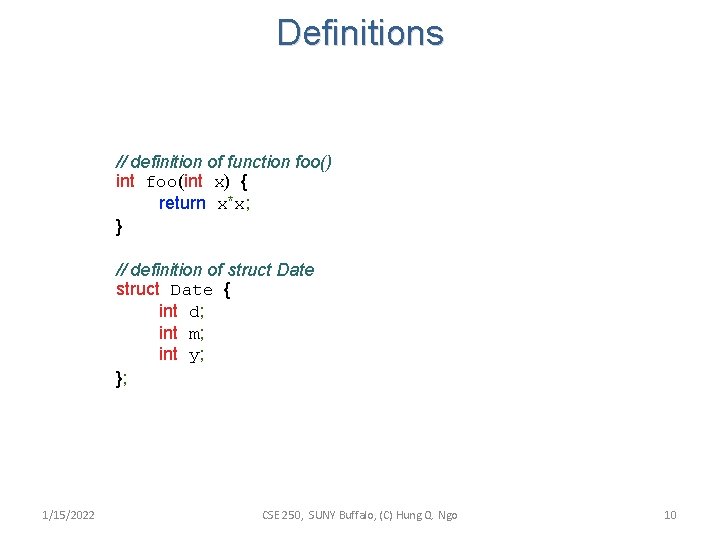
Definitions // definition of function foo() int foo(int x) { return x*x; } // definition of struct Date { int d; int m; int y; }; 1/15/2022 CSE 250, SUNY Buffalo, (C) Hung Q. Ngo 10
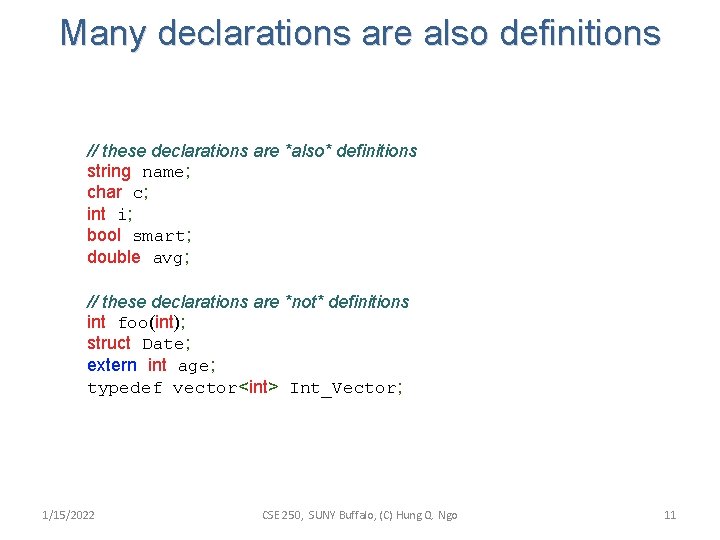
Many declarations are also definitions // these declarations are *also* definitions string name; char c; int i; bool smart; double avg; // these declarations are *not* definitions int foo(int); struct Date; extern int age; typedef vector<int> Int_Vector; 1/15/2022 CSE 250, SUNY Buffalo, (C) Hung Q. Ngo 11
Again • Every name (identifier) must be declared before use • A name can be declared multiples times • There is at most 1 definition per name • Some declarations are also definitions 1/15/2022 CSE 250, SUNY Buffalo, (C) Hung Q. Ngo 12
Similar to java The ones we’ll often use are - if else while loop for loop switch statement continue and break exit(. ) function CONTROL STRUCTURES 1/15/2022 CSE 250, SUNY Buffalo, (C) Hung Q. Ngo 13
Let’s Write a Program That Does The Following • For each line the user types – Prints a copy of the line with all characters in reversed order – Prints a copy of the line with all words in reversed order • Illustrates – Modularization – Functions and control structures 1/15/2022 CSE 250, SUNY Buffalo, (C) Hung Q. Ngo 14
- A reference is an alias for an existing object REFERENCES 1/15/2022 CSE 250, SUNY Buffalo, (C) Hung Q. Ngo 15
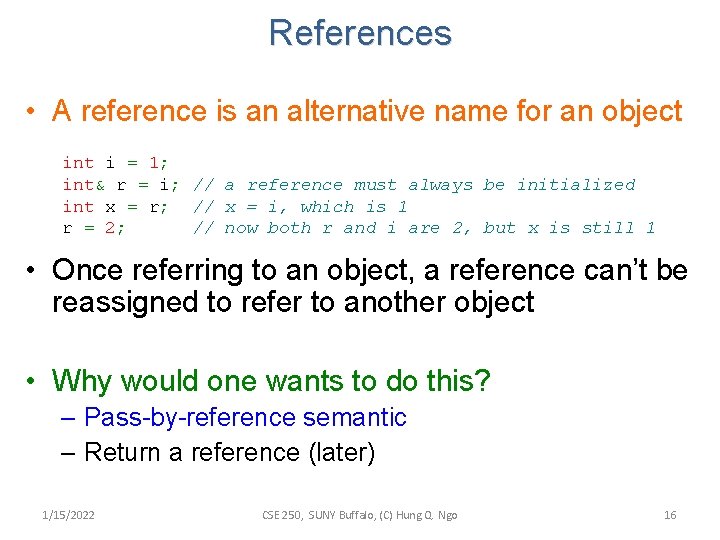
References • A reference is an alternative name for an object int i = 1; int& r = i; // a reference must always be initialized int x = r; // x = i, which is 1 r = 2; // now both r and i are 2, but x is still 1 • Once referring to an object, a reference can’t be reassigned to refer to another object • Why would one wants to do this? – Pass-by-reference semantic – Return a reference (later) 1/15/2022 CSE 250, SUNY Buffalo, (C) Hung Q. Ngo 16
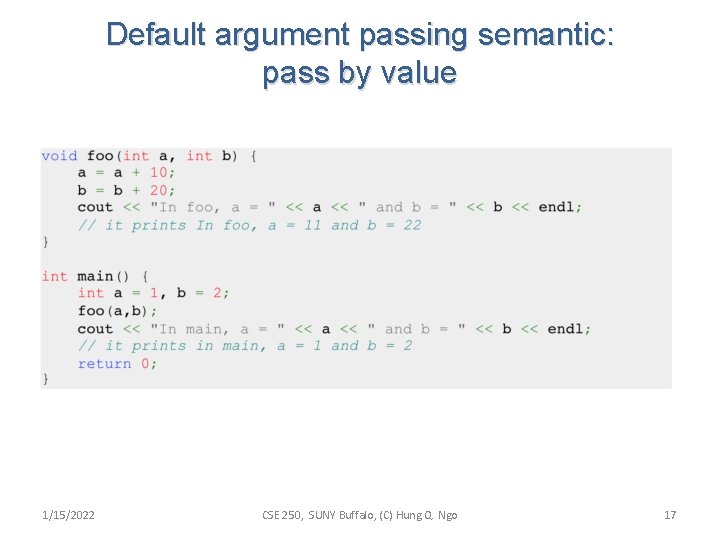
Default argument passing semantic: pass by value 1/15/2022 CSE 250, SUNY Buffalo, (C) Hung Q. Ngo 17
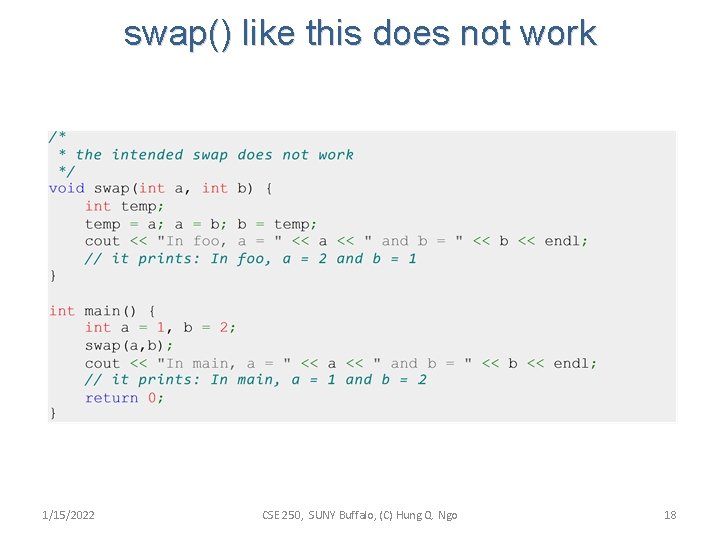
swap() like this does not work 1/15/2022 CSE 250, SUNY Buffalo, (C) Hung Q. Ngo 18
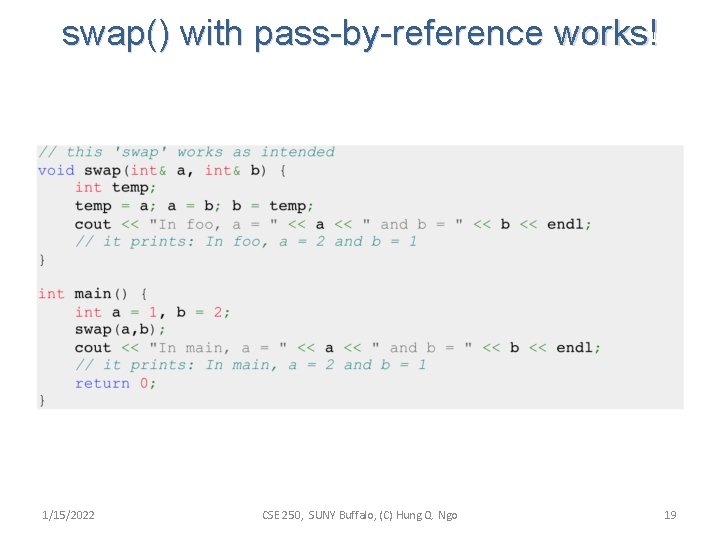
swap() with pass-by-reference works! 1/15/2022 CSE 250, SUNY Buffalo, (C) Hung Q. Ngo 19
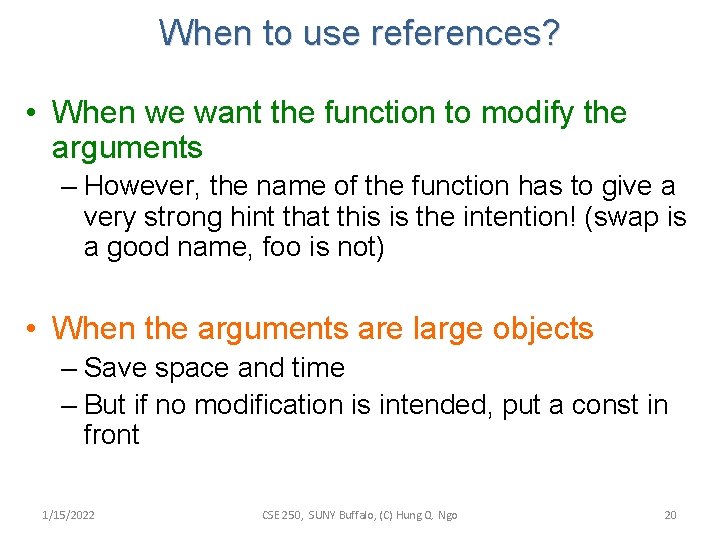
When to use references? • When we want the function to modify the arguments – However, the name of the function has to give a very strong hint that this is the intention! (swap is a good name, foo is not) • When the arguments are large objects – Save space and time – But if no modification is intended, put a const in front 1/15/2022 CSE 250, SUNY Buffalo, (C) Hung Q. Ngo 20