
The Problem with the Blank Slate Approach Derek

The Problem with the Blank Slate Approach Derek Hoiem Beckman Institute, UIUC
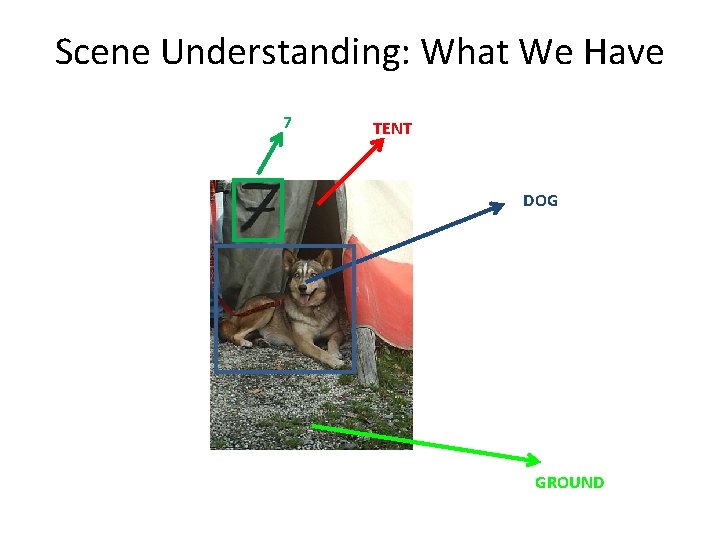
Scene Understanding: What We Have 7 TENT DOG GROUND
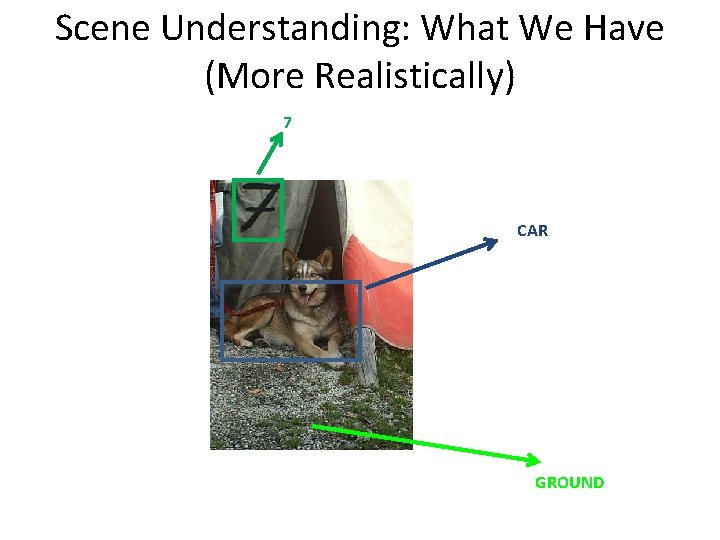
Scene Understanding: What We Have (More Realistically) 7 CAR GROUND
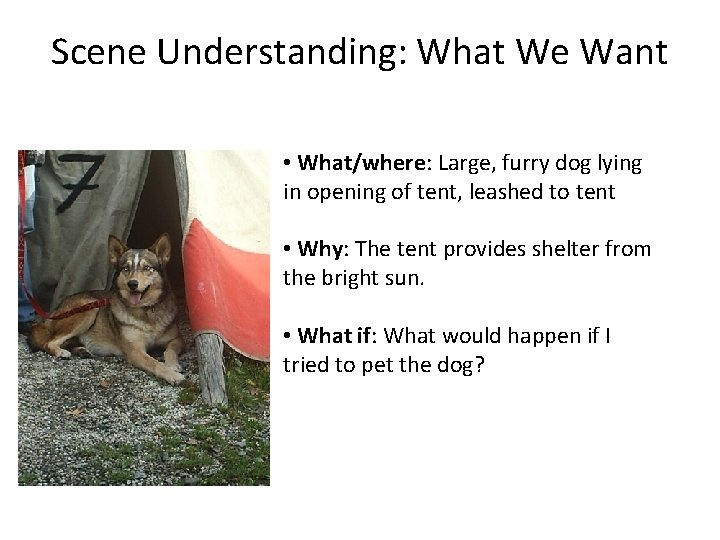
Scene Understanding: What We Want • What/where: Large, furry dog lying in opening of tent, leashed to tent • Why: The tent provides shelter from the bright sun. • What if: What would happen if I tried to pet the dog?
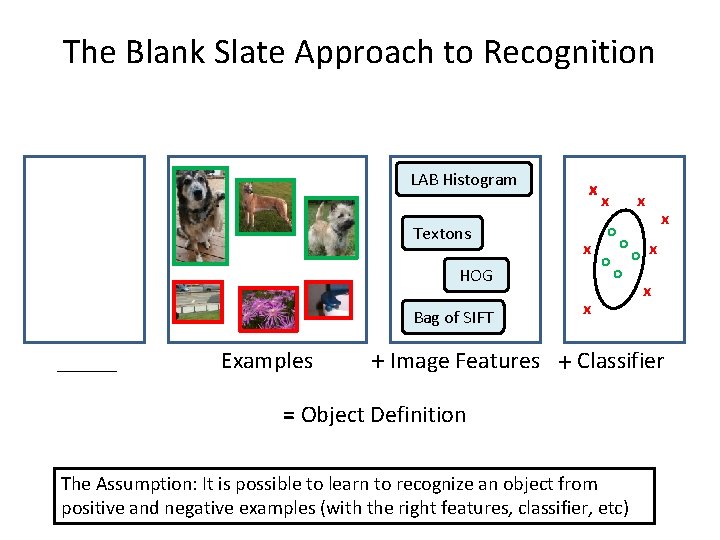
The Blank Slate Approach to Recognition LAB Histogram Textons x x HOG Bag of SIFT _____ Examples x x o o x x + Image Features + Classifier = Object Definition The Assumption: It is possible to learn to recognize an object from positive and negative examples (with the right features, classifier, etc)

Problems with the Blank Slate Approach 1. Is inefficient
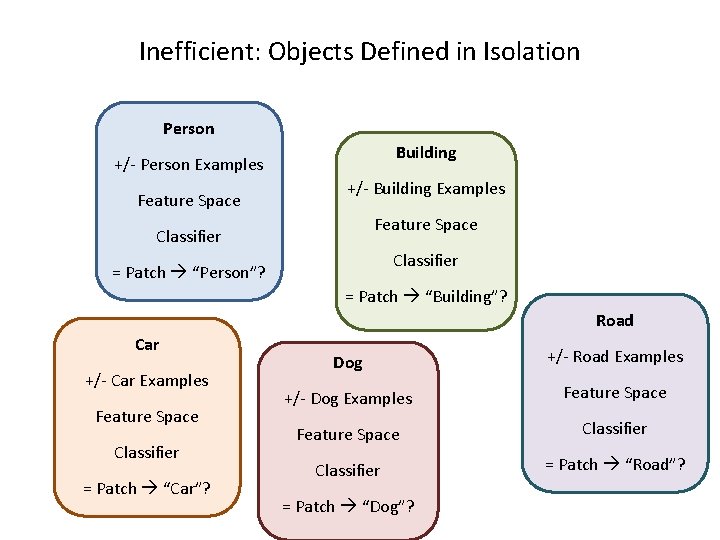
Inefficient: Objects Defined in Isolation Person Building +/- Person Examples Feature Space +/- Building Examples Feature Space Classifier = Patch “Person”? = Patch “Building”? Road Car +/- Car Examples Feature Space Classifier = Patch “Car”? Dog +/- Road Examples +/- Dog Examples Feature Space Classifier = Patch “Road”? = Patch “Dog”?
Problems with the Blank Slate Approach 1. Is inefficient. 2. Does not allow the underlying concept to be learned.
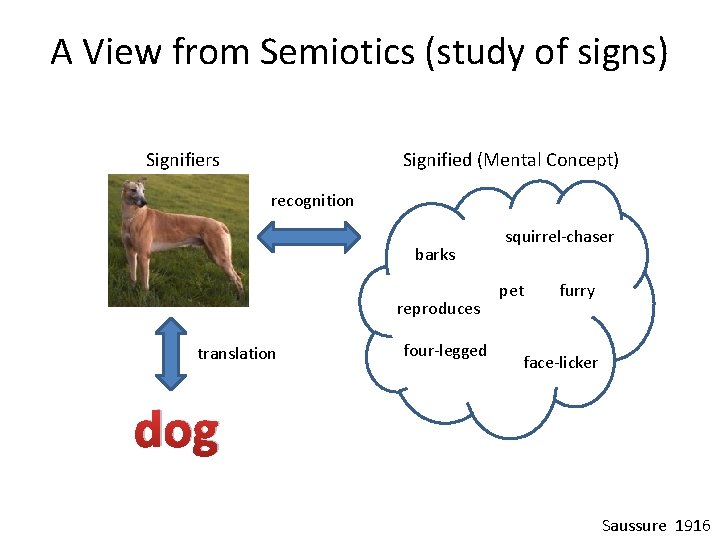
A View from Semiotics (study of signs) Signifiers Signified (Mental Concept) recognition barks reproduces translation four-legged squirrel-chaser pet furry face-licker dog Saussure 1916
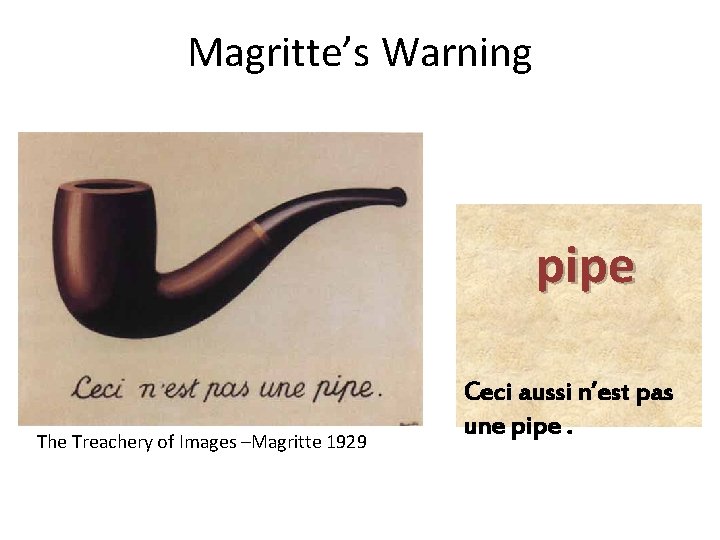
Magritte’s Warning pipe The Treachery of Images –Magritte 1929 Ceci aussi n’est pas une pipe.
Problems with the Blank Slate Approach 1. Is inefficient. 2. Does not allow the underlying concept to be learned. 3. Might not allow accurate naming.
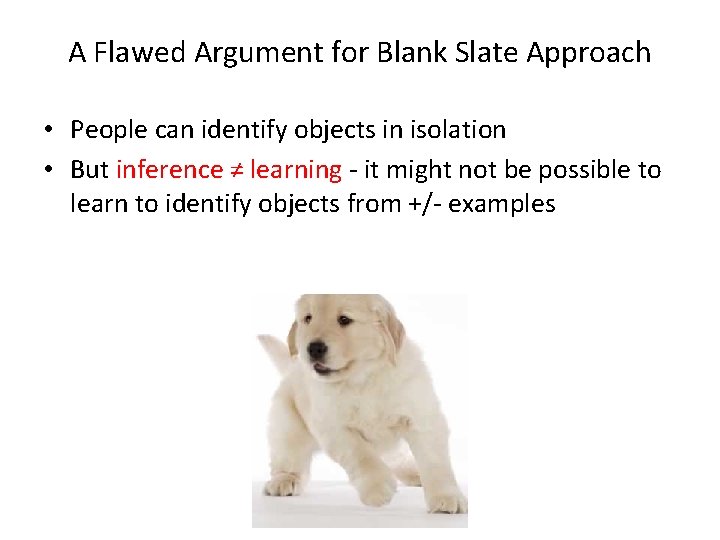
A Flawed Argument for Blank Slate Approach • People can identify objects in isolation • But inference ≠ learning - it might not be possible to learn to identify objects from +/- examples
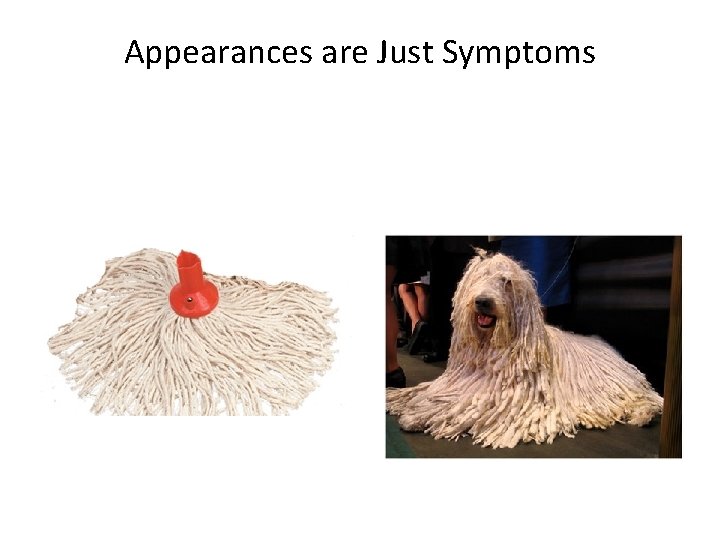
Appearances are Just Symptoms
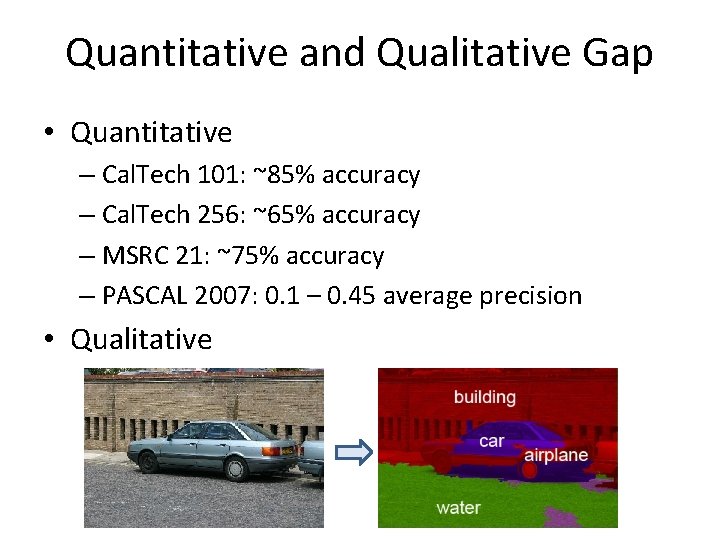
Quantitative and Qualitative Gap • Quantitative – Cal. Tech 101: ~85% accuracy – Cal. Tech 256: ~65% accuracy – MSRC 21: ~75% accuracy – PASCAL 2007: 0. 1 – 0. 45 average precision • Qualitative

Moving Beyond the Blank Slate
Major Shifts in Approach 1. Progressive vision: from starting from scratch to accumulating knowledge
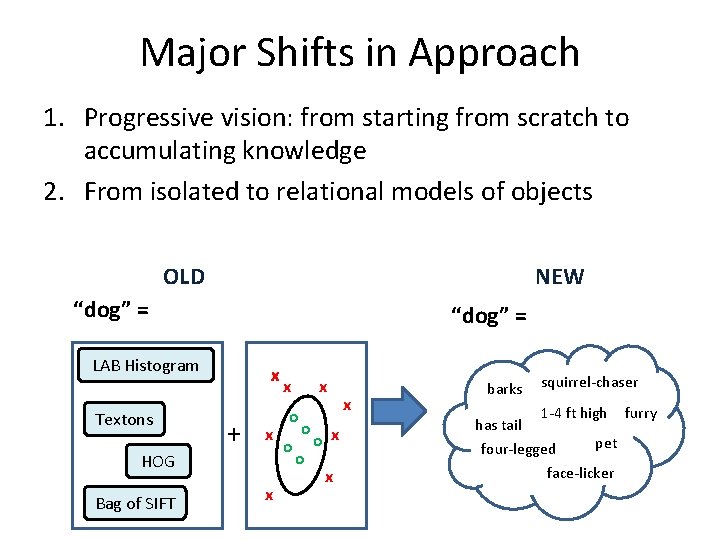
Major Shifts in Approach 1. Progressive vision: from starting from scratch to accumulating knowledge 2. From isolated to relational models of objects OLD NEW “dog” = LAB Histogram Textons x + x HOG Bag of SIFT x x x o o o x x x barks squirrel-chaser 1 -4 ft high furry has tail pet four-legged face-licker
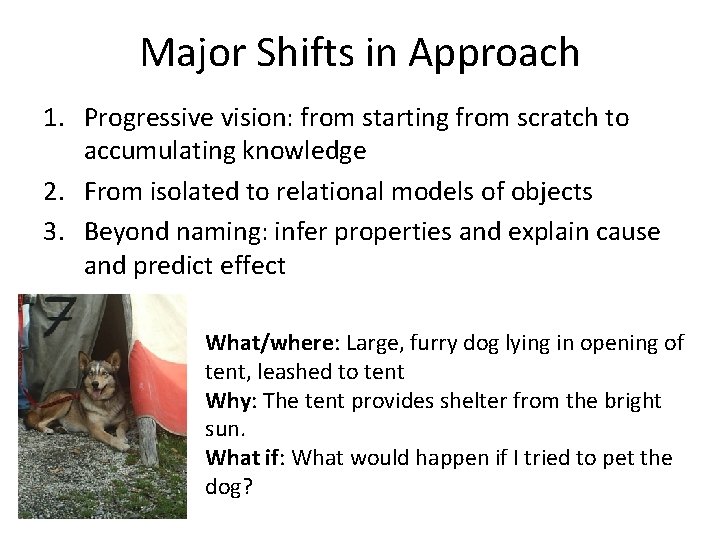
Major Shifts in Approach 1. Progressive vision: from starting from scratch to accumulating knowledge 2. From isolated to relational models of objects 3. Beyond naming: infer properties and explain cause and predict effect What/where: Large, furry dog lying in opening of tent, leashed to tent Why: The tent provides shelter from the bright sun. What if: What would happen if I tried to pet the dog?
Existing Solutions are not Enough • More data – May never have enough – No understanding • Feature sharing or “deep learning” – May not be possible to discover underlying concepts from visual data – “Hidden” features cannot be communicated (or independently improved) – Still no understanding • Compositional models – Only handles “part of” relation • Context with graphical models – Hand-designed relational structure: brittle, not scalable
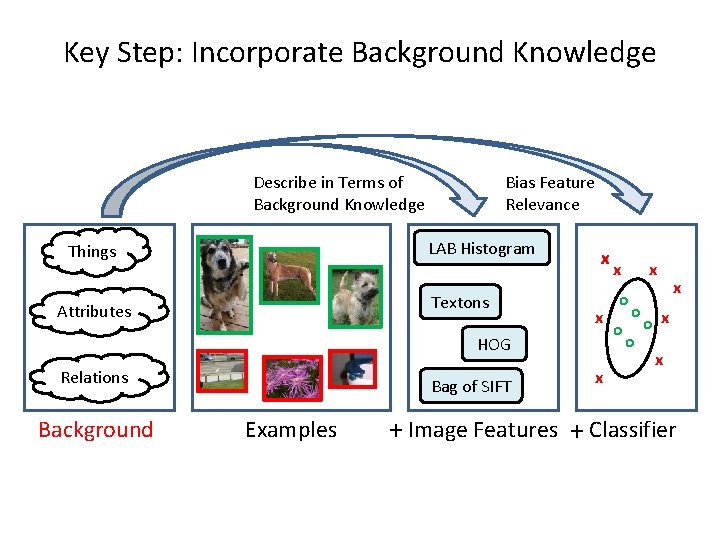
Key Step: Incorporate Background Knowledge Describe in Terms of Background Knowledge Bias Feature Relevance LAB Histogram Things Textons Attributes x x HOG Relations Background Bag of SIFT Examples x x x o o x o x x + Image Features + Classifier
Uses of Background Knowledge Background knowledge (things that can be identified and relational structures) can • Serves as building blocks for new concepts • Helps determine what is likely to be important • Allows properties to be inferred through class hierarchies Early Category and Concept Development – Eds. Rakison and Oakes 2003
Uses of Background Knowledge: Examples • Using background knowledge as building blocks • Explaining away large “stuff”
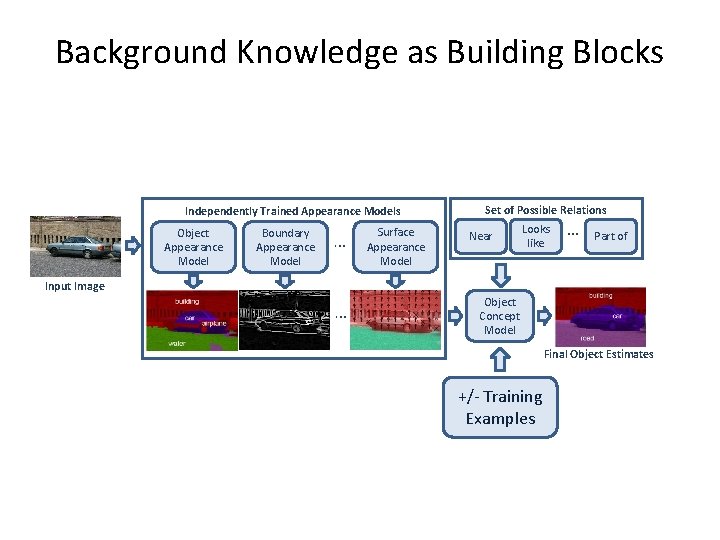
Background Knowledge as Building Blocks Independently Trained Appearance Models Object Appearance Model Boundary Appearance Model … Surface Appearance Model Set of Possible Relations Near Looks like … Part of Input Image … Object Concept Model Final Object Estimates +/- Training Examples
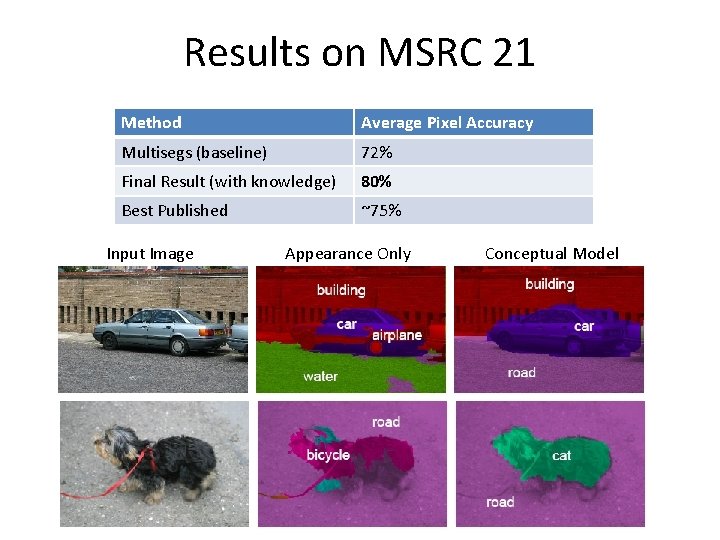
Results on MSRC 21 Method Average Pixel Accuracy Multisegs (baseline) 72% Final Result (with knowledge) 80% Best Published ~75% Input Image Appearance Only Conceptual Model
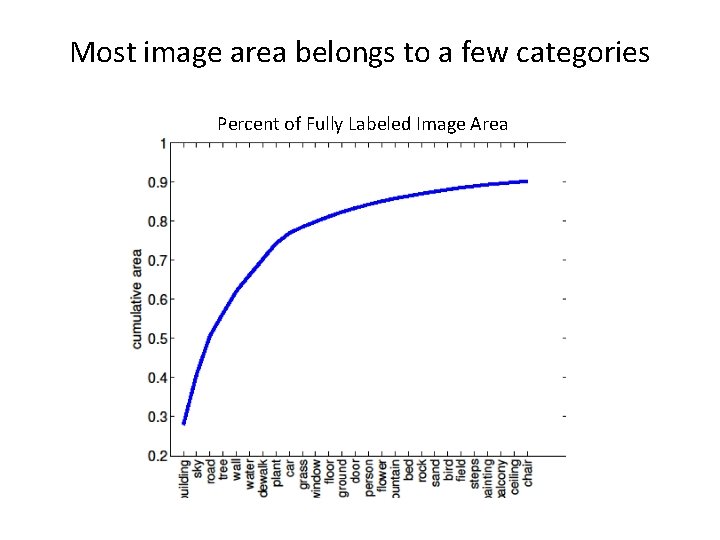
Most image area belongs to a few categories Percent of Fully Labeled Image Area Plot here
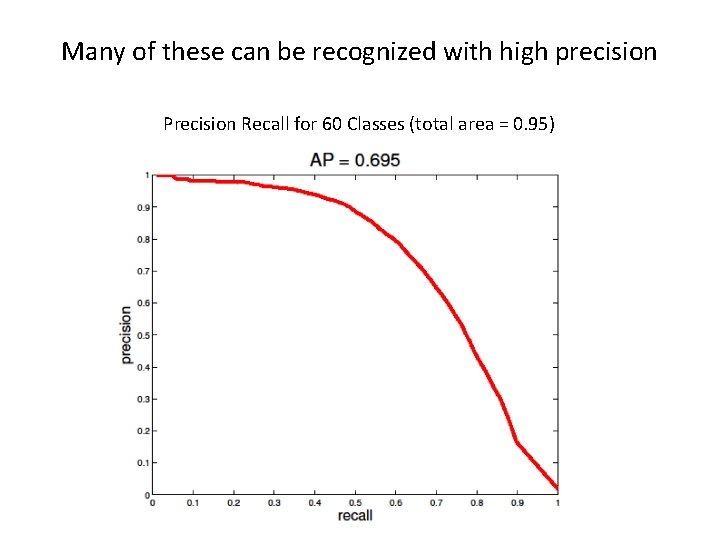
Many of these can be recognized with high precision Precision Recall for 60 Classes (total area = 0. 95) Plot here
Being able to recognize the big stuff is useful 1. Recognize big stuff and ignore it – Efficient search strategies – Improve object discovery 2. Big stuff provides context
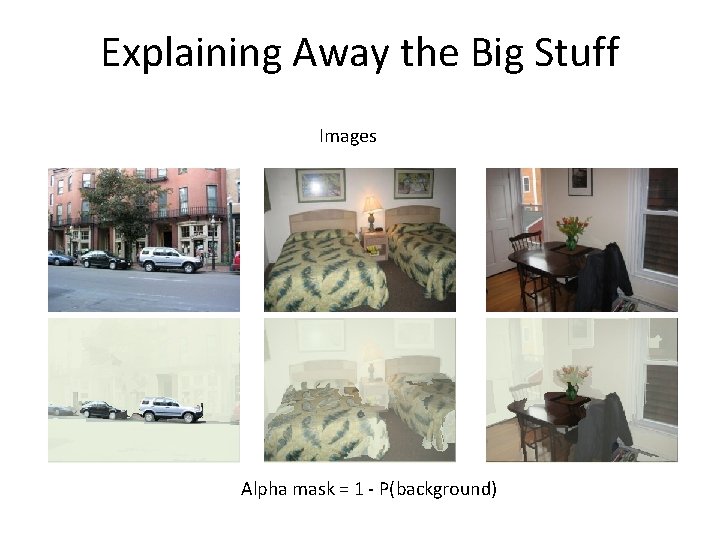
Explaining Away the Big Stuff Images Alpha mask = 1 - P(background)
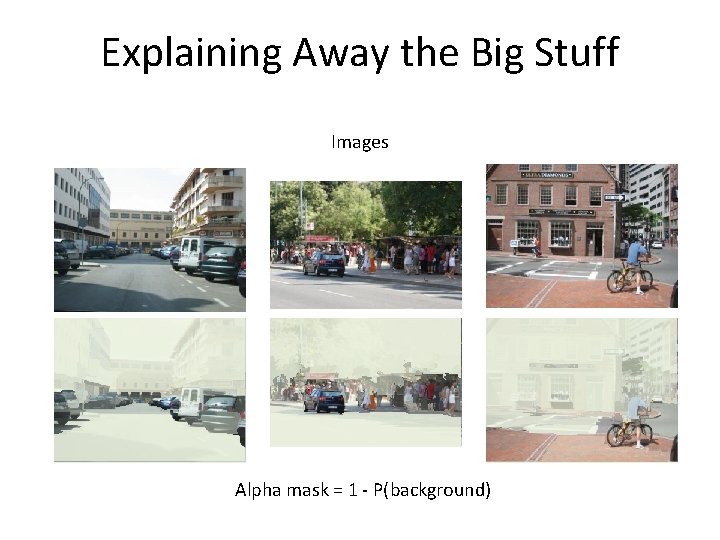
Explaining Away the Big Stuff Images Alpha mask = 1 - P(background)
Knowledge-Based Regularization • Add penalties for assigning weights to features or relations that are unlikely to be relevant, inferred by – – Superclasses (soft inheritance) Guidance from semantic webs, text mining, or instruction Similar objects Functional attributes
Conclusions • The blank slate approach is not sufficient for scene understanding • We need an approach that progressively builds on existing knowledge – Broader recognition (beyond nouns and verbs) – New representations to support relational models – New mechanisms for relational learning and knowledge transfer – New types of evaluation – Integration with linguists, psychologists, etc.
- Slides: 31