
The Problem of Personal Identity John Locke on
The Problem of Personal Identity John Locke on ’Identity and Diversity’
Locke on Personal Identity All the great ends of Morality and Religion, are well enough secured without the philosophical Proofs of the Soul's Immateriality; since it is evident that he who, at first made us beings to subsist here, sensible intelligent Beings, and for several years continued us in such a state, can and will restore us to a like state of Sensibility in another World, and make us there capable to receive the Retribution he has designed to men, according to the doings in this life. [Essay IV: 2: 6] • Locke was (IMHO) the first person to recognize that the problem of personal identity should not be conflated with the mind-body problem and • That it was an open question whether physicalism regarding the mind-body problem was consistent with religious doctrines concerning post-mortem survival.
Synchonic and Diachronic Identity THE PERSONAL IDENTITY PROBLEM
The Problem of Personal Identity Whether we are to live in a future state, as it is the most important question which can possibly be asked, so it is the most intelligible one which can be expressed in language. --Bishop Butler • The Persistence Question: what are non-trivial necessary and sufficient conditions for the persistence of persons? • Why an answer to this question is important – Was I a fetus? Will I be me, a person, after brain damage? – For what past events am I morally/leglly responsible? – Is post-mortem survival possible?

Criterion for Personal Identity • Criterion for Personal Identity: answer to the persistence question. – Necessary and sufficient conditions for personal ‘identitythrough-time’: ‘x is the same person as y iff _____’ – For truth of identity statements in which an individual is identified by descriptions true of them at different times • The question of a criterion is a question concerning numerical identity rather than qualitative similarity • It’s not a question about mere evidences of personal identity
Numerical Identity & Qualitative Similarity • Type-Token Ambiguity: “identical” and its cognates (e. g. “same”) are type-token ambiguous in the sense that we can mean either the same type (kind) of thing or the very same token (individual) thing. – Example: identical twins are type identical—two (token) different individuals of the same type. • Numerical Identity is token-identity: being literally the very same individual • We’re not asking whether someone is, metaphorically, the “same person” after, e. g. religious conversion, but whether we have literally the same (numerically identical) person when we discuss the problem of personal identity.
Criteria vs. Mere Evidences • A condition is criterial rather than merely evidential for identity of objects of a kind, K: necessarily a is the same K as b iff ____. • What makes something the same K--not just how we know • Example: sameness of fingerprints are mere evidences of personal identity – Not necessary because we can imagine the same person’s fingerprints changing—or a person losing his fingers – Not sufficient because we can imagine two different people with the same fingerprints
Criteria • Criteria for identities of objects of different kinds are different • because criteria for being things of different kinds are different (Locke: ‘identity suited to the idea’) – Example: What makes something water is it’s being H 20; it’s being clear, colorless, tasteless and occupying lakes and rivers is merely evidential for it’s being water. • Locke notes: identity criteria for person, man (living human organism), and mass of matter (the stuff of which an object is made) are different.
Locke’s Use of Puzzle Cases • We want to sort out genuine criteria from mere evidences – C is criterial for something’s being an F: necessarily a is an F iff a has C • Since these are claims about what’s necessarily the case, all we need to show that some proposed criterion, C* fails is that it’s logically possible for something to be an F without satisfying C* • Conceivability is traditionally thought to show possibility in the relevant sense—hence puzzle cases – Example: the twin-earth puzzle case shows it’s possible to have superficially water-like stuff that isn’t water hence that the superficial characteristics of water are mere evidences
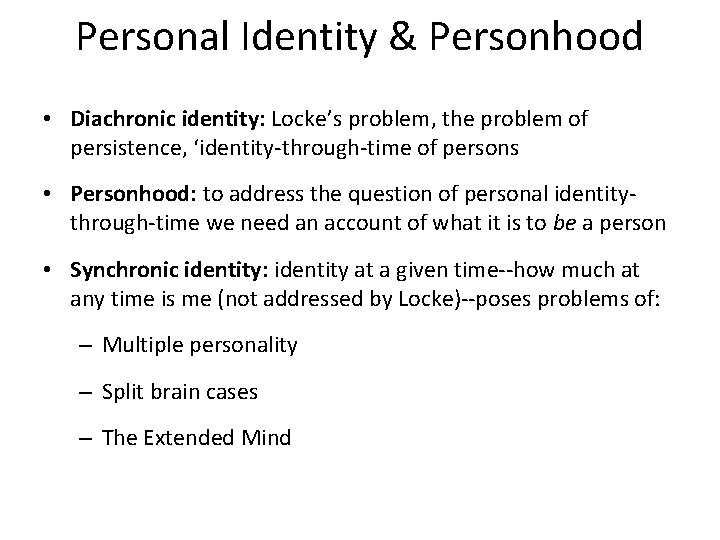
Personal Identity & Personhood • Diachronic identity: Locke’s problem, the problem of persistence, ‘identity-through-time of persons • Personhood: to address the question of personal identitythrough-time we need an account of what it is to be a person • Synchronic identity: identity at a given time--how much at any time is me (not addressed by Locke)--poses problems of: – Multiple personality – Split brain cases – The Extended Mind
Locke on identity: on what there is and how things persist IDENTITY SUITED TO THE IDEA
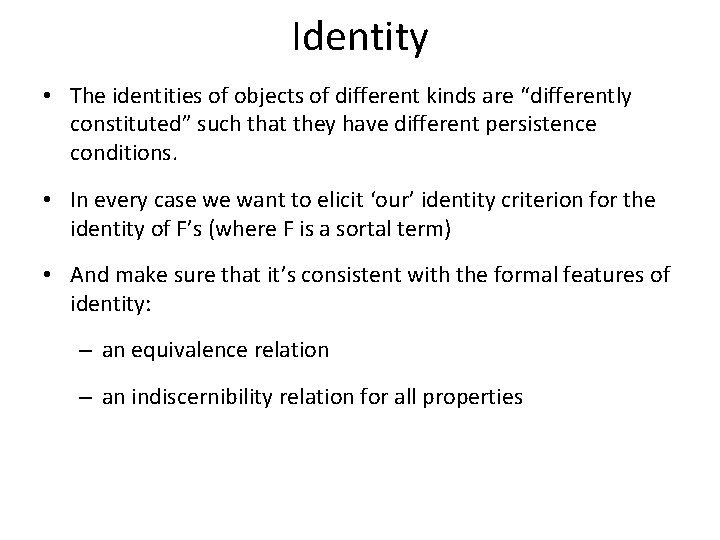
Identity • The identities of objects of different kinds are “differently constituted” such that they have different persistence conditions. • In every case we want to elicit ‘our’ identity criterion for the identity of F’s (where F is a sortal term) • And make sure that it’s consistent with the formal features of identity: – an equivalence relation – an indiscernibility relation for all properties
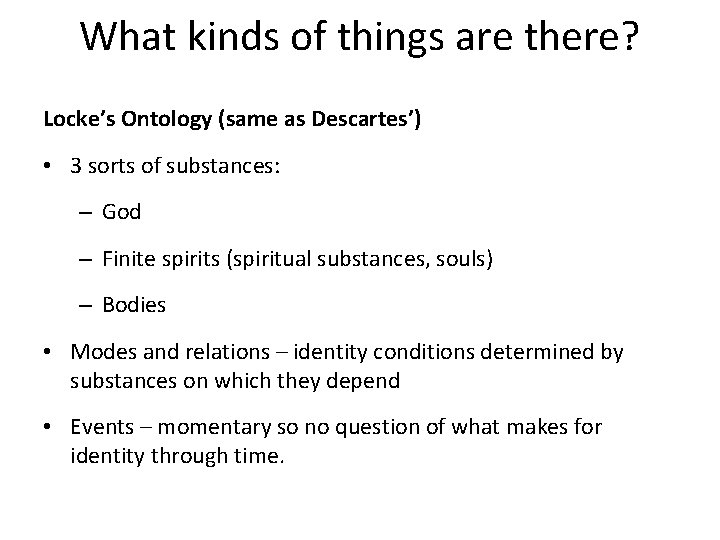
What kinds of things are there? Locke’s Ontology (same as Descartes’) • 3 sorts of substances: – God – Finite spirits (spiritual substances, souls) – Bodies • Modes and relations – identity conditions determined by substances on which they depend • Events – momentary so no question of what makes for identity through time.
Locke on Identity • A thing can’t occupy two different places at the same time so – One thing can’t have two beginnings; two things can’t have one beginning – But what about amoeba case (fission), and fusion? • Two things of the same kind can’t occupy the same s-t region – Couldn’t be distinguished if they did – But what about modal properties (statue and clay) • However, two things of different kinds can occupy the same place at the same time--and in fact do!
Sortals and Identity Criteria The complex idea we use when classifying a thing as being of a certain kind also determines what it is for a thing of that kind to continue in existence. (Essay II: xvii: 29) • Sortals are terms for these ideas that classify things by kind • To understand a sortal term, F, is precisely to understand how to trace Fs through space and time, at least in normal cases – Example: If I understand the sortal river I should be in principle able to determine whether different waters in which I step are both (spatial or temporal) parts of the River Cäyster
Sortals Convey Identity Criteria • Sortal: a +count noun that conveys identity criteria – Mass of matter, spirit, man and person are sortals that – convey different identity criteria • To understand our criterion for personal identity through time, we need to understand what it is to be a person • In ordinary cases persons and human beings coincide but • Locke’s puzzle cases pump the intuition that it ain’t necessarily so! – Person that isn’t human (The Rational Parrot) – Persons that don’t coincide through time with humans
Identity Conditions • Different kinds of substances can occupy the same place at the same time – e. g. an oak tree and the mass of matter that constitutes it • Substances of the same kind can’t occupy the same place at the same time • Mereological essentialism for masses of matter: can’t survive loss (or addition) or parts. • Organisms’ identity conditions allow loss, addition and gradual replacement of parts.
F-hood and F-identity • Locke argues that we get confused about persistence conditions for spatio-temporal objects because we literally don’t know what we’re talking about • At any given time, a spatio-temporal region may be occupied by different objects of different kinds – Example: an oak tree and the mass of matter that constitutes it – Example: a statue and the lump of clay of which it’s composed • To answer questions about an object’s identity we need to know which object, of those that overlap, we’re talking about
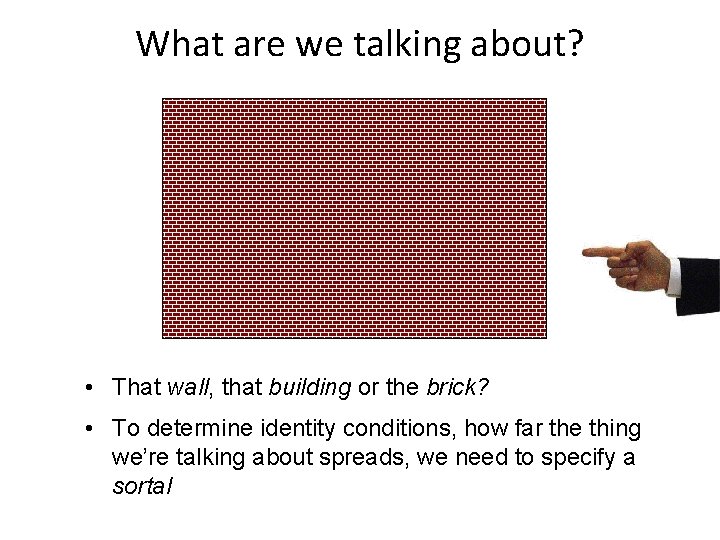
What are we talking about? • That wall, that building or the brick? • To determine identity conditions, how far the thing we’re talking about spreads, we need to specify a sortal
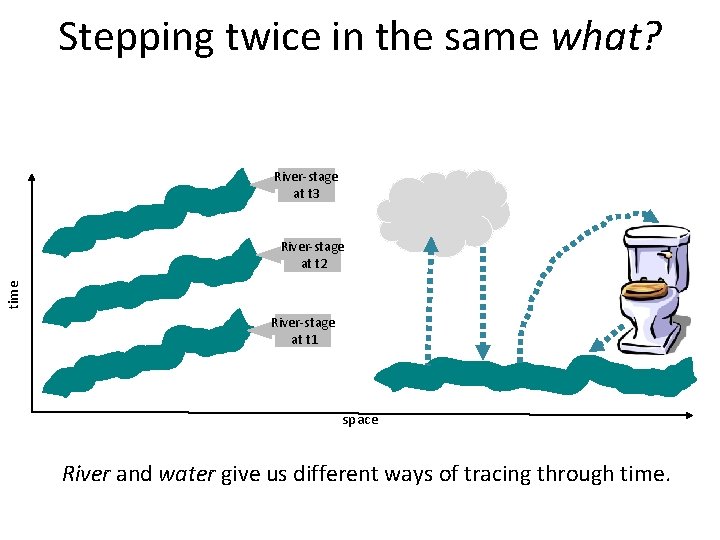
Stepping twice in the same what? River-stage at t 3 time River-stage at t 2 River-stage at t 1 space River and water give us different ways of tracing through time.
Person- vs Man- vs Soul-Identity • Person, human being (“man”) and soul (spirit or spiritual substance) convey different identity conditions. • Locke’s examples (section 6) to show this: – Same man/not same person: • Embryo is same man as developed human but not a person at all • Same man sane and insane not same person – Same soul/different man/different person: • Reincarnation conceivable: Socrates, Pilate, St. Augustine, Caesare Borgia
![Identity of Organisms [S]omething is one plant if it has an organization of parts](http://slidetodoc.com/presentation_image_h/321824351218e7f2c84660336c287084/image-22.jpg "Identity of Organisms [S]omething is one plant if it has an organization of parts")
Identity of Organisms [S]omething is one plant if it has an organization of parts in one cohering body partaking of one common life, and it continues to be the same plant as long as it partakes of the same life, even if that life is passed along to new particles of matter vitally united to the living plant, in a similar continued organization suitable for that sort of plants…An animal is a living organized body; and consequently the same animal…is the same continued life communicated to different particles of matter…the word ‘man’ as we use it stands for the idea of an animal of a certain form. • man (human being) = living homo sapiens organism • as distinct from person
Person not the same as Human Being • Man (Human Being): a living member of species homo sapiens; a particular kind of animal • Person: a thinking intelligent being that has reason and reflection and can consider itself as itself, the same thinking thing, in different times and places [Essay II: XXVII: 11] • Locke will argue that the concept of human being and person are different (since something can count as a person without being a human) and hence that • The persistence conditions (criteria for identity-through-time) for persons and human beings are different
![The Rational Parrot (Sec 6) [Prince Maurice told me] that he had heard of](http://slidetodoc.com/presentation_image_h/321824351218e7f2c84660336c287084/image-24.jpg "The Rational Parrot (Sec 6) [Prince Maurice told me] that he had heard of")
The Rational Parrot (Sec 6) [Prince Maurice told me] that he had heard of such an old parrot when he had been at Brazil; and though he believed nothing of it, and it was a good way off, yet he had so much curiosity as to send for it: that it was a very great and a very old one; and when it came first into the room where the prince was, with a great many Dutchmen about him, it said presently, What a company of white men are here! They asked it, what it thought that man was, pointing to the prince. It answered, Some General or other. When they brought it close to him, he asked it, D'ou venez-vous? It answered, De Marinnan. The Prince, A qui estes-vous? The Parrot, A un Portugais. The Prince, Que fais-tu la? Parrot, Je garde les poulles. The Prince laughed, and said, Vous gardez les poulles? The Parrot answered, Oui, moi; et je scai bien faire; and made the chuck four or five times that people use to make to chickens when they call them. I set down the words of this worthy dialogue in French, just as Prince Maurice said them to me. I asked him in what language the parrot spoke, and he said in Brazilian. I asked whether he understood Brazilian; he said No, but he had taken care to have two interpreters by him, the one a Dutchman that spoke Brazilian, and the other a Brazilian that spoke Dutch
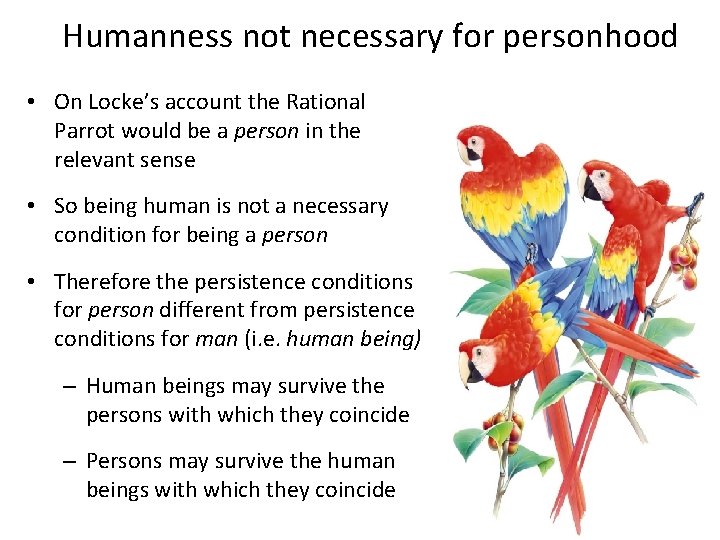
Humanness not necessary for personhood • On Locke’s account the Rational Parrot would be a person in the relevant sense • So being human is not a necessary condition for being a person • Therefore the persistence conditions for person different from persistence conditions for man (i. e. human being) – Human beings may survive the persons with which they coincide – Persons may survive the human beings with which they coincide
Personal identity distinguished from human being and soul identity THE IDENTITIES OF PERSONS
To Be a Person • Section 9: Personhood and Personal Persistence • Person: a thinking intelligent being, that has reason and reflection, and can consider itself as itself, the same thinking thing at different times and places. • Locke’s ‘Memory Criterion’ for personal identity-throughtime: [Consciousness] makes everyone to be what he calls ‘self’ and thereby distinguishes himself from all other thinking things; in this alone consists personal identity, i. e. the sameness of a rational being; and as far as this consciousness can be extended backwards to any past action or thought, so far reaches the identity of that person.
Persons are not substances • Locke’s Question Section 12: Can it be the same person if the substance changes? And Can it be different persons if the same substance does the thinking throughout? – Locke’s answers: Yes, and Yes. • Persons are neither material nor spiritual substances – NB: Locke first to appreciate that the mind-body problem and the problem of personal identity are distinct problems. • Personal identity is to (material or spiritual) substance identity as the identity of a living organism, consisting in the sameness of life or organization is to the identity of an organism (e. g. oak tree)
Locke’s Puzzle Cases • Intended to show – Same person different substance – Different person same substance • Criteria concern what is necessary so all we need is conceivability to show it isn’t, i. e. – Stories where we have same person, different substances – Stories where we have different person, same substance (spiritual or material)
Same Person/Different Substance • Section 10: The question of whether a person persists ‘is about what makes the same person, not whether the same identical substance always thinks in the same person. Different substances might all partake in a single consciousness’. • Section 13: If the thinking substance is changed, can it be the same person? • Depends on what is doing the thinking. • In fact it’s a spiritual substance that, at any time things, but could be otherwise, and could be that the same person ‘happened’ to different spiritual substances (my interpretation)
Different Persons/Same Substance • Reincarnation (Section 14): Yourself may once really have been the soul of…Thersites or Nestor. . . Can their actions have anything to do with you? • Resurrection (Section 15): Not same body, and sameness of soul not good enough to make you in the Resurrection World count as being responsible for pre-mortem actions. – Dryden on the Death of Mrs. Anne Kiligrew – Boyle’s worry about canibalism
Souls • BUT…Locke is not claiming that it’s the identity of “spiritual substance” that makes for personal identity either! • Section 16: Consciousness unites actions…I who write this am the same myself now. . . as I was yesterday, whether or not I consist of all the same substance, material or immaterial. • Puzzle cases intended to pull apart identity of substance, spiritual or material, from personal identity: – Substance identity not sufficient: the Day. Man/Night. Man – Substance identity not necessary: the fool who claimed to be the reincarnation of Socrates
Reincarnation? I once met with one, who was persuaded his had been the soul of Socrates…would anyone say, that he, being not conscious of any of Socrates’s actions or thoughts, could be the same person with Socrates? • If my soul is memory-zapped but recycled do I survive? • If my brain is memory-zapped but reprogrammed do I survive? • Locke argues that neither soul-identity nor bodily (or brain) identity is sufficient for personal identity • Or at least for what matters for survival
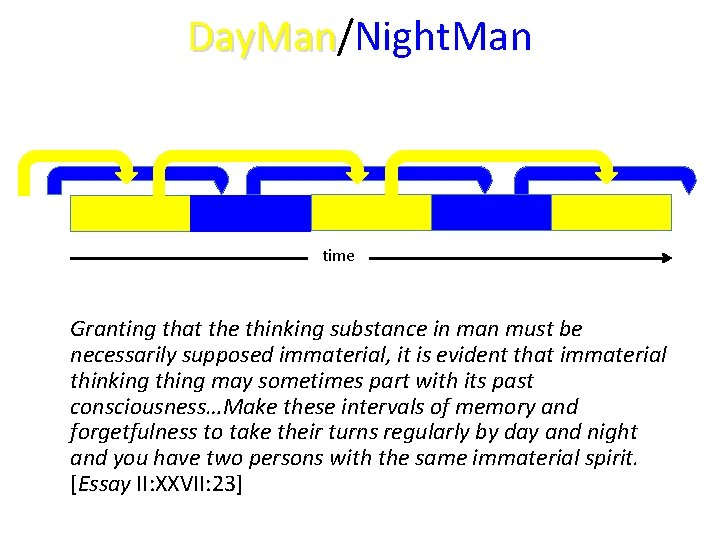
Day. Man/Night. Man Day. Man time Granting that the thinking substance in man must be necessarily supposed immaterial, it is evident that immaterial thinking thing may sometimes part with its past consciousness…Make these intervals of memory and forgetfulness to take their turns regularly by day and night and you have two persons with the same immaterial spirit. [Essay II: XXVII: 23]
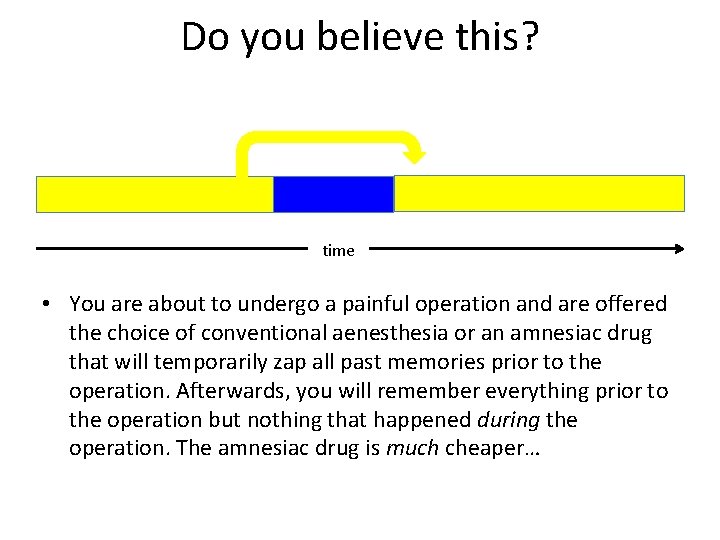
Do you believe this? time • You are about to undergo a painful operation and are offered the choice of conventional aenesthesia or an amnesiac drug that will temporarily zap all past memories prior to the operation. Afterwards, you will remember everything prior to the operation but nothing that happened during the operation. The amnesiac drug is much cheaper…
![Prince and Cobbler Body Exchange [S]hould the soul of a prince, carrying with it](http://slidetodoc.com/presentation_image_h/321824351218e7f2c84660336c287084/image-36.jpg "Prince and Cobbler Body Exchange [S]hould the soul of a prince, carrying with it")
Prince and Cobbler Body Exchange [S]hould the soul of a prince, carrying with it the consciousness of the prince’s past life, enter and inform the body of a cobbler, as soon as deserted by his own soul, every one sees he would be the same person with the prince, accountable only for the prince’s actions: bu who would say it was the same man? [Essay II: XXVII: 15] • Since the Rational Parrot case shows that being human isn’t the same thing as being a person there may be different identity criteria for human and person • Citing the Prince/Cobbler Body Exchange Case, Locke will argue that human being identity is neither necessary nor sufficient for personal identity
Substance and Bundle Theories • Descartes held that personal identity was determined by the sameness of substance—in particular of the spiritual substance underlying our thoughts and other experiences. • Locke argues for a bundle theory: our experiences are bound together as the same person in virtue of relations they bear to one another so: – sameness of substance is not sufficient for personal identity: different persons can occur to the same (spiritual or material) substances at different times (Day. Man/Night. Man) or at the same time (brain splits, etc. ) – sameness of substance is not necessary for personal identity: body exchange and resurrection are possible
Personhood, moral responsibility, and self-regarding concern PERSON AS A FORENSIC TERM
Moral and Legal Responsibility • Our understanding of moral and legal notions like ‘responsibility’ hang on our understanding of personal identity – We don’t hold people responsible for other people’s actions – We don’t reward or punish people for things that they didn’t do • So understanding the notion of responsibility and determining the legitimacy of reward and punishment assumes a proper understanding of personal identity
Consciousness and Culpability • Putative counterexample to Locke’s Memory Criterion • Section 22: You may want to object: ‘But isn’t a man drunk and sober the same person? Why else is he punished for what he does when drunk, even if he is never afterwards conscious of it? • Locke (biting the bullet): if he really doesn’t remember he isn’t responsible--but that’s not something we, or a court of law can determine. • God knows, and will sort things out in the Resurrection World
Resurrection World • In ordinary this-worldly cases we have no problem in principle determining whether we have the same person: fingerprints are good evidence and spatio-temporal continuity settles it – So in this-worldly cases this is evidence of who’s responsible for an action and so who deserves reward or punishment • In a Resurrection World we wouldn’t have spatio-temporal continuity • According to Locke spatio-temporal continuity isn’t necessary for personal identity so • Resurrected individuals may be the same persons as pre-mortem individuals—and so responsible for their actions and worthy of reward or punishment in virtue of consciousness extending to premortem persons!
The problem of personal identity and the mind-body problem, though related, should not be conflated. ------John Perry
- Slides: 42