
The problem of induction A scandal What is
The problem of induction A scandal
What is the relation between Theory and Evidence?
Empiricism vs rationalism • Rationalism (Descartes, Leibniz) • Human minds contain, as innate ideas, the necessary traits to reveal natural laws. • Empiricism (Locke, Hume) • Human mind is tabula rasa there are no innate ideas in the mind
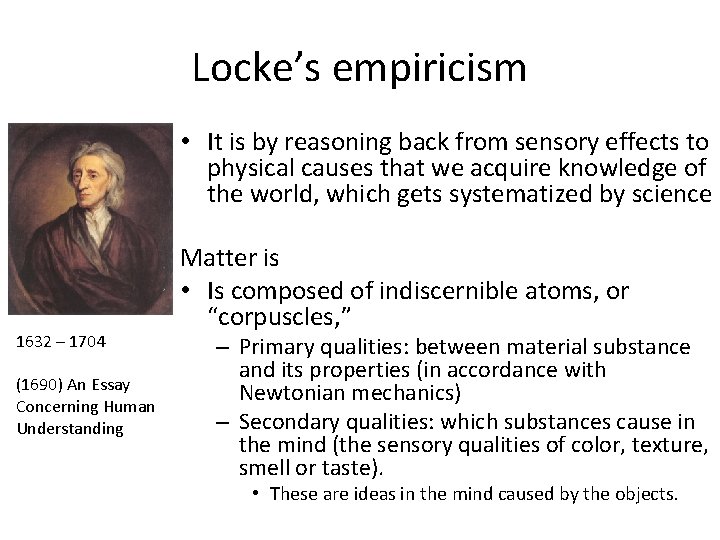
Locke’s empiricism • It is by reasoning back from sensory effects to physical causes that we acquire knowledge of the world, which gets systematized by science 1632 – 1704 (1690) An Essay Concerning Human Understanding Matter is • Is composed of indiscernible atoms, or “corpuscles, ” – Primary qualities: between material substance and its properties (in accordance with Newtonian mechanics) – Secondary qualities: which substances cause in the mind (the sensory qualities of color, texture, smell or taste). • These are ideas in the mind caused by the objects.
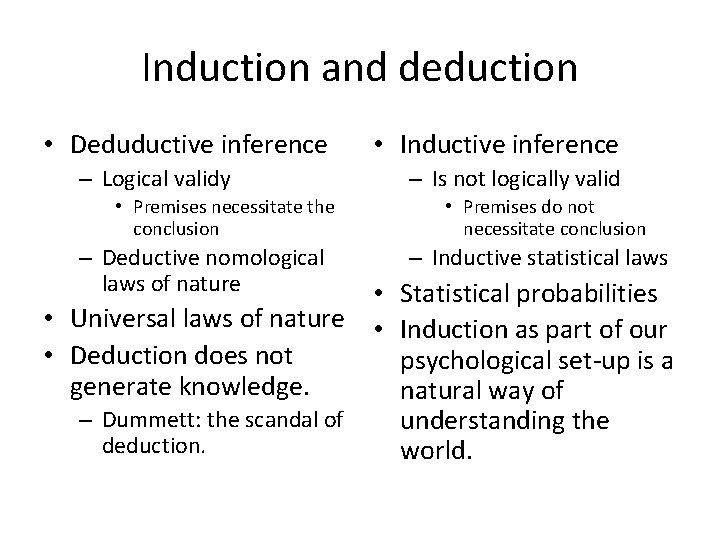
Induction and deduction • Deduductive inference – Logical validy • Premises necessitate the conclusion – Deductive nomological laws of nature • Inductive inference – Is not logically valid • Premises do not necessitate conclusion – Inductive statistical laws • Statistical probabilities • Universal laws of nature • Induction as part of our • Deduction does not psychological set-up is a generate knowledge. natural way of – Dummett: the scandal of understanding the deduction. world.
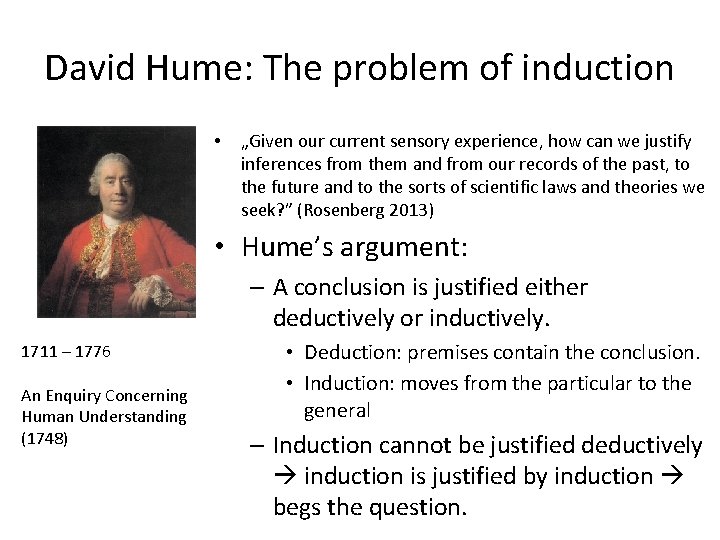
David Hume: The problem of induction • „Given our current sensory experience, how can we justify inferences from them and from our records of the past, to the future and to the sorts of scientific laws and theories we seek? ” (Rosenberg 2013) • Hume’s argument: – A conclusion is justified either deductively or inductively. 1711 – 1776 An Enquiry Concerning Human Understanding (1748) • Deduction: premises contain the conclusion. • Induction: moves from the particular to the general – Induction cannot be justified deductively induction is justified by induction begs the question.
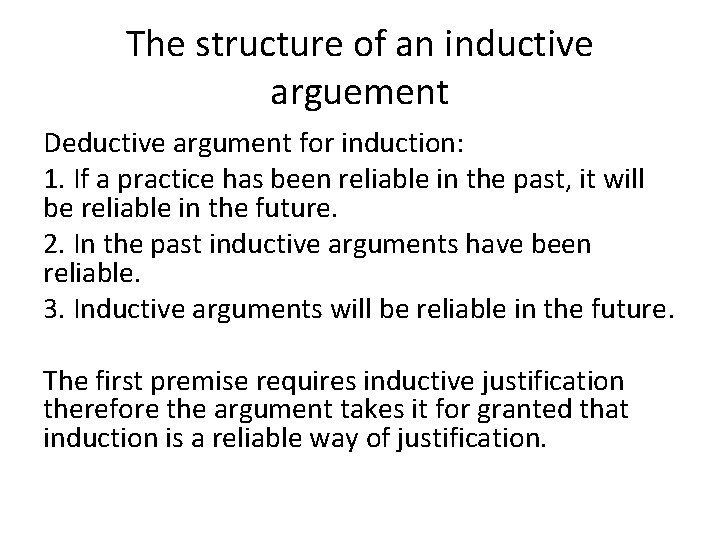
The structure of an inductive arguement Deductive argument for induction: 1. If a practice has been reliable in the past, it will be reliable in the future. 2. In the past inductive arguments have been reliable. 3. Inductive arguments will be reliable in the future. The first premise requires inductive justification therefore the argument takes it for granted that induction is a reliable way of justification.
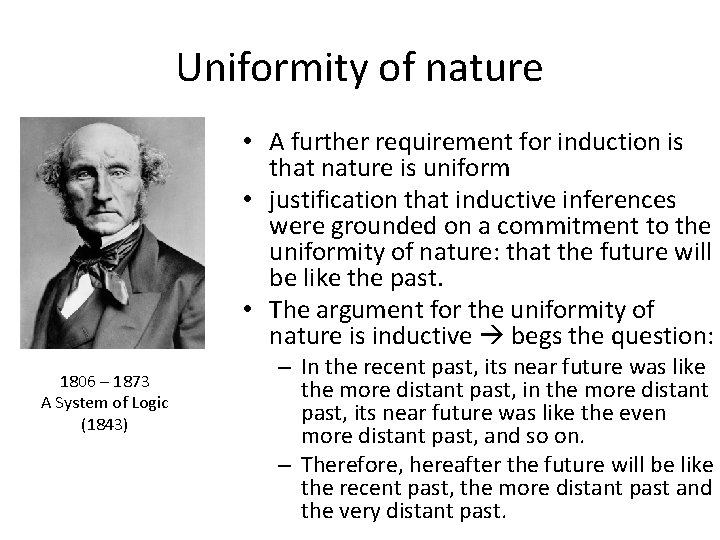
Uniformity of nature • A further requirement for induction is that nature is uniform • justification that inductive inferences were grounded on a commitment to the uniformity of nature: that the future will be like the past. • The argument for the uniformity of nature is inductive begs the question: 1806 – 1873 A System of Logic (1843) – In the recent past, its near future was like the more distant past, in the more distant past, its near future was like the even more distant past, and so on. – Therefore, hereafter the future will be like the recent past, the more distant past and the very distant past.
Confirmation, corroboration instead of justification • Rudolph Carnap and Carl G. Hempel Inductive argument turns out to be deductive argument that employs special rules that confer justification on their conclusions without guaranteeing their truth (unlike the laws of deductive logic which did so). • statements scientists use to describe the data or evidence to which the rules are applied – a rigid logical structure and a – wholly observational vocabulary
- Slides: 9