
The Problem Addition of algebraic fractions What have

The Problem Addition of algebraic fractions
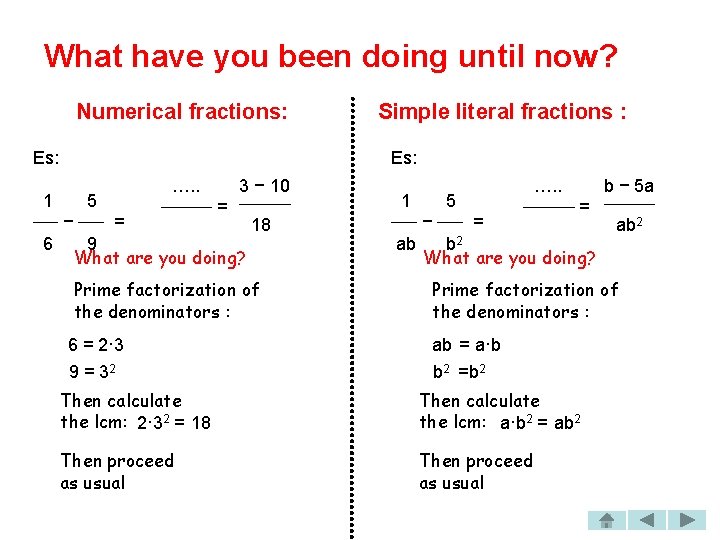
What have you been doing until now? Numerical fractions: Es: Simple literal fractions : Es: …. . 3 − 10 ──── = ──── 18 1 5 ── − ── = 6 9 What are you doing? …. . b − 5 a ──── = ──── ab 2 1 5 ── − ── = ab b 2 What are you doing? Prime factorization of the denominators : 6 = 2· 3 ab = a·b 9 = 32 b 2 =b 2 Then calculate the lcm: 2· 32 = 18 Then calculate the lcm: a·b 2 = ab 2 Then proceed as usual
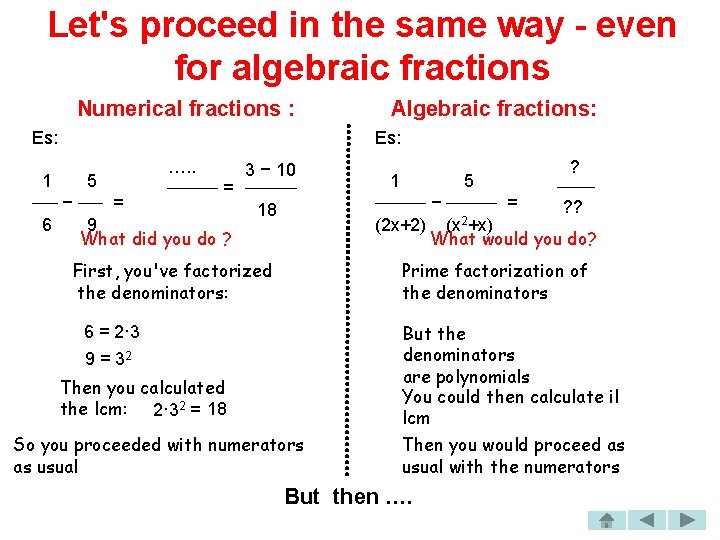
Let's proceed in the same way - even for algebraic fractions Numerical fractions : Algebraic fractions: Es: …. . 3 − 10 1 5 ──── = ──── ── − ── = 18 6 9 What did you do ? ? 1 5 ──── − ──── = ? ? 2 (2 x+2) (x +x) What would you do? First, you've factorized the denominators: Prime factorization of the denominators 6 = 2· 3 9 = 32 Then you calculated the lcm: 2· 32 = 18 So you proceeded with numerators as usual But the denominators are polynomials You could then calculate il lcm Then you would proceed as usual with the numerators But then ….
But then … THE PROBLEM HAS CHANGED : How do you do it? ?
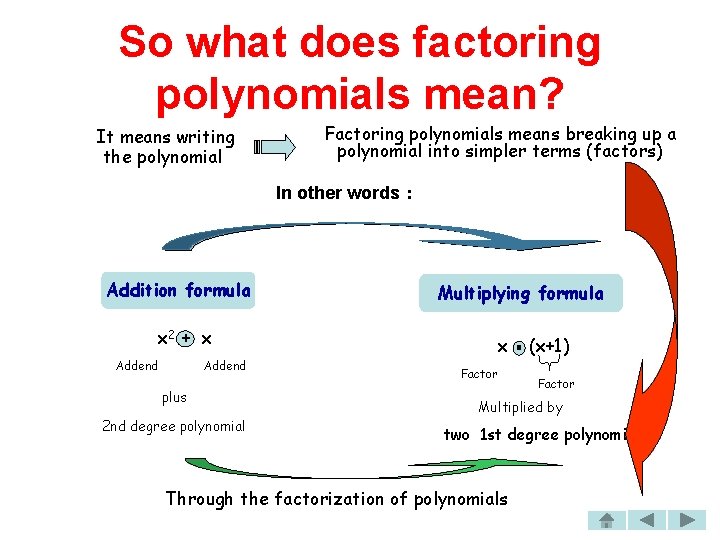
So what does factoring polynomials mean? It means writing the polynomial Factoring polynomials means breaking up a polynomial into simpler terms (factors) In other words : Addition formula x 2 + x Addend plus 2 nd degree polynomial Multiplying formula x Factor (x+1) Factor Multiplied by two 1 st degree polynomials Through the factorization of polynomials
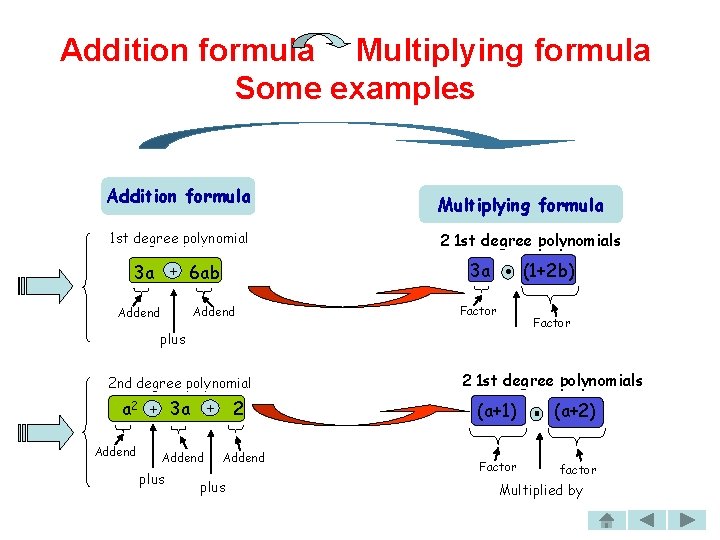
e Addition formula Multiplying formula Some examples Addition formula 1 st degree polynomial 3 a + 2 1 st degree polynomials 3 a 6 ab Addend Multiplying formula (1+2 b) Factor plus 2 nd degree polynomial a 2 Addend 3 a + Addend plus 2 1 st degree polynomials (a+1) (a+2) Factor factor Multiplied by
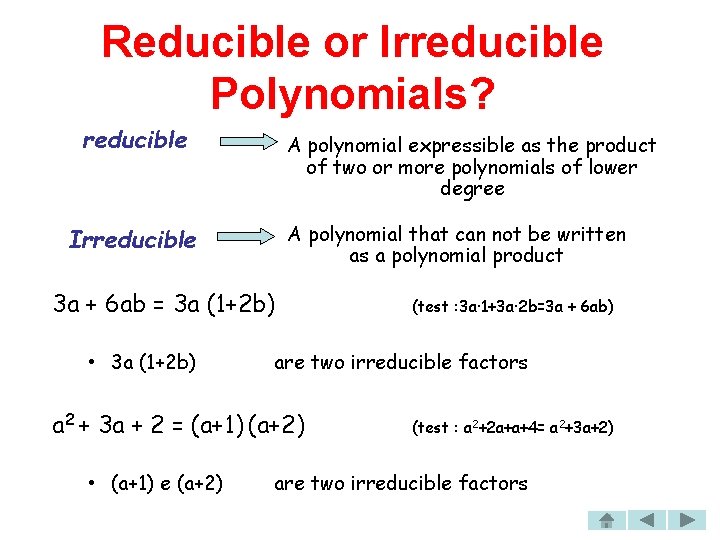
Reducible or Irreducible Polynomials? reducible A polynomial expressible as the product of two or more polynomials of lower degree A polynomial that can not be written as a polynomial product Irreducible 3 a + 6 ab = 3 a (1+2 b) • 3 a (1+2 b) are two irreducible factors a 2 + 3 a + 2 = (a+1) (a+2) • (a+1) e (a+2) (test : 3 a∙ 1+3 a∙ 2 b=3 a + 6 ab) (test : a 2+2 a+a+4= a 2+3 a+2) are two irreducible factors
How is a polynomial factorized? How will you realize it the problem of factorization has become much more complex. By working with numbers the difficulties arise when they deal with numbers "fairly large", instead when working with polynomials you may encounter considerable difficulties even when we consider polynomials of "small" grade Why does this happen? Because there are no rules that allow, in general, to find the factorization of a polynomial So how do we do it? First of all : DO NOT PANIC! Go ahead and find out!!!!
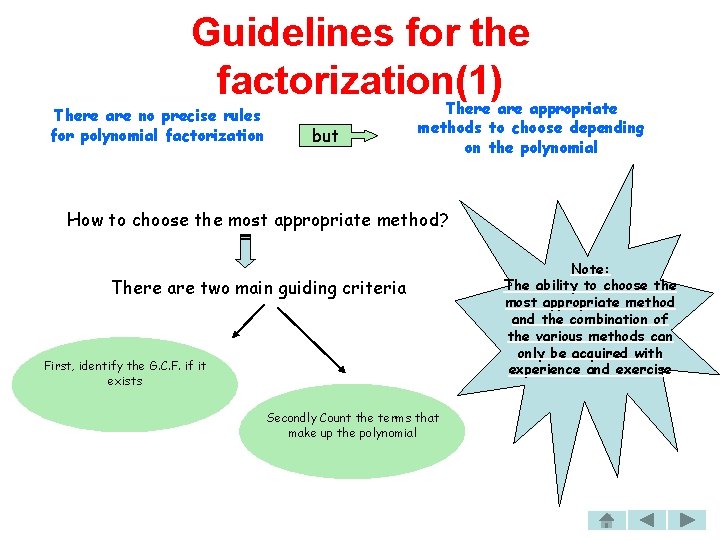
Guidelines for the factorization(1) There are no precise rules for polynomial factorization but There appropriate methods to choose depending on the polynomial How to choose the most appropriate method? There are two main guiding criteria First, identify the G. C. F. if it exists Secondly Count the terms that make up the polynomial Note: The ability to choose the most appropriate method and the combination of the various methods can only be acquired with experience and exercise
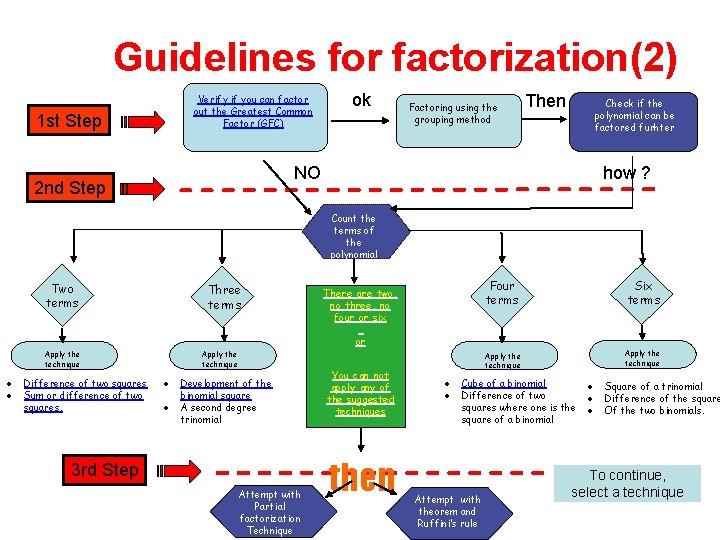
Guidelines for factorization(2) Verify if you can factor out the Greatest Common Factor (GFC) 1 st Step ok Factoring using the grouping method Then Check if the polynomial can be factored furhter NO 2 nd Step how ? Count the terms of the polynomial Two terms Three terms Apply the technique Difference of two squares Sum or difference of two squares. Apply the technique Development of the binomial square A second degree trinomial 3 rd Step Attempt with Partial factorization Technique Four terms Six terms Applica Apply la the tecnica technique There are two, no three, no four or six or You can not apply any of the suggested techniques then Cube of a binomial Difference of two squares where one is the square of a binomial Attempt with theorem and Ruffini’s rule Square of a trinomial Difference of the square Of the two binomials. To continue, select a technique
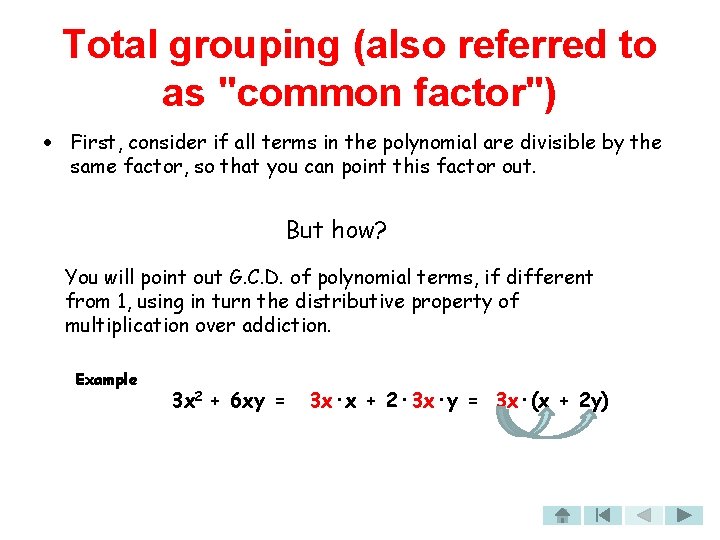
Total grouping (also referred to as "common factor") First, consider if all terms in the polynomial are divisible by the same factor, so that you can point this factor out. But how? You will point out G. C. D. of polynomial terms, if different from 1, using in turn the distributive property of multiplication over addiction. Example 3 x 2 + 6 xy = 3 x∙x + 2∙ 3 x∙y = 3 x∙(x + 2 y)
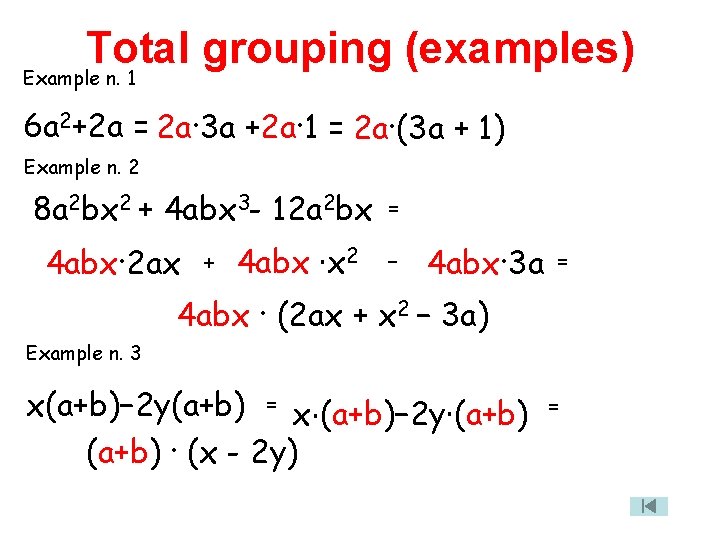
Total grouping (examples) Example n. 1 6 a 2+2 a = 2 a∙ 3 a +2 a∙ 1 = 2 a∙(3 a + 1) Example n. 2 8 a 2 bx 2 + 4 abx 3 - 12 a 2 bx 4 abx∙ 2 ax + 4 abx ∙x 2 = − 4 abx∙ 3 a = 4 abx ∙ (2 ax + x 2 − 3 a) Example n. 3 x(a+b)− 2 y(a+b) = x·(a+b)− 2 y∙(a+b) ∙ (x - 2 y) =
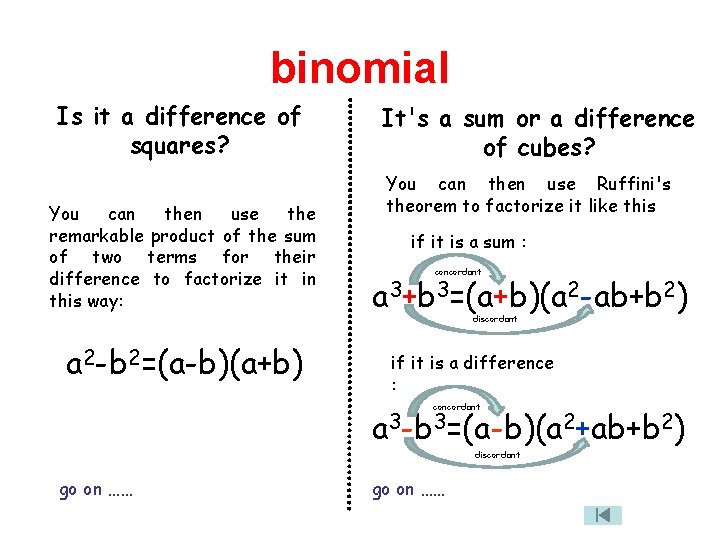
binomial Is it a difference of squares? You can then use the remarkable product of the sum of two terms for their difference to factorize it in this way: a 2 -b 2=(a-b)(a+b) It's a sum or a difference of cubes? You can then use Ruffini's theorem to factorize it like this if it is a sum : concordant a 3+b 3=(a+b)(a 2 -ab+b 2) discordant if it is a difference : concordant a 3 -b 3=(a-b)(a 2+ab+b 2) discordant go on ……
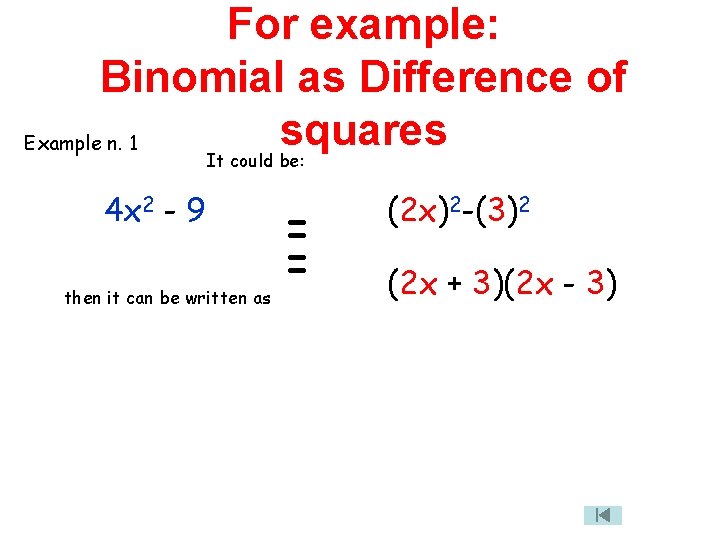
For example: Binomial as Difference of squares Example n. 1 It could be: 4 x 2 - 9 then it can be written as = = (2 x)2 -(3)2 (2 x + 3)(2 x - 3)
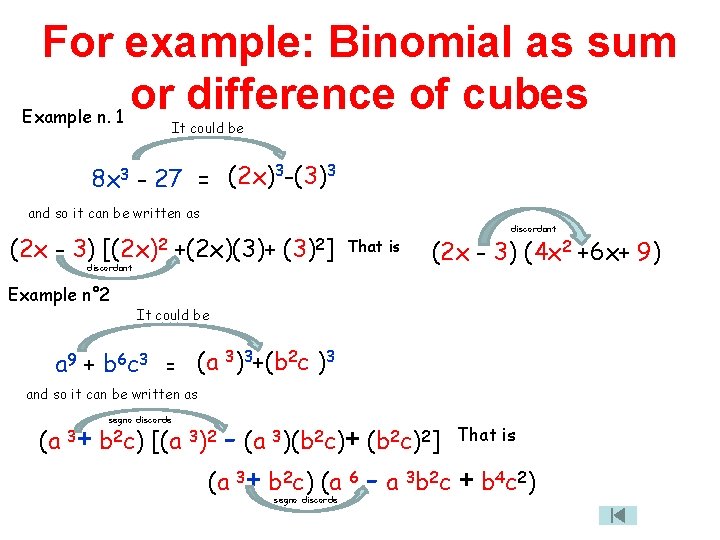
For example: Binomial as sum or difference of cubes Example n. 1 It could be 8 x 3 - 27 = (2 x)3 -(3)3 and so it can be written as (2 x - 3) [(2 x)2 +(2 x)(3)+ (3)2] discordant Example n° 2 That is discordant (2 x - 3) (4 x 2 +6 x+ 9) It could be a 9 + b 6 c 3 = (a 3)3+(b 2 c )3 and so it can be written as segno discorde (a 3+ b 2 c) [(a 3)2 - (a 3)(b 2 c)+ (b 2 c)2] That is (a 3+ b 2 c) (a 6 - a 3 b 2 c + b 4 c 2) segno discorde
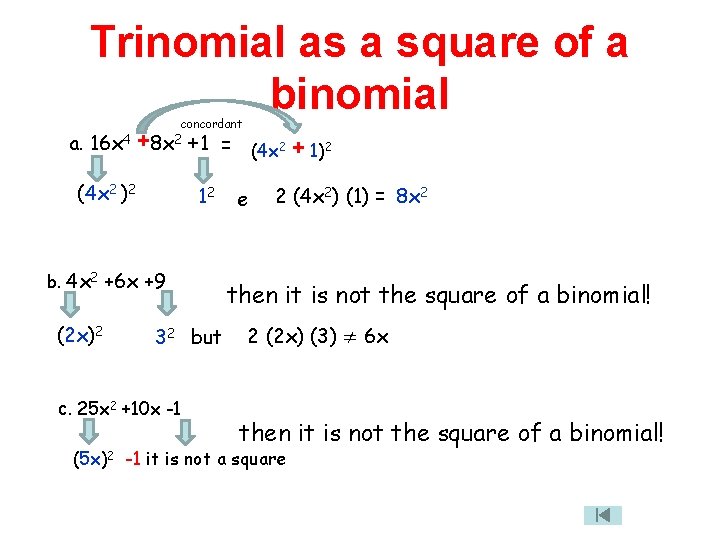
Trinomial as a square of a binomial concordant a. 16 x 4 +8 x 2 +1 = (4 x 2 + 1)2 (4 x 2 )2 12 b. 4 x 2 +6 x +9 (2 x)2 32 but c. 25 x 2 +10 x -1 e 2 (4 x 2) (1) = 8 x 2 then it is not the square of a binomial! 2 (2 x) (3) ≠ 6 x then it is not the square of a binomial! (5 x)2 -1 it is not a square
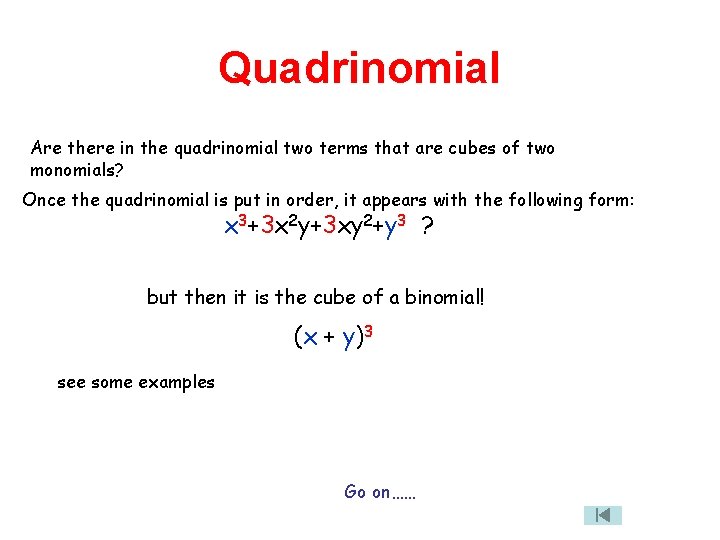
Quadrinomial Are there in the quadrinomial two terms that are cubes of two monomials? Once the quadrinomial is put in order, it appears with the following form: x 3+3 x 2 y+3 xy 2+y 3 ? but then it is the cube of a binomial! (x + y)3 see some examples Go on……
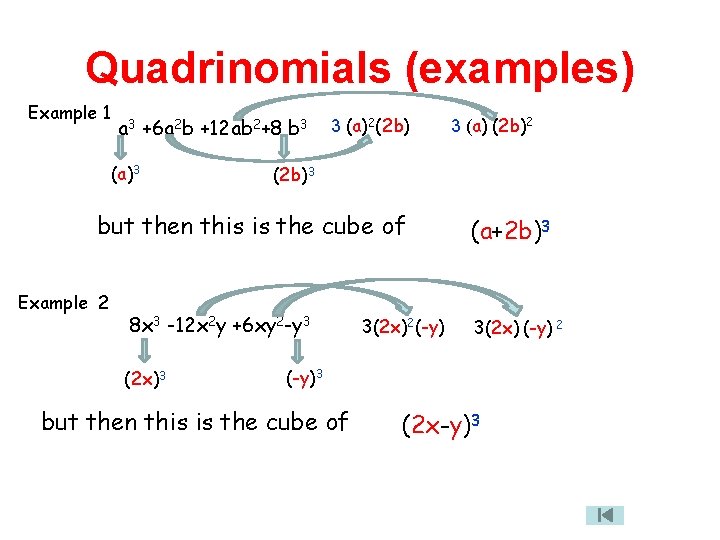
Quadrinomials (examples) Example 1 a 3 +6 a 2 b +12 ab 2+8 b 3 (a)3 3 (a)2(2 b)3 but then this is the cube of Example 2 8 x 3 -12 x 2 y +6 xy 2 -y 3 (2 x)3 3 (a) (2 b)2 3(2 x)2(-y) (a+2 b)3 3(2 x) (-y) 2 (-y)3 but then this is the cube of (2 x-y)3
- Slides: 19