
The Privatization Of Education In Malaysia Advantages Disadvantages


- Slides: 22
The Privatization Of Education In Malaysia : Advantages & Disadvantages
U C A T I O N S t a r t e d i n � I t N h M e
� Until the 1980 s, the Malaysian government was the main provider of higher education � Government kept tuition fees low by heavily subsidizing all public institutions. � The government offers scholarships and loans to low-income students. � Student enrollments at the tertiary level have risen dramatically in the past decade.
� � The ministry faced with tight budgetary constraints in meeting the ever-increasing demand for higher education. State has to relinquish its role as the main provider of higher education Pressing the private sector to set up independent higher education institutions. In 1998, five public universities were given greater institutional autonomy to generate revenue through research contracts, consulting, business ventures with industry, and other forms of investment.
S t a t e R o l � � Private higher education has expanded tremendously 1996, the Private Higher Educational Institutions Act was passed Government regulatory control powers over all private education institutions in the country. 1997, the National Accreditation Board was created to formulate policies on standards and quality control
� � The state has attempted to give higher education a Malaysian identity. All institutions must offer required courses in Malaysian studies, Islamic studies (for Muslim students), and moral education (for non-Muslim students). 1996, the government established the National Council on Higher Education Function: to plan, formulate, and determine national policies and strategies and oversee both the public and private sectors
� � Government would like the private sector to complement and supplement the efforts of the public sector and has sought to steer the private sector toward providing more vocational and technical education. There has been a gradual shift from state control toward state supervision in the relationship between the Malaysian government and higher education.
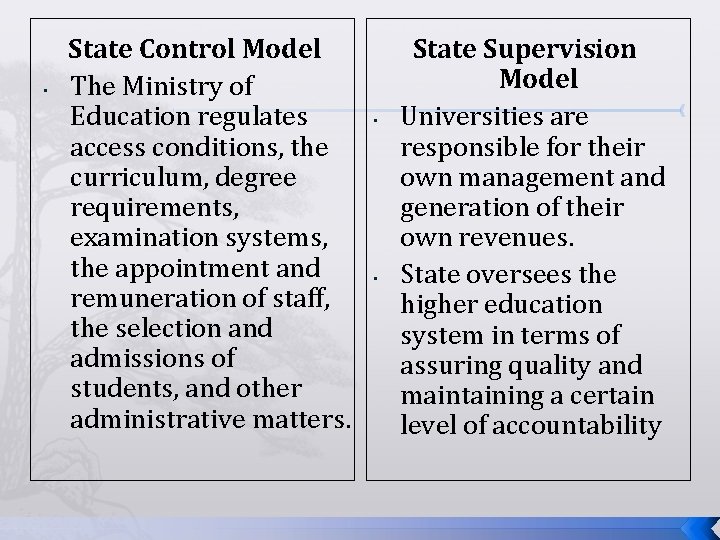
• State Control Model The Ministry of Education regulates access conditions, the curriculum, degree requirements, examination systems, the appointment and remuneration of staff, the selection and admissions of students, and other administrative matters. • • State Supervision Model Universities are responsible for their own management and generation of their own revenues. State oversees the higher education system in terms of assuring quality and maintaining a certain level of accountability
Types of private education institutions: � � � Private kindergartens which adopt the Preschool National Curriculum of the Ministry of Education, Malaysia Private primary and secondary schools which adhere to the National Curriculum and the proposed assessments Private religious schools which use the National Curriculum
� � � Chinese private schools which follow the Ministry of Education guidelines Expatriate schools International schools Tuition centres which provide learning assistance to students according to the National Curriculum Language centres, computer training centres, skills/commerce centres, correspondence schools, etc
Example of related Institution Privatization � � � � International college Unitar Lim Kok Wing Institute HELP institute Unisel Shahputra Lagenda � � � PTPL Cosmopoint Uni. KL Stanford College KDU
PRIVATISATION IN EDUCATION ADVANTAGES lower cost to obtain a foreign degree – by enrolling in a twinning program More references from the main university Different study climate – values - competitiveness - self-efficiency - motivation - language
� � � � The shift is from central state control to market-based policies, which will increase the range of choices for students and address the needs of an increasingly complex social order The Malaysian state will still maintain a central steering role to ensure equity access, consumer advocacy, and national identity, which are broader social and cultural goals that transcend the market. Sought to create the conditions for ‘national unity’ by reducing inter-ethnic disparities. Develop and improve utilities and other infrastructure. Provide the public better services. Changing the status of the institution. Promote competition, improve efficiency and increase productivity.
DISADVANTAGES � � � Complete transfer of ownership and control of a government institution. Burden people especially if charges or fees are raised for privatized services. Implications of 2 sets of services : can afford privatized services. � cannot afford –continue rely on public services. � � Increased costs of living and poorer services and utilities especially in remote and rural areas.
Issue: Privatization & Corporatization � � Upon completion of their diplomas, the students can proceed to the degree "twinning" programmes in collaboration with foreign universities. Finally, these students will be graduating with foreign degrees without having to leave the country. Besides the relatively lower tuition fees in Malaysia, this possibility of proceeding to the degree course is a "selling point" for most private colleges wishing to attract students from the Asia Pacific region.
What is the relative tuition cost of private tertiary education compared to a public one? � � � A three-year undergraduate programme at one of the public universities costs about RM 1, 400 per year in tuition fees (which is 13% of the actual cost) whereas… It costs about RM 30, 000 to complete a 4 -year IT degree at the UNITAR, from RM 8, 000 to RM 13, 000 per year for an engineering degree at Multimedia University (The Star, July 18, 1999) and RM 12, 000 at the UNITEN (e-mail comm. ). One can expect to pay much more to study for a Monash degree at its Sunway campus.
� � All these go to show the extent of subsidization (87%) at Malaysian public universities. Following corporatization, Vice Chancellors in Malaysia have been directed by the Education Ministry NOT to increase tuition fees to local students, as the government has promised the general public that tuition fees remain unchanged after corporatization.
� � A private college enables its students to apply for loans from the National Higher Education Fund Corporation According to one claim, private colleges will have to pay between RM 70, 000 -RM 1 million in accreditation fees depending on the number of courses a college offers per campus operated. If a college has three campuses, it pays three time.
Aggressive Advertisement A KDU ad says the college wants to "make you somebody. " It also claims (perhaps rightly) that it is a pioneer in American university transfer programme. � Kolej Komuniti Mertajam boasts that it is the first government approved private college in Penang. RIMA College in Penang capitalizes on the fact that they are offering "a part-time American degree for busy people. " �
� � � Silicon Institute of Technology proudly promises to offer an Honours degree in engineering and computing in three years after the SPM. HELP Institute says that theirs is "more than just a degree-it's an American experience. " Taylor's College, which is twinning with, among others, Sheffield university, warns that it's not easy to be top engineers and financiers-you have to be prepared for a tough life as an engineering student on its campus.
Law and Order � � � It is advertisements such as this that the 1996 Act tries to regulate. Article 75 states: Any person who makes a false or misleading statement in promoting a private higher educational institution shall be guilty of an offence and shall, on conviction, be liable to a fine not exceeding RM 50, 000 or to imprisonment for a term not exceeding six months or to both. Three years after SPM (eleven years of schooling) is indeed a short-cut way to a degree. The Ministry of Education has recently determined that 3 ½ years is the bare minimum. Some colleges aren't too happy about the new directive. (The Star, August 29, 1999).
S I O N …. . � The actual achievements may have had more to do with organizational, managerial and incentive reforms, which do not require privatization as a precondition. While there are undoubtedly been many improvements in the quality of services provided, user costs have generally risen disproportionately higher, with obvious adverse and distributional implications.