
The principles of integration were formulated independently by

The principles of integration were formulated independently by Isaac Newton and Gottfried Leibniz in the late 17 th century.
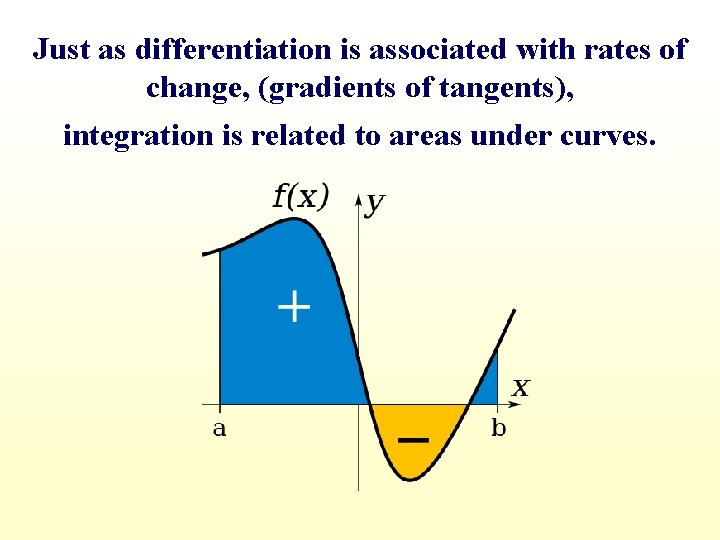
Just as differentiation is associated with rates of change, (gradients of tangents), integration is related to areas under curves.

Integrating is the opposite of differentiating, so: differentiate But : integrate differentiate integrate Integrating 6 x…. . . . which function do we get back
The So when derivative we reverse of anythe constant process, isie 0 integrate, there is no way to know if there was a constant in the original expression or what it was. Constant of Integration …………+ C is always added and more information is needed before it can be determined
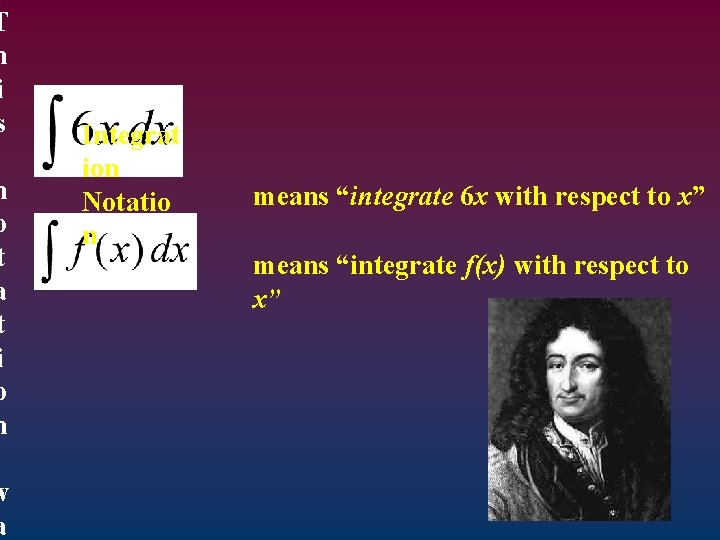
T h i s n o t a t i o n w a Integrat ion Notatio n means “integrate 6 x with respect to x” means “integrate f(x) with respect to x”
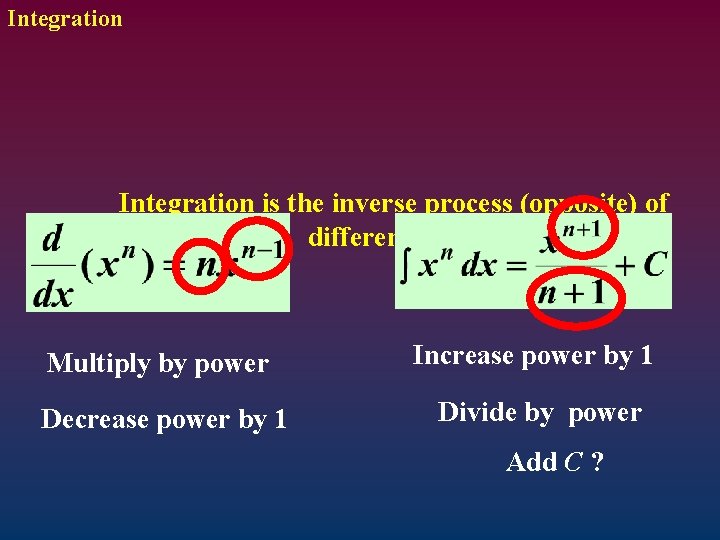
Integration is the inverse process (opposite) of differentiation Differentiating Integrating Multiply by power Increase power by 1 Decrease power by 1 Divide by power Add C ?
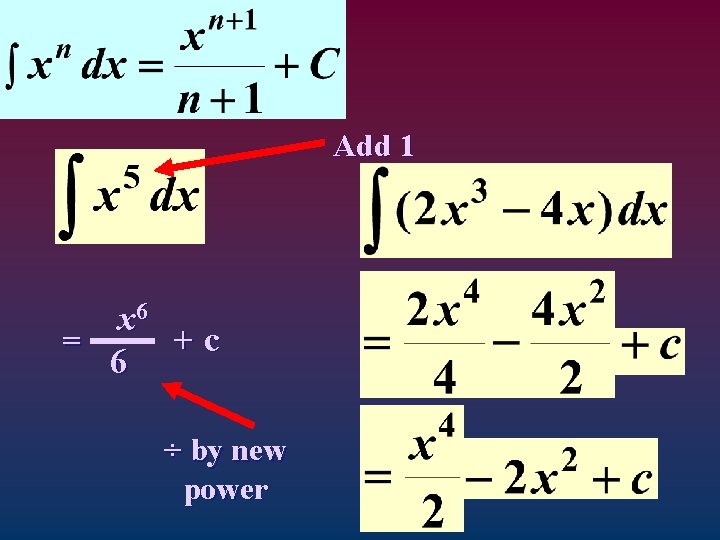
Add 1 x 6 +c = 6 ÷ by new power
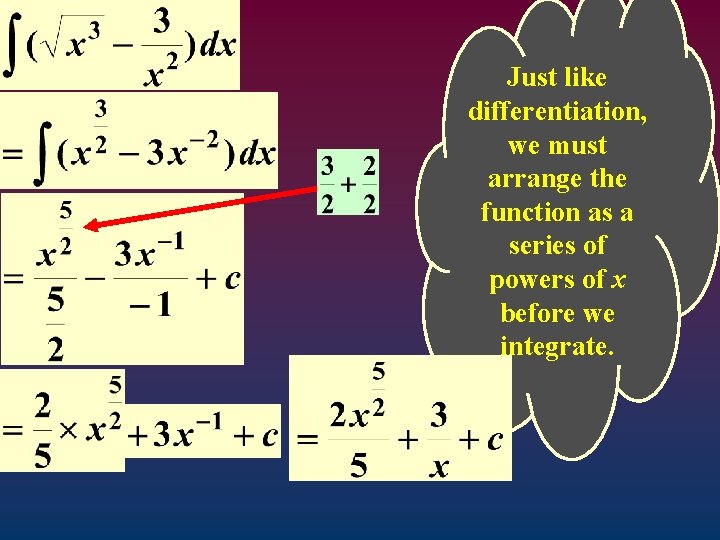
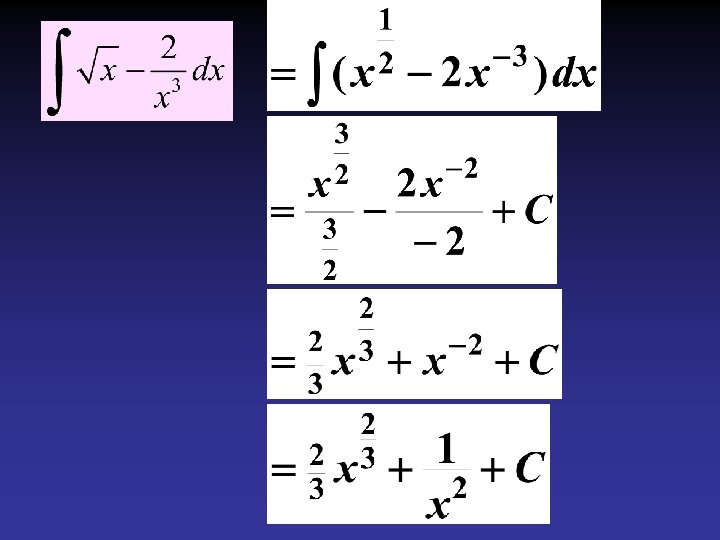
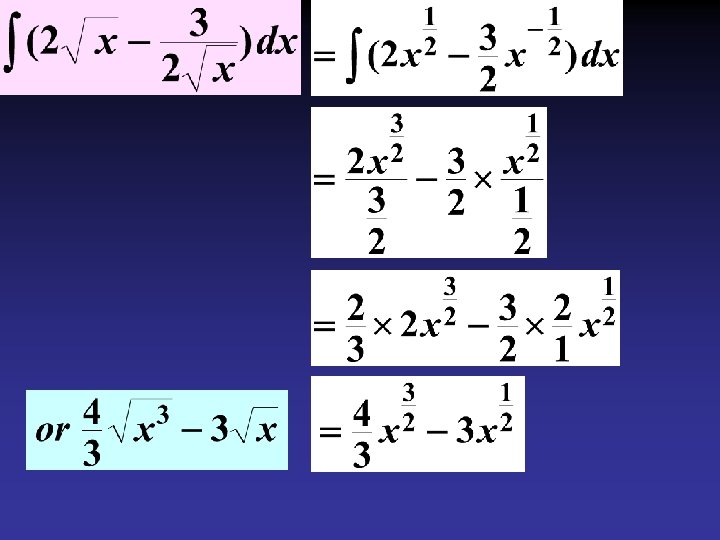
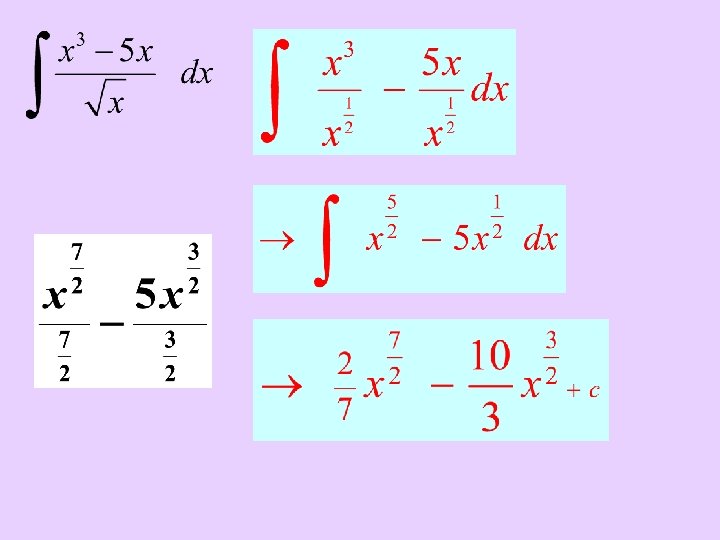
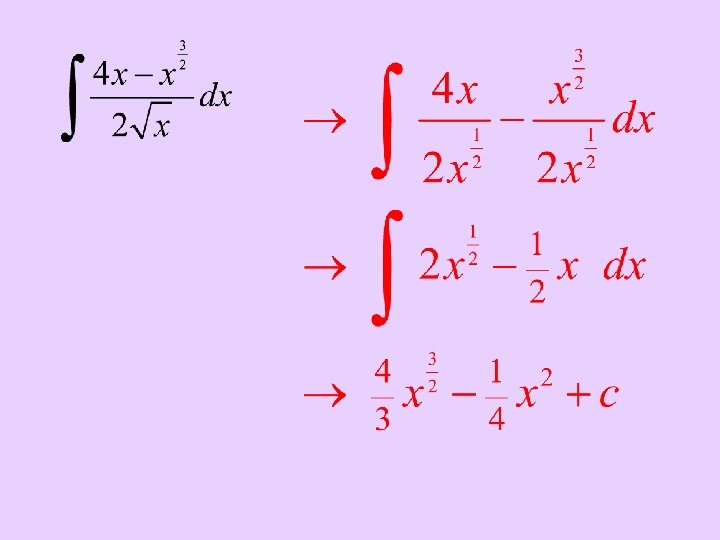
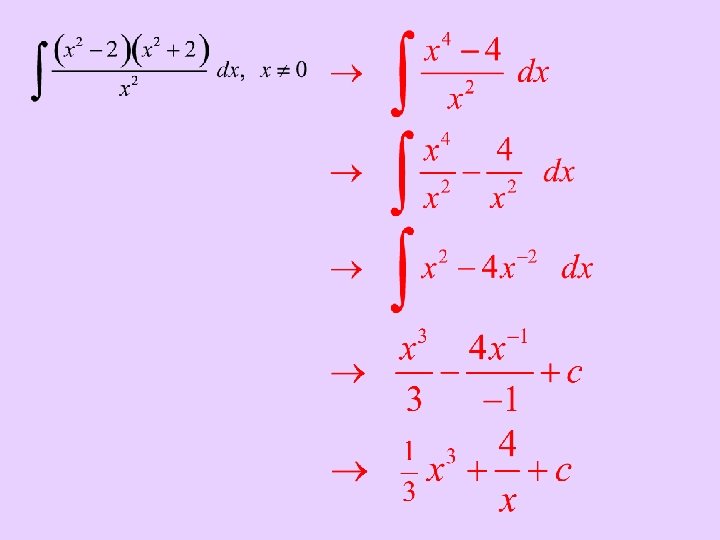
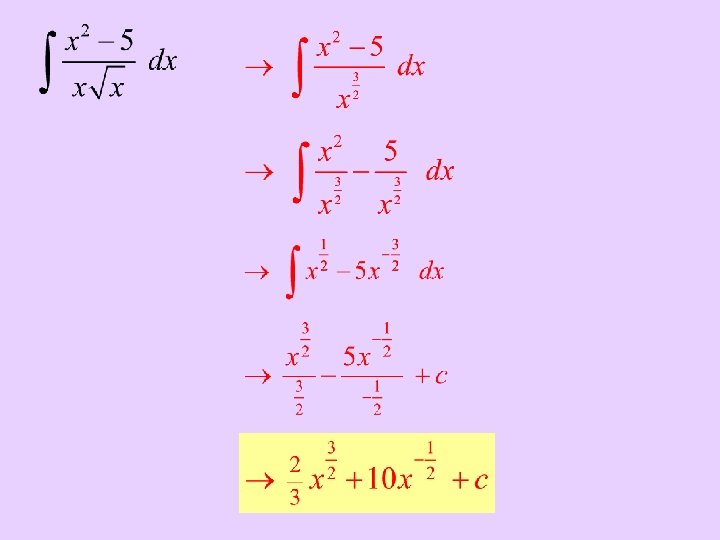
Just like differentiation, we must arrange the function as a series of powers of x before we integrate.
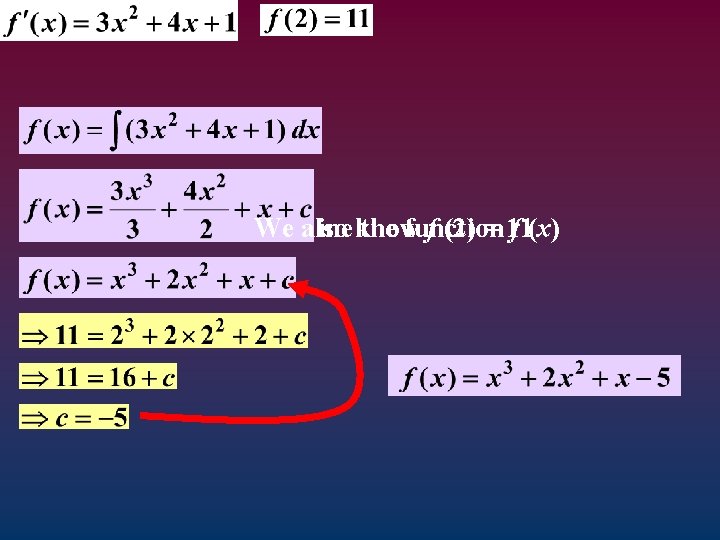
Determine We also know the function f (2) = 11 f (x)
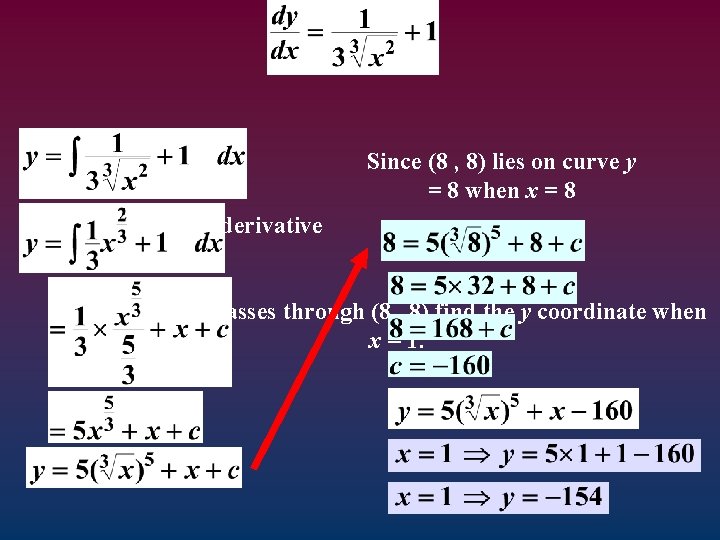
Since (8 , 8) lies on curve y = 8 when x = 8 A curve has a derivative Given that y passes through (8 , 8) find the y coordinate when x = 1.
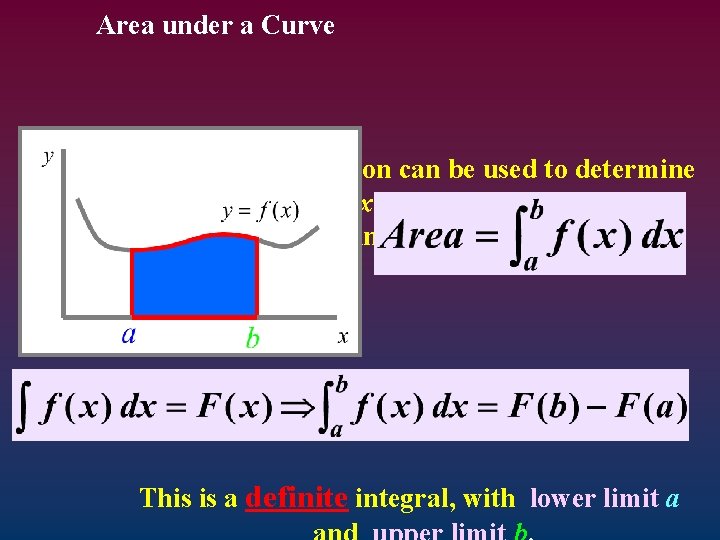
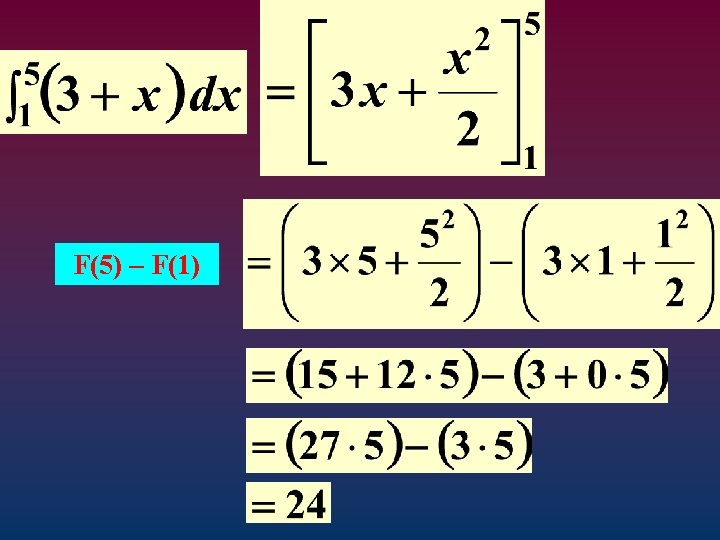
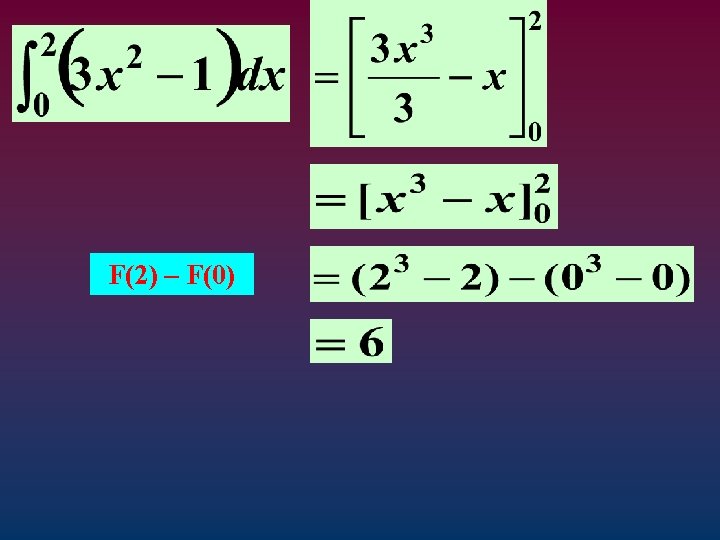
Area under a Curve The integral of a function can be used to determine the area between the x-axis and the graph of the function. This is a definite integral, with lower limit a
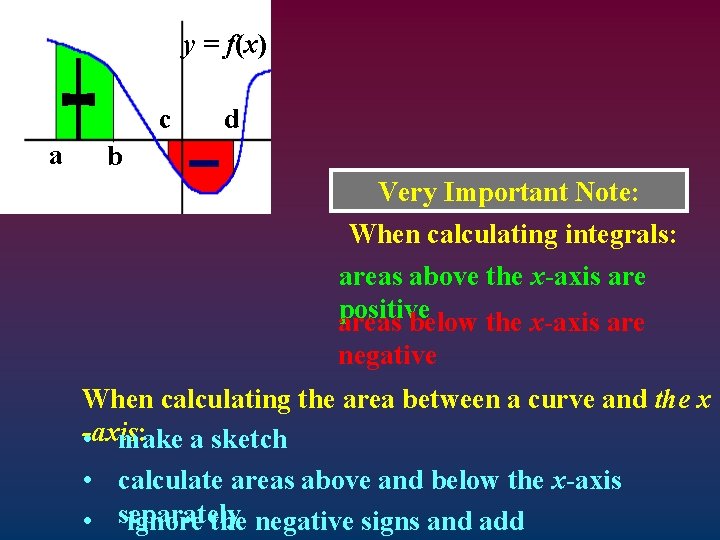
y = f(x) c a d b Very Important Note: When calculating integrals: areas above the x-axis are positive areas below the x-axis are negative When calculating the area between a curve and the x • -axis: make a sketch • calculate areas above and below the x-axis • separately ignore the negative signs and add
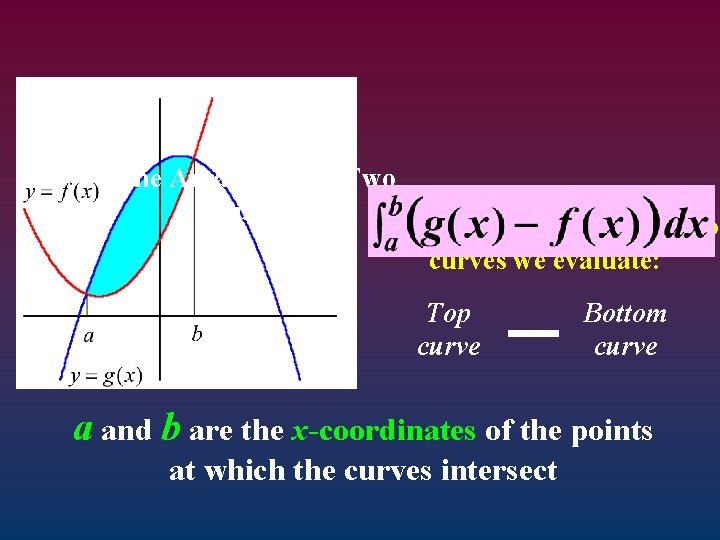
The Area Between Two Curves To find the area between two curves we evaluate: Top curve Bottom curve a and b are the x-coordinates of the points at which the curves intersect
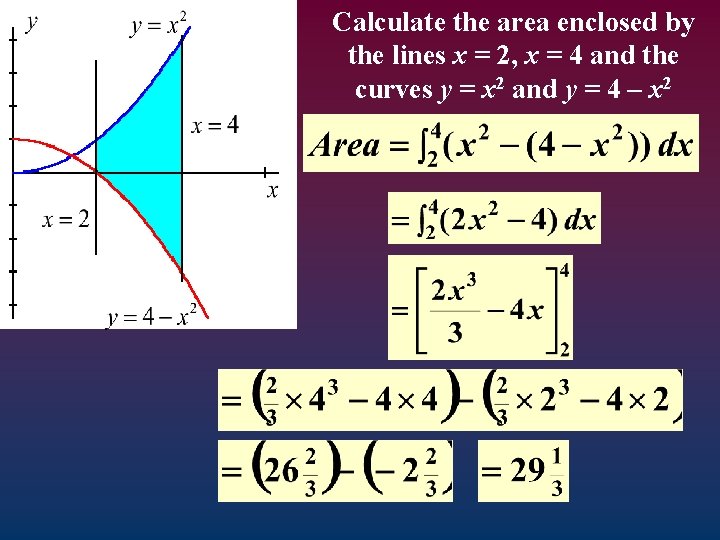
Calculate the area enclosed by the lines x = 2, x = 4 and the curves y = x 2 and y = 4 – x 2
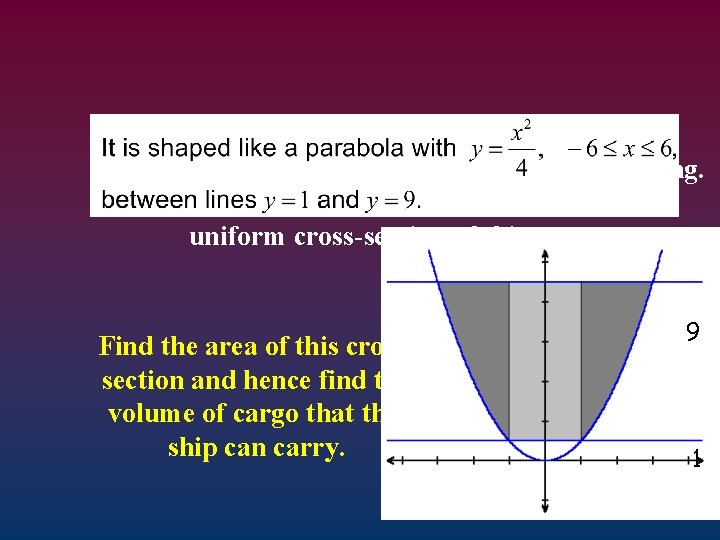
The cargo space of a small bulk carrier is 60 m long. The shaded part of the diagram represents the uniform cross-section of this space. Find the area of this crosssection and hence find the volume of cargo that this ship can carry. 9 1
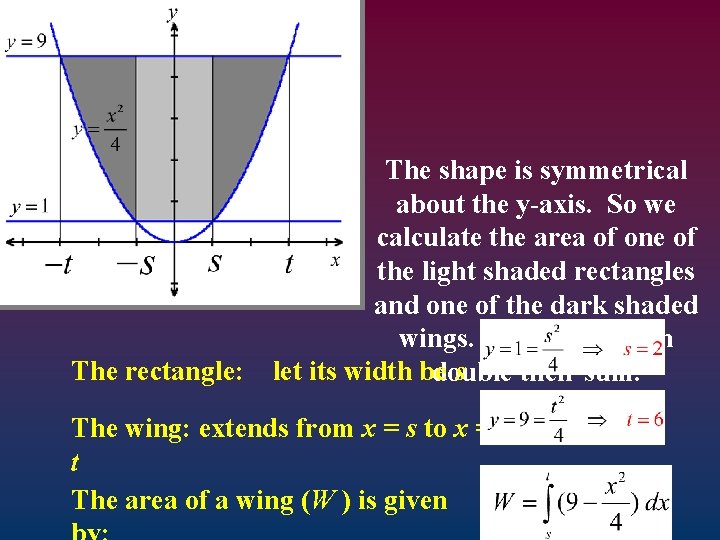
The rectangle: The shape is symmetrical about the y-axis. So we calculate the area of one of the light shaded rectangles and one of the dark shaded wings. The area is then let its width be s double their sum. The wing: extends from x = s to x = t The area of a wing (W ) is given
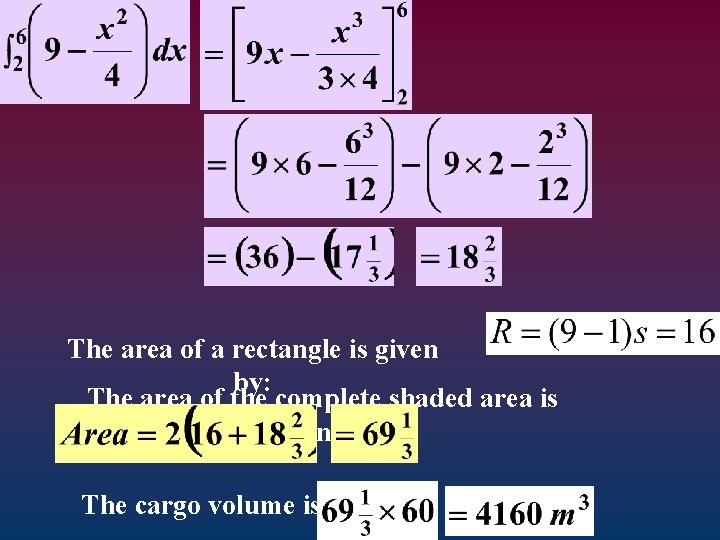
The area of a rectangle is given by: The area of the complete shaded area is given by: The cargo volume is:
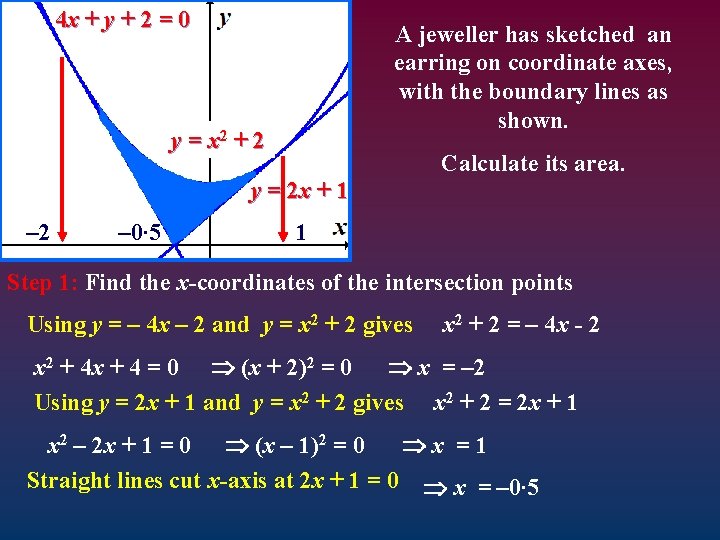
4 x + y + 2 = 0 A jeweller has sketched an earring on coordinate axes, with the boundary lines as shown. y = x 2 + 2 y = 2 x + 1 – 2 – 0∙ 5 Calculate its area. 1 Step 1: Find the x-coordinates of the intersection points Using y = – 4 x – 2 and y = x 2 + 2 gives x 2 + 2 = – 4 x - 2 x 2 + 4 x + 4 = 0 (x + 2)2 = 0 x = – 2 Using y = 2 x + 1 and y = x 2 + 2 gives x 2 + 2 = 2 x + 1 x 2 – 2 x + 1 = 0 (x – 1)2 = 0 x =1 Straight lines cut x-axis at 2 x + 1 = 0 x = – 0∙ 5
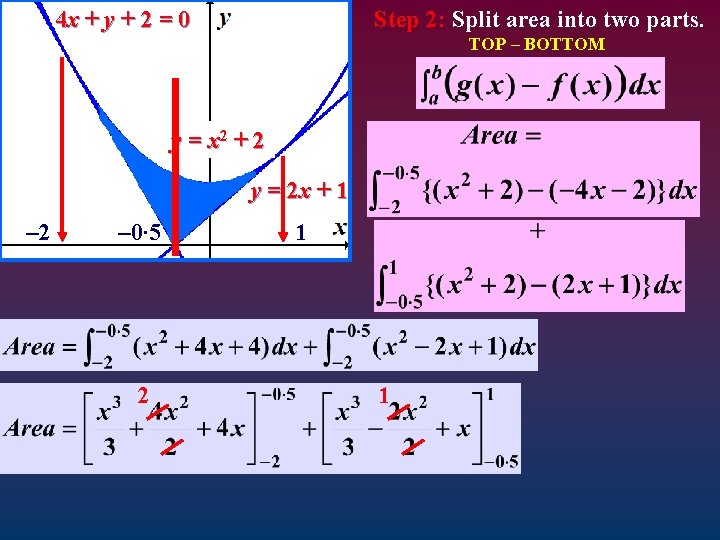
Step 2: Split area into two parts. 4 x + y + 2 = 0 TOP – BOTTOM y = x 2 + 2 y = 2 x + 1 – 2 – 0∙ 5 2 1 1
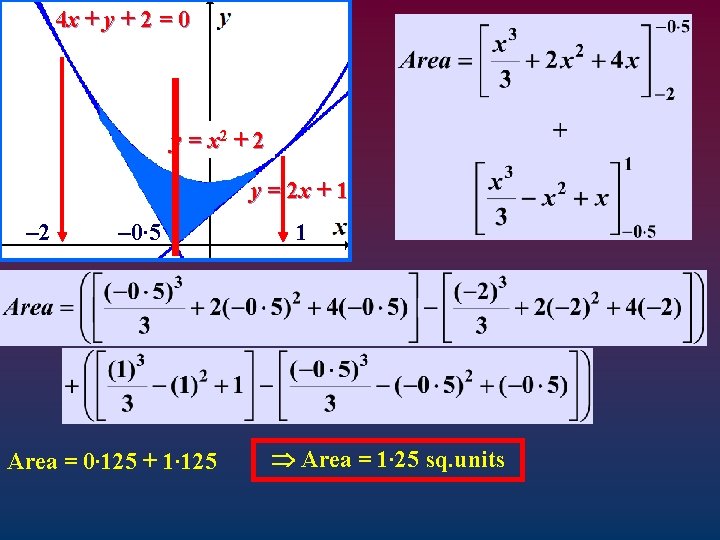
4 x + y + 2 = 0 y = x 2 + 2 y = 2 x + 1 – 2 – 0∙ 5 Area = 0∙ 125 + 1∙ 125 1 Area = 1∙ 25 sq. units

Questions from Past Papers
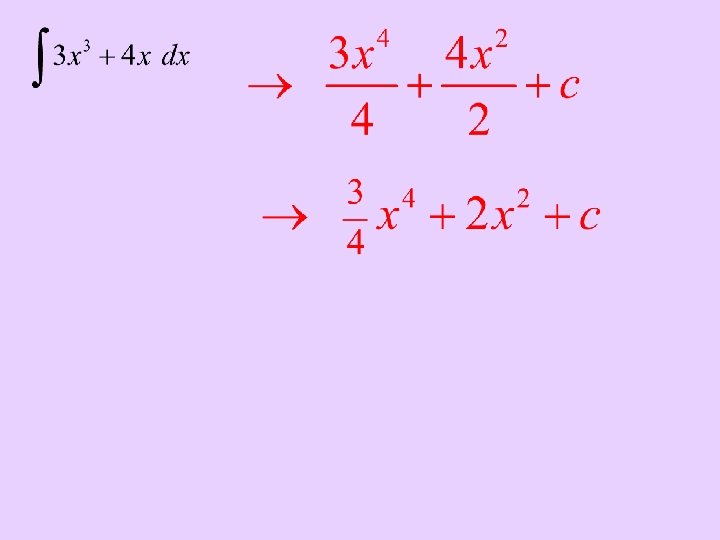
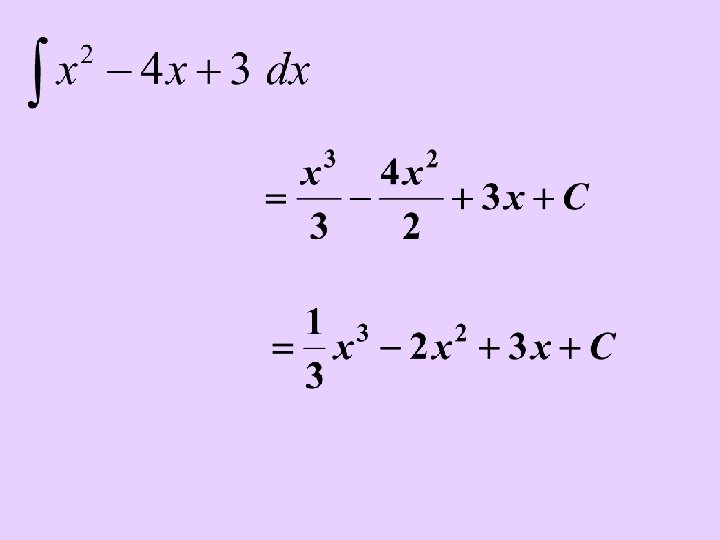
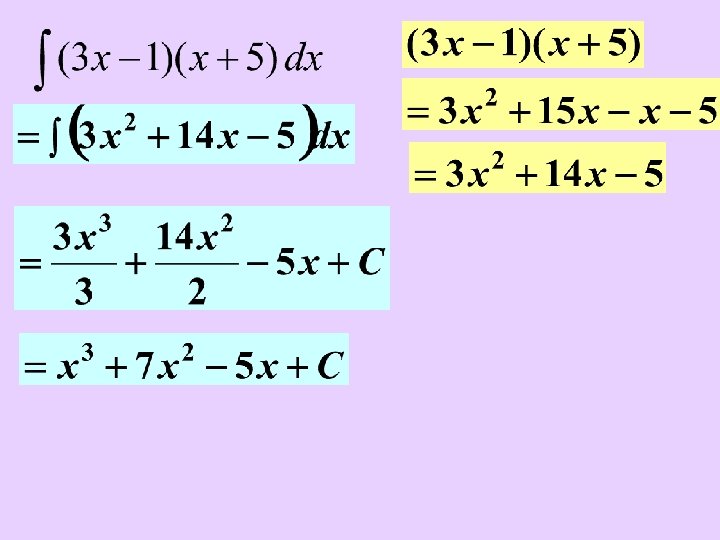
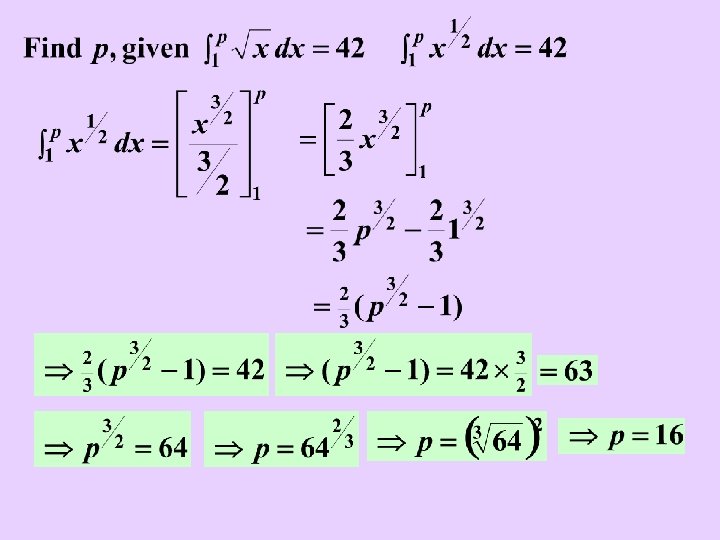
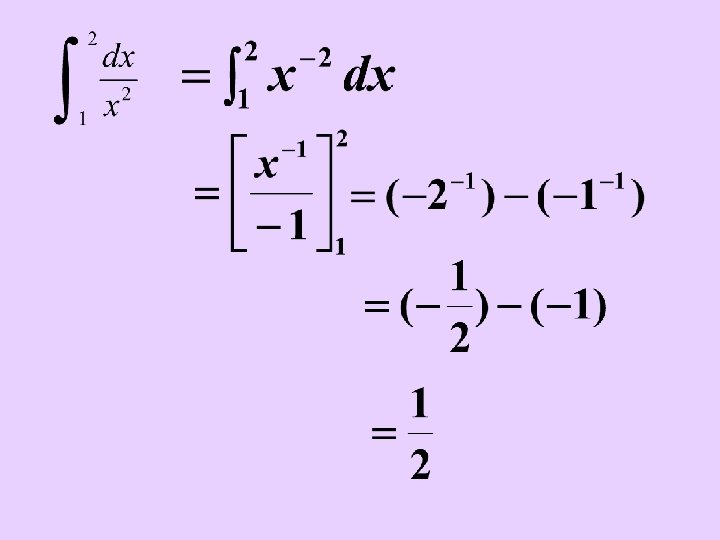
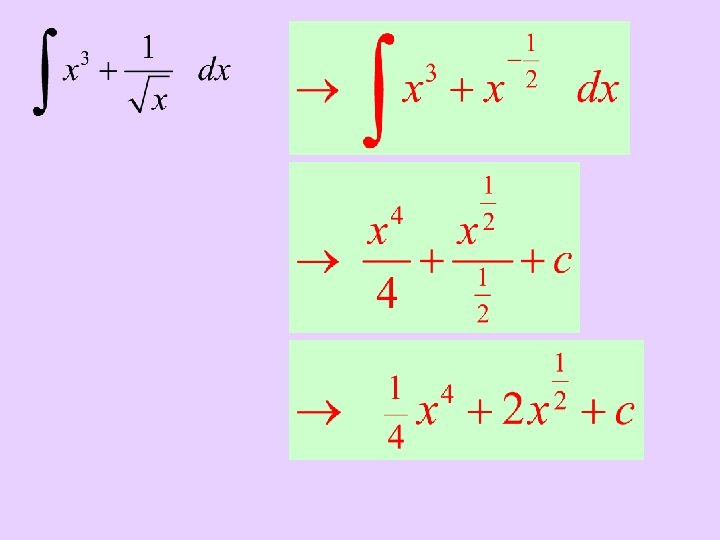
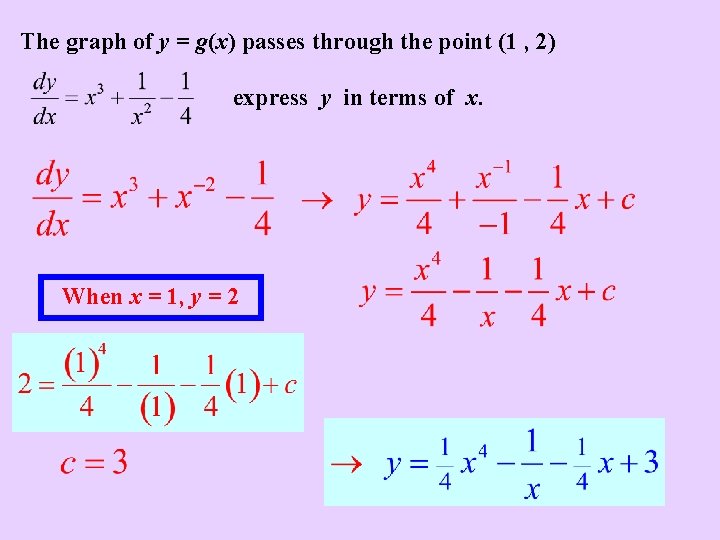
The graph of y = g(x) passes through the point (1 , 2) express y in terms of x. When x = 1, y = 2
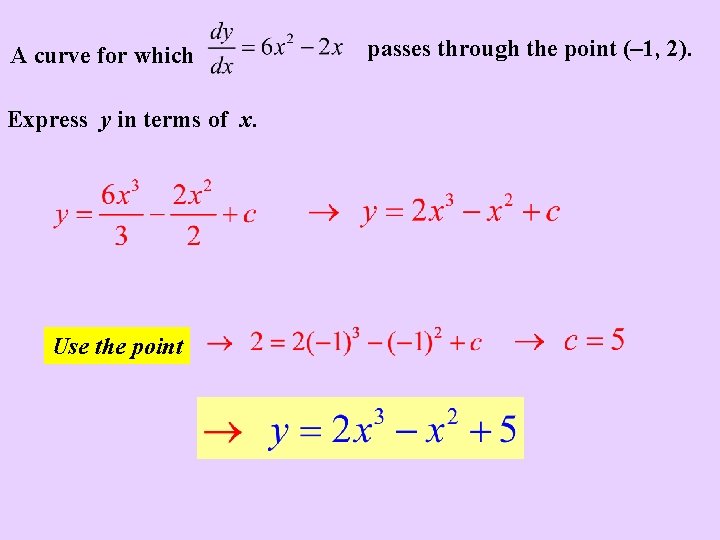
A curve for which Express y in terms of x. Use the point passes through the point (– 1, 2).
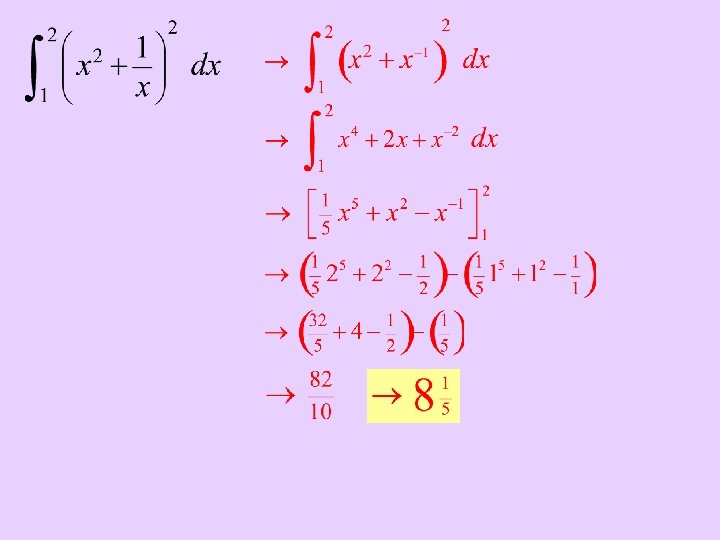

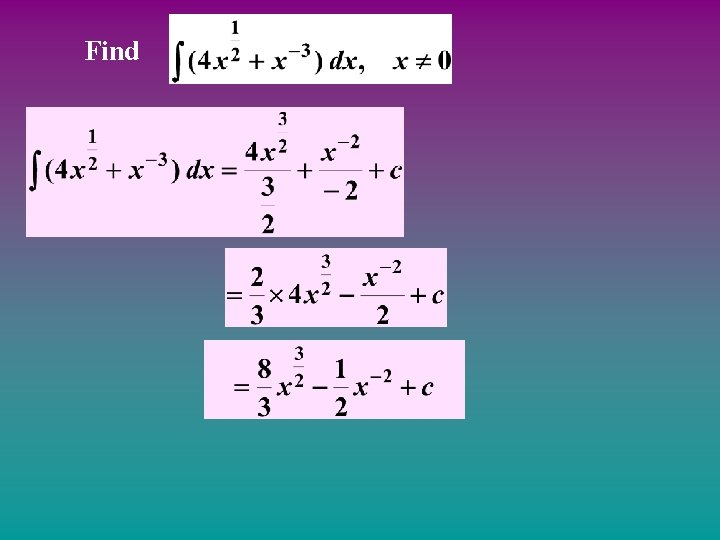
Find
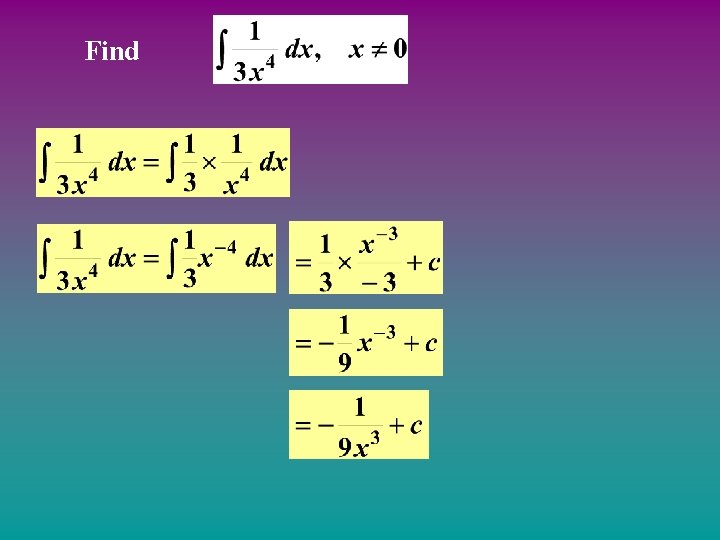
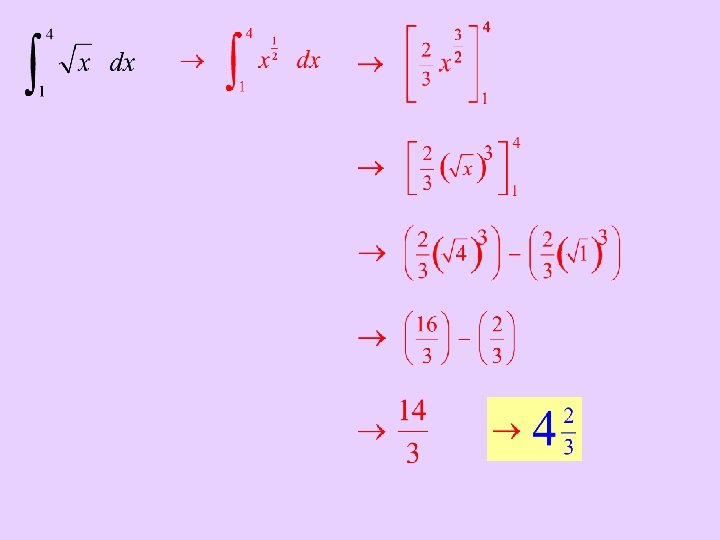
Find
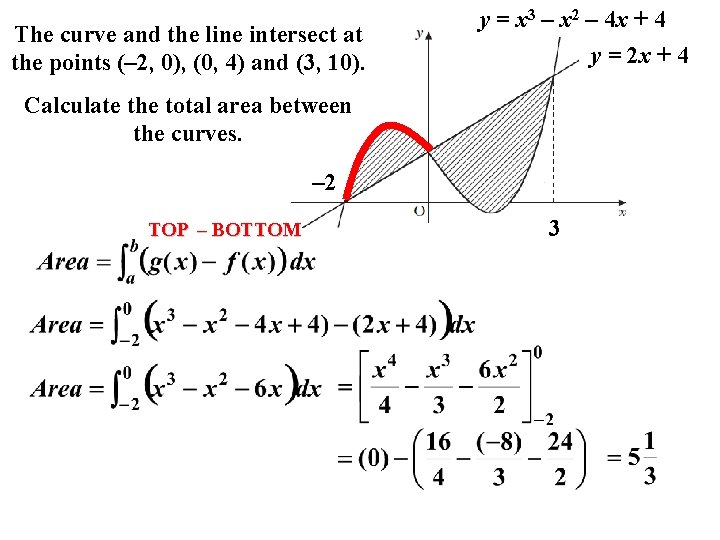
The curve and the line intersect at the points (– 2, 0), (0, 4) and (3, 10). y = x 3 – x 2 – 4 x + 4 y = 2 x + 4 Calculate the total area between the curves. – 2 TOP – BOTTOM 3
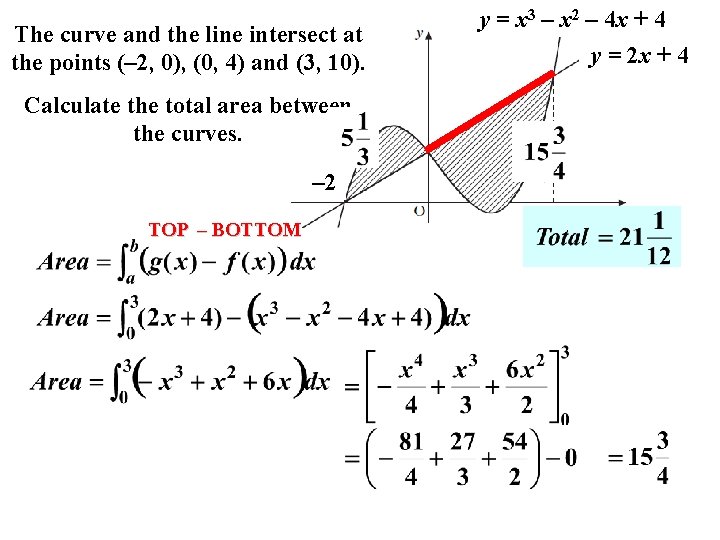
The curve and the line intersect at the points (– 2, 0), (0, 4) and (3, 10). y = x 3 – x 2 – 4 x + 4 y = 2 x + 4 Calculate the total area between the curves. – 2 TOP – BOTTOM 3

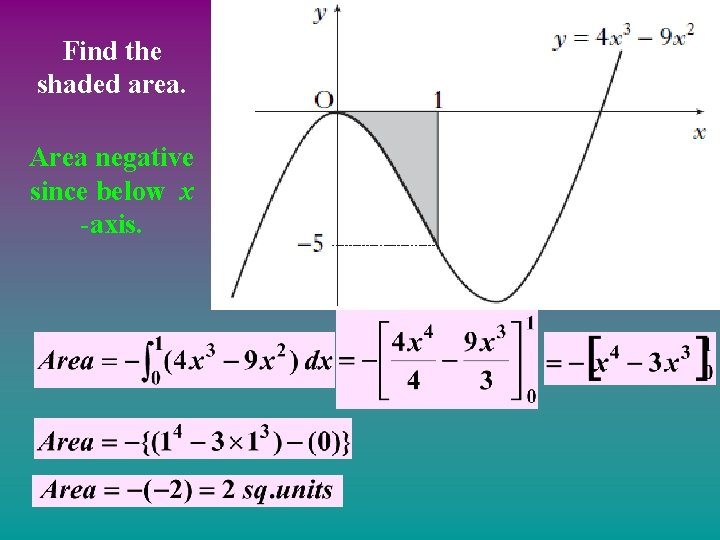
Find the shaded area. Area negative since below x -axis.
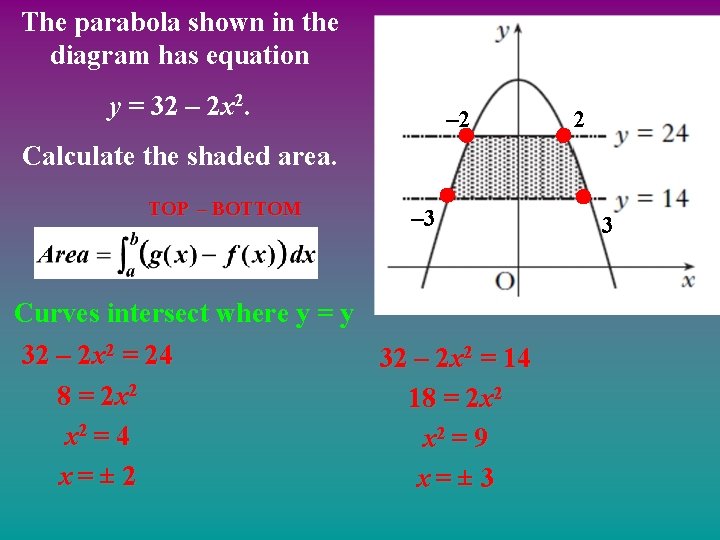
The parabola shown in the diagram has equation y = 32 – 2 x 2. – 2 2 Calculate the shaded area. TOP – BOTTOM – 3 Curves intersect where y = y 32 – 2 x 2 = 24 8 = 2 x 2 = 4 x= ± 2 32 – 2 x 2 = 14 18 = 2 x 2 = 9 x= ± 3 3
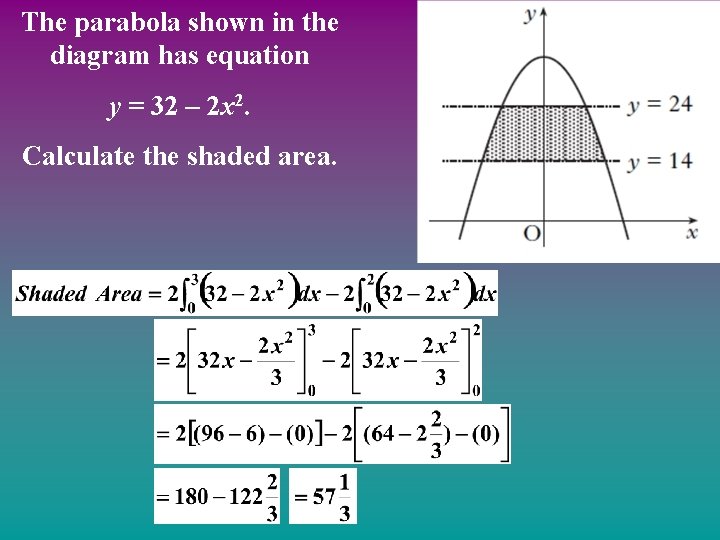
The parabola shown in the diagram has equation y = 32 – 2 x 2. Calculate the shaded area.
- Slides: 48