
The Principles of Art Group 1 Members A
The Principles of Art Group 1 - Members • • • A A A a Angeles, edilberto jr. m. A A a
The Principles of Art Group 1 – Report Outline • Introduction • 7 Principles of Art 1. Balance 2. Variety 3. Harmony 4. Emphasis/Contrast 5. Proportion 6. Movement 7. Rhythm/Pattern • Unity in art • Other Art Principles
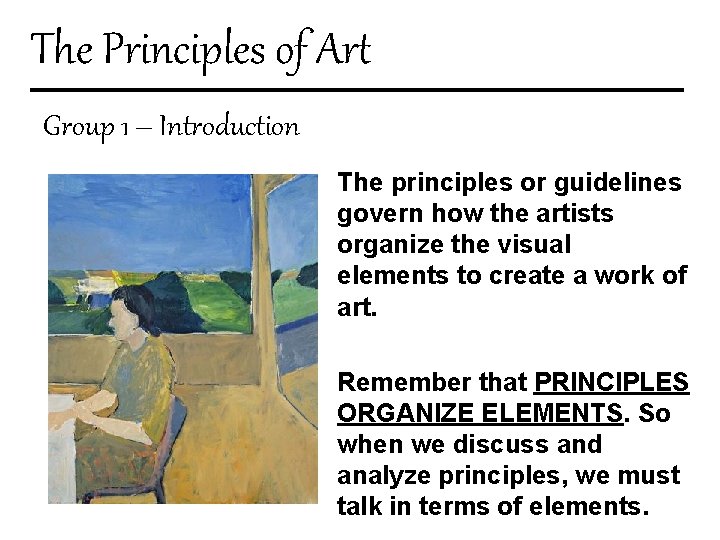
The Principles of Art Group 1 – Introduction The principles or guidelines govern how the artists organize the visual elements to create a work of art. Remember that PRINCIPLES ORGANIZE ELEMENTS. So when we discuss and analyze principles, we must talk in terms of elements.
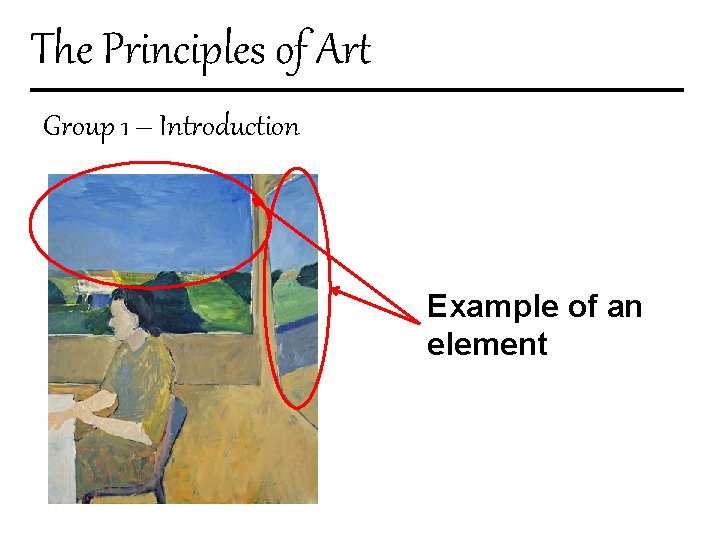
The Principles of Art Group 1 – Introduction Example of an element
The Principles of Art 1. Balance is a principle of art concerned with arranging elements so no one part of work over-powers, or seems heavier than any other part. In art, balance is seen or felt by the viewer.
The Principles of Art 1. Balance 3 kinds of Balance: 1. Formal or Symmetrical Balance 2. Informal or Asymmetrical Balance 3. Radial Balance
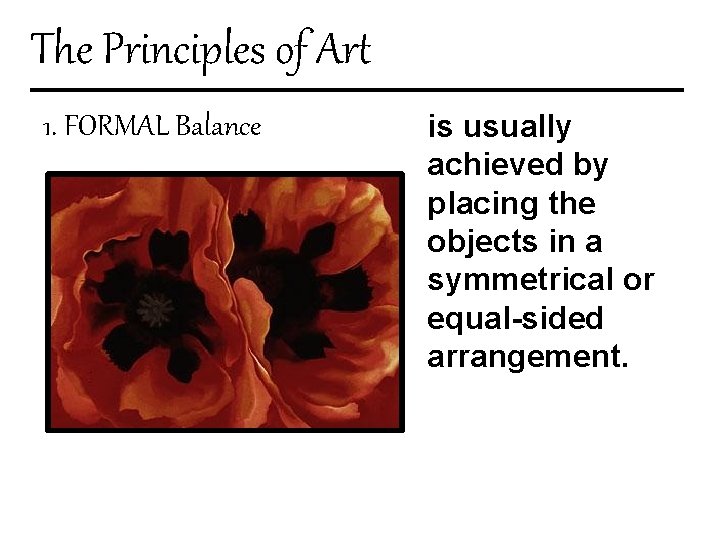
The Principles of Art 1. FORMAL Balance is usually achieved by placing the objects in a symmetrical or equal-sided arrangement.
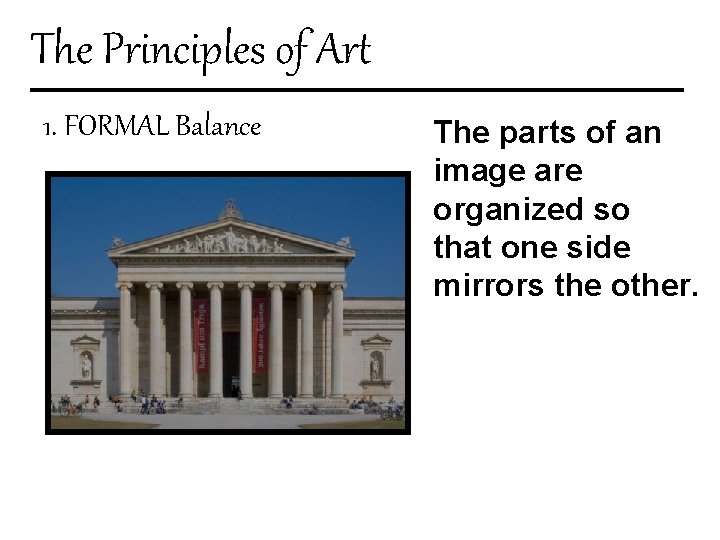
The Principles of Art 1. FORMAL Balance The parts of an image are organized so that one side mirrors the other.
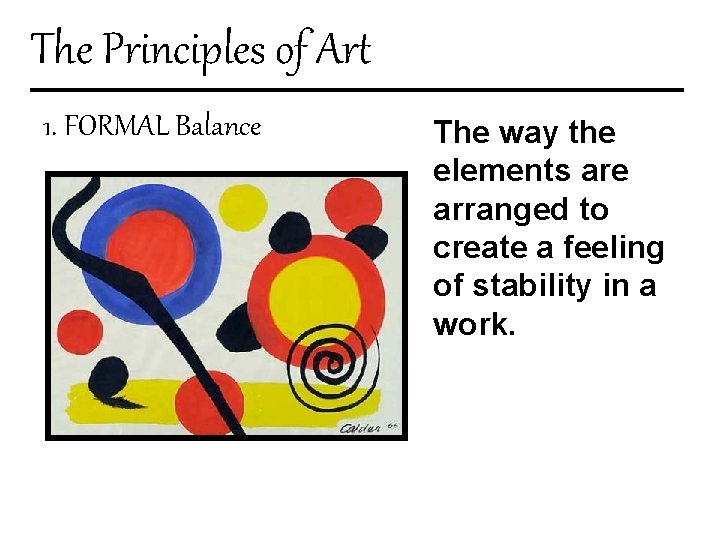
The Principles of Art 1. FORMAL Balance The way the elements are arranged to create a feeling of stability in a work.
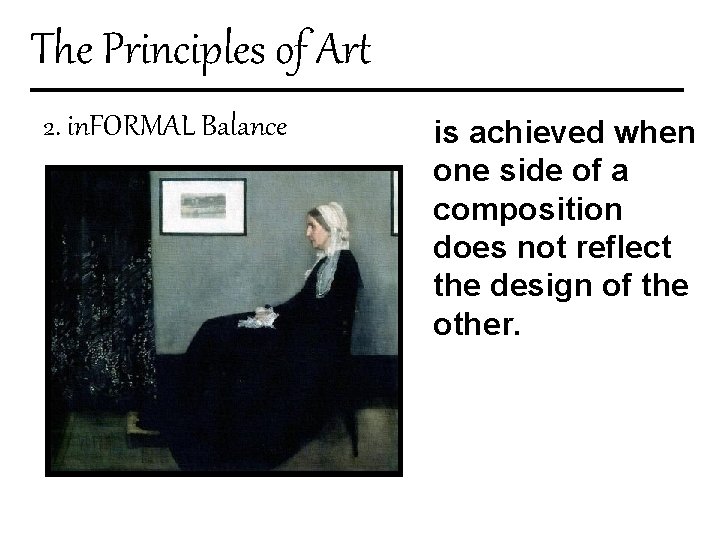
The Principles of Art 2. in. FORMAL Balance is achieved when one side of a composition does not reflect the design of the other.
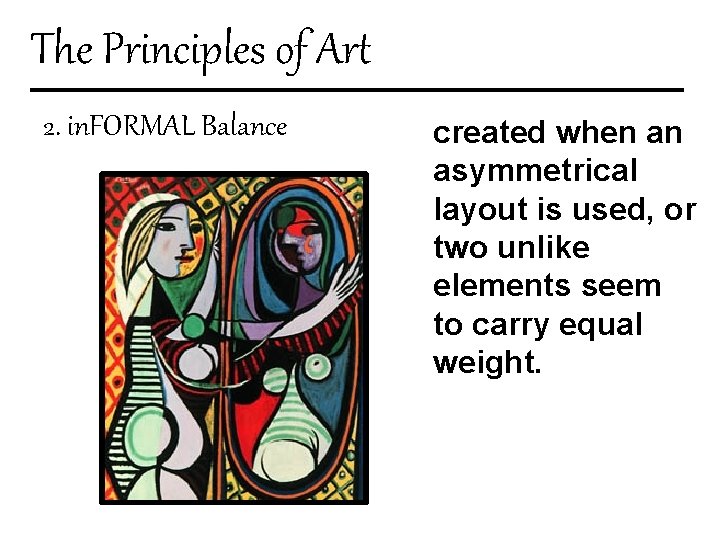
The Principles of Art 2. in. FORMAL Balance created when an asymmetrical layout is used, or two unlike elements seem to carry equal weight.
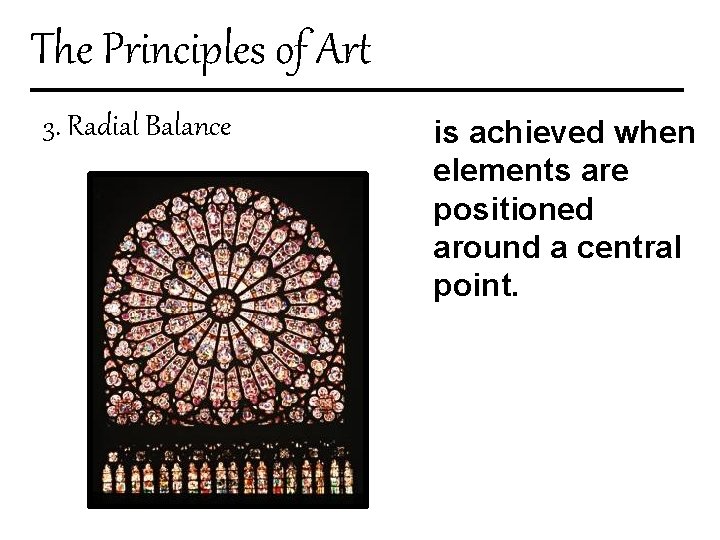
The Principles of Art 3. Radial Balance is achieved when elements are positioned around a central point.
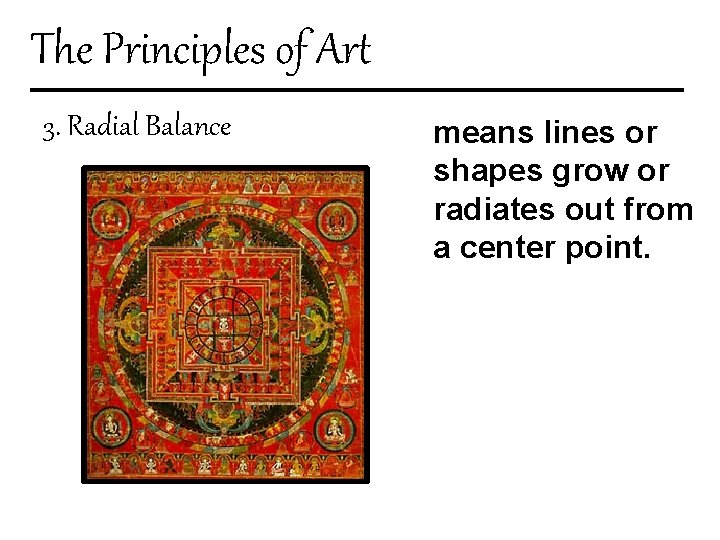
The Principles of Art 3. Radial Balance means lines or shapes grow or radiates out from a center point.
The Principles of Art 2. variety is a principle of art concerned of combining one or more elements to create interest by adding slight changes. It is used to avoid dullness and make the artwork interesting.
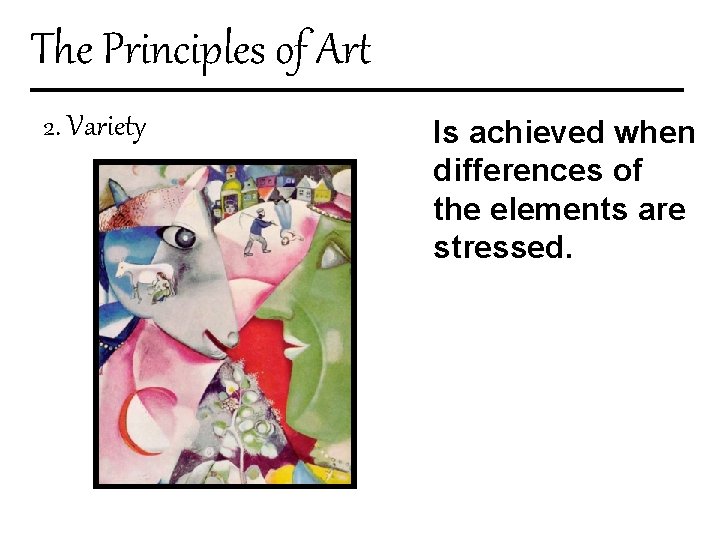
The Principles of Art 2. Variety Is achieved when differences of the elements are stressed.
The Principles of Art 3. harmony Is a principle of art concerned with the blending elements to create a more calm, restful appearance. It is the quality which unifies every part of an arrangement.
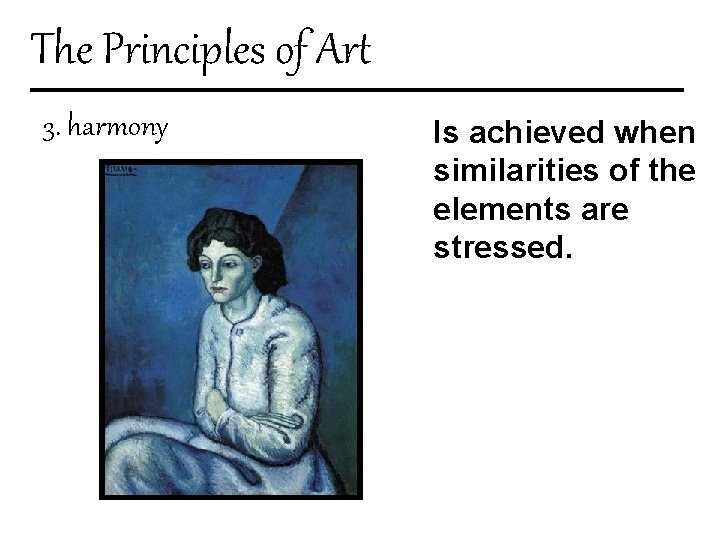
The Principles of Art 3. harmony Is achieved when similarities of the elements are stressed.
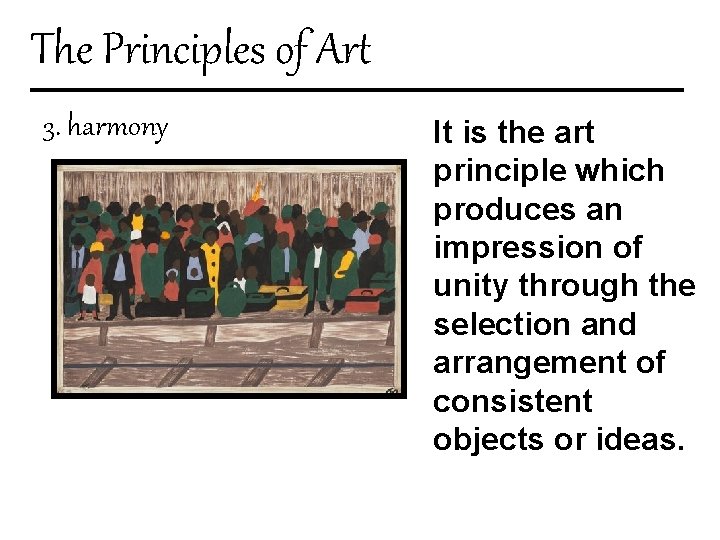
The Principles of Art 3. harmony It is the art principle which produces an impression of unity through the selection and arrangement of consistent objects or ideas.
The Principles of Art 4. emphasis Is a principle of art which tends to carry the eyes from the center of interest or dominant part of any composition to the less important parts. It can be created by contrast or by extreme changes in an element.
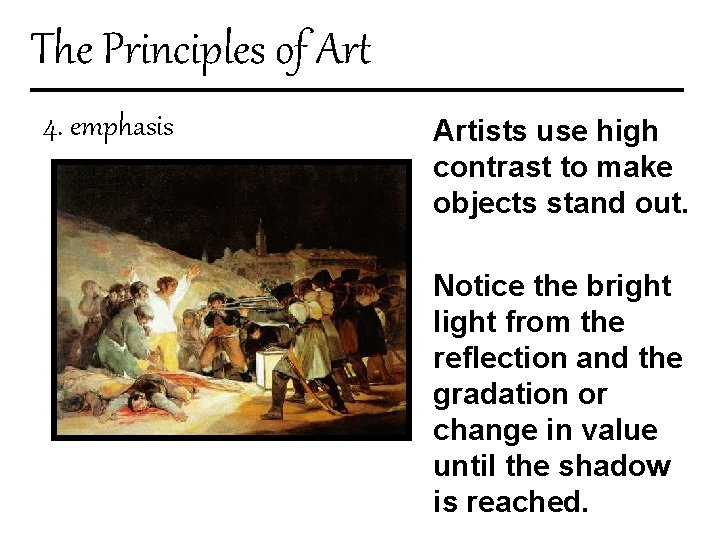
The Principles of Art 4. emphasis Artists use high contrast to make objects stand out. Notice the bright light from the reflection and the gradation or change in value until the shadow is reached.
The Principles of Art 5. proportion Is a principle of art concerned with the relationship of one part to another and to the whole. It is the arrangement of space divisions in pleasing relationships.
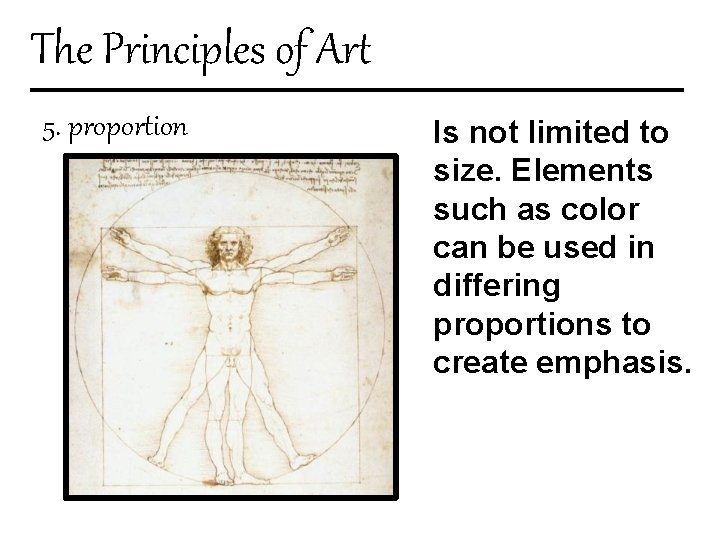
The Principles of Art 5. proportion Is not limited to size. Elements such as color can be used in differing proportions to create emphasis.
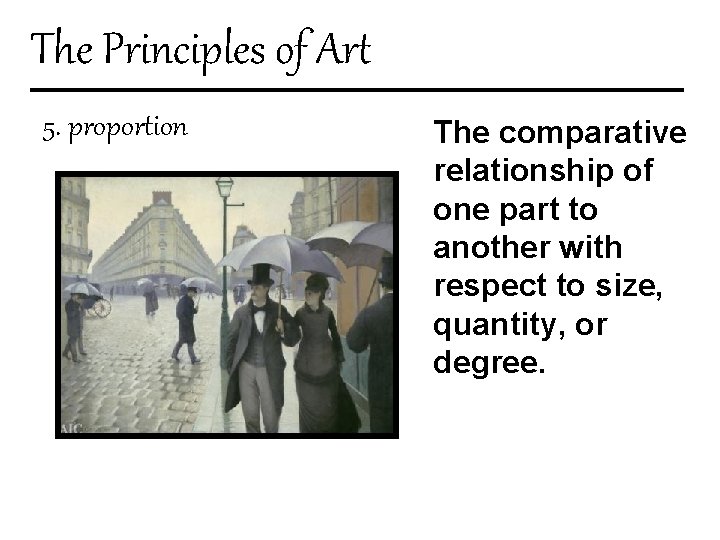
The Principles of Art 5. proportion The comparative relationship of one part to another with respect to size, quantity, or degree.
The Principles of Art 6. movement Is a principle of art used to create the look and feeling of action and to guide a viewers eye throughout the work of art.
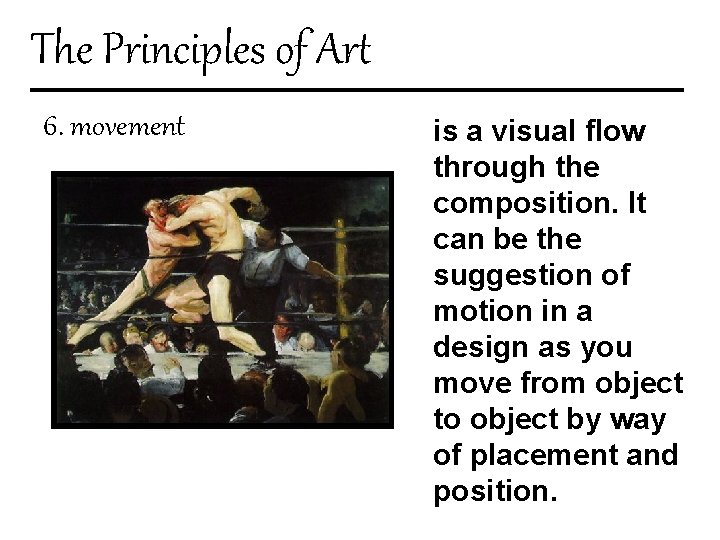
The Principles of Art 6. movement is a visual flow through the composition. It can be the suggestion of motion in a design as you move from object to object by way of placement and position.
The Principles of Art 7. rhythm Is a principle of art concerned with repeating an element to make a work seem active to suggest vibration. It is the most universal, dynamic and pleasing art principle.
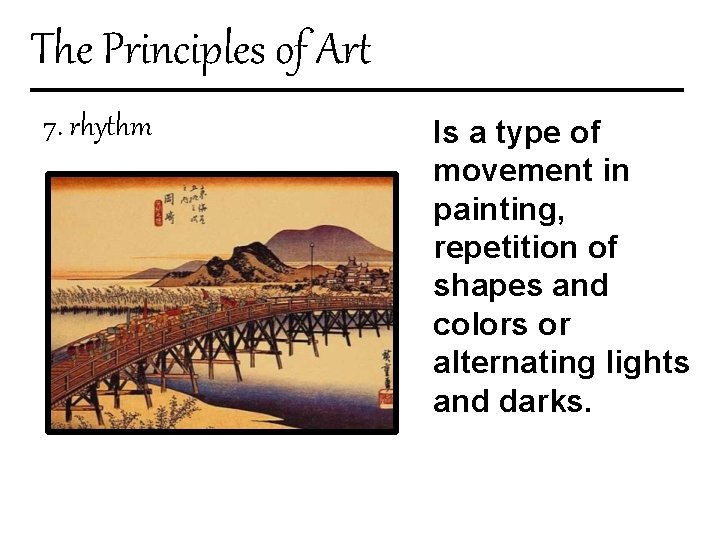
The Principles of Art 7. rhythm Is a type of movement in painting, repetition of shapes and colors or alternating lights and darks.
The Principles of Art Unity in art Is the arrangement of elements and principles of media to create a feeling of completeness. You will sense this unity as you look at work of art in which artists use the elements and principles with skill, imagination and sensitivity.
The Principles of Art Other art principles 1. Novelty or newness. A new style of dress or dance appears more attractive and interesting than ordinary dress design or dance. It provides the best opportunity for developing ones creative ability.
The Principles of Art Other art principles 2. Variety or variation. A set of furniture which is arranged in a certain way and remains as it is for long period of time appears to be monotonous in the long run. Variation in the arrangement or style can be more interesting and attractive.
The Principles of Art Other art principles 3. Unity, Adaptability, or Function. A work of art must not only possess beauty but also utility. The object must be adaptable to the purpose for which it is made.
The Principles of Art Other art principles 4. Contrast. This is synonymous to opposition or contradiction. It has some relationship with balance and emphasis. Two contrasting lines or colors may balance each other. The center of interest in a composition is in contrast with the subordinating parts in the same composition.
That’s all. Thank you!
- Slides: 33