
The Principle of Opportunity Cost No matter what

- Slides: 28
The Principle of Opportunity Cost • No matter what we do, there always tradeoffs. • Scarcity -- limited resources -- is the reason. The opportunity cost of something is what you sacrifice to get it.
Opportunity Costs are Choices ? ? ? » How should I spend my money ? » How should I spend my time ? Opportunity cost is always measured by how much you give up of the next best alternative to get what you want.
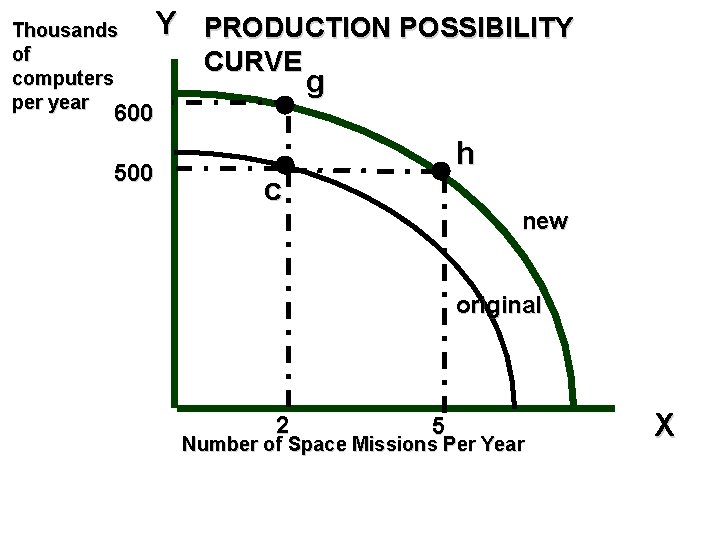
Opportunity Costs and Production Possibilities • The production possibility curve illustrates the principle of opportunity cost for an entire economy. -- shows all possible combinations of goods and services available to entire economy. --- principle of opportunity cost explains why production possibility curve is negatively sloped.
Shifting the Production Possibilities Curve The production possibilities curve will shift as a result of: • An increase in the economy’s production factor -- natural resources -- labor -- physical capital -- human capital -- entrepeneurship • Technological innovation that increases output from a given amount of resources.
Thousands of computers per year Y PRODUCTION POSSIBILITY CURVE 600 500 g h c new original 2 5 Number of Space Missions Per Year X
MARKET An arrangement which allows buyers and sellers to exchange money and goods.
QUESTIONS ADDRESSED ABOUT TRADE • • • Why do both rich and poor nations benefit from trade ? What is a firm, and how are firms organized ? Which of the industrialized nations has the lowest taxes ? Which nations are most dependent on international trade ? How do governments restrict international trade? What are GATT, NAFTA, and the World Trade Organization ?
WHY DO MARKETS EXIST ? • We are not self-sufficient: (We specialize in what we do best. ) • We trade what we make for goods or services we need, or for money to buy goods and services we need. Markets facilitate specialization and exchange.
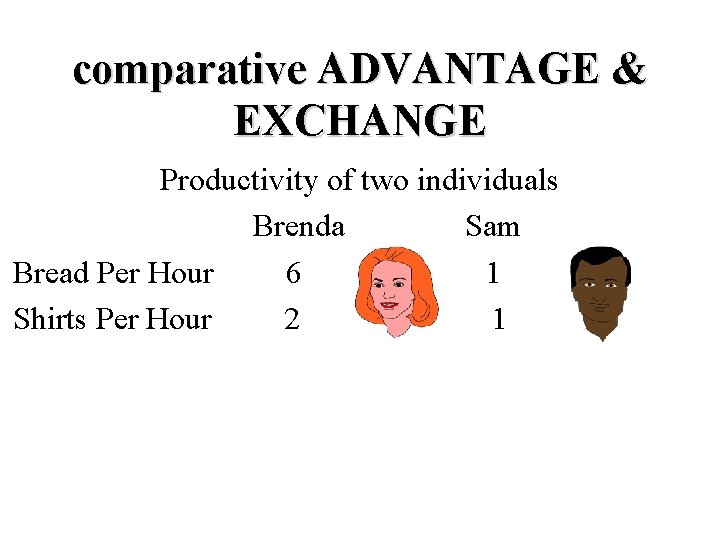
comparative ADVANTAGE & EXCHANGE Productivity of two individuals Brenda Sam Bread Per Hour 6 1 Shirts Per Hour 2 1
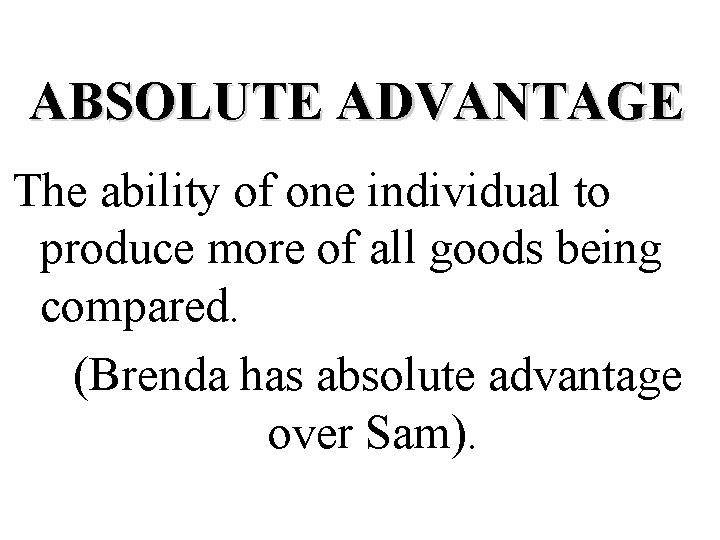
ABSOLUTE ADVANTAGE The ability of one individual to produce more of all goods being compared. (Brenda has absolute advantage over Sam).
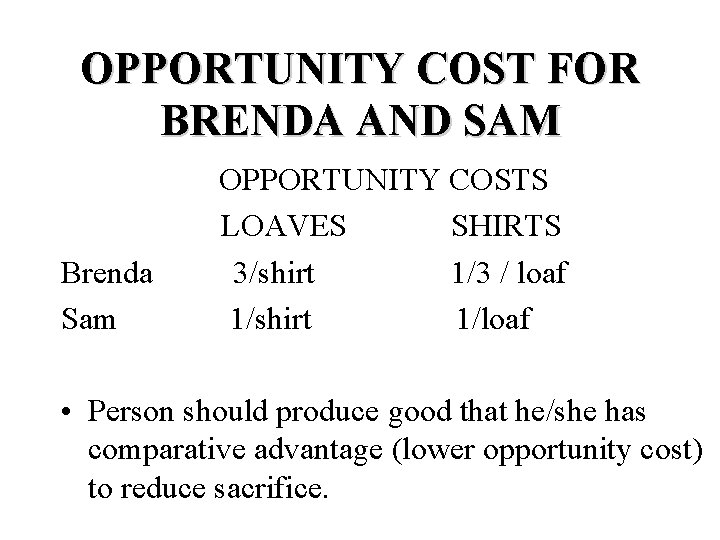
OPPORTUNITY COST FOR BRENDA AND SAM Brenda Sam OPPORTUNITY COSTS LOAVES SHIRTS 3/shirt 1/3 / loaf 1/shirt 1/loaf • Person should produce good that he/she has comparative advantage (lower opportunity cost) to reduce sacrifice.
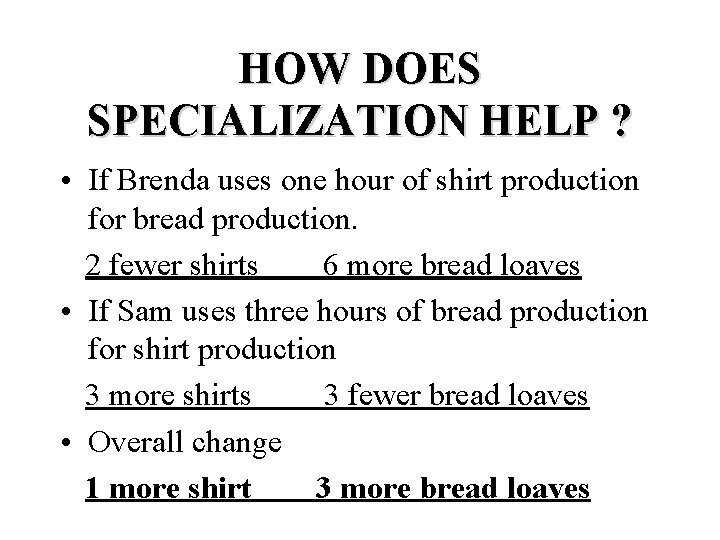
HOW DOES SPECIALIZATION HELP ? • If Brenda uses one hour of shirt production for bread production. 2 fewer shirts 6 more bread loaves • If Sam uses three hours of bread production for shirt production 3 more shirts 3 fewer bread loaves • Overall change 1 more shirt 3 more bread loaves
THE GLOBAL ECONOMY (International Trade) • Exports - Goods produced in the U. S. and sold in another country. • Imports - Goods produced in another country and purchased by citizens of the U. S.
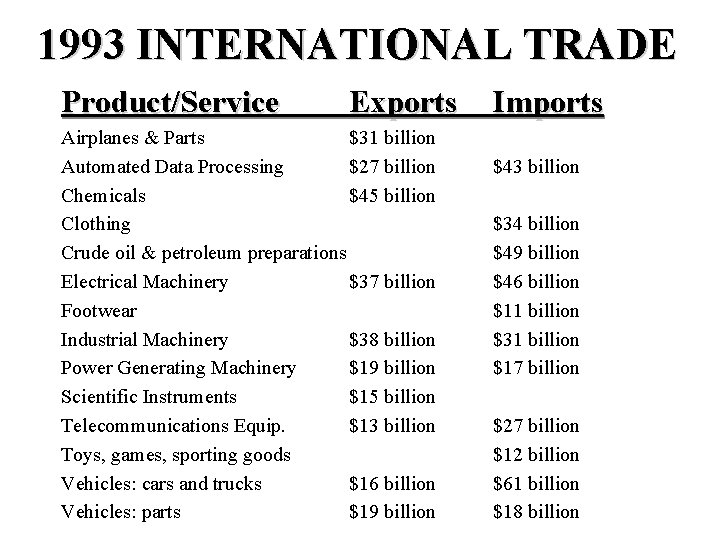
1993 INTERNATIONAL TRADE Product/Service Exports Airplanes & Parts $31 billion Automated Data Processing $27 billion Chemicals $45 billion Clothing Crude oil & petroleum preparations Electrical Machinery $37 billion Footwear Industrial Machinery $38 billion Power Generating Machinery $19 billion Scientific Instruments $15 billion Telecommunications Equip. $13 billion Toys, games, sporting goods Vehicles: cars and trucks $16 billion Vehicles: parts $19 billion Imports $43 billion $34 billion $49 billion $46 billion $11 billion $31 billion $17 billion $27 billion $12 billion $61 billion $18 billion
INTERNATIONAL TRADE • Trade between nations is based on the same principles for trade between individuals: - Specialize in what country does best; - Use comparative advantage; - Lower opportunity cost;
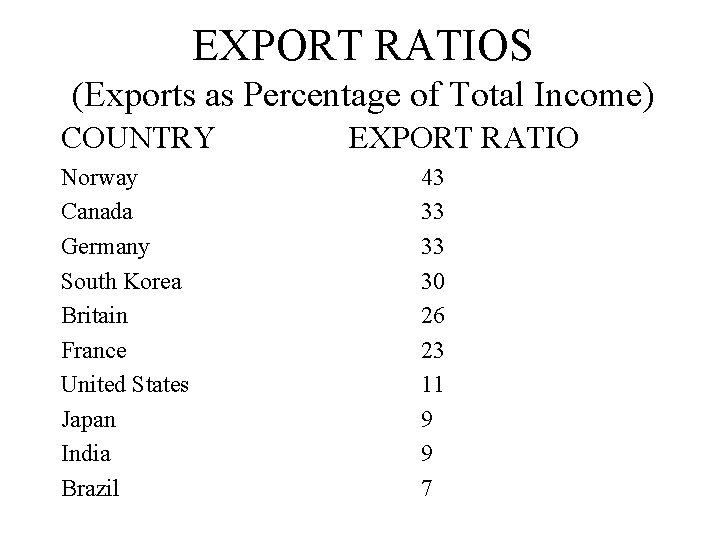
Reliance on Trade Differs With Specific Country • Smaller countries, with fewer opportunities for specialization, rely more heavily on trade; • Larger countries, with greater absolute advantage, rely less on trade.
EXPORT RATIOS (Exports as Percentage of Total Income) COUNTRY Norway Canada Germany South Korea Britain France United States Japan India Brazil EXPORT RATIO 43 33 33 30 26 23 11 9 9 7
THE MARGINAL PRINCIPLE (INCREMENTAL) • Provides a way of fine-tuning decisions. • Will one additional unit of a variable make us better or worse off ?
THE MARGINAL PRINCIPLE • Marginal Benefit The extra benefit resulting from a small increase in the activity. • Marginal Cost The additional cost resulting from a small increase in the activity.
THE MARGINAL PRINCIPLE Increase the level of an activity if its marginal benefit exceeds its marginal cost, but reduce the level if the marginal cost exceeds the marginal benefit. If possible, pick the level at which the marginal benefit equals marginal cost.
EDWARD SCISSORHANDS BARBERSHOP Should Edward stay open 3 or 4 hours? • Marginal benefit -- 5 haircuts x $8 = $40 • marginal cost -electricity @ $4 / hour, plus; $20 / hour opportunity cost trimming hedges and mowing lawns; • marginal benefit exceeds marginal cost $40 - $24 = $16 : stay open the extra hour.
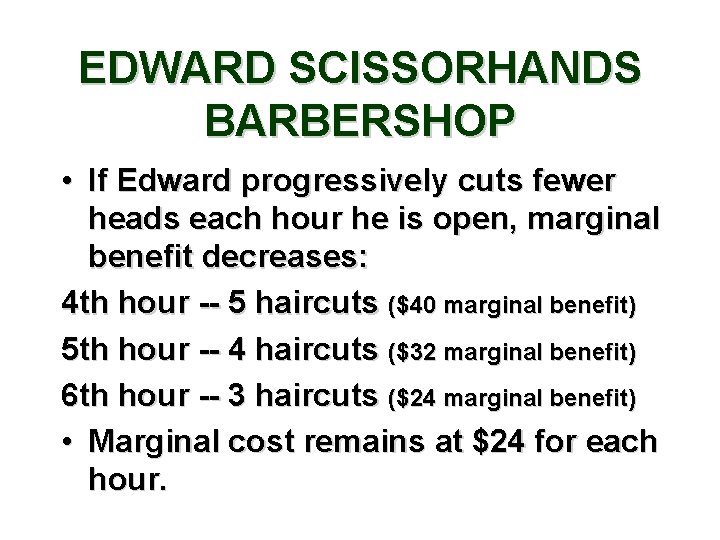
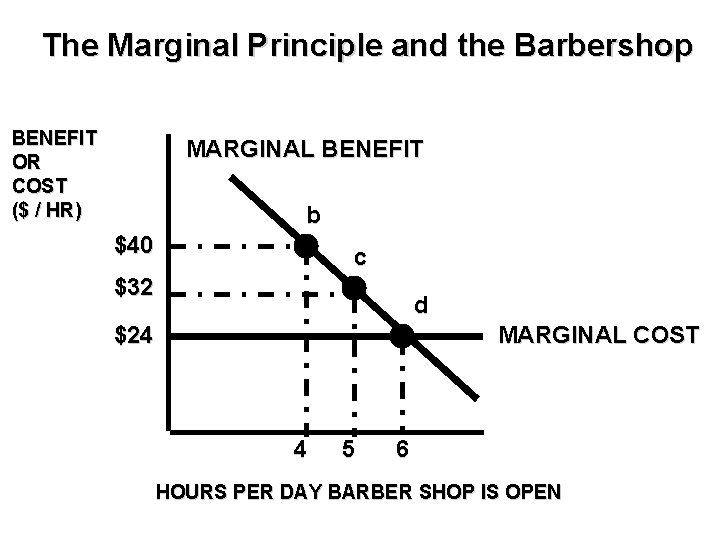
EDWARD SCISSORHANDS BARBERSHOP • If Edward progressively cuts fewer heads each hour he is open, marginal benefit decreases: 4 th hour -- 5 haircuts ($40 marginal benefit) 5 th hour -- 4 haircuts ($32 marginal benefit) 6 th hour -- 3 haircuts ($24 marginal benefit) • Marginal cost remains at $24 for each hour.
The Marginal Principle and the Barbershop BENEFIT OR COST ($ / HR) MARGINAL BENEFIT b $40 c $32 d $24 MARGINAL COST 4 5 6 HOURS PER DAY BARBER SHOP IS OPEN
The Principle of Diminishing Returns If an output produced from two or more inputs has one input increasing, while the other remains constant, a point will be reached where the output will increase at a decreasing rate. THE POINT OF DIMINISHING RETURNS
THE SPILLOVER PRINCIPLE For some goods, the costs or benefits associated with the good are not confined to the individual or organization that decides how much of the good to produce or consume.
THE REALITY PRINCIPLE The real value or purchasing power of money or income means more to people than its face value.
THE REALITY PRINCIPLE • Nominal Value -The face value of a sum of money. • Real Value -The value of a sum of money in terms of the quantity of goods that can be purchased.