
The Prevent Duty in Higher Education an introduction
- Slides: 39
The Prevent Duty in Higher Education: an introduction
Outline We will cover in this session: § The Counter-Terrorism and Security Act, 2015. § What is “Prevent “? § The Prevent duty in higher education – what must be done. § The process of radicalisation. § A case study. § What is “Channel”? § Monitoring arrangements.
Counter-Terrorism and Security Act Passed by parliament in February 2015. Came into force in July 2015 – September 18 for higher education. Section 26 of the Act placed a statutory duty on seven “specified authorities” to have: “due regard to prevent people from being drawn into terrorism” This has become known as the “Prevent duty”.
Prevent statutory guidance § In July 2015 the government issued Prevent duty guidance for all specified authorities in England Wales – there is separate guidance for Scotland. § Separate guidance for higher education institutions in England Wales and in Scotland was issued and came into force on 18 September 2015. § Essential elements of the duty are similar for all authorities and administrations.
So was all this new? § No – the original Prevent strategy was first launched by the Labour government in 2005. § The strategy was revised by the Coalition government in 2011.
Prevent strategy 2011 – three specific objectives § Respond to the ideological challenge of terrorism and the threat we face from those who promote it. § Prevent people from being drawn into terrorism and give them advice and support. § Work with sectors and institutions where there are risks of radicalisation that we need to address. It is the realisation of these objectives that the statutory Prevent duty is all about.
What is terrorism? § Definition from the Terrorism Act 2000: § The use or threat of action (serious violence against a person, serious damage to property, endangering a person’s life, serious risk to the health and safety of the public, serious interference/disruption of an electronic system). § Designed to influence the government or to intimidate the public or a section of the public. § Made for the purpose of advancing a political, religious, racial or ideological cause.
What does Prevent say about terrorism? § This is not only about Islamist extremism and so-called Islamist terrorist attacks – although it has been perceived as such. § Prevent is intended to deal with all forms of terrorism. § Nature and severity of threat varies over time. § The statutory guidance describes the current most significant threats but identifies others. § From where do you think threats come?
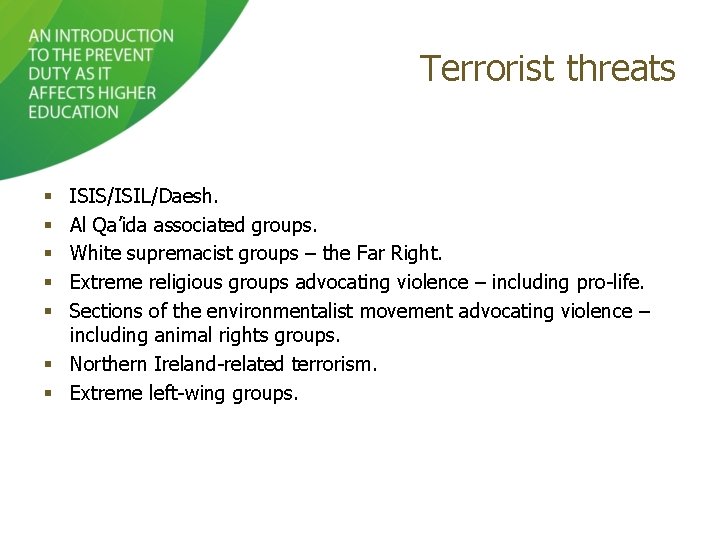
Terrorist threats ISIS/ISIL/Daesh. Al Qa’ida associated groups. White supremacist groups – the Far Right. Extreme religious groups advocating violence – including pro-life. Sections of the environmentalist movement advocating violence – including animal rights groups. § Northern Ireland-related terrorism. § Extreme left-wing groups. § § §
Extremism The 2011 Prevent strategy was explicitly changed to deal not just with all forms of terrorism and violent extremism but also with: “non-violent extremism, which can create an atmosphere conducive to terrorism and can popularise views which terrorists can exploit. ” This presents challenges, especially in the context of the right of people to hold views that others might find offensive or extreme but are perfectly legal.
What is “extremism”? The government has defined this as: “vocal or active opposition to fundamental British values, including democracy, the rule of law, individual liberty and mutual respect and tolerance of different faiths and beliefs. We also include in our definition of extremism calls for the death of members of our armed forces. ” Reactions to this definition?
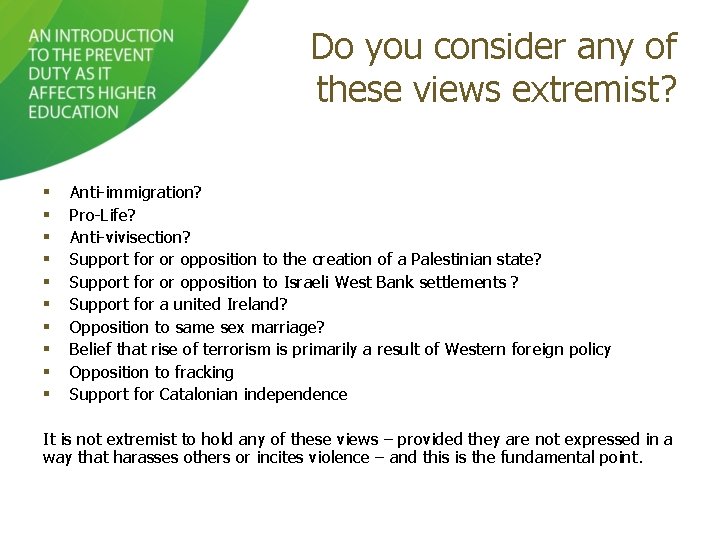
Do you consider any of these views extremist? § § § § § Anti-immigration? Pro-Life? Anti-vivisection? Support for or opposition to the creation of a Palestinian state? Support for or opposition to Israeli West Bank settlements ? Support for a united Ireland? Opposition to same sex marriage? Belief that rise of terrorism is primarily a result of Western foreign policy Opposition to fracking Support for Catalonian independence It is not extremist to hold any of these views – provided they are not expressed in a way that harasses others or incites violence – and this is the fundamental point.
Answer: Prevent is not about stopping people holding and expressing views others might find offensive § Holding the views on the previous slide is legitimate provided they are not expressed or furthered by statements, deeds or actions which result in harassment, intimidation or threats of violence against individuals or society itself. § It is where this occurs that there is a risk of people being drawn into terrorism. § This is where the need arises for RHEBs to risk assess and manage events where these or similar views may be expressed – much more later.
The process of “radicalisation” § It is OK to be a radical – someone who advocates political or social change through a political party or part of a party – to be radical can be to be progressive. § But in the context of Prevent and at an individual level it is the process by which influences are exerted that cause a person to become vulnerable to being drawn into terrorism. § “Radicalisation is a process not an event. During that process behaviours as well as opinion are likely to change. These changes can be apparent to the families, friends and work colleagues of the person concerned. ” (Prevent strategy para, 9. 1)
Preventing radicalisation § This is at the core of the Prevent strategy and duty “This area of Prevent is based on the premise that people being drawn into radicalisation and recruitment can be identified and then provided with support. ” (Prevent strategy para. 9. 4) § In this context Prevent is a safeguarding and welfare issue for staff and students.
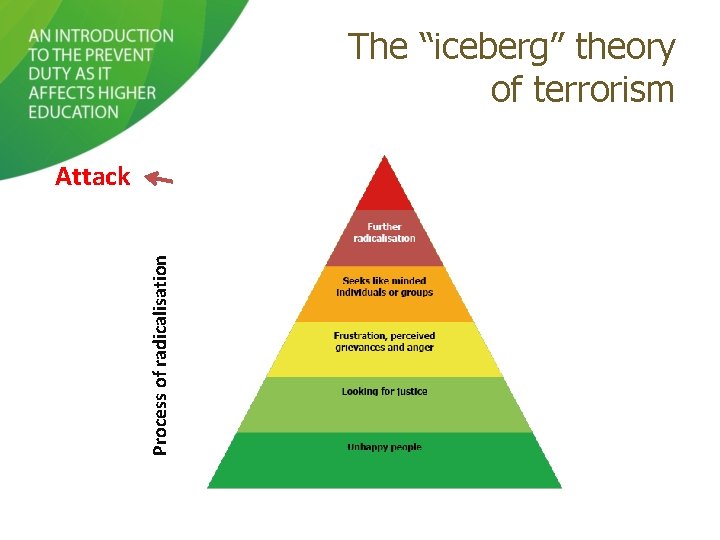
The “iceberg” theory of terrorism Process of radicalisation Attack
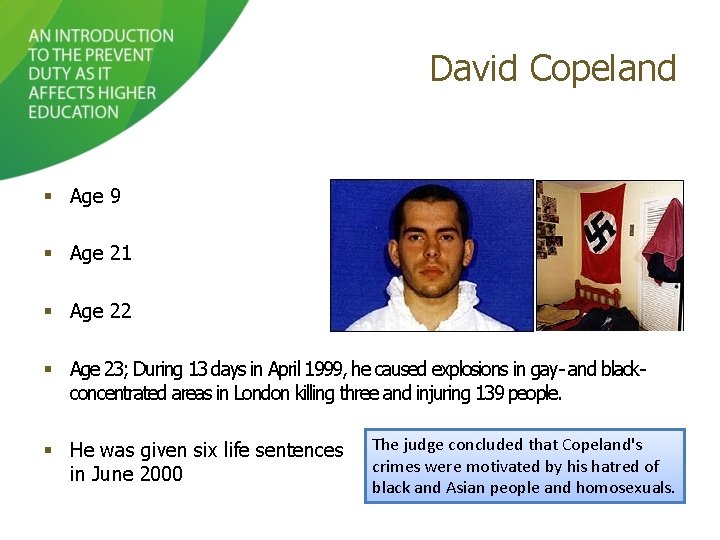
David Copeland § Age 9 § Age 21 § Age 22 § Age 23; During 13 days in April 1999, he caused explosions in gay- and blackconcentrated areas in London killing three and injuring 139 people. § He was given six life sentences in June 2000 The judge concluded that Copeland's crimes were motivated by his hatred of black and Asian people and homosexuals.
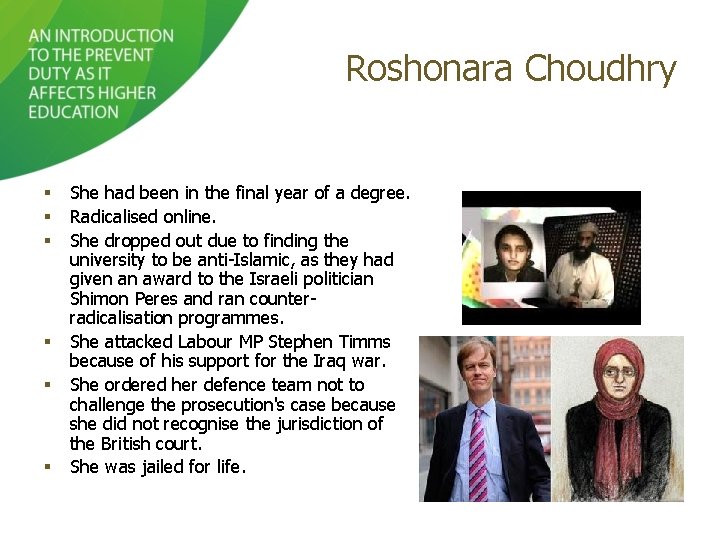
Roshonara Choudhry § § § She had been in the final year of a degree. Radicalised online. She dropped out due to finding the university to be anti-Islamic, as they had given an award to the Israeli politician Shimon Peres and ran counterradicalisation programmes. She attacked Labour MP Stephen Timms because of his support for the Iraq war. She ordered her defence team not to challenge the prosecution's case because she did not recognise the jurisdiction of the British court. She was jailed for life.
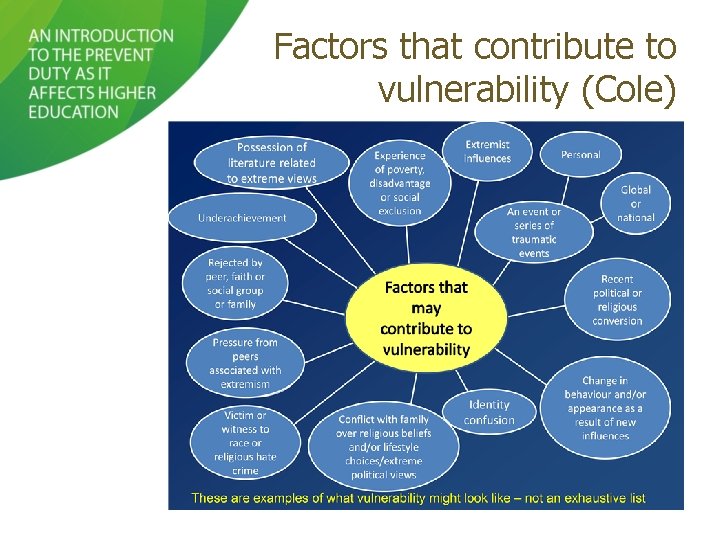
Factors that contribute to vulnerability (Cole)
The HE-specific duty and guidance § The duty applies to all relevant higher education bodies (RHEBs). § Ultimate responsible for implementing the duty lies with the governing body or the proprietor. § Applies to: § providers that are registered categories with the Of. S § providers that are not registered but have more than 250 higher education students § providers that are designated for student support by the Secretary of State (e. g. for the purposes of ‘teach out’) § the autonomous colleges, schools and halls of the Universities of Cambridge, Durham and Oxford.
Expectations § Compliance requires that properly thought-out and proportionate procedures and policies are in place. § Compliance will only be achieved if these are properly followed, actively applied, and reviewed appropriately. § Guidance not prescriptive – institutions will need to make their own decisions on how to implement. § Requirement to undertake and maintain up to date Prevent risk assessments. § Risks of students being drawn into terrorism will vary – geographical location, profile of student body. § A Prevent action plan that is proportionate to the risk.
Prevent is not about § Snooping on our students. § Interfering with academic freedom and freedom of expression. § Ignoring legal responsibilities relating to equality and diversity and promoting good campus relations. § Preventing research and teaching on sensitive topics. § Ignoring our responsibilities around confidentiality and data protection. These are some of the common misconceptions that make Prevent a contentious issue.
Why RHEBs have a key role § “Their commitment to freedom of speech and the rationality underpinning the advancement of knowledge means they represent one of our most important arenas for challenging extremist views and ideologies. ” § “Young people continue to make up a disproportionately high number of those arrested in this country for terrorist-related offences and of those who are travelling to join terrorist-related organisations in Syria and Iraq. ” (Prevent duty guidance for HEIs in England Wales, para 1)
What must be done? § Institutions must undertake a risk assessment of where and how their students might be at risk of being drawn into terrorism. § And a risk assessment of their institutional policies regarding campus and student welfare. § Having done so, develop a Prevent action plan setting out the actions they will take to mitigate any risks. § Policy in place on freedom of speech and external speakers that balances Prevent with the duty to ensure freedom of speech and academic freedom (section 31 of the Act; para 8 of the higher education-specific Prevent guidance). § Appropriate policies and procedures on IT and use of computers including due consideration of filtering.
What must be done continued A “Prevent lead” and steering group. An appropriate programme of awareness training of Prevent. Procedures on pastoral care of students that reference Prevent. Building capability of staff to recognise vulnerable individuals and what to do in such circumstances, using internal cause for concern procedures. § Information sharing agreements – internal and external. § Effective consultation with students, students’ unions (or student associations/representatives) and student societies. § Active senior level engagement with other partners. § §
External speakers and events § Applies to all external speakers. § Applies to events off-campus that are affiliated, branded or funded by the institution. § Applies to events on campus organised by anyone external to the institution. § A process of risk assessment. § Mitigation of risks v cancellation. § Measures to challenge extremist views that risk people being drawn into terrorism. § Awareness of providing physical security.
Policies on pastoral care § This is central to implementation of the duty in higher education. § RHEBs have a long and proud history of providing pastoral care and paying regard to the welfare of their students. § RHEBs have a duty of care to students and staff – especially for those who might be “vulnerable”, including those who might be vulnerable to being drawn towards terrorism. § Prevent duty guidance expects pastoral care to be available to all students. § RHEBs will want to ensure that relevant cause for concern procedures incorporate advice on what to do in cases where a student demonstrates vulnerability to being drawn into terrorism. § Ensuring appropriate chaplaincy support and management of faithrelated spaces where appropriate.
Case studies § We have stressed that Prevent is about protecting people vulnerable to being drawn into terrorism. § If this is to be achieved staff will need to make decisions about individual students. § Staff must not take hasty decisions and take inappropriate action. § Let’s look at a number of scenarios.
1 – What would you do? § A student has converted to Islam. He has no family ties to and no previous understanding of the faith and seems to be learning about it from the internet.
2 – What would you do? § A student has asked his chemistry lecturer how to make anthrax. § Other students in the class laughed at him and the individual stood up, aggressively responding; “you don’t even know me!” and left the class.
3 – What would you do? § A student has started to control use of the prayer room, only allowing those who share similar views and values to enter and making others feel uncomfortable and unwelcome.
4 – What would you do? § During an organised and peaceful demonstration on campus against the Iraq war, one student starts shouting and accusing everyone of being “complacent and as guilty as the government”. It is clear that he is making his peers feel very uncomfortable and has deviated from the message that the campaign is trying to achieve.
5 – What would you do? § A student has showed his counsellor violent videos of beheadings in Syria and seems to be obsessed with them.
A true case All five scenarios relate to a single case – an individual student who was subsequently convicted of preparing terrorist acts involving a shopping centre in Bristol. Each single event went unreported and the connection between them was not made. How might this have been avoided?
A procedure for advice, support, intervention and referral § Your RHEB should have in place a procedure for staff to raise concerns about a student for a broad range of matters. § In many institutions this will be from the department that is responsible for student welfare – student services, student wellbeing or whatever the local arrangement. § These procedures should include matters relating to radicalisation. § Concerns may come from a range of sources – other students, academic or personal tutors, student services staff, residential and accommodation staff. § In the case of concerns around Prevent it is important that referral is made to the designated person as identified in the procedure – the case study shows the importance of connecting what may appear to be isolated events.
“Channel” § First piloted in 2007 and rolled out across England Wales in 2012. § A programme that focuses on providing support at an early stage to people identified as vulnerable to being drawn into terrorism. § About ensuring that vulnerable young people and adults of any faith, ethnicity or background receive support before they become involved in terrorist related activity. § A multi-agency approach whose success depends on cooperation between partners. § Participation in the programme is voluntary § Works best when the individuals and their families fully engage with the programme.
The Channel process § All referrals are screened to ensure that there is a specific risk and that they are not misinformed or malicious. § All local authorities must establish Channel panels and must chair them. § As well as the local authority chair a police representative will be present. § There is a duty on all partners identified in the CT&S Act to cooperate with panels – this includes RHEBs. § The composition of any panel will depend on the nature of the referral – in all relevant cases RHEB representatives will be included.
Making referrals to Channel § § § All RHEBs will have in place a system – usually requiring that referrals are made through a single point of contact. This is important to ensure that there is a suitable internal assessment before proceeding – there have been unfortunate cases where inappropriate referrals have been made and reported in the media. The Channel guidance is very explicit in stipulating that, except in exceptional circumstances, referrals must be made with the knowledge and consent of the individual. Referrals to Channel will not be revealed through reports obtained from the DBS. Members of your Prevent team will be able to give advice in this area.
Monitoring for compliance § § § For RHEBs in England this is the Office for Students (Of. S) in Wales this is HEFCW there are different arrangements for Scotland. HEFCE (now the Of. S) undertook an initial phase of monitoring to assure itself and government that RHEBs had in place the necessary policies and procedures to comply. There is an ongoing requirement for governing bodies or proprietors to submit an annual report demonstrating evidence of ongoing engagement and active implementation of the Prevent duty. This will be used by the Of. S to make an assessment of the provider’s compliance with the duty. There will also be the requirement to include data in the annual reports – numbers trained for example as well as referrals to Channel, higher risk events referred for senior institutional approval. Prevent reviews (face-to-face meetings) of individual institutions will take place where there are particular circumstances or risk indicators. RHEBs should also contact the Of. S to discuss any serious incidents relating to their Prevent duty responsibilities