
The Preterm Breech Vaginal Versus Abdominal Delivery Mohamed

The Preterm Breech Vaginal Versus. Abdominal Delivery Mohamed Kandeel M. B. B. Ch. , M. Sc. (Ob/Gyn), M. D. (Ob/Gyn) Professor of Obstetrics and Gynecology Menofyia University Egypt 1

Introduction • The literature on this subject shows varied conflicting data. On one side, there are reports stating that vaginal delivery does not increase morbidity/mortality for preterm breech. On the other hand, there are many investigators reporting that the method of choice for delivering these babies would be caesarean section in order to improve the perinatal outcome for such babies. • This dilemma has influenced many Obstetricians to consider preterm breech delivery as a high risk situation.
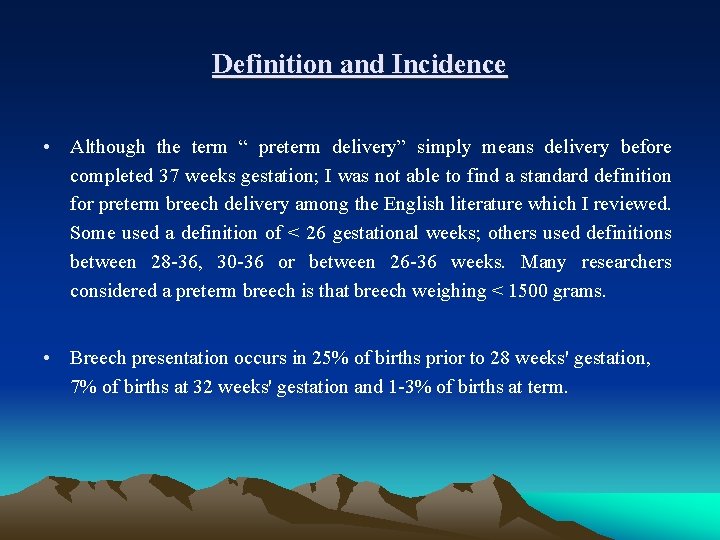
Definition and Incidence • Although the term “ preterm delivery” simply means delivery before completed 37 weeks gestation; I was not able to find a standard definition for preterm breech delivery among the English literature which I reviewed. Some used a definition of < 26 gestational weeks; others used definitions between 28 -36, 30 -36 or between 26 -36 weeks. Many researchers considered a preterm breech is that breech weighing < 1500 grams. • Breech presentation occurs in 25% of births prior to 28 weeks' gestation, 7% of births at 32 weeks' gestation and 1 -3% of births at term.

Types of Breech 1 - Complete breech: Fetus is in flexion attitude. Hips and knees are flexed with the buttocks and knees at the same level. 2 -Incomplete breech: A-Frank breech: Fetal hips are flexed and knees extended B-Footling: Hip and knee joint; on one or both sides, are partially extended. C-Knee presentation: Hip is partially extended and knee is flexed on one or both sides.

Aetiology Causes which favor preterm breech are not different than those for term breech. They include: 1 -Uterine Malformations. E. g. septate or bicornuate uterus. 2 -Fibroids in the lower part of the uterus. 3 -Polyhydramnios. 4 -Fetal abnormalities: e. g. malformations of brain, neck masses & aneuploidy

Aetiology (Cont. ) 5 -Multiple gestations: due to the limited space in the uterus 6 -Grand multiparity 7 -Short umbilical cord 8 -Placenta previa

Complications Of Preterm Breech Delivery 1 -Entrapment of the aftercoming head through an incompletely dilated cervix. 2 -Cord Prolapse 3 -Intrapartum Hypoxia 4 -Inco-ordinate Labor 5 -Aspiration Pneumonia 6 -Traumatic Injuries
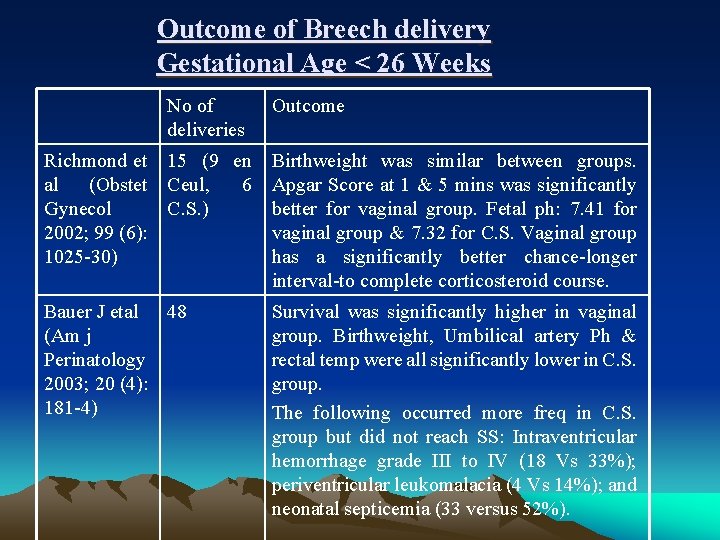
Outcome of Breech delivery Gestational Age < 26 Weeks No of deliveries Outcome Richmond et 15 (9 en Birthweight was similar between groups. al (Obstet Ceul, 6 Apgar Score at 1 & 5 mins was significantly Gynecol C. S. ) better for vaginal group. Fetal ph: 7. 41 for 2002; 99 (6): vaginal group & 7. 32 for C. S. Vaginal group 1025 -30) has a significantly better chance-longer interval-to complete corticosteroid course. Bauer J etal 48 (Am j Perinatology 2003; 20 (4): 181 -4) Survival was significantly higher in vaginal group. Birthweight, Umbilical artery Ph & rectal temp were all significantly lower in C. S. group. The following occurred more freq in C. S. group but did not reach SS: Intraventricular hemorrhage grade III to IV (18 Vs 33%); periventricular leukomalacia (4 Vs 14%); and neonatal septicemia (33 versus 52%).
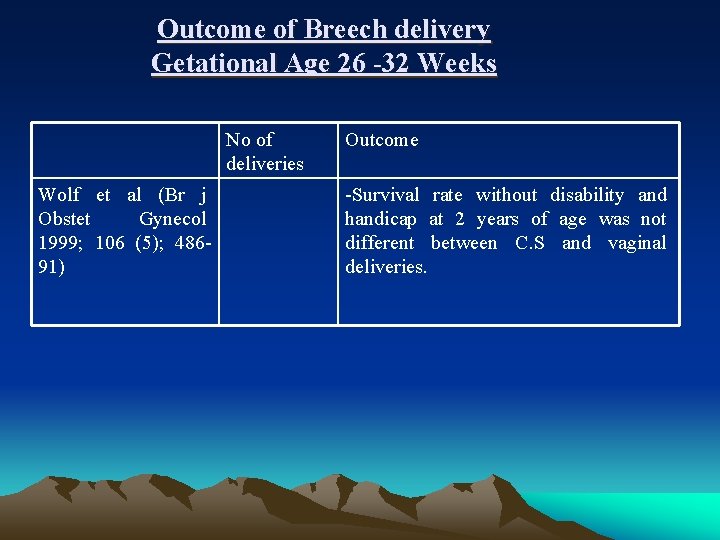
Outcome of Breech delivery Getational Age 26 -32 Weeks No of deliveries Wolf et al (Br j Obstet Gynecol 1999; 106 (5); 48691) Outcome -Survival rate without disability and handicap at 2 years of age was not different between C. S and vaginal deliveries.
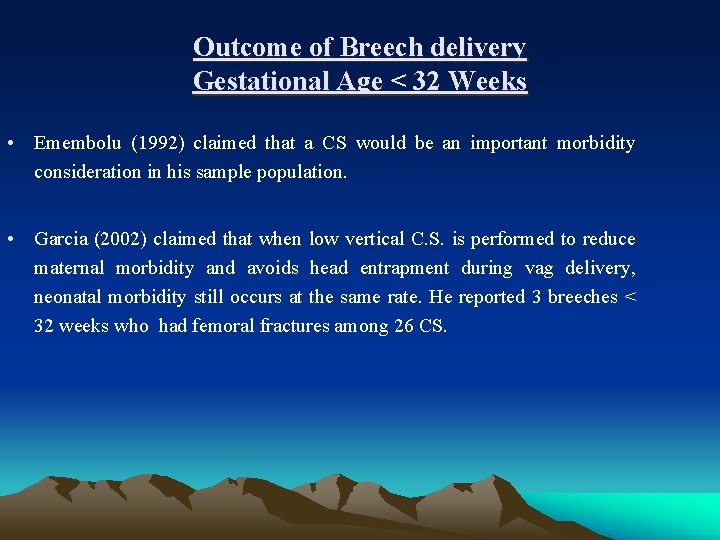
Outcome of Breech delivery Gestational Age < 32 Weeks • Emembolu (1992) claimed that a CS would be an important morbidity consideration in his sample population. • Garcia (2002) claimed that when low vertical C. S. is performed to reduce maternal morbidity and avoids head entrapment during vag delivery, neonatal morbidity still occurs at the same rate. He reported 3 breeches < 32 weeks who had femoral fractures among 26 CS.
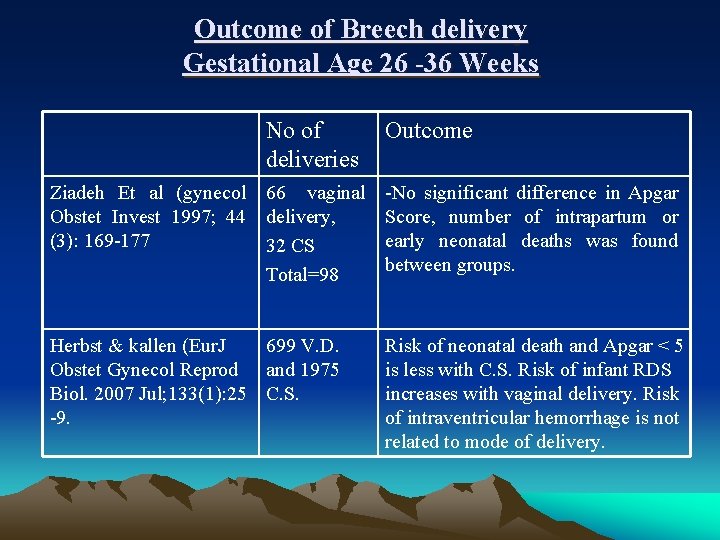
Outcome of Breech delivery Gestational Age 26 -36 Weeks No of deliveries Outcome Ziadeh Et al (gynecol 66 vaginal Obstet Invest 1997; 44 delivery, (3): 169 -177 32 CS Total=98 -No significant difference in Apgar Score, number of intrapartum or early neonatal deaths was found between groups. Herbst & kallen (Eur. J 699 V. D. Obstet Gynecol Reprod and 1975 Biol. 2007 Jul; 133(1): 25 C. S. -9. Risk of neonatal death and Apgar < 5 is less with C. S. Risk of infant RDS increases with vaginal delivery. Risk of intraventricular hemorrhage is not related to mode of delivery.
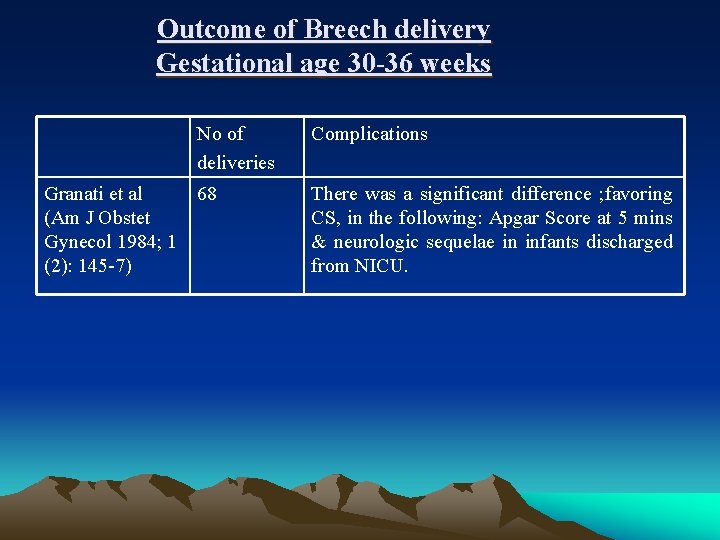
Outcome of Breech delivery Gestational age 30 -36 weeks No of deliveries Granati et al 68 (Am J Obstet Gynecol 1984; 1 (2): 145 -7) Complications There was a significant difference ; favoring CS, in the following: Apgar Score at 5 mins & neurologic sequelae in infants discharged from NICU.
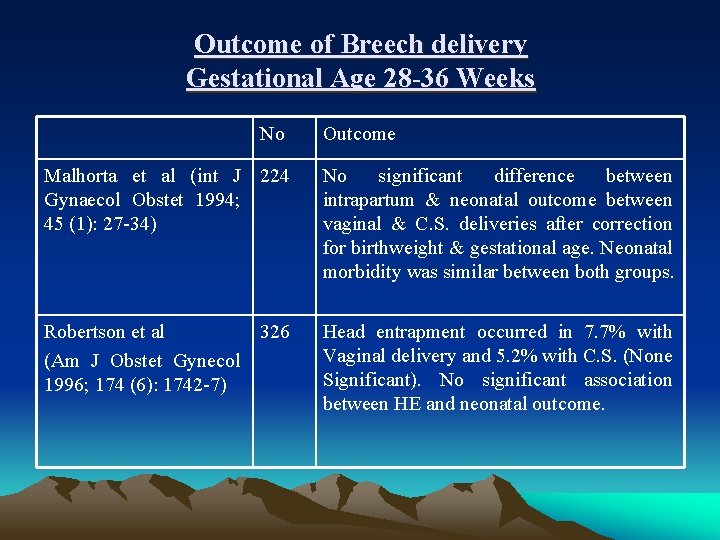
Outcome of Breech delivery Gestational Age 28 -36 Weeks No Outcome Malhorta et al (int J 224 Gynaecol Obstet 1994; 45 (1): 27 -34) No significant difference between intrapartum & neonatal outcome between vaginal & C. S. deliveries after correction for birthweight & gestational age. Neonatal morbidity was similar between both groups. Robertson et al 326 (Am J Obstet Gynecol 1996; 174 (6): 1742 -7) Head entrapment occurred in 7. 7% with Vaginal delivery and 5. 2% with C. S. (None Significant). No significant association between HE and neonatal outcome.
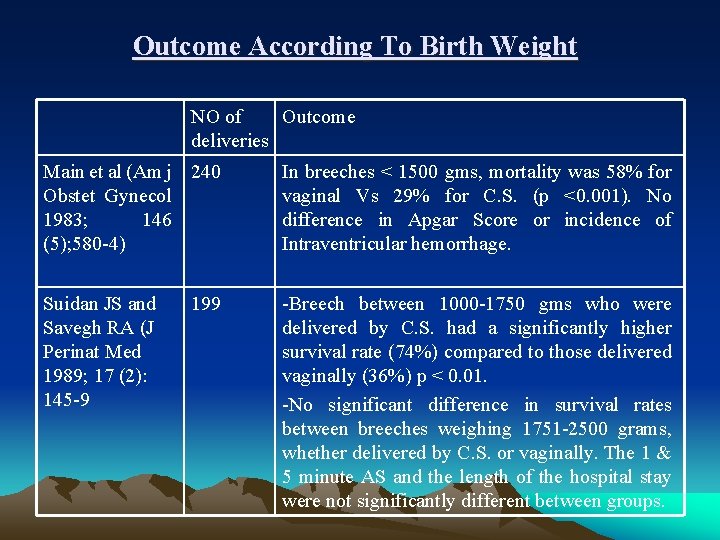
Outcome According To Birth Weight NO of Outcome deliveries Main et al (Am j 240 Obstet Gynecol 1983; 146 (5); 580 -4) In breeches < 1500 gms, mortality was 58% for vaginal Vs 29% for C. S. (p <0. 001). No difference in Apgar Score or incidence of Intraventricular hemorrhage. Suidan JS and Savegh RA (J Perinat Med 1989; 17 (2): 145 -9 -Breech between 1000 -1750 gms who were delivered by C. S. had a significantly higher survival rate (74%) compared to those delivered vaginally (36%) p < 0. 01. -No significant difference in survival rates between breeches weighing 1751 -2500 grams, whether delivered by C. S. or vaginally. The 1 & 5 minute AS and the length of the hospital stay were not significantly different between groups. 199
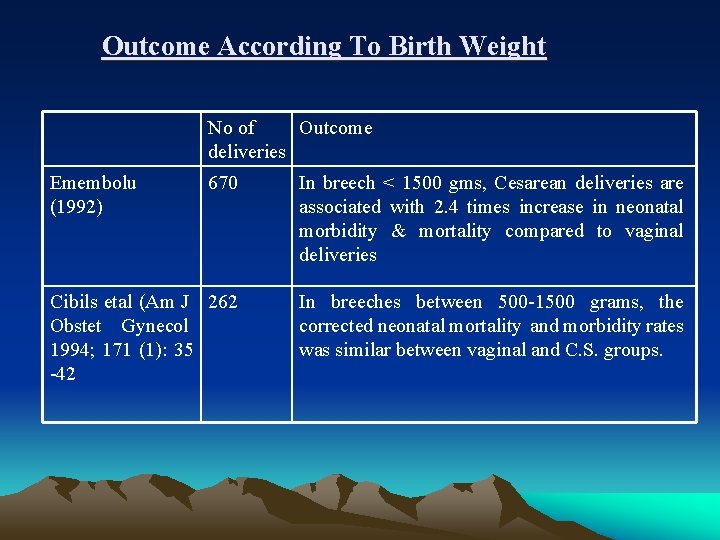
Outcome According To Birth Weight No of Outcome deliveries Emembolu (1992) 670 In breech < 1500 gms, Cesarean deliveries are associated with 2. 4 times increase in neonatal morbidity & mortality compared to vaginal deliveries Cibils etal (Am J 262 Obstet Gynecol 1994; 171 (1): 35 -42 In breeches between 500 -1500 grams, the corrected neonatal mortality and morbidity rates was similar between vaginal and C. S. groups.
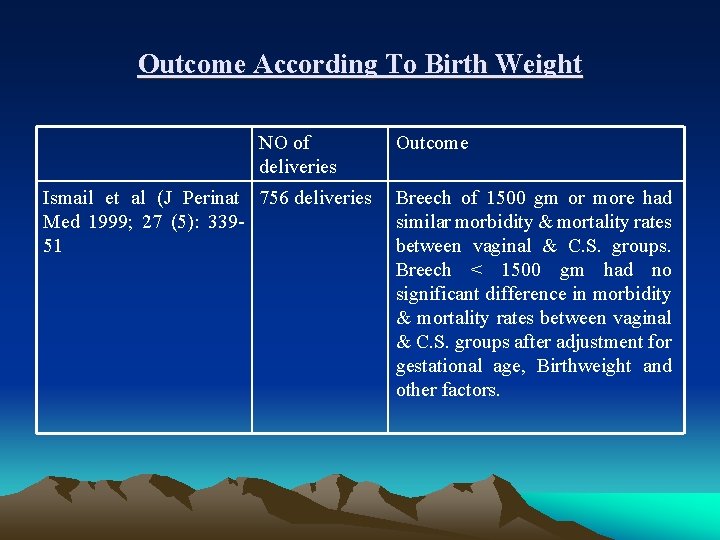
Outcome According To Birth Weight NO of deliveries Ismail et al (J Perinat 756 deliveries Med 1999; 27 (5): 33951 Outcome Breech of 1500 gm or more had similar morbidity & mortality rates between vaginal & C. S. groups. Breech < 1500 gm had no significant difference in morbidity & mortality rates between vaginal & C. S. groups after adjustment for gestational age, Birthweight and other factors.
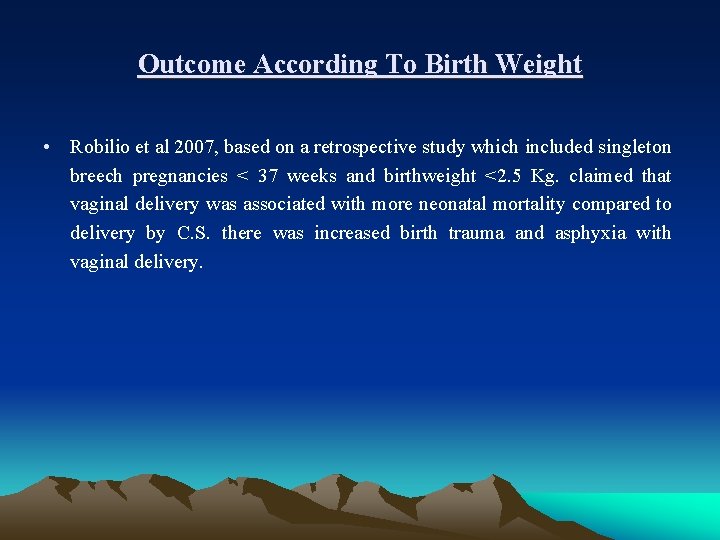
Outcome According To Birth Weight • Robilio et al 2007, based on a retrospective study which included singleton breech pregnancies < 37 weeks and birthweight <2. 5 Kg. claimed that vaginal delivery was associated with more neonatal mortality compared to delivery by C. S. there was increased birth trauma and asphyxia with vaginal delivery.
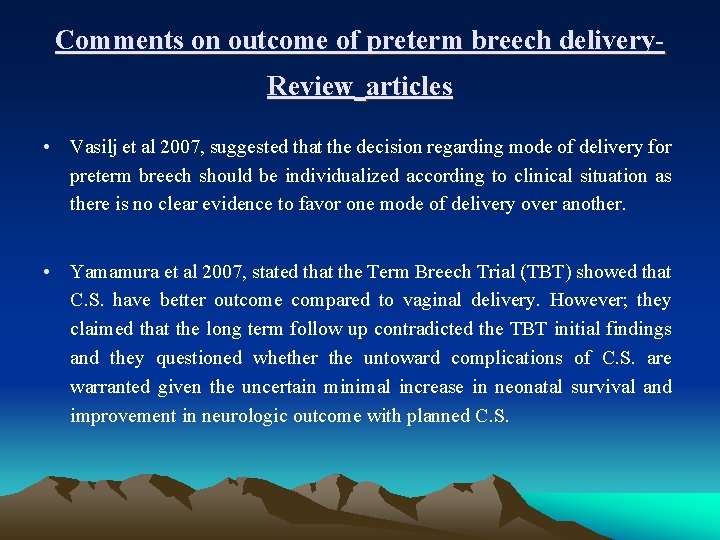
Comments on outcome of preterm breech delivery. Review articles • Vasilj et al 2007, suggested that the decision regarding mode of delivery for preterm breech should be individualized according to clinical situation as there is no clear evidence to favor one mode of delivery over another. • Yamamura et al 2007, stated that the Term Breech Trial (TBT) showed that C. S. have better outcome compared to vaginal delivery. However; they claimed that the long term follow up contradicted the TBT initial findings and they questioned whether the untoward complications of C. S. are warranted given the uncertain minimal increase in neonatal survival and improvement in neurologic outcome with planned C. S.
Conclusions • An honest discussion with the parents should take place to clarify the lack of data regarding the ideal mode of delivery for preterm breech. • Vaginal delivery should be considered For fetuses < 26 weeks within intact membranes (en ceul). Should membranes rupture, C. S. offers the best favorable outcome only if good NICU facilities exist. • Vaginal delivery should be considered for pregnancies between 26 -36 gestational weeks, after a discussion of risks and benefits with the parents.
Conclusions • The major body of evidence; regardless of birthweight whether less or equal or more than 1500 gm, supports vaginal delivery for the preterm breech. Most studies showed no difference in morbidity and mortality between both modes of deliveries. • Regardless of GA or birthweight, CS should be performed whenever C. S. for associated indications such as abnormal pelvis, failure of labor to progress, hyperextension of fetal head etc.
Limitations Of Conclusions I-The best evidence comes from RCTs. To date, only 2 incomplete RCTs are available. Zlatink in 1993 recruited 38 women with GA between 28 -36 weeks in the period between 1978 -1983. He terminated the study because of difficulties in randomization and mode of delivery. Penn et al in 1996 surveyed 26 English hospital to determine willingness to participate. Only 6 hospitals were actively recruiting participants for the study. They cited reasons for termination as difficulty with obtaining consent, concerns over the availability of skilled personnel and medicolegal concerns.
Limitations Of Conclusions II-The reviewed studies lacked the following: 1 - There was no standard definition for gestational age between studies. 2 - The choice of the route of delivery for the LBWt fetuses may reflect judgment on their viability. 3 - No studies reported on maternal morbidity. 4 - Not all studies specified the type of breech delivery whether simple breech, assisted breech or breech extraction. 5 - No data were given in any of the studies regarding any attempted cephalic version or a trial of labor before a decision for CS was made.

Therefore Until such time when a properly conducted RCT or a meta-analysis which include properly designed studies, controversy will continue and the mode of delivery of a preterm breech will remain one of the delivering obstetrician preference.

- Slides: 24