
THE PRESIDENTIAL ELECTION PROCESS Political Parties Campaigning Primary

- Slides: 16
THE PRESIDENTIAL ELECTION PROCESS • • Political Parties Campaigning Primary Election Conventions More Campaigning General Election Electoral College
CAMPAIGNS $$$ SHOW ME THE MONEY $$$ • Running for office is EXPENSIVE – the higher the office, the more expensive the election • Campaign Rallies / Speeches / Special Events get out the message • Advertising: TV, Radio, Campaign Posters, Internet • MONEY!!! Fundraising is a major part of winning an election • http: //online. wsj. com/public/page/election 2008. ht ml? mod=2_1309
SOURCES OF CAMPAIGN CASH • • • Small Contributions – Howard Dean Large Donations Self Pay – Perot the Billionaire Public Money – tax dollars Political Action Committee (PACs) – special interest groups • Temporary Organizations - Swift Boat Veterans for Truth • Limits on Contributions – see Ch 7, s 3
Campaign REGULATION • The FEC – FEDERAL ELECTION COMMISSION • Regulates campaign donations according to federal (USA) law • Candidates in federal elections must report to the FEC the amount of money they receive in donations and account for its use
If I give, what do I get? ? ? • • Donating money is political participation $ 5. 3 Billion in 2008 Elections Obama raised most money EVER!!! People give because – they believe in a candidate – they want access to government (you’ll do what I want when elected) – Promote a certain policy – special interest (environmental protection, education, etc)
The Primary Election • *Definition: an election in which registered voters in a jurisdiction select a candidate from a political party who will enter the General Election in November. • Members of each political party choose their candidates for each available office. • A primary election takes place EVERY YEAR, for EVERY TYPE OF ELECTION at the local, state and federal level.
Types of Primary Elections • *CLOSED PRIMARY - you can only vote for the political party for which you are registered. (PA) • OPEN PRIMARY – Any registered voter can choose to participate as a Republican or Democratic voter. (NH) • CAUCUS – Town hall meetings of the local members of a political party to register preferences for candidates running for office. (IOWA)
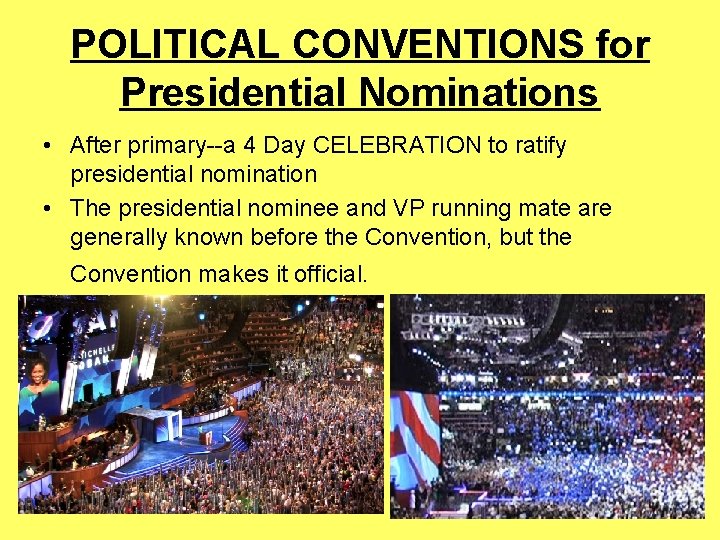
POLITICAL CONVENTIONS for Presidential Nominations • After primary--a 4 Day CELEBRATION to ratify presidential nomination • The presidential nominee and VP running mate are generally known before the Convention, but the Convention makes it official.
Minor Party and Independent Candidates • Minor parties will also hold primaries and conventions (ex. Libertarians) • Independent candidates PETITION to get on a ballot and be a candidate for an elected office – NADER in PA in 2008 • The higher the elected position, the more signatures are typically required • Presidential Candidates must petition in each state to get on the state ballot
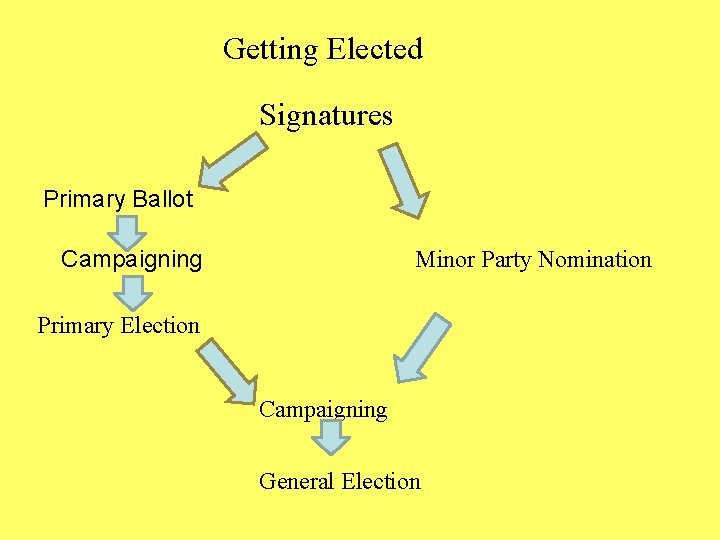
Getting Elected Signatures Primary Ballot Campaigning Minor Party Nomination Primary Election Campaigning General Election
*GENERAL ELECTION • the winners of primary elections face off during the general election, Democrat versus Republican versus Other • Obama v. Mc. Cain v. Nader v. Barr • *ALL REGISTERED VOTERS PARTICIPATE IN GENERAL ELECTION • *YOU CAN VOTE FOR ANY CANDIDATE IN THE GENERAL ELECTION
GENERAL ELECTION • *In all elections EXCEPT the Presidential election (local, state and federal – such as School Board, Commissioner, Mayor, Governor, Senator, etc. ), the candidate who receives the MOST VOTES WINS the election
ELECTING THE PRESIDENT • Presidential Candidates compete to win the *POPULAR VOTE (the people’s vote) in each state (PA, OH, FL, IN, IL, etc. ) • When a candidate wins the Popular Vote in a state, the candidate is entitled to the state’s ELECTORAL COLLEGE VOTES • Winner take all (except in Maine and Nebraska)
Electoral College • US Constitution establishes the Electoral College • Article II, section 1 • If no majority is earned, the House of Representatives will vote to choose the President (and the Senate will choose VP)
ELECTING THE PRESIDENT • How many votes in Electoral College? – Representatives + Senators • 435 + 100 + 3 (D. C. ) = 538 • How much is a majority? – 270: Number of votes needed to become the President • Which states are most valuable?
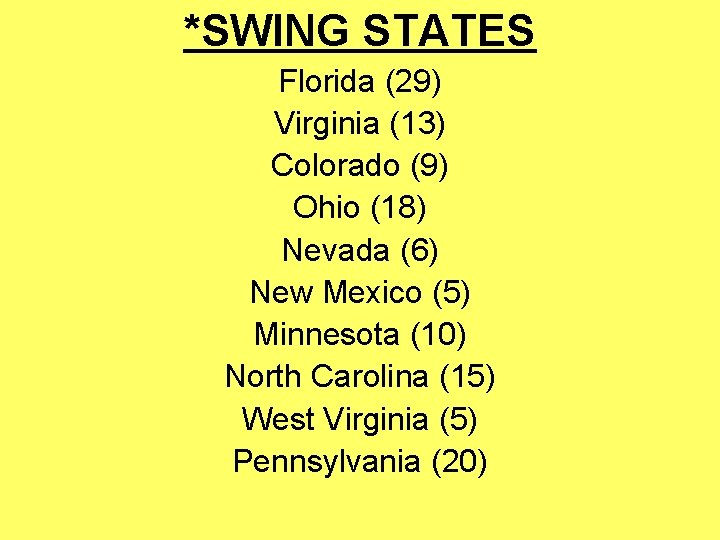
*SWING STATES Florida (29) Virginia (13) Colorado (9) Ohio (18) Nevada (6) New Mexico (5) Minnesota (10) North Carolina (15) West Virginia (5) Pennsylvania (20)