
The Presidency of George W Bush Mini Biography
The Presidency of George W. Bush

Mini Biography • https: //www. youtube. com/watch? v=l. Avvz. PLurs

Background • Son of Pres. George H. W. Bush • Harvard Graduate • Worked in the oil business in Texas • Governor of Texas • Wife- Laura – Her pet project as First Lady was literacy, since she was a former librarian
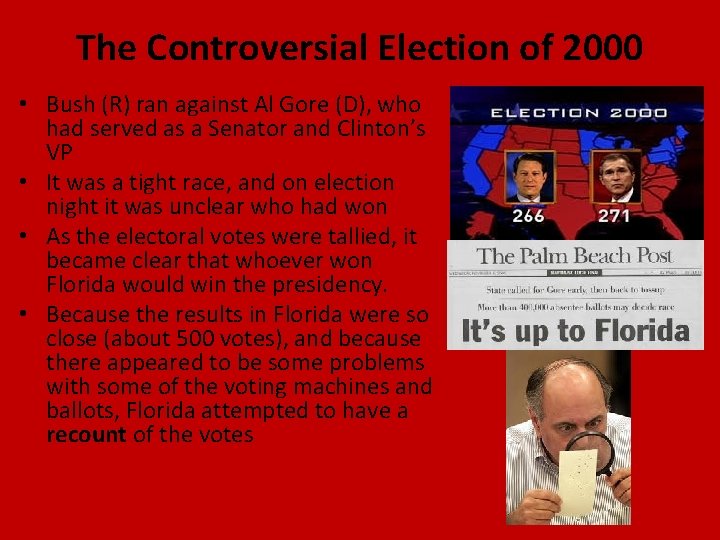
The Controversial Election of 2000 • Bush (R) ran against Al Gore (D), who had served as a Senator and Clinton’s VP • It was a tight race, and on election night it was unclear who had won • As the electoral votes were tallied, it became clear that whoever won Florida would win the presidency. • Because the results in Florida were so close (about 500 votes), and because there appeared to be some problems with some of the voting machines and ballots, Florida attempted to have a recount of the votes
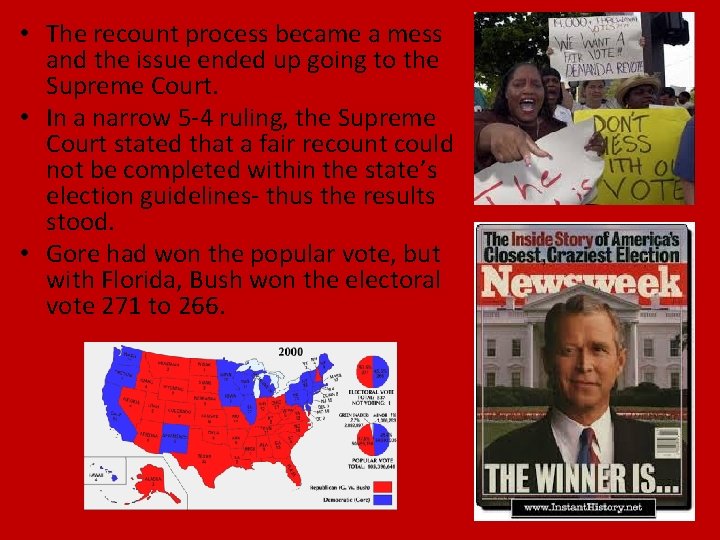
• The recount process became a mess and the issue ended up going to the Supreme Court. • In a narrow 5 -4 ruling, the Supreme Court stated that a fair recount could not be completed within the state’s election guidelines- thus the results stood. • Gore had won the popular vote, but with Florida, Bush won the electoral vote 271 to 266.
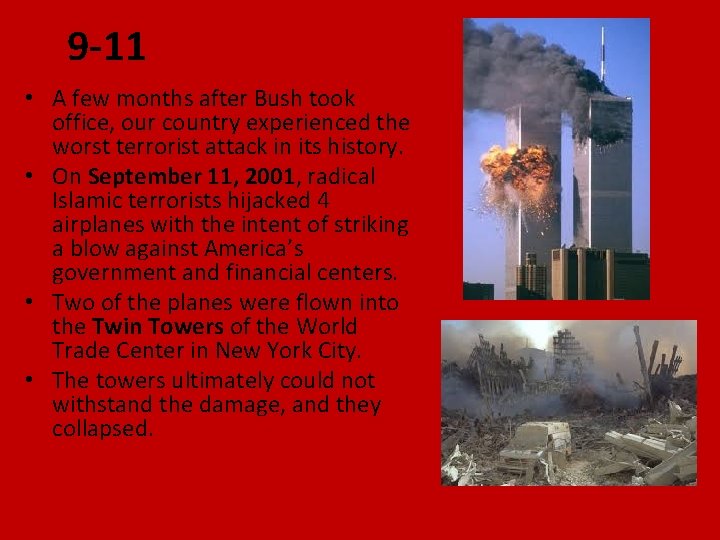
9 -11 • A few months after Bush took office, our country experienced the worst terrorist attack in its history. • On September 11, 2001, radical Islamic terrorists hijacked 4 airplanes with the intent of striking a blow against America’s government and financial centers. • Two of the planes were flown into the Twin Towers of the World Trade Center in New York City. • The towers ultimately could not withstand the damage, and they collapsed.
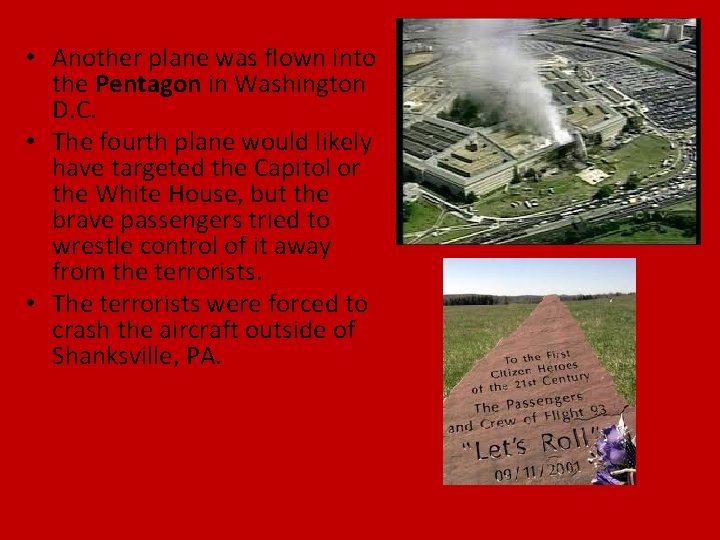
• Another plane was flown into the Pentagon in Washington D. C. • The fourth plane would likely have targeted the Capitol or the White House, but the brave passengers tried to wrestle control of it away from the terrorists. • The terrorists were forced to crash the aircraft outside of Shanksville, PA.
ACTIVITY Listen to the song Where Were You (When the Earth Stopped Turning) by Alan Jackson and analyze the lyrics. • https: //www. youtube. com/watch? v=g. PHnad. J 0 h. E
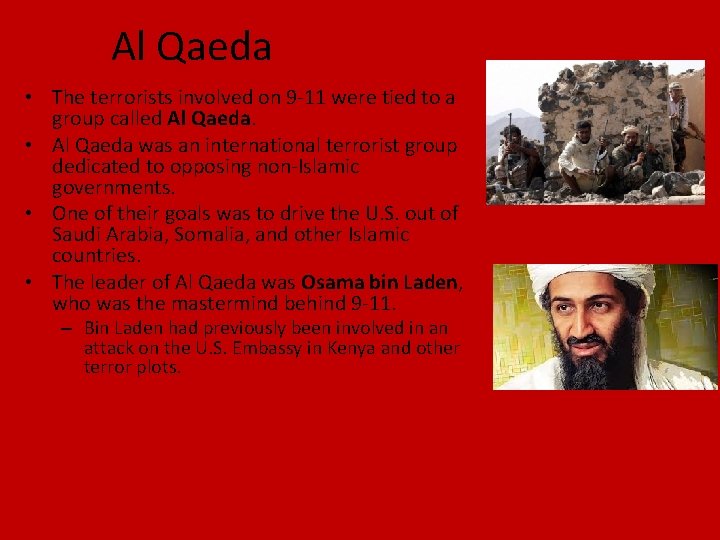
Al Qaeda • The terrorists involved on 9 -11 were tied to a group called Al Qaeda. • Al Qaeda was an international terrorist group dedicated to opposing non-Islamic governments. • One of their goals was to drive the U. S. out of Saudi Arabia, Somalia, and other Islamic countries. • The leader of Al Qaeda was Osama bin Laden, who was the mastermind behind 9 -11. – Bin Laden had previously been involved in an attack on the U. S. Embassy in Kenya and other terror plots.
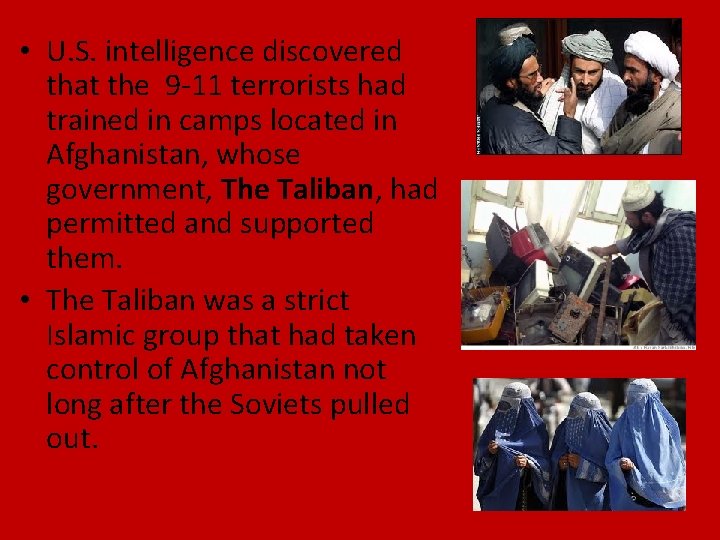
• U. S. intelligence discovered that the 9 -11 terrorists had trained in camps located in Afghanistan, whose government, The Taliban, had permitted and supported them. • The Taliban was a strict Islamic group that had taken control of Afghanistan not long after the Soviets pulled out.
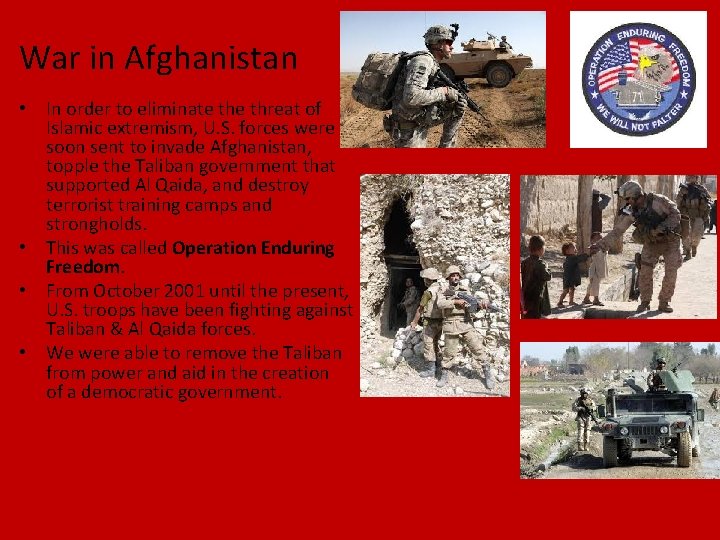
War in Afghanistan • In order to eliminate threat of Islamic extremism, U. S. forces were soon sent to invade Afghanistan, topple the Taliban government that supported Al Qaida, and destroy terrorist training camps and strongholds. • This was called Operation Enduring Freedom. • From October 2001 until the present, U. S. troops have been fighting against Taliban & Al Qaida forces. • We were able to remove the Taliban from power and aid in the creation of a democratic government.
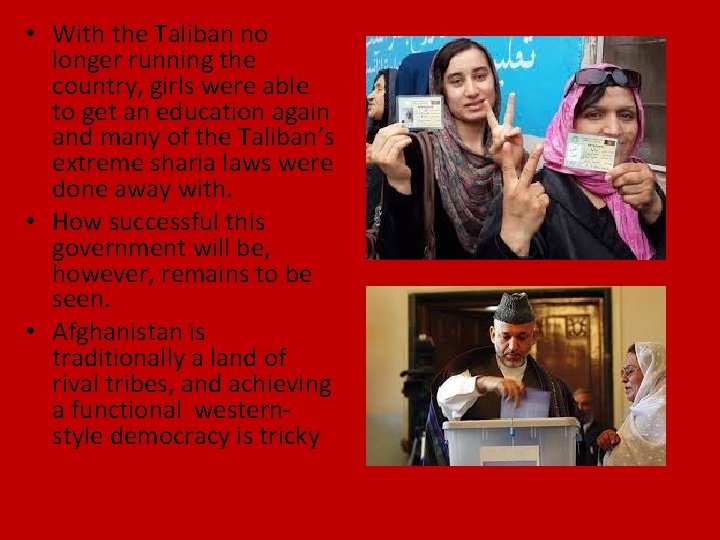
• With the Taliban no longer running the country, girls were able to get an education again and many of the Taliban’s extreme sharia laws were done away with. • How successful this government will be, however, remains to be seen. • Afghanistan is traditionally a land of rival tribes, and achieving a functional westernstyle democracy is tricky
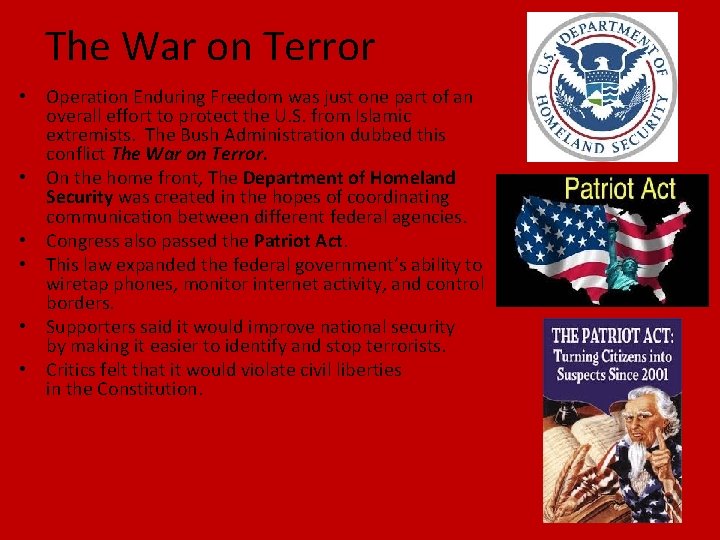
The War on Terror • Operation Enduring Freedom was just one part of an overall effort to protect the U. S. from Islamic extremists. The Bush Administration dubbed this conflict The War on Terror. • On the home front, The Department of Homeland Security was created in the hopes of coordinating communication between different federal agencies. • Congress also passed the Patriot Act. • This law expanded the federal government’s ability to wiretap phones, monitor internet activity, and control borders. • Supporters said it would improve national security by making it easier to identify and stop terrorists. • Critics felt that it would violate civil liberties in the Constitution.
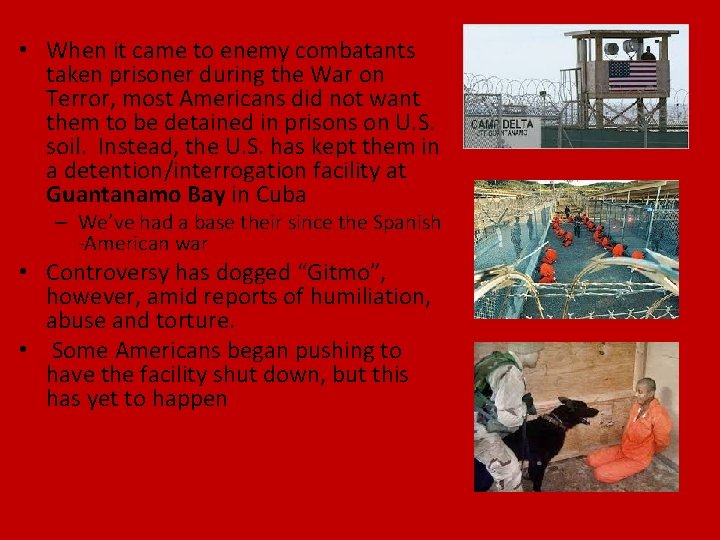
• When it came to enemy combatants taken prisoner during the War on Terror, most Americans did not want them to be detained in prisons on U. S. soil. Instead, the U. S. has kept them in a detention/interrogation facility at Guantanamo Bay in Cuba – We’ve had a base their since the Spanish -American war • Controversy has dogged “Gitmo”, however, amid reports of humiliation, abuse and torture. • Some Americans began pushing to have the facility shut down, but this has yet to happen
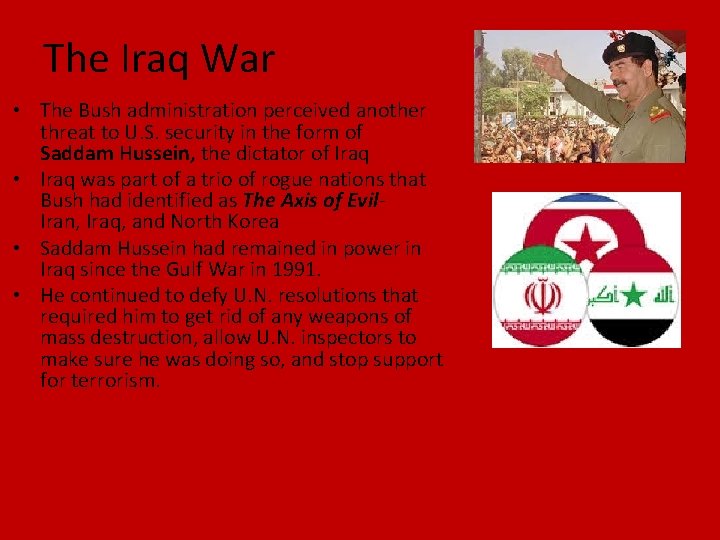
The Iraq War • The Bush administration perceived another threat to U. S. security in the form of Saddam Hussein, the dictator of Iraq • Iraq was part of a trio of rogue nations that Bush had identified as The Axis of Evil. Iran, Iraq, and North Korea • Saddam Hussein had remained in power in Iraq since the Gulf War in 1991. • He continued to defy U. N. resolutions that required him to get rid of any weapons of mass destruction, allow U. N. inspectors to make sure he was doing so, and stop support for terrorism.
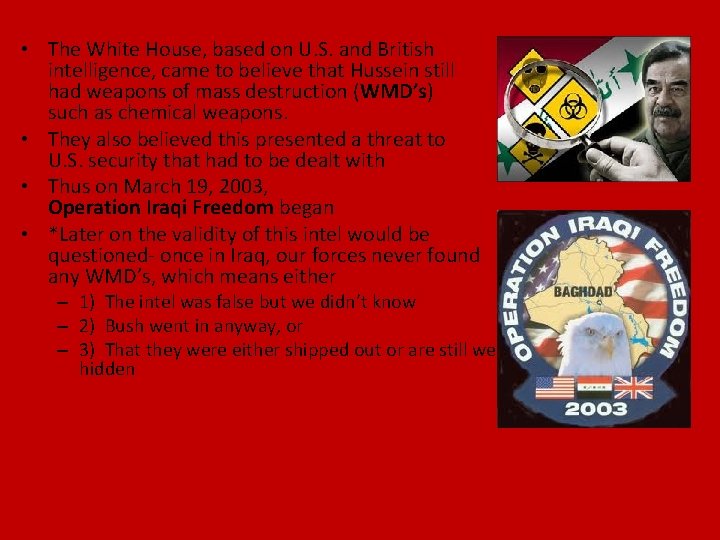
• The White House, based on U. S. and British intelligence, came to believe that Hussein still had weapons of mass destruction (WMD’s) such as chemical weapons. • They also believed this presented a threat to U. S. security that had to be dealt with • Thus on March 19, 2003, Operation Iraqi Freedom began • *Later on the validity of this intel would be questioned- once in Iraq, our forces never found any WMD’s, which means either – 1) The intel was false but we didn’t know – 2) Bush went in anyway, or – 3) That they were either shipped out or are still well hidden
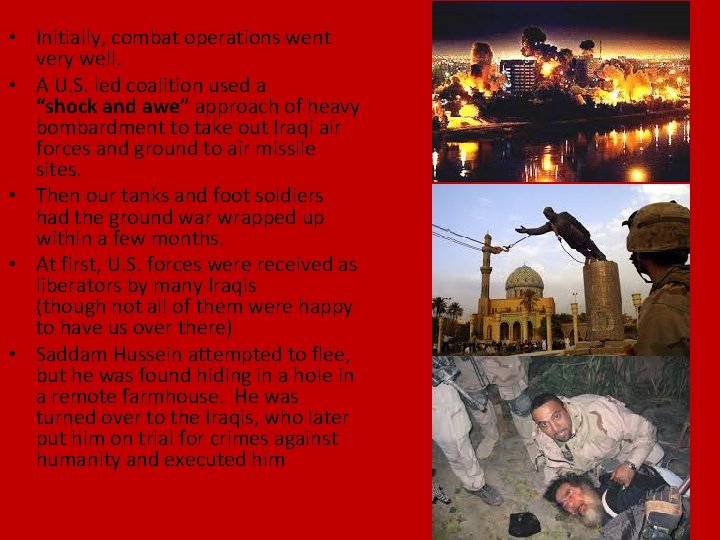
• Initially, combat operations went very well. • A U. S. led coalition used a “shock and awe” approach of heavy bombardment to take out Iraqi air forces and ground to air missile sites. • Then our tanks and foot soldiers had the ground war wrapped up within a few months. • At first, U. S. forces were received as liberators by many Iraqis (though not all of them were happy to have us over there) • Saddam Hussein attempted to flee, but he was found hiding in a hole in a remote farmhouse. He was turned over to the Iraqis, who later put him on trial for crimes against humanity and executed him
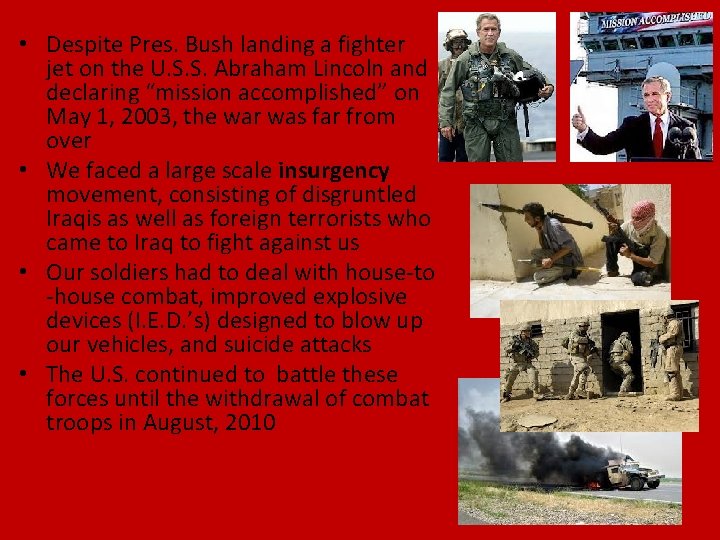
• Despite Pres. Bush landing a fighter jet on the U. S. S. Abraham Lincoln and declaring “mission accomplished” on May 1, 2003, the war was far from over • We faced a large scale insurgency movement, consisting of disgruntled Iraqis as well as foreign terrorists who came to Iraq to fight against us • Our soldiers had to deal with house-to -house combat, improved explosive devices (I. E. D. ’s) designed to blow up our vehicles, and suicide attacks • The U. S. continued to battle these forces until the withdrawal of combat troops in August, 2010

Iraq Today • Iraq held its first free elections in 2005, but has had issues with factions, corruption, and violence since then. • Another major issue is the recent rise of ISIS (The Islamic State of Iraq & Syria), an anti-western militant Islamist group that seeks to create an independent Islamic state in the region (a modern-day caliphate) • They have used brutal methods to seize control of several major cities and numerous oil fields. • The U. S. and its allies have conducted numerous airstrikes, which have helped the democratic Iraqi government to reassert itself, but we have been hesitant to involve ground troops.
Thought Question What were the pros & cons of our invasion of Iraq?
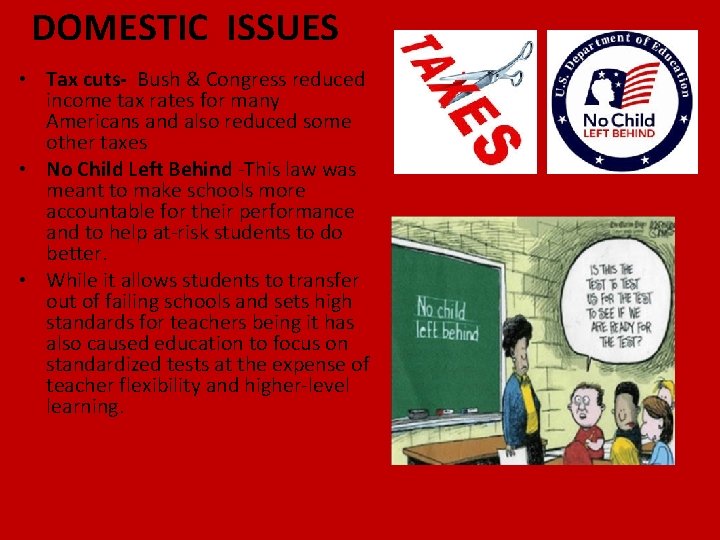
DOMESTIC ISSUES • Tax cuts- Bush & Congress reduced income tax rates for many Americans and also reduced some other taxes • No Child Left Behind -This law was meant to make schools more accountable for their performance and to help at-risk students to do better. • While it allows students to transfer out of failing schools and sets high standards for teachers being it has also caused education to focus on standardized tests at the expense of teacher flexibility and higher-level learning.
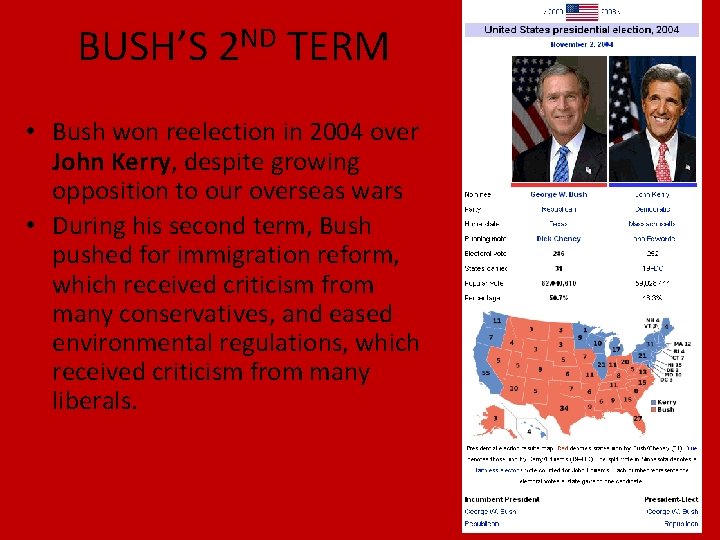
BUSH’S 2 ND TERM • Bush won reelection in 2004 over John Kerry, despite growing opposition to our overseas wars • During his second term, Bush pushed for immigration reform, which received criticism from many conservatives, and eased environmental regulations, which received criticism from many liberals.

HURRICANE KATRINA • Hurricane Katrina struck the Gulf Coast (and New Orleans in particular) in 2005. • It was the worst natural disaster in U. S. history. • The levees in New Orleans broke, causing massive flooding, which devastated the city. • Over 1, 100 people lost their lives.

• Thousands who chose not to evacuate flocked to the Superdome, where there was inadequate food, sanitation, and police presence. Reports of sexual abuse and other crimes were widespread. • Violence and looting in the wake of the storm made matters worse.
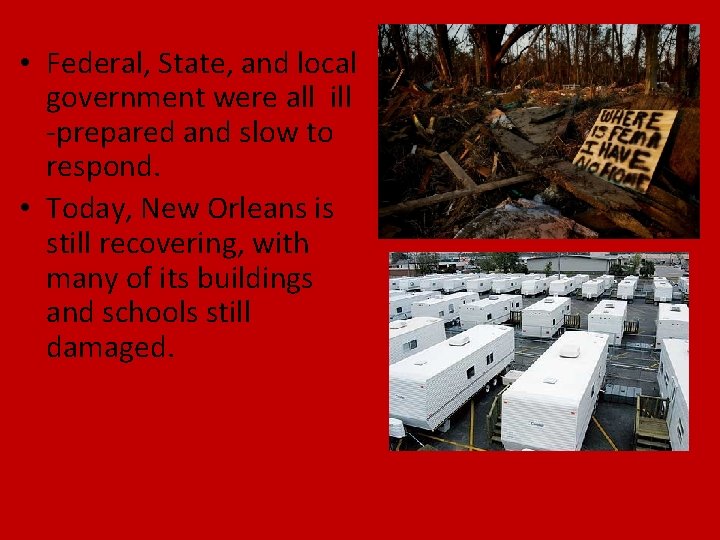
• Federal, State, and local government were all ill -prepared and slow to respond. • Today, New Orleans is still recovering, with many of its buildings and schools still damaged.
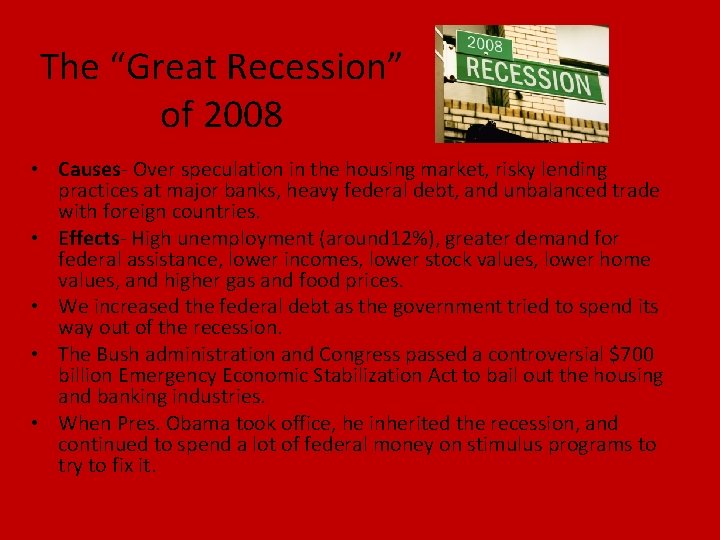
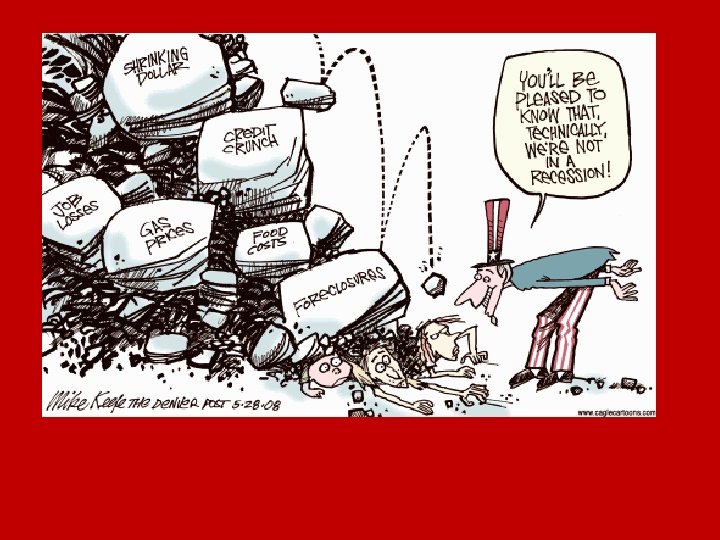
The “Great Recession” of 2008 • Causes- Over speculation in the housing market, risky lending practices at major banks, heavy federal debt, and unbalanced trade with foreign countries. • Effects- High unemployment (around 12%), greater demand for federal assistance, lower incomes, lower stock values, lower home values, and higher gas and food prices. • We increased the federal debt as the government tried to spend its way out of the recession. • The Bush administration and Congress passed a controversial $700 billion Emergency Economic Stabilization Act to bail out the housing and banking industries. • When Pres. Obama took office, he inherited the recession, and continued to spend a lot of federal money on stimulus programs to try to fix it.
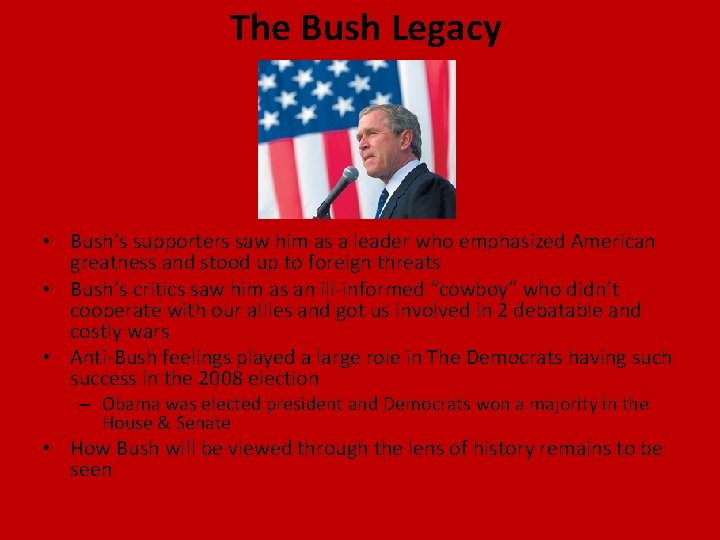
The Bush Legacy • Bush’s supporters saw him as a leader who emphasized American greatness and stood up to foreign threats • Bush’s critics saw him as an ill-informed “cowboy” who didn’t cooperate with our allies and got us involved in 2 debatable and costly wars • Anti-Bush feelings played a large role in The Democrats having such success in the 2008 election – Obama was elected president and Democrats won a majority in the House & Senate • How Bush will be viewed through the lens of history remains to be seen
- Slides: 28