
The present progressive ir a with infinitives direct
- Slides: 7
The present progressive, ir a with infinitives, direct object pronouns Español 2 Sra. Godsey Midfield High School
The present progressive � Used to talk about what is happening RIGHT NOW! � The equivalent to the –ing form in English To form the present progressive: 1. Use a conjugated form of estar (estoy, estás, está, estamos, están) 2. Follow “estar” with the present participle of the infinitive
To form the present participle: 1. Drop the –ar, -er, or –ir off of the infinitive. 2. Add –ando to –ar verbs 3. Add –iendo to –er/ir verbs ***The present participle of stem-changing –ir verbs have the same stem change as in the preterite. Examples: 1. hablar hablando 2. Hacer haciendo 3. Escribir escribiendo 4. Dormir durmiendo 5. Leer leyendo
Ir a with infinitives � This phrase is used to say what you and other are going to do. � Ir must be conjugated to match the subject (voy, vas, vamos, van) � Ir and venir are used in the present tense, usually, to mean going or coming. � They must be conjugated. Example: 1. Voy a estudiar. I’m going to study.
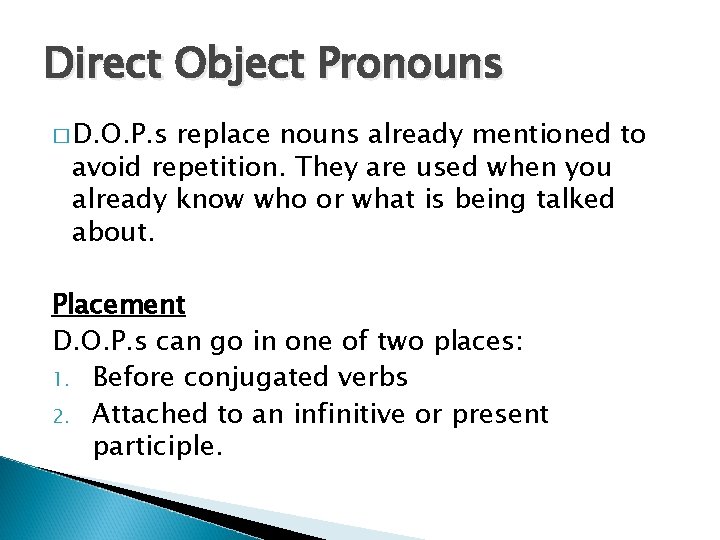
Direct Object Pronouns � D. O. P. s replace nouns already mentioned to avoid repetition. They are used when you already know who or what is being talked about. Placement D. O. P. s can go in one of two places: 1. Before conjugated verbs 2. Attached to an infinitive or present participle.
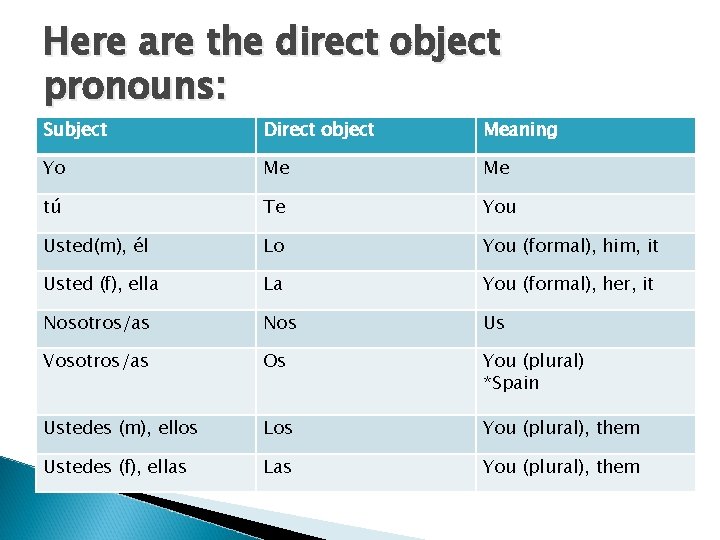
Here are the direct object pronouns: Subject Direct object Meaning Yo Me Me tú Te You Usted(m), él Lo You (formal), him, it Usted (f), ella La You (formal), her, it Nosotros/as Nos Us Vosotros/as Os You (plural) *Spain Ustedes (m), ellos Los You (plural), them Ustedes (f), ellas Las You (plural), them
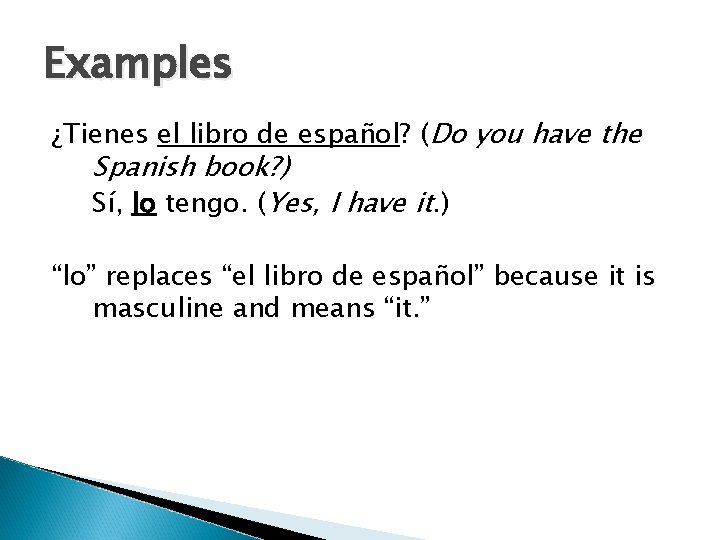
Examples ¿Tienes el libro de español? (Do you have the Spanish book? ) Sí, lo tengo. (Yes, I have it. ) “lo” replaces “el libro de español” because it is masculine and means “it. ”