
The PreHistory of the Two Black Hole Collision
“The Pre-History of the Two Black Hole Collision Problem” Invited Talk History of Numerical Relativity Session American Physical Society Columbus, OH April 15, 2018 Dr. Larry Smarr Director, California Institute for Telecommunications and Information Technology Harry E. Gruber Professor, Dept. of Computer Science and Engineering Jacobs School of Engineering, UCSD http: //lsmarr. calit 2. net 1
Abstract From the first mathematical solution of Einstein's equations of General Relativity, representing what we now know as a black hole, in 1918 to the observation of the gravitational radiation from two colliding black holes in 2015 was almost 100 years. I will give a brief history of the mathematical and computational developments, up to the 1970 s when the first computational solution of Einsteins equations for two black holes colliding head-on was obtained. The 1920 s saw the equation of motion posed, the 1930 s envisioned the two-body problem, the 1940 s set up the Cauchy problem, the 1950 s conceived of numerical relativity, the 1960 s witnessed the first numerical solutions, and the 1970 s produced the first numerical collision with generation of gravitational radiation.
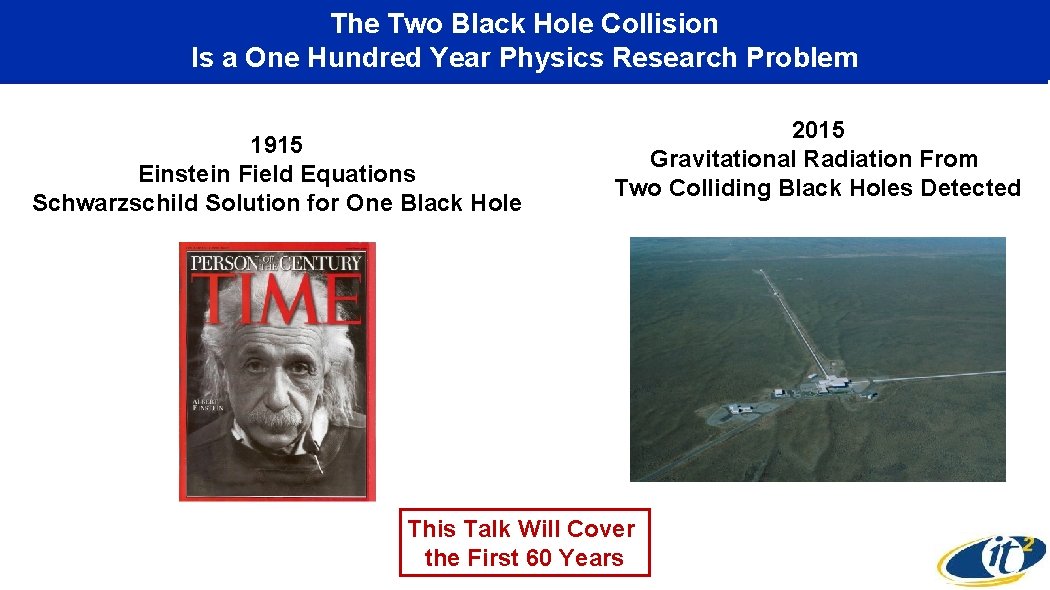
The Two Black Hole Collision Is a One Hundred Year Physics Research Problem 1915 Einstein Field Equations Schwarzschild Solution for One Black Hole 2015 Gravitational Radiation From Two Colliding Black Holes Detected This Talk Will Cover the First 60 Years
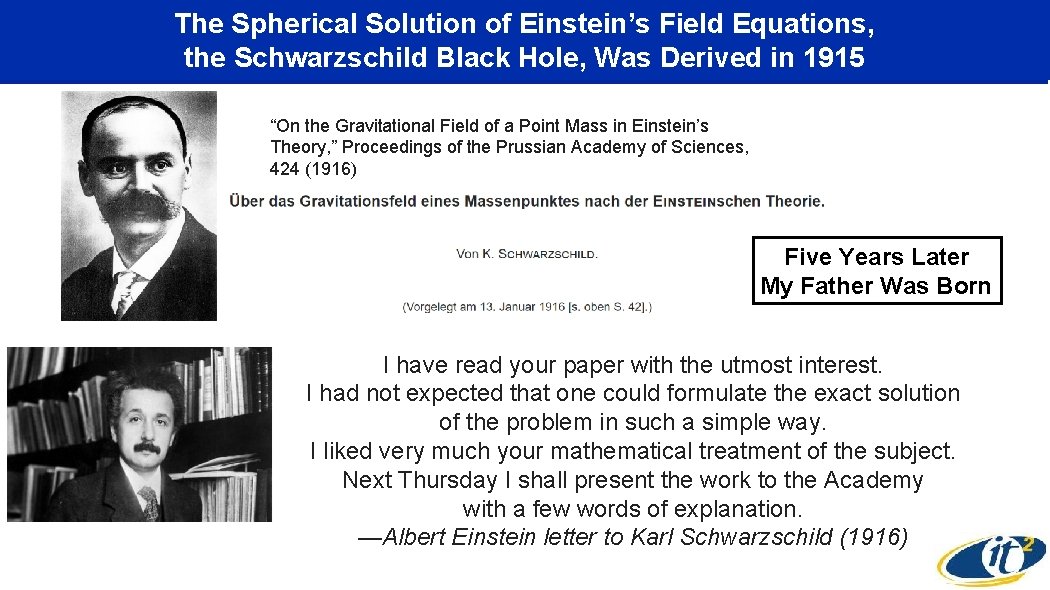
The Spherical Solution of Einstein’s Field Equations, the Schwarzschild Black Hole, Was Derived in 1915 “On the Gravitational Field of a Point Mass in Einstein’s Theory, ” Proceedings of the Prussian Academy of Sciences, 424 (1916) Five Years Later My Father Was Born I have read your paper with the utmost interest. I had not expected that one could formulate the exact solution of the problem in such a simple way. I liked very much your mathematical treatment of the subject. Next Thursday I shall present the work to the Academy with a few words of explanation. —Albert Einstein letter to Karl Schwarzschild (1916)
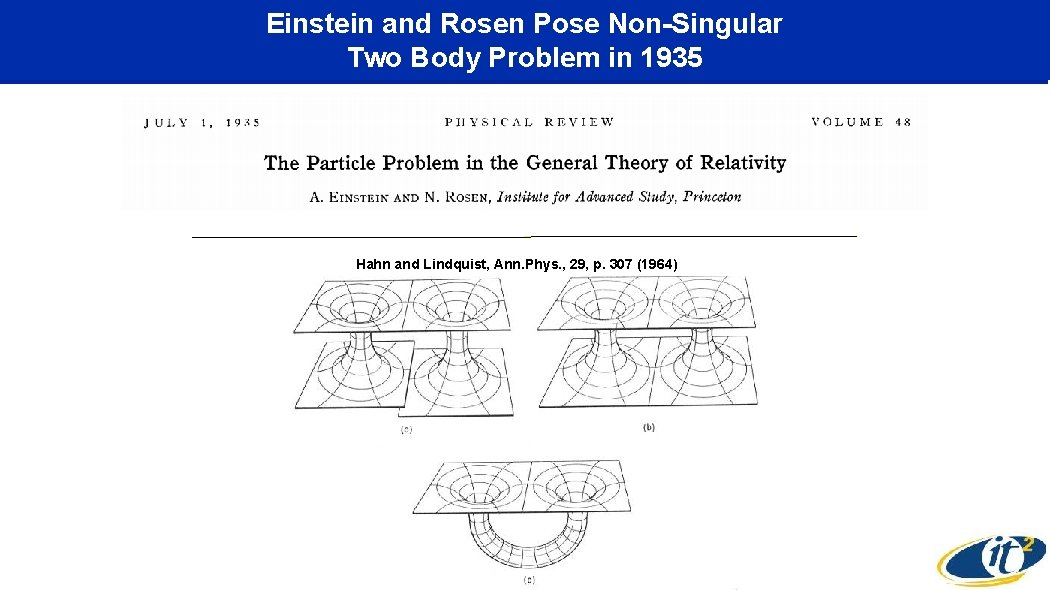
Einstein and Rosen Pose Non-Singular Two Body Problem in 1935 Hahn and Lindquist, Ann. Phys. , 29, p. 307 (1964)
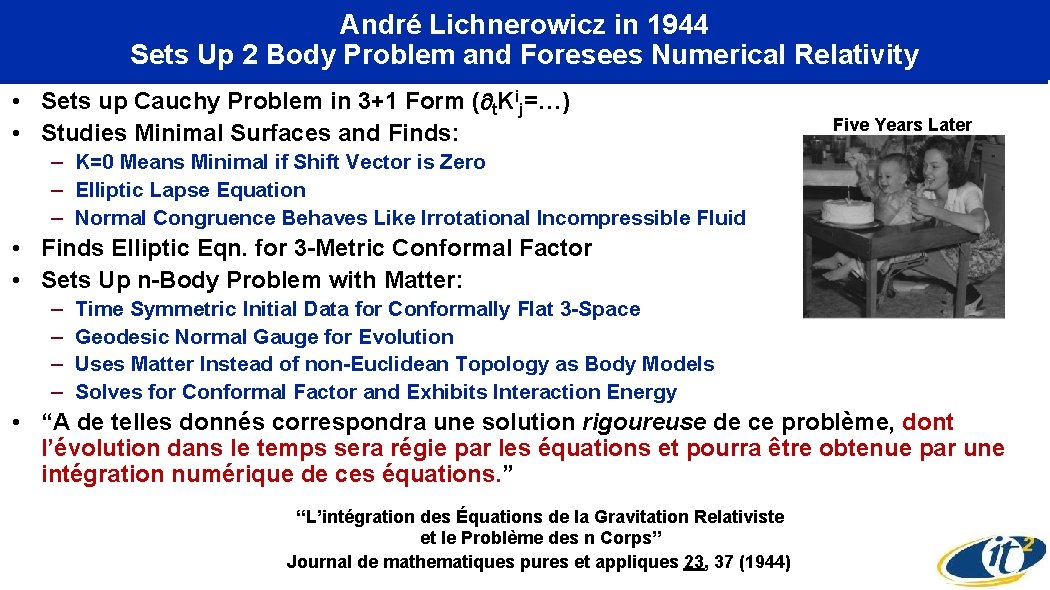
André Lichnerowicz in 1944 Sets Up 2 Body Problem and Foresees Numerical Relativity • Sets up Cauchy Problem in 3+1 Form ( t. Kij=…) • Studies Minimal Surfaces and Finds: Five Years Later – K=0 Means Minimal if Shift Vector is Zero – Elliptic Lapse Equation – Normal Congruence Behaves Like Irrotational Incompressible Fluid • Finds Elliptic Eqn. for 3 -Metric Conformal Factor • Sets Up n-Body Problem with Matter: – – Time Symmetric Initial Data for Conformally Flat 3 -Space Geodesic Normal Gauge for Evolution Uses Matter Instead of non-Euclidean Topology as Body Models Solves for Conformal Factor and Exhibits Interaction Energy • “A de telles donnés correspondra une solution rigoureuse de ce problème, dont l’évolution dans le temps sera régie par les équations et pourra être obtenue par une intégration numérique de ces équations. ” “L’intégration des Équations de la Gravitation Relativiste et le Problème des n Corps” Journal de mathematiques pures et appliques 23, 37 (1944)
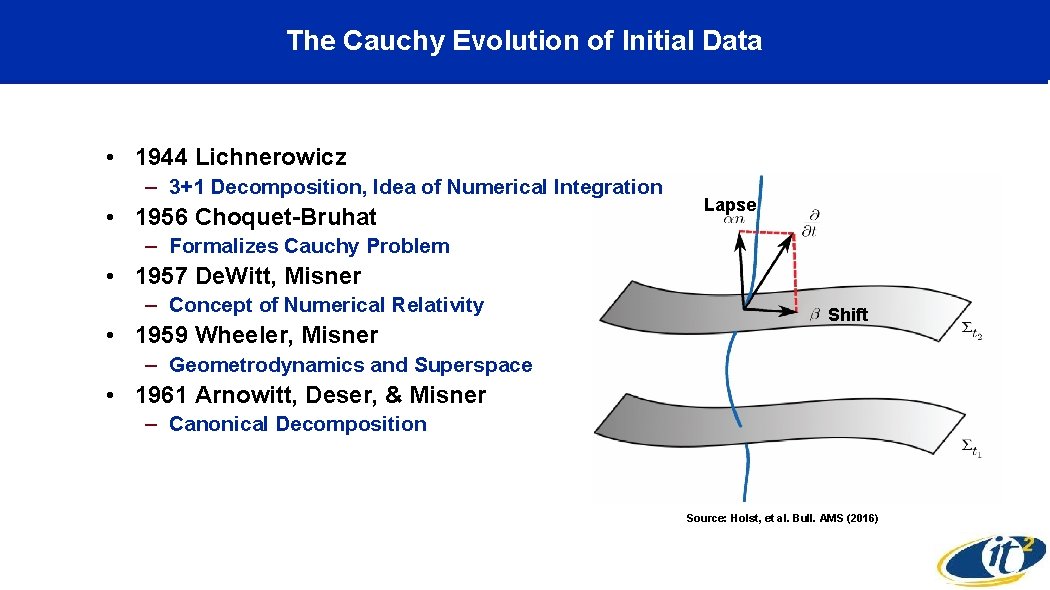
The Cauchy Evolution of Initial Data • 1944 Lichnerowicz – 3+1 Decomposition, Idea of Numerical Integration • 1956 Choquet-Bruhat Lapse – Formalizes Cauchy Problem • 1957 De. Witt, Misner – Concept of Numerical Relativity • 1959 Wheeler, Misner Shift – Geometrodynamics and Superspace • 1961 Arnowitt, Deser, & Misner – Canonical Decomposition Source: Holst, et al. Bull. AMS (2016)
Chapel Hill Conference on the Role of Gravitation in Physics 1957 • Bryce De. Witt asked if the Cauchy problem is now understood sufficiently to be put on an electronic computer for actual calculation. • Charles Misner answered that he had computed initial data for two Einstein -Rosen throats that “can be interpreted as two particles which are nonsingular… These partial differential equations, although very difficult, can then in principle be put on a computer. ” • Misner thinks that one can now give initial conditions so that one would expect to get gravitational radiation, and computers could be used for this. Conference on the Role of Gravitation in Physics, Wright Air Development Center Technical Report 57 -216 (1957) http: //www. edition-open-sources. org/media/sources/5/Sources 5. pdf
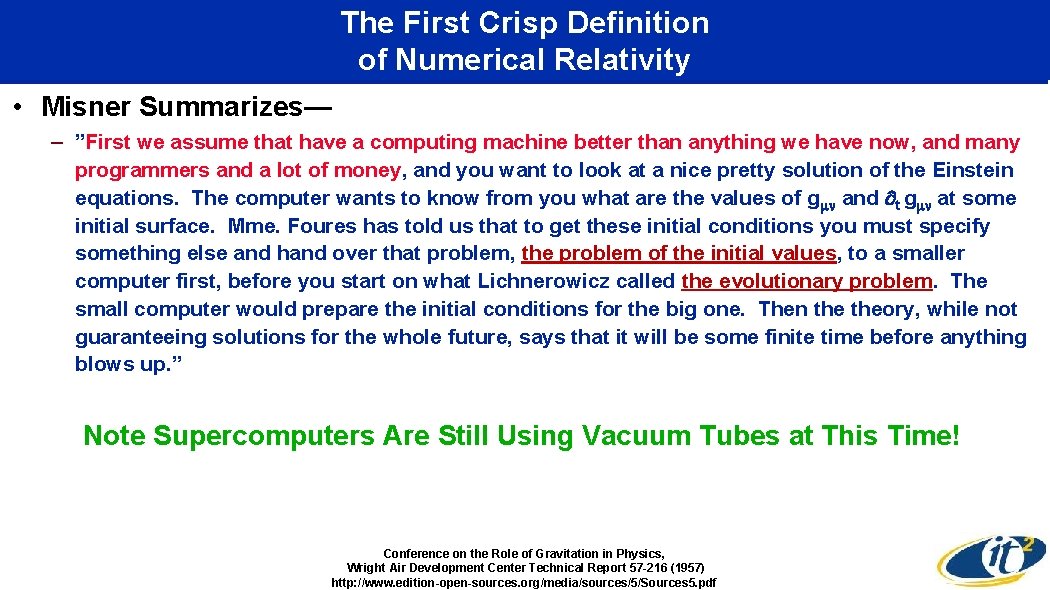
The First Crisp Definition of Numerical Relativity • Misner Summarizes— – ”First we assume that have a computing machine better than anything we have now, and many programmers and a lot of money, and you want to look at a nice pretty solution of the Einstein equations. The computer wants to know from you what are the values of g and t g at some initial surface. Mme. Foures has told us that to get these initial conditions you must specify something else and hand over that problem, the problem of the initial values, to a smaller computer first, before you start on what Lichnerowicz called the evolutionary problem. The small computer would prepare the initial conditions for the big one. Then theory, while not guaranteeing solutions for the whole future, says that it will be some finite time before anything blows up. ” Note Supercomputers Are Still Using Vacuum Tubes at This Time! Conference on the Role of Gravitation in Physics, Wright Air Development Center Technical Report 57 -216 (1957) http: //www. edition-open-sources. org/media/sources/5/Sources 5. pdf
Bryce De. Witt Foresees the Three Major Conceptual Challenges of Numerical Relativity • “Bryce De. Witt pointed out some difficulties encountered in high-speed computational techniques. Problems would arise in applying computers to gravitational radiation, since you don’t want the radiation to move quickly out of the range of your computer. ” --page 83 of 1957 Chapel Hill Conference • “Bryce saw clearly in 1957…the conceptual problems in simultaneously worrying about”: – The Computer Algorithm – The Structure of Space-Time – The Coordinate System Source: Larry Smarr, The Contribution Of Bryce De. Witt To Classical General Relativity In Ahead of His Time: Bryce S. De. Witt. 1984, ed. S. Christensen
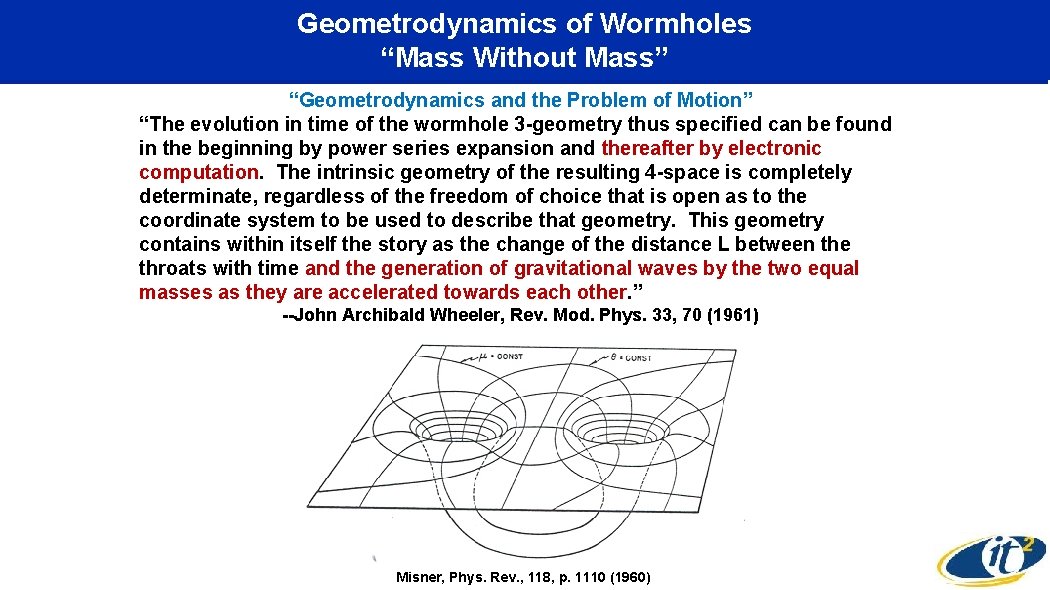
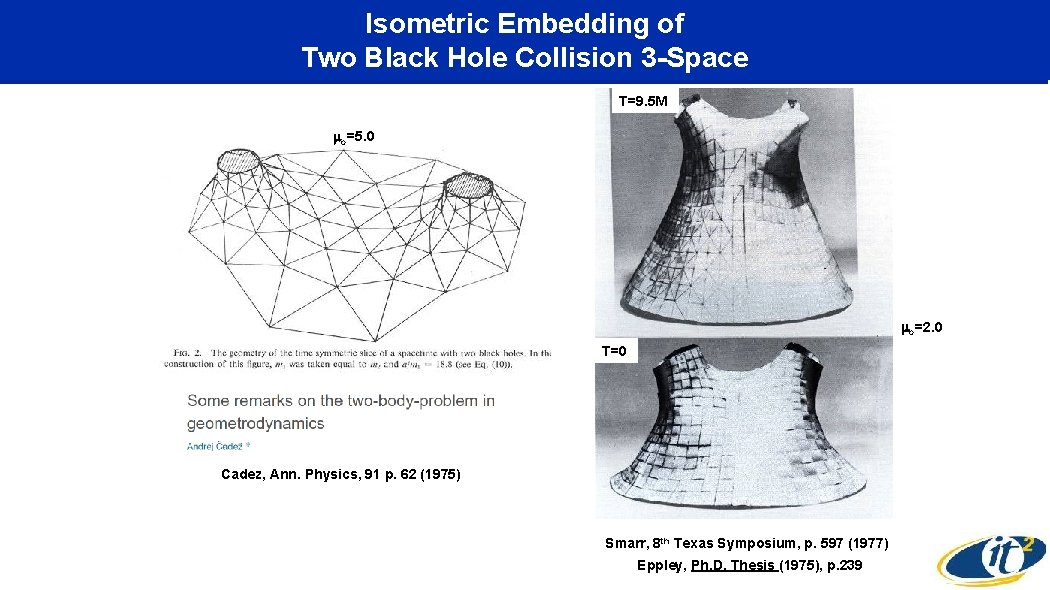
Geometrodynamics of Wormholes “Mass Without Mass” “Geometrodynamics and the Problem of Motion” “The evolution in time of the wormhole 3 -geometry thus specified can be found in the beginning by power series expansion and thereafter by electronic computation. The intrinsic geometry of the resulting 4 -space is completely determinate, regardless of the freedom of choice that is open as to the coordinate system to be used to describe that geometry. This geometry contains within itself the story as the change of the distance L between the throats with time and the generation of gravitational waves by the two equal masses as they are accelerated towards each other. ” --John Archibald Wheeler, Rev. Mod. Phys. 33, 70 (1961) Misner, Phys. Rev. , 118, p. 1110 (1960)
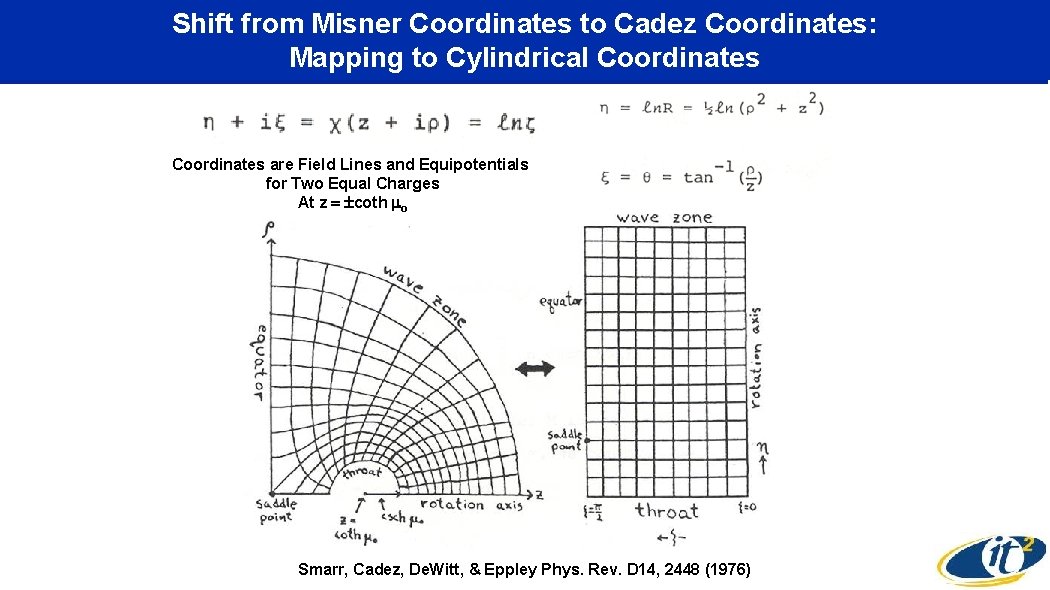
Hahn and Lindquist 1964 “The Two Body Problem in Geometrodynamics” • Conceptually Studying Causality and Area of Throats • Black Hole is not a Term until Four Years Later • Used Misner Coordinates – Good Near Throats – Terrible at Large Distances – Mesh Size 51 x 151 • Used Geodesic Normal Coordinates • Initial Data Represented “Already Merged” Black Holes ( o=1. 6) • Used IBM 7090 (~0. 3 MFLOPS or ~1 Millionth the Speed of an i. Phone 7) – Integrated Very Short Time to Future (<0. 3 M) • Proof of Principle that Numerical Relativity Worked Hahn and Lindquist, Ann. Phys. , 29, p. 304 (1964)
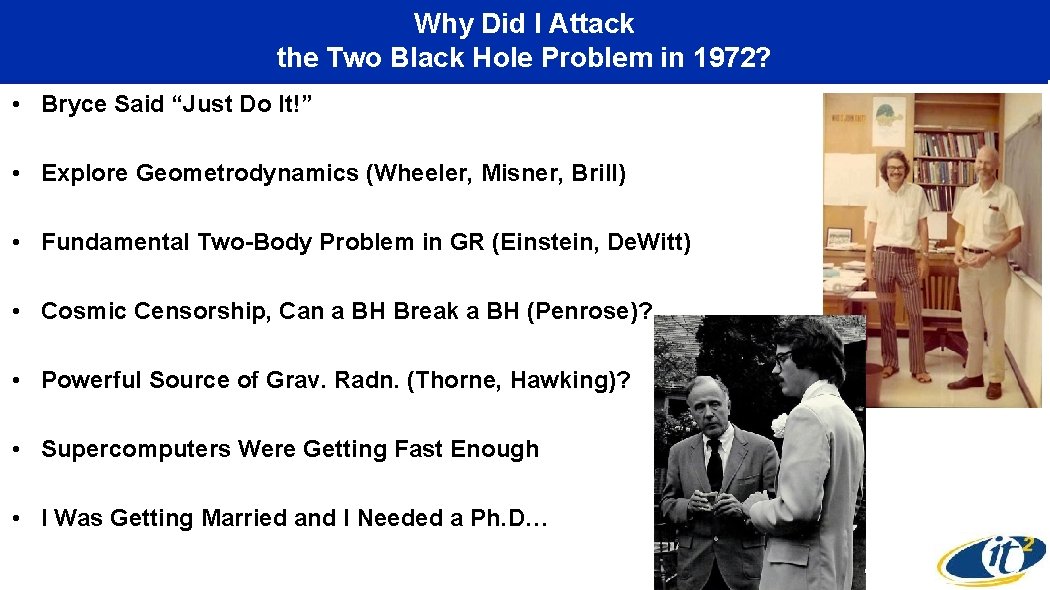
Why Did I Attack the Two Black Hole Problem in 1972? • Bryce Said “Just Do It!” • Explore Geometrodynamics (Wheeler, Misner, Brill) • Fundamental Two-Body Problem in GR (Einstein, De. Witt) • Cosmic Censorship, Can a BH Break a BH (Penrose)? • Powerful Source of Grav. Radn. (Thorne, Hawking)? • Supercomputers Were Getting Fast Enough • I Was Getting Married and I Needed a Ph. D…
What is the End State of Two Colliding Black Holes? “These considerations have very little to say about large perturbations, however. We might, for example, envisage two comparable black holes spiraling into one another. Have we any reason, other than wishful thinking, to believe that a black hole will be formed, rather than a naked singularity? Very little, I feel; it is really a completely open question. ” --Roger Penrose, 6 th Texas Symposium on Relativistic Astrophysics, p. 131 (1973)

Expected Behavior of Event Horizon and Apparent Horizons This Was the Status of Knowledge As I Started to Work on the 2 BH Collision In 1972… Hawking, Les Houches Lectures, p. 597 (1972)
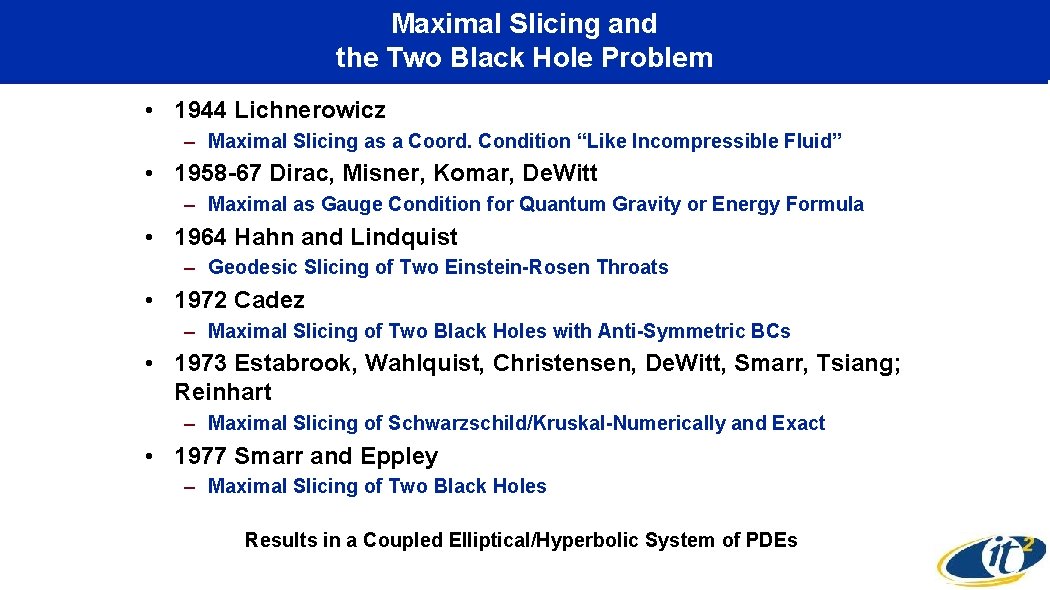
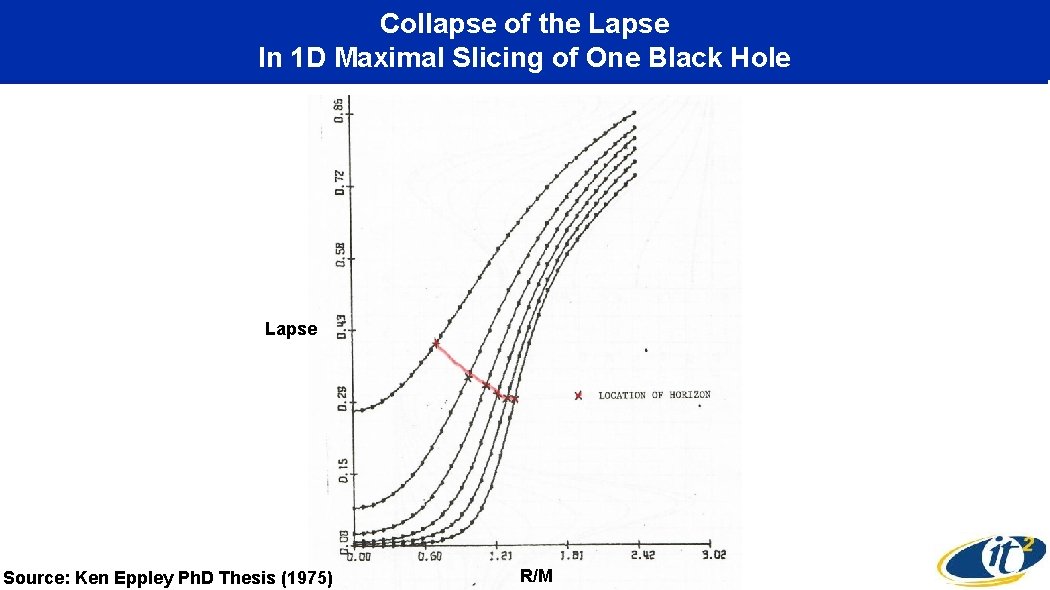
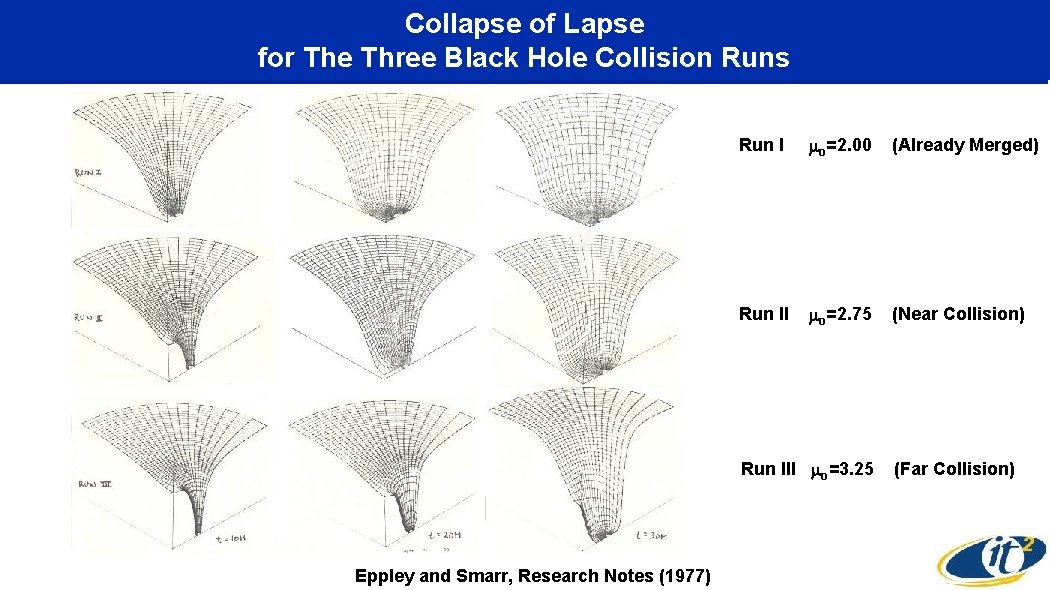
Maximal Slicing and the Two Black Hole Problem • 1944 Lichnerowicz – Maximal Slicing as a Coord. Condition “Like Incompressible Fluid” • 1958 -67 Dirac, Misner, Komar, De. Witt – Maximal as Gauge Condition for Quantum Gravity or Energy Formula • 1964 Hahn and Lindquist – Geodesic Slicing of Two Einstein-Rosen Throats • 1972 Cadez – Maximal Slicing of Two Black Holes with Anti-Symmetric BCs • 1973 Estabrook, Wahlquist, Christensen, De. Witt, Smarr, Tsiang; Reinhart – Maximal Slicing of Schwarzschild/Kruskal-Numerically and Exact • 1977 Smarr and Eppley – Maximal Slicing of Two Black Holes Results in a Coupled Elliptical/Hyperbolic System of PDEs
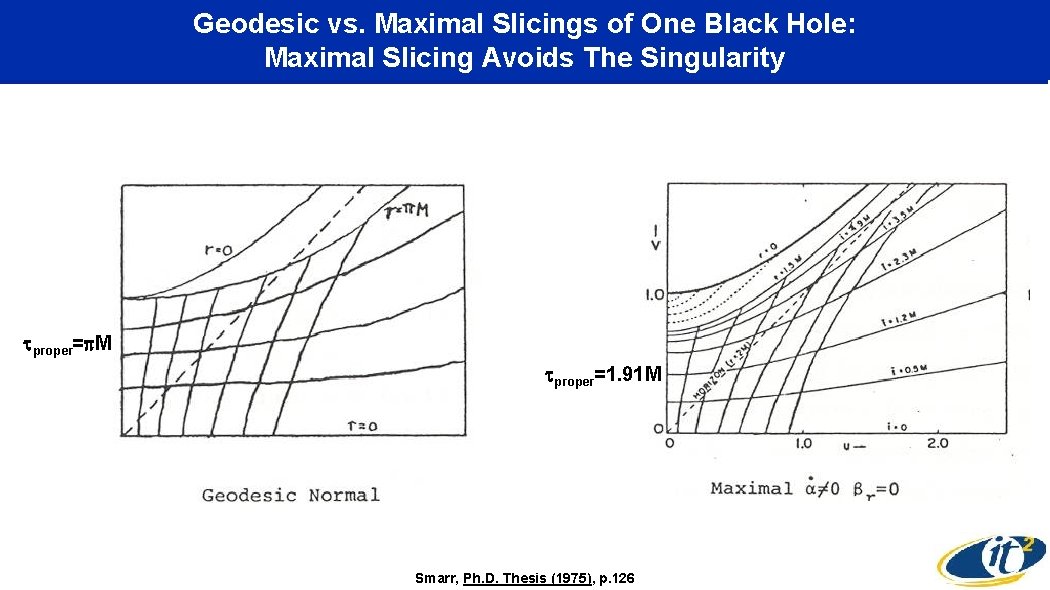
Geodesic vs. Maximal Slicings of One Black Hole: Maximal Slicing Avoids The Singularity proper= M proper=1. 91 M Smarr, Ph. D. Thesis (1975), p. 126
Collapse of the Lapse In 1 D Maximal Slicing of One Black Hole Lapse Source: Ken Eppley Ph. D Thesis (1975) R/M
Shift from Misner Coordinates to Cadez Coordinates: Mapping to Cylindrical Coordinates are Field Lines and Equipotentials for Two Equal Charges At z coth o Smarr, Cadez, De. Witt, & Eppley Phys. Rev. D 14, 2448 (1976)
Collapse of Lapse for The Three Black Hole Collision Runs Run I o=2. 00 (Already Merged) Run II o=2. 75 (Near Collision) Run III o=3. 25 Eppley and Smarr, Research Notes (1977) (Far Collision)
Isometric Embedding of Two Black Hole Collision 3 -Space T=9. 5 M o=5. 0 o=2. 0 T=0 Cadez, Ann. Physics, 91 p. 62 (1975) Smarr, 8 th Texas Symposium, p. 597 (1977) Eppley, Ph. D. Thesis (1975), p. 239
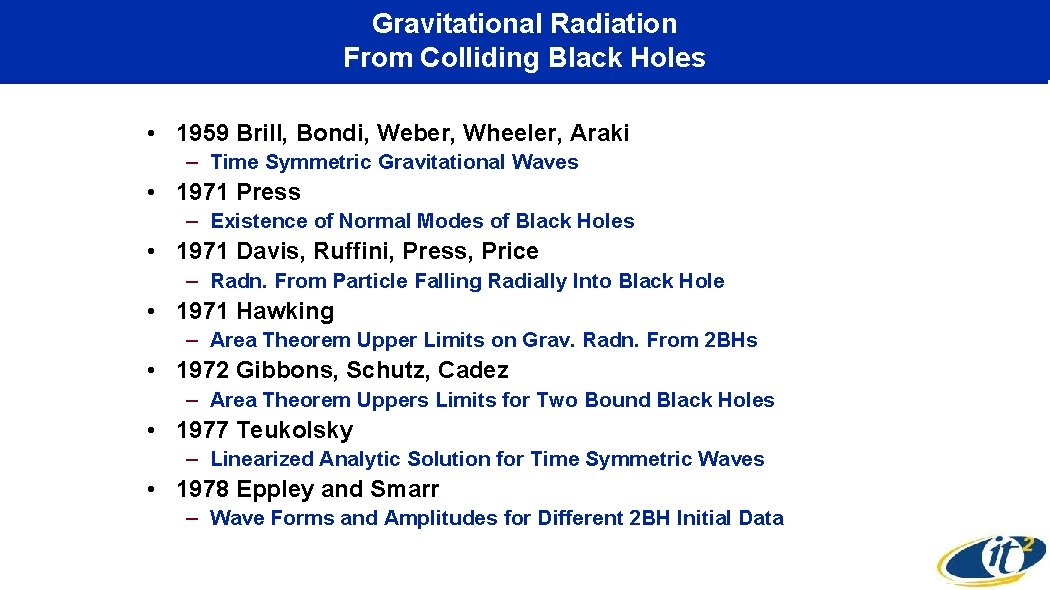
Gravitational Radiation From Colliding Black Holes • 1959 Brill, Bondi, Weber, Wheeler, Araki – Time Symmetric Gravitational Waves • 1971 Press – Existence of Normal Modes of Black Holes • 1971 Davis, Ruffini, Press, Price – Radn. From Particle Falling Radially Into Black Hole • 1971 Hawking – Area Theorem Upper Limits on Grav. Radn. From 2 BHs • 1972 Gibbons, Schutz, Cadez – Area Theorem Uppers Limits for Two Bound Black Holes • 1977 Teukolsky – Linearized Analytic Solution for Time Symmetric Waves • 1978 Eppley and Smarr – Wave Forms and Amplitudes for Different 2 BH Initial Data
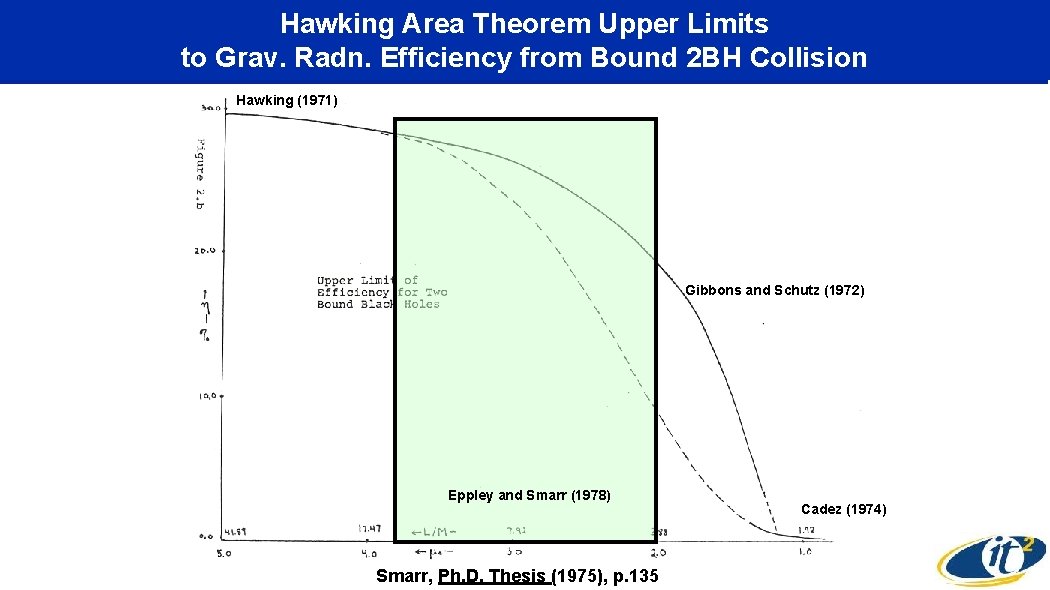
Hawking Area Theorem Upper Limits to Grav. Radn. Efficiency from Bound 2 BH Collision Hawking (1971) Gibbons and Schutz (1972) Eppley and Smarr (1978) Smarr, Ph. D. Thesis (1975), p. 135 Cadez (1974)
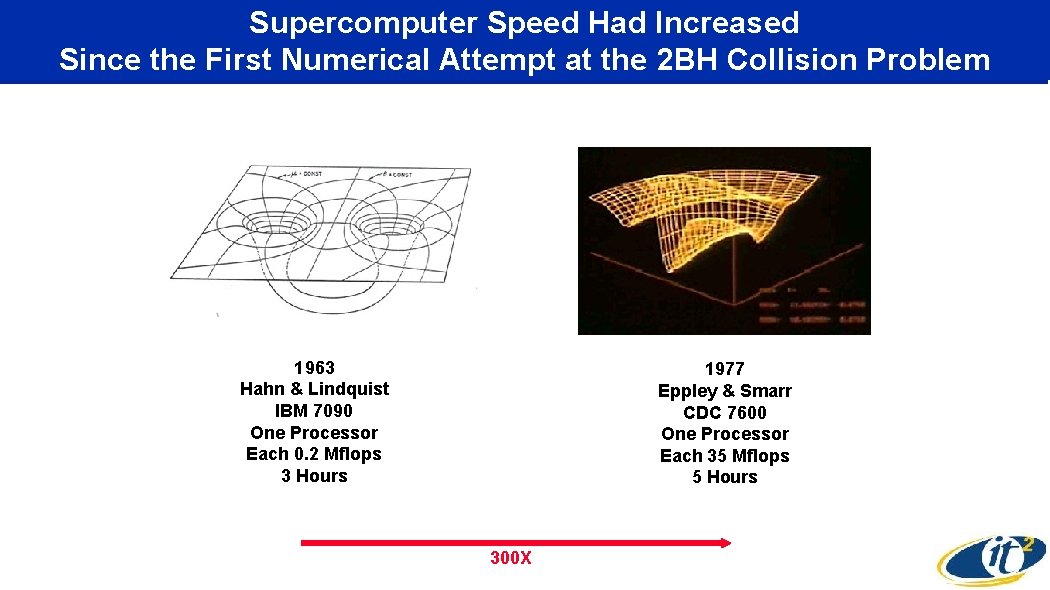
Supercomputer Speed Had Increased Since the First Numerical Attempt at the 2 BH Collision Problem 1963 Hahn & Lindquist IBM 7090 One Processor Each 0. 2 Mflops 3 Hours 1977 Eppley & Smarr CDC 7600 One Processor Each 35 Mflops 5 Hours 300 X
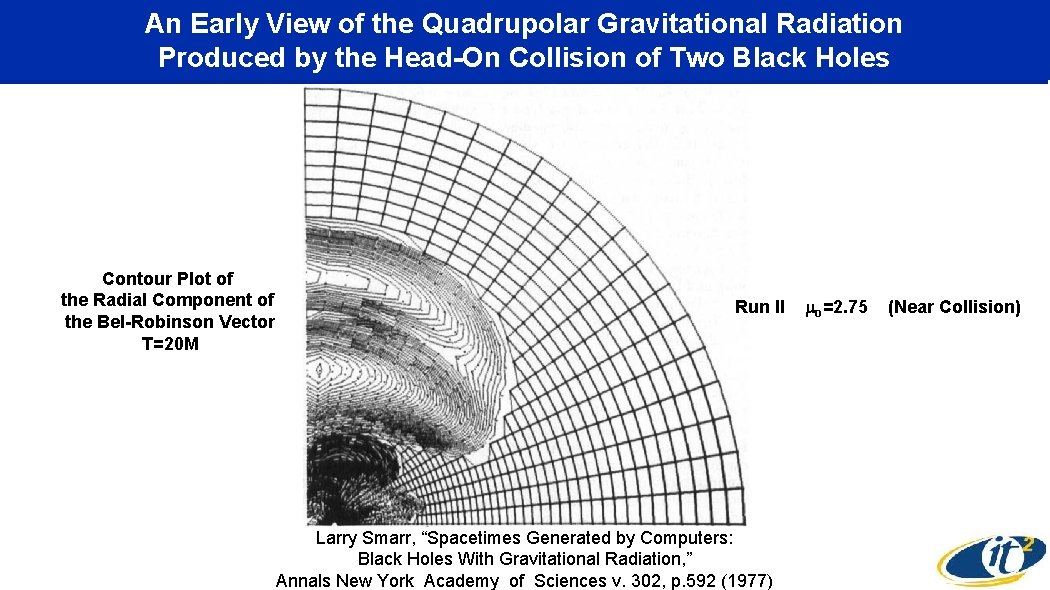
An Early View of the Quadrupolar Gravitational Radiation Produced by the Head-On Collision of Two Black Holes Contour Plot of the Radial Component of the Bel-Robinson Vector T=20 M Run II Larry Smarr, “Spacetimes Generated by Computers: Black Holes With Gravitational Radiation, ” Annals New York Academy of Sciences v. 302, p. 592 (1977) o=2. 75 (Near Collision)

Comparison of Two Black Hole Collision Waveform and the DRPP Perturbation Waveform Indicated Ringing Dominated (Far Collision) x x (Already Merged) Smarr, Sources of Grav. Radn (1978), p. 268 x (Near Collision) Eppley-Smarr Results Anninos, Hobill, Seidel, Smarr, Suen, Phys. Rev. Lett. , 71, p. 2854 (1993) DRPP
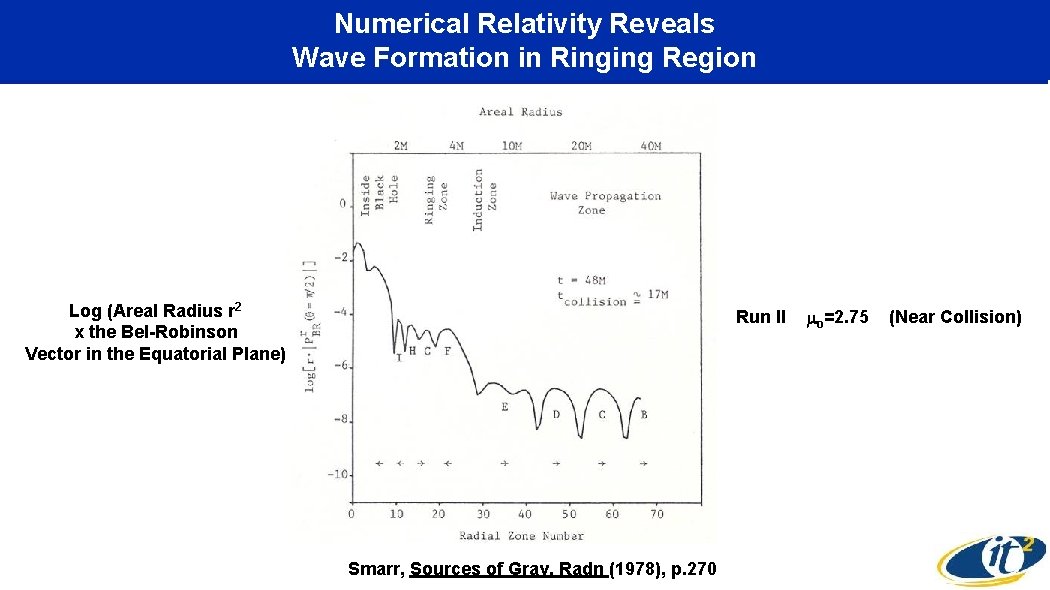
Numerical Relativity Reveals Wave Formation in Ringing Region Log (Areal Radius r 2 x the Bel-Robinson Vector in the Equatorial Plane) Run II Smarr, Sources of Grav. Radn (1978), p. 270 o=2. 75 (Near Collision)

The End of The First Sixty Years of the 2 Black Hole Problem A Bookend to the Chapel Hill Conference 30 Years Earlier Workshop Board of Advisors: Bryce De. Witt, Frank Estabrook, Charles Misner, Jerry Ostriker, Bill Press, David Schramm, Kip Thorne, Rai Weiss, John Wheeler, Jim Wilson Workshop Organizers: Larry Smarr, Doug Eardley, Saul Teukolsky, Jim York Local Organizers: Jim Bardeen, P. C. Peters, Battelle Staff
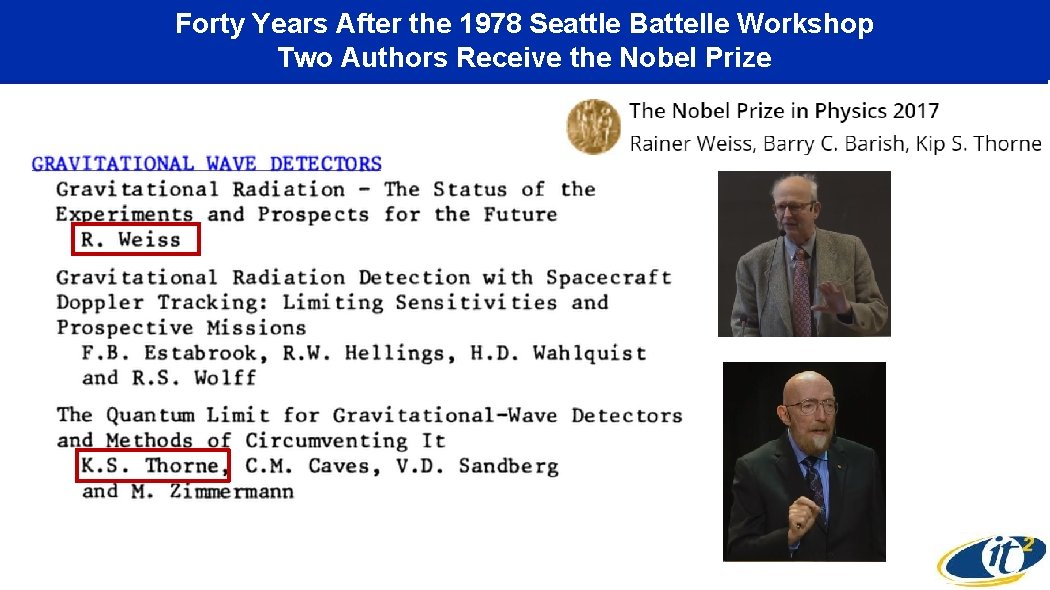
Forty Years After the 1978 Seattle Battelle Workshop Two Authors Receive the Nobel Prize
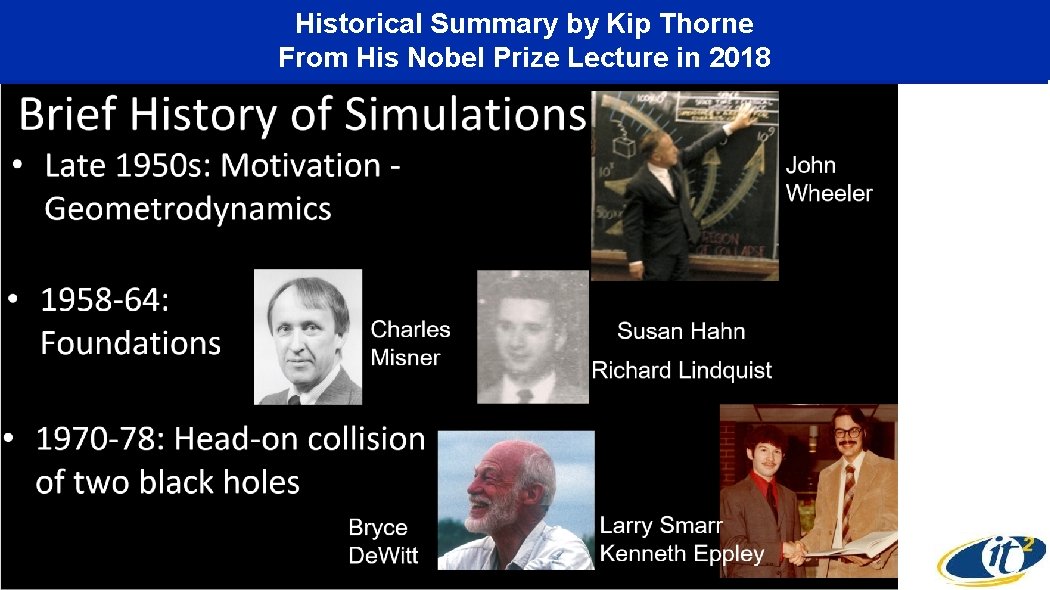
Historical Summary by Kip Thorne From His Nobel Prize Lecture in 2018
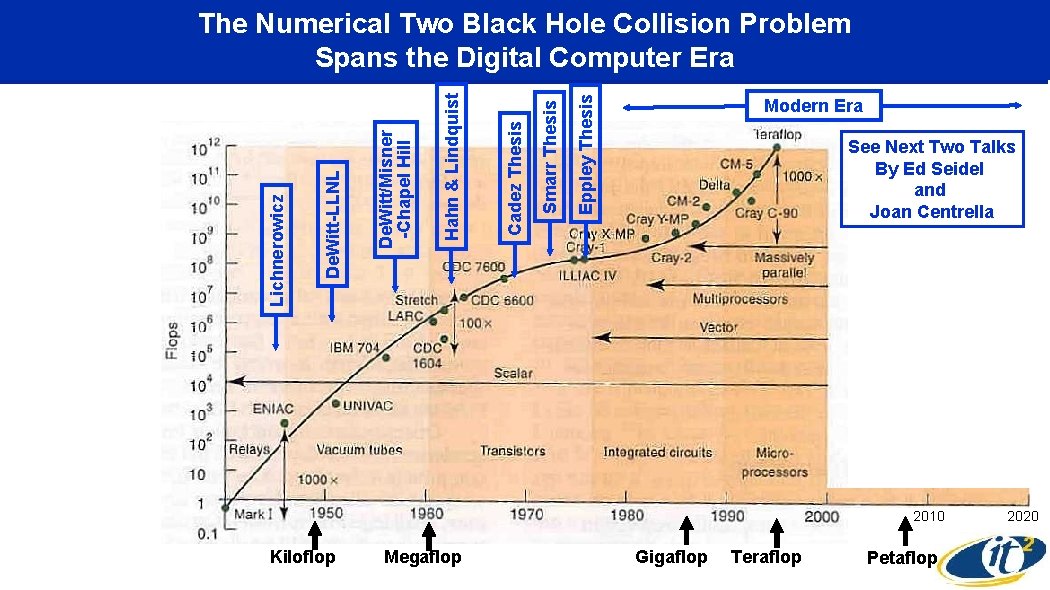
Eppley Thesis Smarr Thesis Cadez Thesis Hahn & Lindquist De. Witt/Misner -Chapel Hill De. Witt-LLNL Lichnerowicz The Numerical Two Black Hole Collision Problem Spans the Digital Computer Era Modern Era See Next Two Talks By Ed Seidel and Joan Centrella 2010 Kiloflop Megaflop Gigaflop Teraflop Petaflop 2020
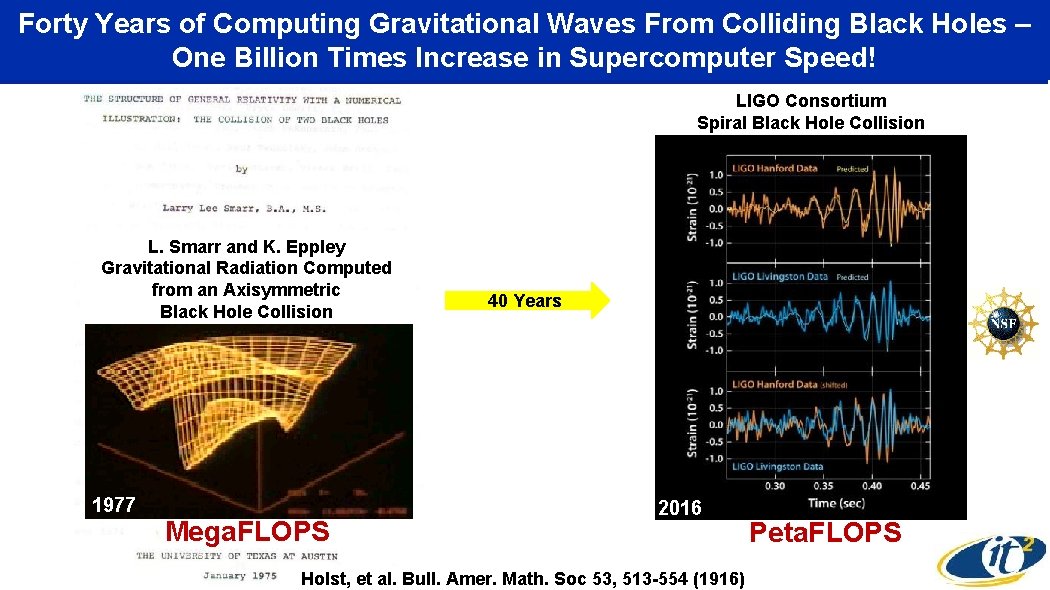
Forty Years of Computing Gravitational Waves From Colliding Black Holes – One Billion Times Increase in Supercomputer Speed! LIGO Consortium Spiral Black Hole Collision L. Smarr and K. Eppley Gravitational Radiation Computed from an Axisymmetric Black Hole Collision 1977 Mega. FLOPS 40 Years 2016 Holst, et al. Bull. Amer. Math. Soc 53, 513 -554 (1916) Peta. FLOPS
- Slides: 32