
The Precision Airdrop System PADS Airborne Mission Planner

The Precision Airdrop System (PADS) Airborne Mission Planner: A System Now Enabling Precision High Altitude Airdrop Presented at the Aerospace Control and Guidance Systems Committee Meeting Hilton Head Island, South Carolina by Phil Hattis Draper Laboratory, Cambridge, MA October 21, 2005 21 Oct 2005: Slide 1

Outline • PADS objectives and architecture • Current Precision Airdrop Planning System (PAPS) capabilities • PADS features used by PAPS • Demonstrated performance • Deployment status and next development steps • Summary 21 Oct 2005: Slide 2

PADS Objectives and Architecture System Objectives Overarching Goals • Enable precision cargo delivery from high altitude – Combat re-supply – Humanitarian relief • Reduce surface weapon threats to carrier aircraft – Enable delivery aircraft to remain near their upper altitude limit for airdrop Specific PADS Goals • Provide a common platform for ground-based and in -flight airdrop Mission Planning (MP) – Enable application to ballistic and guided airdrop systems – Support both cargo and personnel drops • Include advanced wind modeling • Make the planning system easy to use and its outputs easy to understand 21 Oct 2005: Slide 3
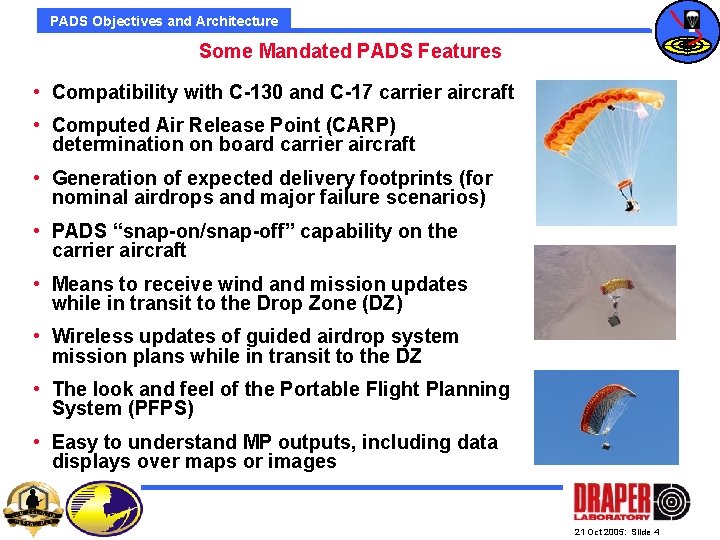
PADS Objectives and Architecture Some Mandated PADS Features • Compatibility with C-130 and C-17 carrier aircraft • Computed Air Release Point (CARP) determination on board carrier aircraft • Generation of expected delivery footprints (for nominal airdrops and major failure scenarios) • PADS “snap-on/snap-off” capability on the carrier aircraft • Means to receive wind and mission updates while in transit to the Drop Zone (DZ) • Wireless updates of guided airdrop system mission plans while in transit to the DZ • The look and feel of the Portable Flight Planning System (PFPS) • Easy to understand MP outputs, including data displays over maps or images 21 Oct 2005: Slide 4

PADS Objectives and Architecture PADS Software Components A laptop personal computer (PC) with the following features • The “Wind. PADS” atmosphere modeling tool provided by Planning Systems, Inc. (PSI) • A PAPS that accounts for: – – Payload weight, aircraft load station, decelerator type Altitude, heading, and airspeed at release Roll-out and decelerator opening models (for ballistic parachutes) 6 degree of freedom (6 DOF) cargo/decelerator descent models • A tool to predict the expected payload delivery footprints • Means to acquire real-time aircraft state data • An easy-to-use PFPS-like Graphical User Interface (GUI) • A image/map overly display using Falcon. View including: – Desired CARP, and feasible release envelopes for guided airdrops – Expected landing footprints (for ballistic parachutes) and expected impact footprints for failed airdrop systems 21 Oct 2005: Slide 5

PADS Objectives and Architecture PSI-Supplied PADS Block 2 Flight Hardware Components Key Components (clockwise from upper-left) • Panasonic CF-29 data processor with 802. 11 g wireless interface • 4 -channel UHF radio transmitter • Cables and connectors to aircraft interface • GPS hand-launched dropsonde (expendable) Total weight with portable case: 75 pounds This page extracted from AIAA paper CP-2005 -7070, “On-Board Atmospheric Modeling System to Support Precision Airdrop, ” by R. Wright, R. Benney, and J. Mc. Hugh, presented at the Infotech@Aerospace Conference, Arlington, Virginia, September 26 -29, 2005 21 Oct 2005: Slide 6

PADS Objectives and Architecture PADS System Features and Interfaces Air Force Weather Agency Atmospheric Forecast Model - High-Resolution Nested Grid Surrounding Drop Zone(s) 5 -KM Grid Domain within 15 -KM Grid Domain Via 802. 11 G Wireless Laptop Computer Mesoscale 4 D Field 3 D Field - Wind, Density, Pressure for Drop Time PADS-Derived Upload Data Navigator or Navigation System Assimilation Processor Secure Interface PIP Airdrop Dynamics. S imulation Computed Air Release Point (CARP) Com Satellite Combat Track II Radio Receiver INTERNET/SIPRNET Guided/Smart. A irdrop Systems Wind Data Sources • Satellite-Derived • TACMET Radiosonde • Theater Pilot Reports Dropsonde Processor Radio Receiver Aircraft 1553 Data Bus Aircraft Top Antenna GPS Dropsonde Aircraft Bottom Antenna 21 Oct 2005: Slide 7
Current PAPS Capabilities Ballistic Parachute Support • MP support for an expandable set of systems, currently including: – G-12 and 26 ft ring-slot hemispherical canopy airdrop systems » Enables delivery of payloads in the 2, 000 lb class (+/- 25%) » Includes treatment of stick releases (multiple load drops on a single pass) • Targets the stick’s CARP for any one designated load in a stick • Determines expected delivery footprints for each load in a stick – Footprint determination for the Tri-wall Aerial Delivery System (TRIADS) » Enables airdrop of Meals Ready to Eat (MREs) • MP parachute trajectory determination accounts for: – – Aircraft release and roll-out dynamics Canopy opening and deceleration Descent response to 3 D wind and density fields Statistical variation in all the above effects • TRIADS trajectory determination accounts for: – Carrier box release and deceleration dynamics – Dispersed MRE statistical response to 3 D wind and density fields 21 Oct 2005: Slide 8

Current PAPS Capabilities Airdrop Trajectory Factors Treated by PAPS 21 Oct 2005: Slide 9
Current PAPS Capabilities Guided Airdrop Support • Supports an expandable set of cargo airdrop systems, with L/D values ranging from 0. 5 to over 4, currently including: – Sherpa, Screamer, and the Affordable Guided Airdrop System (AGAS) in the 2, 000 lb payload class – Screamer and Dragonfly in the 10, 000 lb payload class • Seeing initial application to personnel airdrops – MJN-1, MC-4/5 and variants, as well as a generic canopy capability • Derives feasible release zones and preferred CARPS, including for sticks with varied landing targets • MP trajectory determination accounts for: – System-specific L/D and velocity vs. payload mass characteristics – Descent response to 3 D wind and density fields • Dispersion footprints generated for the following scenarios: – Failed canopies – Failed guidance and/or control after successful canopy deployment 21 Oct 2005: Slide 10
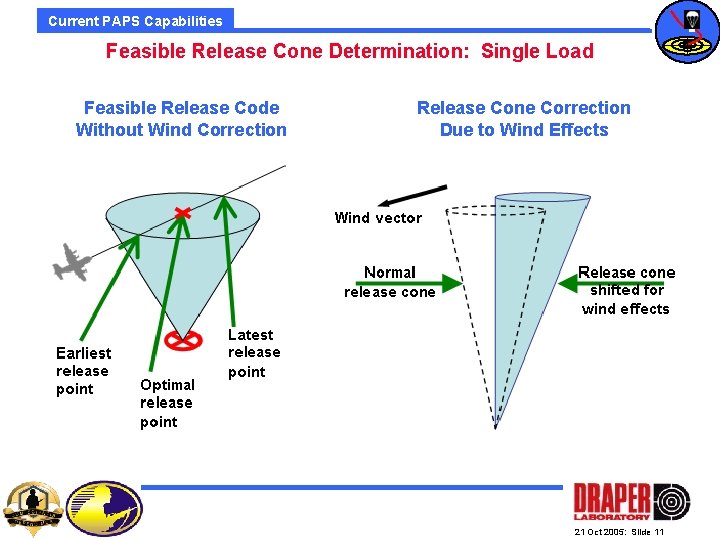
Current PAPS Capabilities Feasible Release Cone Determination: Single Load Feasible Release Code Without Wind Correction Release Cone Correction Due to Wind Effects 21 Oct 2005: Slide 11
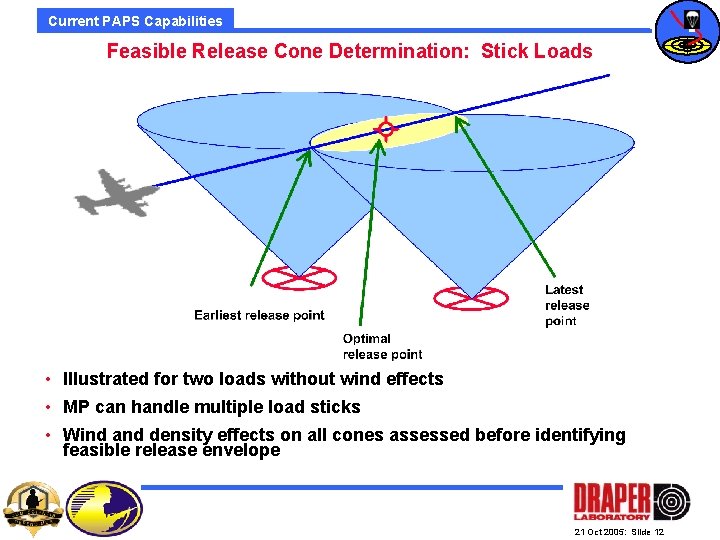
Current PAPS Capabilities Feasible Release Cone Determination: Stick Loads • Illustrated for two loads without wind effects • MP can handle multiple load sticks • Wind and density effects on all cones assessed before identifying feasible release envelope 21 Oct 2005: Slide 12
PADS Features Used by PAPS Interface Functionality • Graphical User Interfaces (GUIs) – Modeled after PFPS Combat Airdrop Planning Software (CAPS) GUIs – Accommodates user inputs of payload data before flight » Carrier aircraft type; payload mass; cargo bay location; airdrop system type; DZ target; planned release altitude and airspeed; expected weather data source file; etc. » Provides resulting CARP and engineering data displays • Falcon. View Overlay Displays – Provides visual user cues regarding: » CARP locations; landing footprints; feasible release zones; etc. • 1553 Bus Interface – Provides aircraft navigation data and at-altitude wind estimate – Enables monitoring designated bus data • Combat Track II CTII Interface – Provides secure UHF-link access to flight plan and wind updates during transit to the DZ • File Upload Capability – Provides an in-transit wireless interface for upload of updated descent mission plans for guided airdrop systems 21 Oct 2005: Slide 13
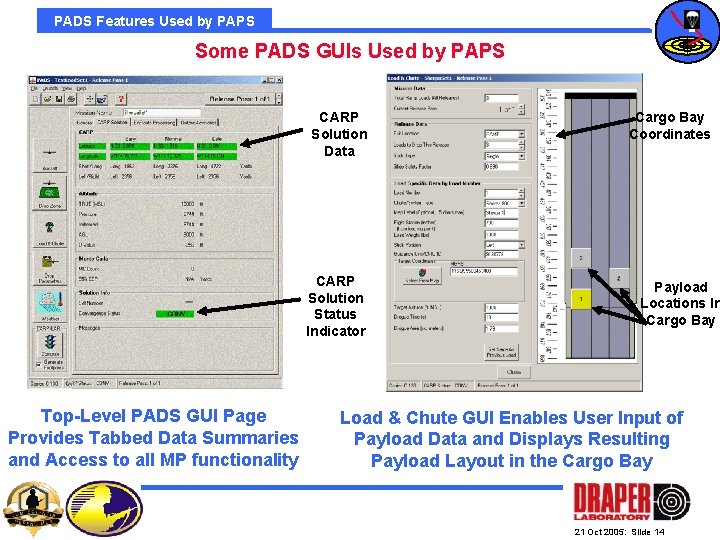
PADS Features Used by PAPS Some PADS GUIs Used by PAPS CARP Solution Data CARP Solution Status Indicator Top-Level PADS GUI Page Provides Tabbed Data Summaries and Access to all MP functionality Cargo Bay Coordinates Payload Locations In Cargo Bay Load & Chute GUI Enables User Input of Payload Data and Displays Resulting Payload Layout in the Cargo Bay 21 Oct 2005: Slide 14
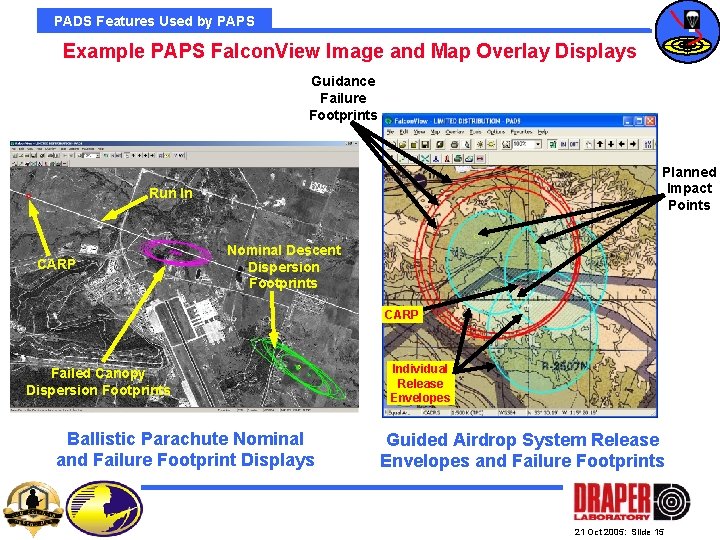
PADS Features Used by PAPS Example PAPS Falcon. View Image and Map Overlay Displays Guidance Failure Footprints Planned Impact Points Run In CARP Nominal Descent Dispersion Footprints CARP Failed Canopy Dispersion Footprints Ballistic Parachute Nominal and Failure Footprint Displays Individual Release Envelopes Guided Airdrop System Release Envelopes and Failure Footprints 21 Oct 2005: Slide 15
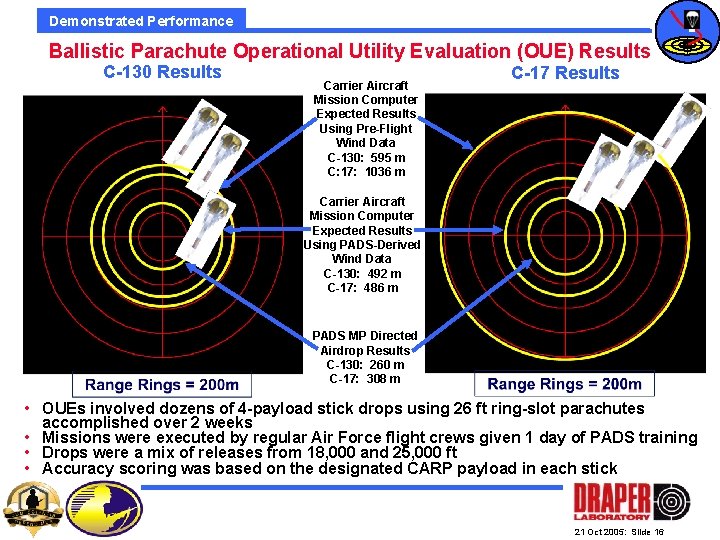
Demonstrated Performance Ballistic Parachute Operational Utility Evaluation (OUE) Results C-130 Results Carrier Aircraft Mission Computer Expected Results Using Pre-Flight Wind Data C-130: 595 m C: 17: 1036 m C-17 Results Carrier Aircraft Mission Computer Expected Results Using PADS-Derived Wind Data C-130: 492 m C-17: 486 m PADS MP Directed Airdrop Results C-130: 260 m C-17: 308 m • OUEs involved dozens of 4 -payload stick drops using 26 ft ring-slot parachutes accomplished over 2 weeks • Missions were executed by regular Air Force flight crews given 1 day of PADS training • Drops were a mix of releases from 18, 000 and 25, 000 ft • Accuracy scoring was based on the designated CARP payload in each stick 21 Oct 2005: Slide 16
Demonstrated Performance Guided Airdrop System Demonstration Status • Numerous guided airdrop system flight tests have been accomplished using PADS-generated mission update files uploaded in transit to the DZ – Sherpa, AGAS and Screamer 2, 000 -lb class systems – Dragonfly 10, 000 -lb class systems • All the 2, 000 -lb class systems have achieved mean accuracies better than 100 m to their targets, including stick releases with scattered targets • Despite the still early developmental status of its guidance and control system, the Dragonfly has achieved mean accuracies of about 200 m using PADS generated mission files 21 Oct 2005: Slide 17
Deployment Status and Next Development Steps • PADS is now in initial field use – Some military free fall operations now apply PADS to assure personnel jumps from carrier aircraft are within reach of the DZ – 2, 000 pound-class guided airdrop systems are currently being fielded with PADS MP support capability enabled • PADS-enabled precision ballistic parachute and guided airdrop system delivery capabilities to be used to limit the need for hazardous ground convoys in many scenarios • Initial PADS MP support capabilities for 10, 000 and 30, 000 pound class guided and ballistic parachute airdrop systems will be available for field use by the end of the calendar year • An open architecture Guidance, Navigation, and Control (GN&C) software package for steerable parafoil applications to be hosted on PADS laptops is under development – Will be available for upload to compatible guided airdrop systems – Designed to provide GN&C for a wide variety of parafoil airdrop systems 21 Oct 2005: Slide 18
Summary • A Precision Airdrop System (PADS) in-flight Mission Planner (MP) has completed initial development and is now being used in the field – Applies high fidelity wind estimates based on data gathered from forecast, in situ measurements, and securely transmitted data – Supports ballistic parachute and guided system airdrops of cargo and personnel – Has interfaces compatible with the Portable Flight Planning System to assure ease of use by carrier aircraft crew in the field • Operation Utility Evaluation from C-130 and C-17 aircraft was completed for ballistic parachute airdrops – Major accuracy improvement was demonstrated in comparison to prior high altitude airdrop methods • The fielded PADS MP supports a variety of 2, 000 pound class airdrop systems – Provides mission plan upload capability for guided airdrop systems • An extension of the PADS MP to 10, 000 and 30, 000 pound class airdrops systems is currently in work 21 Oct 2005: Slide 19
- Slides: 19