
The Practitioner Education and Decision Support PEDS Initiative
- Slides: 40
The Practitioner Education and Decision Support (PEDS) Initiative 2013 Learning Community Andrew Cleek, Psy. D CTAC Team 1
Agenda Welcome and Introduction What is PEDS? What is MAP? Why is it important? What is a Learning Community? The nuts and bolts of joining this Learning Community Activities and Timeframe Q&A
Welcome As partners in this most important effort, we extend a warm welcome to all of you who have joined us to explore the value of resources designed to support clinical staff You are contributing to our collective knowledge that will help move the field forward We are excited to partner with you over the next year.
Polling Question: Which of the following methods do you use most often in making decisions about treatment? Talk to my supervisor Talk to my colleagues Review research literature Rely on previous experience None of the above
Introduction: What problem are we attempting to address There are several hundred evidence-based protocols that cover a variety of common child mental health diagnoses. ◦ Not feasible to learn all of these protocols ◦ Some are costly to be trained in and implement Many of these EBPs share common approaches, practices, and decision points Our goal in this project is to explore the value of a decision support tool to practitioners, supervisors and clients in a way that is practical and sustainable.
What is Practitioner Education and Decision Support (PEDS)? Our initiative is designed to explore, adapt and evaluate an online decision support tool called MAP stands for Managing and Adapting Practices MAP was developed by Bruce Chorpita and Eric Daleiden of UCLA. It is currently being used in a variety of children’s clinical treatment settings in a number of states including LA county, California
PEDS (continued) Practitioner Education refers to the integration of the decision support tool with clinical guidelines and education in a number of key clinical areas: depression, anxiety. conduct problems, and trauma
The PEDS Learning Community: What is it? A year-long partnership across 20 clinics in New York State, involving a combination of supervisors and practitioners. The learning community is designed to: ◦ Engage practitioners and supervisors in evaluating and adapting the MAP approach to: Support clinical decisions related to the formulation of treatment needs Select interventions that are evidence informed Monitor treatment goals and objectives ◦ Establish an ongoing partnership with clinics and practitioners to identify the most useful components of Practice Wise ◦ ◦ Explores the impact of streamline training and education on the successful application and utilization of the Practice Wise system.
What is Managing and Adapting Practice (MAP)? A system that allows practitioners to manage and adapt practice to meet the needs of children receiving mental health treatment. The system is not a single treatment model. Rather, it involves several decision and practice support tools to assist in the selection, review, adaptation, or construction of promising treatments to match particular child characteristics based on the latest scientific findings. It consists of three online tools designed to guide and support practitioners in clinical decision making, service planning and progress monitoring (Practice Wise). 9
What is MAP (con’t) MAP is designed to improve the quality, efficiency, and outcomes of children’s mental health services Decision support tools and resources address the need for more reliable, easily accessible, timely information, and resources to support clinical decisions.
Why is MAP Important? The role of practitioner friendly decision support tools to promote effective practices that demonstrate measurable outcomes are increasingly critical. MAP assists practitioners to coordinate and supplement the use of evidence-based practices for children’s mental health. Practitioners often need additional tools to support the clinical decisions that are made on a daily basis. There is a focus on ‘common elements’ that can help practitioners utilize the best practices for their clients.
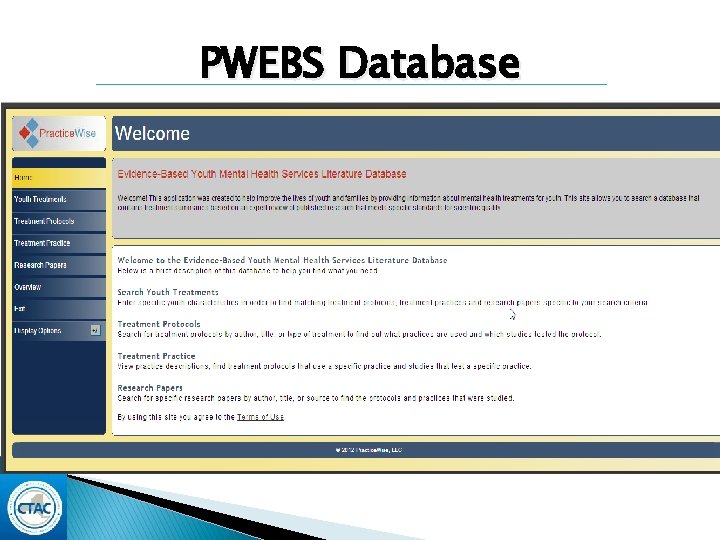
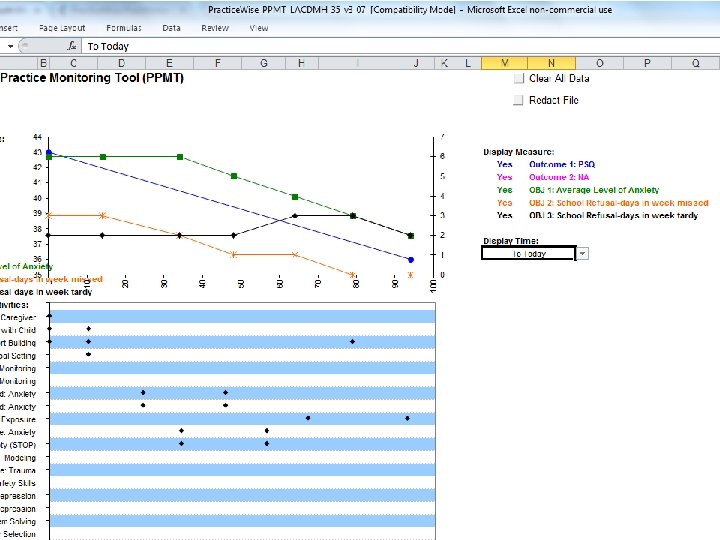
Components of MAP 1. Practice. Wise Evidence-Based Service Database: (PWEBS) online database that can make recommendations about formal evidence-based programs OR about specific components of evidencebased treatments (based on client characteristics) 2. Practitioner Guides: Provides user-friendly measurement tools and clinical protocols 3. Clinical Dashboard: Tracks outcomes and practices on a graphical clinical dashboard
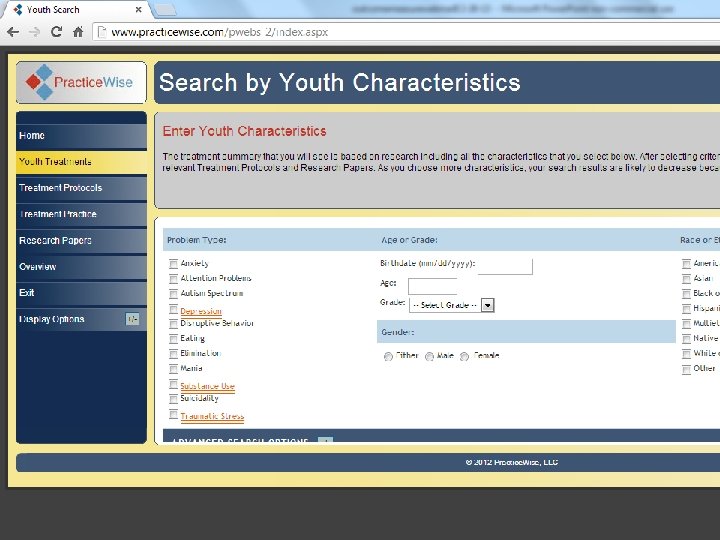
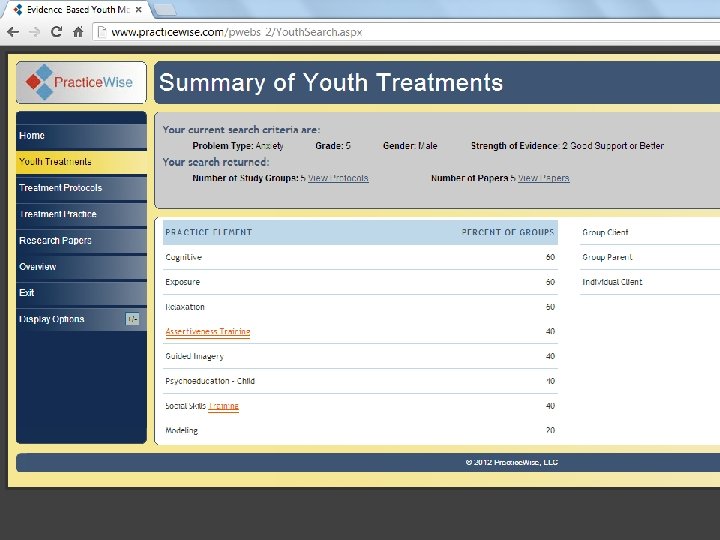
MAP: PWEBS Evidenced based youth mental health literature database Easy to use & searchable by problem type (dx), age/grade, gender and or ethnicity
PWEBS Database
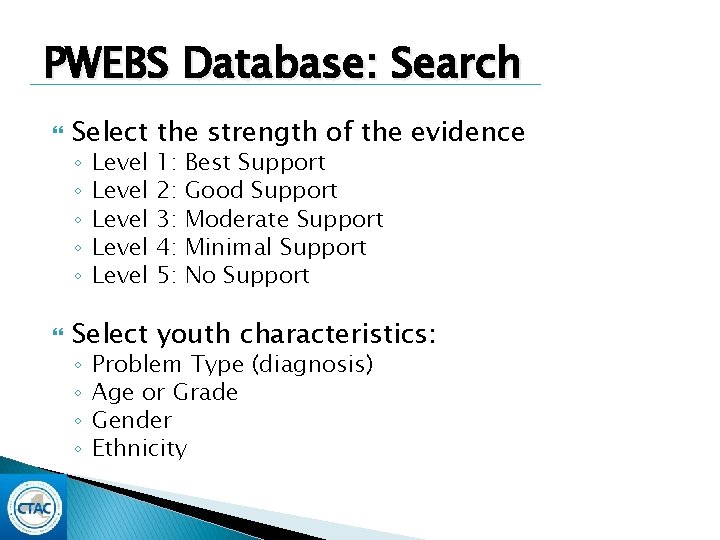
PWEBS Database: Search Select the strength of the evidence ◦ ◦ ◦ Level Level 1: 2: 3: 4: 5: Best Support Good Support Moderate Support Minimal Support No Support Select youth characteristics: ◦ ◦ Problem Type (diagnosis) Age or Grade Gender Ethnicity
Materials owned by ICL, Licensed by CTAC
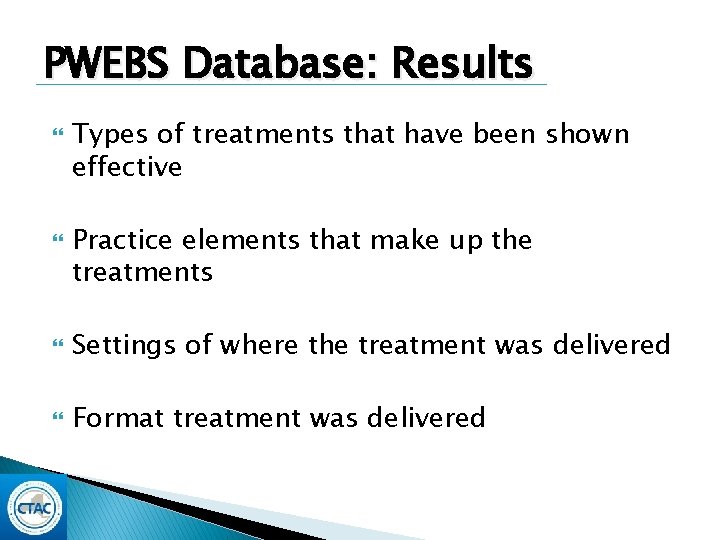
PWEBS Database: Results Types of treatments that have been shown effective Practice elements that make up the treatments Settings of where the treatment was delivered Format treatment was delivered
Materials owned by ICL, Licensed by CTAC
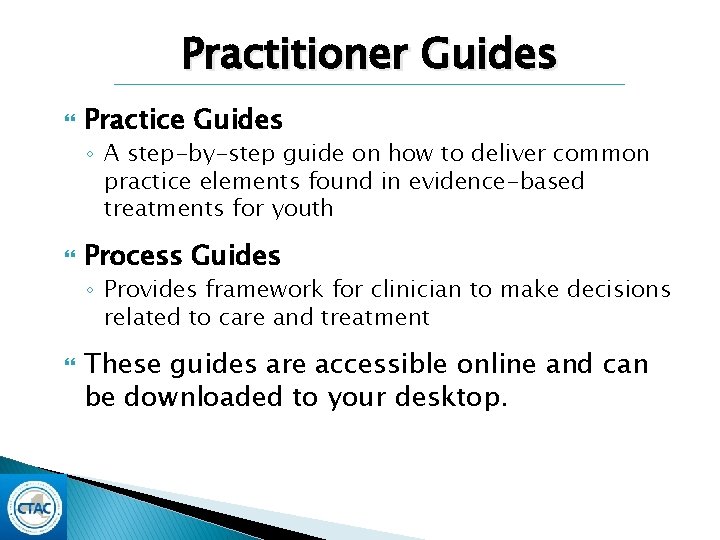
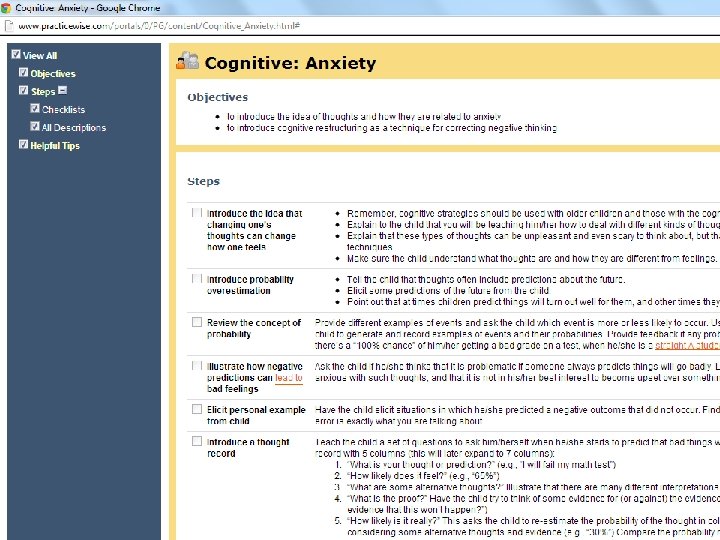
Practitioner Guides Practice Guides ◦ A step-by-step guide on how to deliver common practice elements found in evidence-based treatments for youth Process Guides ◦ Provides framework for clinician to make decisions related to care and treatment These guides are accessible online and can be downloaded to your desktop.
Practice Guide Example Materials owned by ICL, Licensed by CTAC
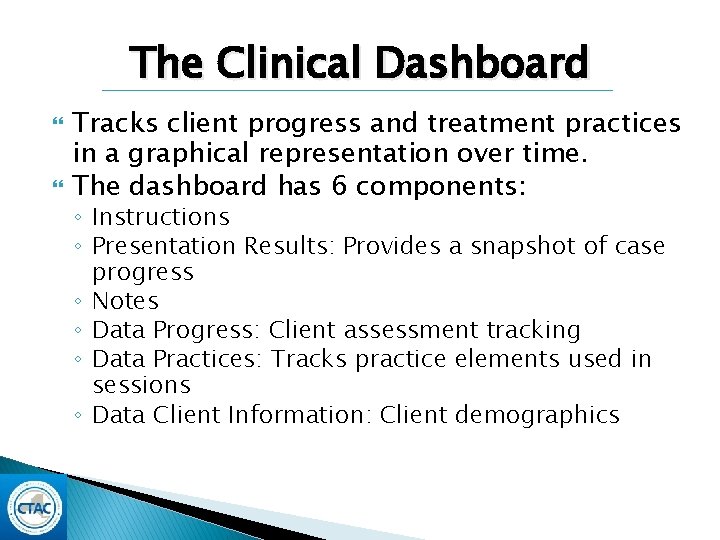
The Clinical Dashboard Tracks client progress and treatment practices in a graphical representation over time. The dashboard has 6 components: ◦ Instructions ◦ Presentation Results: Provides a snapshot of case progress ◦ Notes ◦ Data Progress: Client assessment tracking ◦ Data Practices: Tracks practice elements used in sessions ◦ Data Client Information: Client demographics
Materials owned by ICL, Licensed by CTAC
The PEDS Learning Community Expectations, Activities, and Timeframes
Why is a Learning Community Important? ◦ Builds on the collective knowledge and real world experiences of participants ◦ Social networking and shared learning encounters are energizing ◦ Efficient and effective method to support widespread practice improvement ◦ Ensures that the common and unique concerns, challenges and needs are addressed
What you get by joining the Learning Community ◦ Each clinic will be provided: Three subscriptions that provides 1 supervisor and 2 practitioners access to the Practice Wise Evidence-Based Service database, Practitioner Guides, and Clinical Dashboards Supervisors and practitioners will receive a 1 day in-person training on the Practice Wise system Optional follow-up consultation call after the training There are 4 quarters to this LC: each quarter will focus on a clinical treatment area (depression, anxiety, conduct disorders, and trauma) Each quarter will provide a minimum of 1 web-based training and 2 small group calls designed to promote an exchange of ideas and collective problem solving
What you get by joining the Learning Community (con’t. ) Monthly contact- may be clinical topic focused webinars (depression, anxiety, conduct disorders, and trauma), small group consultation calls Educational webinars on key clinical treatment topics (depression, anxiety, conduct difficulties, trauma) that are archived and open to all members of the participating clinic’s workforce Learning community meetings at 6 mos and 12 mos that will last about 3 hours.
Your Resource Team Provides all members of the learning community with the technical, clinical, social, organizational and logistical support to successfully utilize, evaluate and modify the Practitioner Education and Decision Support (PEDS) Process
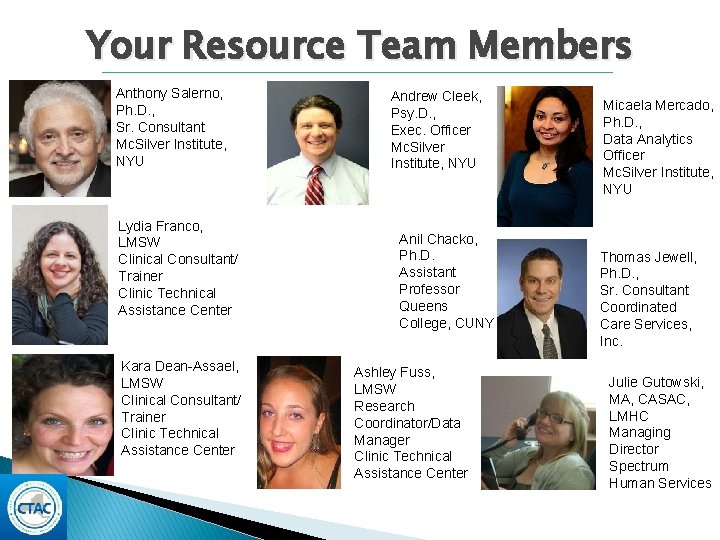
Your Resource Team Members Anthony Salerno, Ph. D. , Sr. Consultant Mc. Silver Institute, NYU Lydia Franco, LMSW Clinical Consultant/ Trainer Clinic Technical Assistance Center Kara Dean-Assael, LMSW Clinical Consultant/ Trainer Clinic Technical Assistance Center Andrew Cleek, Psy. D. , Exec. Officer Mc. Silver Institute, NYU Anil Chacko, Ph. D. Assistant Professor Queens College, CUNY Ashley Fuss, LMSW Research Coordinator/Data Manager Clinic Technical Assistance Center Micaela Mercado, Ph. D. , Data Analytics Officer Mc. Silver Institute, NYU Thomas Jewell, Ph. D. , Sr. Consultant Coordinated Care Services, Inc. Julie Gutowski, MA, CASAC, LMHC Managing Director Spectrum Human Services
Supervisors Supervision focused on clinical treatment and decision support is often challenging ◦ ◦ Multiple demands Time pressures Multiple staff to supervise Ambiguity of clinical treatment and outcomes - exclusive reliance on practitioner experience and recall This system has been designed to support and promote practical, efficient, and effective supervision Your participation is integral in the PEDS process Webinar focused on Educational Supervision: ◦ The key role of supervisors in promoting successful implementation of the PEDS initiative Follow-up small group discussion calls
Evaluation of PEDS > Your Resource Team will support members to measure key performance indicators that help answer the question…… In what way has the PEDS approach: …. added value to your services? …. enhanced your professional satisfaction? …. increased your sense of accomplishment? …. helped to address the needs of particularly challenging children and caregivers? …. addressed your felt need for support in making treatment decisions? The resource team offers members the opportunity to have their performance indicators data analyzed and organized
The Evaluation Process Formal and informal survey of practitioners and supervisors that focus on the pros and cons of the Practice Wise system Number of practitioners who employ the system in a clinically meaningful manner Number of supervisors who employ the system as part of the supervisory process Identification of components of Practice Wise that are sustainable and valued by supervisors and practitioners Usefulness and satisfaction with the clinical practice trainings, webinars, and calls Clinical outcomes: Submission of 1 dashboard per clinical topic area (anxiety, depression, conduct difficulties, and trauma)
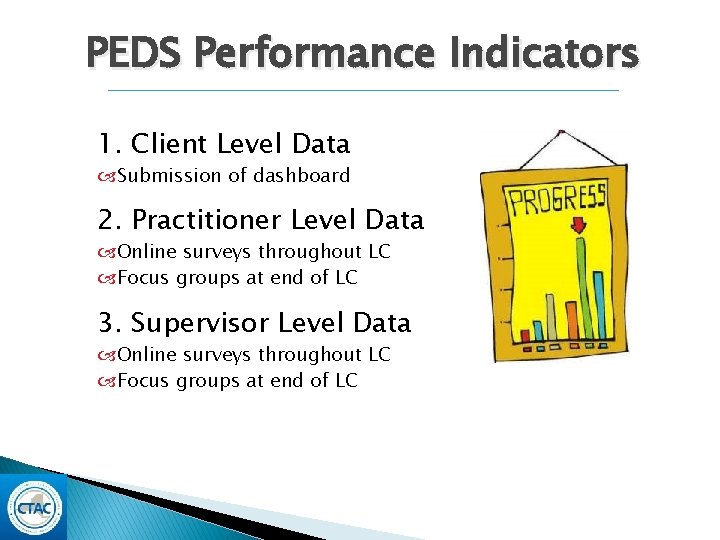
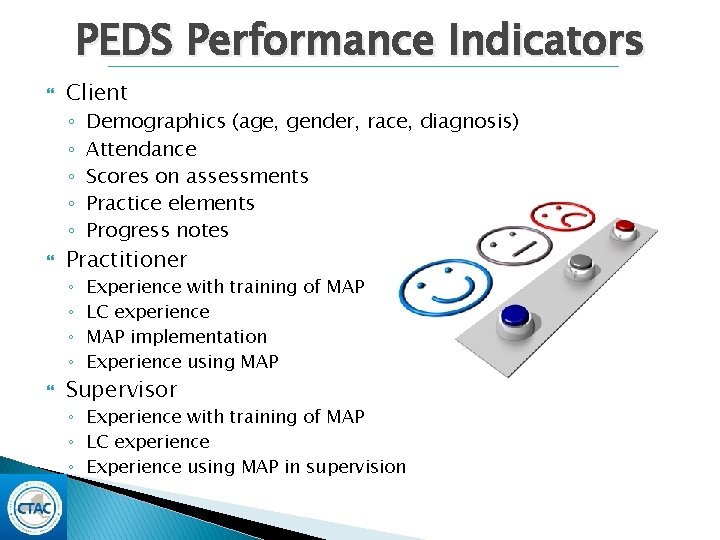
PEDS Performance Indicators 1. Client Level Data Submission of dashboard 2. Practitioner Level Data Online surveys throughout LC Focus groups at end of LC 3. Supervisor Level Data Online surveys throughout LC Focus groups at end of LC
PEDS Performance Indicators Client ◦ ◦ ◦ Practitioner ◦ ◦ Demographics (age, gender, race, diagnosis) Attendance Scores on assessments Practice elements Progress notes Experience with training of MAP LC experience MAP implementation Experience using MAP Supervisor ◦ Experience with training of MAP ◦ LC experience ◦ Experience using MAP in supervision
Upcoming Events: One Day Training New York City/Downstate - ◦ Located at the Mc. Silver Institute for Poverty, Policy, and Research, 41 East 11 th Street, NY, 7 th Floor ◦ Choose a date that works best for you: May 20, May 22, or June 5, from 9: 30 am-4 pm. Registration will be limited each day and we recommend that staff from the same clinic attend together. Upstate - ◦ June 5 - Located at Hutchings Psych Center, Syracuse, NY, from 9: 30 am-4 pm More detailed future meeting schedule will be distributed at the above trainings
One Day Training Full day from 9: 30 -4 pm Focus on navigating Practice Wise System Please bring in an actual case to use in learning the system. Optimal cases include: ◦ A child with a primary diagnosis of depression ◦ Relatively new case ◦ A case that you will likely have for at least 3 months Please bring your own laptop Lunch will be provided
Polling Question: What are your initial impressions of the PEDS process? It will be… Very useful Somewhat useful Not useful at all Not sure yet
Polling Question: What do you think will be the most challenging aspect about this project? Learning to use the Practice Wise tools Time pressures/multiple demands Complexity of cases we see Getting enough support Other challenge Not sure yet
The Learning Community is dynamic! The proposed structure, process, and content of the Learning Community is a starting point! The experience, needs and wants of Learning Community members helps to shape how the Learning Community evolves over time!
Q&A Materials owned by ICL, Licensed by CTAC
Contact Us…. Andrew Cleek andrew. cleek@nyu. edu Anthony Salerno anthony. salerno@nyu. edu Anil Chacko anil. chacko@mssm. edu Lydia Franco lydia. franco@mountsinai. org Micaela Mercado micaela. mercado@nyu. edu Ashley Fuss Ashley. fuss@nyu. edu Kara M. Dean-Assael kara. dean@nyu. edu Tom Jewell tjewell@ccsi. org Julie Gutowski gutowskij@shswny. org Materials owned by ICL, Licensed by CTAC