
The Power Spectra and Point Distribution Functions of
�The Power Spectra and Point Distribution Functions of Density Fields in Isothermal, HD Turbulent Flows Korea Astronomy and Space Science Institute Jongsoo Kim Collaborators: Dongsu Ryu Enrique Vazquez-Semadeni Thierry Passot Kim, & Ryu 2005, Ap. JL (PS) Kim, VS, Passot, & Ryu 2006, in preparation (PDF)
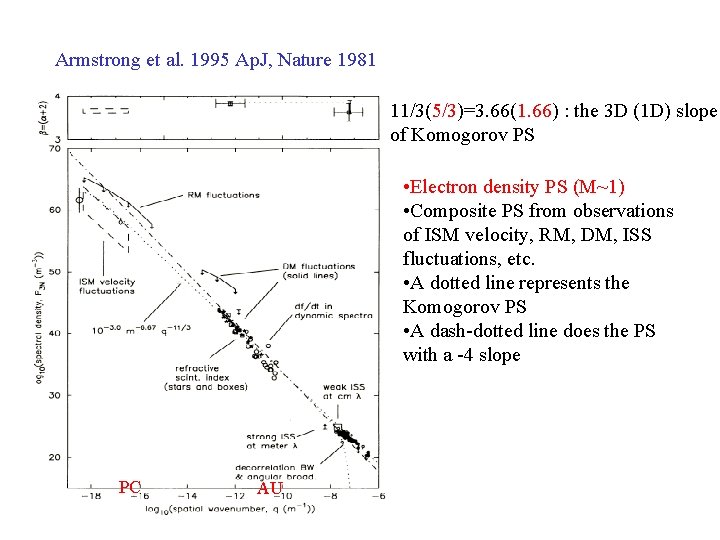
Armstrong et al. 1995 Ap. J, Nature 1981 11/3(5/3)=3. 66(1. 66) : the 3 D (1 D) slope of Komogorov PS • Electron density PS (M~1) • Composite PS from observations of ISM velocity, RM, DM, ISS fluctuations, etc. • A dotted line represents the Komogorov PS • A dash-dotted line does the PS with a -4 slope PC AU
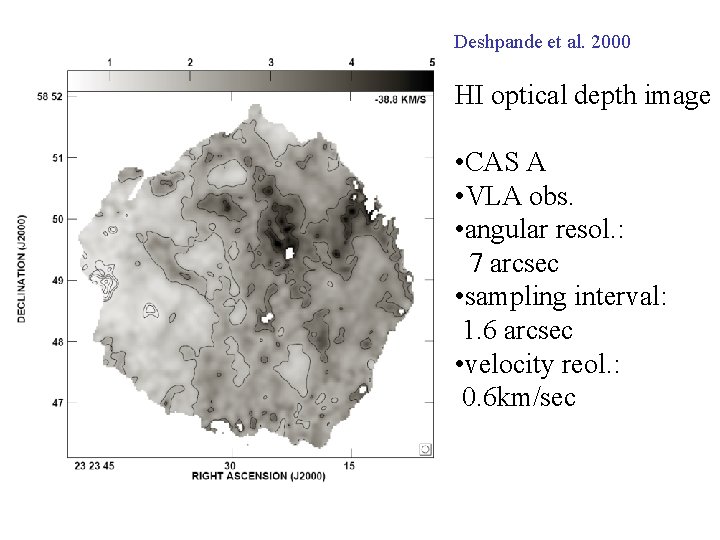
Deshpande et al. 2000 HI optical depth image • CAS A • VLA obs. • angular resol. : 7 arcsec • sampling interval: 1. 6 arcsec • velocity reol. : 0. 6 km/sec
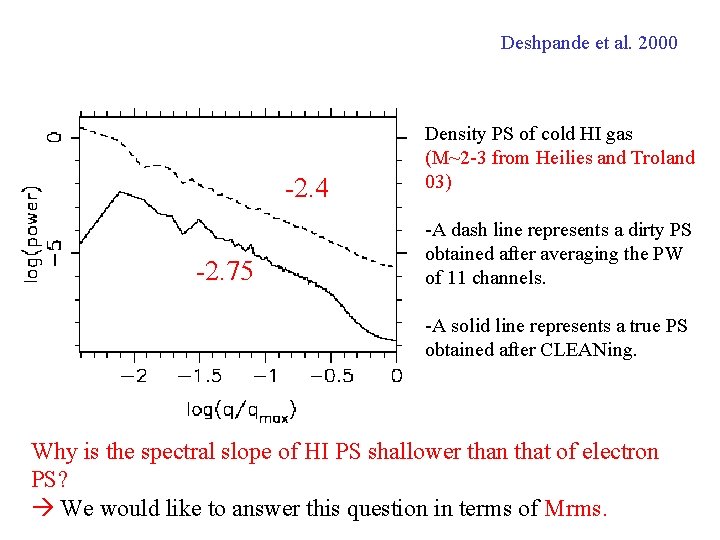
Deshpande et al. 2000 -2. 4 -2. 75 Density PS of cold HI gas (M~2 -3 from Heilies and Troland 03) -A dash line represents a dirty PS obtained after averaging the PW of 11 channels. -A solid line represents a true PS obtained after CLEANing. Why is the spectral slope of HI PS shallower than that of electron PS? We would like to answer this question in terms of Mrms.
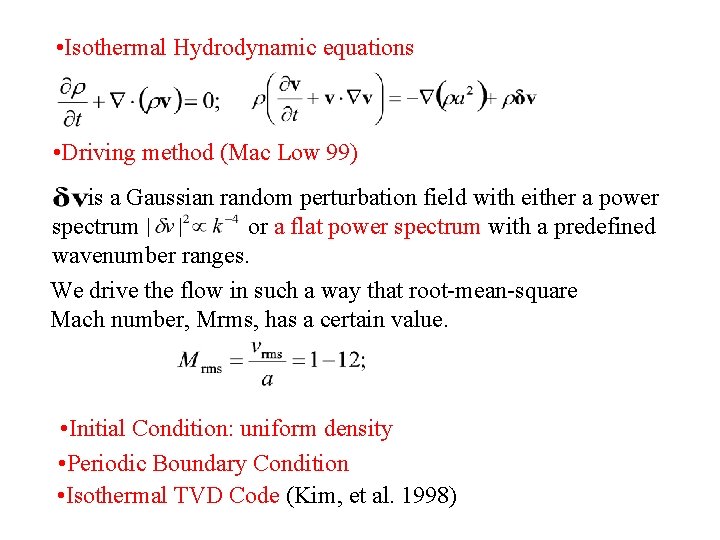
• Isothermal Hydrodynamic equations • Driving method (Mac Low 99) is a Gaussian random perturbation field with either a power spectrum or a flat power spectrum with a predefined wavenumber ranges. We drive the flow in such a way that root-mean-square Mach number, Mrms, has a certain value. • Initial Condition: uniform density • Periodic Boundary Condition • Isothermal TVD Code (Kim, et al. 1998)
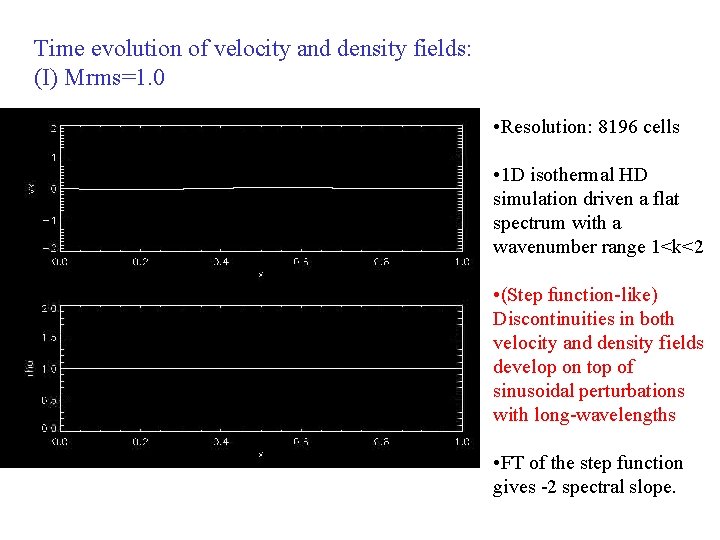
Time evolution of velocity and density fields: (I) Mrms=1. 0 • Resolution: 8196 cells • 1 D isothermal HD simulation driven a flat spectrum with a wavenumber range 1<k<2 • (Step function-like) Discontinuities in both velocity and density fields develop on top of sinusoidal perturbations with long-wavelengths • FT of the step function gives -2 spectral slope.
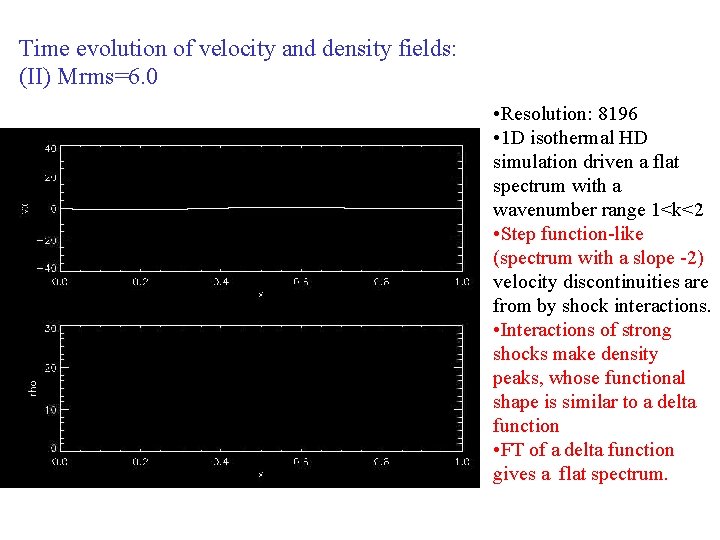
Time evolution of velocity and density fields: (II) Mrms=6. 0 • Resolution: 8196 • 1 D isothermal HD simulation driven a flat spectrum with a wavenumber range 1<k<2 • Step function-like (spectrum with a slope -2) velocity discontinuities are from by shock interactions. • Interactions of strong shocks make density peaks, whose functional shape is similar to a delta function • FT of a delta function gives a flat spectrum.

Density power spectra from 1 D HD simulations • Large scale driving with a wavenumber ranges 1<k<2 • Resolution: 8196 • For subsonic (Mrms=0. 8) or mildly supersonic (Mrms=1. 7) cases, the slopes of the spectra are still nearly -2. • Slopes of the spectra with higher Mach numbers becomes flat especially in the low wavenumber region. • Flat density spectra are not related to B-fields and dimensionality.
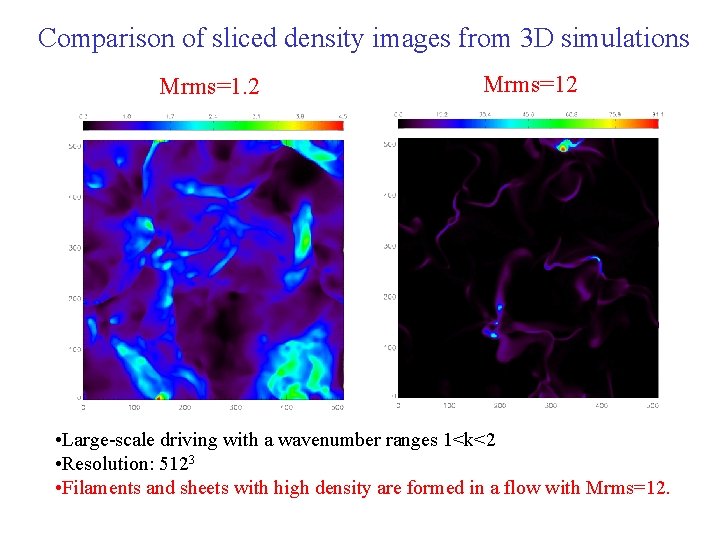
Comparison of sliced density images from 3 D simulations Mrms=1. 2 Mrms=12 • Large-scale driving with a wavenumber ranges 1<k<2 • Resolution: 5123 • Filaments and sheets with high density are formed in a flow with Mrms=12.
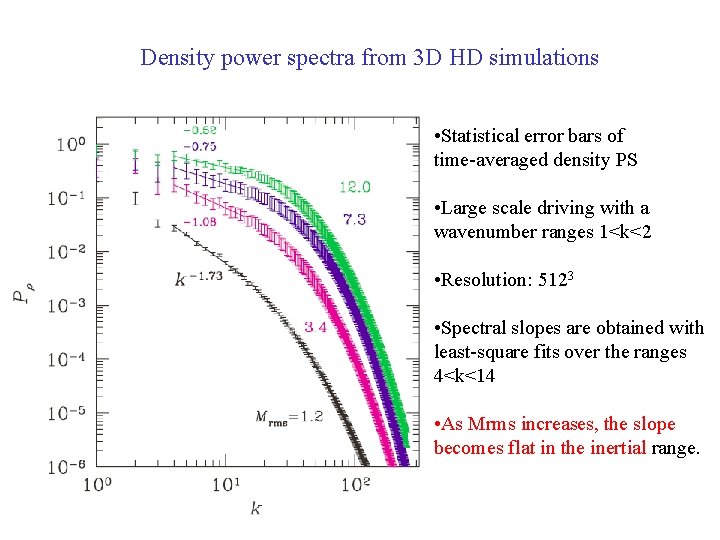
Density power spectra from 3 D HD simulations • Statistical error bars of time-averaged density PS • Large scale driving with a wavenumber ranges 1<k<2 • Resolution: 5123 • Spectral slopes are obtained with least-square fits over the ranges 4<k<14 • As Mrms increases, the slope becomes flat in the inertial range.
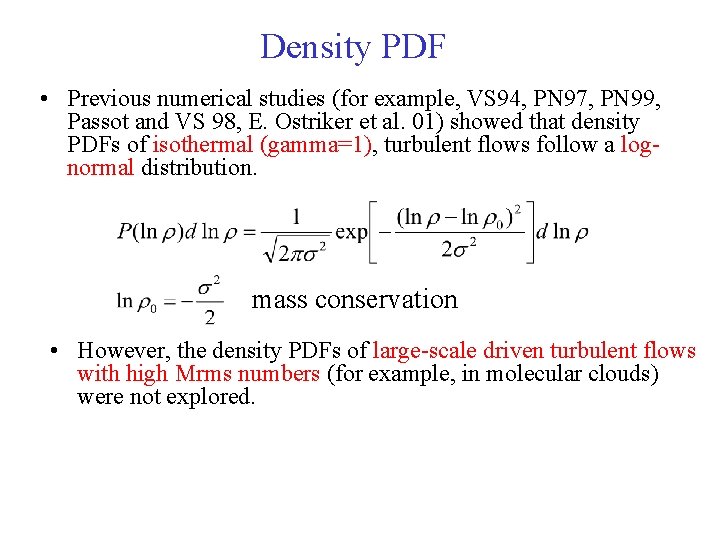
Density PDF • Previous numerical studies (for example, VS 94, PN 97, PN 99, Passot and VS 98, E. Ostriker et al. 01) showed that density PDFs of isothermal (gamma=1), turbulent flows follow a lognormal distribution. mass conservation • However, the density PDFs of large-scale driven turbulent flows with high Mrms numbers (for example, in molecular clouds) were not explored.
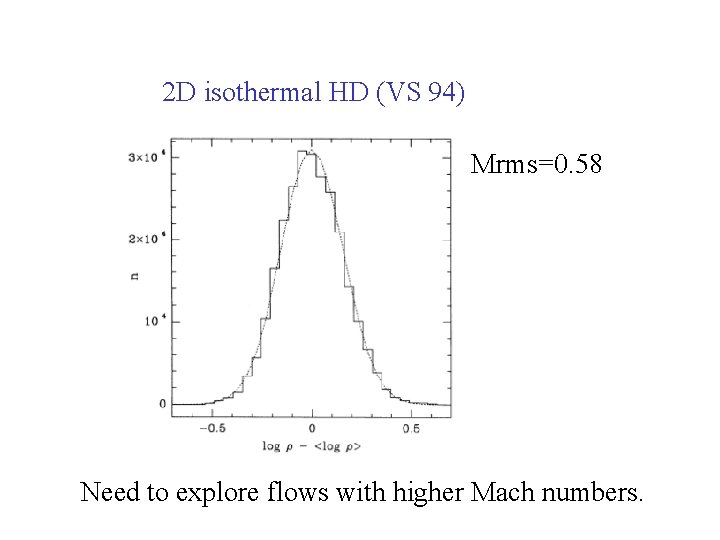
2 D isothermal HD (VS 94) Mrms=0. 58 Need to explore flows with higher Mach numbers.
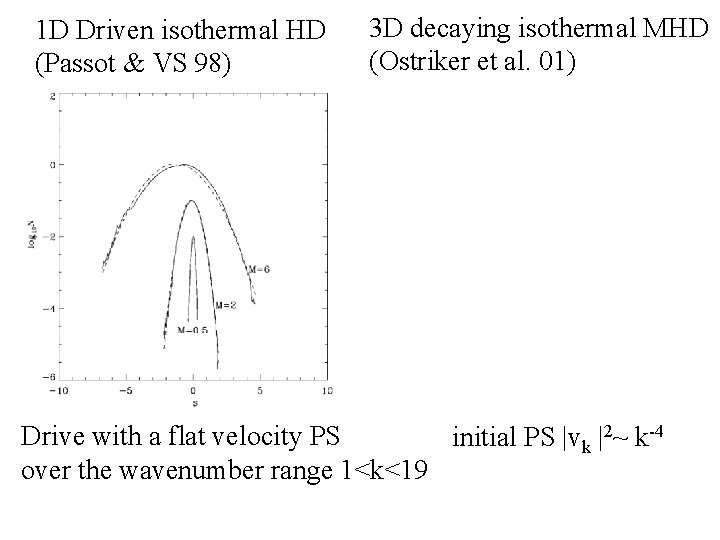
1 D Driven isothermal HD (Passot & VS 98) 3 D decaying isothermal MHD (Ostriker et al. 01) Drive with a flat velocity PS initial PS |vk |2~ k-4 over the wavenumber range 1<k<19
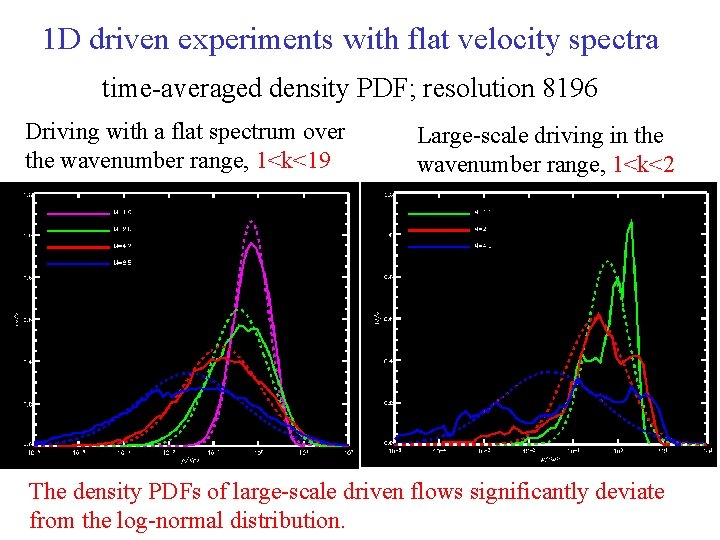
1 D driven experiments with flat velocity spectra time-averaged density PDF; resolution 8196 Driving with a flat spectrum over the wavenumber range, 1<k<19 Large-scale driving in the wavenumber range, 1<k<2 The density PDFs of large-scale driven flows significantly deviate from the log-normal distribution.
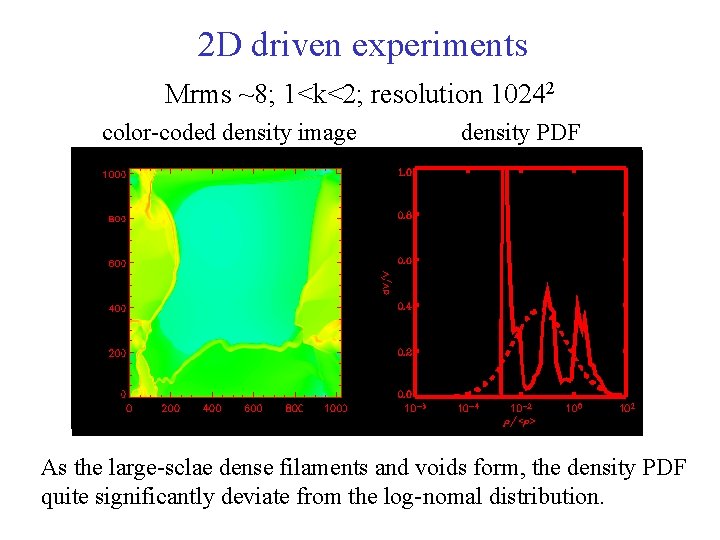
2 D driven experiments Mrms ~8; 1<k<2; resolution 10242 color-coded density image density PDF As the large-sclae dense filaments and voids form, the density PDF quite significantly deviate from the log-nomal distribution.
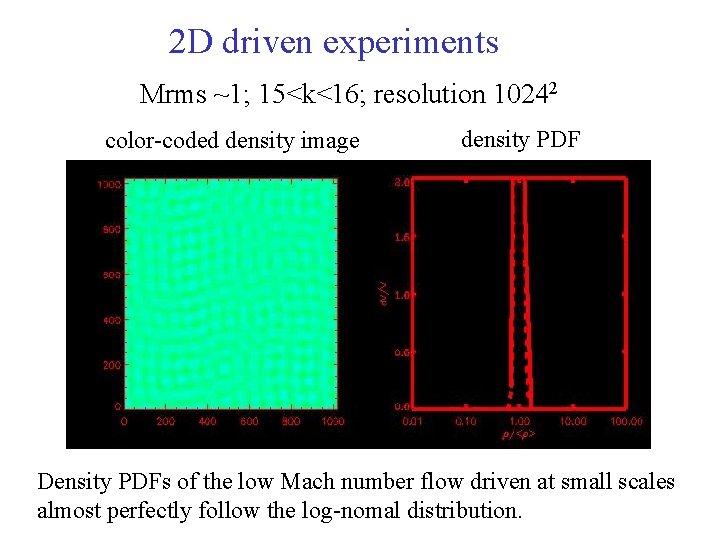
2 D driven experiments Mrms ~1; 15<k<16; resolution 10242 color-coded density image density PDF Density PDFs of the low Mach number flow driven at small scales almost perfectly follow the log-nomal distribution.
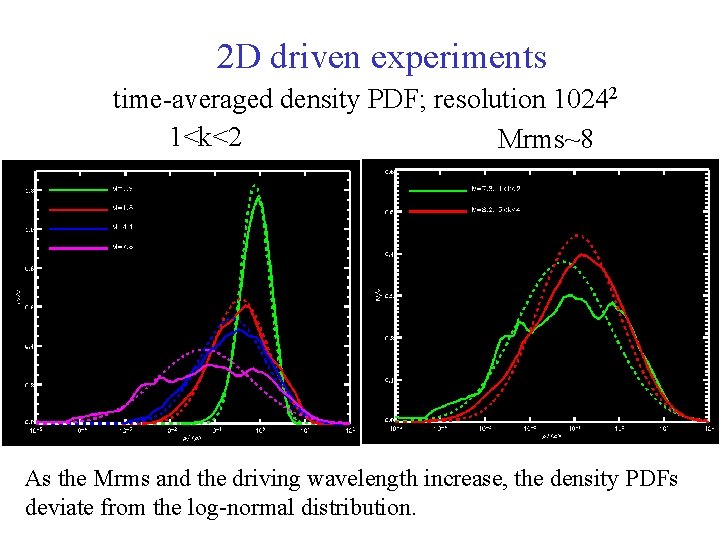
2 D driven experiments time-averaged density PDF; resolution 10242 1<k<2 Mrms~8 As the Mrms and the driving wavelength increase, the density PDFs deviate from the log-normal distribution.
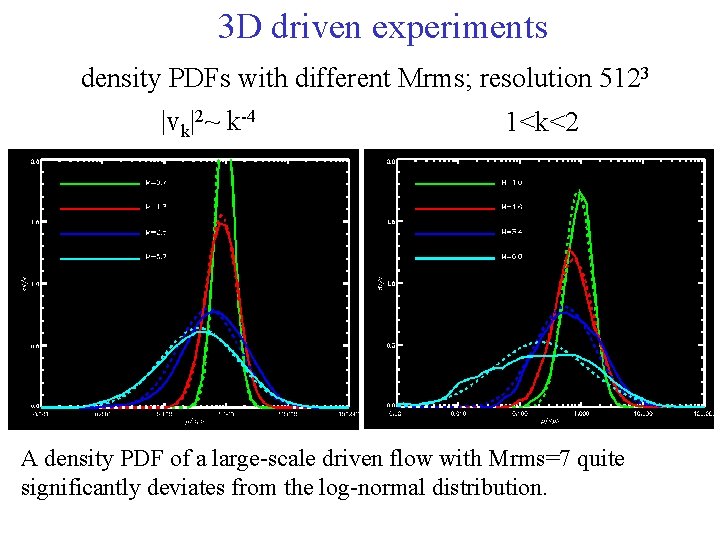
3 D driven experiments density PDFs with different Mrms; resolution 5123 |vk|2~ k-4 1<k<2 A density PDF of a large-scale driven flow with Mrms=7 quite significantly deviates from the log-normal distribution.
Conclusions • As the Mrms of compressible turbulent flow increases, the density power spectrum becomes flat. This is due to density peaks (filaments and sheets) formed by shock interactions. • The Kolmogorov slope of the electron-density PS is explained by the fact that the WIM has a transonic Mach number; while the shallower slope of a patch of cold HI gas is due to the fact that it has a Mach number of a few. • Density PDFs of isothermal HD, turbulent flows deviates significantly from the log-normal distirbution as the Mrms and the driving scale increase.
- Slides: 19