
The power set of N is uncountable Prof
The power set of N is uncountable Prof. Ting-Lu Huang Introduction to Formal Languages National Chiao Tung University
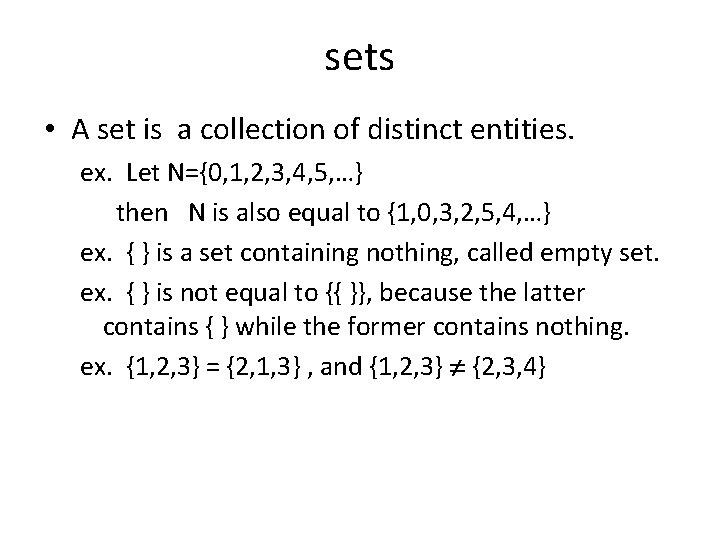
sets • A set is a collection of distinct entities. ex. Let N={0, 1, 2, 3, 4, 5, …} then N is also equal to {1, 0, 3, 2, 5, 4, …} ex. { } is a set containing nothing, called empty set. ex. { } is not equal to {{ }}, because the latter contains { } while the former contains nothing. ex. {1, 2, 3} = {2, 1, 3} , and {1, 2, 3} {2, 3, 4}
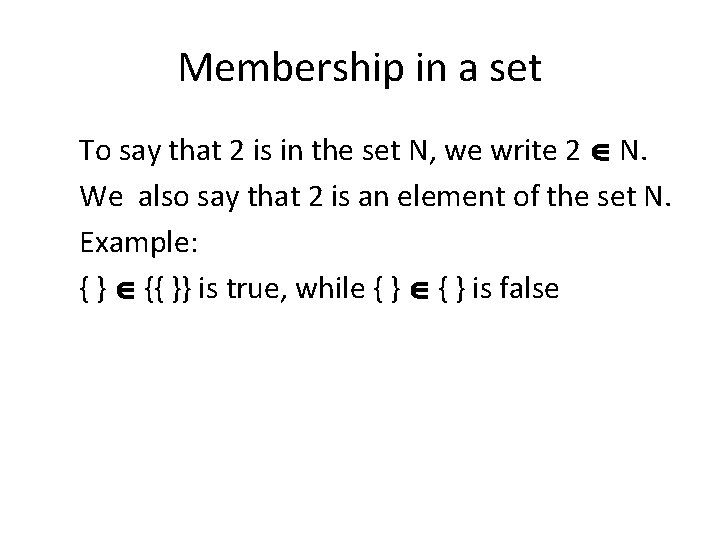
Membership in a set To say that 2 is in the set N, we write 2 N. We also say that 2 is an element of the set N. Example: { } {{ }} is true, while { } is false
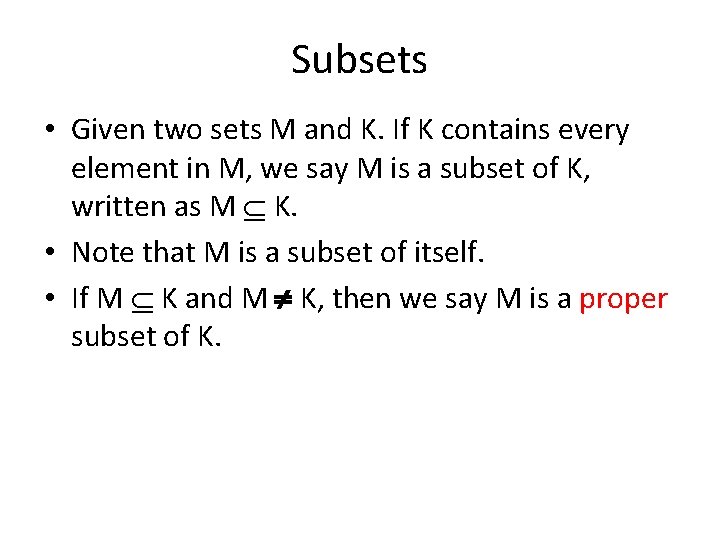
Subsets • Given two sets M and K. If K contains every element in M, we say M is a subset of K, written as M K. • Note that M is a subset of itself. • If M K and M K, then we say M is a proper subset of K.
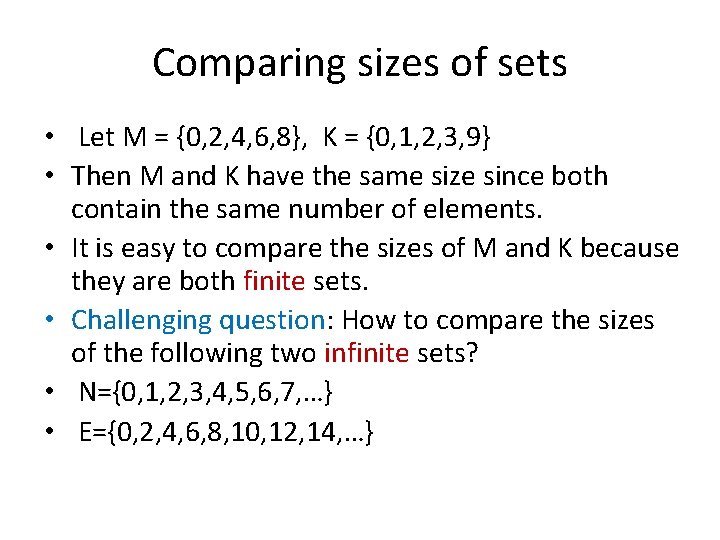
Comparing sizes of sets • Let M = {0, 2, 4, 6, 8}, K = {0, 1, 2, 3, 9} • Then M and K have the same size since both contain the same number of elements. • It is easy to compare the sizes of M and K because they are both finite sets. • Challenging question: How to compare the sizes of the following two infinite sets? • N={0, 1, 2, 3, 4, 5, 6, 7, …} • E={0, 2, 4, 6, 8, 10, 12, 14, …}
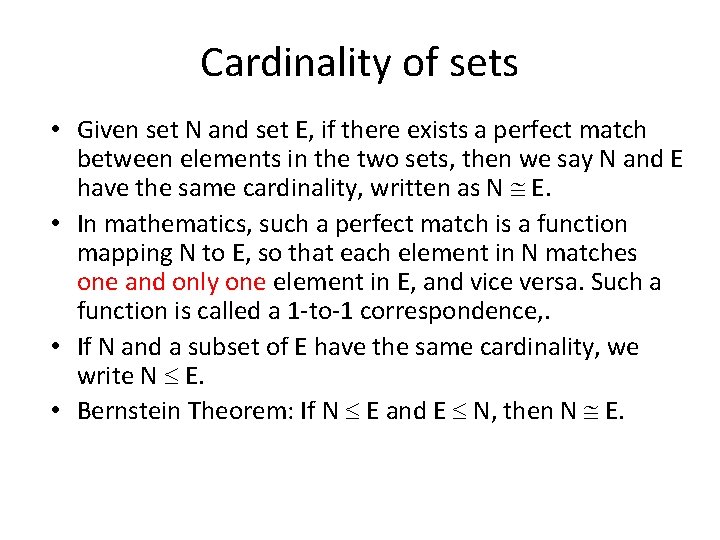
Cardinality of sets • Given set N and set E, if there exists a perfect match between elements in the two sets, then we say N and E have the same cardinality, written as N E. • In mathematics, such a perfect match is a function mapping N to E, so that each element in N matches one and only one element in E, and vice versa. Such a function is called a 1 -to-1 correspondence, . • If N and a subset of E have the same cardinality, we write N E. • Bernstein Theorem: If N E and E N, then N E.

Cardinality: examples N: natural numbers E: even numbers N={0, 1, 2, 3, 4, 5, 6, 7, …} E={0, 2, 4, 6, 8, 10, 12, 14, …} Both can be put in a linear order. Pairing up by the position in the linear order is a perfect match between N and E. Therefore, they have the same cardinality. • It is counter-intuitive since E is a proper subset of N but both E and N have the same cardinality. • • •
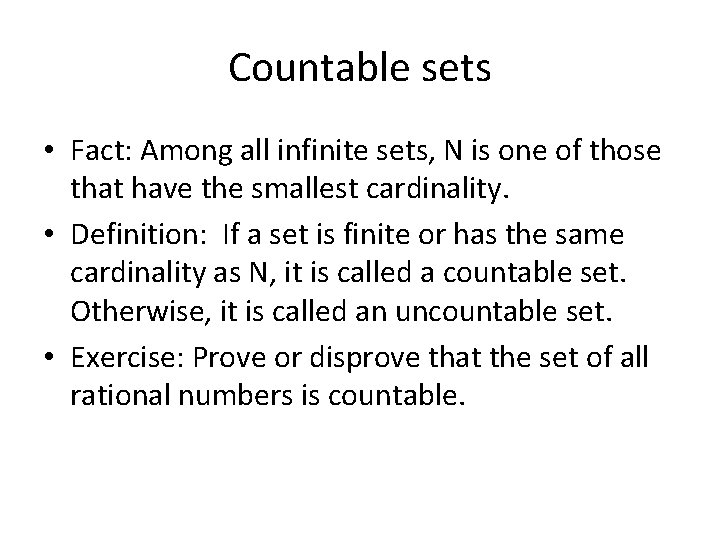
Countable sets • Fact: Among all infinite sets, N is one of those that have the smallest cardinality. • Definition: If a set is finite or has the same cardinality as N, it is called a countable set. Otherwise, it is called an uncountable set. • Exercise: Prove or disprove that the set of all rational numbers is countable.

Power sets • Given a set K, the set consisting of all possible subsets of K is called the power set of K, written as P(K). • Ex. Let M={3, 4}. Then P(M)={{}, {3}, {4}, {3, 4}}.
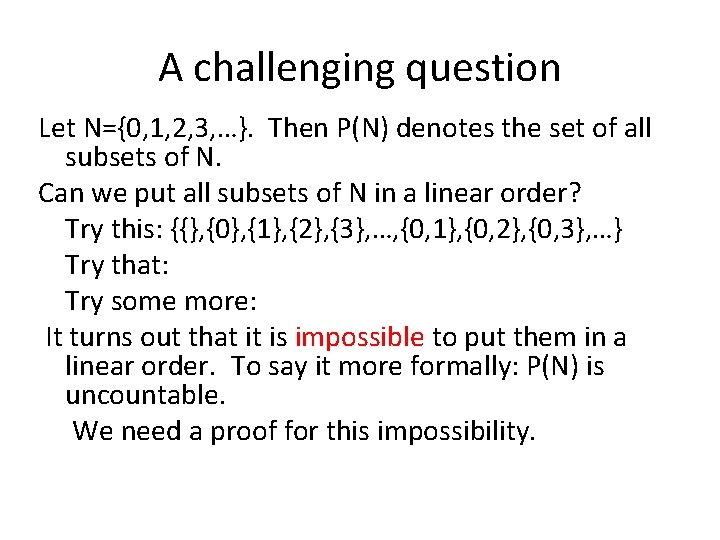
A challenging question Let N={0, 1, 2, 3, …}. Then P(N) denotes the set of all subsets of N. Can we put all subsets of N in a linear order? Try this: {{}, {0}, {1}, {2}, {3}, …, {0, 1}, {0, 2}, {0, 3}, …} Try that: Try some more: It turns out that it is impossible to put them in a linear order. To say it more formally: P(N) is uncountable. We need a proof for this impossibility.
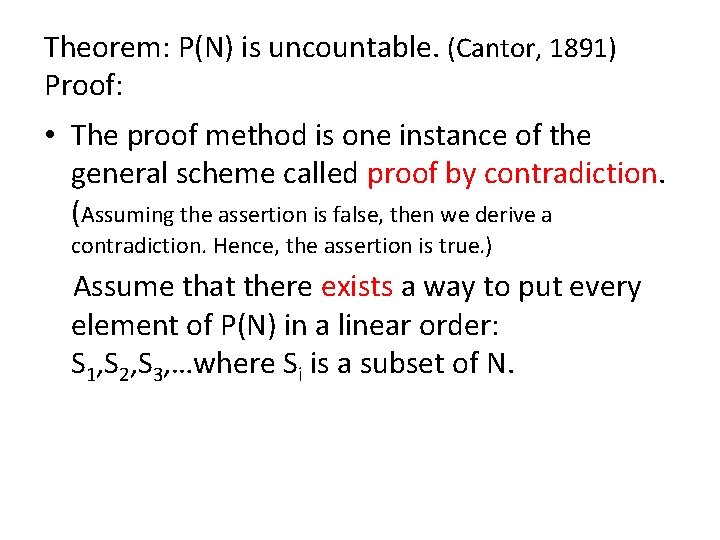
Theorem: P(N) is uncountable. (Cantor, 1891) Proof: • The proof method is one instance of the general scheme called proof by contradiction. (Assuming the assertion is false, then we derive a contradiction. Hence, the assertion is true. ) Assume that there exists a way to put every element of P(N) in a linear order: S 1, S 2, S 3, …where Si is a subset of N.
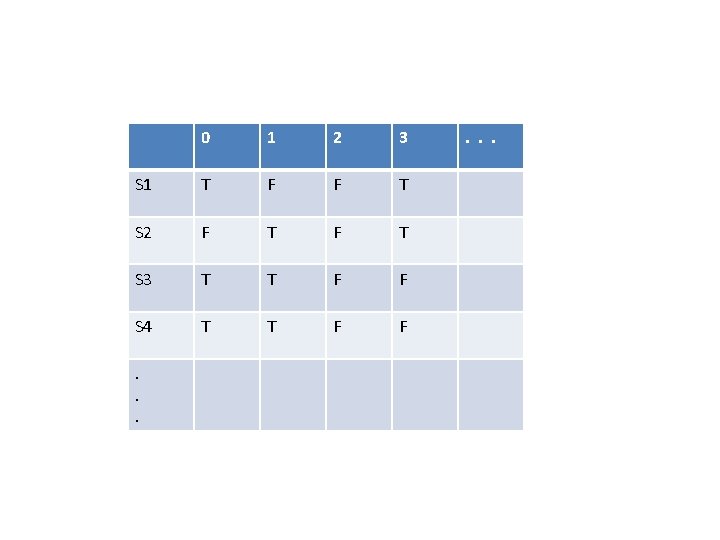
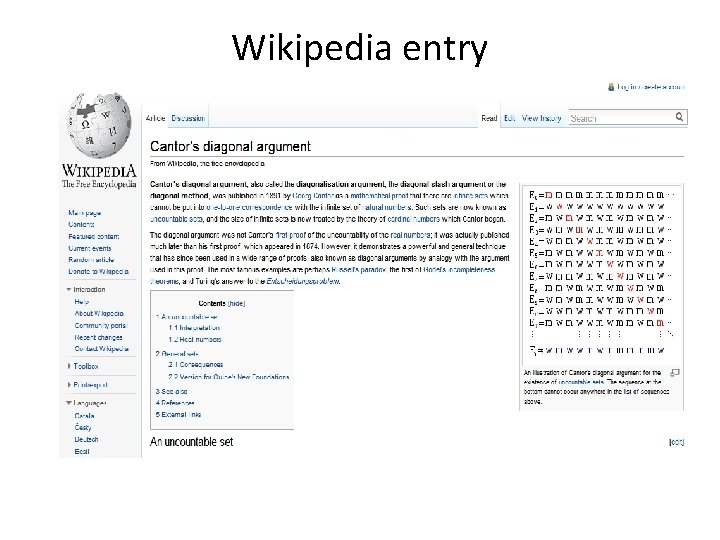
0 1 2 3 S 1 T F F T S 2 F T S 3 T T F F S 4 T T F F . . .
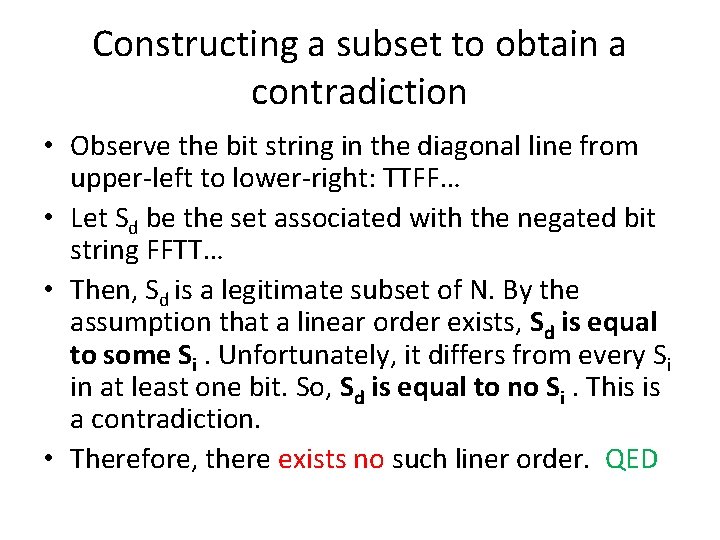
Constructing a subset to obtain a contradiction • Observe the bit string in the diagonal line from upper-left to lower-right: TTFF… • Let Sd be the set associated with the negated bit string FFTT… • Then, Sd is a legitimate subset of N. By the assumption that a linear order exists, Sd is equal to some Si. Unfortunately, it differs from every Si in at least one bit. So, Sd is equal to no Si. This is a contradiction. • Therefore, there exists no such liner order. QED
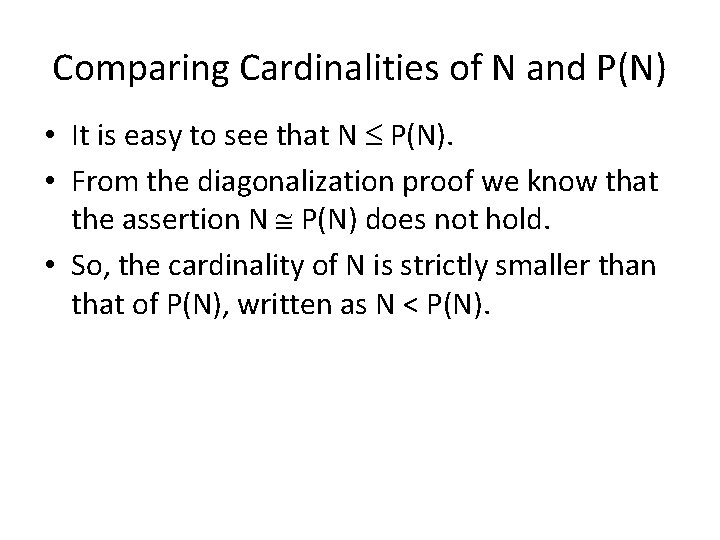
Comparing Cardinalities of N and P(N) • It is easy to see that N P(N). • From the diagonalization proof we know that the assertion N P(N) does not hold. • So, the cardinality of N is strictly smaller than that of P(N), written as N < P(N).
Wikipedia entry
- Slides: 15