
THE POWER OF WORDS by Sophie Rosen www
THE POWER OF WORDS by Sophie Rosen www. msrosenreads. com

Have you ever… • …been told you were rude after you said something that you did not intend as rude? • …wondered whether you were being insulted because of how someone said something?
You can sometimes determine what people mean by the tone of their voice.
But… what if you are reading the words in a text message or on Facebook or in a book?

LESSON ONE Words affect meaning!
Carefully choose your words! • • • formal situations for informal situations for peers for people in authority for younger children
Words can have… • a neutral meaning • a positive meaning • a negative meaning
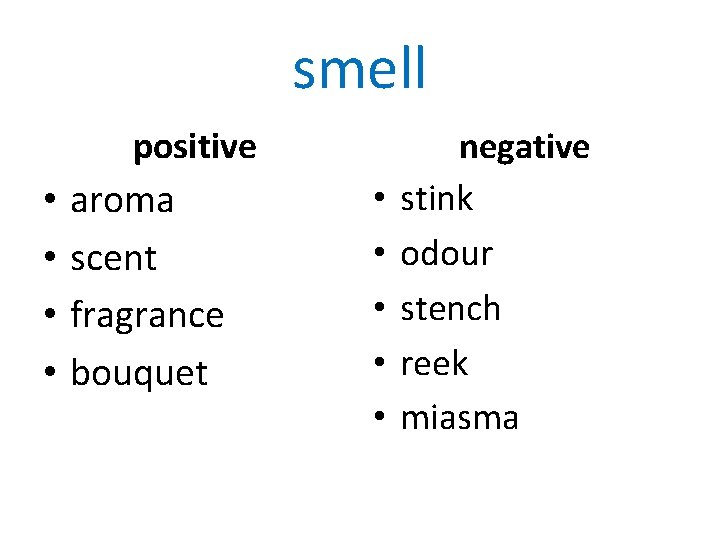
smell positive • • aroma scent fragrance bouquet • • • negative stink odour stench reek miasma
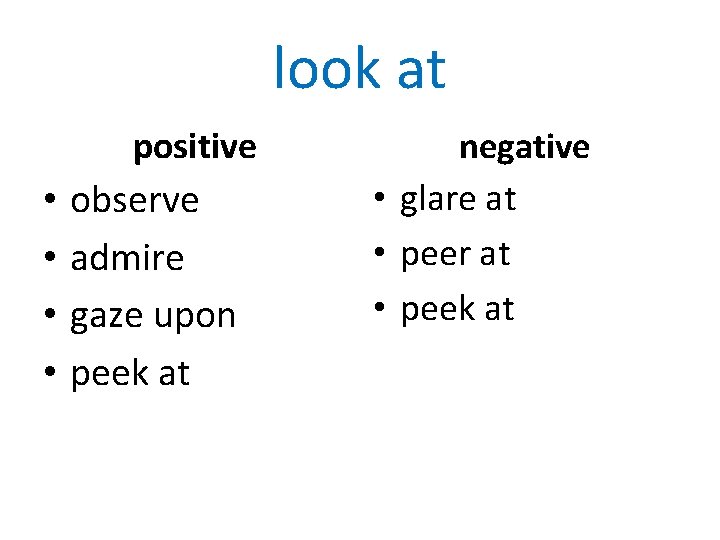
look at positive • • observe admire gaze upon peek at negative • glare at • peer at • peek at
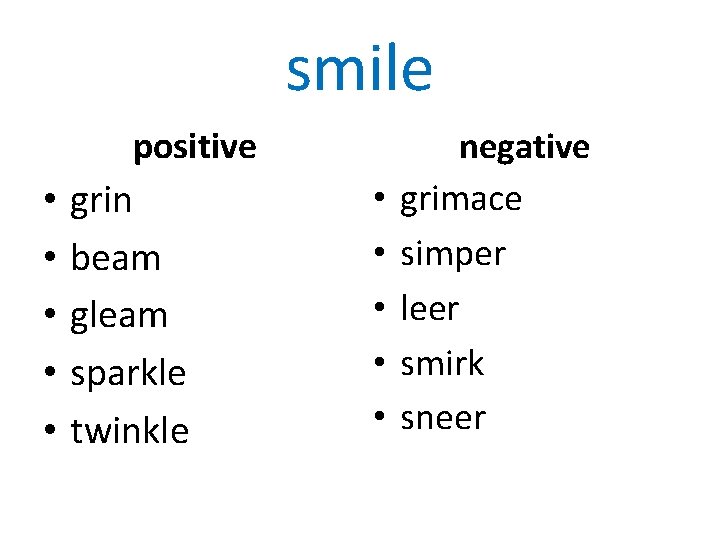
smile positive • • • grin beam gleam sparkle twinkle • • • negative grimace simper leer smirk sneer
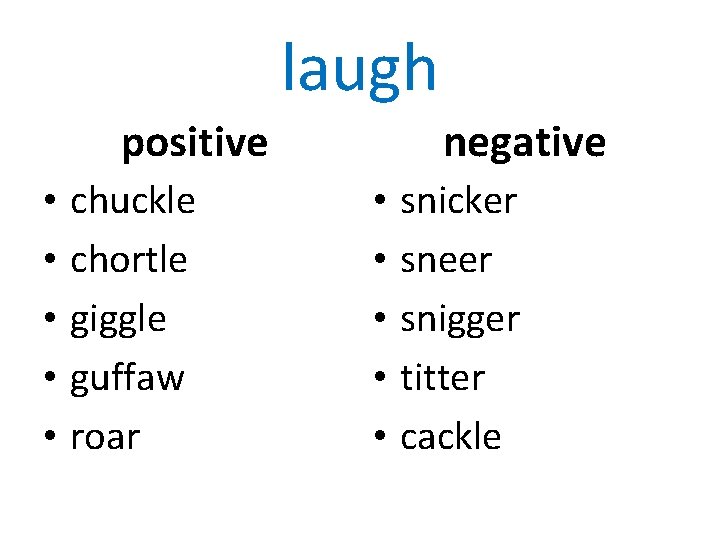
laugh negative positive • • • chuckle chortle giggle guffaw roar • • • snicker sneer snigger titter cackle
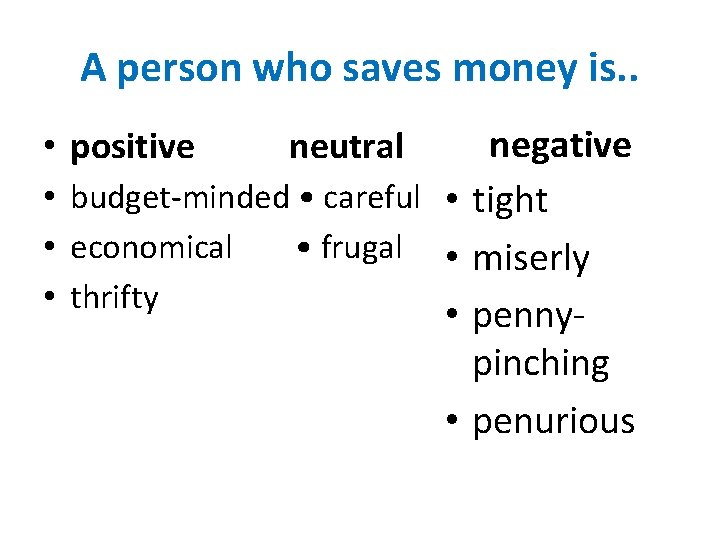
A person who saves money is. . • positive neutral • budget-minded • careful • • economical • frugal • • thrifty • • negative tight miserly pennypinching penurious
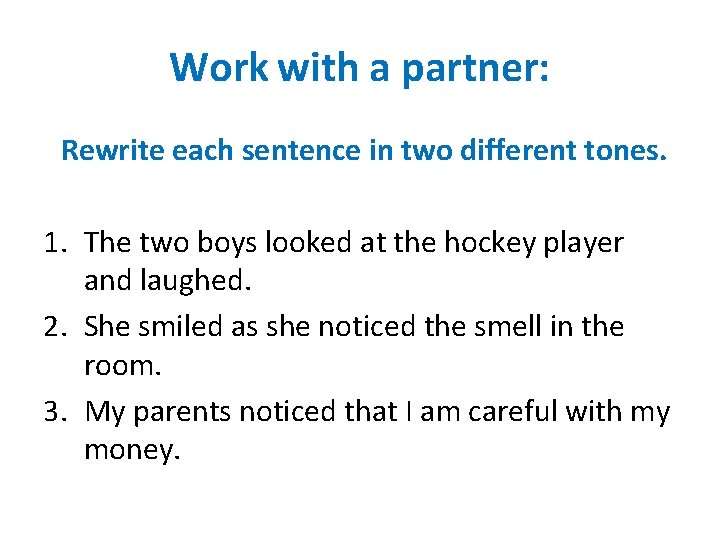
Work with a partner: Rewrite each sentence in two different tones. 1. The two boys looked at the hockey player and laughed. 2. She smiled as she noticed the smell in the room. 3. My parents noticed that I am careful with my money.
Share Get ready to stand read your sentences aloud.
LESSON TWO Words have both a denotation and connotation.
Two words to learn: D = dictionary C = can feel • denotation • connotation
Denotation - objective - dictionary definition • is factual • may require additional information in order to discover the emotional meaning
Connotation - positive, - negative or - neutral - formal or - informal • contains emotional information • meaning that is implied • varies from culture to culture • may require background information to understand whether the emotion is positive or negative
Individual Practice You will receive a worksheet to help you practise using words with different connotations. Carefully choose words to create the intended meaning.
Get ready for a review quiz! Take out a piece of paper and a pen.
Cloze Quiz: Fill-in-the-Blanks • Denotation refers to the l______ definition of a word, the one found in a d_____. It is f______ and o____. It may require a_______ information to discover the emotion. • Connotation refers to the e______ meaning of a word. It is s_____ and varies from _______ to ______. It may require b_______ information to understand. It deliberately shows a p______, n______ or n______ meaning.
LESSON THREE Words reveal emotions! Before we begin, get ready to stand read aloud, filling in the correct answers. (You may read with a partner, if you prefer. )
Oral Practice: Fill-in-the-Blanks • Denotation refers to the l______ definition of a word, the one found in a d_____. It is f______ and o____. It may require a_______ information to discover the emotion. • Connotation refers to the e______ meaning of a word. It is s_____ and varies from _______ to ______. It may require b_______ information to understand. It deliberately shows a p______, n______ or n______ meaning.
Practice detecting emotions! 1. Look at each word in the list. 2. How does it change the meaning of the sentence? 3. Discuss in your group. 4. Be prepared to report your observations to the class.
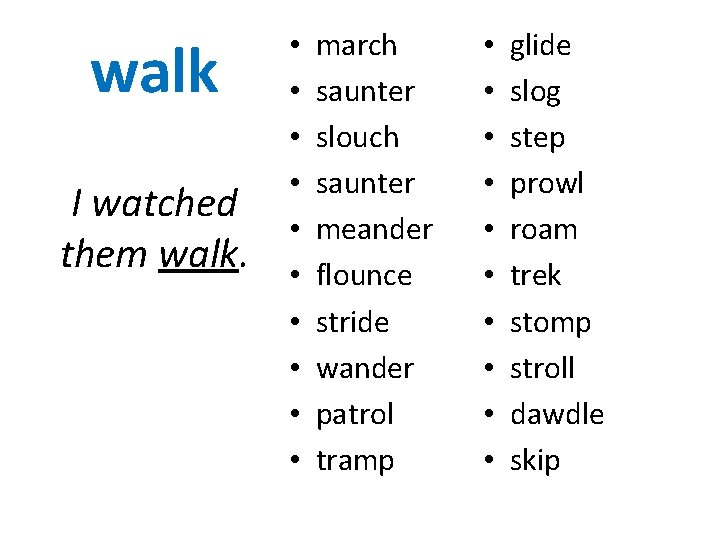
walk I watched them walk. • • • march saunter slouch saunter meander flounce stride wander patrol tramp • • • glide slog step prowl roam trek stomp stroll dawdle skip
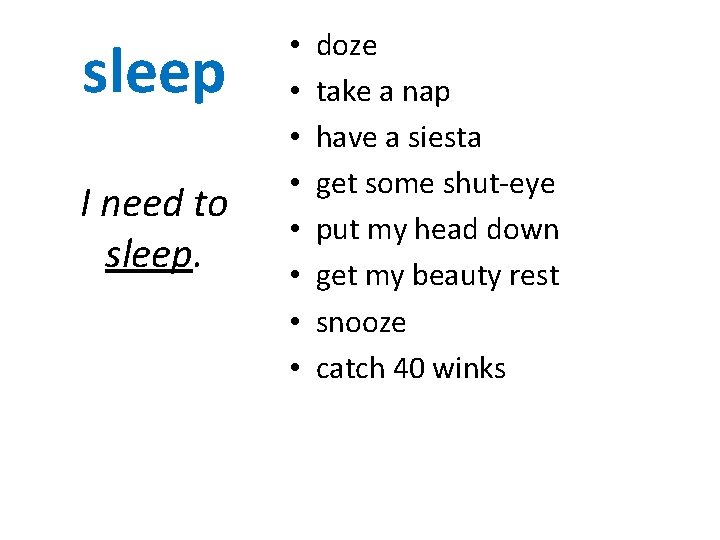
sleep I need to sleep. • • doze take a nap have a siesta get some shut-eye put my head down get my beauty rest snooze catch 40 winks
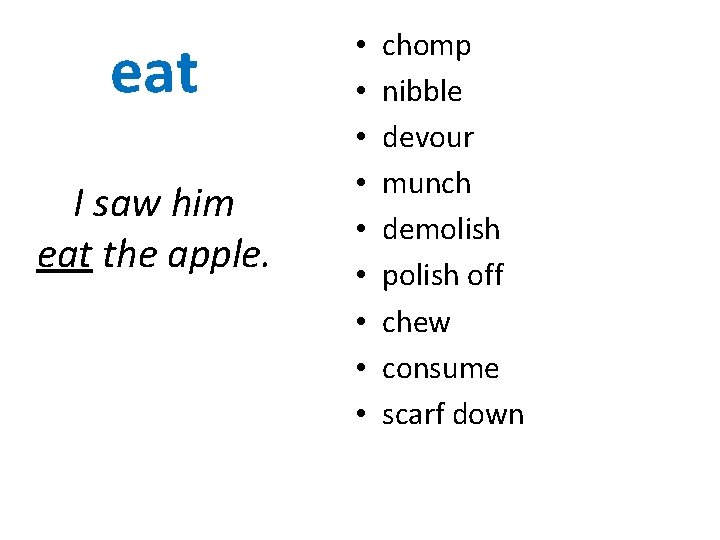
eat I saw him eat the apple. • • • chomp nibble devour munch demolish polish off chew consume scarf down
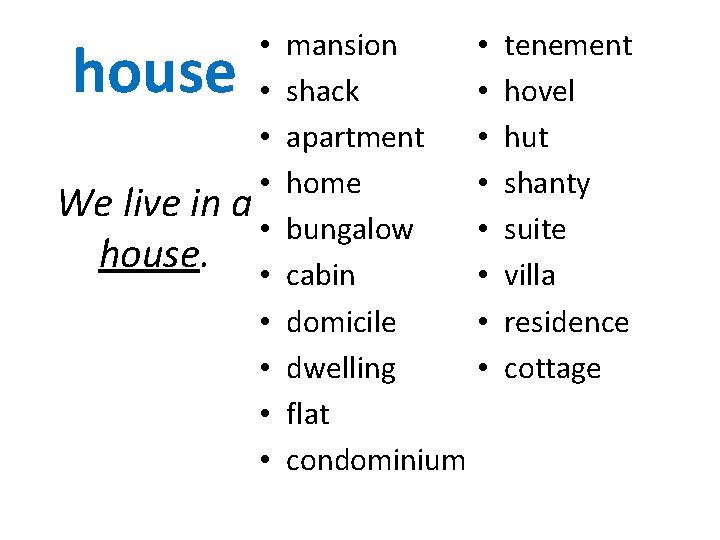
• • We live in a • house. • • • house mansion shack apartment home bungalow cabin domicile dwelling flat condominium • • tenement hovel hut shanty suite villa residence cottage
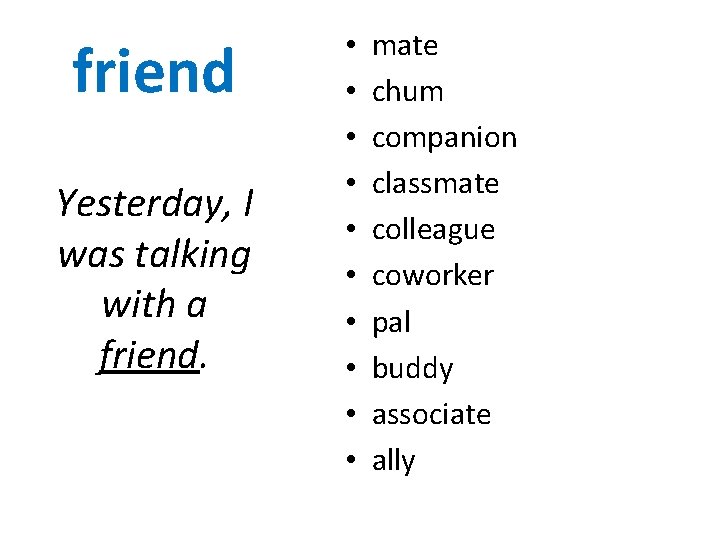
friend Yesterday, I was talking with a friend. • • • mate chum companion classmate colleague coworker pal buddy associate ally
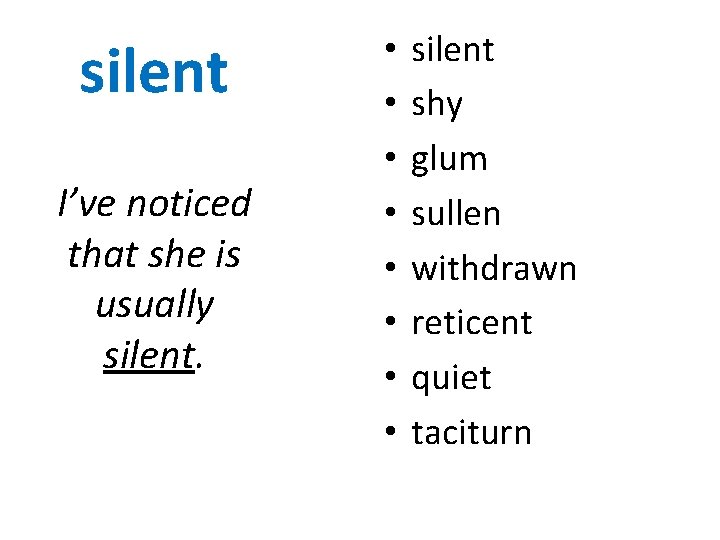
silent I’ve noticed that she is usually silent. • • silent shy glum sullen withdrawn reticent quiet taciturn
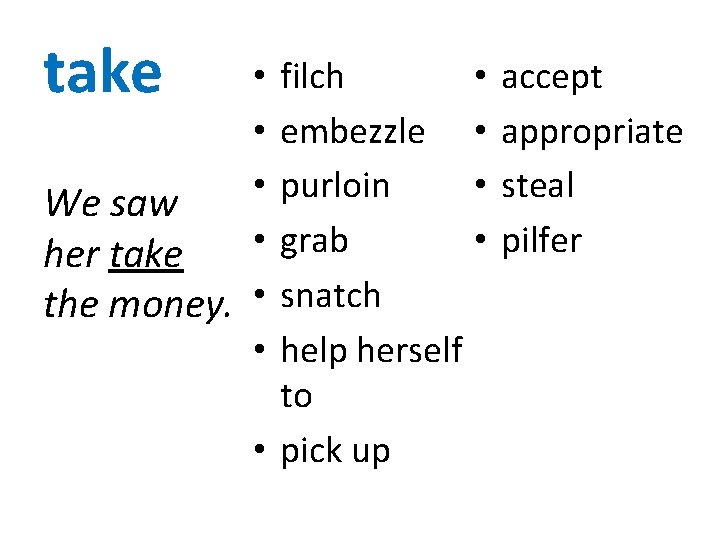
take filch embezzle purloin grab snatch help herself to • pick up • • • We saw • her take the money. • • • accept appropriate steal pilfer
Now you are ready to create sentences with deep meaning! Rewrite each sentence in two different ways to create two different implied meanings. Yes, you may work with a partner. Yes, you may use a thesaurus.
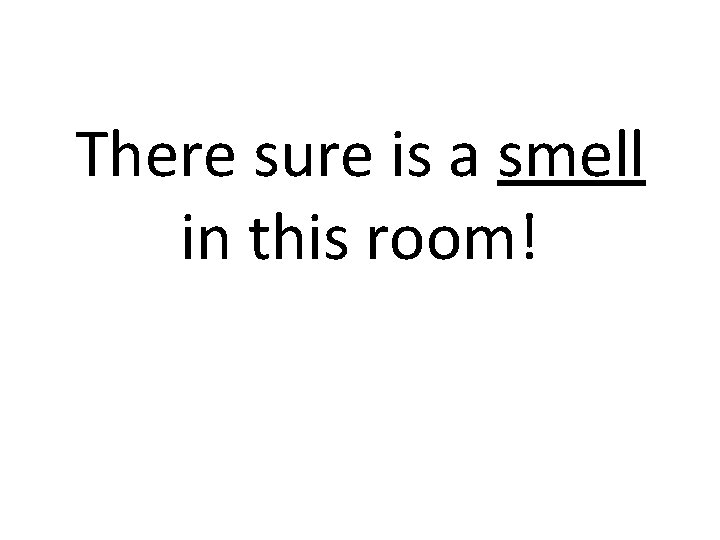
There sure is a smell in this room!
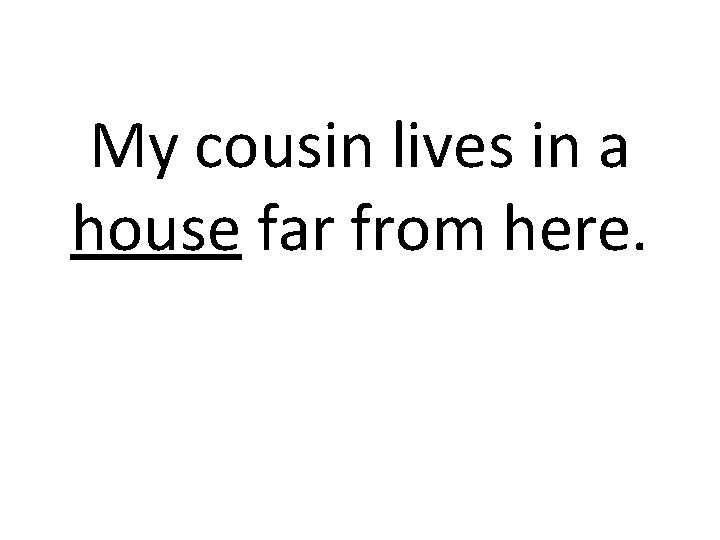
My cousin lives in a house far from here.
She ate that steak.
He likes to be the leader.
Share Get ready to stand read your sentences aloud.
LESSON FOUR Words create a mood in a reader.
Before we begin, let’s review connotation and denotation. Take out paper and a pen.
Complete the Definitions • Denotation refers to the l______ definition of a word, the one found in a d_____. It is f______ and o____. It may require a_______ information to discover the emotion. • Connotation refers to the e______ meaning of a word. It is s_____ and varies from _______ to ______. It may require b_______ information to understand. It deliberately shows a p______, n______ or n______ meaning.
Authors use emotions wisely to create… a mood: a temporary emotion.
Many Moods • • Abandonment Desertion Emptiness Foreboding Hopefulness Isolation Loneliness • • Apathy Boredom Curiosity Disinterest Excitement Irritation Annoyance
More Moods • • Expectancy Generosity Interest Suspicion Worry Jealous Envious • • Peacefulness Joy Rejection Restfulness Resentful Bravery Self-confidence
Good writers choose words carefully! They are trying to create emotions in their readers.
What emotion do you feel? • “We had our swim before sundown, and while we were cooking our supper the oblique rays of light made a dazzling glare on the white sand about us. The translucent red ball itself sank behind the brown stretches of corn field as we sat down to eat, …” – Willa Cather
What emotion do you feel? • “There was once a Velveteen Rabbit, and in the beginning he was really splendid. He was fat and bunchy, as a rabbit should be; his coat was spotted brown and white, he had real thread whiskers, and his ears were lined with pink sateen. …” – Willa Cather
What emotion do you feel? • “I had a pretty good supper last night and then I talked with a friend who came over. We talked in the kitchen which looks pretty good since it was just painted last month. My friend and I ate some good cookies that my dad baked last week…. ”
Stop-and-Go Reading • We will read aloud chapter 1 of Word to Caesar by Geoffrey Trease. • We are watching for words and phrases that convey a mood of foreboding (negative foreshadowing). • Raise your hand when you notice foreboding. • We will stop and you will record, on a piece of paper, the relevant words and phrases.
Share Get ready to stand read aloud your list of words and phrases.
LESSON FIVE Careful use of diction creates an effect in a reader.
Before we begin, let’s review! Take out a piece of paper and a pen.
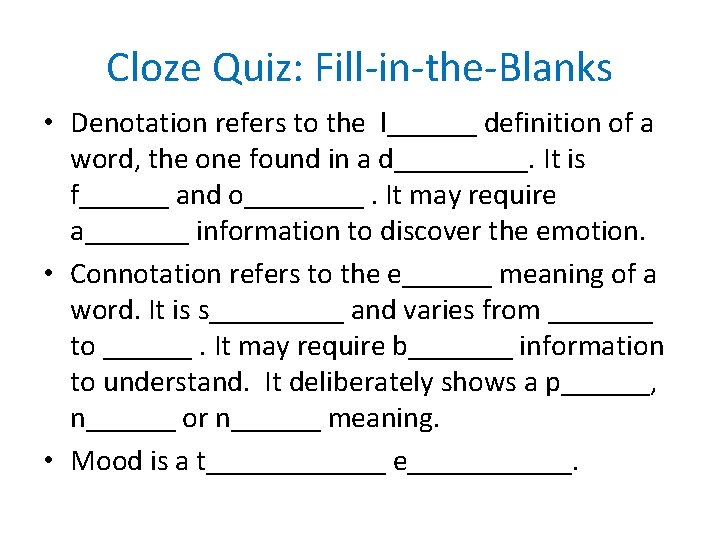
Cloze Quiz: Fill-in-the-Blanks • Denotation refers to the l______ definition of a word, the one found in a d_____. It is f______ and o____. It may require a_______ information to discover the emotion. • Connotation refers to the e______ meaning of a word. It is s_____ and varies from _______ to ______. It may require b_______ information to understand. It deliberately shows a p______, n______ or n______ meaning. • Mood is a t______ e______.
Writers use the connotations of words to create a mood: a temporary emotion.
The use of connotation is part of diction: the careful use of words and phrases to create an effect in readers.
Detecting Diction • Today, you will receive a sheet with three ‘stories’. • Read the stories independently. • Underline the words and phrases that create the mood of the story. • We will mark your work in 30 minutes.
LESSON SIX Diction includes tone and mood.
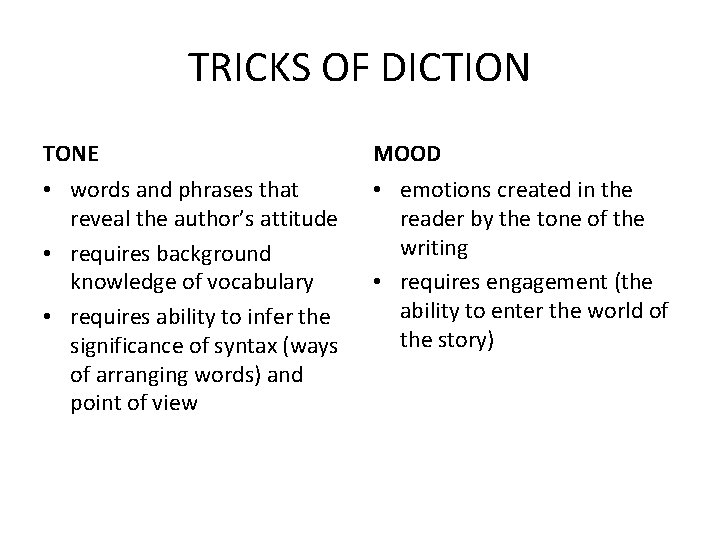
TRICKS OF DICTION TONE MOOD • words and phrases that reveal the author’s attitude • requires background knowledge of vocabulary • requires ability to infer the significance of syntax (ways of arranging words) and point of view • emotions created in the reader by the tone of the writing • requires engagement (the ability to enter the world of the story)
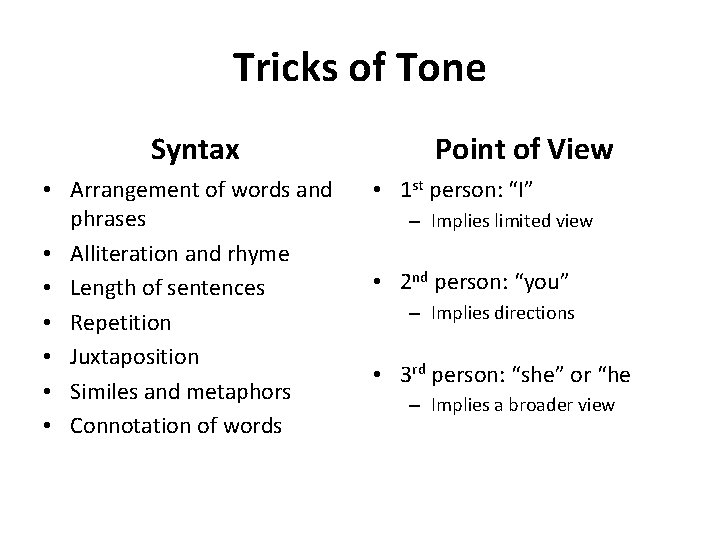
Tricks of Tone Syntax • Arrangement of words and phrases • Alliteration and rhyme • Length of sentences • Repetition • Juxtaposition • Similes and metaphors • Connotation of words Point of View • 1 st person: “I” – Implies limited view • 2 nd person: “you” – Implies directions • 3 rd person: “she” or “he – Implies a broader view
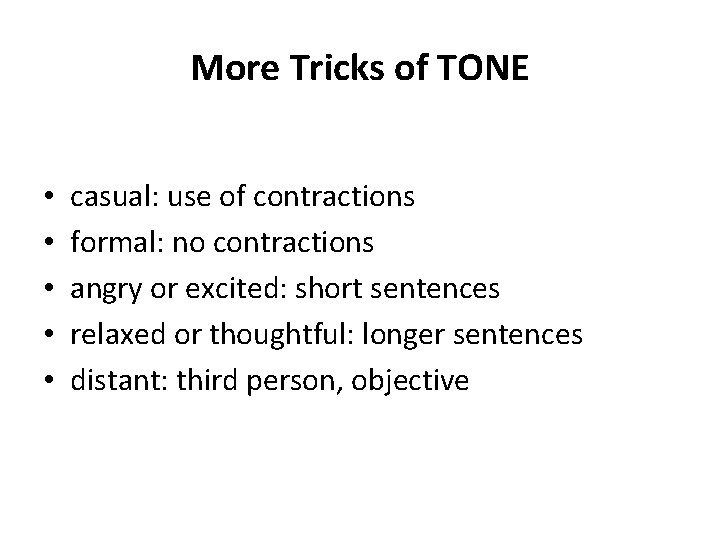
More Tricks of TONE • • • casual: use of contractions formal: no contractions angry or excited: short sentences relaxed or thoughtful: longer sentences distant: third person, objective
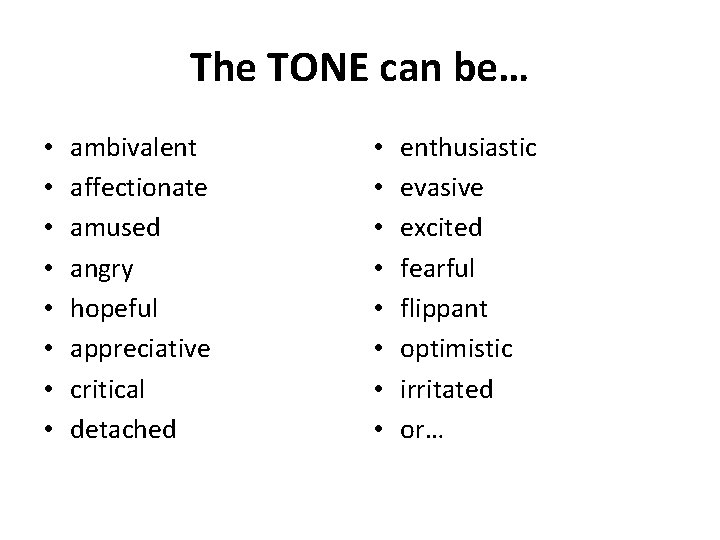
The TONE can be… • • ambivalent affectionate amused angry hopeful appreciative critical detached • • enthusiastic evasive excited fearful flippant optimistic irritated or…
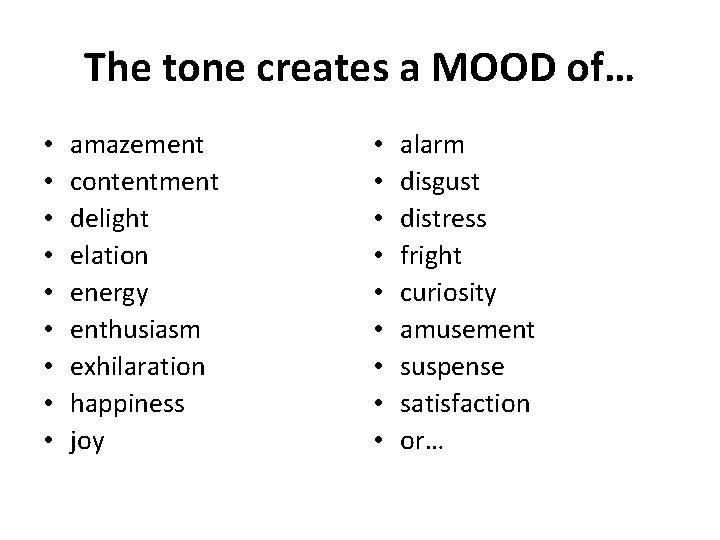
The tone creates a MOOD of… • • • amazement contentment delight elation energy enthusiasm exhilaration happiness joy • • • alarm disgust distress fright curiosity amusement suspense satisfaction or…
Partner Practice You will receive a worksheet to help you practise creating a mood in writing Choose words carefully to create a specific mood. Be careful with your diction.
Share Get ready to stand, with your partner if you wish, and read aloud your sentences.
LESSON SEVEN A thesaurus helps build vocabulary. Before we begin, make sure you have your own thesaurus.
Time to use your thesaurus! • You may, if you wish, work with a partner. • Find at least 5 positive and 5 negative synonyms for each word given. • Time limit: 3 minutes per word. • At the end of each time period, be ready to share your synonyms with the class. • There will be 4 different words.
Walk Positive Negative
Road Positive or Neutral Negative
Wind (Moving air) Positive Negative

Sat Positive Negative
Knowledge Review • You may work individually, with a partner, or in a small group. • Copy the sentences, filling in the blanks with the correct answers. You may use your notes from previous days if necessary. • Be ready to read the sentences aloud when we mark the quiz in 20 minutes.
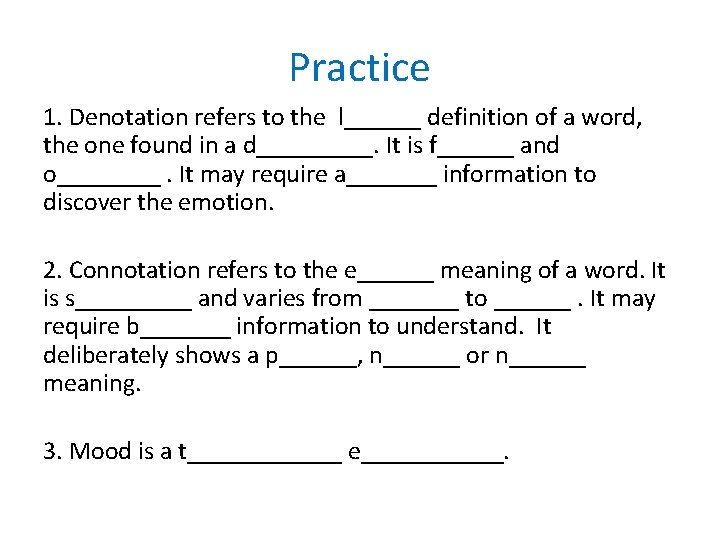
Practice 1. Denotation refers to the l______ definition of a word, the one found in a d_____. It is f______ and o____. It may require a_______ information to discover the emotion. 2. Connotation refers to the e______ meaning of a word. It is s_____ and varies from _______ to ______. It may require b_______ information to understand. It deliberately shows a p______, n______ or n______ meaning. 3. Mood is a t______ e______.
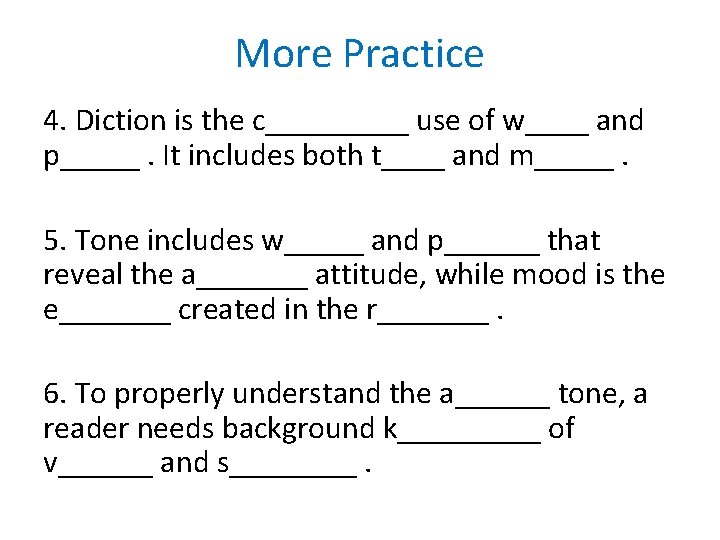
More Practice 4. Diction is the c_____ use of w____ and p_____. It includes both t____ and m_____. 5. Tone includes w_____ and p______ that reveal the a_______ attitude, while mood is the e_______ created in the r_______. 6. To properly understand the a______ tone, a reader needs background k_____ of v______ and s____.
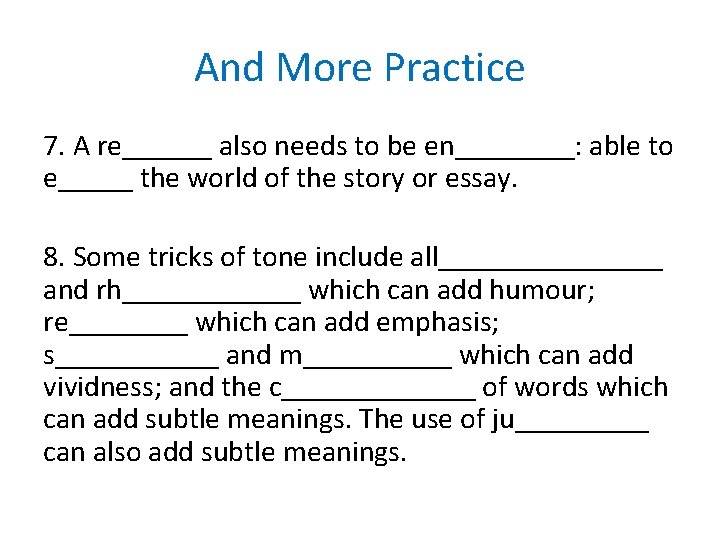
And More Practice 7. A re______ also needs to be en____: able to e_____ the world of the story or essay. 8. Some tricks of tone include all________ and rh______ which can add humour; re____ which can add emphasis; s______ and m_____ which can add vividness; and the c_______ of words which can add subtle meanings. The use of ju_____ can also add subtle meanings.
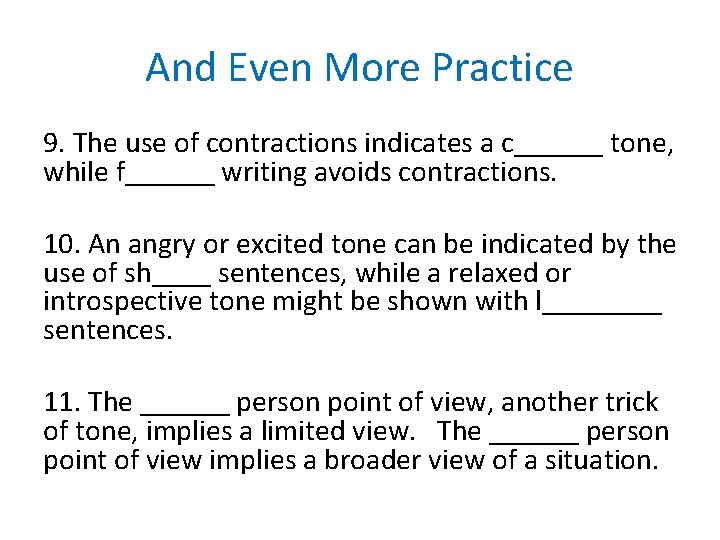
And Even More Practice 9. The use of contractions indicates a c______ tone, while f______ writing avoids contractions. 10. An angry or excited tone can be indicated by the use of sh____ sentences, while a relaxed or introspective tone might be shown with l____ sentences. 11. The ______ person point of view, another trick of tone, implies a limited view. The ______ person point of view implies a broader view of a situation.
Mark Your Work Get ready to stand, with your partner if you wish, and read aloud your sentences.
LESSON EIGHT Careful use of vocabulary affects the tone of writing.
Get ready to write! • This time, you will use your background knowledge of words. You may not use a dictionary or thesaurus. • You may not work with a partner. • You will silently rewrite two paragraphs. You may change the denotation as well as the connotation of the words. • Time limit: 15 minutes per paragraph. • Get out your supplies: paper and pen
Change the Tone to Cheerful When I walked in the door after school, my father was standing there. He looked at me with a solemn expression. “I have news, ” he said quietly. “ Your grandmother called. Something has happened. ”
Share Get ready to stand read aloud your paragraph.
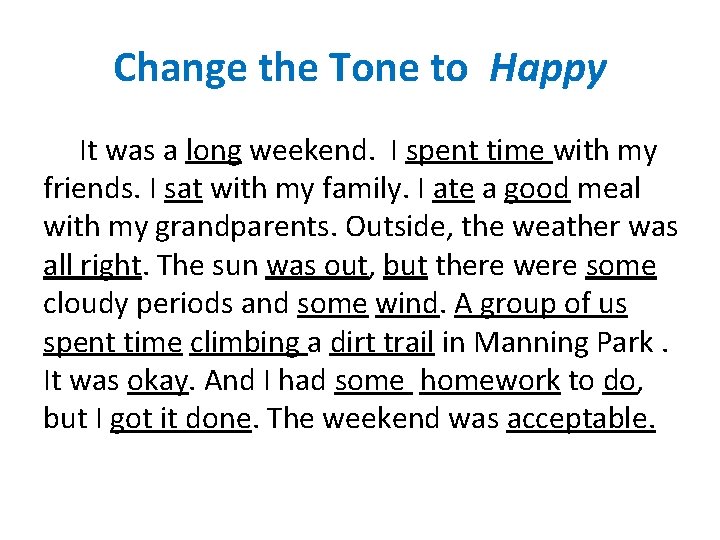
Change the Tone to Happy It was a long weekend. I spent time with my friends. I sat with my family. I ate a good meal with my grandparents. Outside, the weather was all right. The sun was out, but there were some cloudy periods and some wind. A group of us spent time climbing a dirt trail in Manning Park. It was okay. And I had some homework to do, but I got it done. The weekend was acceptable.
Share Get ready to stand read aloud your paragraph.
LESSON NINE You are now ready to be tested on your knowledge and skill level. You will complete this test silently and independently. Take out a pen and piece of paper.
Test: A 1. Denotation refers to the l______ definition of a word, the one found in a d_____. It is f______ and o____. It may require a_______ information to discover the emotion. 2. Connotation refers to the e______ meaning of a word. It is s_____ and varies from _______ to ______. It may require b_______ information to understand. It deliberately shows a p______, n______ or n______ meaning. 3. Mood is a t______ e______.
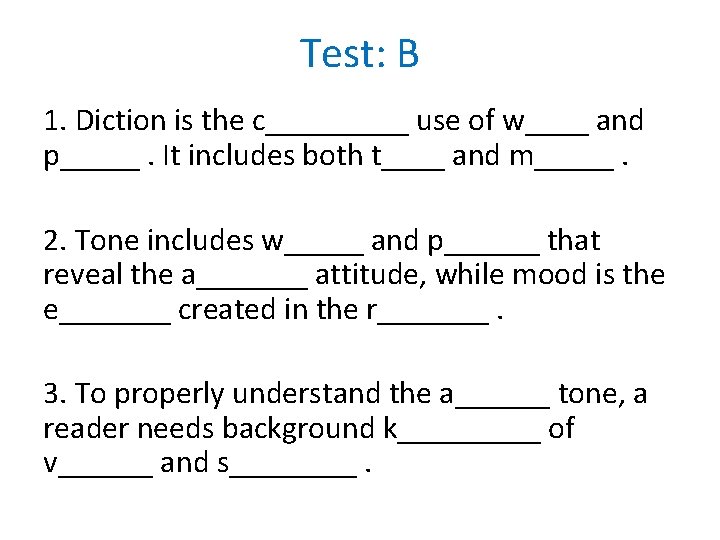
Test: B 1. Diction is the c_____ use of w____ and p_____. It includes both t____ and m_____. 2. Tone includes w_____ and p______ that reveal the a_______ attitude, while mood is the e_______ created in the r_______. 3. To properly understand the a______ tone, a reader needs background k_____ of v______ and s____.
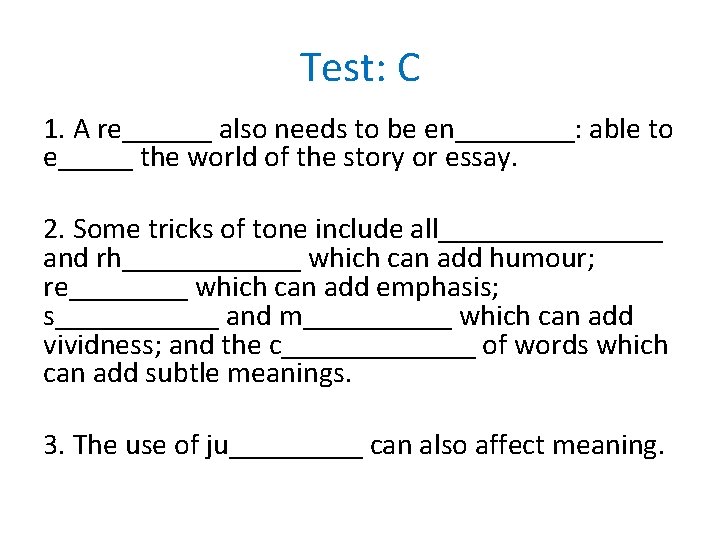
Test: C 1. A re______ also needs to be en____: able to e_____ the world of the story or essay. 2. Some tricks of tone include all________ and rh______ which can add humour; re____ which can add emphasis; s______ and m_____ which can add vividness; and the c_______ of words which can add subtle meanings. 3. The use of ju_____ can also affect meaning.
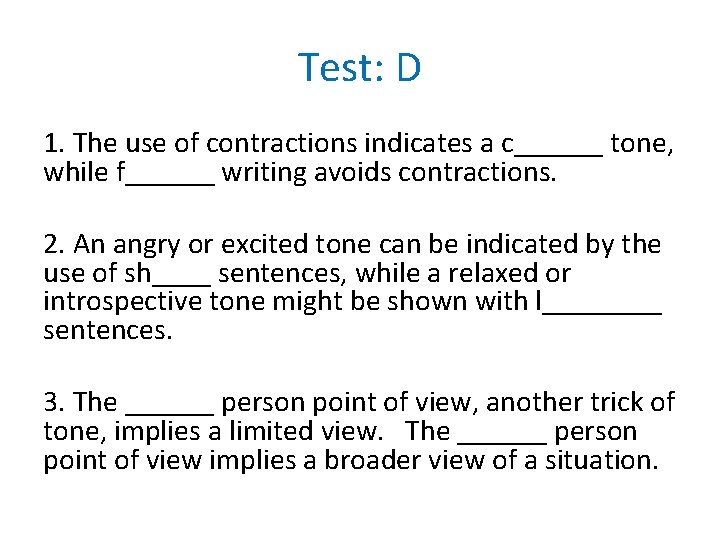
Test: D 1. The use of contractions indicates a c______ tone, while f______ writing avoids contractions. 2. An angry or excited tone can be indicated by the use of sh____ sentences, while a relaxed or introspective tone might be shown with l____ sentences. 3. The ______ person point of view, another trick of tone, implies a limited view. The ______ person point of view implies a broader view of a situation.
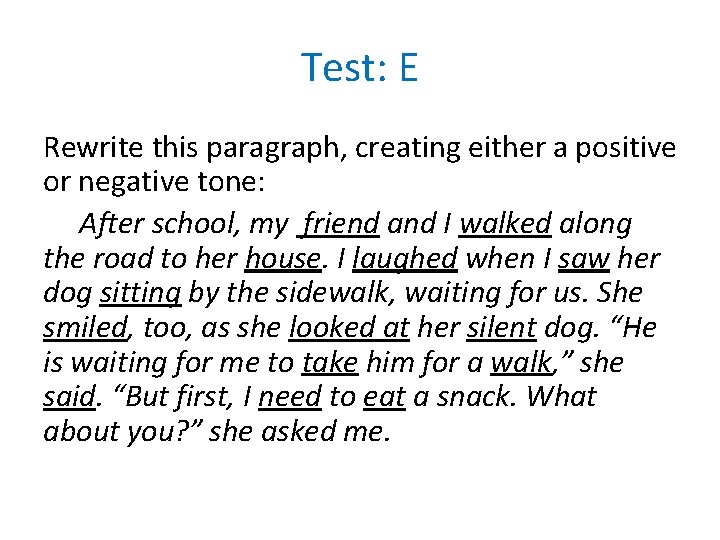
Test: E Rewrite this paragraph, creating either a positive or negative tone: After school, my friend and I walked along the road to her house. I laughed when I saw her dog sitting by the sidewalk, waiting for us. She smiled, too, as she looked at her silent dog. “He is waiting for me to take him for a walk, ” she said. “But first, I need to eat a snack. What about you? ” she asked me.
LESSON TEN Analyze tone and mood in a picture book.
Get organized. 1. Decide whether to work alone or with a partner. 2. Choose a picture book. 3. Write a citation: Author. Title. City: Publisher, copyright date. 4. Read the book. 5. Then read it again, taking notes.
Look for tricks of tone! 1. 2. 3. 4. 5. 6. 7. 8. Alliteration Rhyme Similes and metaphors Juxtaposition Length of sentences Contractions Point of view Connotation of words
Record your observations: • Tricks: • Evidence:
Remember mood factors! 1. Set aside your own thoughts and focus on the story. 2. Tune out all the other people in the room and focus on the story. 3. Understand the denotation and connotation of words. 4. Understand the intended effects of the tricks of tone.
Record the tone’s effect on your mood! • Your mood • Cause
You are now a more literate person! denotation: able to read and write connotation: - enjoy reading and writing - have a wide background of literary knowledge - regularly reflect on what you are reading - share your thoughts on what you are reading
Congratulations! You have completed this unit on ‘The Power of Words’. What have you learned? Tell someone!
- Slides: 95