
The Power of Social Norms in Behavior Change
The Power of Social Norms in Behavior Change Robert B. Cialdini Department of Psychology Arizona State University
Contentions ¡Decision-makers can focus too much on financial / economic factors when seeking to motivate others. ¡They would be well advised to consider, as well, what is known about social psychological motivators such as social norms.
Principle 1: Consensus (Descriptive Social Norm) ¡People are likely to follow the lead of multiple, comparable others
We follow the lead of: ¡Many others ¡Similar others
People Underestimate the Power of Social Norms ¡This is true both: – when, as observers, they decide how to interpret the causes of their own actions and – when, as tacticians, they decide how to influence the actions of others
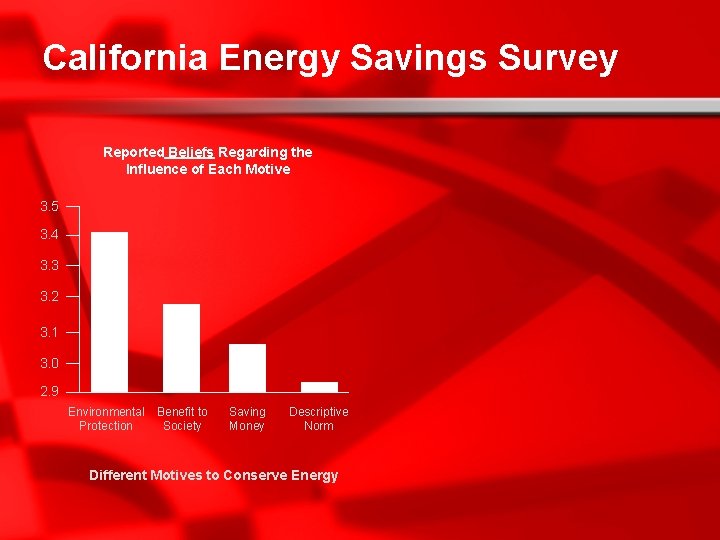
California Energy Savings Survey Reported Beliefs Regarding the Influence of Each Motive 3. 5 3. 4 3. 3 3. 2 3. 1 3. 0 2. 9 Environmental Protection Benefit to Society Saving Money Descriptive Norm Different Motives to Conserve Energy
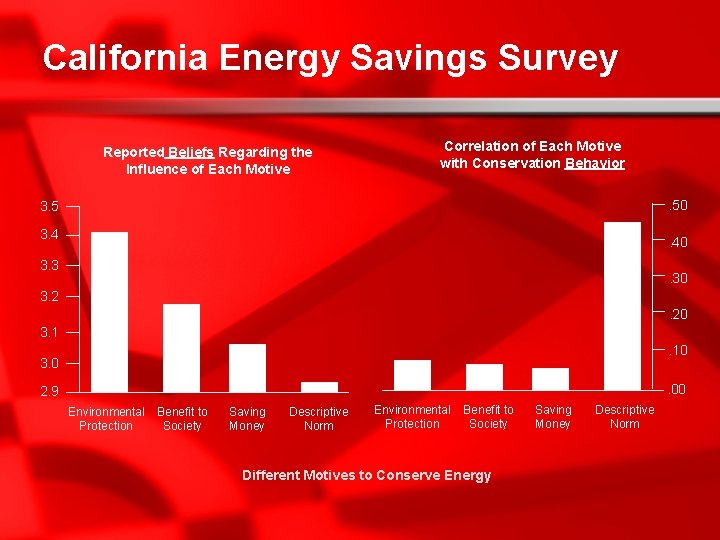
California Energy Savings Survey Reported Beliefs Regarding the Influence of Each Motive Correlation of Each Motive with Conservation Behavior. 50 3. 5 3. 4 . 40 3. 3 . 30 3. 2. 20 3. 1. 10 3. 0 . 00 2. 9 Environmental Protection Benefit to Society Saving Money Descriptive Norm Environmental Protection Benefit to Society Different Motives to Conserve Energy Saving Money Descriptive Norm
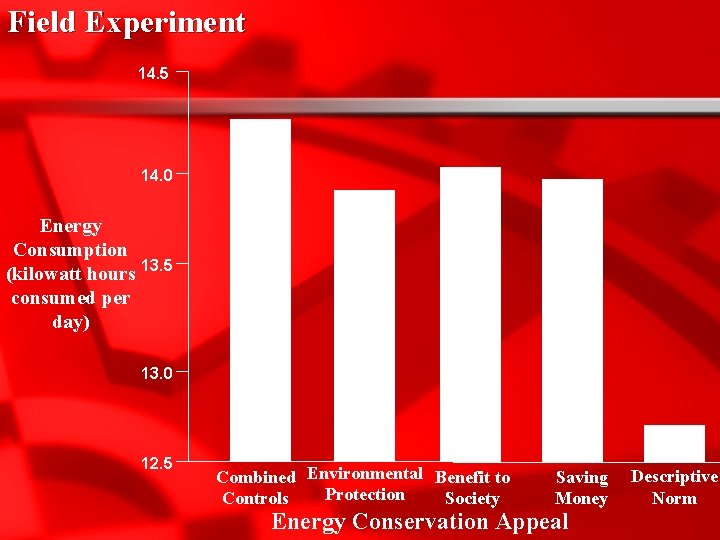
Field Experiment 14. 5 14. 0 Energy Consumption (kilowatt hours 13. 5 consumed per day) 13. 0 12. 5 Combined Environmental Benefit to Protection Controls Society Saving Money Energy Conservation Appeal Descriptive Norm
Descriptive Social Norm (Consensus) How can we use this principle to advance environmental goals? …by providing a corrective to the approaches typically employed to mobilize pro-environmental action.
People Underestimate the Power of Social Norms ¡This is true both: – when, as observers, they decide how to interpret the causes of their own actions and – when, as tacticians, they decide how to influence the actions of others
The Big Mistake ¡To mobilize corrective action against a social problem that is large or growing, public service communicators often decry it as regrettably frequent Drinking & Driving Tax Fraud Teen Suicide Teen Smoking
Some Suggestive Evidence The Brown University Medical School Study of Adolescent Cigarette Smoking Initiation and Persistence.
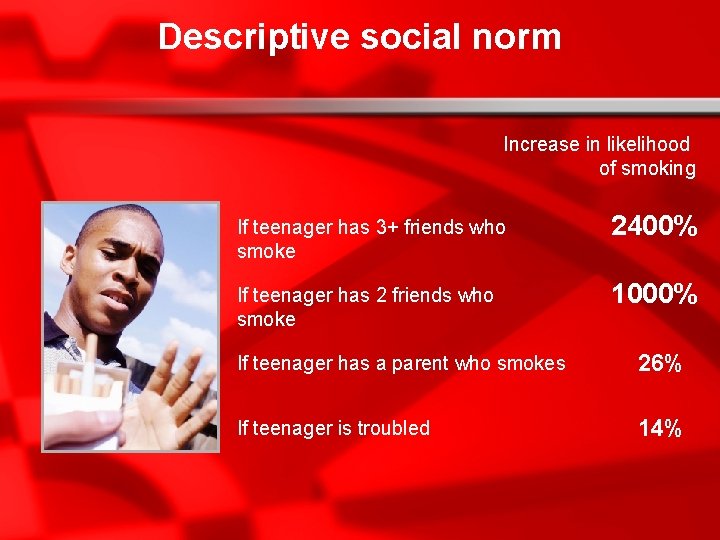
Descriptive social norm Increase in likelihood of smoking If teenager has 3+ friends who smoke 2400% If teenager has 2 friends who smoke 1000% If teenager has a parent who smokes 26% If teenager is troubled 14%
Implications ¡Within the statement “Look at all the people who are doing this undesirable thing” lurks the powerful and undercutting normative message “Look at all the people who are doing this undesirable thing. ”
Some Experimental Evidence The National Petrified Forest Study
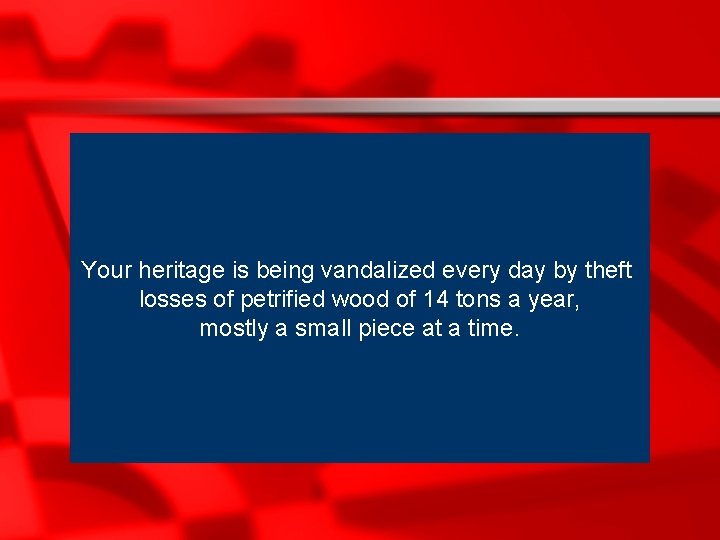
Your heritage is being vandalized every day by theft losses of petrified wood of 14 tons a year, mostly a small piece at a time.
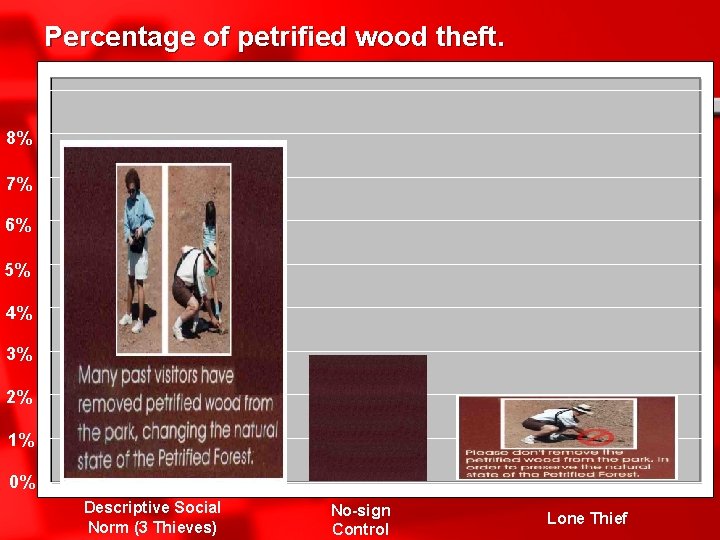
Percentage of petrified wood theft. 8% 7% 6% 5% 4% 3% 2% 1% 0% Descriptive Social Norm (3 Thieves) No-sign Control Lone Thief

Descriptive Social Norm Conclusion: Although describing a problem as severe and widespread is precisely the right strategy when seeking funding / resources / staffing for a social program, it is important not to generalize this approach to messages sent to citizens, who may interpret such descriptions as legitimizing the undesirable activity.
Descriptive Social Norm Does this conclusion mean that we should never use the descriptive norm to manage socially undesirable behavior? No. When the undesirable behavior is not the norm, evidence of what most others are doing is precisely what should be communicated.
Descriptive Social Norm (Consensus) The Hotel Towel Reuse Study
Typical in-room appeals: (1) Environmental protection; and (2) Reciprocal benefits (Economic cooperation)
Social Influence Principle 2: The Norm for Reciprocation § People are more likely to take an action if it is in return for a gift, favor, service or concession received
Reciprocity § How can we use this principle to advance environmental goals?

The Towel Reuse Study

Typical Hotel Bathroom
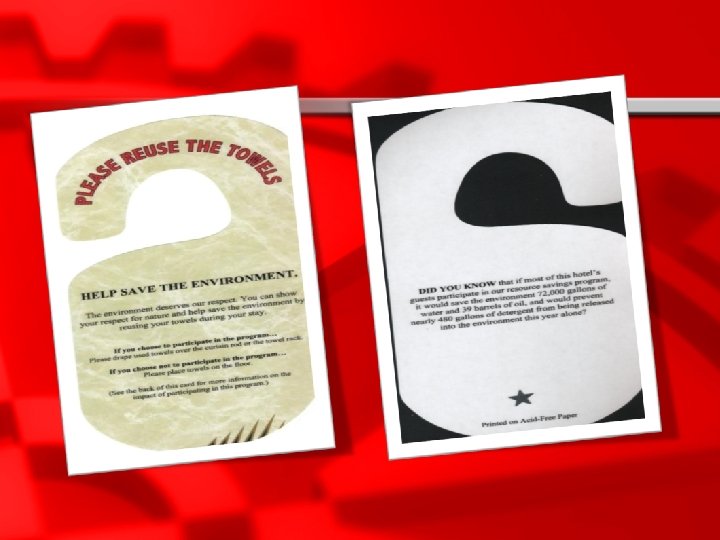
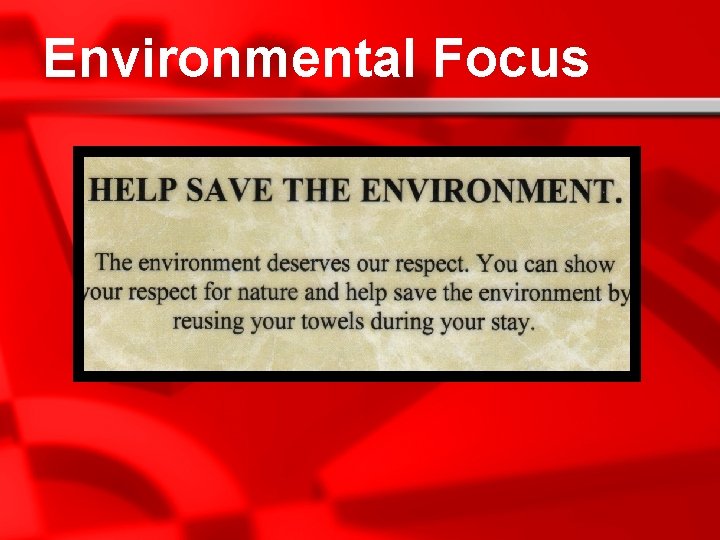
Environmental Focus
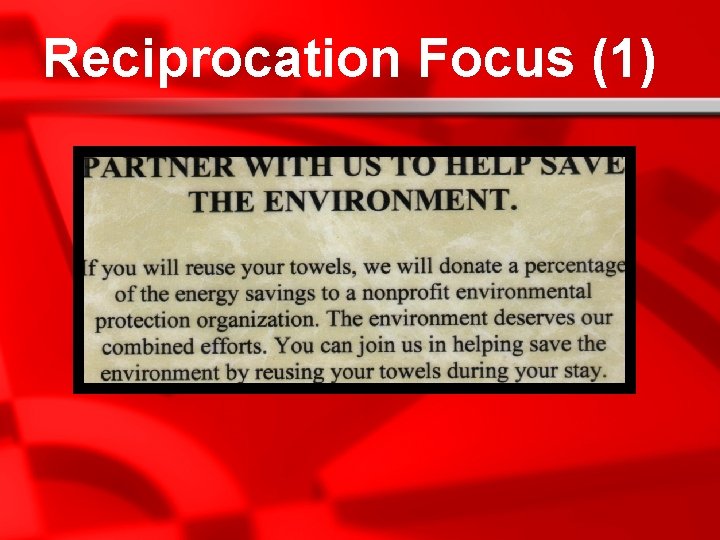
Reciprocation Focus (1)
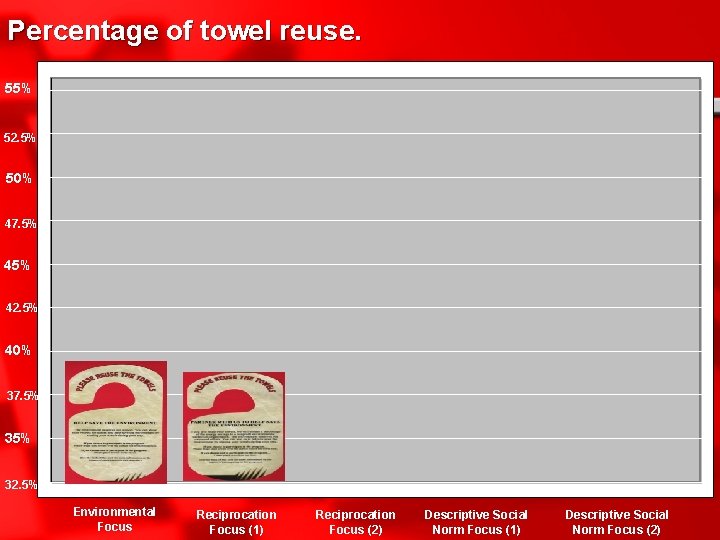
Percentage of towel reuse. 55% 52. 5% 50% 47. 5% 42. 5% 40% 37. 5% 32. 5% Environmental Focus Reciprocation Focus (1) Reciprocation Focus (2) Descriptive Social Norm Focus (1) Descriptive Social Norm Focus (2)
A notable aspect of the data: In the Reciprocation Focus (1) condition, the hotel’s pledge to donate to an environmental cause if guests reused their towels didn’t increase recycling at all. Why? There is no sense of social obligation to cooperate with someone who offers you something, provided that you perform a favor first. However, there is a powerful sense of social obligation — embodied in the norm for reciprocation—to cooperate with someone who does something for you first and then asks for a favor in return.
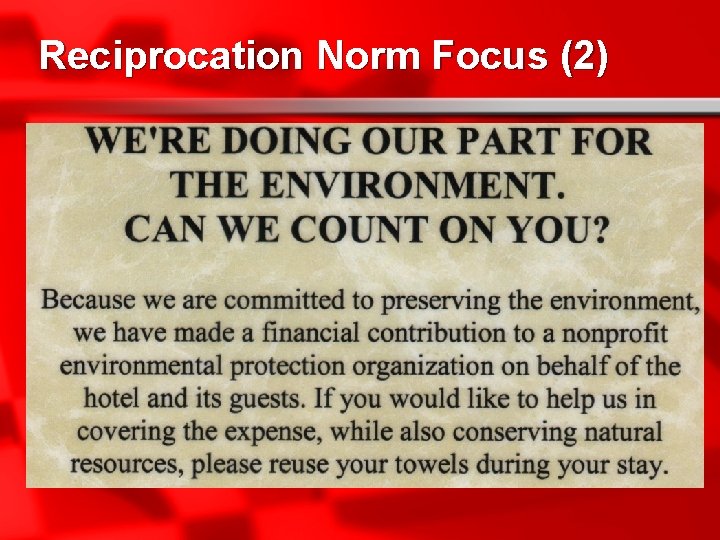
Reciprocation Norm Focus (2)
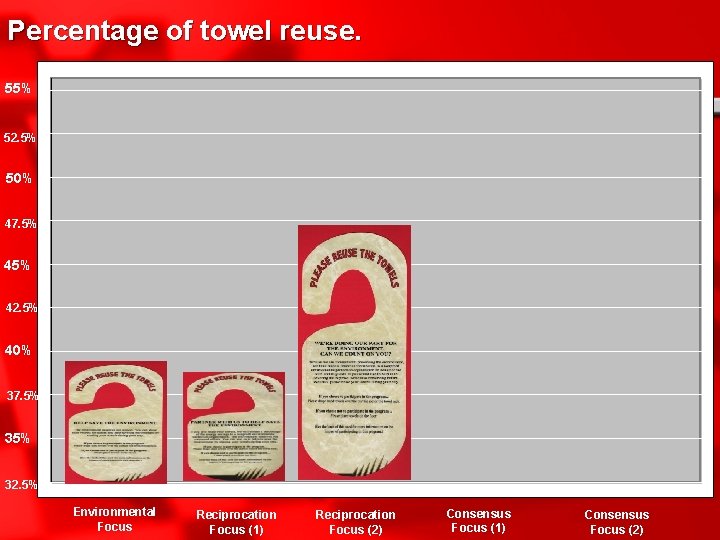
Percentage of towel reuse. 55% 52. 5% 50% 47. 5% 42. 5% 40% 37. 5% 32. 5% Environmental Focus Reciprocation Focus (1) Reciprocation Focus (2) Consensus Focus (1) Consensus Focus (2)
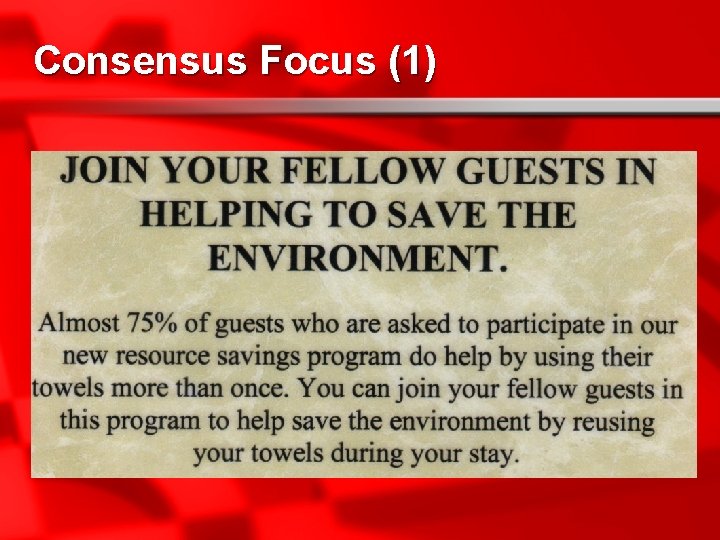
Consensus Focus (1)
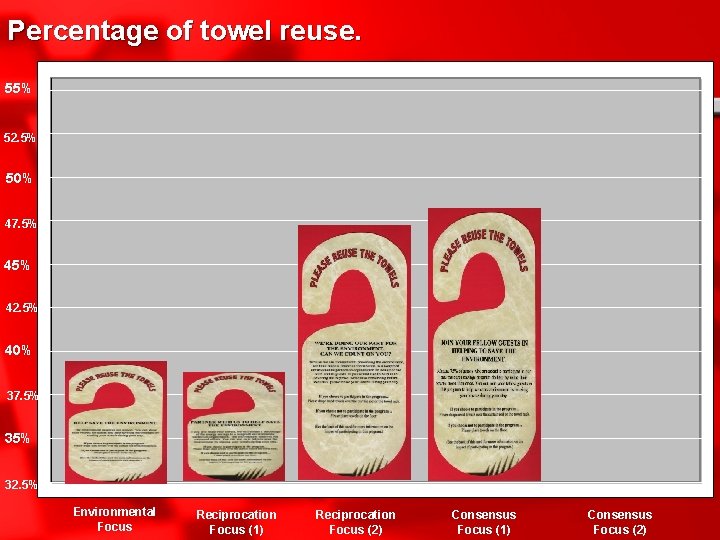
Percentage of towel reuse. 55% 52. 5% 50% 47. 5% 42. 5% 40% 37. 5% 32. 5% Environmental Focus Reciprocation Focus (1) Reciprocation Focus (2) Consensus Focus (1) Consensus Focus (2)
But is there an even more impactful message that could be sent, knowing what we know about the consensus principle?
We follow the lead of: • Many others • Similar others
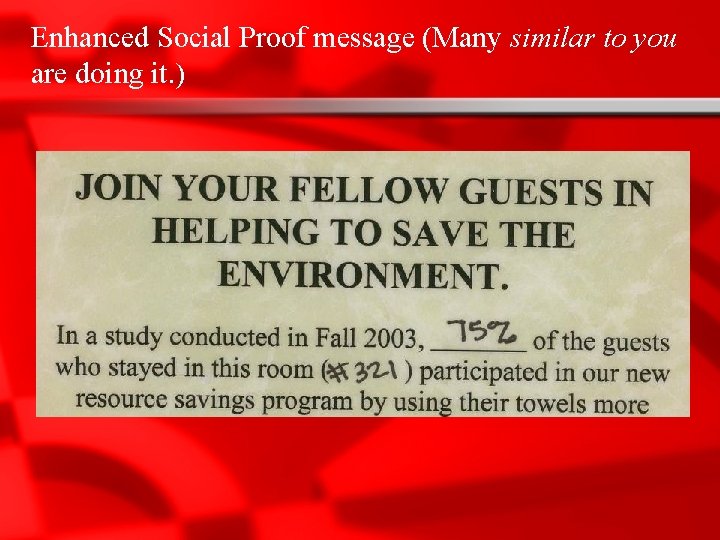
Enhanced Social Proof message (Many similar to you are doing it. )
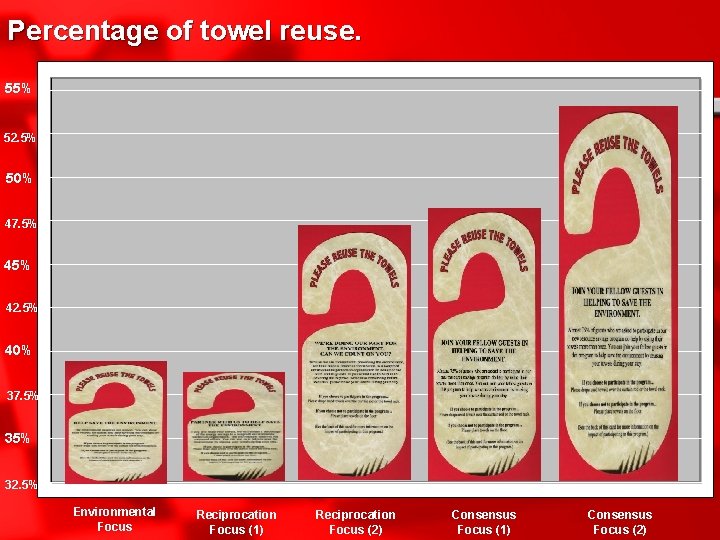
Percentage of towel reuse. 55% 52. 5% 50% 47. 5% 42. 5% 40% 37. 5% 32. 5% Environmental Focus Reciprocation Focus (1) Reciprocation Focus (2) Consensus Focus (1) Consensus Focus (2)
Two other notable aspects of the data: ¡The most successful of the communications – was one that we have never seen employed by any hotel management, – yet was costless to the organization.
Consensus (Descriptive Social Norm) § Computer Lab Environmental Survey Study
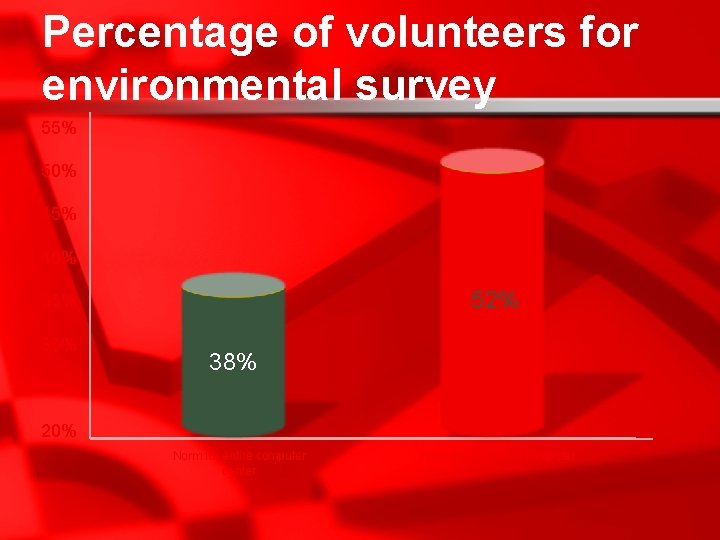
Percentage of volunteers for environmental survey 55% 50% 45% 40% 52% 35% 30% 38% 25% 20% Norm for entire computer center Norm for individual computer
Conclusions ¡By and large, decision-makers focus too often on financial / economic factors when seeking to motivate others. ¡They would be well advised to consider what is known about social psychological motivators such as social norms.
- Slides: 42