
The Power of Social Connection How We Are



- Slides: 30
The Power of Social Connection How We Are Wired To Connect And Love
Your homework…? • Write down three pieces of events you’re grateful for. – What happened? – What caused you grateful for them? – How did you feel in the past week?
Plan for today • Social connection and the power of it • Your personality score, and what it means • Some reading and group discussion for our content from last week
SOCIAL CONNECTION AND ITS POWER
Question to start with… From your understanding: • Why are people social animals? • What’s the benefit for being social?
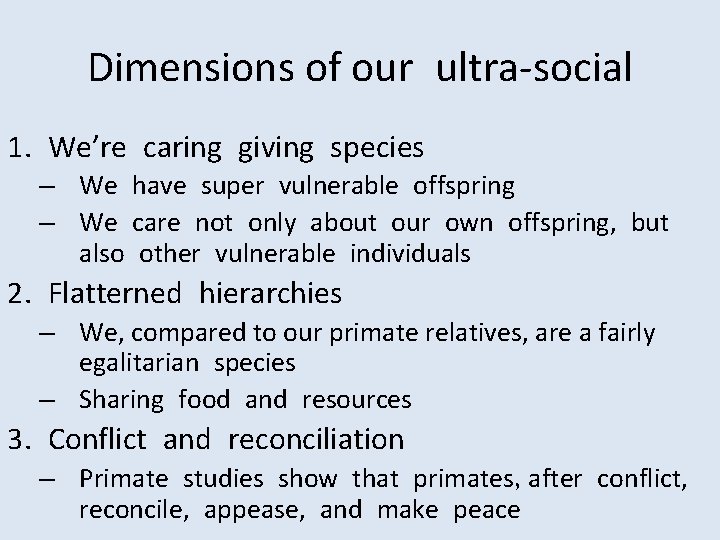
Dimensions of our ultra-social 1. We’re caring giving species – We have super vulnerable offspring – We care not only about our own offspring, but also other vulnerable individuals 2. Flatterned hierarchies – We, compared to our primate relatives, are a fairly egalitarian species – Sharing food and resources 3. Conflict and reconciliation – Primate studies show that primates, after conflict, reconcile, appease, and make peace
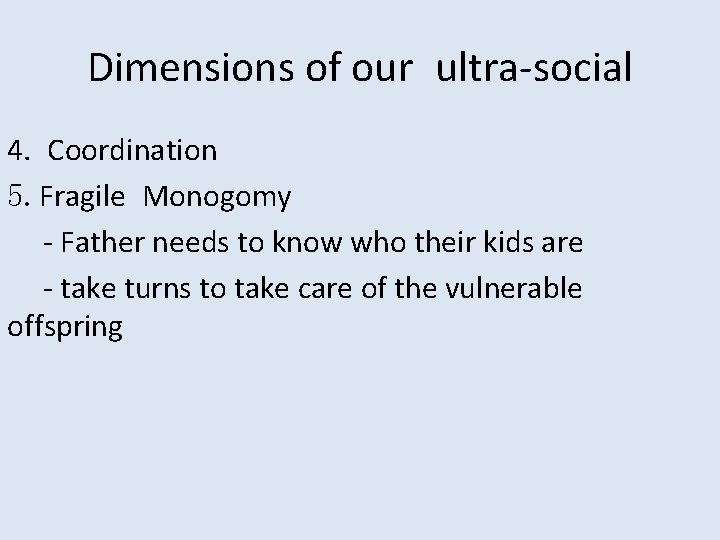
Dimensions of our ultra-social 4. Coordination 5. Fragile Monogomy - Father needs to know who their kids are - take turns to take care of the vulnerable offspring
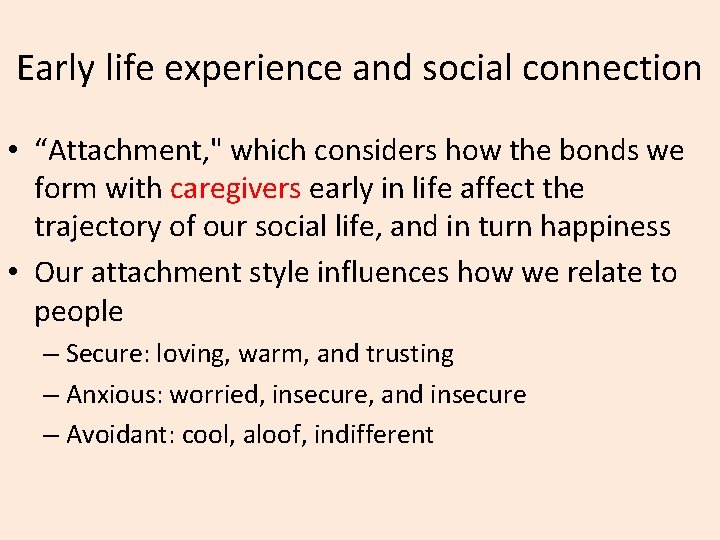
Early life experience and social connection • “Attachment, " which considers how the bonds we form with caregivers early in life affect the trajectory of our social life, and in turn happiness • Our attachment style influences how we relate to people – Secure: loving, warm, and trusting – Anxious: worried, insecure, and insecure – Avoidant: cool, aloof, indifferent
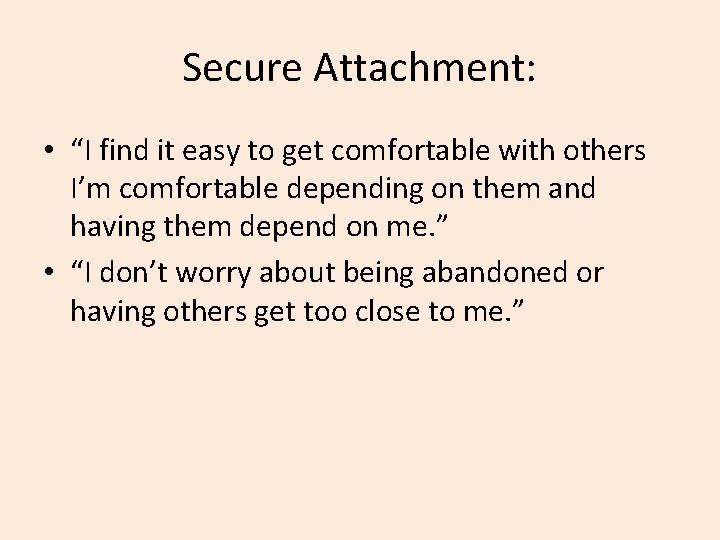
Secure Attachment: • “I find it easy to get comfortable with others I’m comfortable depending on them and having them depend on me. ” • “I don’t worry about being abandoned or having others get too close to me. ”
Avoidant Attachment • “I’m somewhat uncomfortable being close” • “I find it difficult to trust people completely or to allow myself to depend on anyone I’m nervous when people get too close. ” • “Romantic partners often want me to be more intimate than I feel comfortable being. “
Anxious Attachment Style • “I find that others are reluctant to get as close” • “I would like I often worry that my partner doesn’t love me or won’t stay with me” • “I want to merge completely with the other person but this tendency tends to scare people away. ”
One piece of taking-home message • If you want to find a person who’s feeling good about life, they have to have secure attachment style – They feel trusting and comfortable with intimacy – Report greater happiness they’re more likely to remain in stable relationships – On a daily basis they feel more positive emotions like gratitude or awe or amusement or enthusiasm. – They’re more likely to be optimistic, they’re more likely to forgive their partners, they’re more likely when their partner is suffering, to offer social support
• People who have anxious attachment style – More prone to depression, anxiety, drug abuse, eating disorders – Anxious attachment style drives a lot of the problems of social living.
Discussion • We've offered evidence that humans have a strong propensity to form social bonds, and to derive psychological benefits from those bonds. We've also talked about how early life experiences affect social style, and shared some research-backed suggestions for how people who had less attentive, safe, trustworthy, or reliable caretakers might transcend some of the obstacles that this kind of experience imprints upon them. • Does this research align with your own experience, particularly the connections between caregiver-infant attachment and happiness? Do you see other challenges to forming authentic, caring relationships?
The biological basis for happiness • Vagus Nerve: the care-giving nerve • Think while we watch the video: will this change your opinion about human nature? • https: //www. youtube. com/watch? v=5 d 6 e_Un 6 dv 8
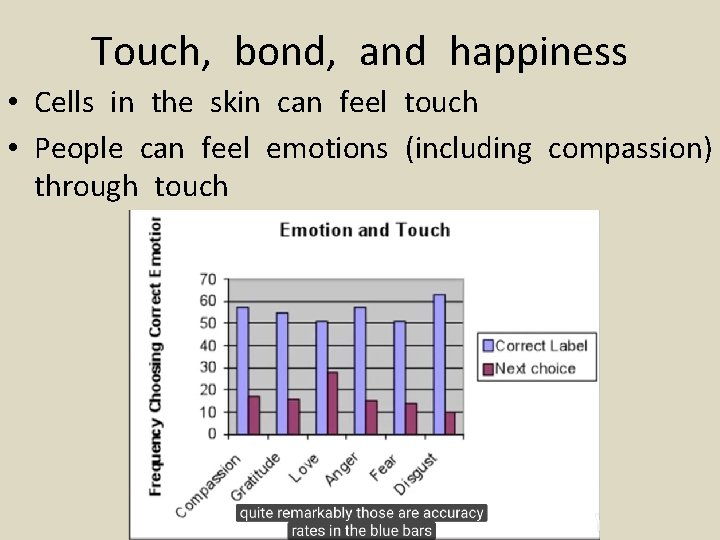
Touch, bond, and happiness • Cells in the skin can feel touch • People can feel emotions (including compassion) through touch
Some interesting findings… • When women tried to express anger toward men through touch, men didn’t realise it… • When men tried to express compassion toward women through touch, women didn’t feel it either…
Touch increases social bond • … but in the west, it’s a touch-deprived culture • Café, friends’ talk – UK: 0 times… – Costa Rica: 180 times…
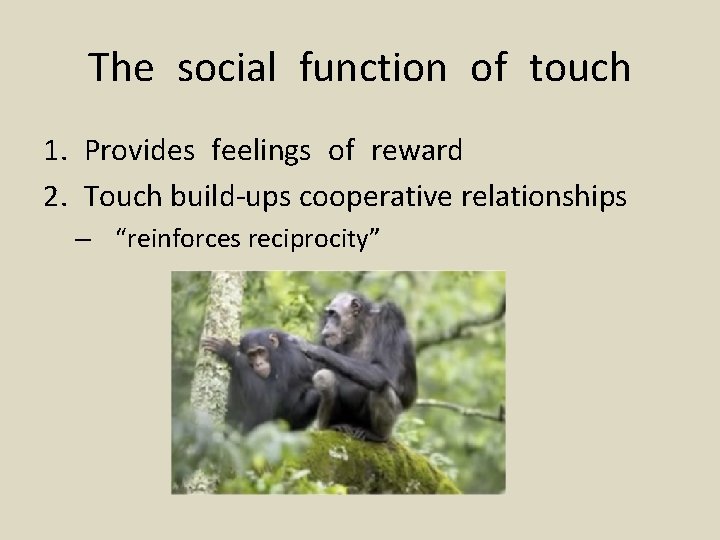
The social function of touch 1. Provides feelings of reward 2. Touch build-ups cooperative relationships – “reinforces reciprocity”
The social function of touch 3. Signals safety and trust 4. Soothes stress and leases oxytocin 5. Promotes cooperation
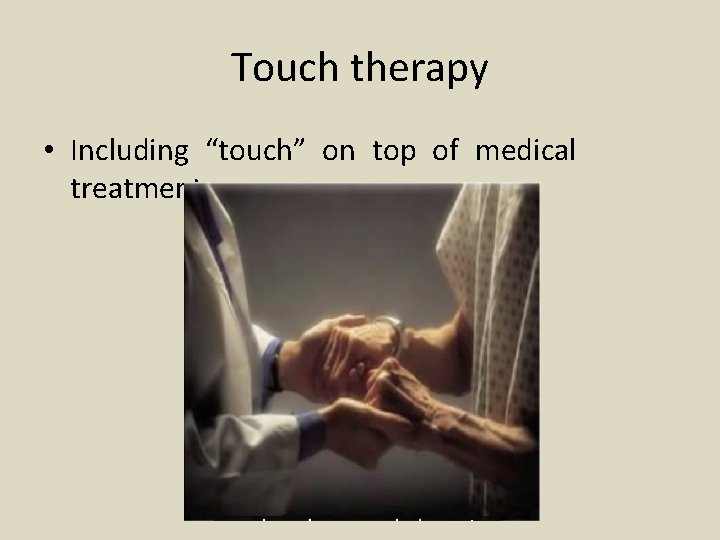
Touch therapy • Including “touch” on top of medical treatment
Touch therapy • Including “touch” on top of medical treatment – Touching premature babies: regular physical contact gets a boost of the a weight gain by 47% – Reduces depression in patients with Alzheimers – Teachers pat students on their back, will motivate the student to speak out twice more – Teacher librarians who pat students on their backs, the students are more likely to come
Some Questions • Which of the following has NOT been reported as an effect of social exclusion or loneliness on the body? 1) Activation of brain regions that signal physical pain. 2) Decreased inflammatory control. 3) More rapid immune response. 4) Difficulty sleeping.
Some Questions • Attachment theorists John Bowlby and Mary Ainsworth documented the importance of safe, trusting bonds between parents and children early in life (known as "secure attachment"). Which of the following is a key insight from attachment research? 1) Attachment status shapes the way that people relate to others into adulthood. 2) People who are securely attached tend to have lower self-esteem during adolescence and adulthood. 3) Anxious attachment makes getting married impossible. 4) When people reflect on their secure attachment figure, they feel more negative toward unfamiliar others.
Happiness Practice: Active Listening • In a group of three – Speaker, listener, and observer – Describe some of your difficult time – Listeners don’t interrupt, and don’t check your phone, just listen; then describe what happened – Observer gave feedback whether listener fully got the information
SOME VIDEOS AND DISCUSSIONS
Social Connection and Happiness • https: //www. ted. com/talks/robert_waldinger _what_makes_a_good_life_lessons_from_the _longest_study_on_happiness#t-754912
The power of social connection • https: //www. youtube. com/watch? v=WZv. Upp a. Df. Ns
READINGS AND PRESENTATIONS IN GROUPS
PERSONALITY: SCORE AND UNDERSTANDING